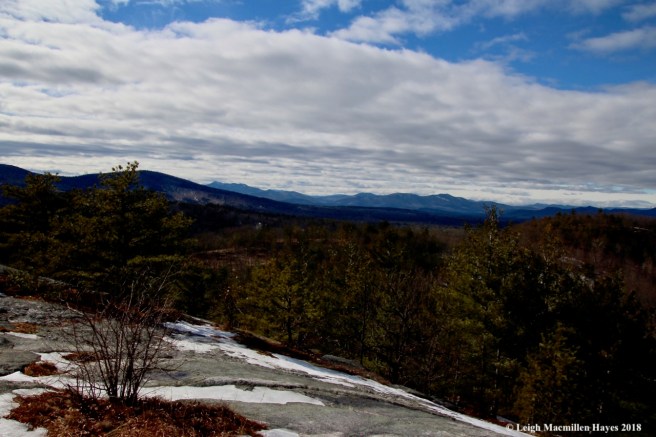
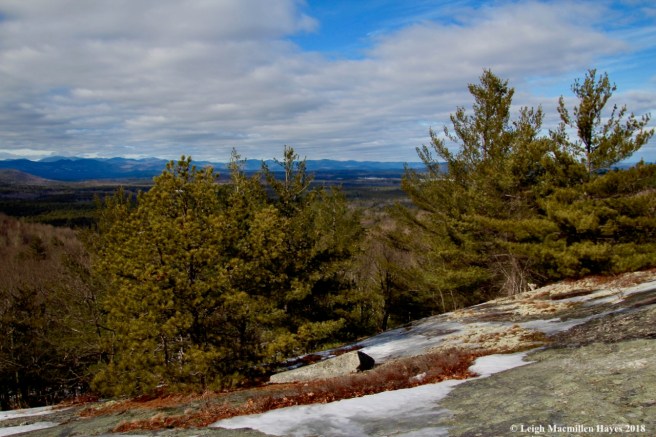
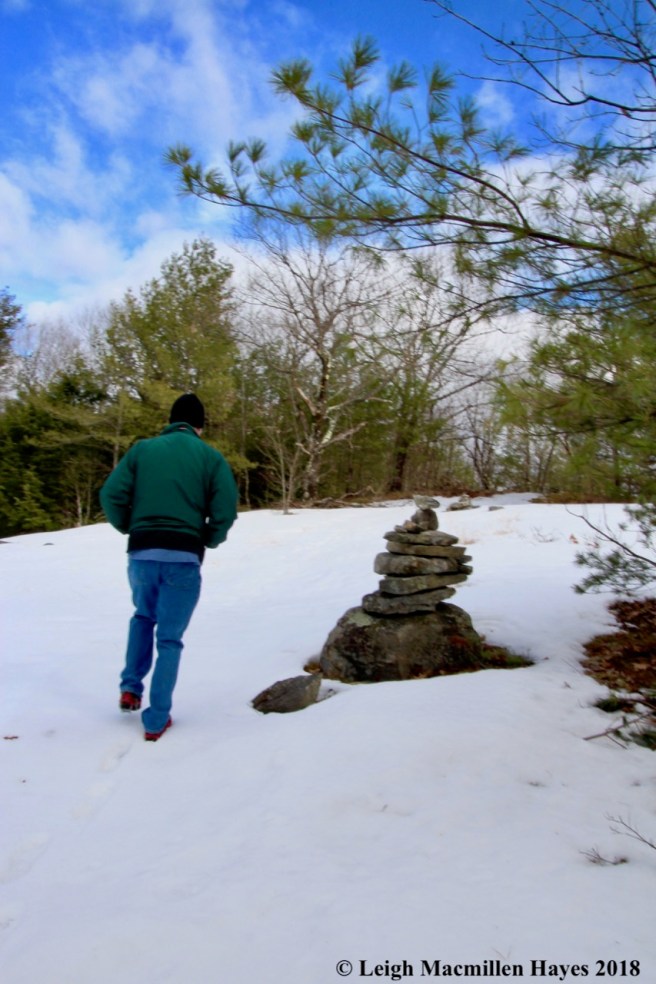
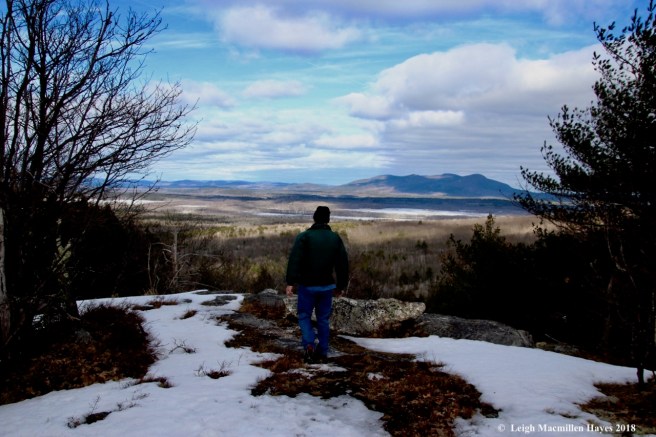
Cozy Cabin

This afternoon Jinny Mae and I went in search of the perfect location to build a cabin. A tiny cabin. A one room cabin. With an outhouse of course. And an infinity pool.

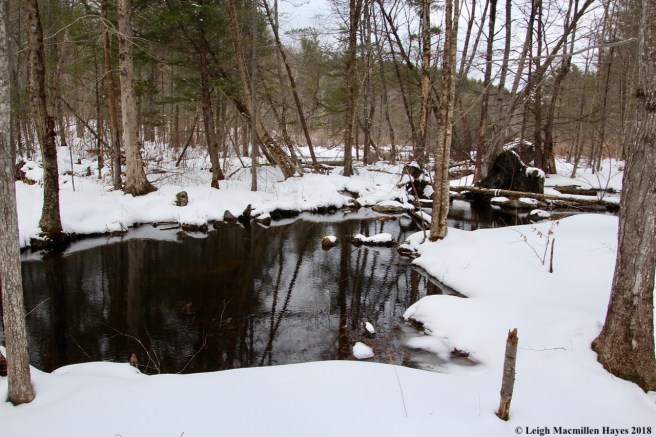
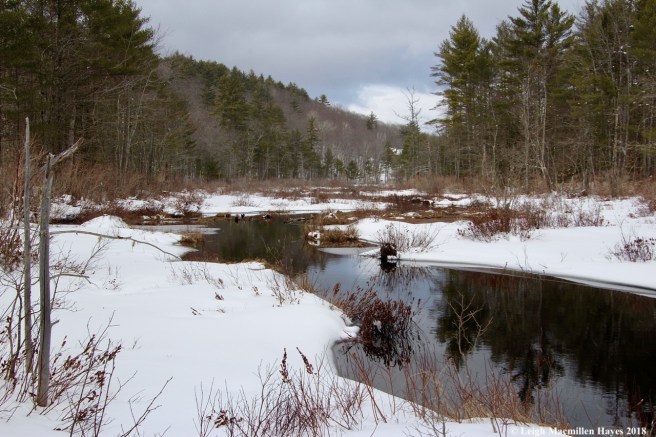
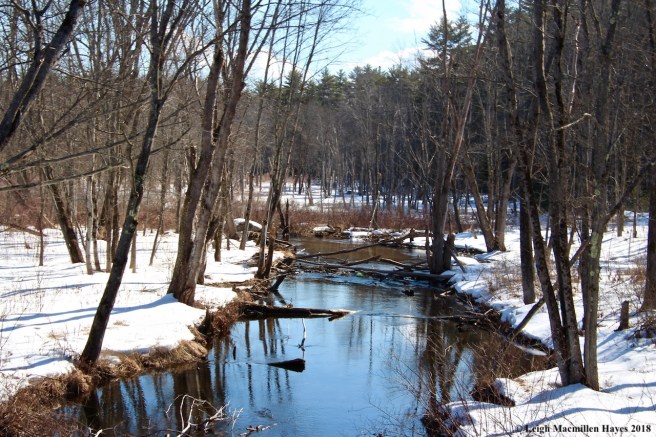
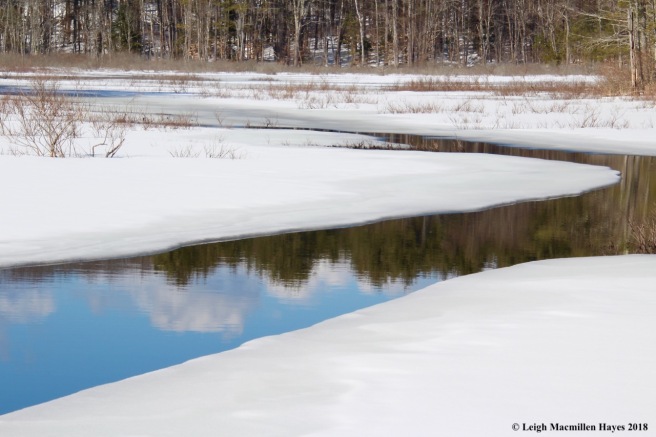
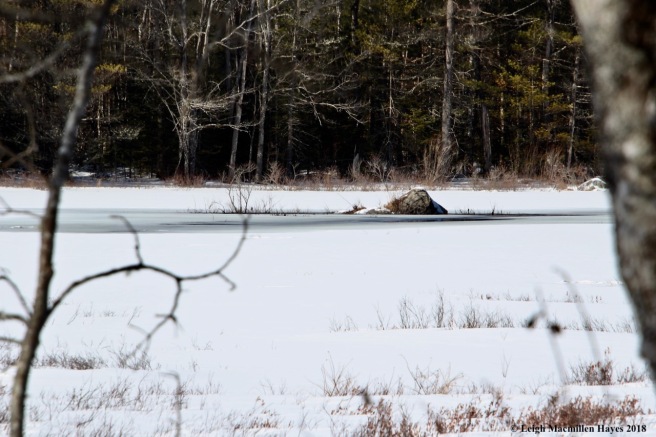
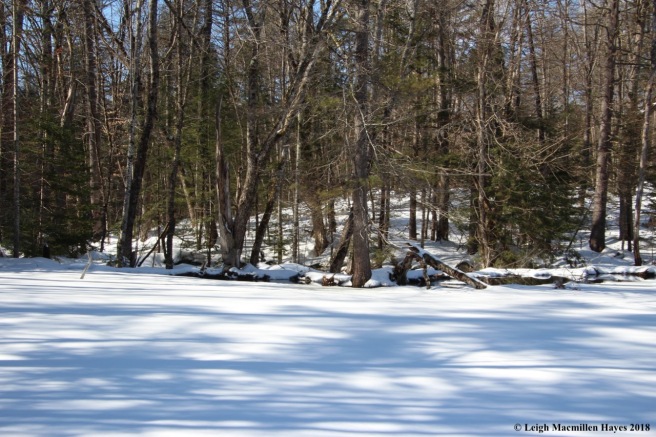
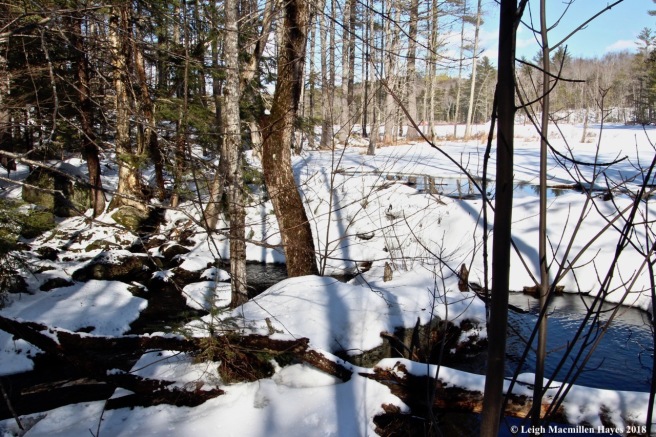
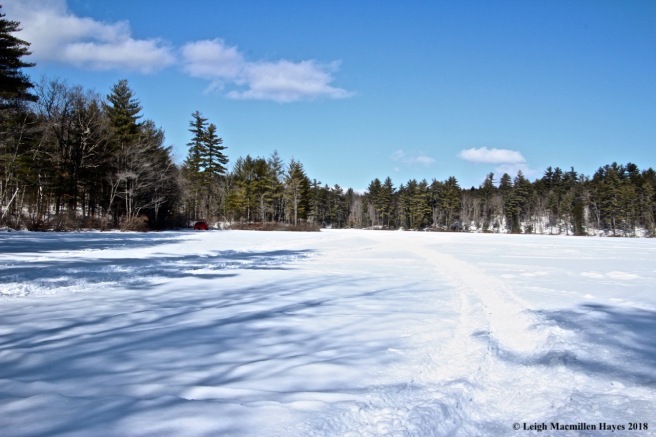
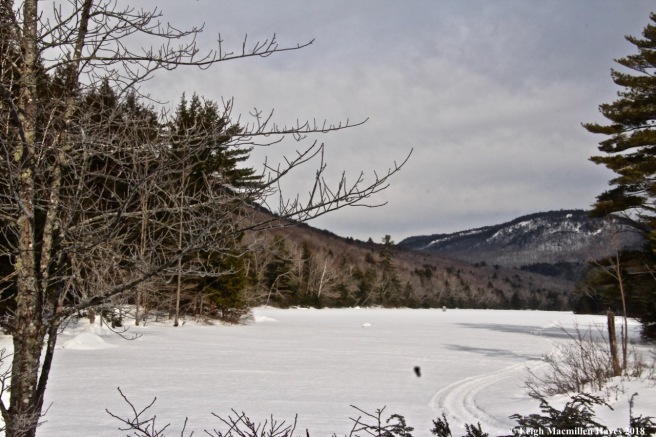
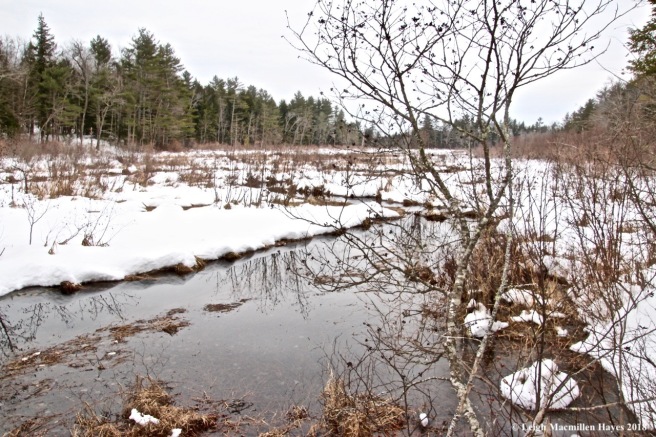
p1-Old Beaver Pond

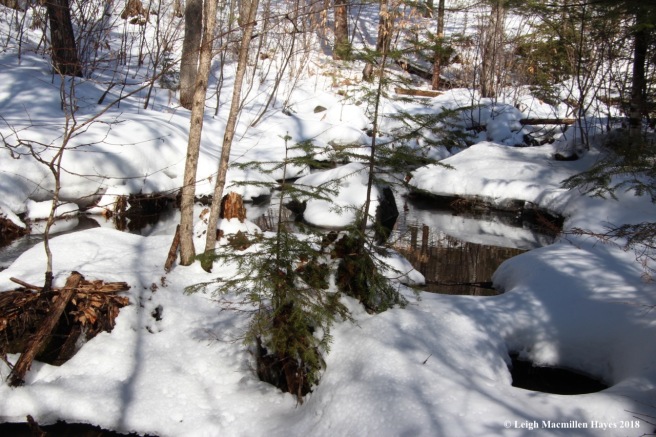
Deciding where to place it proved to be the most challenging part of the building process. We didn’t want to rush into the things and so we stood. For a long time. And absorbed the sun’s warmth. And reveled in the quiet. It was a contender, but decided we might have to return in another month or so when the song birds sing to decide if it was the right spot, for it was almost too quiet.

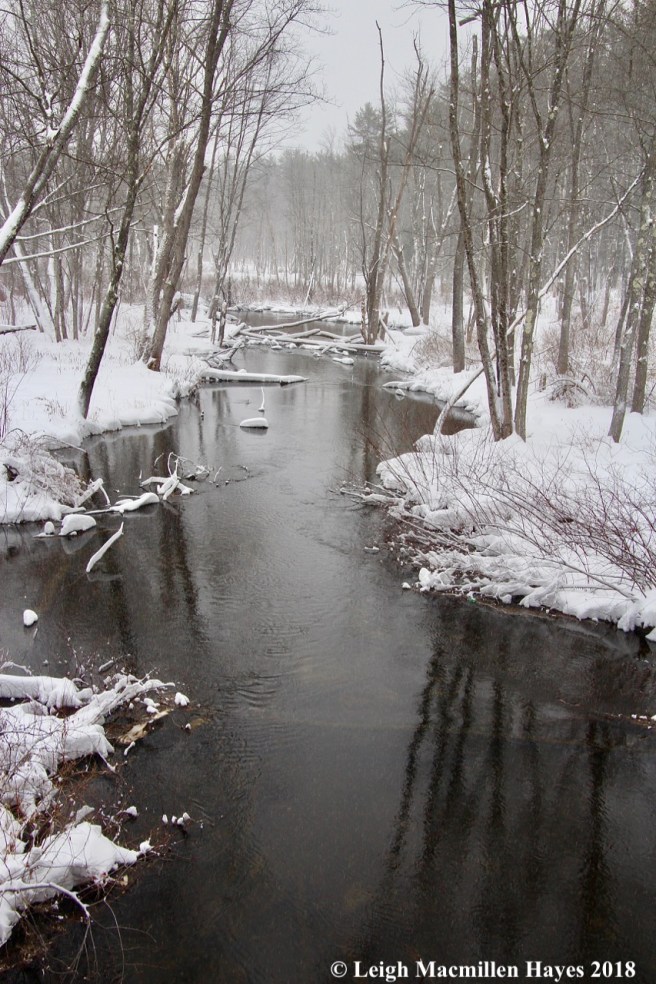
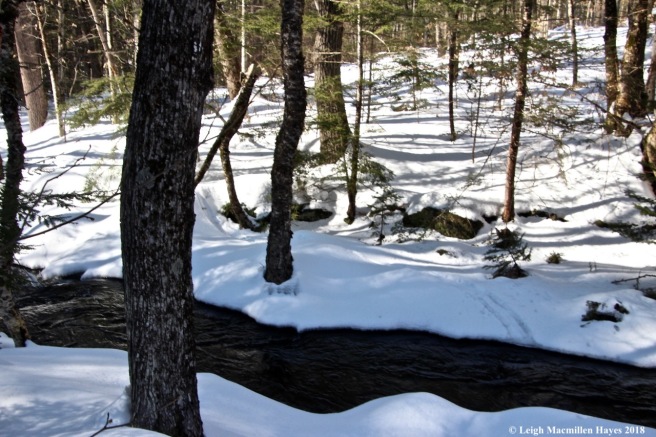
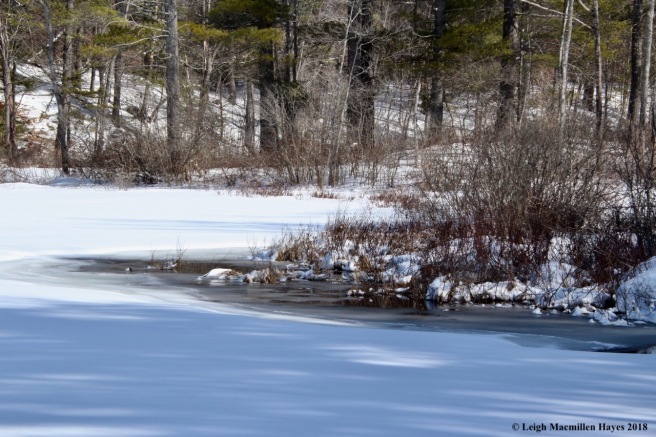
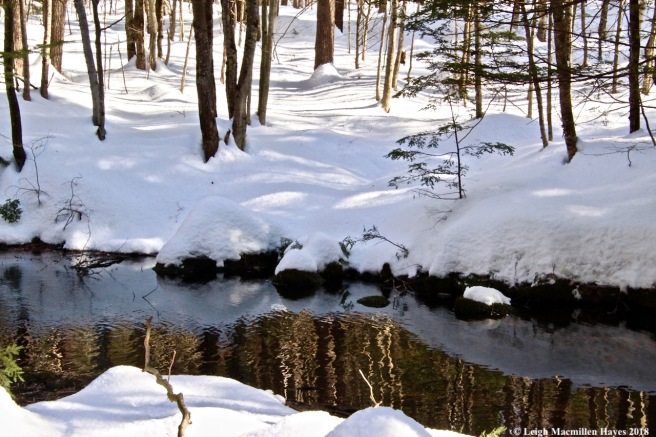
p4-brook

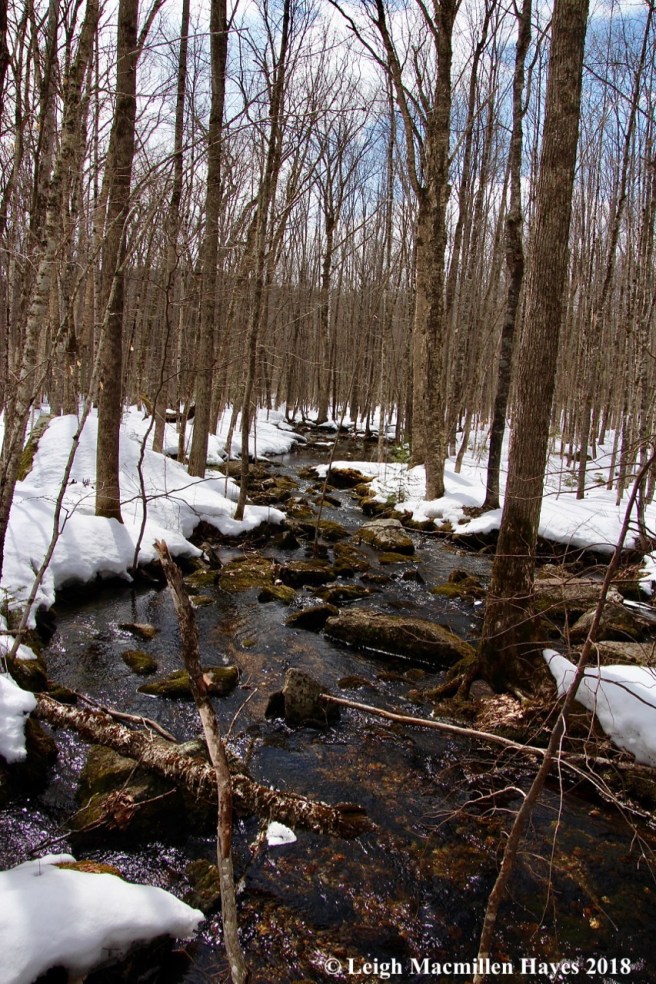
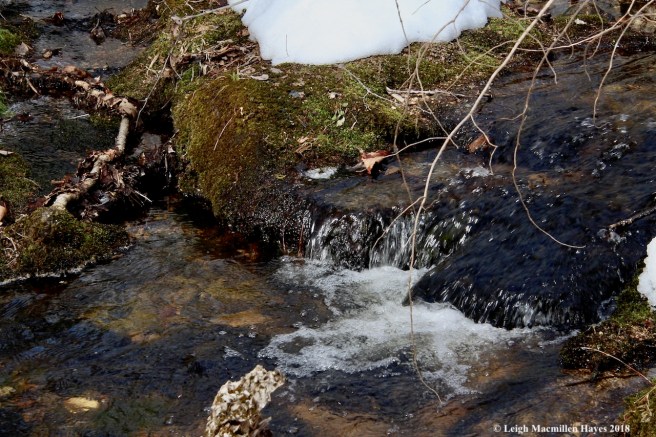
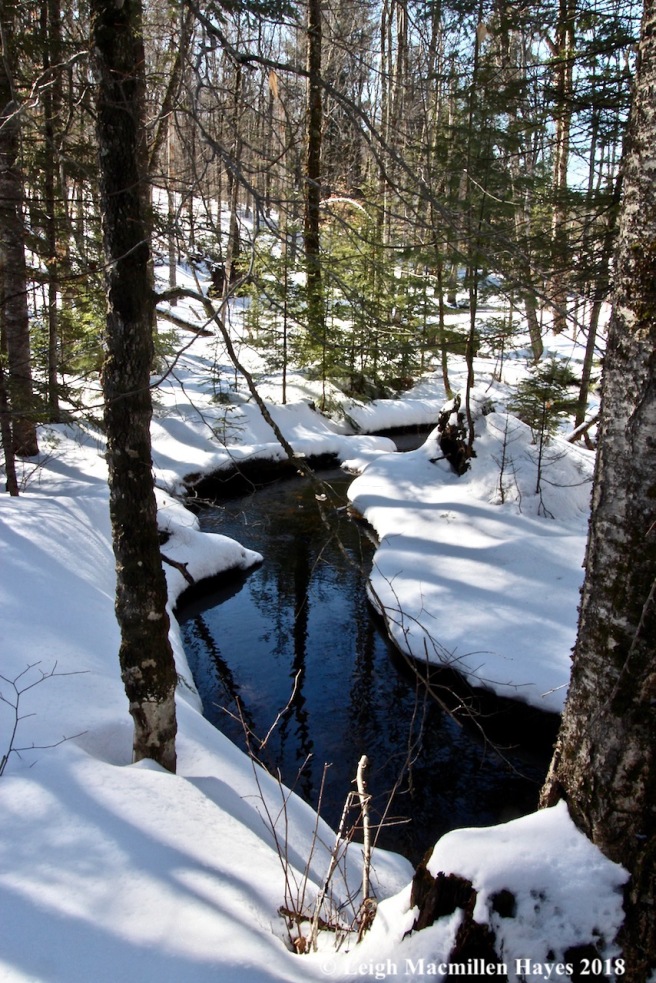
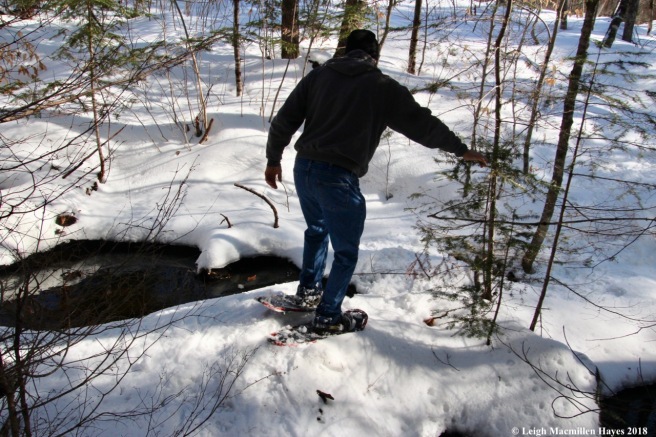
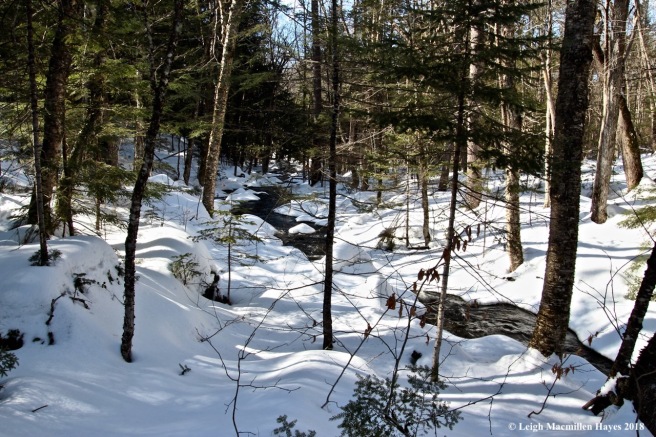
And so we continued our journey beside a stream where the ice had melted and water gurgled.

p5-water

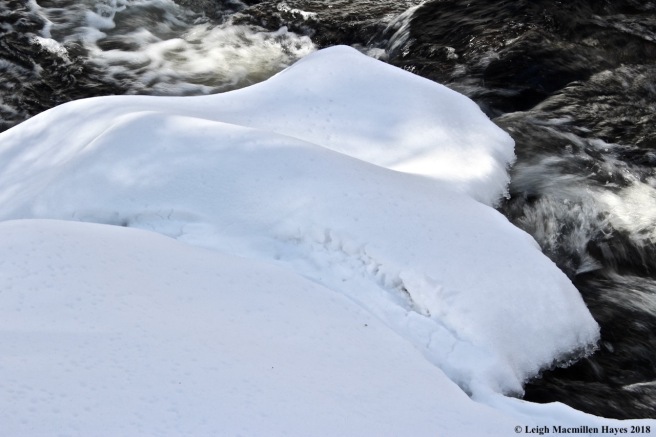
In fact, it gurgled so much that it was irresistible and we began looking about because we felt drawn to the spot.

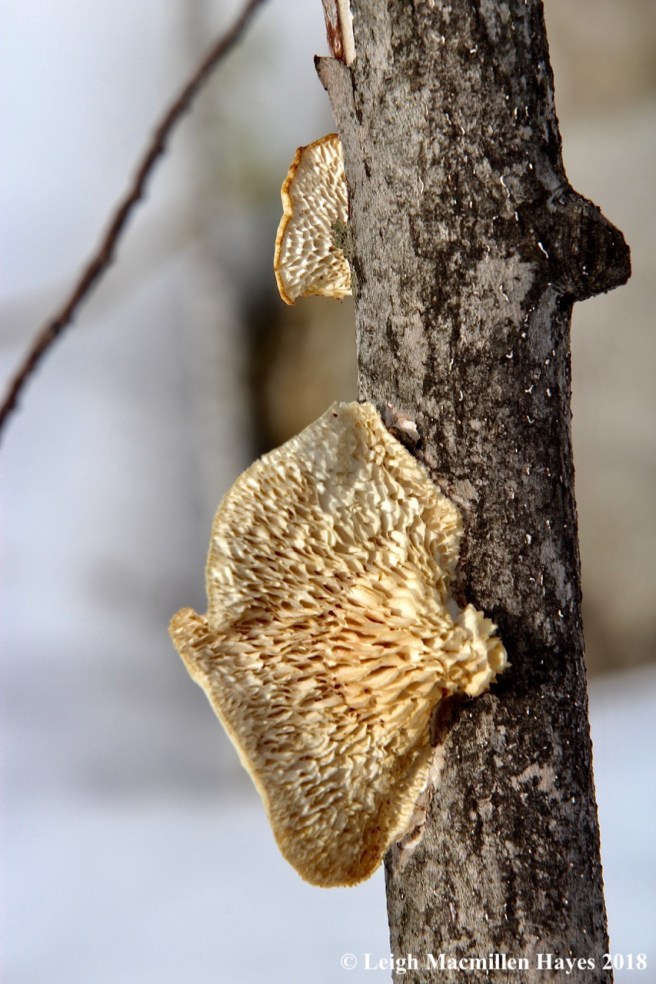
p3-hexagonal-pored polypore (Polyporus alveolaris)

The neighborhood also appealed to us because it had so many interesting landmarks including the hexagonal-pored polypores,

p11--tinder conk pore surface

tinder conks (aka hoof fungus) with their pore surfaces exposed,

p10-false hoof fungus

and even some false tinder conks.

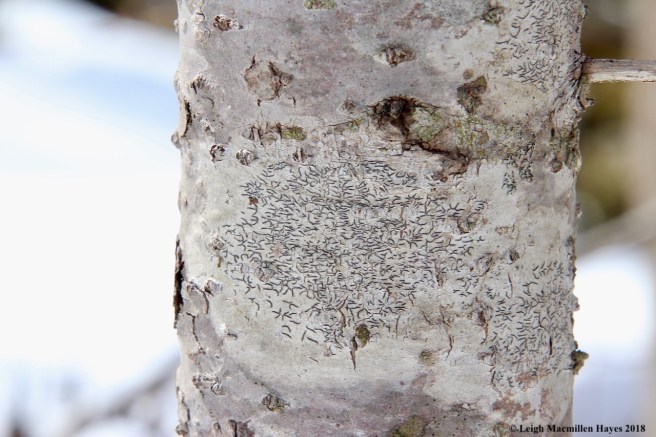
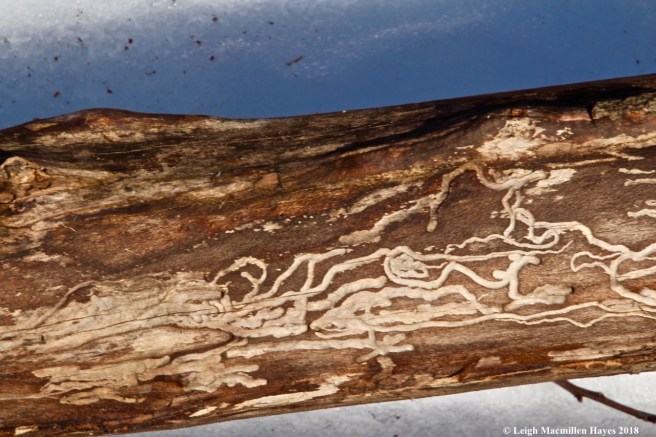
p7-script lichen

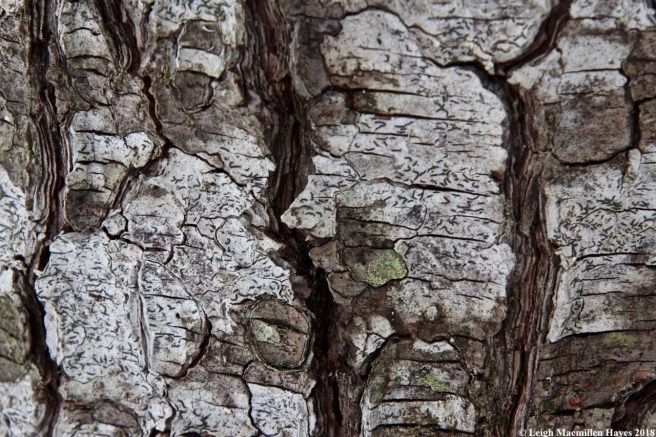
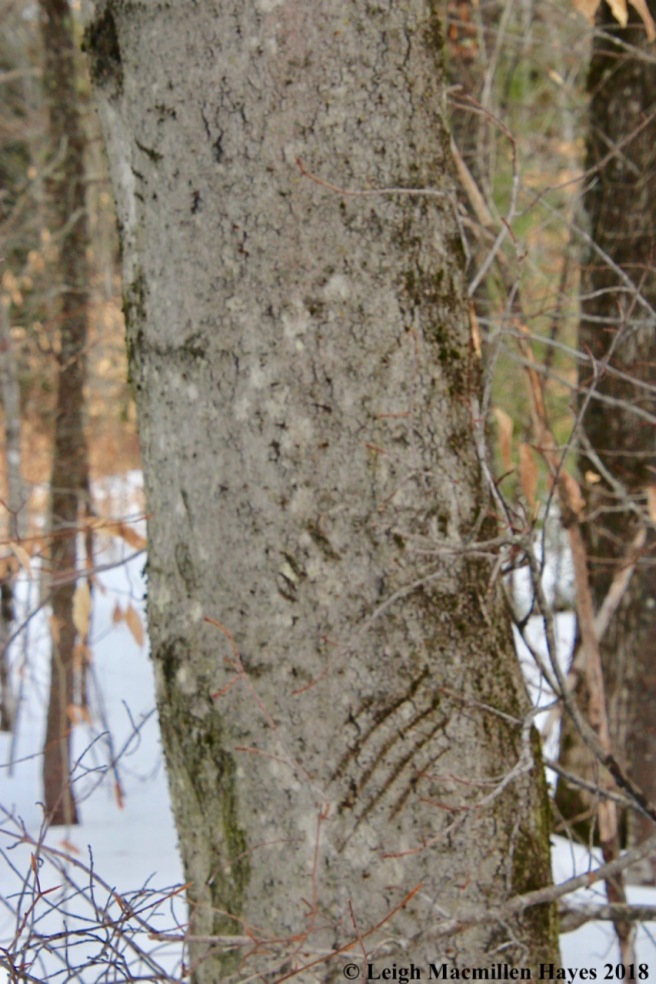
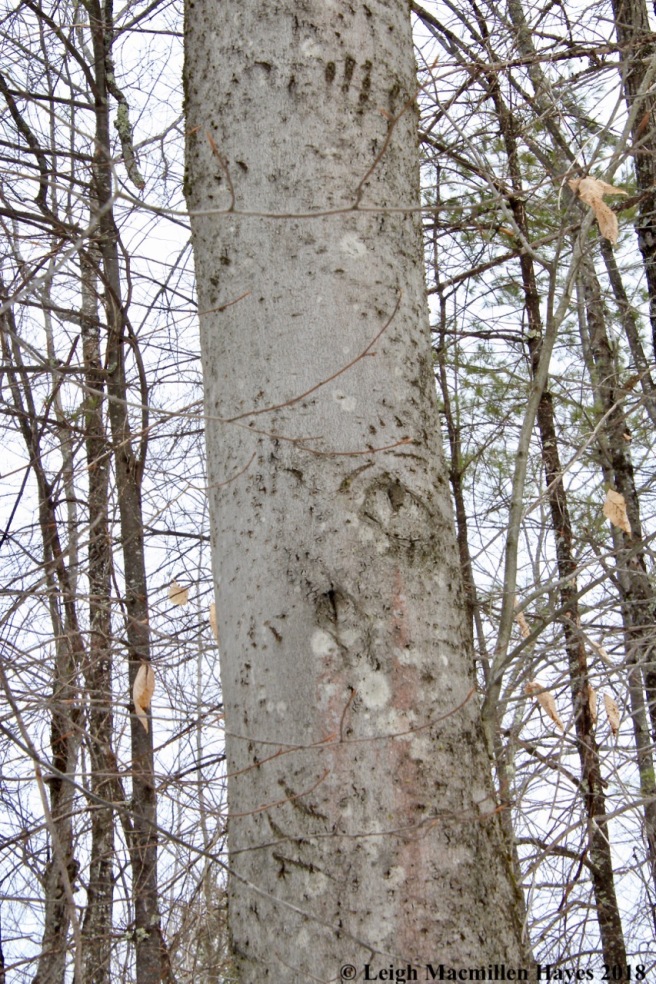
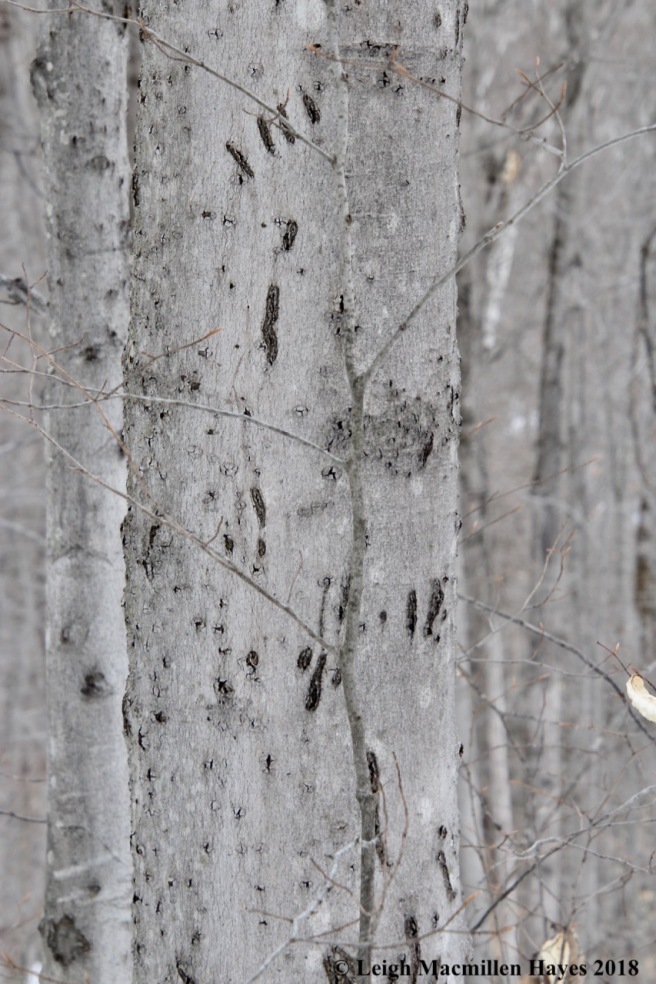
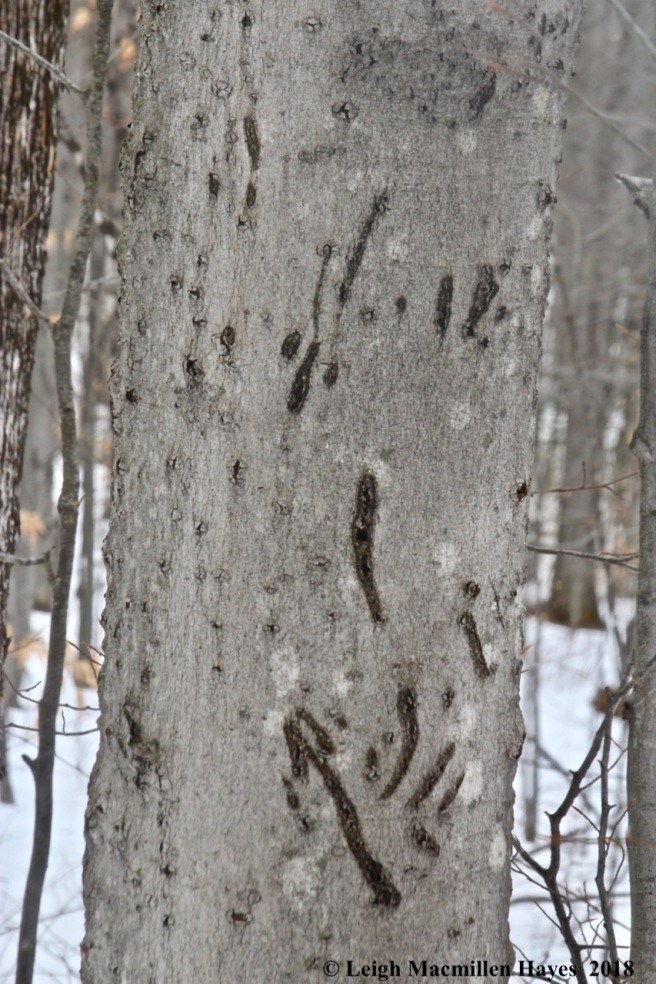
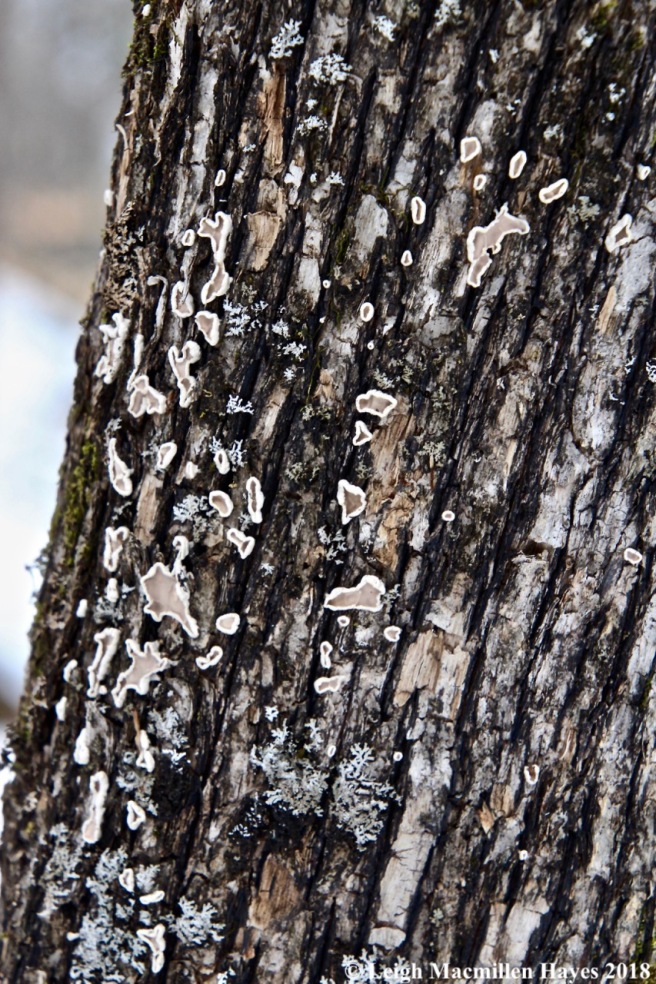
One of the things that surprised us was all the writing on the bark for we found script lichen on many a tree trunk. It felt like we’d stumbled upon volumes of research about the construction process.

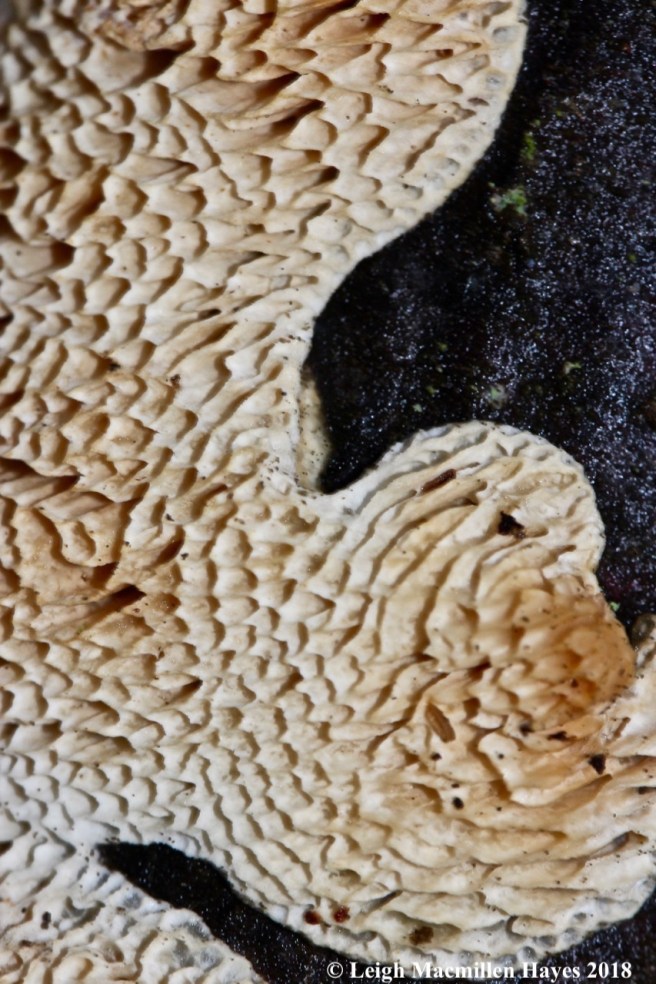
p12-hairy curtain crust fungus 2

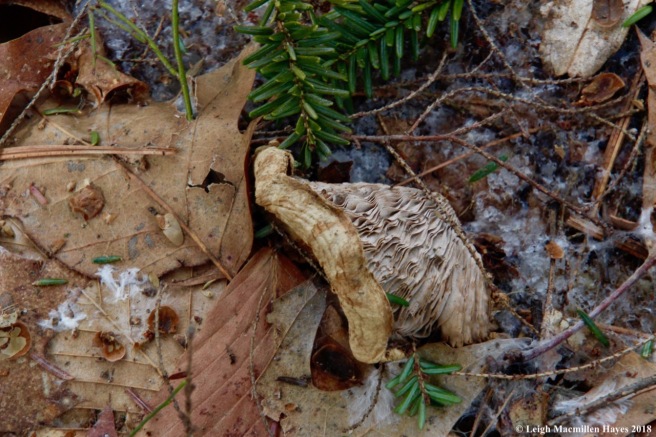
When building, the old adage is location, location, location, but it helps when local resources are available–which we found in the form of curtains, aka hairy curtain crust fungus (or so I think).

p15-many fruited pelt lichen

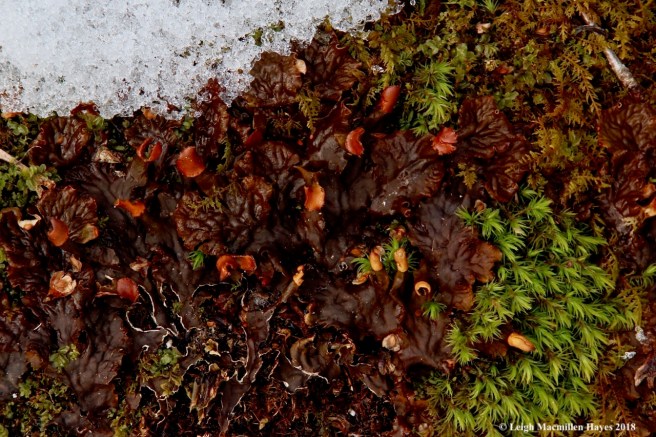
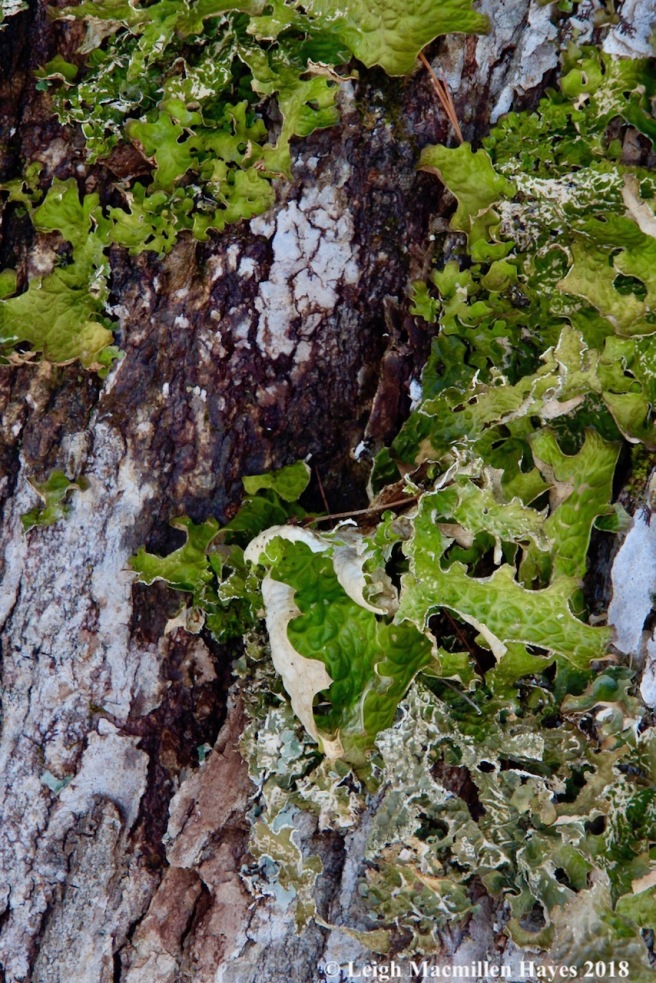
We also spied multi-fruited pelt lichen that would be suitable to cover the floors.

p17-beaver 2

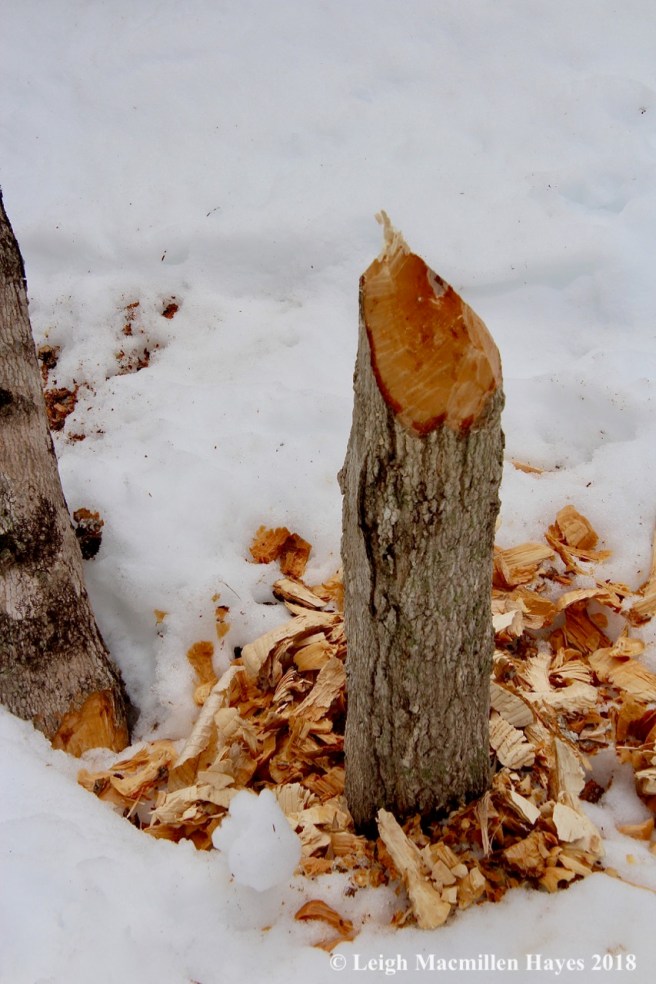
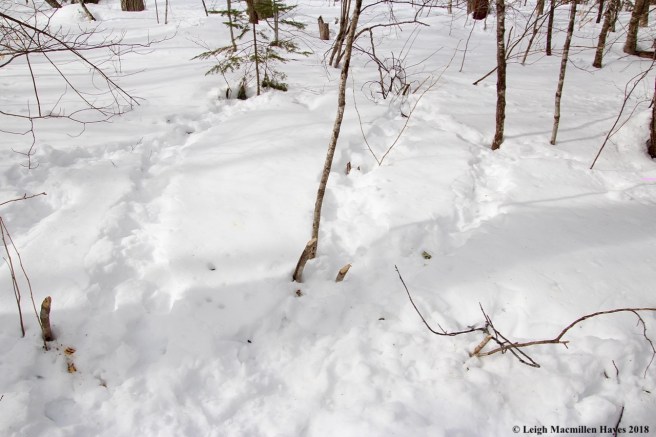
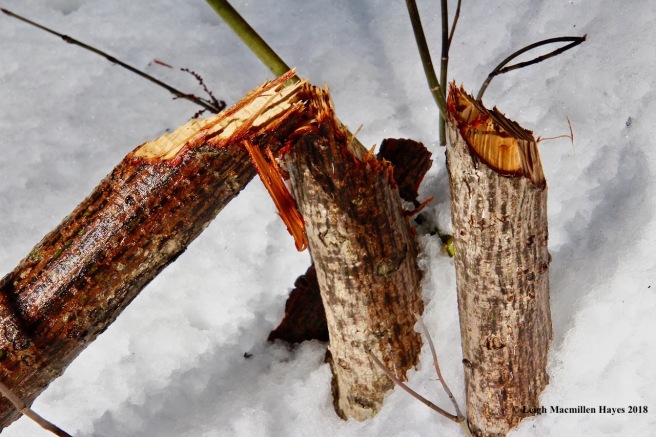
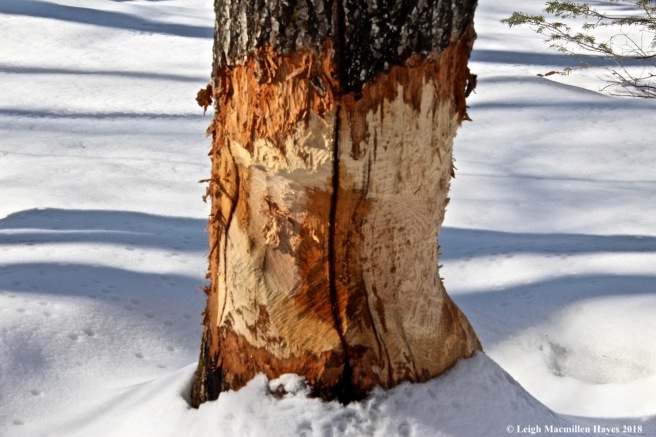
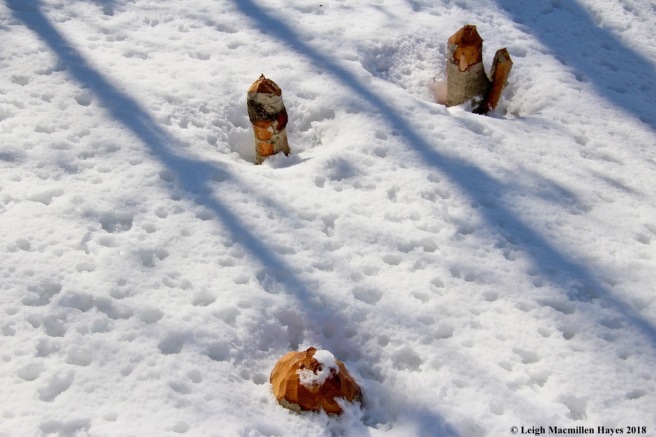
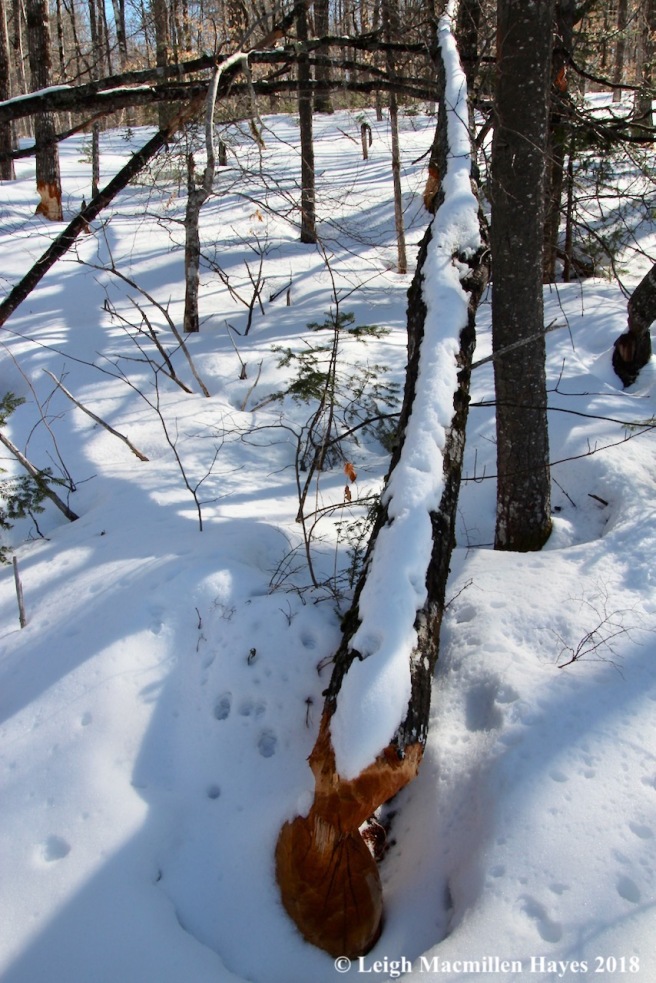
And then we began to notice the available lumber.

p19-beaver 4

It came in a variety of tree species.

p20-beaver 5

And was already de-barked.

p19-beaver 6

And pre-hewn.

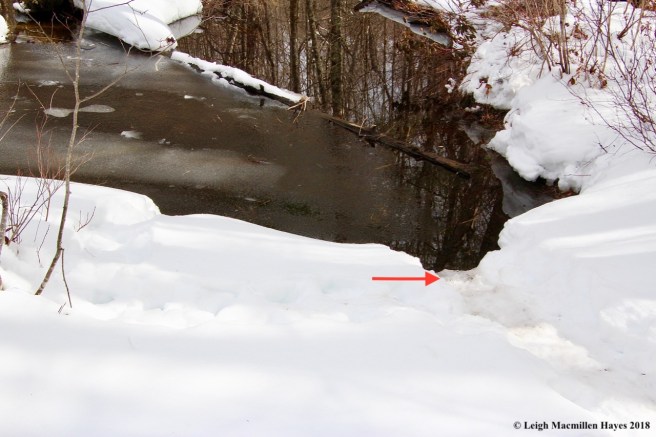
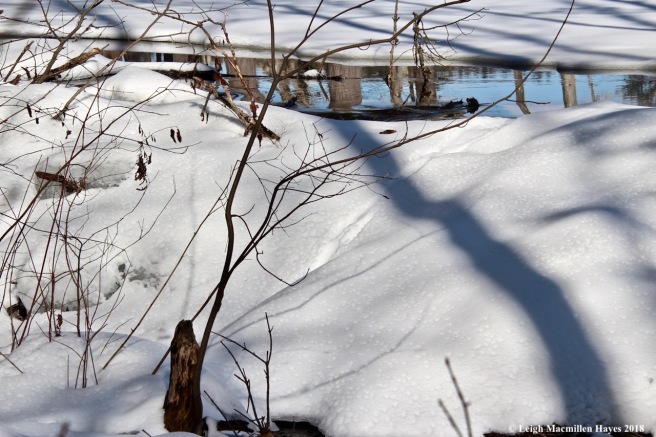
p23-infinity pool

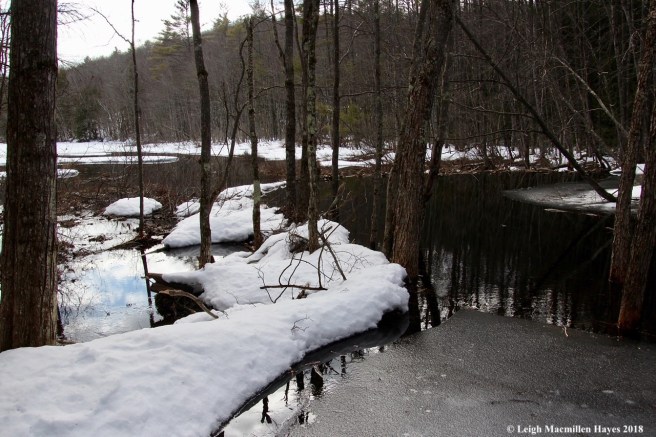
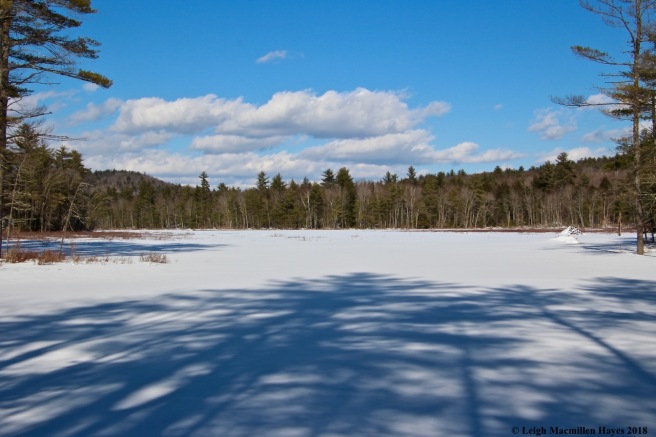
When we saw the infinity pool, we were certain that we’d found the prime location.

p24-lodge roof top

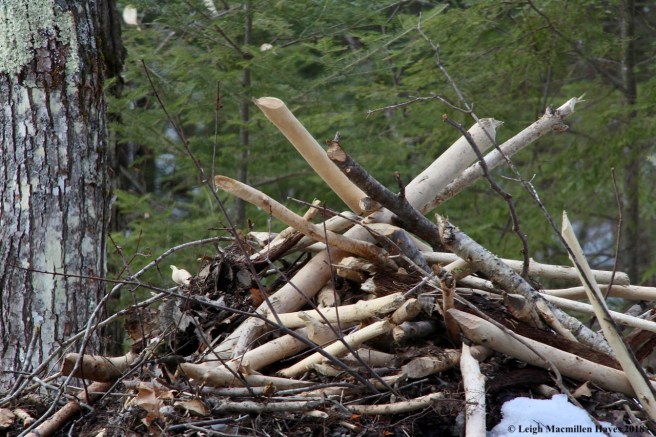
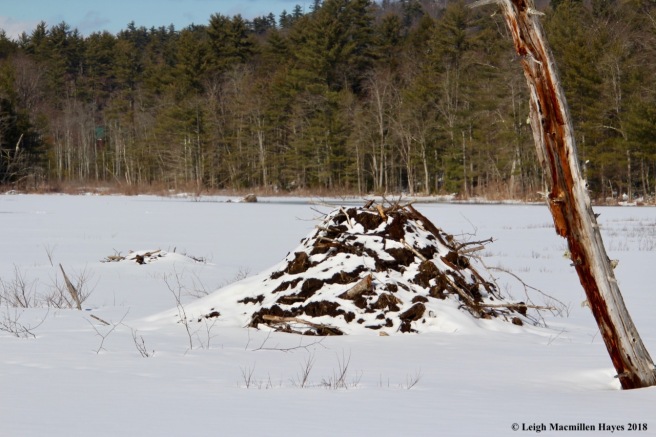
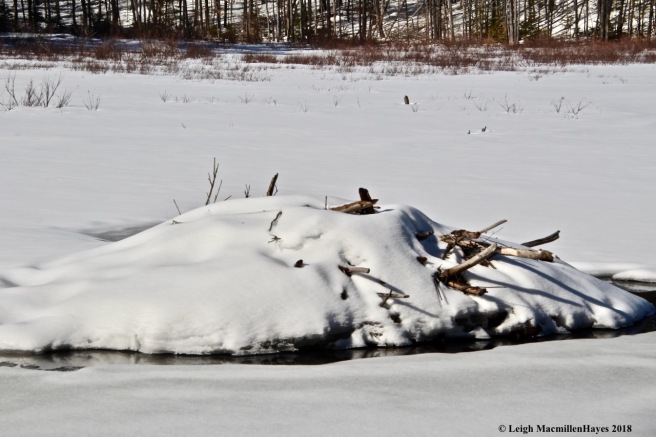
And then we spied a pre-built cabin with a new roof top and we imagined a chimney in the center of the structure.

p25-lodge and dinner raft below water

As it turned out, there was no need for us to build a tiny cabin after all, for we found one already constructed and it even included a refrigerator filled with a cache of branches. Fine dining was definitely in our future.

We were excited because we wouldn’t need to do the building ourselves and our dream was realized in a lodge that was well placed as it graced the landscape and took advantage of the local offerings. A cozy cabin indeed.

Transitions

Life, it seems, is always in transition. Or perhaps it is a series of transitions that we experience on this fast boat as we whiz through time and participate in endings and beginnings, with learning opportunities thrown into the mix. So it feels, when one season overlaps another.

If we had no winter, the spring would not be so pleasant. If we did not taste adversity then prosperity would not be so welcome. ~ Anne Bradstreet

s3a-the crew

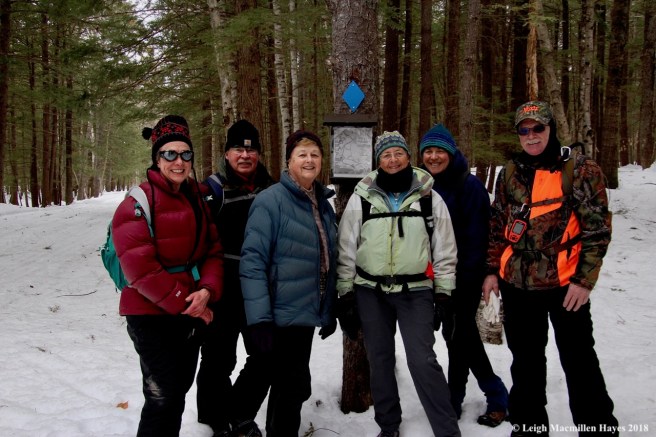
And so this morning, I enjoyed the opportunity to experience the natural transition from winter to spring at Sebago Lake State Park with a group of seven led by AMC volunteer JoAnne Diller. (JoAnne donned the lime green coat.)

s1- Ice on Songo River

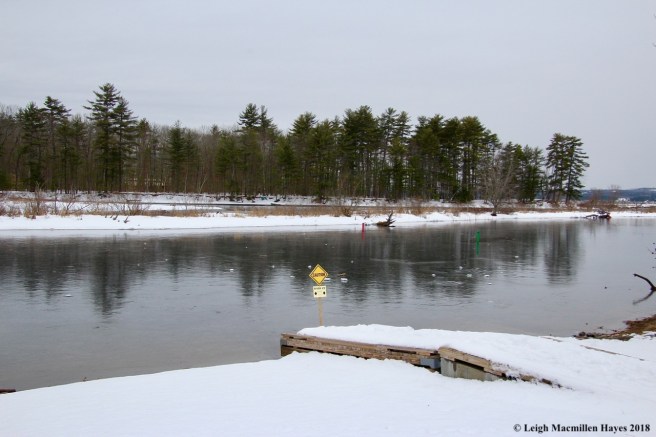
We began our journey at the boat launch beside Songo River, where signs warned of thin ice and Canada geese honked in the distance.

s2-Songo River curves

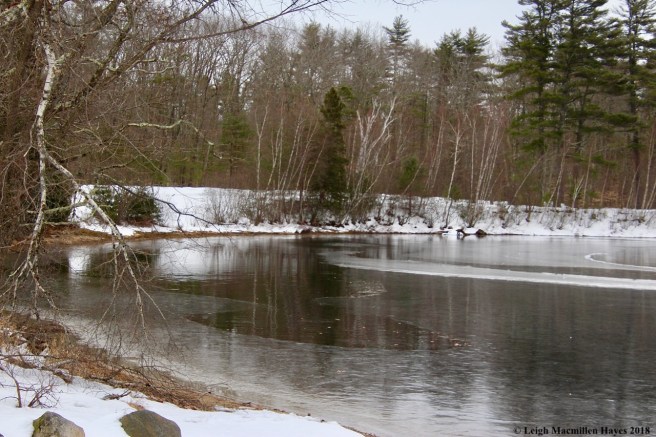
Tree buds added a subtle hint of color to the landscape. And the ice in the oxbow indicated nights of cooler temps followed by days of warming.

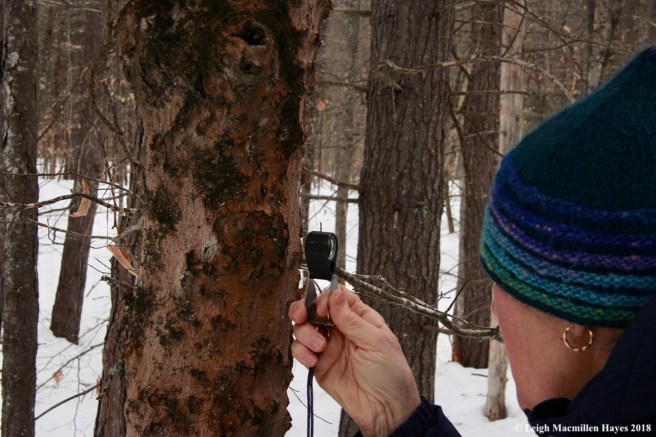
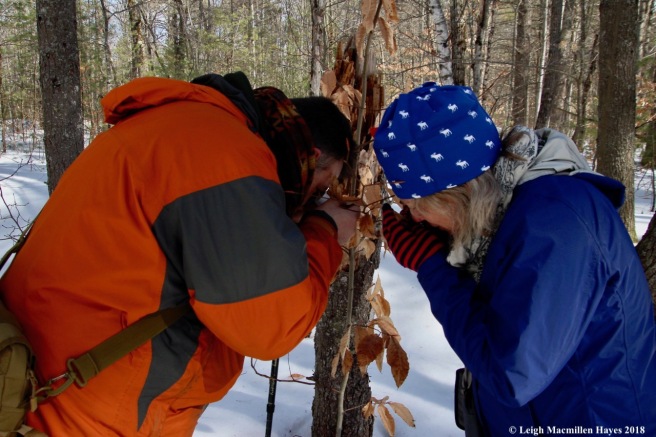
s3-Jan examines beech scale insect

Trees within the forest showed other signs of change for we noted the cinnamon tinge on many a beech tree. Not all transitions were good.

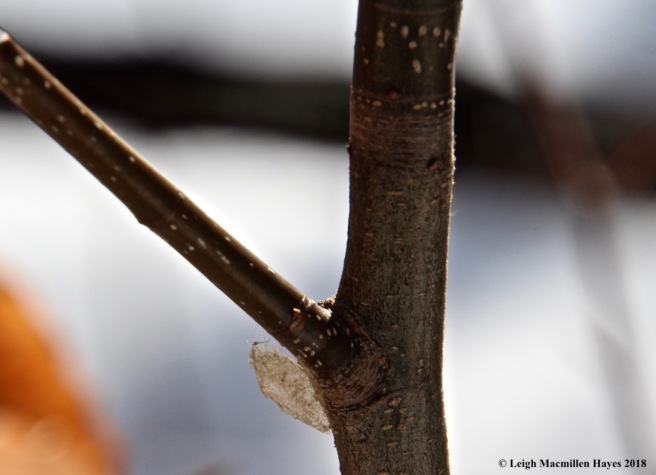
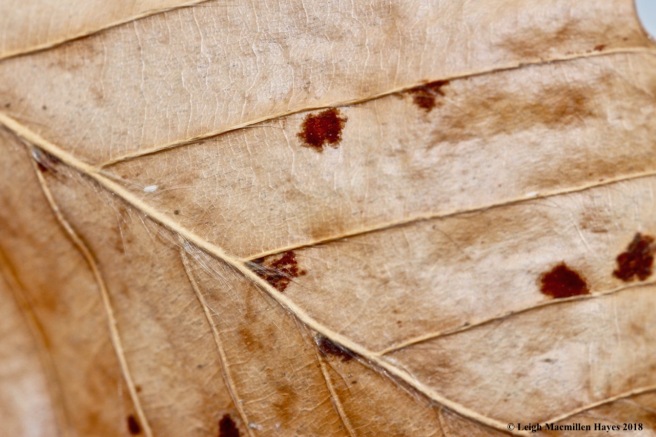
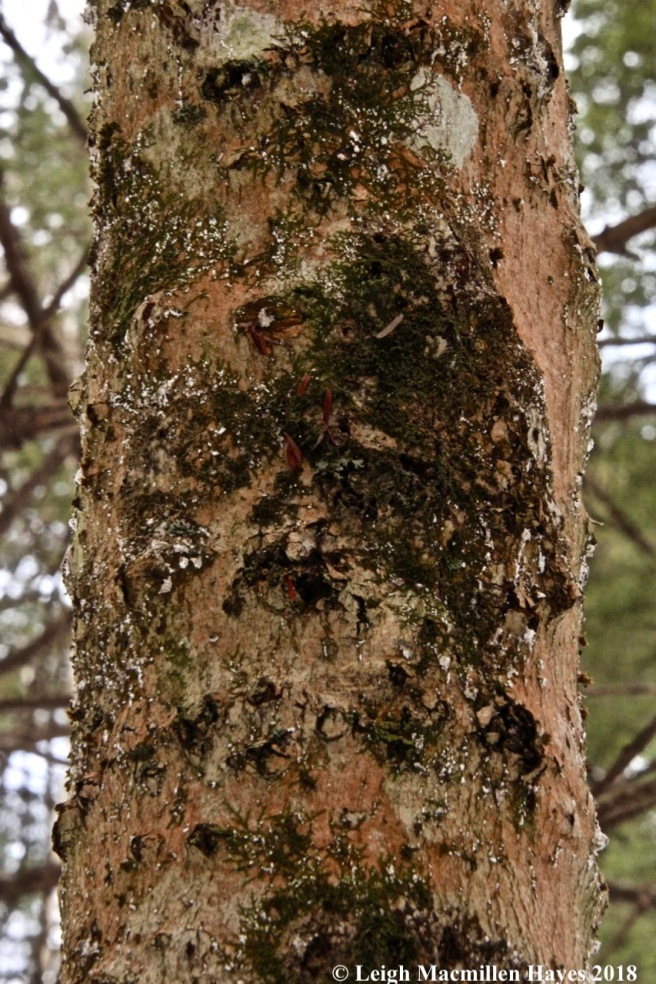
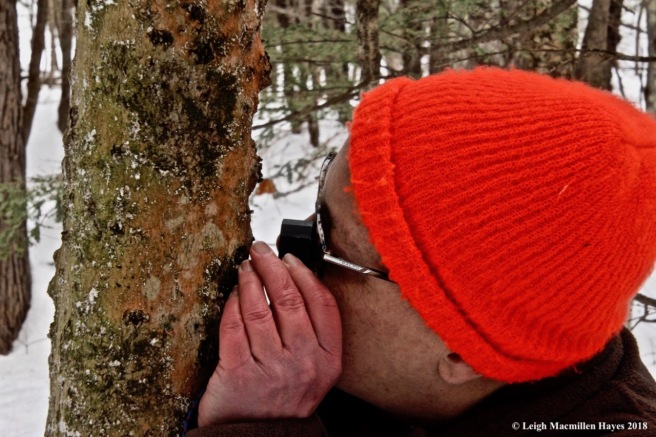
The trees were dotted with the waxy exterior winter coating of the beech scale insect, Cryptococcus fagisuga, a tiny insect that sucks sugar and other nutrients from beech trees only.

Soon, the beech scale insect will molt into its second, legless nymph stage and emerge. Immediately, it will start sucking sap through its tubular mouthpart or stylet. That instar stage doesn’t last long, and quickly it will become a mature female. For the rest of its life it will remain sedentary, but repeatedly remove and reinsert its piercing stylet, wounding the tree and providing entry points for fungi to enter. An interesting fact about beech scale insects–its a world of females who reproduce by parthenogenesis; there are no known males.

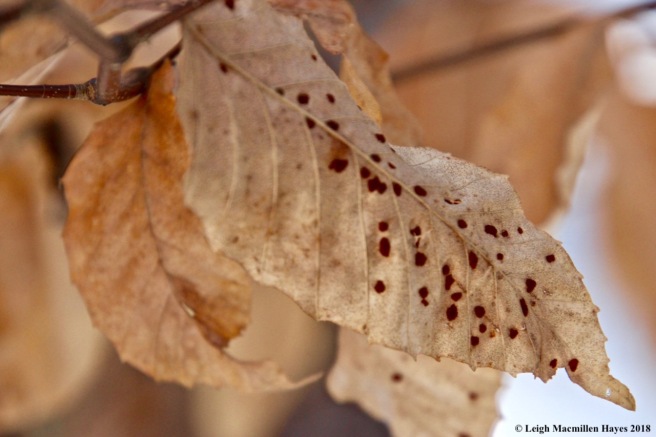
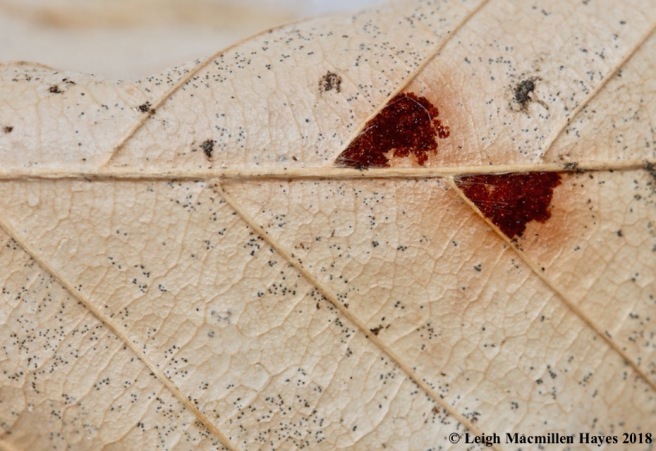
But what about that cinnamon color? Was it a fungus? Or was it related to the insects? Yes and yes. Two species of nectria fungi are associated with beech bark disease, Nectria coccinea var. faginata and Nectria gallengia. What we examined was a large area of the former’s fruiting bodies.

s4-Y in the road

For the most part we followed the groomed trail system, though we did do some post holing as we crossed from one route to another. And then we came to a fork in the road–so we took it! Actually, first we went left and along the way startled some deer. And realized we weren’t exactly where we wanted to be so we backtracked and journeyed on to the right. How often does that happen on this boat ride? Frequently. But the best part about today was that no one complained because we were all happy to travel the trail and enjoy the world around us.

s5-beach on Sebago Lake

At last we arrived at the beach on Sebago Lake, where snow and sand in the cove and small bits of ice moving with the gentle waves spoke of what is to come.

s7-pitch pine

It was at the same spot, where we paused at a picnic table to eat a snack, that we stood in awe of the pitch pines as they showed off their plates of bark thickened by age and unique manner of needles growing from the trunk.

s8-pitch pine cone

Even their cones, each scale topped with a rigid prickle, were beginning to break down as they began their journey of giving back to the earth.

s9-tree roots

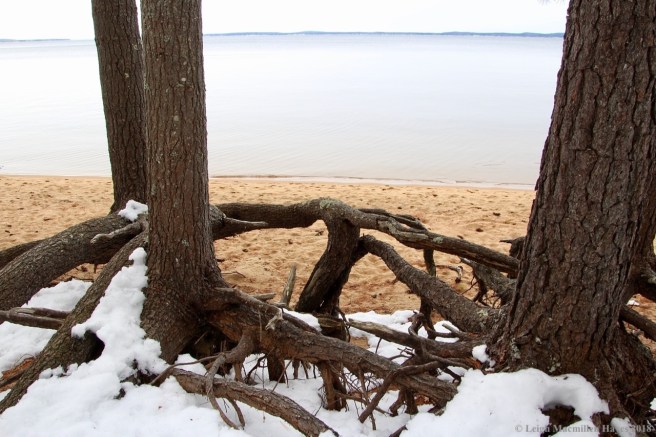
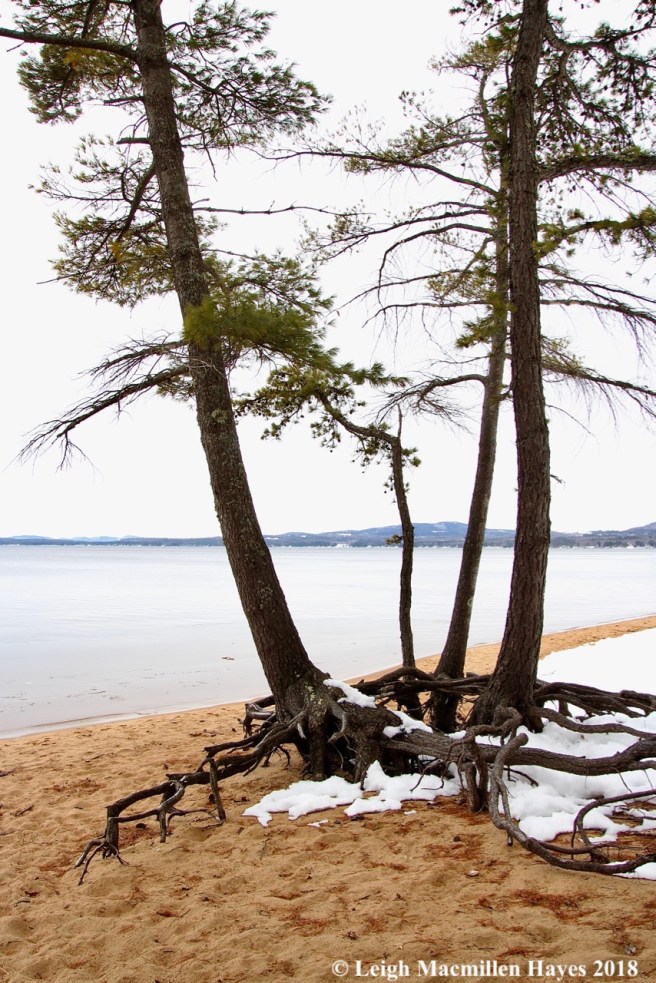
But what struck us the most were the tree roots all along the beach. And we began to wonder what had happened.

s10-roots

How old were the trees? Had the sand eroded?

s11-trees

Was the lake once much higher? And how do those trees survive? If only they could talk, we would hear their stories of pounding waves and raging storms. And maybe other adversities. Maybe they do talk and we just don’t know how to listen.

s13-back to the river

In what seemed like a flash, I realized we were on the opposite end of the oxbow I’d photographed when we first arrived–our journey had been a circular one, well sorta.

s14-buoys

By the boat launch two channel buoys waited patiently for spring to return in full force so they could move onto the river and do the job for which they were best suited.

s15-Canada geese

We took one last look before saying our goodbyes and going our own ways on this journey we call life. That’s when we spied the Canada geese–a sure sign that spring really is just around the corner.

Thank you, JoAnne, for organizing such a delightful hike and allowing us to absorb the richness of the woods, river and lake as they remind us about the transitions in life.

*And Tom, this trek is for you, and your own transition.  Love all.


Back Soon Mondate

We headed south today in search of spring. LOL! Indeed, we found as much snow on Sawyer Mountain in Limington as we have in western Maine.
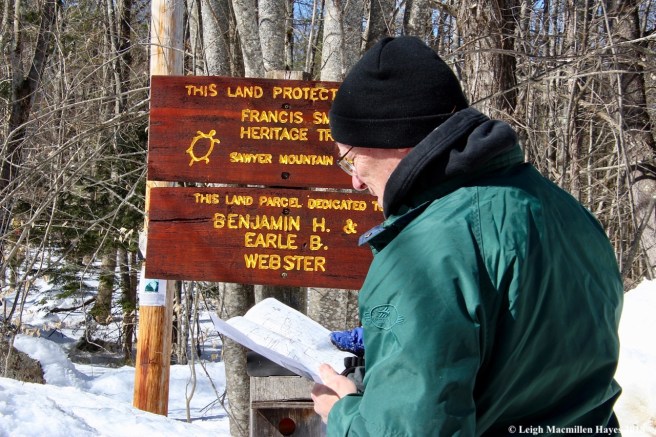
s1-trailhead

The mountain was a new one for us. It featured two trailheads and we chose the one on Route 117 where only one map was available. We borrowed it and later returned it for others.

Much of the mountain, as in 1,472 acres, was purchased over the course of eleven years by the Francis Small Heritage Trust. According to an article in the Portland Press Herald written by hiking enthusiast Carey Kish in May 2016, “Francis Small, the namesake of the trust, was a fur trader and landowner who lived from 1625 to 1714. Small is said to have owned the largest amount of land of any person who has ever lived in Maine.

In 1668, Small operated a trading post a few miles northwest of Sawyer Mountain, at the confluence of the Ossipee and Saco rivers and the crossroads of three major Native American travel routes, the Sokokis Trail (now Route 5), the Ossipee Trail (now Route 25) and the Pequawket Trail (now Route 113).

Newichewannock Abenaki tribesmen who owed debts to Small plotted to kill him to avoid payment. Their chief, Wesumbe, warned Small in time to foil the plan, but not before Small’s home was burned to the ground.

To compensate for the loss, Chief Wesumbe sold Small 20 square miles of land for two large Indian blankets, two gallons of rum, two pounds of powder, four pounds of musket balls and 20 strings of beads.

Small’s Ossipee Tract was bounded by the Saco, Great and Little Ossipee, and Newichewannock (later Salmon Falls) rivers, and included today’s towns of Limerick, Limington, Cornish, Newfield and Parsonsfield, the area where Francis Small Heritage Trust works to conserve land.”
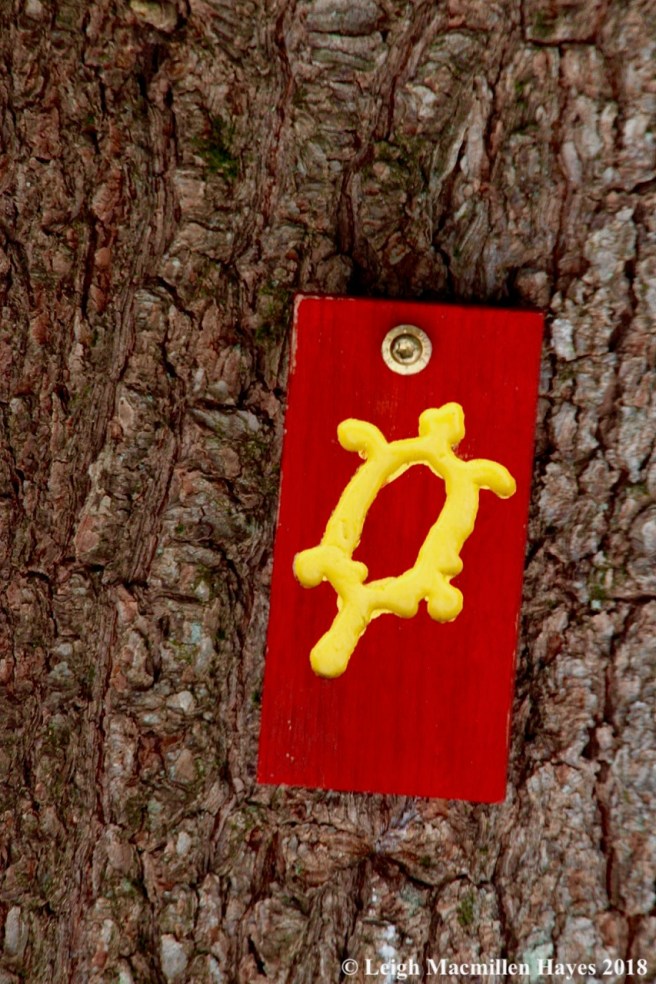
s1a-trail sign

Wooden blocks with yellow turtles carved into them blazed the trail. According to Kish, “This is the mark of Captain Sandy, also known as Chief Wesumbe, of the Newichewannock Abenaki tribe.” Having been a turtle enthusiast for most of my life, I smiled each time I saw one.

s3-Camp Ticumoff

Not everyone felt the same way. Less than a half mile up, we came upon a cabin beside the trail. It had been named Camp Ticumoff. Say it slowly.

s4a--guided turtle hunts

Zooming in on the side of the cabin, we noted a sign–“Guided Turtle Hunts.” And there was another sign as well about the Francis Small Heritage Trust being an ethically challenged organization. We weren’t sure what it was all about, but obviously not all were thrilled with the trail that we immensely enjoyed.
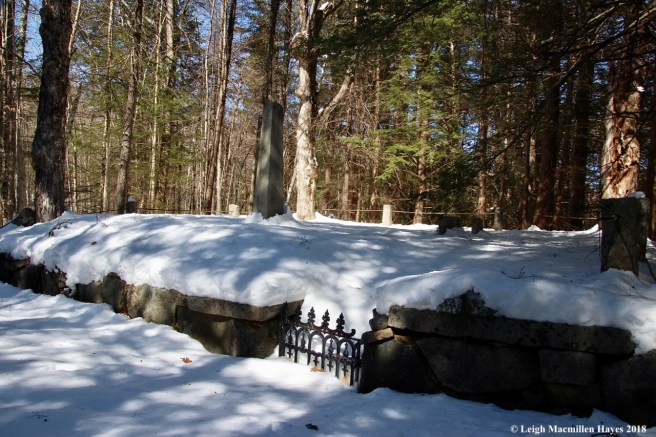
s5-Estes cemetery

Continuing on, we came across the first of several cemeteries. With the snow so deep, we didn’t climb up to inspect the gravestones more carefully.
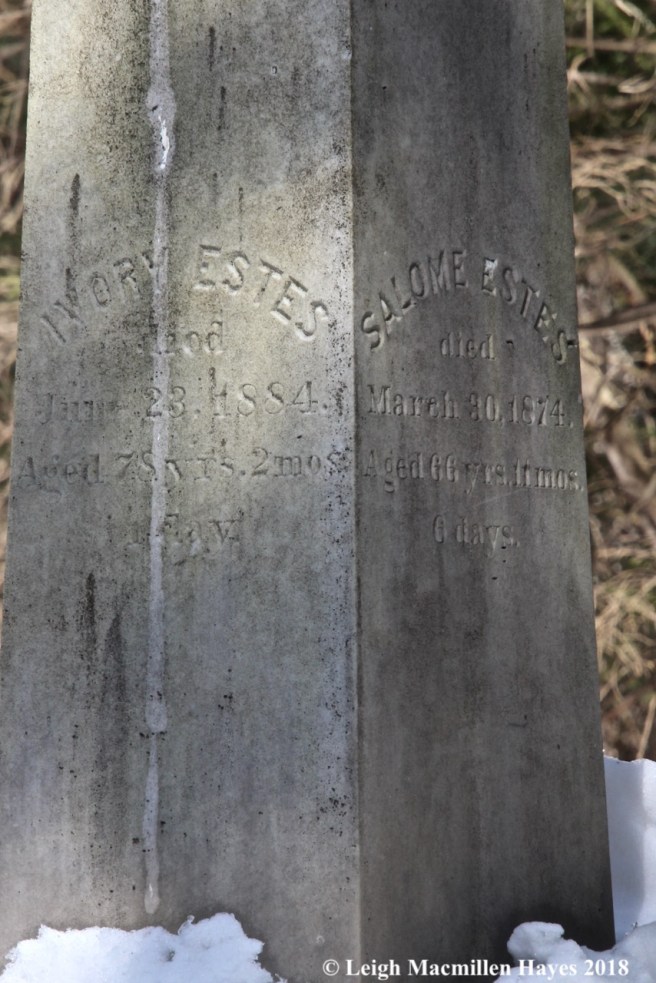
s6-Estes grave

But in the center stood a marker recognizing various members of the Estes family. Salome died March 30, 1874, aged 66 years, 11 months and 6 days. We often see that in old cemeteries–the number of days into the person’s final month indicated.
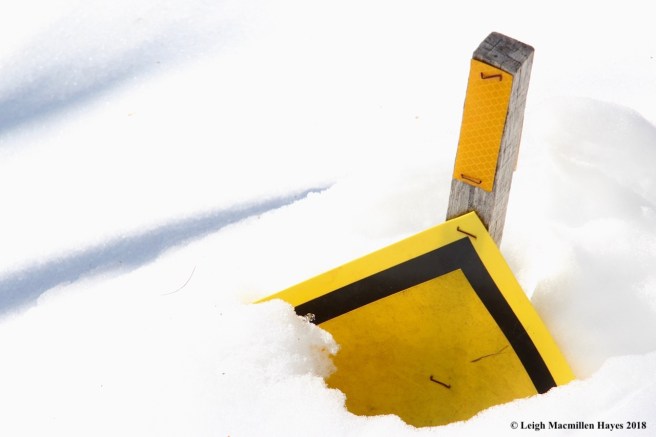
s7-caution sign

As we crossed over a brook, a caution sign gave an indication of its own–did I mention how deep the snow was?
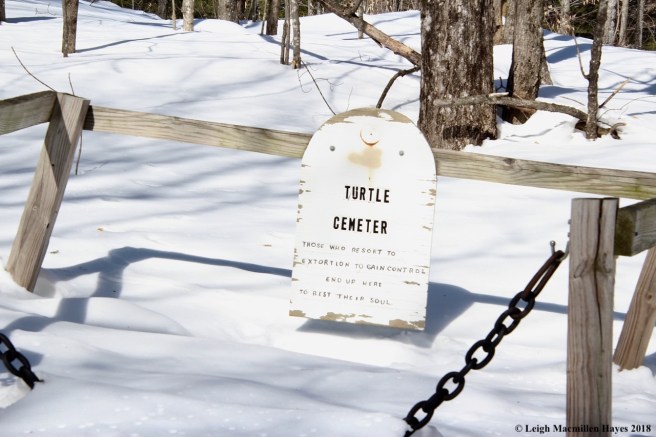
s8-Turtle cemetery

And then we found another turtle reference–on the negative side. Definitely some unhappy neighbors in the old ‘hood.

s8a--large foundation

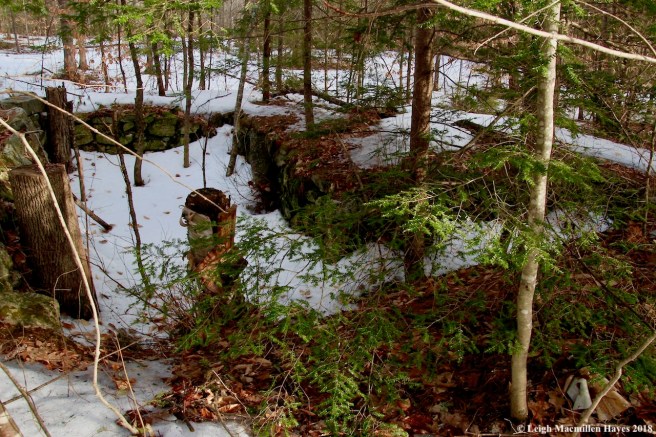
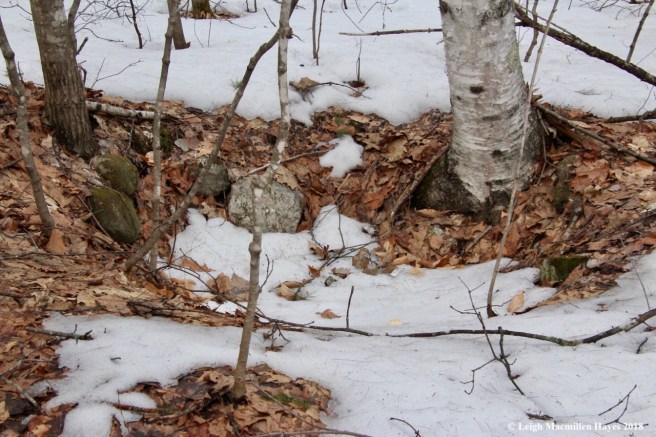
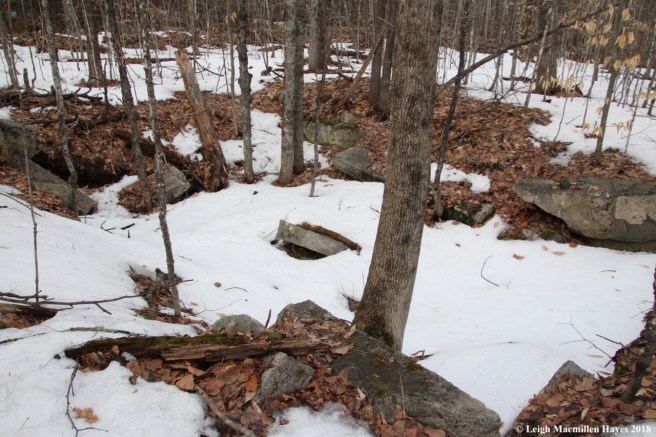
We were in an old ‘hood, after all, for most of our journey was along Sawyer Mountain Road, which was discontinued over one hundred years ago. Left behind were not only cemeteries, but also foundations, this one quite large and I wasn’t sure if it was a home or a barn.

s9-trail map

Right by the foundation, we stood for a few minutes and examined a trail map.

s10-phoebe nest

Apparently others have examined it as well, and decided it suited them. I wasn’t surprised. Kiosks often serve as nest sites for Eastern Phoebes, which I trust will return soon.

s11-deer feeding site

It was about a mile and a half to the spur trail that led to the summit. All along, we noted the lack of mammal activity. Not total lack, for occasionally we did see squirrel tracks, but that was all. And then on the spur we found lots of deer activity–where they’d pawed through the snow in search of last year’s acorns.
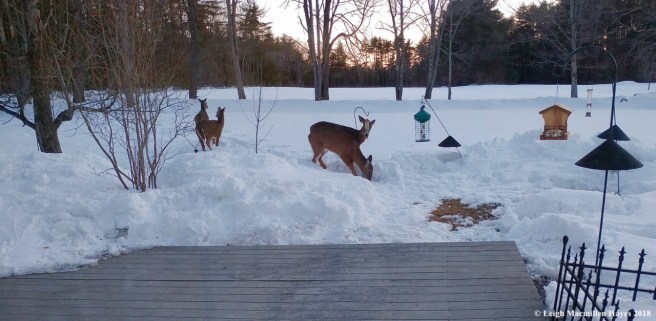
s36

Apparently they don’t have a feeding station like the deer in our neighborhood.
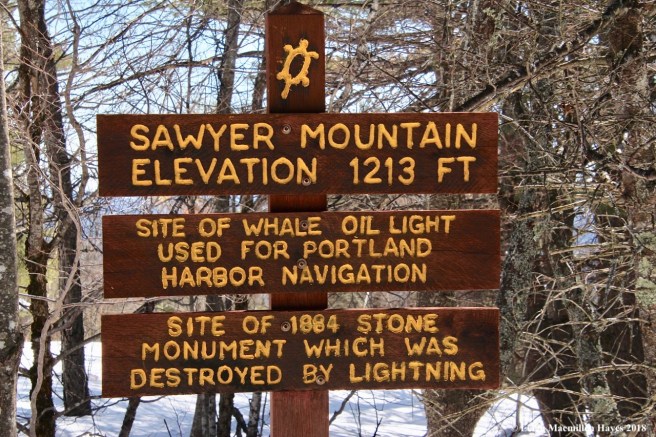
s12-summit

At last, we reached the summit, the site of a whale oil lighthouse used for navigation within Portland Harbor during the eighteenth century. It’s our understanding that the mountain is visible from the ocean so sailors would line up the light with other points to guide their ships into the harbor. We had hoped for a view of the ocean, but as it turned out, the summit was rather anticlimactic. To the northwest, we did catch a glimpse of Sebago Lake, but that was about it as too many trees had taken over the space. It didn’t matter too much as we’d enjoyed the climb and the history, both old and new, encountered along the way.
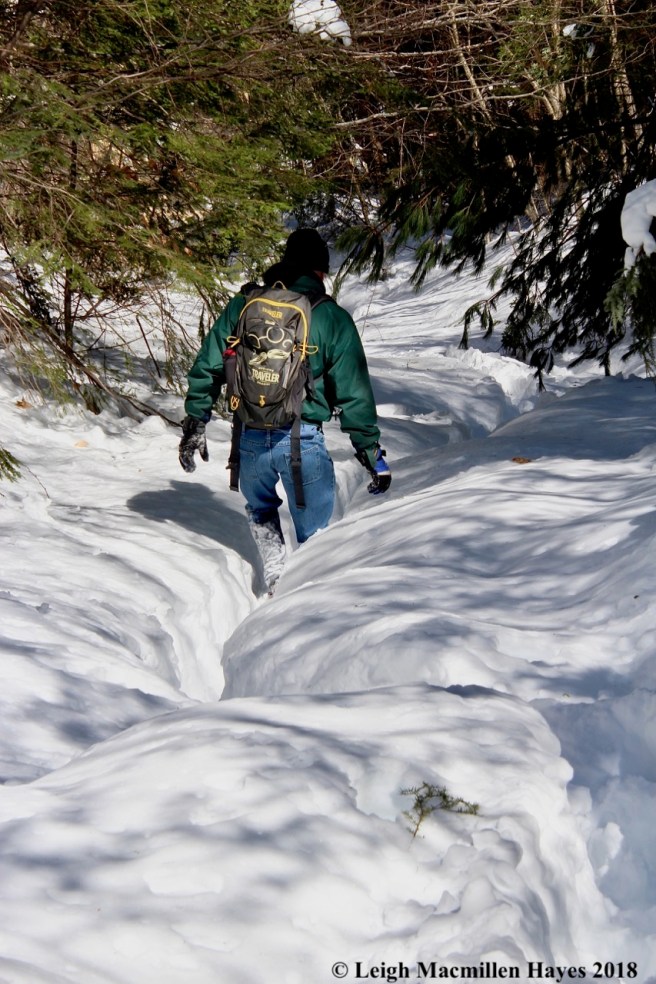
s13-hiking down in deep snow

After sharing lunch on two tree stumps at the summit, we began our journey down, again traveling through deep snow.
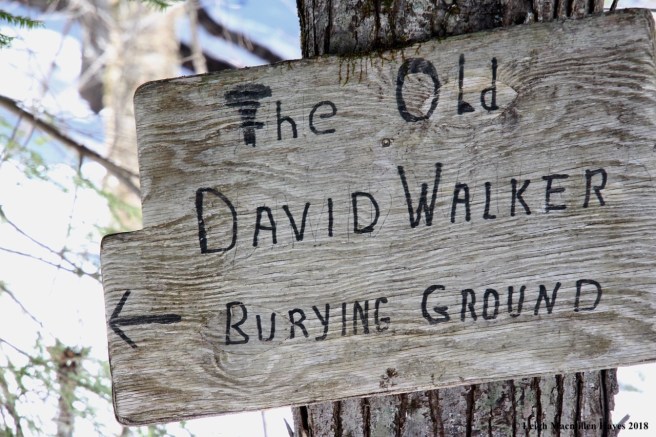
s14-Old David Walker Burying Ground

Because we were on our way down and no one had previously carved a trail to another cemetery, we decided to go for it. We’re not sure what the sign meant–was David Walker old? Or had his burying ground been moved to another site?
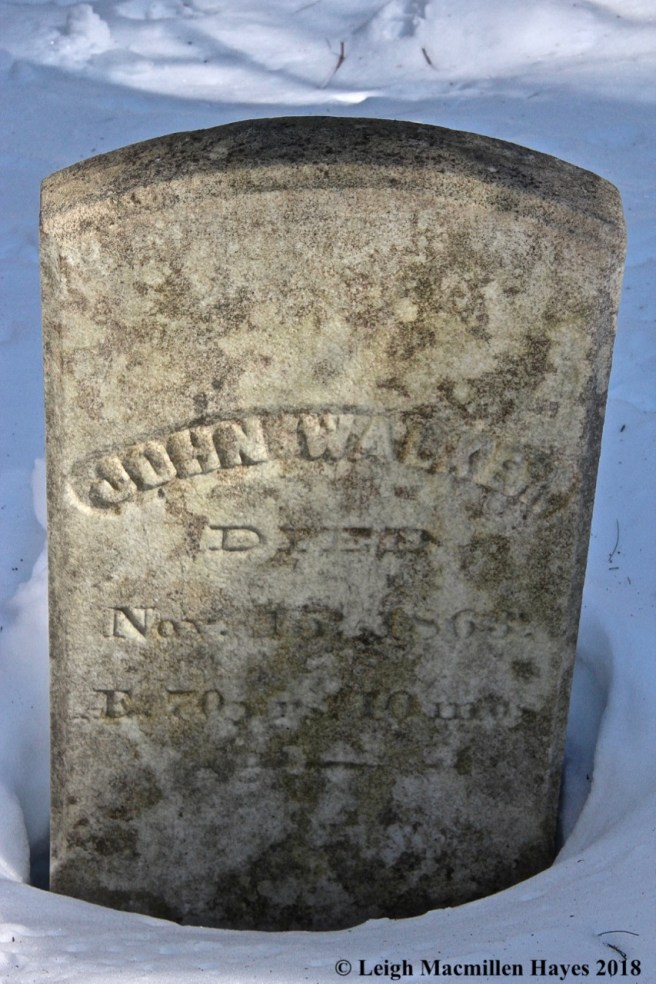
s15--John Walker gravestone

Up a hill, we located a small plot with a couple of stones. The first was for John Walker, who died in 1863.
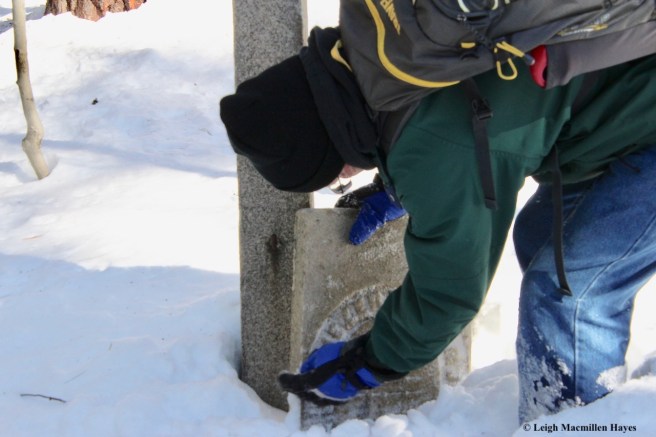
s16-cleaning off a stone

And then another leaning against a granite pillar–so my guy wiped the snow away.
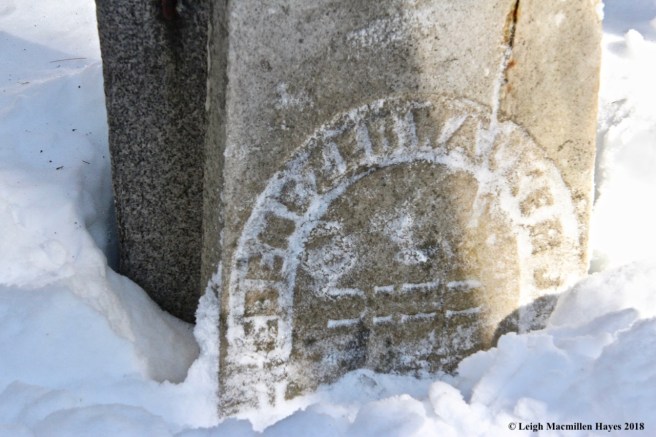
s17--Ebenezer Walker

That one was for Ebenezer Walker. So where was Old David Walker buried?

s19-nature trail sign

Back at the trailhead, I decided to loop around the nature trail while my guy headed to the truck. A sign said a nature trail map would be available at the trailhead, but I found none.

s20-blue turtle

And so I followed the blue turtles and decided to interpret the trail my way.
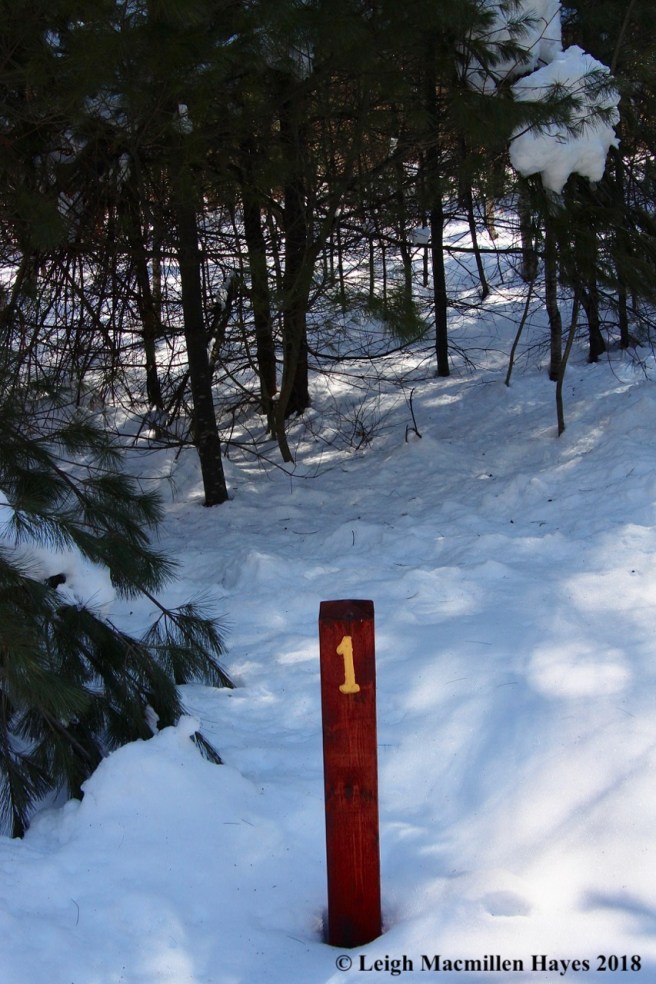
s21-young pines?

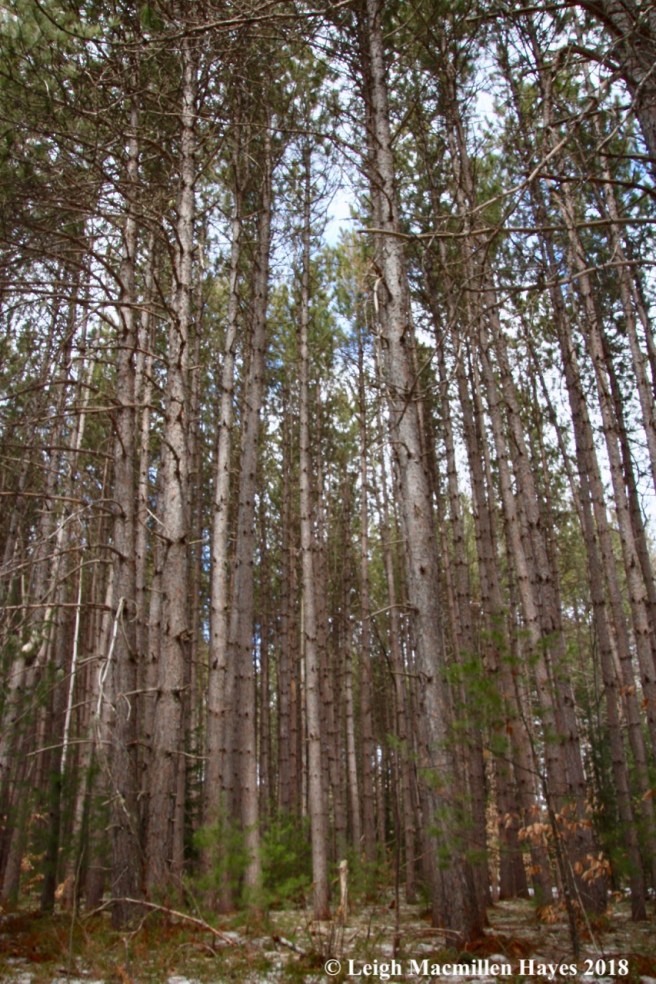
1. White pines: the Maine state tree, took advantage of the clearing and started to fill in the space.

s22-stone wall

2. Stories in granite: A stone wall at least four feet high; a lacy wall perhaps built to keep sheep in or out.

s23-hemlock stand

3. Hemlock grove: The perfect habitat for mammals, including deer. Because of their evergreen leaves (needles) that hold snow, its easier for critters to move below them.
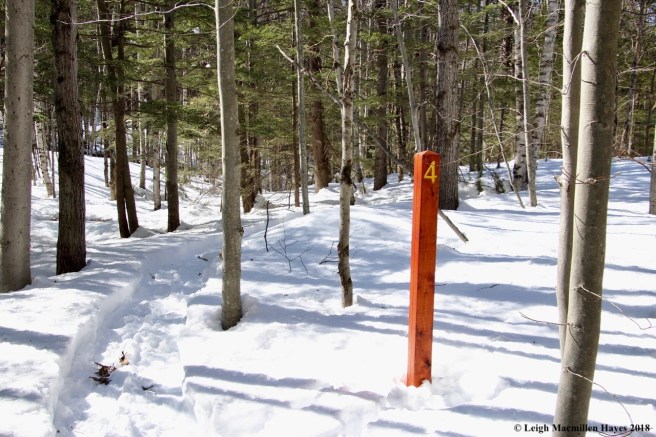
s24-beech trees

4. A Mixed Forest: Beech, maples, oaks, hemlocks, pines–all living together in harmony of sorts.

s25-glacial eratics

5. Glacial erratics: Large boulders dropped by the last glaciers about 12,000 years ago.

s26-ledge and life on a rock

6. Life on a ledge: From lichens and mosses to  hemlock trees, the ledge was a prime example of the abiotic and biotic interactions that create an ecosystem.

s27-downed trees? summer storm?

7. I dunno: A piece of blue flagging and another of orange. Perhaps it was the downed trees to the left–several hemlocks had fallen during a storm with winds out of the southeast–indicating a summer storm probably.
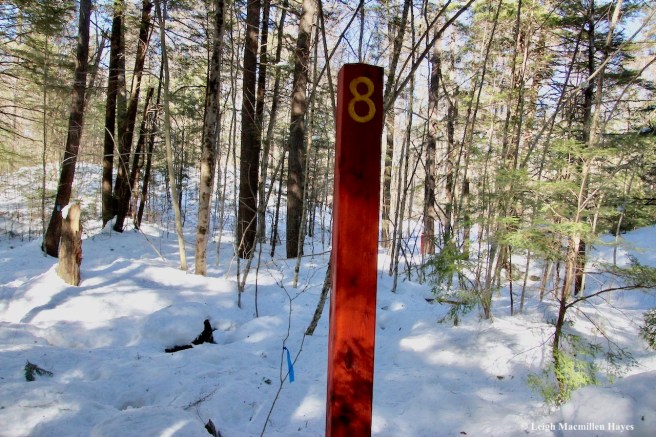
s28-not sure

8. I Dunno Ditto: Perhaps the stream that flowed just below.

s29-pine tree?

9. Big White Pine: But really, was it the tree?

s30-giant boulders

Or the giant boulders beside it?

Perhaps one day, I’ll learn how I did on the quiz–though I do think I got at least two wrong.

s4-no one home

I rejoined my guy and together we reflected upon our journey. One of the things we most enjoyed was the historical features along the way, including the 1940s hunting camp built by the father of Sherwood Libby, one of the Trust’s founders.
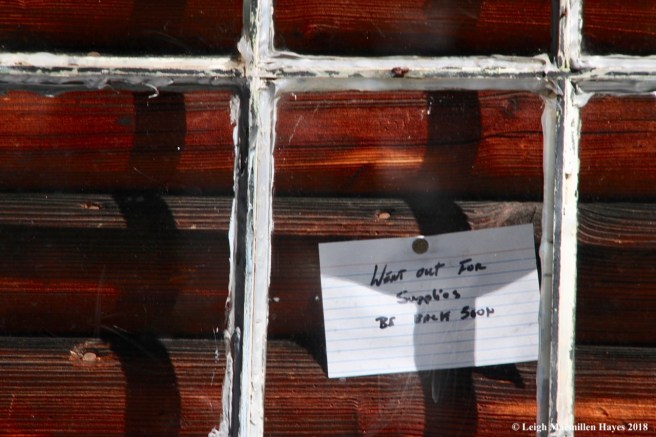
s34-Be back soon

And our absolute favorite–a sign on the hunting camp door–“Went out for supplies. Be back soon.”

We will also return–once the snow melts– for there’s so much more to see, as well as other trails to explore. What a fine place for a Mondate on this last day of winter. Be Back Soon. Indeed.
Beside Browns Pond

One should not work from home for then it is much too easy to do an about face with plans for the day and hit the trail before meeting deadlines. But alas, that is how I found myself on the Chessey Property this morning. It just seemed to make more sense to head out early in the day, rather than wait until the end to reward myself.

c14-map

The 100-acre property Chessey Property was forever protected from development under a conservation easement with the Presumpscot Regional Land Trust. Though I’d passed by numerable times, I had never before ventured that way.

c1-trail sign

And so this morning I decided to rectify that and drove to the trailhead. Actually, I drove past the trailhead, spotted the large cemetery on my left and turned around. The sign was facing in the opposite direction and easy to miss. Because the trail was only a half mile long, I figured it would be a quick trip. Apparently, I don’t know myself very well.

c2-snowshoes

I hadn’t tramped far when I realized I was moving in the opposite direction of one whose ancestors had inspired my own mode of transportation.  The start of the trail is a field in early succession and so it made sense to find snowshoe hare prints crisscrossing the opening.

c3-red fox

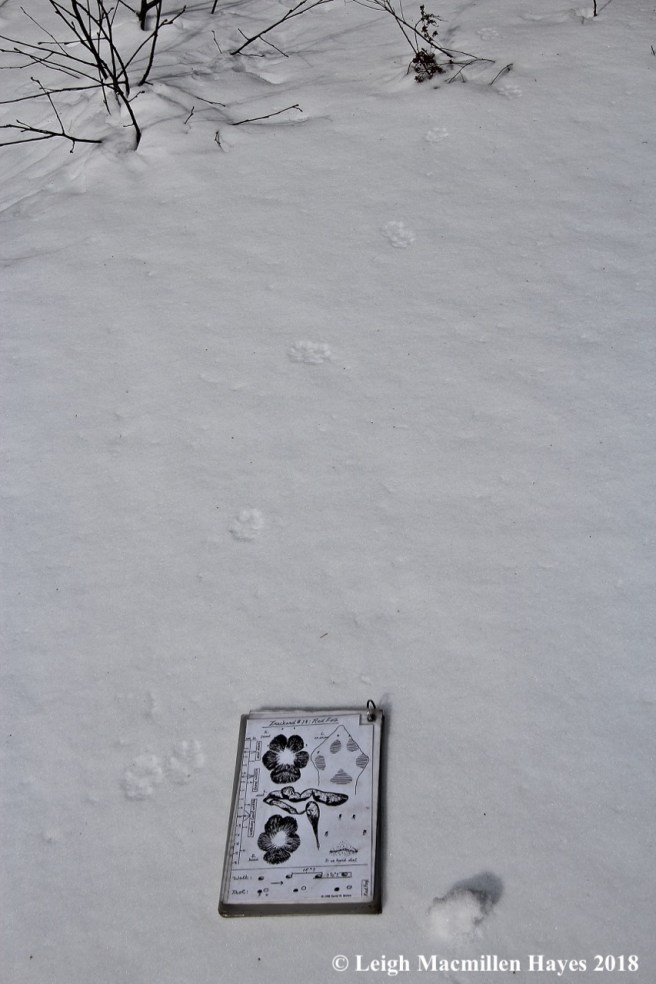
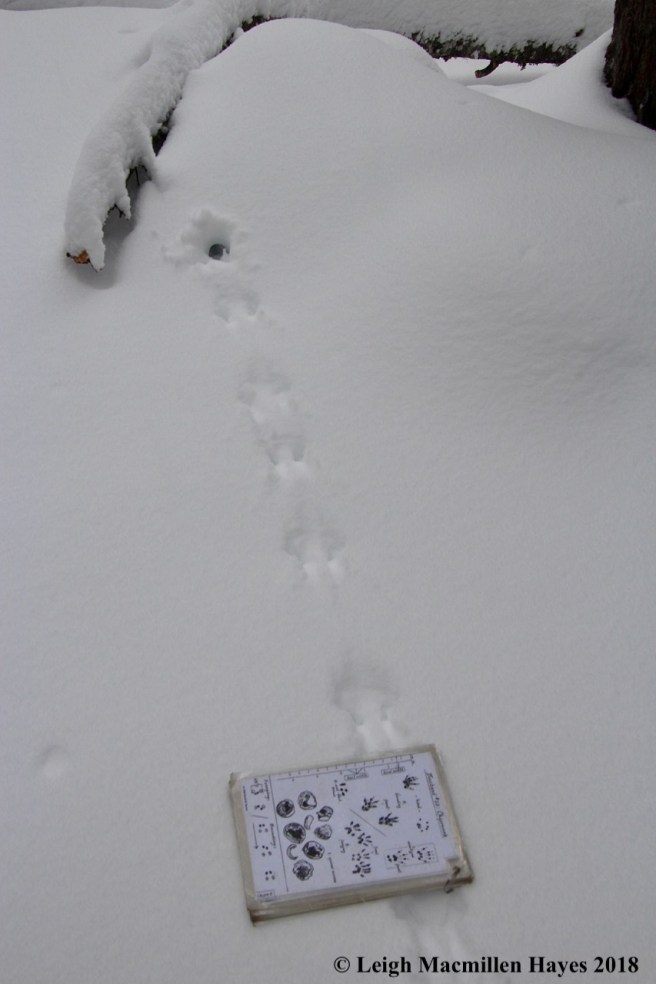
But . . . it wasn’t just a hare that had moved atop the snow. The print size and stride told me a red fox had also traveled there–and not too long before I’d arrived. To add to my identification was the chevron visible in the front foot print. Do you see what the arrows indicate?

c4-red fox track

I didn’t follow the track, and so I wasn’t sure if I was looking at prints made by one fox or perhaps two. My gut told me one and that the back foot didn’t always land exactly in the impression of the front.

c5-hare and fox cross tracks

Nor do I know how the story ended–for the fox crossed the hare’s tracks. Did the two ever actually meet?

c12-speckled alder

In the same area I found speckled alder, so named for its bark speckled with pores or lenticels. Its red and maroon catkins grew longer–well, at least the male catkins. The shorter catkins are the females, for alders are monoecious–male and female flowers grow on the same plant. As March gives way to April, the male color will deepen to burgundy, while the females will turn bright red–in full blush.

c13-pussy willows

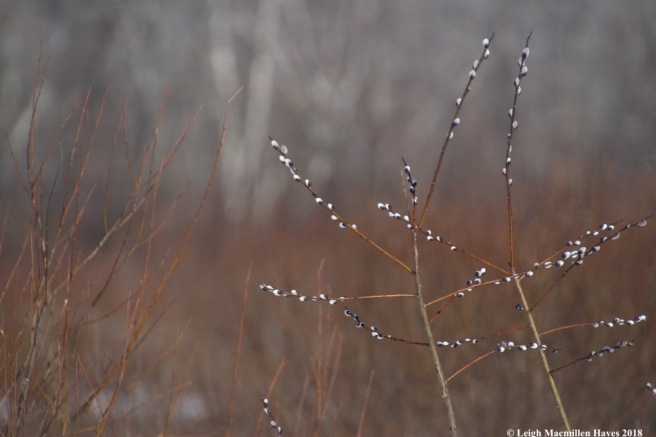
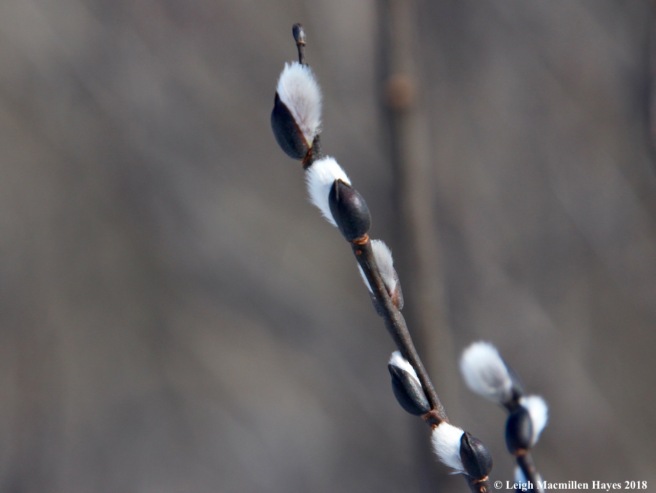
Another color also caught my attention–pussy willows with their furry little silver flower buds just opening. The soft tufts earned their common name due to their resemblance to tiny kitten paws.

c6-my tracks

All of that, and I hadn’t gone far from my truck. But, by the depth of my impressions, you can see that my travel would be slow for no one had packed the trail before me.

c7-water obstacle

I journeyed on, stopping every ten to twenty steps to look around, listen, and catch my breath. Tracking was almost impossible once I ventured into the forest for snow drops from the trees created their own random impressions. Water obstacles were a bit of a challenge, but I managed to manipulate around all four. And bird song included the throaty caws of Ravens. At one point I heard their powerful wing beats and looked up to see three chasing another bird that I couldn’t identify.

c10-face in the snow

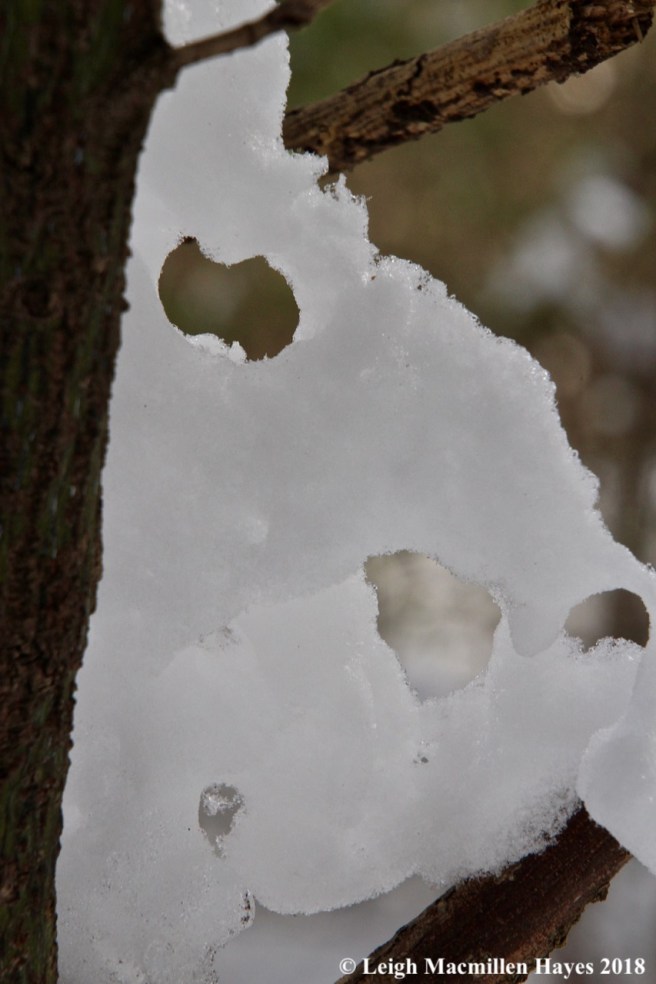
But never fear, though I couldn’t find tracks as I continued, I found plenty of other things to look at, including a tilted snow mask, and . . .

c11-snow art

snow sculptures. How does snow do that? Worth a wonder, indeed.

c8-otter tracks:slide

I’d almost reached the turn around point when I recognized a pattern by my feet and realized an otter had passed that way–probably yesterday based on the state of the slides, prints, and scat. One really cool thing that I learned as I followed its trail was that every once in a while it tunneled under the snow. I don’t know that I’ve ever noted that behavior previously. Most of its tunnels were about ten feet long and then it emerged again to bound and slide.

c9-Browns Pond

At last I turned my attention to the 110-acre pond that opened before me. It’s my understanding that it remains undeveloped–a rare feat in these parts. I wanted to stay and explore, but knew I had to save it for another day because work really did sit at home awaiting my attention. I trust I’ll return in another season when the traveling isn’t quite as difficult, but until then this morning’s moments beside Browns Pond will sustain me.


Hunkered Down

Three nor’easters in two weeks. Such is March in New England. The latest delivered over twenty inches of snow beginning yesterday morning. And still the flakes fall.

p-chickadee

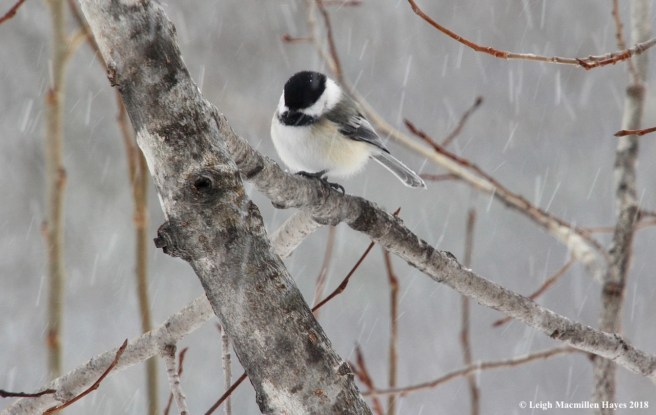
But staying inside all day would be much too confining and so I stretched my legs for a few hours before giving my arms another workout with driveway cleanup duty. It was much more fun to explore and listen to the chickadees sing.

p-snow on trees

There are a few places in our woods that I find myself stopping to snap a photo each time a snowstorm graces our area. The stand of pines with their trunks snow coated was one such spot yet again. And tomorrow the scene will transform back to bare trunks and so it was one I was happy to behold in the moment.

p-snow on limbs

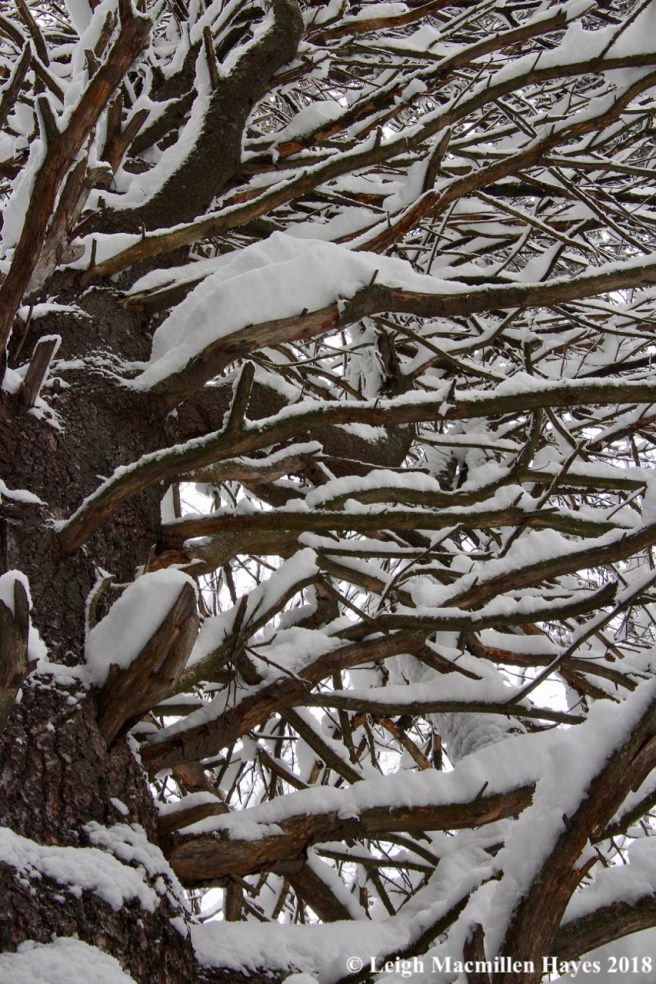
As was the older pine that grows beside a stonewall along the cowpath and perhaps served as the mother and grandmother of all the pines in my forest–bedecked in piles of flakes, her arms reached out as if to embrace all of her offspring.

p-snow on insulators

With the snow so deep, I felt like a plow as I powered through under the insulated insulators.

p-snow on park sign

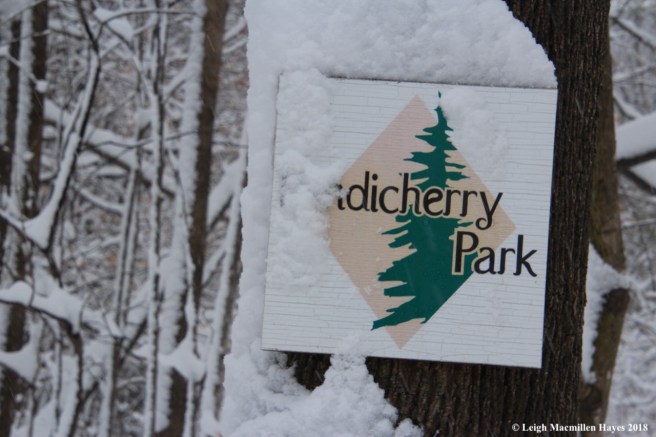
Finally, I reached one of the entryways to Pondicherry Park and while I love being the first of the day to leave my mark, I’d secretly hoped someone had trudged before me. But . . . a few steps at a time meant taking frequent breaks to rest and look around.

p-snow on tree trunk

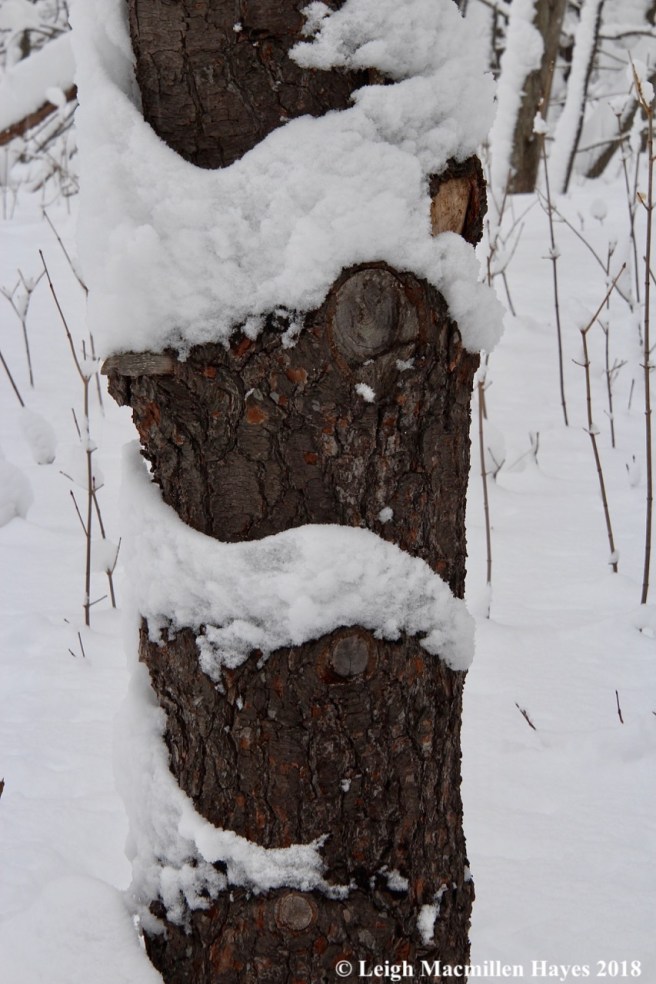
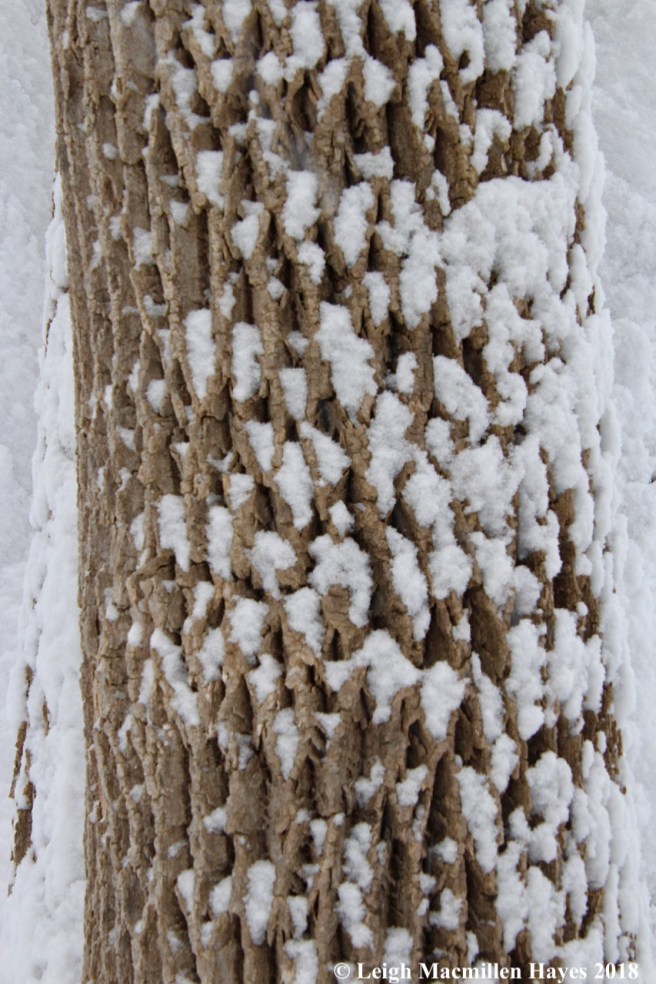
Again, it was the snow’s manner of hugging tree trunks that drew my awe.

p-snow on tree trunk 2

Sometimes it reminded me of giant caterpillars climbing into the canopy.

p-snow on roots

Even the roots of a downed tree took on an artistic rendition.

p1-snow on bittersweet

And that most invasive of species in these woods, bittersweet, offered curves worth appreciating–ever so briefly, of course.

p-snow on fences

Snow blanketed fences of stone and wood.

p-snow on bridge

Enhanced the bridge.

p-snow on bench

And buried a bench.

p-Stevens Brook

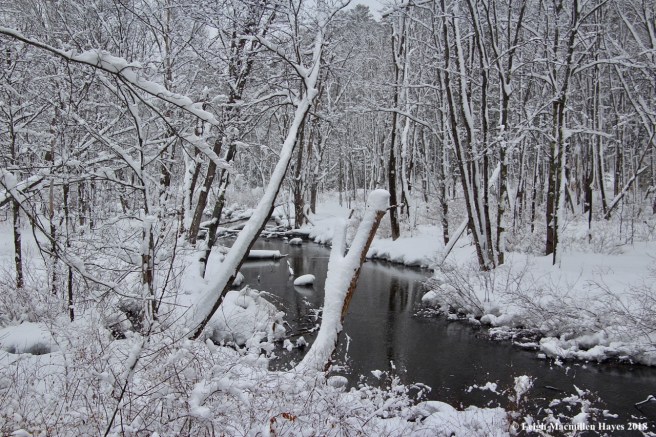
Beside Stevens Brook, it looked as if winter still had a grasp though we’re about to somersault into spring.

p-snow on trees reflected

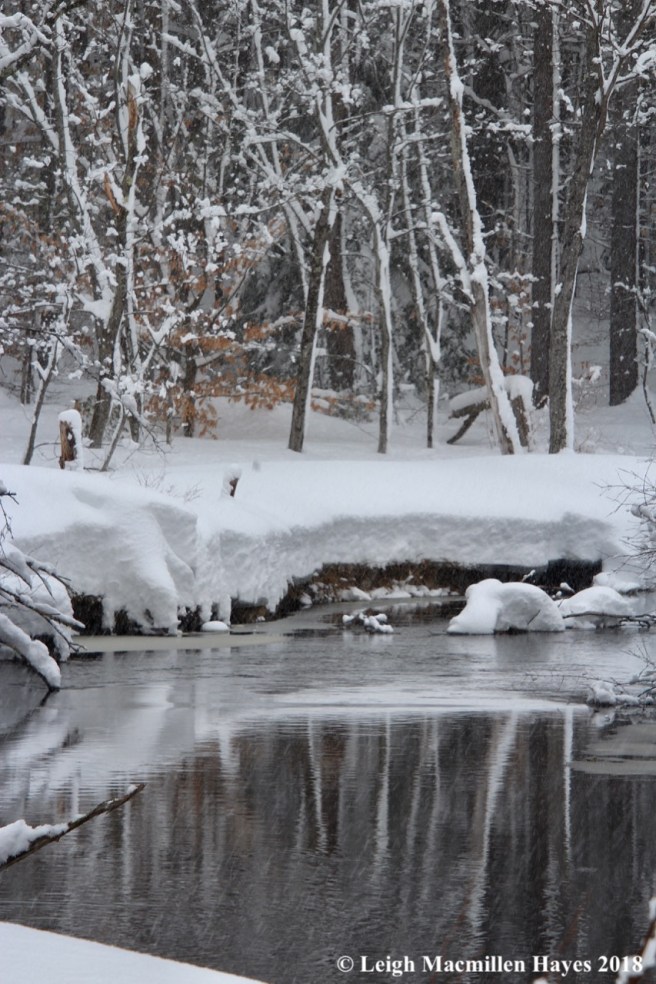
And the reflection in Willet Brook turned maples into birches.

p-kneeland spring

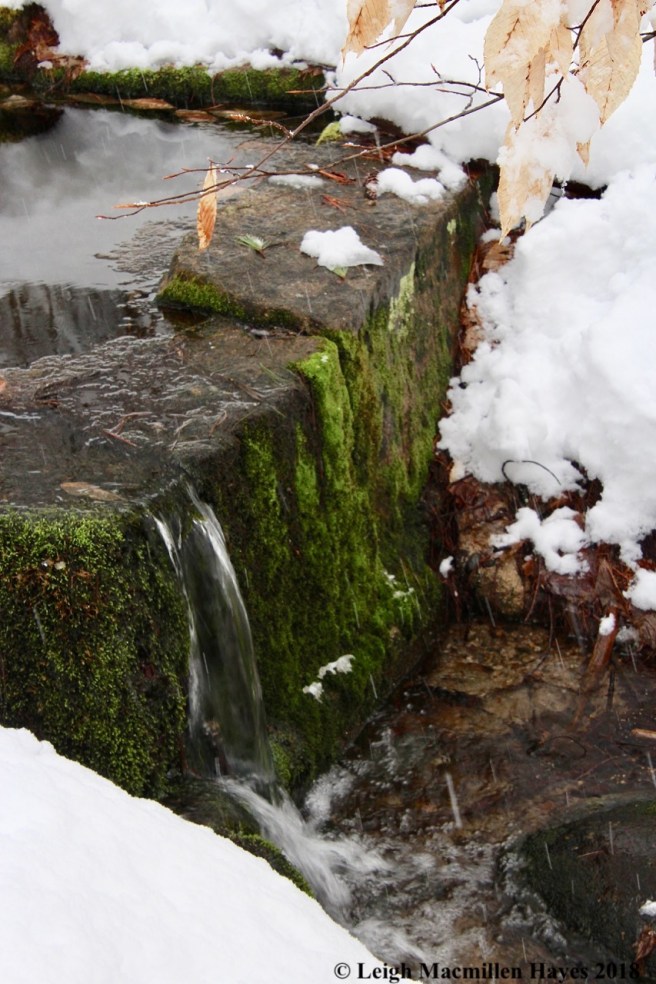
At Kneeland Spring, water rushed forth in life-giving form and the sound was one we’ll soon hear everywhere as streams and brooks overflow.

p-mallards 1

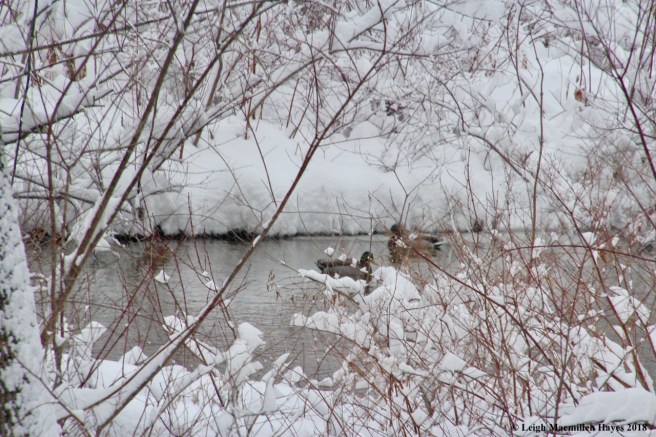
I went not to see just the snow in its many variations, but also the wildlife. I found that like me, the squirrels and deer had tunneled through leaving behind troughs. And the ducks–they didn’t seem at all daunted by the mounds of white stuff surrounding them.

p-mallards 2

In fact, one female took time to preen.

p-mourning dove

I found mourning doves standing watch.

p-Robin

And heard robins singing.

p-snow spider

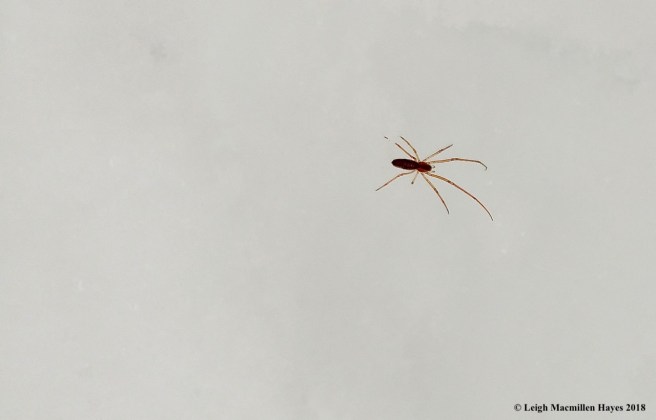
And because I spent a fair amount of time looking down, I began to notice life by my feet, such as the snow spider–an indicator that the thermometer was on the rise. It lives in the leaf litter, but when the temp is about 30˚ or so, it’s not unusual to see one or more. Today, I saw several. And wished I had my macro lens in my pocket, but had decided to travel light.

p-winter stonefly

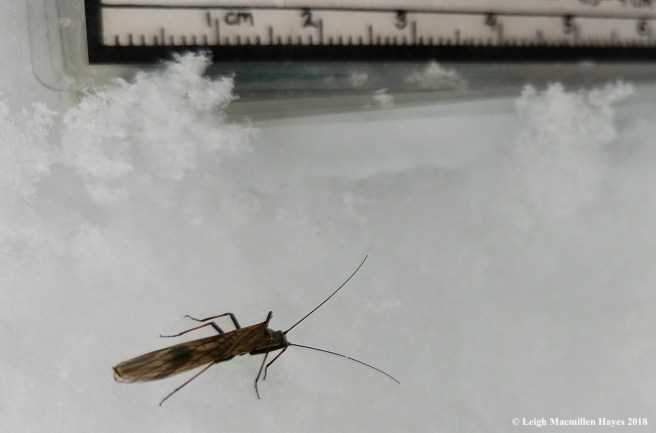
Winter stoneflies were also on the move. They have an amazing ability to avoid freezing due to the anti-freeze in their systems.

p-winter dark firefly 2

I also found a winter dark firefly. While the species is bioluminescent, I’m not sure if this one was too old or not to still produce light.

p1-snow on me

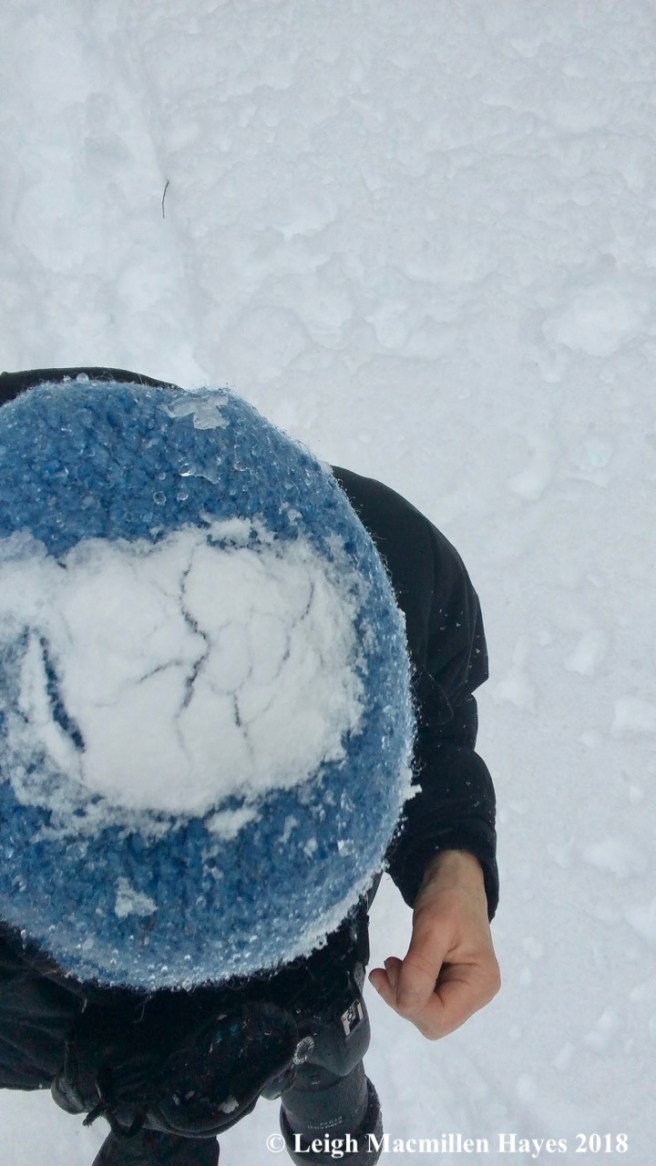
At last the time had come for me to head home for not only was the snow still falling, but so was the sky–or so it felt each time a clump hit my head as it fell from the trees.

p-final photo

We’ve got snow! In fact, we’ve got snows! And in reference to a question an acquaintance from Colorado had asked yesterday–“Are you hunkered down?” My answer was, “No, Jan, I’m not. Nor is the world around me. In fact, except for the shoveling, I relish these storms as winter holds on for just a wee bit longer.”


Lovejoy Mondate

A man walked into a hardware store . . . and told my guy about a couple of mountains we should climb. And my guy came home and told me. And we looked for trail maps and found none. And we decided to go anyway because we had a sorta idea about where one of them was located.

l1-Lovejoy Mountain Road

And so we drove up Hunts Corner Road in Albany, Maine, and located a road sign that bore the same name as the mountain we hoped to climb–and the road wasn’t plowed. But . . . another man was gathering mail across the street and so my guy asked him about the trail. The man said it would be fine for us to head in and we’d probably get as far as the pond where a few old camps stood, but wouldn’t reach the summit. We weren’t sure we would either, but figured it was worth a try.

l2-my guy way ahead

For those who have followed our Mondates previously, you’re well aware that my guy is often far ahead of me and such was the case today. The snow was deep and journey up a bit of a trudge, but that didn’t stop him. I really don’t mind for it gives me time to take in all that is around me and listen to the voices in my head. And I’ve a feeling he does the same–solving all the problems of the hardware world and any other issues that need to be addressed, plus possibly singing a few tunes to himself. The latter would never occur to me, but that’s another story.

l3-No Name Pond and Round Mtn

Today, we met periodically, the first time being at No Name Pond, where we enjoyed the backdrop of Round Mountain–a hike we’ve previously completed. Truthfully, this pond has no name–at least that I can find on any topo maps.

l4-bear pole

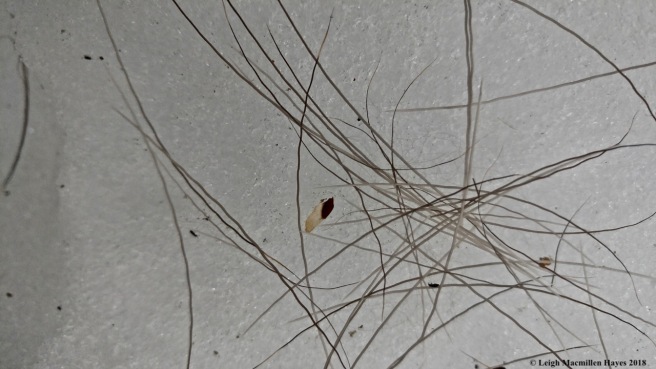
Onward we journeyed, for a few steps–because a telephone pole caught my attention. Do you see what I see? (Karen H.–I took you with me today and mentioned your name several times to my guy–read on.) Bites and scratches courtesy of a black bear.

l5-bearhair

And hair left behind. There was actually quite a bit of hair. But . . . I’d forgotten to put the battery in my Canon Rebel camera and so had to depend on my phone to capture all the moments.

l6-onward and upward

We really had no idea where we were going, and when we came to a Y, chose the left-hand route, which had a few water obstacles.

l7-bushwhack

And then we decided to do some bushwhacking because we had no idea where the road might lead and we assumed the mountain was to our right.

l8-Into the Evergreens

It wasn’t totally an assumption, for I’d downloaded a GPS program recently and played with it a bit. The mountain was to our right, but there was a ledge between us and it.

l9-finding our way

And so we did some traversing, and slipping and sliding, and offered each other advice and occasionally a hand. Well, he offered me a hand, which I gladly accepted. And all the while I dreaded our descent, though we figured we’d probably need to sit on our bums and pretend we were otters–belly up.

l10-over the tree

We finally saw the light of day and assumed the summit was just above. Only one more downed tree to conquer.

l11-me

We did–with lots of giggles thrown in as we practiced our graceful moves.

l12-moose work 1

But, we weren’t at the summit. Instead, we were in moose alley for such was the evidence we found on the numerous striped maple trees.

l13-moose work 2

There were no fresh tracks, but we knew who had dined . . .

l14- moose work 3

by the size of the tooth marks they left behind.

l16-striped maple leaf

Because we were in a striped maple community, my eye was drawn to their moose nipped buds of previous years, but also to the artful twist of occasional dried leaves.

l15- snowshoe hare track

We had also entered snowshoe hare (snow lobster) territory and their tracks were innumerable.

l15-view toward the Balds in Evans Notch

Again, we found ourselves on an old logging road, and then we decided to go off it and bushwhack some more. As we checked the GPS periodically, it showed that we were following a ridge, but still had a ways to trek.

l17-continuing on

We thought we’d been so smart when we left the road, until we swung through the forest and came to a bit of an opening where we realized it was in front of us again. Or at least we thought it was the same road.

l18-winter wonderland

And so we followed it through the winter wonderland.

l19-summit view

And at last, according to the GPS, reached the summit, where the view through the trees was of the Bald Faces in Evans Notch. It wasn’t much of a view–and we wondered if we might have missed one, but decided to save that thought for another time.

l22-cairn?

After treating ourselves to some dark chocolate McVities digestives, we started to follow our tracks back down. About fifty feet away, we spotted a cairn we’d walked right by–it was large and we didn’t know its purpose. To mark the summit? Or did it represent something else?

l23-bobcat print

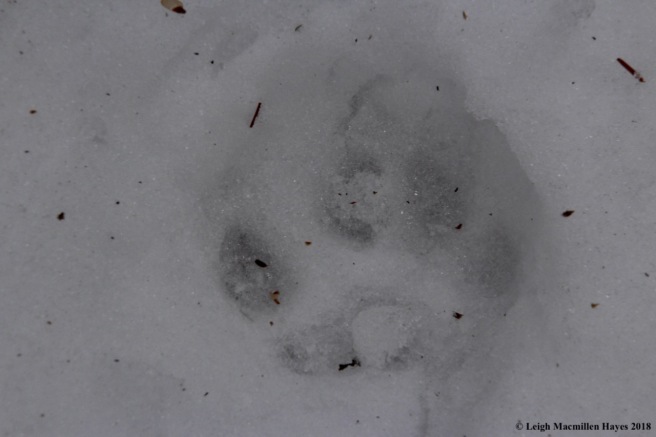
On the way back down, we paused again–by some prints I’d seen earlier. Yes, Karen–this one is for you. A bobcat indeed. Because of the deep, soft snow, its nails had provided traction.

l24-hiking down

When we reached the spot where we’d done some bushwhacking, we decided to take a chance and stay on the road. It proved the right choice and soon we picked up our previous tracks.

l25-quartz snag

And then we got to see a couple of other things we’d missed on the way up, like this quartz snag. Huh? Funny things grow in trees ’round these parts.

l28-bear tree 3

And big mammals climb trees ’round these parts.

l27-bear tree 2

Yes, Karen, another bear tree. ;-)

l30-final view

Just below that we found ourselves back at the point where we’d climbed up the ledge. And discovered that the road turned to the right. Again, we weren’t sure we were making the right choice, but decided to take our chances. Bingo–it eventually curved around and we found our own tracks once again. We were tickled with ourselves and paused by one of the old camps to take in their view–the same view we’d enjoyed from above, but more open because some trees had been cut.

Roger Lowell had suggested this hike to my guy and the man collecting the mail said that the land belongs to the Stiflers, who own Round Mountain, Long Mountain and Overset Mountain, all hikes that we had enjoyed in the past. We weren’t sure the mountain road we were on was open to the public, but we gave thanks to Roger for the suggestion and the Stiflers for not posting the land. And we toasted this Mondate with sips of water–as we appreciated our love and joy for today’s journey–on Lovejoy Mountain.


What the Bobcat Knows

As I drove down Heald Pond Road in Lovell today I wasn’t sure what awaited me. But isn’t that the point? Every venture into the great outdoors should begin as a clean slate and it’s best not to arrive at the trailhead with expectations.

f1-Heald Pond Road barn

And so I didn’t. Well, sorta. I really wanted to see a porcupine. And maybe an otter. And definitely an owl. But I knew better and so I passed the last barn on the road and then backed up and stepped out, captivated by the colors in the scene before me.

f2-trail signs

A few minutes later, I strapped on my snowshoes and headed up the trail. My plan–to climb to the summit of Flat Hill at the Greater Lovell Land Trust’s Heald and Bradley Ponds Reserve and then circle around Perky’s Path upon my return.

f3-trail up flat hill

Breaking trail was my job in the rather deep snow given recent storms, but easy to move upon and so I sashayed up. What surprised me, however, was the lack of tracks left behind by the mammals that I know live in these woods.

f4-pine cone bird feeders

I did stop at the balsam firs decorated by a local 4-H club in December as part of the Maine Christmas Tree Hunt. The dangling pinecones once sported peanut butter and birdseed, but today that was all a memory so I knew birds and deer had stopped by in the last few months.

f5-bobcat 1

And then, as I neared the flat summit, I found tracks of a mammal that had checked out the base of every tree and under every downed limb. In fact, as I soon realized, it was more than one mammal that I followed as I went off trail. Bobcats. Indeed. Though typically solitary, these two traveled together. It is mating season and males and females will travel together during courtship.
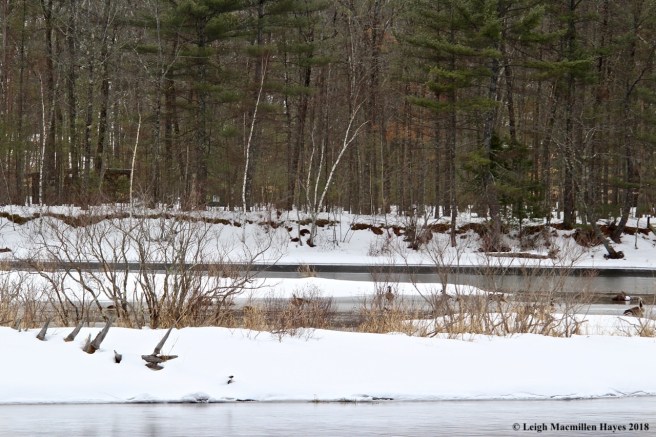
f11-bobcat print

Though the prints were difficult to photograph given the glare, by the toes, ridge and overall shape, I knew them.

f12-bobcat scat and print

And scat! Filled with white hair. I have close-up views should you choose a closer look, but chose to give those who find scat to be rather disgusting a break. ;-)

f6-porcupine and bobcat

And then I found another set of tracks and knew that besides squirrels and little brown things, the bobcats were also searching for a bigger dinner. On the left–a porcupine trough, and on the right, the bobcat trail.

f8-porky work

Ever since I’ve traveled this trail, I’ve seen the work of the porcupines at the summit. And sometimes I even get to see the creator. In winter, porcupines eat needles and the bark of trees, including hemlocks, birch, beech, aspen, oak, willow, spruce, fir and pine. And they leave behind a variety of patterns.

f7-porky work

If I didn’t know better, I could have been convinced that this ragged work was left behind by a chiseling woodpecker, but it, too, was porcupine work.

f9-porky work

All about the summit, recent chews were easily identified for the inner bark was brighter than the rest of the landscape. And below these trees–no bark chips such as a beaver would leave, for the porcupine consumed all the wood.

f10-flat hill view

While snow flurries fluttered around me, the summit view was limited and it looked like the mountains were receiving more of the white stuff. (Never fear–we’ll get more as our third Nor’easter in two weeks or so is expected in two more days. Such is March in Maine.)

f13-script lichen between pine lines

From the summit, rather than follow the trail down, I tracked the bobcats for a while, first to the north and then to the south. I had hoped to find a kill site, but no such luck. Instead, the writing on the page was found upon the pines where script lichen, a crustose, was located between the lines of bark scales.

f14-ulota moss and frullania

I also found plenty of Frullania, that reddish brown liverwort that graced so many trees. And among it, a moss I’ll simply call an Ulota. As I looked in Ralph Pope’s book, Mosses, Liverworts, and Hornworts , upon arriving home, I realized I should have paid attention to capsules for that would have helped me determine whether what I saw was Ulota crispa or Ulota coarctata. Another lesson for another day.

f15-beaver pond on Perky's Path

At last I reached Perky’s Path, which may not seem like a major feat if you’ve been there, but actually I’d explored off trail for quite a ways and it took me a while to get down to the wetland.

f16-maleberry

And because I was in the wetland, maleberry shrubs bordered the edge and showed off their bright red buds and woody, star-shaped seedpods.

f16a-bobcat across wetland

After focusing on them for a while, I looked down at the snow’s surface and the most subtle of prints appeared before my eyes. My two bobcats. The curious thing–at the summit the mammals had sunk into the snow and the prints were a bit difficult to decipher. I assumed those summit impressions had been made about two days ago. But on the wetland, the bobcats walked atop the snow–when conditions were firmer and I suspected they’d been created last night.

f17-brook toward Bradley Pond 1

I followed the edge of the wetland to the bridges that cross a brook that forms at the outlet of Bradley Pond, constantly on the lookout for the bobcat tracks again.

f18-more bobcat

And I found them! Beside the brook.

f19-beaver pond from bridge

What had they found on the wetland, I wondered?

f21a-beaver trail

Continuing on, I found that they’d checked on the woodwork left behind by another critter of these woods who had also moved about last night.

f20-beaver works

Beaver works. And their piles of woodchips. Unlike a porcupine, a beaver doesn’t eat the chips. Rather, it cuts down a tree for food or a building material. The chips are like a squirrel’s midden of cone scales–the garbage pile of sorts.

f22-beaver trail to water

I noted where the beaver had moved into the brook . . .

f23-beaver treats

And left some sticks behind. For future food? Future building? Stay tuned.

f27-brook to Bradley pond

Typically in other seasons I can’t move beside the edge of the brook, but today I could. The lighting kept changing and water reflected the sky’s mood.

f24-Diamesa sp. and snow flea

And because I was by the water, I kept noting small insects flying about–almost in a sideways manner. Then I found some on the snow–a member of the Diamesa species, a midge I believe. And do you see the small black speck below it–a snowflea, aka spring tail.

f25-Diamesa sp.:haltere

And do you see the two little nobs on the fly’s back, the red arrow pointing to one? Those are the haltere: the balancing organ of a two-winged fly; a pair of knobbed filaments that take the place of the hind wings.

f29-beaver pond wetland low

Eventually, I followed the eastern edge of the wetland back to my truck, wondering if there was any more action but found none. In fact, the water was low so I knew the beaver works weren’t to rebuild the dam. Yet. Nor did I find any more bobcat tracks. But I’d found enough. And I think I know some of what the bobcat knows.


Angels Among Us

As March continued to roar in like a lion, I stepped into the park this morning and was embraced by beauty. Snowflakes, white and pure and eternal drifted my way. Though I was alone, I wasn’t.

p1

For within each flake I felt millions of wings brush against my face–reminding me of those I know who are at the moment downtrodden and have hurdles to conquer. Some may be tiny, others immense, but all were angelic in nature.

p3

As the flakes gathered together, they enhanced the reflection of harmony . . .

p8

and illumination.

p9

They brought Heaven down to earth . . .

p17

and reminded me that even in the darkest hours I hope my friends remember that grace surrounds them.

p18

May they find healing energy,

p24

creativity,

p13

and unwavering strength–both inner and outer.  Support is everywhere and often floats softly about while carrying a bigger presence.

p15

May they realize they are surrounded by so many angels offering comfort, reassurance and encouragement,

p15a

while looking so ordinary that at times they may not be recognized.

p10

May they maintain a sense of balance going forward,

p12

and let the flakes soften any rough edges.

p7

May they listen carefully . . .

p6

and hear whispers in the breeze that I trust will tickle their beings.

p4

May they hear the universe sing (or occasionally quack),

p2

its song as sweet or maybe sweeter than that of the cardinal.

p19

And at the end of the day, may they follow the tracks home, no matter how big . . .

p5

or small.

p20

May they continue to look up as the flakes fall and know that our friendship is a privilege I honor.

p21

May we all recognize the angels among us, innocent and yet brilliant. Even on a days when a nor’easter blows through. Or especially then.

P.S. I was going to dedicate this post to Jin, and Tom, and Cris, and Bob, and Ronny, and Becky, and Bev, and Pammie, and Rosemary,  and so many others. I do dedicate it to them, but really–to everyone for I may not know what you face day in and day out. May you all persist and be strong.


The Amazing Race–Our Style, episode 2

Even though we’d won the first leg of our Amazing Race adventure, we were disappointed with the start time we received for today’s journey. We couldn’t leave home until 10:24 a.m. But, despite that, we’d read the clue carefully, checked the maps and navigated to the starting point:

a1-cribwork bridge

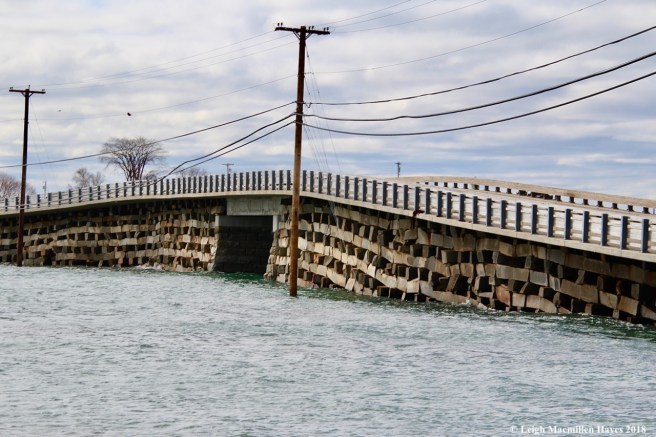
The world-famous cribstone bridge that connects Bailey Island and Orr’s Island in Harpswell, Maine. Though it may look rickety, it’s stood since 1927 and as far as we knew had only been repaired once–in 2010. The stacked granite blocks are held together only by gravity and allow the tide to flow freely. The bridge was placed on the the National Register of Historic Places in 1975. Would we make it across?

a2-Maine Fishermen monument

We did. And continued on to Land’s End, where our next clue awaited by the Maine Fishermen’s memorial. It was also a memorial to my mother, for the only other time we’d been to this place was either before we were married or shortly after and Mom was with us–enjoying most the Land’s End Gift Shop. Today–it was closed for the season. It was also a memorial to Dad for he would have told us to fill the innermost recesses of our lungs with salt air. And so we did.

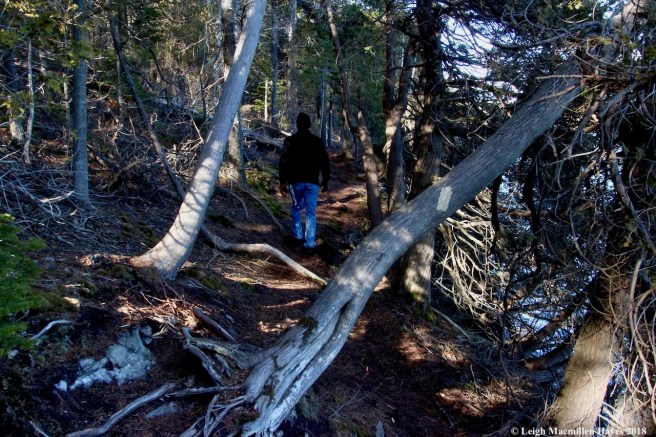
a3a-following the path

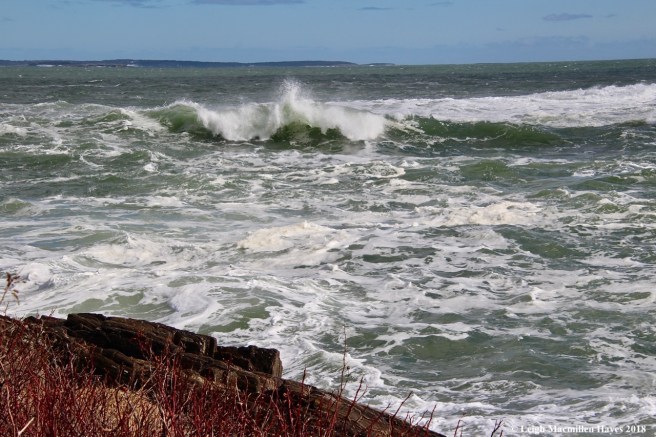
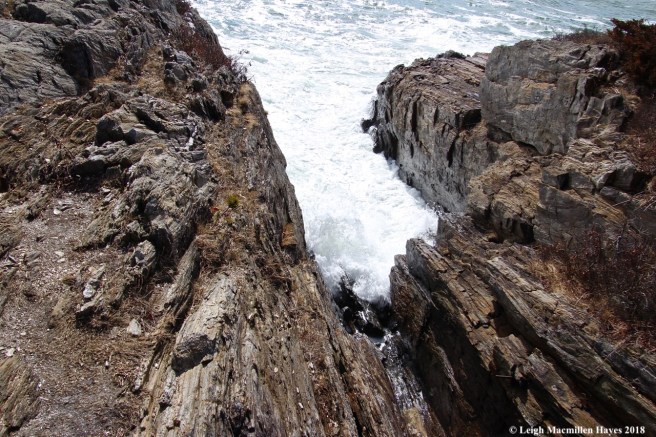
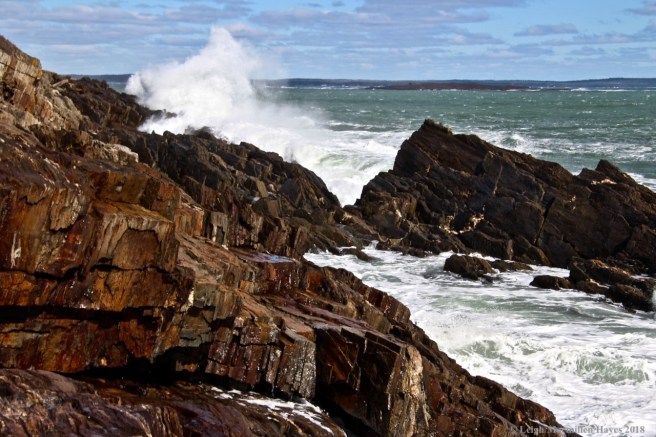
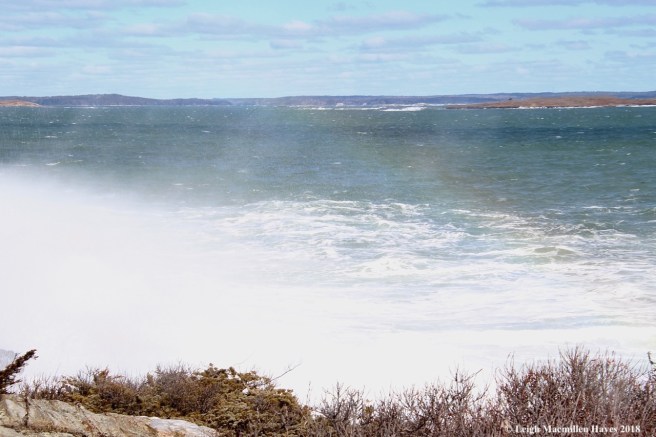
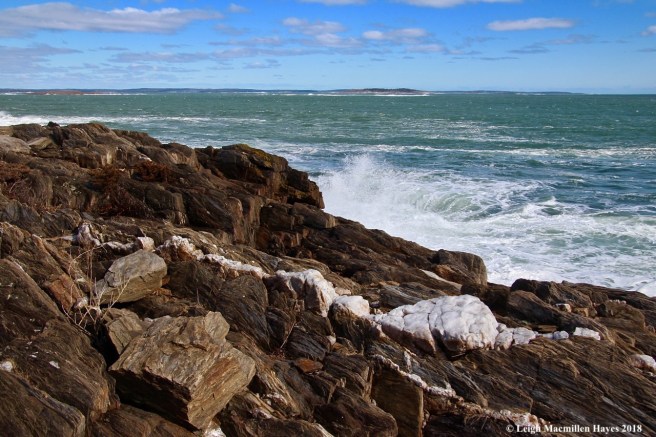
Out to the rugged coast of Maine we headed. Just a few days ago, a Nor’easter had made its presence known in these parts and still today the surf spoke to its force.

a3-surfs up 1

Our task–to be mesmerized.

a4-surf's up 2

And to record it in a variety of renditions.

a6-surf's up

And so we did both.

a7-surf's up

Numerous ohs and ahs escaped our lips.

a9-surf's up

And we hadn’t even ventured far.

a9-thunder hole

Finally, we arrived at Thunder Hole and though the wave action wasn’t all that spectacular, we did hear the thunder. Our job–to note which side sounded louder. We chose the left and received our next clue.

a13-on the edge

One of us had to get as close to the surf as possible. And so he did.

a14-surf's up

Together, we needed to appreciate the power.

a15-surf's up

And so we stood.

a16-surf's up

And watched.

a17-surf's up

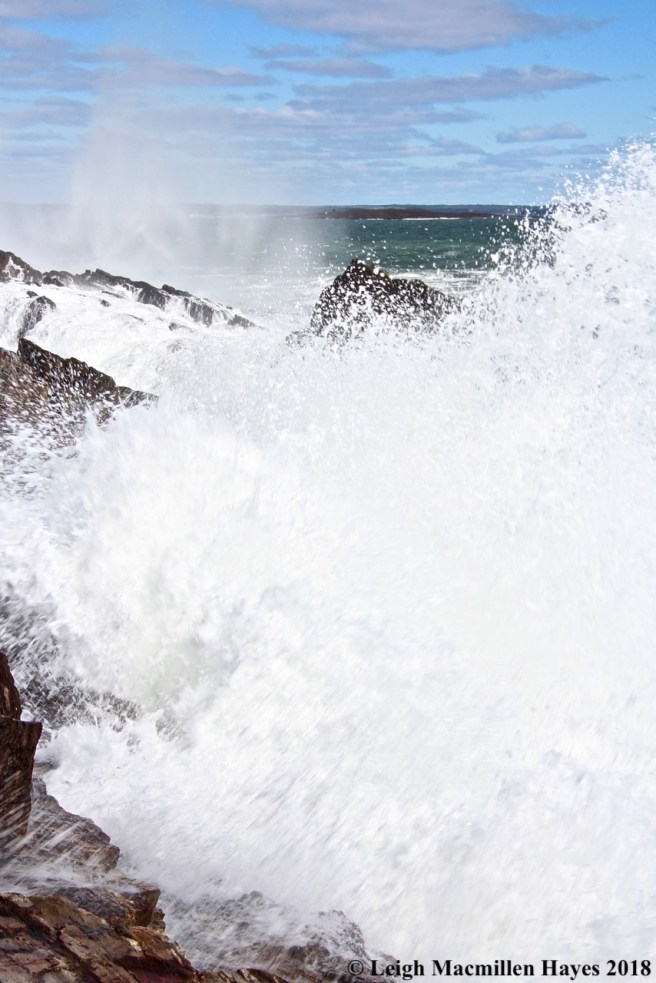
As water exploded.

a18-continuing on

And then we received our next clue–to move on to the next spot.

a20-Giant's Stairs 1

The Giant’s Stairs.

a21-giant's stairs

The blocky formation earned it the whimsical name of the Giant’s Staircase many years ago. We were reminded of the Giant’s Causeway in Ireland and prior to arriving wondered if it might look the same. It didn’t, but every giant leaves his own mark on the world. Fortunately, we didn’t need to climb down for today’s challenge–just to acknowledge it. Which we did with pleasure. It seemed only the waves were allowed to ascend and immediately descend–so quick was their exit.

a22-rainbow 1

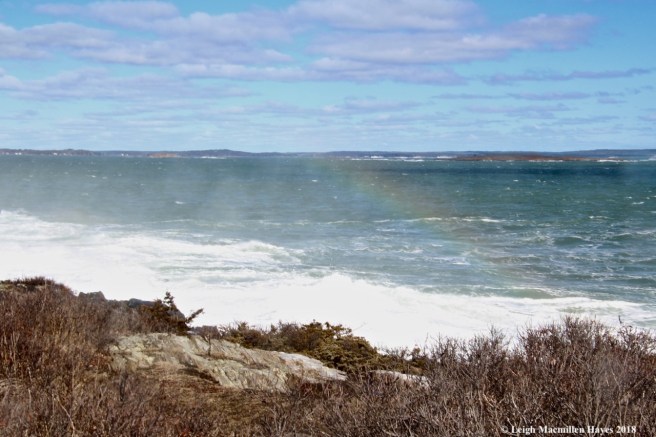
Having accomplished that leg of the race, we next needed to spy five rainbows. One.

a22-rainbow 2

Two.

a22-rainbow 3

Three.

a22-rainbow 4

Four.

a22-rainbow 5

Five.

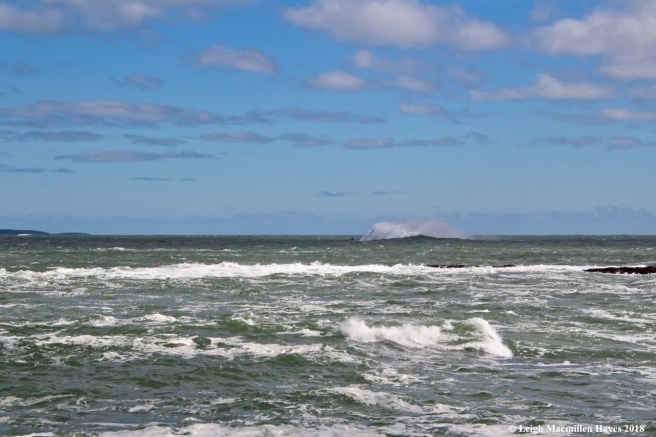
a25-ocean spray

Task done. And then my guy had to tell me when to take a shot for dramatic effect.

a26-wave explosion

He nailed it.

a28-devil's back

We were feeling good about our position when our next clue told us to eat locally so we grabbed sandwiches at “BIGS,” aka Bailey Island General Store and Eatery. And then we headed to our next destination located on Orr’s Island–Devil’s Back. The name was curious to us, but the trail system is located on either side of Route 24, which apparently is known locally as Devil’s Back. It does form an obvious spine between the two sides of the Harpswell Heritage Land Trust property.

a30-cedars

Winds had wreaked havoc mainly on the Gun Point Cove side where we walked all of the trails first.

a32-cedars

And then we slipped across the spine or Devil’s Back to the Long Cove side. Curiously, the land trust describes the forest here as being mixed, but mostly I noted evergreens including cedars like these, spruce, fir, and pine, with a few maples and paper birch in the mix. I suppose it’s all in the eye of the beholder.

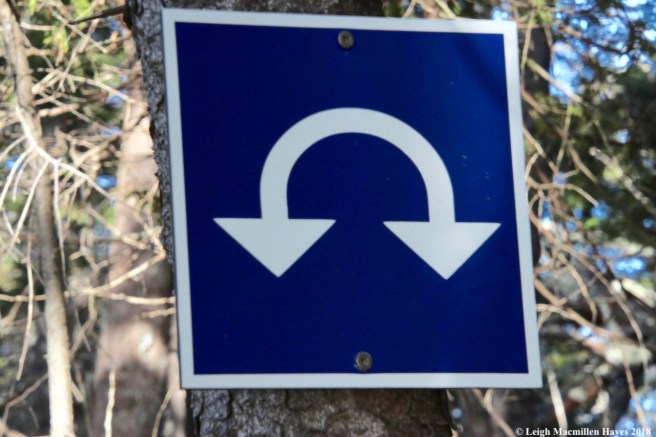
a33-U turn

As we were cruising along, we did get U-turned. It happens on the Amazing Race and was to be expected because we had been in the lead for so long.

a34-folds

And so we had to recall the folds of the rock along Casco Bay. By looking at the angle, our eyes began to see the metamorphic rock turned on its side due to intense pressure in its long-term history and understood that over time various pressures and results of heating and cooling events caused the variation in color and mineral size of the bands. We could also see the arc the folds created that had since eroded.

a34-polypody fern

An easy one for us (well, me anyway) was to identify the fern that grew on the rocks along the Long Cove side of Devil’s Back–Common Polypody it was.

a34-sausage-shaped boudins

And then there was the geologic formation–an igneous dike (lighter color) that cut across the metamorphic rock created we believed by the pinching and swelling from compression and shearing to the Northeast that formed sausage-shaped boudins.

a34-starburst lichen

And we had to name that lichen–sunburst with deep orange disks of its fruiting body or apothecia. Again, we were feeling kinda confident, but one never knows in a race such as this.

a34-stone wall

Our final U-turn challenge was to locate a stone wall–and we did. Island style is so much different from inland style.

a35-fairy home

We thought we were done, but discovered we still had a couple of more challenges to complete. The first was to locate two whimsical sites–in keeping with the Giant’s Stairs. And so we found a fairy house.

a35-octupus

And an octopus.

a38-Cundy's Harbor

Our last challenge before we headed to the mat–to locate two American flags blowing in the breeze at Cundy’s Harbor. Bingo. One.

a40-American Flag

And two.

a5-getting wet

At last we arrived at the mat and much to our surprise–got a wee bit sprayed! But that didn’t matter for we’d beat our imaginary contestants and once again finished first. Our prize from the Gnome and Travelocity–a leftover homemade pizza dinner. That meant we didn’t have to prepare a meal when we arrived home on this Mondate. Yippee.

The Amazing Race–Our Style: episode 2. Check back in with us in April to see what challenges we’ll face next.


Connecting the Dots

We thought we were so smart. A friend had drawn a map in the snow last week to show me the location of an alternate trailhead for Peary Mountain in Brownfield, Maine, and spoke of a round-trip hike that would include Frost Mountain. A quick look at a map in our worn and torn Delorme Gazeteer and we knew exactly where we were going–until we didn’t. We soon discovered that the gate and sign I’d been told about didn’t exist and the road turned 90˚ to the left and eventually became impassable and so we turned around and paused again at the sharp turn and wondered some more and drove back out to the main road and continued on to another road and looked for other possible trailheads that appeared on the road map and turned around again and returned to that sharp turn and parked the truck and slipped on our micro-spikes.

p1-Peary Mtn Road sign

It was worth a try we decided. The name was right though it looked less like a road and more like a snowmobile trail. No matter, we figured we’d give it a whirl and if nothing else, at least we’d enjoy exploring.

p2-wetland below mountains

Almost immediately, we spied two mountains above a wetland and wondered if those were the two summits we sought. We’d never looked at Peary from what we considered the back side before, since all of our previous experiences had been from Farnsworth Road off of Routes 5/113.

p3-trail

The road was quite icy and it had been more than a few days since any snowmobiles had passed by.

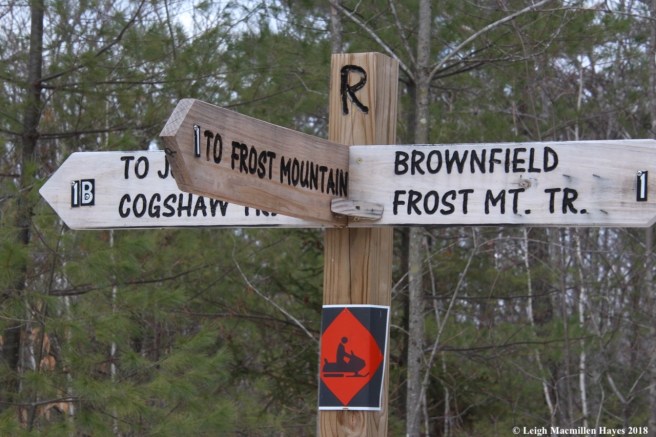
p5-trail sign

Eventually we came to a snowmobile sign, looked around for a map that I thought my friend had mentioned, and decided to begin with a journey up the Peary Mountain Trail.

p7-trailing arbutus and wintergreen

Conditions were such where previous logging had left the southwestern side open to the sun’s powerful rays and so in places the snow had melted and wildflowers such as trailing arbutus and winterberry basked in the warmth.

p8-Peary Mtn basement

We continued on up, hopeful that we were on the right path, when a familiar foundation confirmed our location. It’s directly across from this foundation that the Peary Mountain trail makes a 90˚ turn–in the past the turn had always been to the left, but yesterday’s turn was to the right. That is, after we noted that my guy should probably encourage the homeowners to purchase a sump pump, so full was their cellar.

p9-trail sign

If you do approach from Peary Mountain Road, you’ll only see a tad of the back of this sign. And if you come from Farnsworth Road, again, it’s not very obvious. But, for both, the turn is located at the height of land . . . and directly across from the foundation.

p10-Peary view 1

The hike to the bald summit isn’t difficult and offers the best of views on any day, but especially in the fall when the tapestry of color stretches forever–or at least to the White Mountains in the distance.

p11-Mount Washington

Yesterday, the view of Mount Washington was obscured by clouds, but we could see that even there the snow was receding.

p13-Mountain view

We stood for a bit, taking in the scene to the west.

p14-Mountain views

And to the north.

p15-across the ridge

And then we followed the ridge, certain that at the end we’d slip onto another trail we’ve never traveled before and begin to make the loop to Frost Mountain.

p16-Pleasant Mtn, Brownfield Bog

Just before slipping onto that other trail, we had one more view to partake–Brownfield Bog and the Saco River were backdropped by Pleasant Mountain.

Well, we followed that other trail for a while, but realized that rather than going toward Frost Mountain, we were moving further and further away from it. And so . . . we backtracked and rose once again to the summit of Peary and retraced our steps down.

p17-another foundation

We were disappointed, except that we knew we would return. And as often happens when following the same trail, we made new discoveries, including an L-shaped foundation.

p19-well

And then I spied a circular sunken formation subtly outlined with rocks and trusted it was a well.

p19-third foundation

Bingo. For behind it was another foundation, the largest we saw.

p20-day 2-red pines

And so late this morning we returned. But first, we looked for maps in our hiking books and online and found only those created by the local snowmobile club. We had a copy that dated to 2011 and decide to bring it along. We also copied a portion of the map from the Delorme Gazeteer–just in case.

Upon our return, we remembered to pause at the beginning of the trail and take note of the red pine cathedral. Brownfield is a town that knew the fury of the wildfires of October 1947. Most homes and public buildings were mere piles of ash the day after the fire. Many stately places including the summer home and laboratory of Dr. Philo Farnsworth, the inventor of television, had burned. Churches, schools, the post office, Grange, library and town hall all went up in smoke–only twenty houses survived. In the end, 85% of the town was destroyed.

Red pines were planted in reaction and today they stand tall in honor of that event of just over seventy years ago.

p21-water flowed

Our plan today was to follow the same route to the turn off for Frost Mountain. And so we did. This time the snow and ice were softer and mud a constant as snow melted and streams formed.

p21-ruffed grouse scat

One of the things we noted yesterday was a lack of mammal prints. But today made up for that and we found plenty of deer tracks in mud and snow. And then, a pile of bird scat–left behind by a ruffed grouse who had probably plowed into the snow when it was a couple of feet thick and spent the night, leaving behind its signature.

p22-kill site

We also found a kill site with no tracks leading to or fro and so we thought a bird had eaten another bird. The circle of life continued in the Maine woods.

p23-fisher prints

A bit further up the trail we spied weasel prints–left behind by a fisher, the meanest of mean. Notice the teardrop shaped toes and diagonal positioning.

p22-sweet fern

We were distracted (or at least I was) by sculptures a many, including those created by sweet-fern.

p24-another foundation

My guy was also distracted and spied an opening in the woods.

p25-fourth foundation

It was another L-shaped cellar. And nearby were what would have been some outbuildings and possibly even a mill. Along most of today’s trail we encountered one stone wall after another, some single and others double.

I don’t know how to decipher stone that’s known fire, but hope one of these days to be able to make that interpretation. In the meantime we wondered–why had these homes been abandoned. Did they burn? I did later note that homesteads in the area belonged to the Johnsons, Grays and other families in the 1880s.

p28-confusing signs

Though we continued on, we really had no idea where we were going and hoped that we had made the right decision with the intention of reaching the summit of Frost Mountain. But, even if we didn’t, we were delighted with our finds. And confused by the signs.

p29-Pleasant Mtn behind us

And then, we started to climb. I turned around as we moved upward and noted our beloved Pleasant Mountain behind us.

p29-summit at lasst

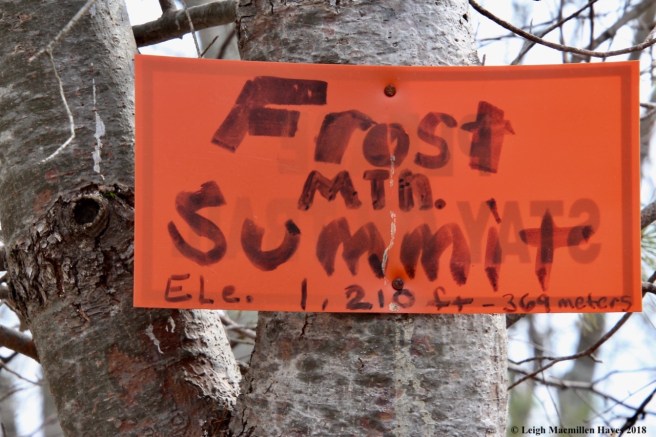
And finally–success. We’d reached the summit of Frost Mountain.

p30-looking toward Peary

About 300 feet below, we had a view from the ledge, but it wasn’t nearly as spectacular as that on Peary Mountain, which my guy looked toward. It was hardly visible from where we stood.

p32-Burnt Meadow Mountain

From the summit, we followed a loop around, pausing to take in the view of Burnt Meadow Mountain.

p33-Brownfield below

And the town of Brownfield below. As the historical society likes to proclaim, “Brownfield’s still here.” Indeed.

p34--my heart bleeds blue pine sap for you

We’d planned to climb Frost and then make our way to Peary, but changed our minds. We’d already climbed Peary yesterday and after finding our way today had a better understanding of the trail system. We also knew that had we made the loop, we’d have walked on Farnsworth Road for over a half mile and then climbed up and down Peary on trails we already knew. Instead, we let our hearts bleed pine blue sap with happiness.

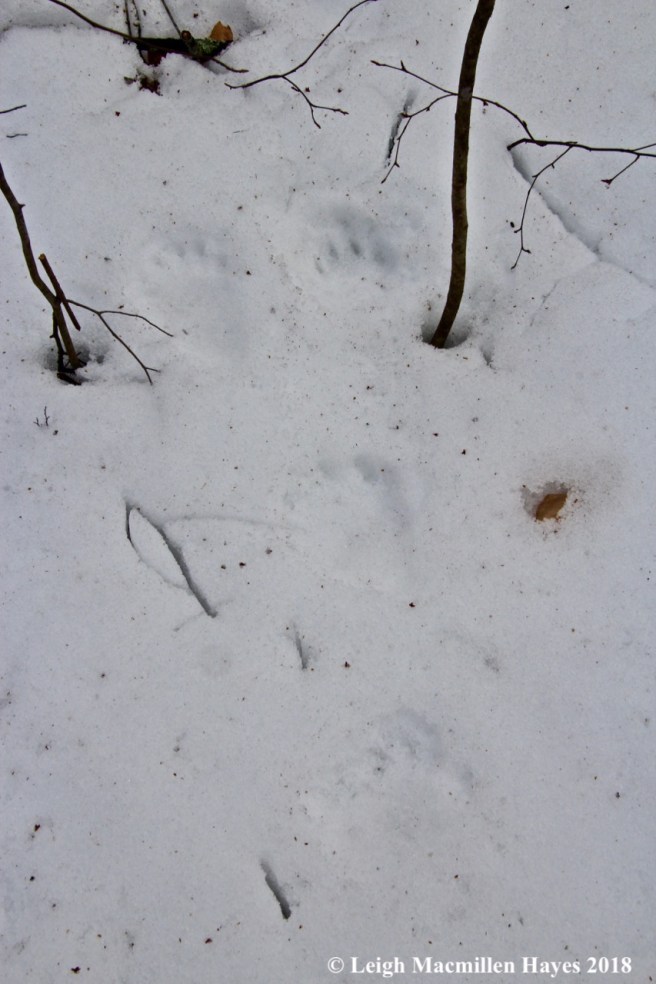
p27-bear prints

Our happiness overflowed when we spied the final set of prints.

p26-bear prints

A black bear. How cool is that? Our second sighting of black bear prints this winter.

We’d connected the dots–even if not literally–and gained a better understanding of the neighborhood and all who live(d) there.

Books of the Month: Stone Walls–Stories Set in Stone

It’s March, that most indecisive of months. And so, I decided to follow in the same pattern by choosing not one,

s11

or two,

s9

or even three,

s10

but four–

s8

all books about stone walls which are once again revealing their idiosyncrasies. These are the Books of March.

p-on-the-cowpath

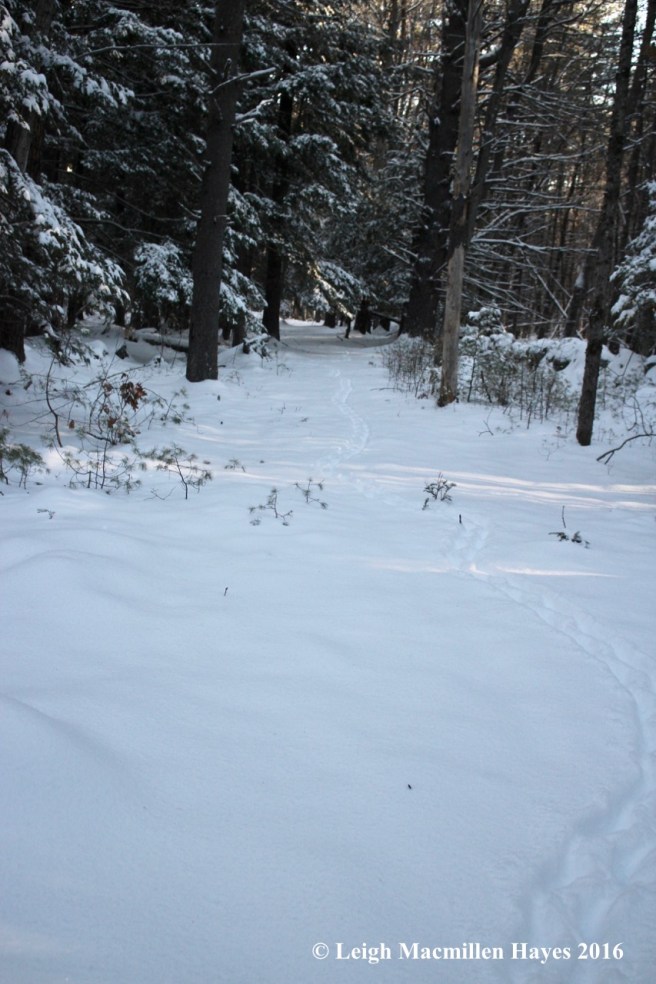
Walk along our woodland trail with me and you’ll know that something different happened there ages and ages ago. To reach the trail, we’ll need to pass through two stone walls. Continuing on, we’ll come to a cow path where several pasture pines, massive trees that once stood alone in the sun and spread out rather than growing straight up, must have provided shade for the animals.

e-pine whorls

They are the grandparents of all the pines that now fill this part of the forest.

Further out, one single wall widens into a double wall, indicating a different use of the land.

s4

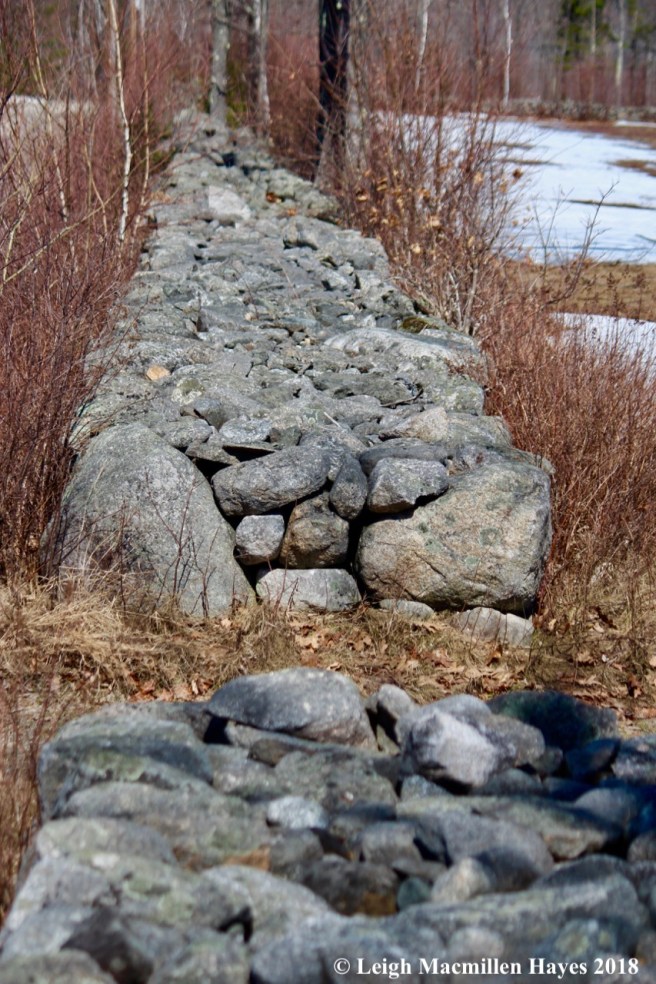
The walls stand stalwart, though some sections are more ragged than others. Fallen trees, roots, frost, weather, critters and probably humans have added to their demise, yet they are still beautiful, with mosses and lichens offering striking contrasts to the granite. Specks of shiny mica, feldspar and quartz add to the display. And in winter, snowy outlines soften their appearance.

The fact that they are still here is a sign of their endurance . . . and their perseverance. And the perseverance of those who built them. and yet . . . . the stone walls aren’t what they once were, but that doesn’t matter to those of us who admire them.

s2

For me, these icons of the past conjure up images of colonial settlers trying to carve out a slice of land, build a house and maybe a barn, clean an acre or two for the garden and livestock and build walls. The reality is that in the early 1700s, when western Maine was being settled, stones were not a major issue. The land was forested and they used the plentiful timber to build. It wasn’t until a generation or two later, when so much timber had been harvested to create fields for tillage and pasture, that the landscape changed drastically, exposing the ground to the freezing forces of nature. Plowing also helped bring stones to the surface. The later generation of farmers soon had their number one crop to deal with–stone potatoes as they called them. These needed to be removed or they’d bend and break the blade of the oxen-drawn plowing rake.

s1

Stone removal became a family affair for many. Like a spelling or quilting bee, sometimes stone bees were held to remove the stones from the ground. Working radially, piles were made as an area was cleared. Stone boats pulled by oxen transported the  piles of stones to their final resting place where they were woven into a wall.

Eventually single walls, also called farmer or pasture walls, were built as boundaries, but mainly to keep animals from destroying crops. The advent of stone walls and fences occurred within a few years of homesteads being settled, but during the sheep frenzy of the early 1800s many more were built. Those walls were supposed to be 4.5 feet high and fence viewers were appointed by each town to make sure that farmers tended their walls.

s3

Double walls were lower and usually indicated an area that was to be tilled. A typical double wall was about 4-10 feet wide and consisted of at least two single walls with smaller rubble thrown between.

Drive our back roads and you’ll see many primitive walls created when stone was moved from the roadway and tossed into a pile, or wander through the woods and discover stone walls and fountains in unexpected places. The sheep craze ended about 1840 after the sheep had depleted the pastures and younger farmers heeded the call to “Go west young man, go west.” The Erie Canal, mill jobs, and better farming beyond New England all added to the abandonment of local farms.

s5

Today we’re left with these monuments of the past that represent years of hard labor. Building a wall was a chore. Those who rebuild walls now find it to be a craft.

Sam Black, who lives in Bridgton, Maine and spent twelve years rebuilding the walls on his property, once told me, “It was meditation time, like working in the garden. It’s one of those things you do philosophically and it lets you operate at a deeper level. You have time to think and contemplate as you work on the jigsaw puzzle.”

Frank Eastman of Chatham, New Hampshire, is the caretaker for the Stone House property in Evans Notch, and said when I asked if he’d ever worked on single walls, “No, I ain’t that good at balancing things. You got to have a pretty good ability to make things balance and a lot of the times your rock will titter until you put a small rock in just to hold it. No, I don’t want to monkey around with a single wall.”

Karl Gifford of Baldwin, Maine, told me, “I’m either looking for the perfect stone or trying to create the perfect space for the stone I’m working with. It takes a lot of practice, seeing what I need and being able to pick it out of the pile.” The entire time we chatted, his hands moved imaginary stones.

The more walls I encounter in the woods, the more respect I have for those who moved the stones and those who built the fences that became the foundation of life. Walk in the woods and you’ll inevitably find evidence that someone has been there before you–maybe not in a great many years, but certainly they’ve been there. Their story is set in stone.

If you care to learn more about stone walls, I highly encourage you to locate these books. I found all of them at my local independent book store: Bridgton Books.

Books of March:

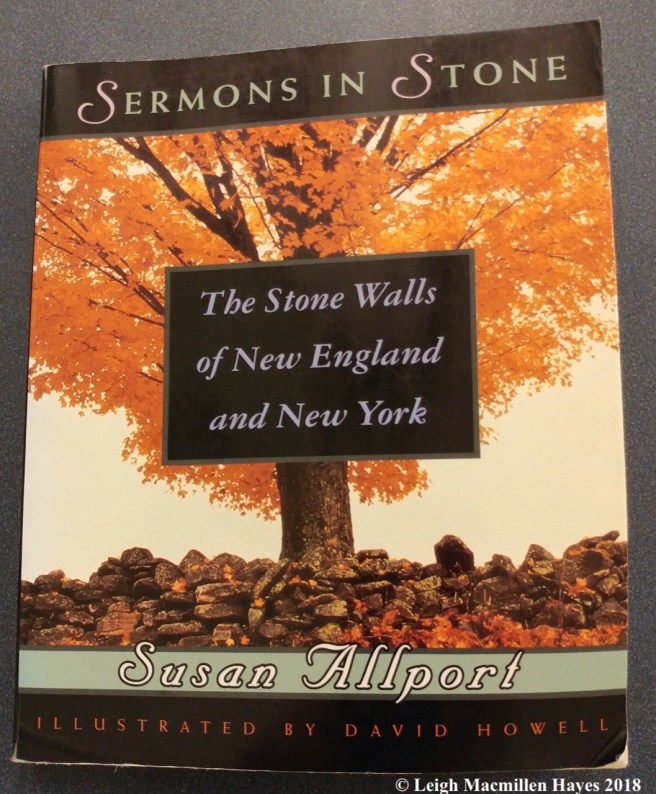
Sermons in Stone by Susan Alport, published 1990, W.W. Norton & Company, Inc.
A history of stone walls in New England.

Stone by Stone by Robert M. Thorson, 2002, Walker & Company.
A geological look at stone walls

Exploring Stone Walls by Robert M. Thorson, 2005, Walker & Company.
A field guide to determining a walls history, age, and purpose.

The Granite Kiss by Kevin Gardner, 2001, The Countryman Press.
A look at repairing walls of stone.

And now I leave you with this poem:

The Old Stone Fence of Maine

Shall I pay a tribute here at home,
To the Old Stone Fence of Maine?
It was here when you were born,
And here it will remain.
Stone monuments, to grand old sires,
Who, with a good right arm,
Solved problems little known to you,
E’re their “clearing,” was your farm.

When you see an Old Stone Fence,
Weed grown and black with age,
Let your mind’s eye travel backward
And read its written page.
And, as Moses left us words in stone,
That live with us today,
Almost, with reverence, let us read
What these Stone Fences say.

They tell of those who “blazed the trail,”
We are walking in today;
Those who truly “bore the burdens
In the heat of the day.”
For every stone was laid by hand,
First taken from the soil
Where giant trees were cut and felled,
Bare handed–honest toil.

The Stone Fence marked the boundary line
Whereby a home was known;
Gave them dignity, as masters
Of that spot they called their own.
The Stone Fence, guarded church and school
And the spots more sacred far,
The silent spots, in memory kept
For those who’ve “crossed the bar.”

Then, treasure this inheritance,
Handed down from sire to son,
Not for its worth, to you, today,
But for when, and why, begun.
For with it comes a heritage
Of manly brawn and brain,
That is yours today, from the builders
Of the Old Stone Fence of Maine.

~Isabel McArthur, 1920

Bogging with Barb

Passing off a copy of the book, From Grassroots to Groundwater, about how two small Maine towns fought Nestlé and won, was the perfect excuse to head to Brownfield Bog. I told Barb I didn’t mind driving to her home or somewhere nearby to give her the book because I’d then go exploring and she welcomed the opportunity to do the same.

b2-Kathy's sign

As we began our journey, I asked if she knew Kathy McGreavy. Of course she did. I mentioned that Kathy walks in the bog daily and we might encounter her. Of course we did. Kathy and “her friend” were just coming out after walking their dogs and so we chatted for  bit. Our discussion included mention of the sign Kathy made last year as her capstone project for the Maine Master Naturalist Program. It’s an incredible piece of artwork and as she’s learned, I’m not the only one who thinks so. Recently, she discovered that a woodpecker had taken to pecking it and so the bottom is now protected with a piece of plexiglass. Crazy birds.

b1-Bog view from the road

Eventually, Barb and I said our goodbyes to the McGreavys and walked down the unplowed road where I did warn her about my obsession for stopping frequently to take photos. It began from the start–when we spied the bog through the trees and noticed the contrast of colors and layers.

b3a-pussy willows

And then–specks of white were ours to behold.

b3-pussy willows

Pussy willows. Was it too early she wondered. No–in fact, I spotted some a year ago on February 23 at Lakes Environmental Association’s Holt Pond Preserve.

b4-red-winged blackbirds

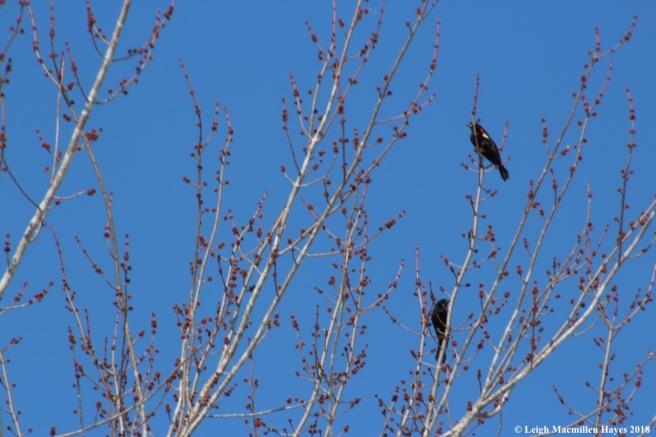
Our next reason to stop–the red and yellow shoulder patch or epaulet providing their name: Red-Winged Blackbirds. Again, Barb asked if it was too early. This time, I referenced Mary Holland for the February 27th entry in her book Naturally Curious Day by Day has this headline: Returning Red-Winged Blackbirds Survive Cold Temperatures and Few Insects. Bingo.

b5-water obstacles

Sometimes our stops were to contemplate our next steps–especially when it came to the water that covered the cobble stones on the road.

b6-Barb charges through the water

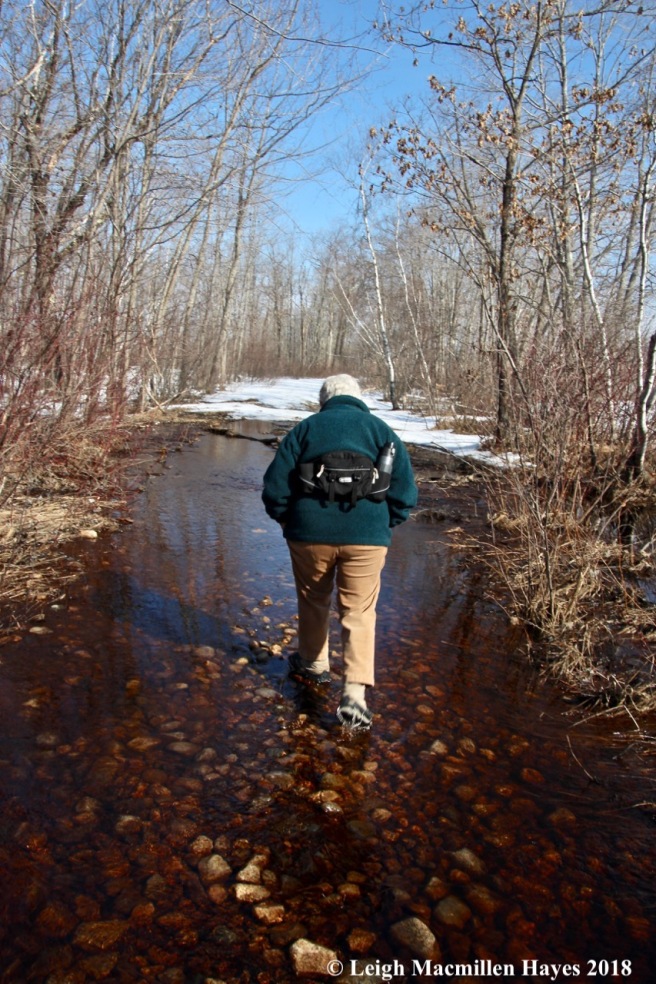
But sometimes you just have to go for it. And we did. As the morning continued, we ventured through deeper water and plowed ahead knowing that we would need to dry our hiking boots out when we arrived home.

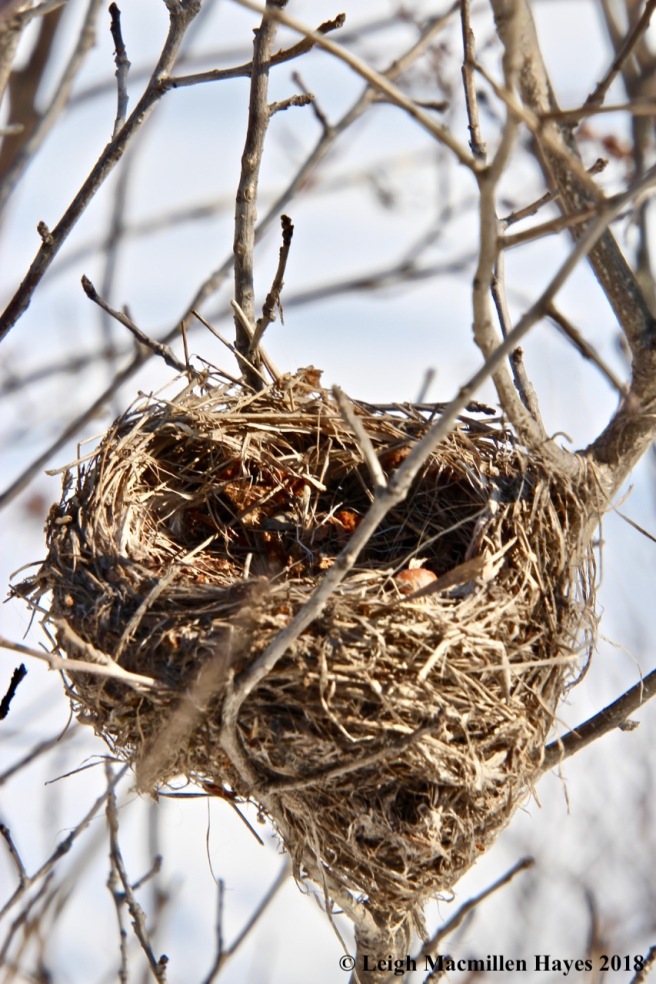
b7-bird's nest

We found a bird nest and wondered about its creator. We did note some acorn pieces inside, so we think it had more than an avian inhabitant.

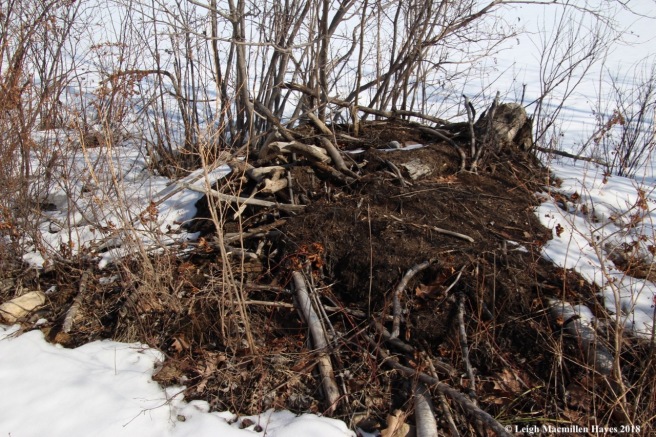
b8-beaver lodge

And we paused to look at an old beaver lodge. The mud looked recent but none of the sticks were this year’s additions so we didn’t know if anyone was home.

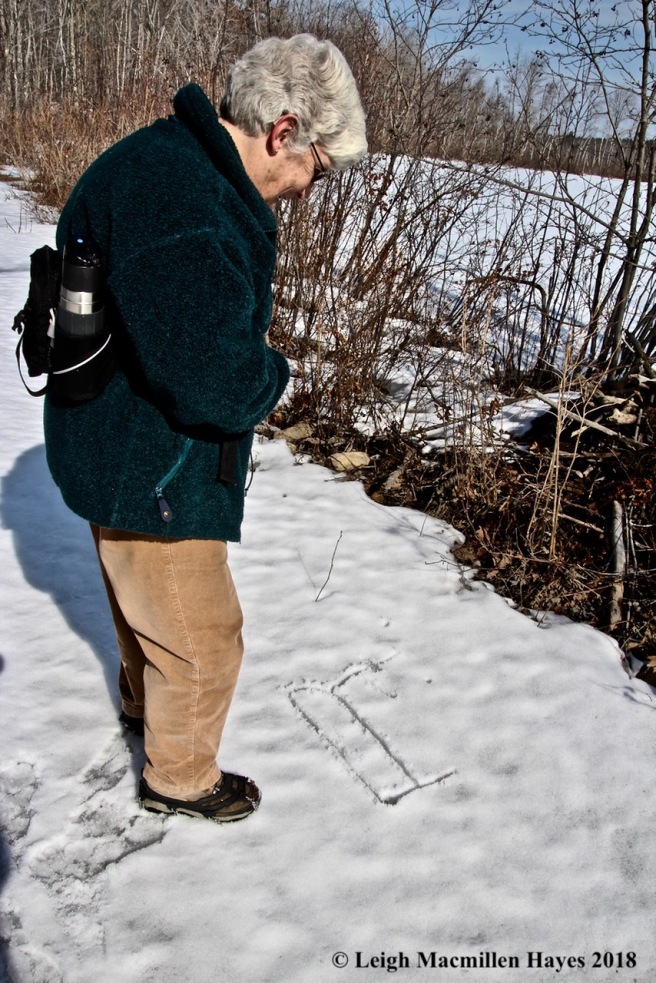
b9-map in the snow

All along, we’d been talking about places we’ve hiked and other topics of interest to both of us. We even learned that we’d both worked in Franklin, New Hampshire, just not at the same time. But speaking of hikes, with her finger, Barb drew a map in the snow and now I have another trail to check out soon with my guy. Should I forget the way, I’ll just reference this map. ;-)

b10-raccoon prints

Because we were near water, though most of it still frozen, and the temp was high (actually, too high–in fact, it felt HOT as it soared into the upper 60˚s today), we weren’t surprised to find this set of prints created recently by a raccoon. I love the hand-like appearance and opposite diagonal of each two feet. Can’t you just see him waddling through–in your mind’s eye, that is?

b11-the bog

Our turn-around point offered an expansive view of the bog. As much as we may have wanted to head out onto it, we sided with caution and kept to the edge of the shore.

b12-winterberry

On the way back, there were other things to admire as there always is even when you follow the same route: winterberries drying up;

b13-rhodora

rhodora’s woody seed pods and flower buds swelling;

b14-willow gall

and the pinecone-like structure created with leaves by a reaction to a chemical released by the larva that allows a gall gnat midge to overwinter on the willows.

b16-carrion-flower tendrils

And then we stumbled upon a plant neither of us knew. With it’s long stem and curly tendrils, we were sure it was a vine.

b15-carrion-flower

Upon arriving home, however, I wondered about the umbel structure that had been its flower and now still held some fruits. A little bit of research and I found it: Carrion Flower (Smilax herbacea), which apparently smells rather foul when it’s in bloom and thus attracts carrion flies as its pollinator. Now I can’t wait to return and check it out in the next two seasons. Any excuse to get back there.

b17-bog to Pleasant Mountain

At last the time had come to say goodbye to the bog and then goodbye to each other. Thanks Barb, for giving me an excuse to go bogging with you. It was indeed a treat.

Otter Spotter Mondate

Fresh snow. Blue-bird sky. Mid-range temperature. Day off. All the makings for a fine Monday date with my guy.

m1-apples

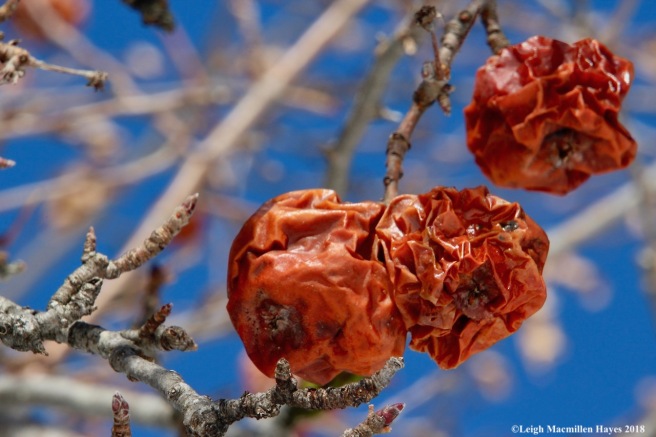
We weren’t sure if snowshoes would be the right choice as we feared the snow might stick to the cleats and make us feel like we were walking on high heels–hardly our style. But, actually, conditions were perfect. Of course, my guy tried going without at first, but after creating one post hole after another, he strapped his on while I headed over to an apple tree to enjoy the view.

We were on a private property in Lovell that is under conservation easement with the Greater Lovell Land Trust.

m2-coyote track

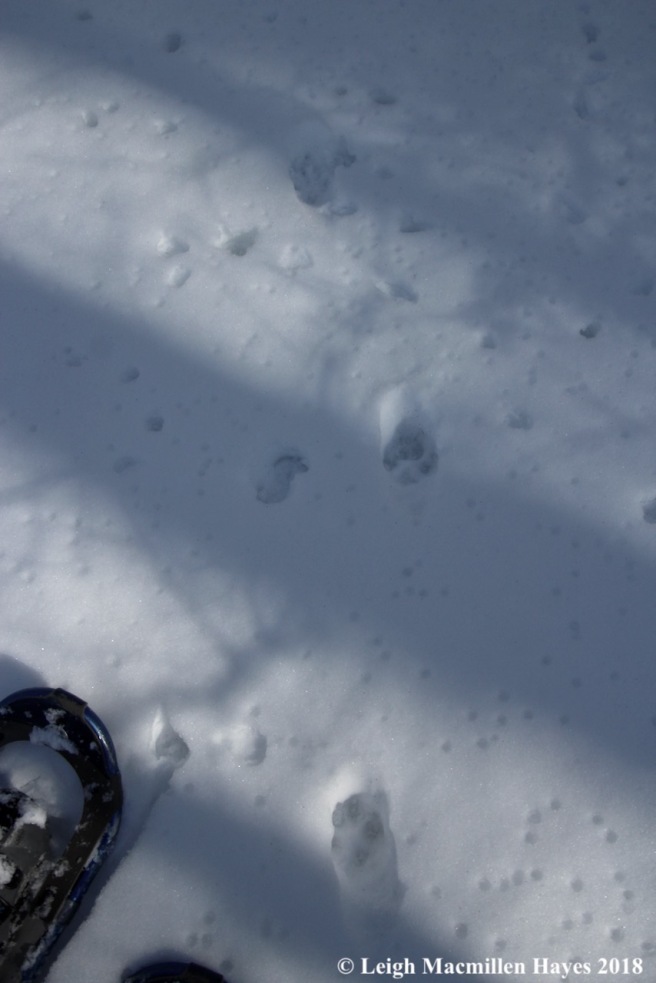
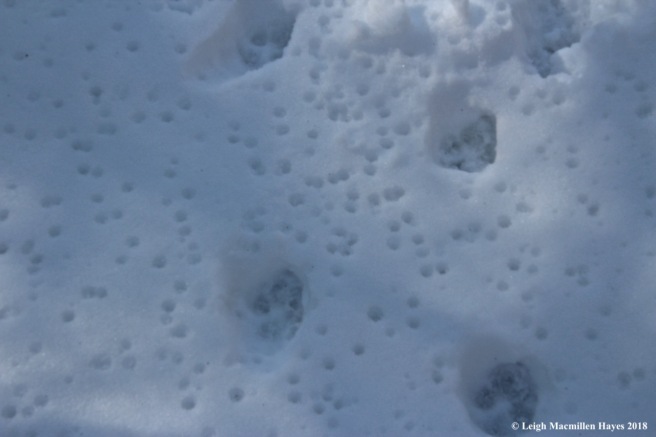
I’d been on this property only a few days ago and the tracks were many, but with the advent of yesterday’s snow, we found only a few. One set was that of a coyote. And fairly fresh was it.

m4-brook below

We moved quickly (of course we did for I was with my guy–but I was equally anxious to get to two destinations) and in no time found ourselves walking along beside a brook.

m5-brook crossing

As we approached we wondered how open the brook might be and decided we’d cross that “bridge” when we got to it. But really, there was no bridge.

m3-icicles at brook crossing

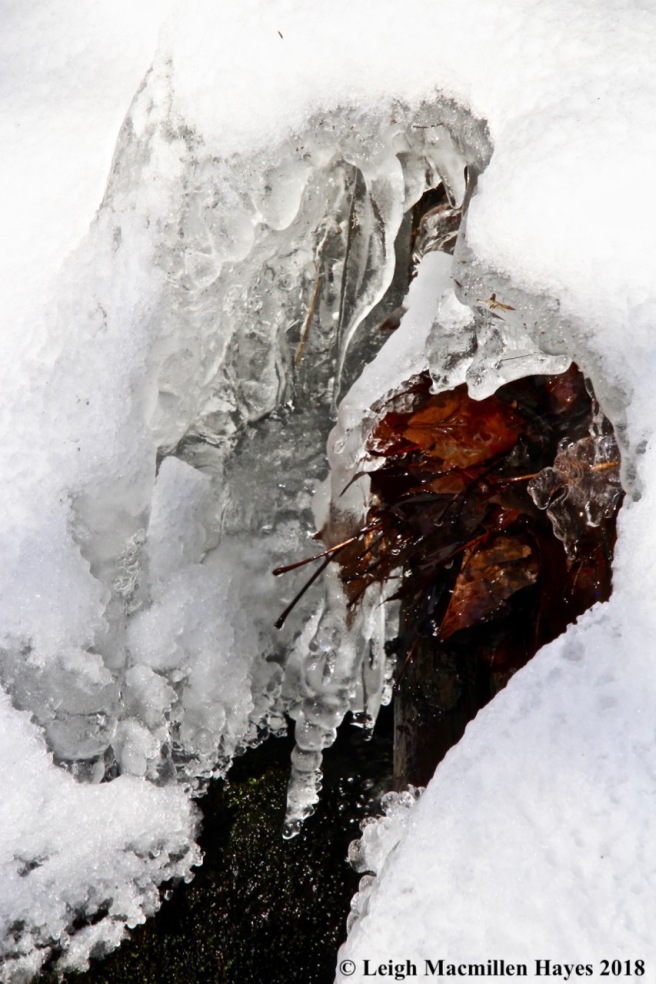
The ice, however, delighted our sense of sight, understanding, and artistic form. Like the water from which it was created, it flowed in much variety.

m6-one coyote became 2

Without any problems, we found our way to the other side and realized we were in the company of others who had done the same. One moment it seemed we’d followed one, but then realized we were on the trail of two coyotes when their path split.

m8-porky body

And it split for a reason. To check out a previous kill site. But they only seemed to sniff and not partake.

m9-porky tail

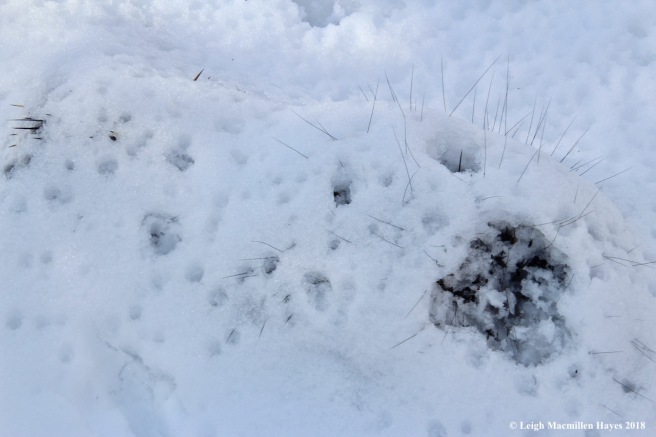
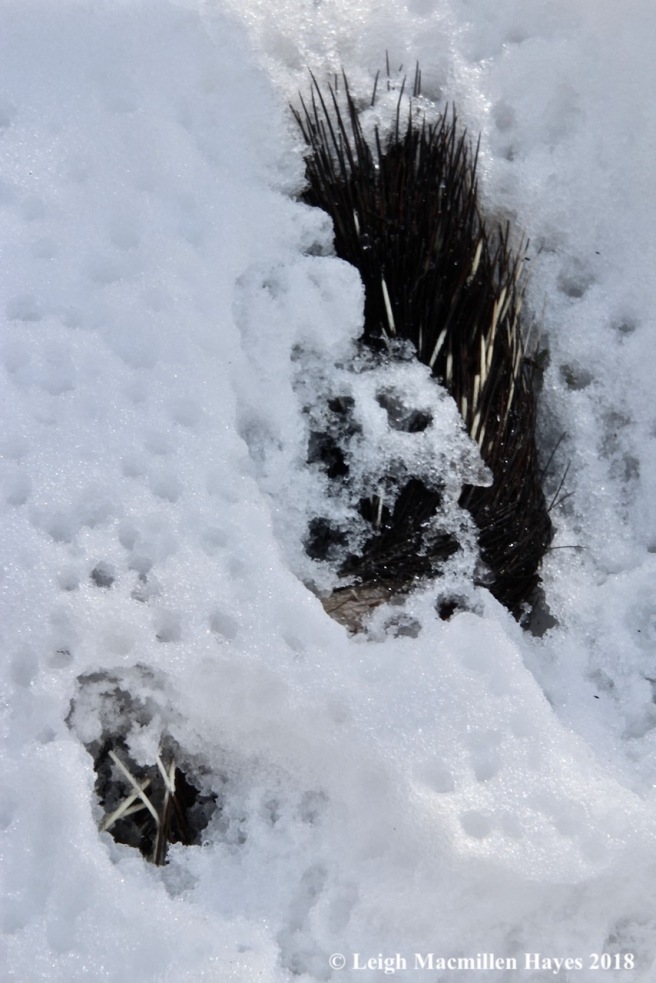
Just as well for it was a porcupine. But really, I was surprised they didn’t try to flip it over to get at the stomach. Maybe somebody else had already taken the pleasure.

m10-rookery and coyote track

On we trekked, until we reached water again. And this time we stopped to look around, while the coyotes moved on.

m11-heron nests

High in the trees across the way we spied the heron rookery–one of our reasons for visiting. We knew the nests would be empty, but still, it’s fun to take note.

m13-heron rookery

And they’re easier to see in the winter than spring/summer when this rookery is monitored for the state HERON project: the Heron Observation Network of Maine. I’ve had the honor of visiting this particular rookery in the past and helping to document the number of residents. Though it was active last April, something happened later to upset the neighborhood and so I’ll be curious to see what the status will be in the future.

m14-heron rookery

For today, the nests looked like they were in great shape and even two in the condominium were awaiting the return of the snowbirds who’d spent the winter south of this location.

m16-lungwort

Because we were there, I also turned to check on another tree–which sports a healthy colony of lungwort–photosynthesizing because it had been snowed upon.

m15-mesmerizing scene

We stayed for a while, my guy and I, enjoying the peace and quiet and colors and textures of the afternoon that curled around us.

m18-crossing over

At last, we pulled ourselves away and crossed back over the brook. It was a piece of cake. Well, at least we didn’t fall in.

m19-chipmunk

Our next destination took us past a condo of another sort–one created by a chipmunk who kept an eye on us, then swiftly disappeared. We could only wonder about the inner chambers of its home.

m17-striped maple beaver works

It was after that that we began to encounter the works of another rodent, this time upon striped maple.

m20-beaver works

The art pieces were sometimes large,

m21-beaver works small

other times small,

m23-beaver works mistake

and sometimes mistaken–as in logistics of the felling.

m22--false lodge

But that didn’t matter for their buildings were many. Oops, the first one we spied was actually a boulder.

m24-beaver lodge 1

Further along, however, we found the main building. It was topped with fresh wood and well mudded, so we assumed warm bodies dined and wined within.

m25-beaver lodge 2

There was another nearby, and we could see indentations denoting visitors had stopped by prior to yesterday’s storm. We also noted that the ice had melted all around it. Was someone home? We knew not.

m26-looking back from the dam

On we moved and then turned back to enjoy the view as shadows grew long.

m27-beaver dam

Turning 180˚ again,  we looked toward the beaver dam that stretched before us. I’d last visited in late November and wondered what it would look like today.

m28-below the beaver dam

It looked . . . snow covered.

m30-otter track

But . . . in that snow we spied our critter. Do you see him?

m32-otter moving from brook to land

We followed him downstream–he was on the other side of the brook, but moved in his telltale manner . . .

m33-following the brook

across the landscape . . .

m35-otter again

in and out of the water . . .

m43-otter slide and bound

bounding and sliding . . .

m42-otter slide

and sliding some more . . .

m40-prints, trough, scat

leaving behind fresh scat and prints . . .

m44-ice and tree and water and reflection

for our pleasure. We had the time of our lives watching the otter–did you see him?

Truth be told, we never did actually see him, but in our minds eyes we knew his every motion. When we first spied the prints and trough on the other side, we thought he had moved in the same direction as we did. But when he crossed to our side, and we could get an upclose look, we realized we were traveling in opposite directions. He had moved through not long before we arrived. Was he also checking out the beaver lodges? Probably. And hunting for his next meal.

Though we didn’t get to actually see this member of the weasel family, the signs left behind were enough to tickle our fancy and on this Mondate we were indeed otter spotters.

Brain Share–Naturally

I was thankful I’d thrown my winter coat into the truck for I had a feeling it would be a better choice than a vest given the group I’d be traveling with this morning. And sure enough, though the sun felt warm, a breeze added a chill to the air. Plus, I knew we wouldn’t travel far and would spend much of our time standing around.

r0-life on a rock

Well, not exactly standing, for as Maine Master Naturalists, we’ve been trained to get down for a closer look. Our first stop–to check out the life on a rock that was revealing itself as the snow slowly melted. Karen is on the left, an Augusta grad, and Sarah and Anthony to her right, both South Paris grads.

r0a-polypody

The focus of our attention was common polypody, a fern with leathery leaves and spherical spore clusters on the underside. Rocks are their substrate and they often give a boulder a bad-hair day look.

r1b-speckled alder

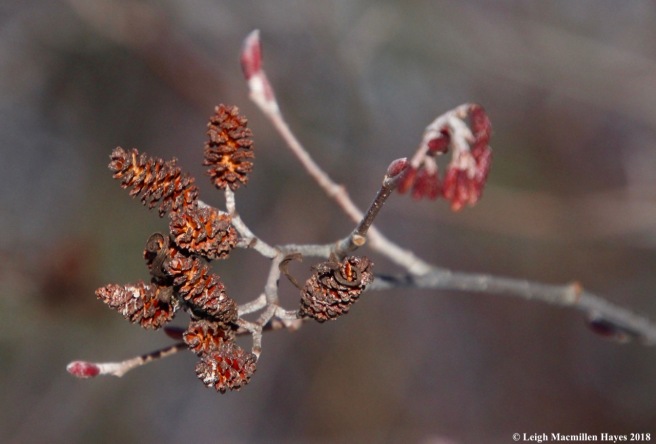
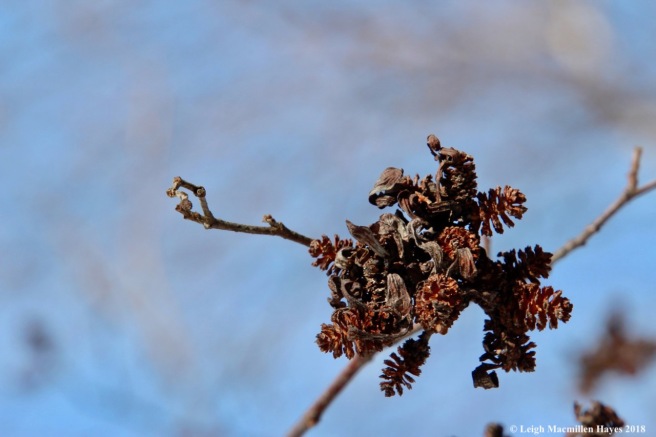
Moseying along, we reached a point where we knew we wanted to spend some time–at a wetland beside one of the Range Ponds (pronounced Rang) at Range Pond State Park in Poland, Maine. Because it likes wet feet, we weren’t surprised to find speckled alder growing there, but what did throw us for a loop was the protrusions extending from last year’s cones.

r1a-speckled alder

It was almost like they had tried to flower atop the cones and all we could think of was an insect creating a gall. Indeed, it appeared that the cones were also experiencing a bad hair day. After a little research, it may be alder tongue gall–resulting from a fungus rather than an insect infecting the female catkins. Apparently, the tongue-like growths are green to begin, but transform to orange, red and finally brown. It was certainly a new one for the four of us.

r2a-leatherleaf and sphagnum moss

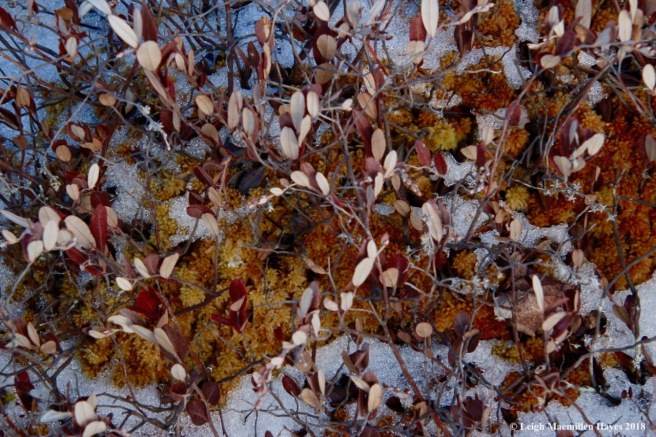
On we moved down to the wetland where the snow surprisingly held us for most of the journey and we didn’t leave behind too many post holes. Leatherleaf and sphagnum moss showed off their winter hues at our feet.

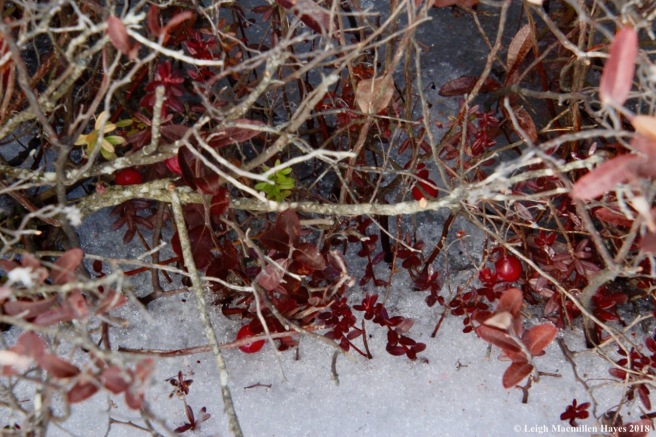
r4-cranberries

We also spied cranberries hiding underneath.

r3-cranberries among the leatherleaf

And sampled them. A few were tart, while others had fermented.

r1-two lodges

In the middle of the wetland, two well built lodges stood tall. They had fresh wood and had been mudded in the fall. One did look as if the vent hole had been enlarged, so we wondered if anyone still lived there. We heard no noises, but had to assume that we were bothering the residents so we didn’t stay long.

r2-wetland and pond beyond

One last view of the wetland and pond beyond, then we turned and walked toward the opposite side.

r5-bird nest

Just before climbing uphill, we spotted a bird nest in the winterberry shrubs. It was filled with dried berries, and we again made an assumption, that a mouse had cached its stash for the winter and maybe dined there in peace and quiet while the nest was covered in snow. That’s our story and we’re sticking with it. Whose nest it was prior to the mouse? We don’t know, but it was made of twigs. If you have an answer, please enlighten us.

r6-bone

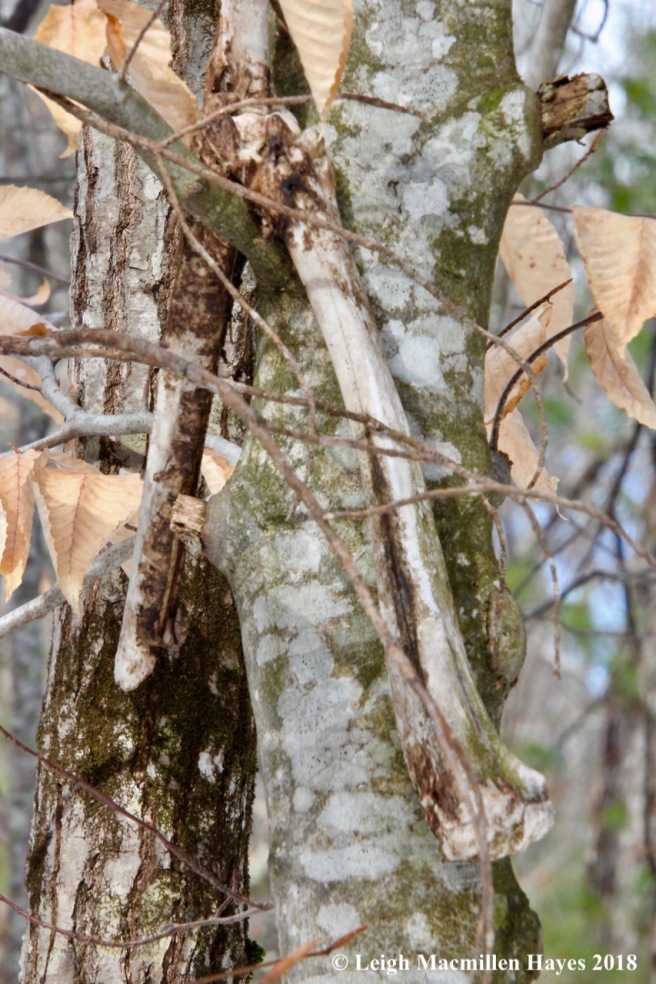
Back up on an old railroad bed, we again stopped frequently, including to talk about the beech scale insect and nectria fungus that moves in and eventually kills the trees. And then something else came to our attention–it wasn’t a broken branch hanging down like an upside-down V on the beech tree. No indeed. It was a bone. A knee bone. And it had been there for quite a while given its appearance.

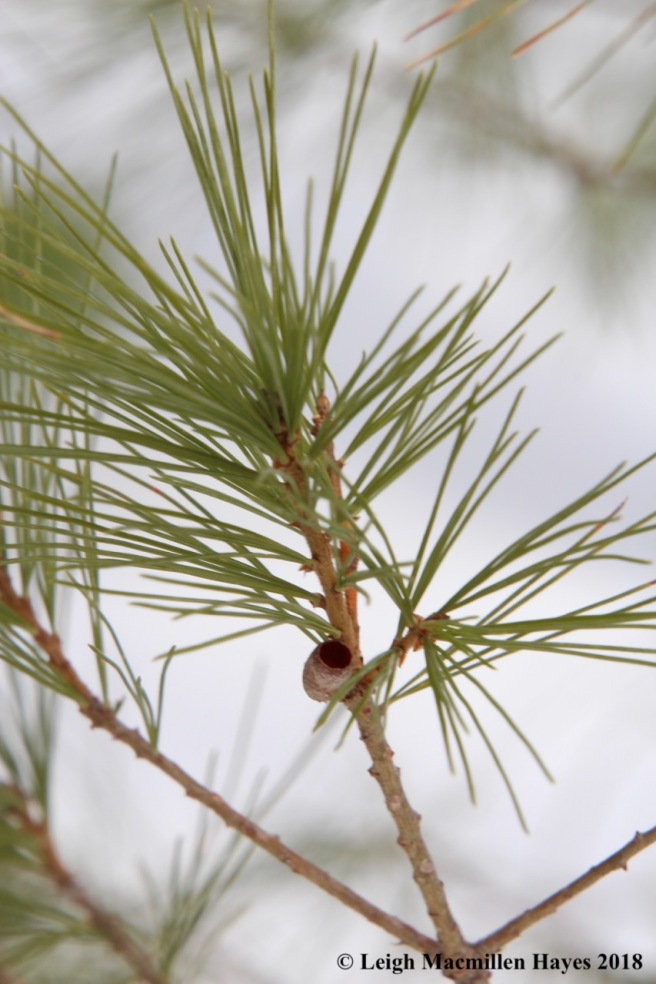
r7-Introduced Pine Sawfly pupal case

Because Anthony was with us and he’s our insect whiz, we spent a lot of time learning from him–including about the pupal case of an introduced pine sawfly. The sawfly had already pupated and in this case no one was home.

r8-Introduced sawfly pupal case

As the morning went on, we became quite adept at locating more cases of other sawfly species, including one that wasn’t yet opened. We each channeled our ten-year-old selves as we tried to be first to find the next one. But really, Anthony won for he had insect case eyes.

r9-going in for a closer look

And eyes for other things as well.

r10-old spider web case

This time we examined a delicate, almost lacy structure under a branch on a young beech. Anthony suspected a pirate spider, which tickled our fancy for we imagined them raiding the goods of others. But later he e-mailed with another option: “The old spider egg case could also be from an orbweaver of the araneidae family.” Either way, we were happy for the sighting; for taking the time to slow down and notice.

r11-beech leaves

And there was more. Sarah had to leave us a wee bit early, so she missed our finds on the backside of beech leaves.

r12-maroon dots on beech leaves

They were dotted with raised bumps that under our hand lenses reminded us a bit of the sori on common polypody.

r13-maroon dots on beech leaves

Leaf rust? Was it related in any way to the splattering of tiny black dots also on the leaves? We left with questions we haven’t yet answered.

r14-hair on beech leaves

Taking a closer look did, however, remind us of how hairy beech leaves are–do you see the hairs along the main vein? And that reminded us of how the tree works so hard to protect the bud with waxy scales all winter, keeping the harsh conditions at bay. In early spring, slowly the leaves emerge, ever hairy, which strikes me as an adaptation to keep insects at bay, and then . . . and then . . . it seems like every insect finds a reason to love a beech leaf and in no time they’ve been chewed and mined and you name it.

r15-oak gall

We made one more discovery before heading out–a gall formed on oak twigs. Do you see the exit hole? It’s in the shape of a heart–apparently the insect that created the gall loved the oak.

r15-pine tube moth

As we made our way back to the parking lot, I kept searching all the pine trees because I wanted to share an example of the tube created by a pine tube moth. Of course, there were none to be found, but as soon as I arrived home, I headed off into the woods for I knew I could locate some there. Bingo.

Notice how the lumps of needles are stuck together in such a way that they formed a tube. Actually, the tube is a tunnel created by the moth. The moth used silk to bind the needles together, thus forming the hollow tube. And notice the browned tips–that’s due to the larvae feeding on them. Eventually the overwintering larvae will pupate within the tube and emerge in April. Two generations occur each year and those that overwinter are the second generation. Fortunately, they don’t seem to harm the trees–yet.

Three and a half hours later we hadn’t walked a great distance, but our findings and learnings were many and we talked about how we’d added more layers to our understanding. Now if only we can remember everything. Thanks to Karen, Sarah and Anthony for sharing your brains me with–naturally.

P.S. Lewiston MMNP grads, et al, I’ll be in touch. Look for a doodle poll soon so we can get out and do the same. Or if you want to take the initiative, please feel free to go for it.


Spring Erupts–Sort of

Two days ago the thermometer climbed to 68˚ and old records were broken. But then, as it does in New England, we had a low of 15˚ this morning. And now it is sleeting.

w-beech snag in complete decay

Before the sleet began, however, I decided to do a loop hike at the Greater Lovell Land Trust’s Heald and Bradley Ponds Reserve, beginning from the Gallie Trail and climbing up the Hemlock Trail to the summit of Whiting Hill, with a return via the Red Trail back to the Gallie. It’s a perennial favorite that always has some different things to offer, including the skeletal remains of a beech snag. I think what intrigued me most, besides the pileated woodpecker holes, were the lines of the wood, curved in nature.

w-Lactarius deterrimus (orange latex milk cap)?

Similarly curved were the gills of a decaying Orange Latex Milk Cap (Lactarius deterrimus)–at least that’s what I think it was–found beneath a hemlock.

w-bear 1

Part of my love for the Hemlock Trail can be found among the beech trees that also grow there and it is my habit to admire the lines that decorate them as well.

w-bear 2

No matter how many times I visit, I’m filled with awe.

w-bear 3

And wonder.

w-bear 4

For the black bears that left their signatures behind.

w-paper birch bark 2

Other trees also gave me pause, for though some know them as white, I prefer to call them paper birch. The curled-back bark offered hues of a different color reminiscent of a sunrise in the midst of a graying day. As my mother was fond of saying, “Red sky in the morning, sailors take warning.” Today was a day to heed said warning.

w-paper birch bark 1

Others bespoke a setting sun.

w-paper birch bark--stitchwork

And not to go unnoticed, more bark from another paper birch that had fallen to the ground. It too, offered subtle pink hues, but it was the stitchery created by former lenticels (the tree’s pores) that drew my eye. They reminded me of a million zippers waiting to reveal hidden secrets.

w-yellow birch bark

And then there was the yellow birch–with its ribbony bark shedding its own light on the world.

w-wintergreen

Around the base of some trees, the snow had melted and wintergreen plants showed off their transitional colors–winter magenta giving way to summer green.

w-bench over Heald Pond

At last I reached the summit and headed to the east side first, where Heald Pond was visible through the bare trees.

w-Mollisia cinerea--gray cap?

Nearby, still another tree invited a closer look. I love the bark of hophornbeams, but this one sported a growth I wasn’t familiar with until I checked Lawrence Millman’s Fascinating Fungi of New England upon my return home. In the world of mushrooms my knowledge is enough to be dangerous, but I trust my fungi friends will weigh in if I’m wrong on the ID. I’m going out on a limb and calling this one Gray Cup (Mollisia cinerea), for it seemed to match Millman’s description: “With luck, you might find several hundred of these stalkless ascos . . . each fruiting body will be more or less cup or saucer-shaped, but wavy or irregular in age.” And he describes their habitat as scattered or densely crowded under hardwood logs. Well, these weren’t under a log, so that made me question my ID, but they certainly seemed to match the rest of the description and hophornbeam is among the hardest of the hardwoods.

w-hophornbeam

Below another hornbeam I found the ground scattered with little fruits.

w-hophornbeam hops

The common name for the tree derived from those fruits, which when attached to their twig (the arrow points to such) are so arranged that they look like hops. As they fall, each little bladder that contains a single seed separates from the group in hopes of finding the right spot to grow into the future.

w-vole tunnels

As I moved toward the western outlook, half tunnels in the snow let me know that the vole community had been active. It probably still is . . . maybe.

w-Whiting Hill view toward Kearsarge

And then, the view to the west, which encompasses Kezar Lake, Mount Kearsarge and the Whites. The scene changed a bit last October when a windstorm just before Halloween toppled a dead white pine . . . and the cairn that marked the summit.

w-asters in snow

While there, I looked around for evidence of the wild columbine that will bloom in a few months, but found only asters hugging the snow.

I stayed for a few minutes, but the wind had picked up and so I finally turned to head back down.

w-white pine blue sap

For a short link, I followed the same path until I turned right onto the Red Trail. Just prior to that I realized I’d missed a sight on my way up–the blue sap that bled from a white pine. I’ve seen it often over my years of noticing, but have no idea why the color blue, which was really almost periwinkle. In this case, the sap flowed because a pileated woodpecker had been hard at work.

w-pileated scat

And that meant I had to look–and wasn’t disappointed. Woodpecker scat. It was so well packed, that I pulled out my hand lens and got down on my knees for a closer examination. I practically kissed it but can say for certain that insect parts were layered within.

w-heart

A few minutes later, the trail split and as I said earlier, I followed the Red Trail to descend. I had only gone a wee bit when I heard a barred owl call, “Who cooks for you? Who cooks for you all?” It was noon, after all, so it seemed totally appropriate. The call came from somewhere near the summit and I had to wonder if I’d made the mistake of not looking up quite enough, so taken was I with the hops and the view to the west. Perhaps that vole had provided a meal. And then I heard a response somewhere quite possibly along the Hemlock Trail by which I’d ascended. For about five minutes they called back and forth and I thought of the irony, for months ago I’d scheduled an Owl Prowl for this evening, but had cancelled it this morning due to the weather forecast. That decision was the right one, but perhaps the prowl should have been scheduled for an earlier time. No matter–what’s not to love about hearing an owl hoot at any time of day or night? Especially if one happens to be standing near a tree sporting a heart.

w-lunch bench

Continuing down, another critter made me scan the forest constantly for I saw bobcat tracks and smelled a musky cat odor that I’ve previously associated with this trail. But . . . all I saw were gray and red squirrels scampering from tree to tree and signs of lunch consumed on benches.

w-chipmunk

At the bottom, I switched back and forth between the Gallie and Homestead Trails. It was along the Homestead that another sign of spring’s advent being around the corner showed its face as a chipmunk darted in and out of a hole in a stonewall and watched me from the safety of a fallen tree.

w-foundation filled with chunks of ice

Because I was there, I decided to pay a visit to the McAllister family spirits and told them of my great finds. Of course, what I shared was nothing new to them for they’ve been keeping an eye and ear on this property since the mid 1800s.

w-foundation 2

I also let them know that I was impressed they’d stacked up on ice blocks in the root cellar–certainly their produce had remained fresh throughout the season.

w-spring 1

I was almost back to my truck when I detoured by a certain yellow birch. All along I’d been walking on tracks others had made, so packed was the snow. And even when I went off trail, which was frequently, I didn’t sink. But . . . up to my knees I went as I approached my final destination–the light colored sand in the middle of  the water.

w-spring 2

It was well worth the wee challenge to get to it for the action of bubbles and sand flowing like lava was ever mesmerizing. At last I’d reached a spring that erupts in all seasons.


Wondermyway Celebrates Third Anniversary

Three years ago this journey began as a quiet entry into the world of blogging, of sharing my finds and questions found along the trail. And ever so slowly, you joined me to wander and wonder.

So really, today is a celebration of you, for I give thanks that you’ve continued to follow and comment and wander and wonder along, whether literally or virtually.

I absolutely love to travel the trail alone and do so often. But I also love hiking with my guy and others because my eyes are always opened to other things that I may have missed while hiking on my own.

I’m blessed with the community of naturalists with whom I’m surrounded–and this includes all of you for if you’re following along and taking the time to actually read my entries, then you share my interest and awe. And you may send me photos or I may send you photos and together we learn.

t6-cecropia cocoon

Just yesterday, while tramping in Lovell, Maine, with fellow trackers, I spotted a cocoon  dangling from a beech tree. My first thought–Cecropia moth, but I contacted Anthony Underwood, a Maine Master Naturalist who has great knowledge about insects, and learned that I was wrong. He said it looked more like the cocoon of a Promethea moth. “They hang down whereas Cecropia are usually attached longitudinally,” wrote Anthony. And there you have it.

Now I just have to remember it, which is part of the reason I value my post entries. The information has been recorded and I can always plug a key word, e.g. Promethea, into the search bar and today’s blog will come up–jogging my memory.

And so, without further ado, I present to you my favorites of the past year. It’s a baker’s dozen of choices. Some months, I had difficulty narrowing the choice to one and other months there was that one that absolutely stood out. I hope you’ll agree with my selection. I also hope that you’ll continue to follow me. And if you like what you read here, that you’ll share it with your families and friends and encourage others to follow along.

February 23, 2017:  Knowing Our Place

h-muddy-river-from-lodge

Holt Pond is one of my favorite hangouts in western Maine on any day, but on that particular day–it added some new notches to the layers of appreciation and understanding.

March 5, 2017: Tickling the Feet

CE 3

I don’t often write about indoor events, but while the rest of the world was out playing in the brisk wind of this late winter day, a few of us gathered inside to meet some feet.

April 22, 2017: Honoring the Earth

h-spotted sallie 2 (1)

It would have been so easy to stay home that night, curled up on the couch beside my guy while watching the Bruins play hockey. After all, it was raining, 38˚, and downright raw. But . . . the email alert went out earlier in the day and the evening block party was scheduled to begin at 7:30.

May 21, 2017: On the Rocks at Pemaquid Point

p16-fold looking toward lighthouse

Denise oriented us northeastward and helped us understand that we were standing on what is known as the Bucksport formation, a deposit of sandstone and mudstone metamorphosed into a flaky shist. And then she took us through geological history, providing a refresher on plate tectonics and the story of Maine’s creation–beginning 550 million years ago when our state was just a twinkle in the eyes of creation.

June 9, 2017: Fawning with Wonder

p-fawn 2

Though fawning is most oft used to describe someone who is over the top in the flattery department (think old school brown nose), the term is derived from the Old English fægnian, meaning “rejoice, exult, be glad.”

July 3, 2017: Book of July: Flying on the Wild Wind of Western Maine

d-skimmer, yellow legged meadowhawk, wings

My intention was good. As I sat on the porch on July 1st, I began to download dragonfly and damselfly photographs. And then the sky darkened and I moved indoors. Suddenly, and I mean suddenly, the wind came up. Torrential rain followed. And thunder and lightening. Wind circled around and first I was making sure all screens and doors were closed on one side of the wee house and then it was coming from a different direction and I had to check the other side. Trees creaked and cracked. Limbs broke. And the lightening hit close by.

August 6, 2017: B is for . . .

b-bye

Our original plan was to hike to the summit of Blueberry Mountain in Evans Notch today,  following the White Cairn trail up and Stone House Trail down. But . . . so many were the cars on Stone House Road, that we decided to go with Plan B.

September 15, 2017: Poking Along Beside Stevens Brook

s22-cardinal flower

Raincoat? √

Notecards? √

Camera? √

Alanna Doughty? √

This morning I donned my raincoat, slipped my camera strap over my head, and met up with LEA’s Education Director Alanna Doughty for our reconnaissance mission along Stevens Brook in downtown Bridgton. Our plan was to refresh our memories about the mill sites long ago identified and used beside the brook.

October 5, 2017: Continued Wandering Into the World of Wonder

i-baskettail, common baskettail 1

May the answers slowly reveal themselves, while the questions never end.

November 24, 2017: Black Friday Shopping Extravaganza

b8-the main aisle

At last, I’d raided enough aisles. My cart was full to the brim and my brain overwhelmed. I guess I’m not really a “shop-til-you drop” kind of gal. It was time to wind along the trail and end my Black Friday shopping extravaganza.

December 29, 2017: Oh Baby!

s-screech owl 2

We shared about ten minutes together and it was definitely an “Oh baby!” occasion. But there was more . . .

January 21, 2018: Sunday’s Point of View

p17-Needle's Eye

We arrived home with ten minutes to spare until kickoff.

February 8, 2018: Hardly Monochromatic

p18-Stevens Brook

My world always takes on a different look following a storm and today was no different.

To all who have read thus far, thanks again for taking a trip down memory lane today and sticking with me these past three years. I sincerely hope you’ll continue to share the trail as I wander and wonder–my way.

And to wondermyway.com–Happy Third Anniversary!


The Amazing Race–Our Style

I’m sure when we said our wedding vows back in 1990, there was something in there about only riding a snowmobile once. And I did that once two years or so ago–mostly because I knew it would please my guy. Certain memories remain from that experience: I felt like a bobblehead inside the helmet; I lacked control as I sat behind him and couldn’t see; when I did peek around, I was sure my head was going to strike a tree so narrow was the trail; and I didn’t like the speed. Oh yeah, and at a road crossing, I do believe I jumped off and walked to the other side. With all of that in mind, I’m not sure what I was thinking when I created a Valentine’s gift for him–our very own Amazing Race. My rationale was that we enjoy the show, but know that while there are certain stunts one or both of us could handle with ease, there are others that would certainly cause us to be last to the mat–and lose. So, why not create an Amazing Race that we have a 99.9% chance of winning. If we lose, we’re in big trouble. All that being said, our race includes twelve events, one for each month. And this month’s activity meant a snowmobile ride for two. Oy vey. I created this so I could only blame me.

a1-selfie

We awoke to five inches of snow this morning and knew that today was the day. After an early lunch, I tried to delay the inevitable. The dishes needed to be washed. And dried (I never dry the dishes). Toilet cleaned. I even thought about vacuuming, but my guy stopped me. And presented me with a black helmet. It was much too big and kept shifting around. He gave me a second helmet to try on. I felt claustrophobic and couldn’t take it off fast enough. “We have another,” he said as he headed to the barn. Darn. And the third one fit just right. Double darn.

a3-the chariott of choice

Our mode of transportation was ready and waiting. No long lines of others vying for a seat. No being put off until a later time. Our race had begun.

a2-double selfies

We hopped aboard and headed off down the trail. At first it was sort of okay and I almost relaxed, until that is, we took a sharp corner and I clenched my hand rails while leaning away. Sometimes, I felt like I was a kid again in the back of the school bus and jumping up and down as we went over the bumps on Valley Road in my hometown.

I was glad my guy couldn’t hear me unless I leaned close and spoke up–I kept my own running commentary for the first twenty minutes, which occasionally included an expletive not worth repeating.

a4-tunnel vision

At last we reached the Narrow Gauge trail, where my guy picked up the speed, but given it’s a fairly flat old railbed, I chose not to complain. And as good as his word, he stopped whenever I asked. One of my favorite spots along the trail is what we refer to as the tunnel, for in that section only, the walls are high on both sides and hemlock trees tower over.

a6-icicle

One of the things about riding on the machine is that you don’t get to really see anything. He loves it because it takes him places he wouldn’t ordinarily go. Yeah, there’s that. But . . . I prefer a slo-mo approach. And so today, we melded our ways–full speed ahead (although he thinks he took it slow) and complete stops every once in a while to take a look at things like sap forming an icicle,

a7-hemlock and rocks

hemlock roots and rocks intertwined,

a8-elephant

and an elephant.

a9-looking back

At last I walked back to him and we continued on our way. We were only going to go the length of the Narrow Gauge, but I was surviving and my guy smiling.

a9-Hancock Pond

Our next destination–Hancock Pond in Denmark.

a11-Hancock Pond

I asked him to stop by this camp intentionally, for I wanted to show its owners, Faith and Ben, the midwinter view–and lack of snow mainly because of its orientation to the sun.

a13-rock tripe

Despite the fact that most of last night’s snow had already melted, rock tripe along their shoreline had turned green–photosynthesis in action.

a14-Bear Trap

As we walked back to the chariot, we noted the houses on top of Bear Trap. My guy suggested that we turn around and head in that direction next. From the start, I suspected our plan of an out and back trip wouldn’t occur for he loves to return via a different route, while I don’t mind following the same path back because I usually see something I missed previously. But . . . I agreed with him.

a15-Perley Pond

We did have to travel a wee bit back on the Narrow Gauge to reach the turn toward Narramissic, located just below Bear Trap. Since we were passing by for a second time, I asked to stop at Perley Pond for a quick look.

a16-edges melting

Around the edges, the melt down was beginning.

a19-Peabody-Fitch House

And then onward and upward we rode to Narramissic, the Peabody-Fitch Homestead erected in 1797 by William Peabody, one of Bridgton’s first settlers. Today, the property is owned and managed by the Bridgton Historical Society.

a18a-Pleasant Mountain

Our main mountain wasn’t part of today’s journey, but the view of the ridgeline was spectacular from the farm’s field.

a20-map between Holt and Otter Ponds

From there, we passed by the spur to the bear trap, and continued on toward Holt Pond. For a while, I felt lost in a daze as we flew through woods in varying degrees of succession due to logging events over the years. I tried to look for bear trees for I knew there should be some, but didn’t spy any. And hardly recognized our place when we suddenly arrived at the emerald field near Holt Pond.

a21-Stone House

I also completely missed the quarry from which the Stonehouse was built. The house had an interesting history. In the early 1800s, John Mead built a primitive house in South Bridgton. Like the big bad wolf of fairy tales, wind huffed and puffed and blew the house down. Mr Mead was quoted as saying, “I can and will build a house that will stand the winds and weather.” And so he did–using the plug and feather method to cut the stone from the nearby quarry and transporting it a half mile via a stone boat or sledge. The stone treasure rose from the hillside, where Mead had situated it out of the wind. The field was certainly windy and we didn’t pause for long.

a22-Otter Pond

Our next stop was to a place I’d never visited before and I was impressed by its size–Otter Pond. Today, I felt like we were the otters as we slid across the snow-covered ice.

a23-wetland at Otter Pond

At the far edge, I found a spot I hope to return to for it looked like an interesting wetland.

a24-cattail

For today, the cattails, their seeds blowing in the breeze, were enough to whet my appetite.

a25-Hayes Hardware

And then in a few more zigs and zags, we found ourselves in familiar territory as we passed by my guy’s store.

a26-mat--home sweet home

Two more road crossings and a few more bends in the trail–and finally the mat welcomed us home after a successful finish to the first leg of The Amazing Race–our style.


Did You See What I Saw?

Aimless wanders are among my favorite and today was such when I headed out the back door. Rather than follow any trail or even in my own former footprints, my direction changed with many a whim.

p-pileated woodpecker holes

Porcupine tracks first caught my focus and I followed them to a hemlock that is slowly being consumed–on a nightly basis. Just beyond, I noticed a dead snag that was once a healthy pine had some fresh wood chips surrounding its base. A pileated woodpecker had worked above, but there were also two new holes near the bottom. I’ve watched pileateds work from the ground, but it still seems amazing that they’d take such a risk. And they do–frequently.

p-pileated scat

Scat left beside those particular excavations were filled with insect body parts. A while later I came upon another well-drilled tree and discovered scat filled with bittersweet seeds.

p-fisher prints

Right near the pileated works, I spied a set of prints that made my heart flutter. Might I find a kill site? Did a porcupine meet its demise?

fisher track

The five tear-drop shaped toes and diagonal of paired prints, plus great strides between sets informed me that I was following a fisher. I thought perhaps it might lead me to a porcupine den other than under our barn, but no such luck. Instead it led me to another set of tracks and then disappeared into thin air. I’m not sure how the fisher’s story ended. Then again, I rarely read a complete chapter for any of the mammals I track.

p-raccoon track 2

That’s okay, for where the fisher left me hanging at the end of a page, a raccoon picked me up. And along a double-wide stonewall I traveled with it.

p-turkey hens and tom

The raccoon tracks led to turkey tracks and I felt as if I knew the creators for I was probably a quarter of a mile from home and they’ve been spending the nights high up in the white pines of our woodlot and part of their days consuming bird seed in our yard. Ten hens and one tom are they.

t-vernal pool

The turkey tracks led me to a favorite spot–the vernal pool, where I noticed deer had also paid a visit. I crossed over, thankful that the ice was still frozen, and followed the deer.

p-bounding deer 2

They led me to a grove of gray birches that grow among the pines, beech and red maple. And in one opening below a bent tree, catkins had rained seeds and scales shaped like fleur de lis upon the snow. And a snowshoe hare leaped.

p-deer beds 1

The hare led me to more deer and turkeys. Again, I climbed a double-wide wall and while reflecting on the size of the field this plot formerly was for it had been plowed many moons ago, I noticed the deer had also paused. To my left were four beds, those icy looking impressions left behind by their warm bodies.

p-deer beds 2

And to my right five more. There was actually one at my feet, making a total of ten. I find beds all the time, but I’m not sure I’ve ever found them upon a wall before–all in a row.

p-deer scat and hemlock cone

The wall is located under a hemlock grove, and so it was no surprise to discover hemlock cones beside deer scat. Deer dine on hemlock bark and buds and their scat mimics the size, shape and color of a cone, often with a dimple at one end and nipple at the other. That the color should be similar makes sense, but I’d never thought about the similarity with the size and shape. As my guy would say, I’m overthinking.

p-squirrel 2

I continued to follow the deer’s lead when I thought I heard a slight noise above. It wasn’t the chatter I usually associate with a red squirrel. This one was so busy pulling scales off a pinecone to get to the two seeds imbedded within each, that it hardly noticed I stood watching.

p-squirrel 3

For about ten minutes he allowed me to watch him work.

p-squirrel cache:midden

A glance around and I knew that time and again he’d dined in the same area, turning a fall cache of cones into a winter midden of scales and cobs.

p-vole tunnels

It was near the squirrel haven that I began to notice vole tunnels–a sight I didn’t expect to see so soon. Voles spend the winter mainly in the subnivean layer–between the snow and ground. Under the hemlocks, the snow depth was shallow and the vole’s travels revealed.

p-moose and deer intersection

Of course, I was still following deer tracks, for really, this is their home site, aka yard. The place where they eat and sleep, with well packed runs leading from one to the other. And secretly (though it’s no longer a secret since I’m about to reveal it) I hoped to find an antler. Or two! I found none–yet this year. But . . . I did spy a track of another sort. A couple of moose also passed through, their prints so much larger than that of the deer.

p-moose print and hair

Consequently, I found a shed of a different sort for by some of the moose prints I noticed hair. It may have felt a bit wintery today, but tomorrow the temperature should rise into the 40˚s. Spring is on its way.

p-moose hair

I wasn’t the only one who wanted to take a closer look at the hair–a couple of spring tails, aka snowfleas, were also checking it out.

p-bobcat

I let the moose be my turnaround point and followed a different route home. And had the pleasure of discovering bobcat prints. I also saw fox tracks. The only prints I didn’t find for the perfect walkers were coyote, which surprised me. All in all, it was an extremely successful wander.

p-spectacles on ice

Made even better when I realized I wasn’t the only one looking. “Did you see what I saw?” asked the bespectacled ice goddess. “Indeed, I did,” was my reply.


Distracted by Nature

A morning message from my dear friend Carissa set the tone for today. Her Lenten devotional is based on the poetry of Mary Oliver and she thought of me when she read “The Summer Day.”

The Summer Day
Who made the world?
Who made the swan, and the black bear?
Who made the grasshopper?
This grasshopper, I mean-
the one who has flung herself out of the grass,
the one who is eating sugar out of my hand,
who is moving her jaws back and forth instead of up and down-
who is gazing around with her enormous and complicated eyes.
Now she lifts her pale forearms and thoroughly washes her face.
Now she snaps her wings open, and floats away.
I don’t know exactly what a prayer is.
I do know how to pay attention, how to fall down
into the grass, how to kneel down in the grass,
how to be idle and blessed, how to stroll through the fields,
which is what I have been doing all day.
Tell me, what else should I have done?
Doesn’t everything die at last, and too soon?
Tell me, what is it you plan to do
with your one wild and precious life?
~Mary Oliver

A perfect beginning, indeed.

w-Horseshoe Pond

A short time later I joined a couple of other friends and we traveled together to the Greater Lovell Land Trust’s Wilson Wing Moose Pond Bog Preserve. Our snowshoe journey began beside Horseshoe Pond where we paused to enjoy its beauty and recall trips up Lord Hill, whose face was obscured to the left.

w-hemlock cones and seed below

Once we got onto the trail, it was the little things that we noticed, like the hemlock cones with partially opened scales, their seeds all released. One tiny seed sits atop my name in this photo, but we wondered together why we’ve always seen the cones only in their closed up formation, whether fresh or old. Had they always looked like this one in late winter and we just never realized it previously?

w-frullania liverwort with new growth

And then we paused beside yellow birches where the liverwort Frullania eboracensis grew in abundance. Again, a new realization for us. We knew it to have brown stems, but today spied the green. As it turns out, in his book, Mosses, Liverworts and Hornworts, author Ralph Pope begins his description with this: “Plant dark green to brown . . .” Our eyes were opened.
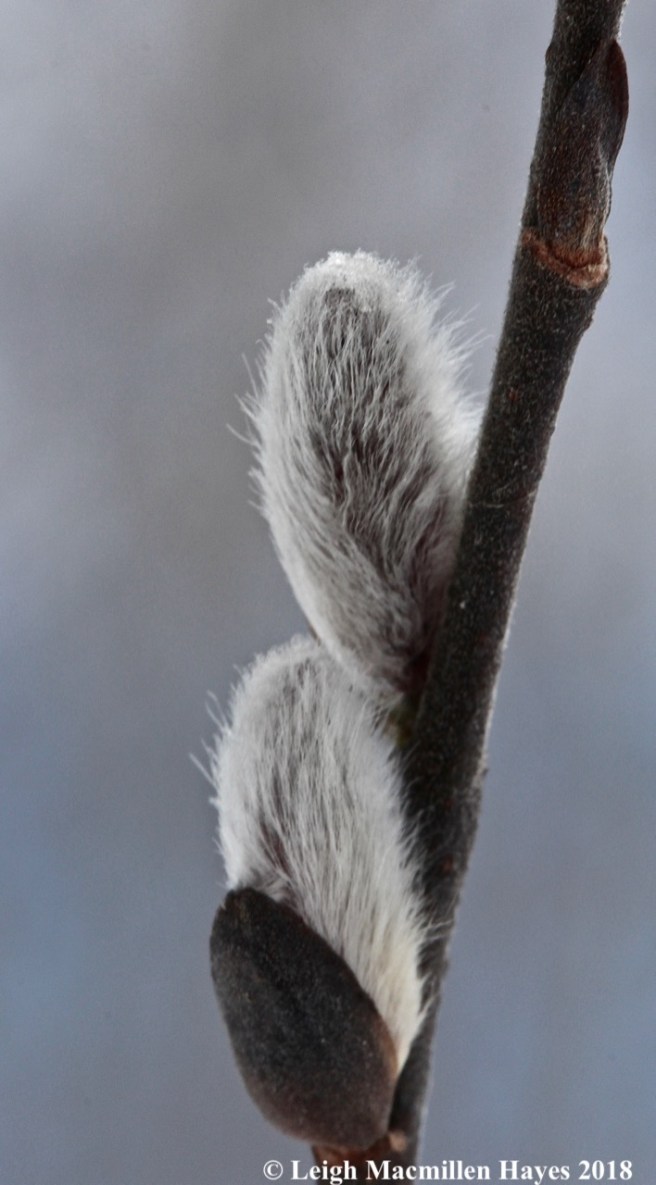
w-crowded parchment laterally fused

Next there was the Crowded Parchment fungus that threw us off momentarily. We recognized the cap, but were unsure about the part of the fungus that was spread out flat like a crust. It turns out, the flat parts or fertile surfaces of this mushroom laterally fuse or join together at the dark ridges. This behavior certainly spoke to its name of crowded. In Fascinating Fungi of New England, Lawrence Millman refers to it as “One of the most common fungi as well as one of the most crowded in New England . . . It’s not unusual to see several hundred gregarious fruiting bodies laterally fused or in dense clusters on a single branch.” Common or not, we were wowed.

w-script lichen

And because we stopped to gain a better understanding of the Crowded Parchment, another gift was offered in the form of script lichen writing its own story on an adjoining branch.

w-nectria fruiting bodies?

Nearby, there was a similar cinnamonish color on beech bark. This particular beech was dotted with the waxy exterior winter coating of the beech scale insect. As I’ve noted before, the scale insect or more technically, Cryptococcus fagisuga, is a tiny insect that sucks sugar and other nutrients from beech trees only.

Soon, the beech scale insect will molt into its second, legless nymph stage and emerge. Immediately, it will start sucking sap through its tubular mouthpart or stylet. That instar stage doesn’t last long, and quickly it will become a mature female. For the rest of its life it will remain sedentary, but repeatedly remove and reinsert its piercing stylet, wounding the tree and providing entry points for fungi to enter. An interesting fact about beech scale insects–its a world of females who reproduce by parthenogenesis; there are no known males.

w-closer look

But what about that cinnamon color? Was it a fungus? Or was it related to the insects? Yes and yes. As some further research revealed, two species of nectria fungi are associated with beech bark disease, Nectria coccinea var. faginata and Nectria gallengiaIt is now my understanding that what we examined was a large area of the former’s fruiting bodies. Oh my.

w-lichen garden1

We also paused frequently beside gardens dominated by lichens. Crustose, foliose and fruticose varieties completely enveloped the bark of this toppled tree, their individual colors and textures adding to the visual display.

w-mink 1

And then . . . and then . .  . as we looked, a motion captured the attention of one in our group. I only wish my focus had been better, but still, it was enough.

w-mink 2

We were blessed with the opportunity to spend a few moments with a mink as it bounded down the hill before realizing it had an audience.

w-mink measurements

Of course, after it disappeared down a hole into a stream and we’d waited a bit, we checked out the tracks it left behind. The size of the prints and length of the straddle or measurement from the outside of one print to the outside of the other confirmed our ID.

w-mink prints

From that point on, we continued to find evidence that the mink had traveled to and fro over the course of several days. Our hearts were grateful to have shared such a moment.

w-hairy, bony find

And as we took measurements, we spotted something else on the snow. Something hairy and bony found about three or four inches from the fresh mink tracks.

w-hairy, bony--scapula

A scapula from a little brown thing, possibly a vole. Dropped from the mink or from above by a bird? We’ll never know. But we do know that someone consumed someone else–as it is in the natural world.

w-Sucker Brook

Seeing the mink made perfect sense because we traveled on and off trail beside Sucker Brook.

w-hobblebush flower and leaf buds

It was there that the naked but hairy hobblebush leaves and flower buds reminded us that spring isn’t far off. The three of us don’t necessarily want winter to end for we love how it forces us to notice other things such as the nectria’s fruiting bodies. And we love to track. But . . . we also love the other seasons, so we’re happy exploring at any time of the year.

w-suds

Beside the water, the icy formations kept calling my name and I honored many by snapping a photograph. But, then we met the suds. Water foam is caused by the decay of twigs and plants and occurs naturally in streams and brooks. As they release compounds, the interaction breaks the surface tension, allowing air to mix in and create bubbles. And just as we found the Crowded Parchment living in a large community, we also found this congregation of bubbles–creating a design all its own.

w-Wilson Wing Moose Pond Bog

Despite the short trail, it took us forever to reach the point where the brook becomes Moose Pond Bog, but we did.

w-stream with rattlesnake liverwort

And then we beelined (sort of, for still we kept stopping) to the final stream crossing on the trail for we wanted a glimpse of the rattlesnake liverwort we’d discovered growing there last year. Alas, it was buried under snow. And that means we’ll have to return again. Darn.

w-sucker brook reflections

In the end, it was a morning well spent as we dillied and dallied over the littlest of things. And watched a mink. We got to see a mink!

No, it wasn’t a summer day. But . . . we were distracted by nature. As Mary Oliver asked, “What else should we have done?”