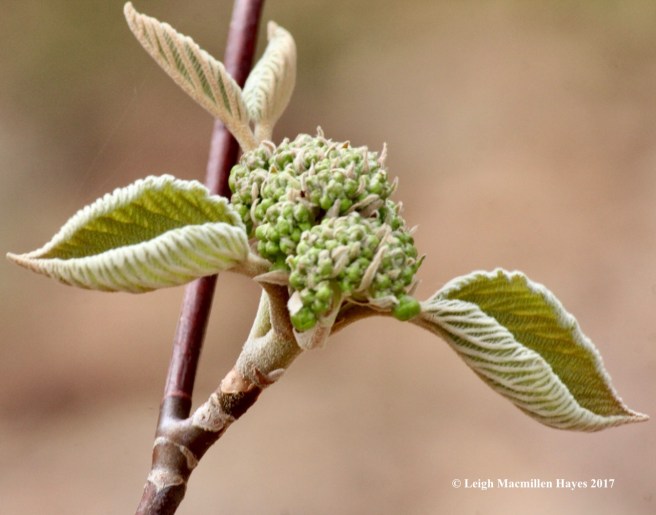
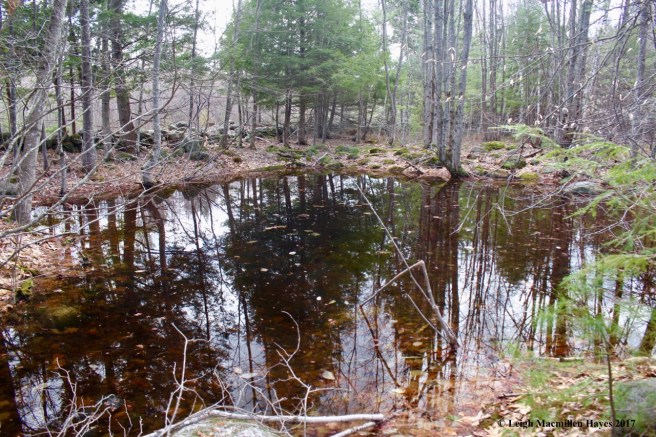
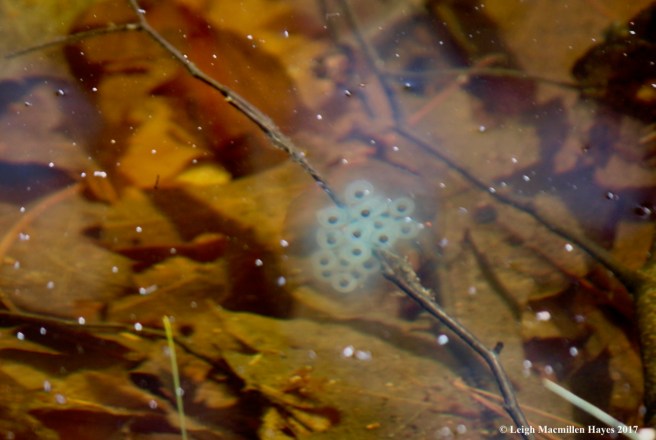
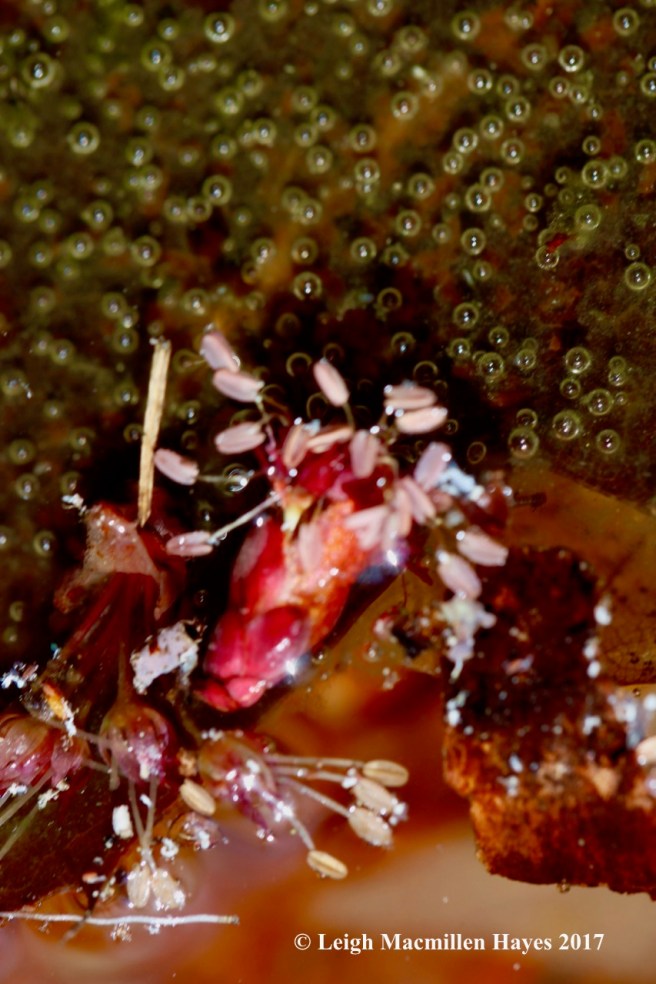
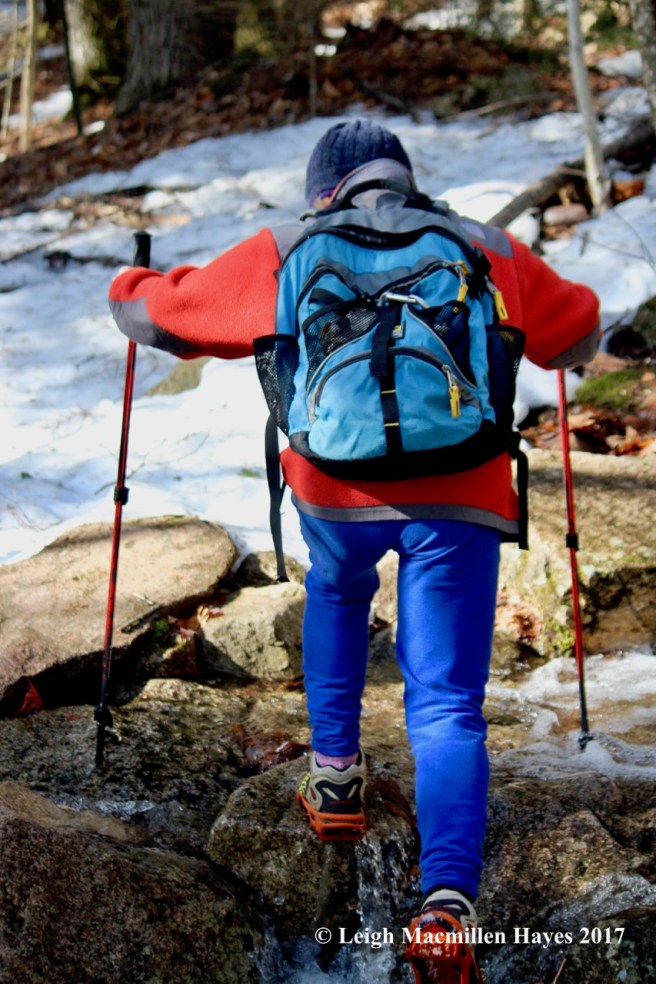
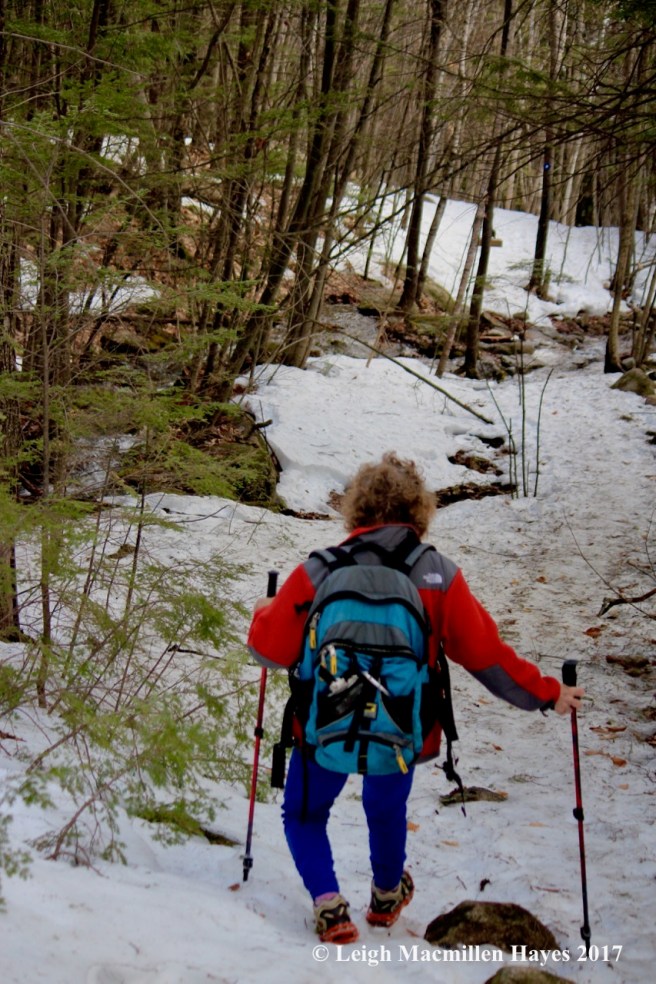
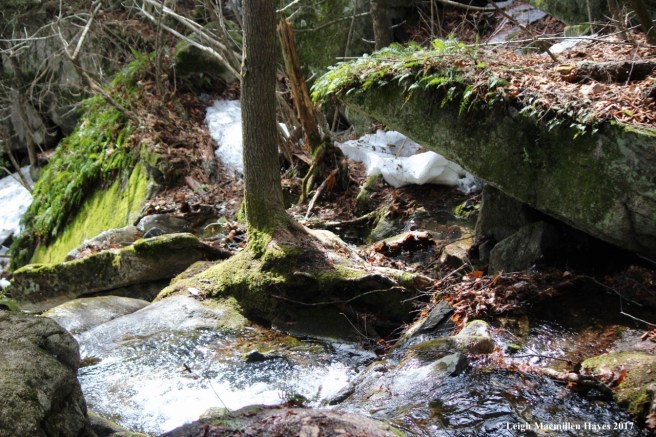
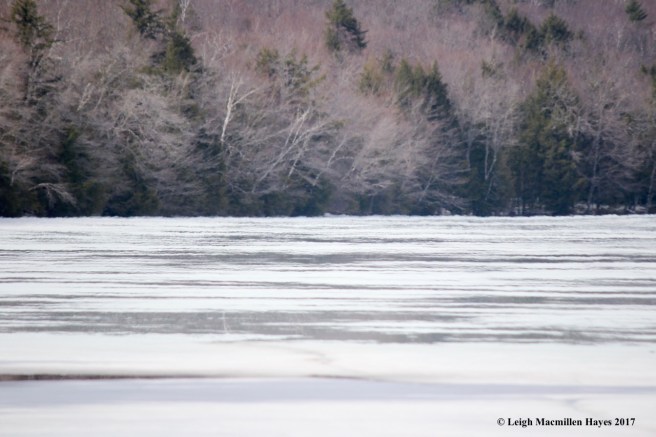
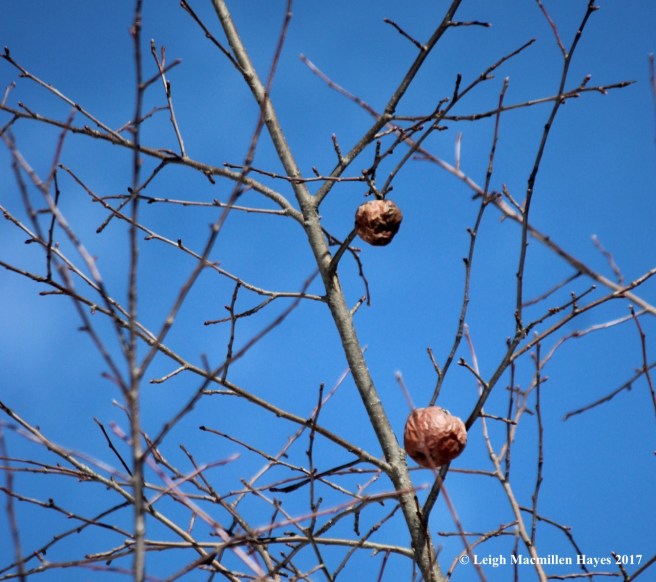
This Land Is . . .

My land. I’m sure of it. I don’t own it all, but I walk it often because it’s not posted and I know it well. Well, only just so well. It’s constantly offering me new learnings.

o-Mt Wash

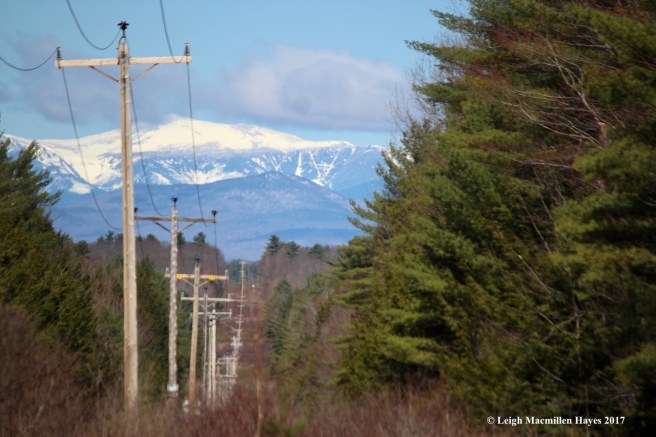
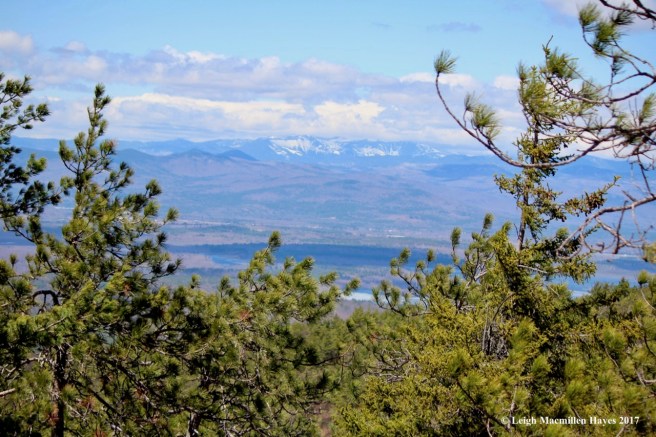
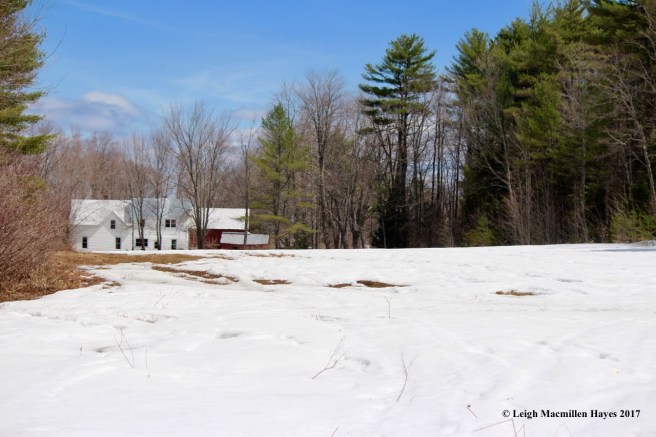
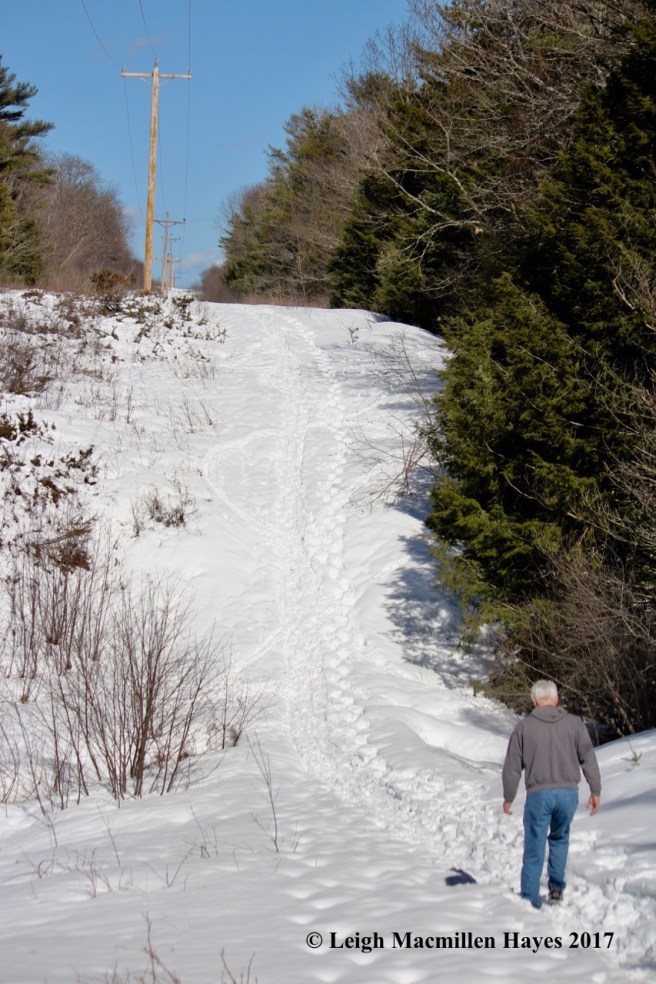
And so once again, out the back door I ventured, intending to head north toward the land of snow–haha. My sister asked the other day if we still had snow. We don’t have any on our land, but this is our view from the power line right of way–yup–we’ve got snow ;-) (in our view).

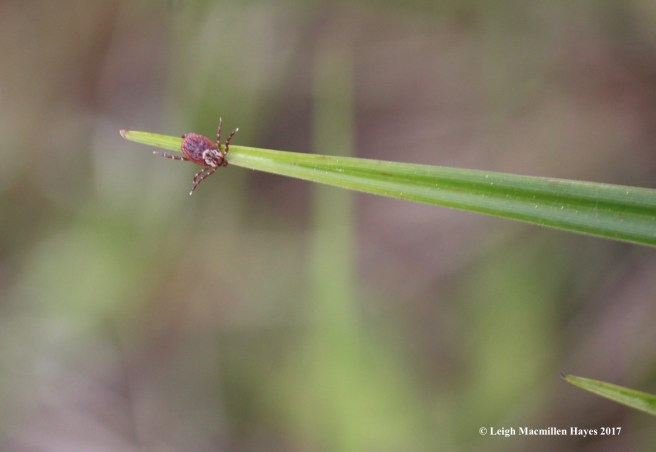
o-tick

I changed my mind about the direction, however, when I saw numerous dog ticks on the tips of grass as I crossed our neighbor’s field. Though they aren’t the purveyors of diseases such as Lyme disease, Babesiosis, and Anaplasmosis, seeing them still unnerved me and I decided to head in the opposite direction where it isn’t so grassy. Of course, that’s where the deer ticks live. Nightly tick checks are a must every day.

o-early yellow rocket 1

It was in the opposite direction that I was caught by surprise. Behind a local business, where the land had been disturbed a year ago, a wall of yellow greeted me.

o-yellow rocket 3

It was a sea of early yellow-rocket that is common along roadsides and fields. Apparently this one spot was the cat’s meow for it to grow so prolifically.

o-bee 3

What was more prolific–the sound.

o-bee 1

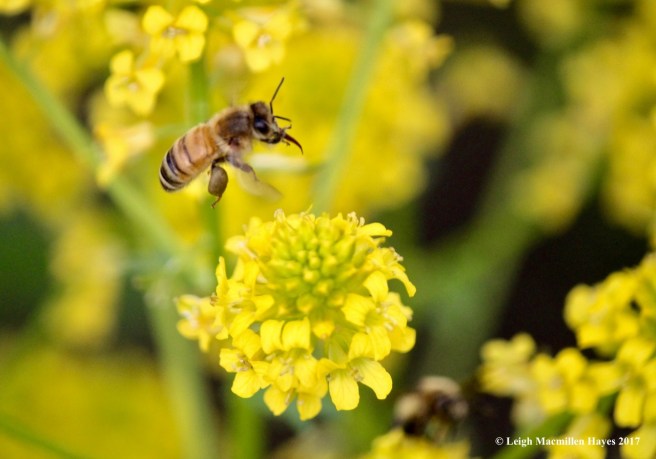
Bees and other insects hummed as they worked,

o-bee 2

filling their pollen sacks to the brim.

o-fritillary 1

Even a fritillary butterfly enjoyed the goodness within.

o-fringed 2

Those weren’t the only wings I saw. It was a complete surprise to also discover gaywings or fringed polygala growing deeper in the woods.

o-turkey print

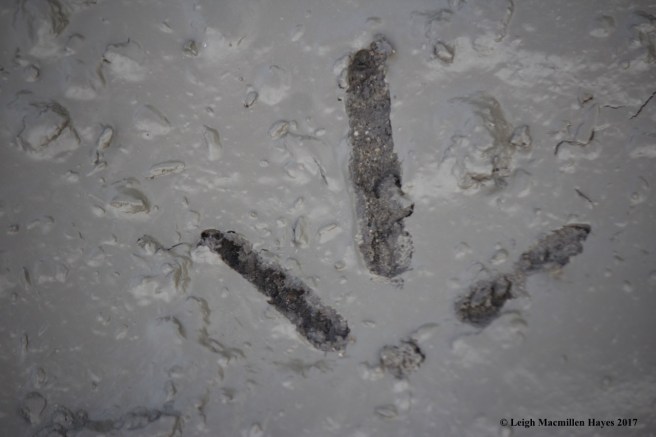
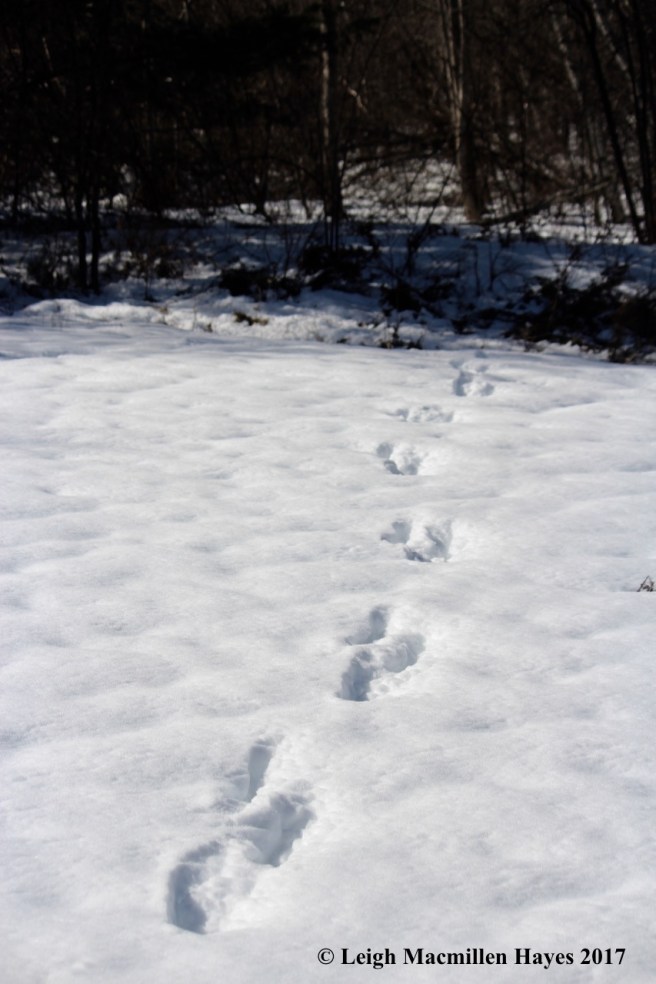
Walking along, I flushed a couple of deer and a ruffed grouse. And though I didn’t see or hear any turkeys, I knew they’d been there by their signature prints.

o-tadpole 1

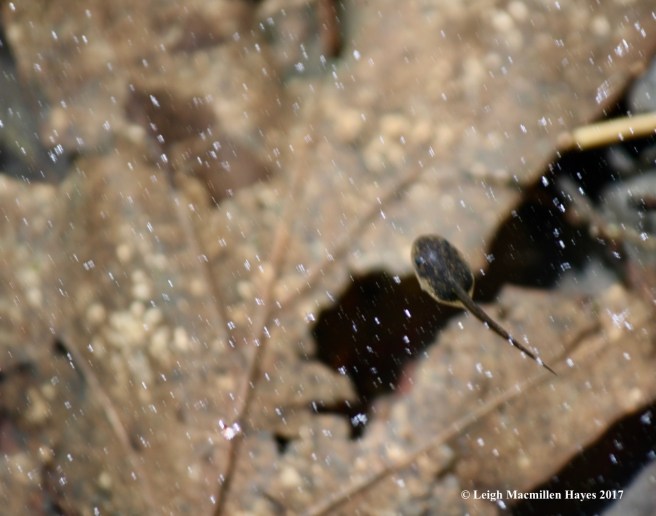
And then I slipped off the trail to stop at a vernal pool that I don’t often visit. The water is shallow, but tadpoles are growing.

o-tadpole 2

A week or two ago after they’d just emerged, they were easy to spot as they clung to their egg masses or swam by water’s edge. But they are maturing and I had to stand still or they’d disappear under the leaf cover.

o-water scavenger larvae

While standing there, I spotted another resident I didn’t immediately recognize–the larval form of a water scavenger beetle. According to A Field Guide to the animals of Vernal Pools,  “they are poor swimmers and will hang from the water surface (where they obtain oxygen) or hide in vegetation to await prey.” That all makes sense given their body structure.

o-sugar ant?

On the way back, another insect stopped me. I think they were sugar ants with a white thorax. But why were they on beech leaves? Then again, every insect seems to like beech leaves. I guess I don’t think of them as being sweet, but . . .

o-old gate in wall

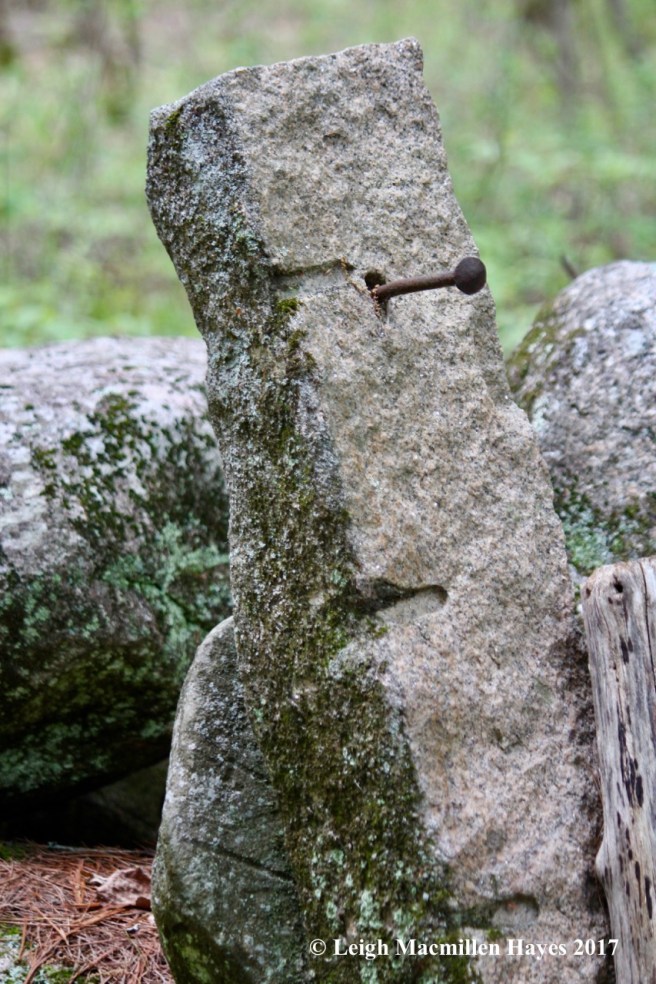
As I headed home, I paused by an old wall and gate. This land was farmed in the late 19th and early 20th centuries. The walls formed boundaries for animals and are owned by numerous neighbors I’ve never met. Thankfully, they let me and others cross–though few will do so until hunting season begins in the fall.

Anyway, it all got me thinking about who owns the land. And then I knew the actual answer. The plants. The trees. The flowers. The insects. The amphibians. The birds. The mammals. They all own the land. We are mere visitors. I thank all of nature for letting me trespass and gain a better understanding of its various life forms.

This land isn’t my land. And it wasn’t even made for you and me. But I have great reverence for it. And for those who have protected it.

Happy Memorial Day.

Walking with Ursula

No matter when or where I walk, Ursula Duve is always along. She sees what I see, smells what I smell, feels what I feel, tastes what I taste and knows way more than I’ll ever know.

h-Ursula 2

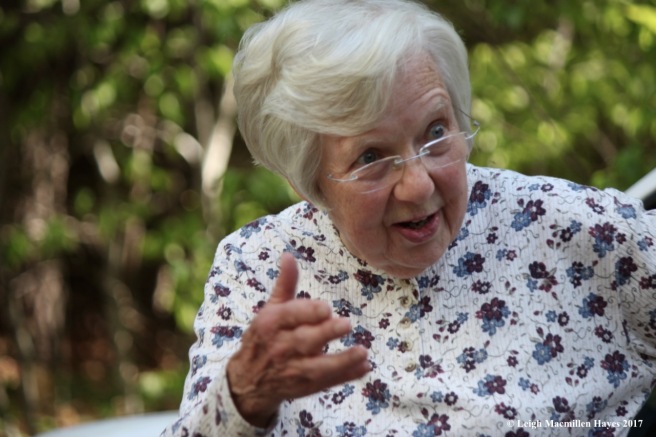
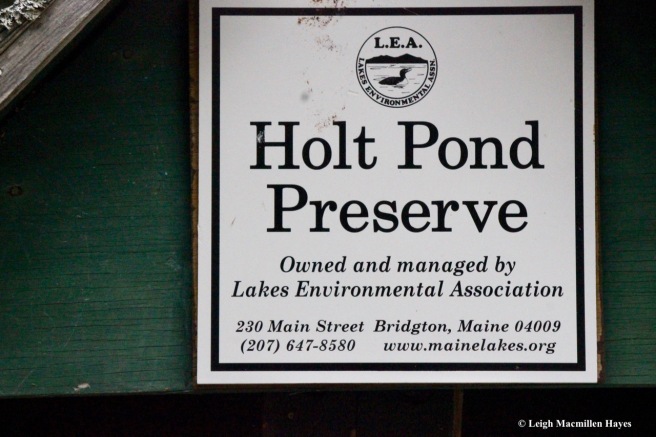
And so it was today that a bunch of us followed this delightful little woman as she led us down the trail at Lakes Environmental Association’s Holt Pond Preserve.

h-sign

We gathered in the parking lot, where the black flies tried to swallow us whole. But, we got the better of them and practiced mind over matter. Of course, bug spray and our flailing arms helped–or at least made us feel as if it was worth the effort.

h-wild oats 1

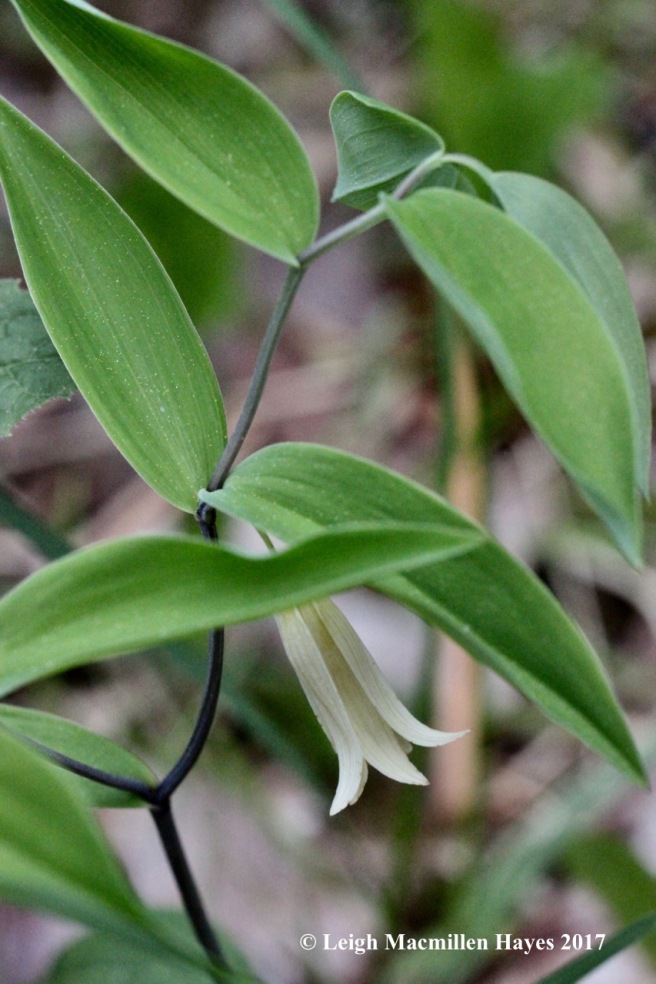
After an introductory greeting from LEA’s teacher/naturalist Mary Jewett, we stopped frequently as Ursula shared stories of plants and life. You see, she was born in Hamburg, Germany, and grew up during WWII so she has quite a few memories flowing through her system, but as she reminded us, with the bad comes the good. And the good comes from moments she associates with wildflowers, like this bellwort.

h-painted trillium

Having lived in the United States for 50+ years now, with the last nineteen in Maine, Ursula considers herself a Mainer despite her German accent because she loves it here. And she knows when and where each flower will bloom, such as the painted trillium.

h-chokeberry buds

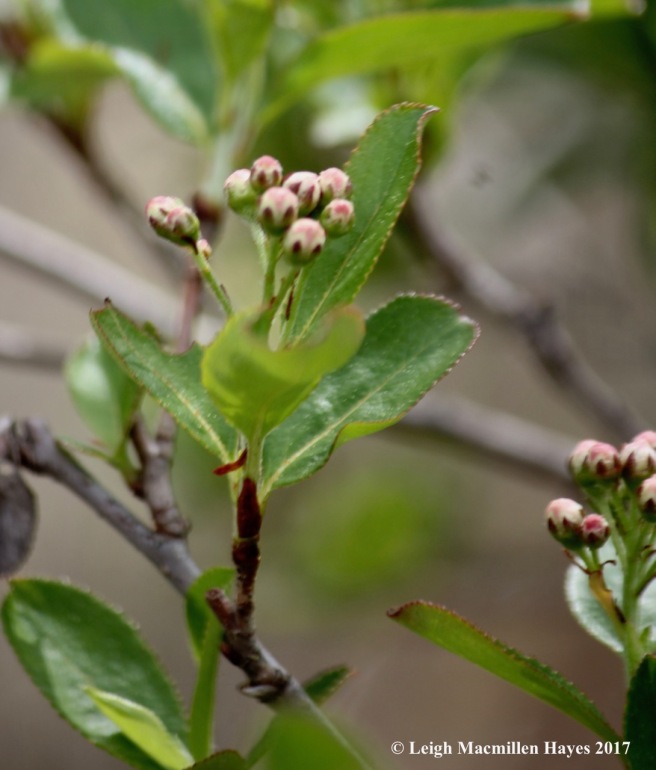
Even those not yet in bloom drew her attention–this being a chokeberry along the first boardwalk.

h-pitcher 3

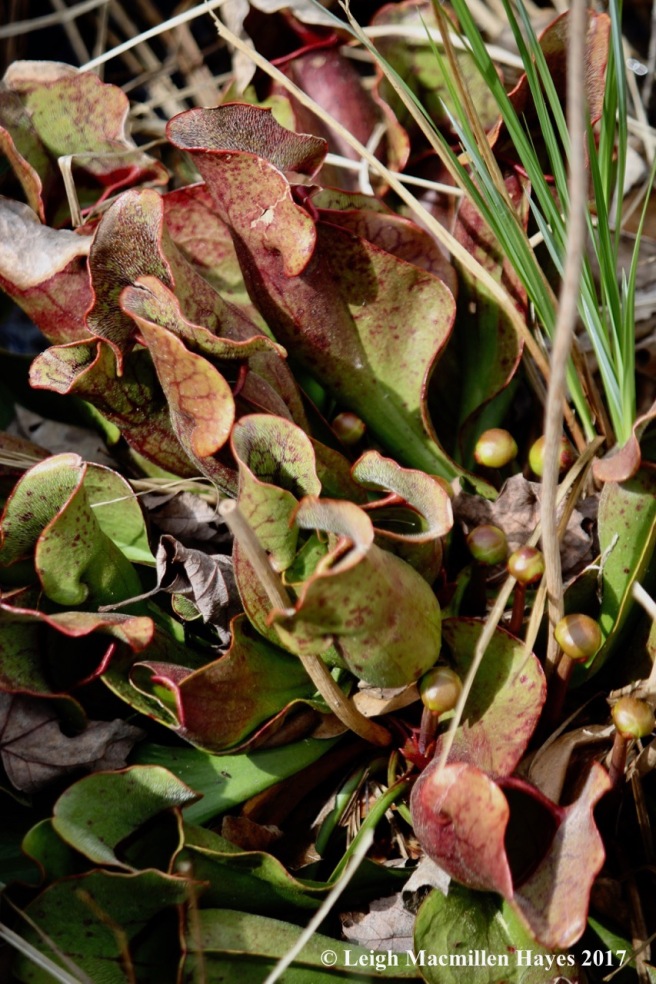
One of the finds Ursula enjoys sharing with others is the pitcher plant, a perennial herb with pitcher-shaped leaves. We noted that this particular one sported new flower buds.

h-pitcher flower

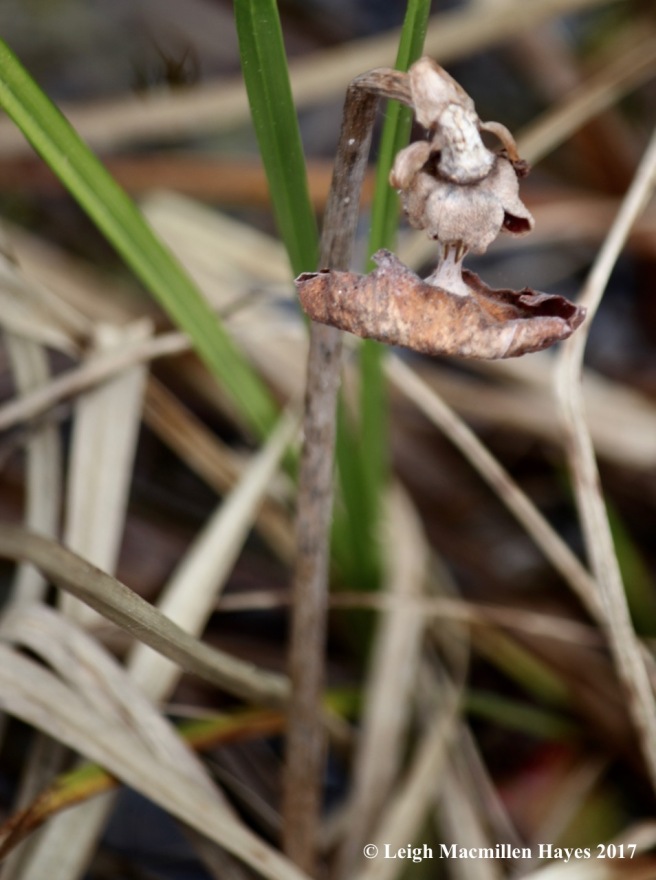
And on another, the otherworldly shape of last year’s now woody flower capsule–its job completed.

h-pitcher plant 1

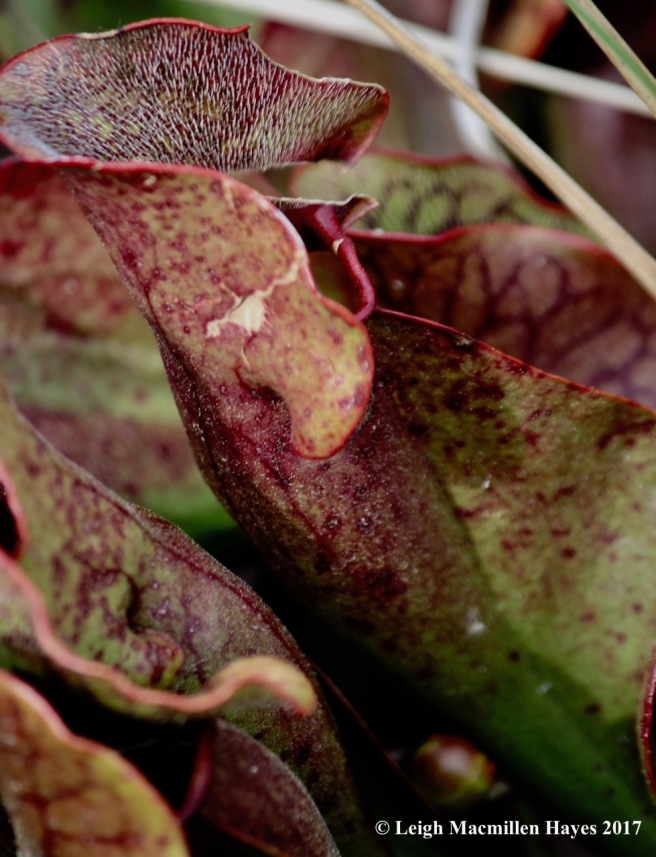
Ursula is as awed as I am by the power of the pitcher plants. Color, scent (that I’ve never smelled) and nectar in glands near the top of the pitcher leaf attract insects. Once inside, those downward-pointing hairs make it difficult to leave. So what happens next? The insect eventually drowns in the rainwater, decomposes and is digested by the plant’s liquid, which turns phosphorus and nitrogen released by the insect into supplemental nutrients for the surrounding peat. Interestingly, no “joules” or units of energy are passed on through this process to the plant itself. The plant gathers its energy through the process of photosynthesis instead.

h-rhodora 1

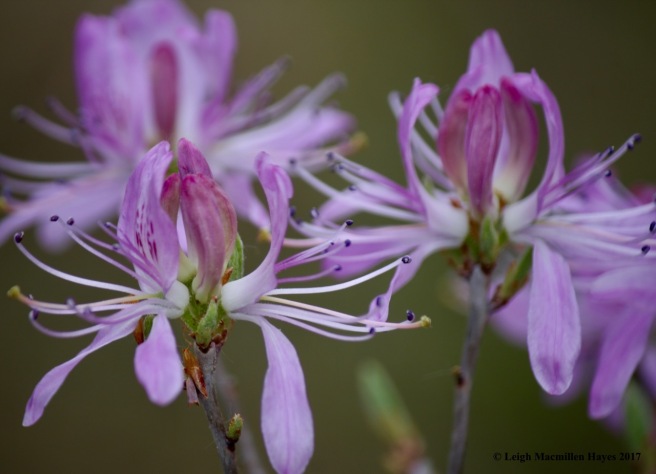
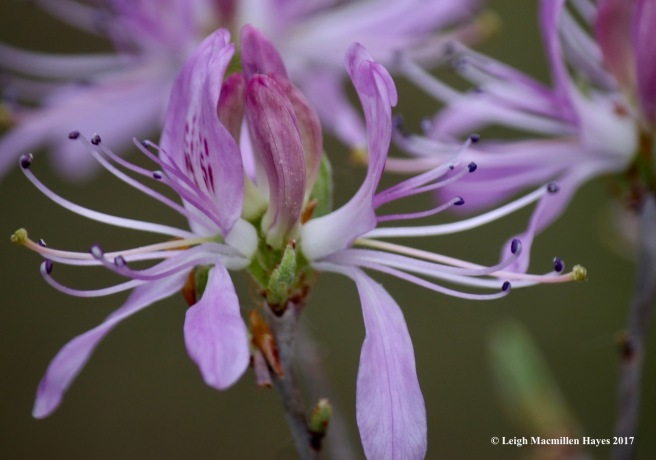
As we continued, we were wowed once again–this time by the sight of the showy rhodora. Rhodora flowers fully before its leaves emerge and so today they were but small nubs located alternately along the shrub’s branches.

h-rhodora 3

But those flowers–oh my! The rose-purple bloom has what’s considered two lips–with the upper consisting of three lobes and the lower of two. And each produces ten purple-tipped stamen surrounding the pistil, where the pollen will germinate into a many-seeded capsule.

h-leatherleaf

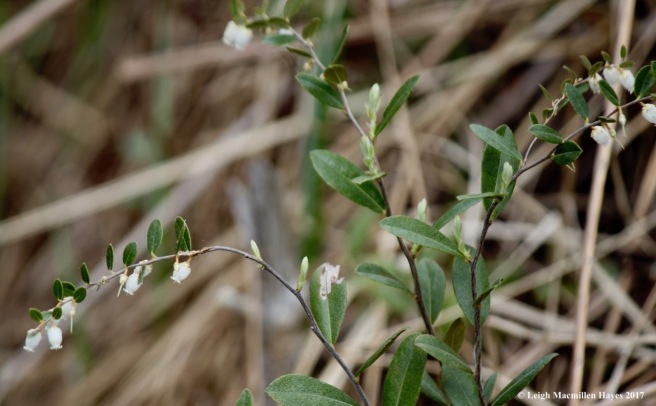
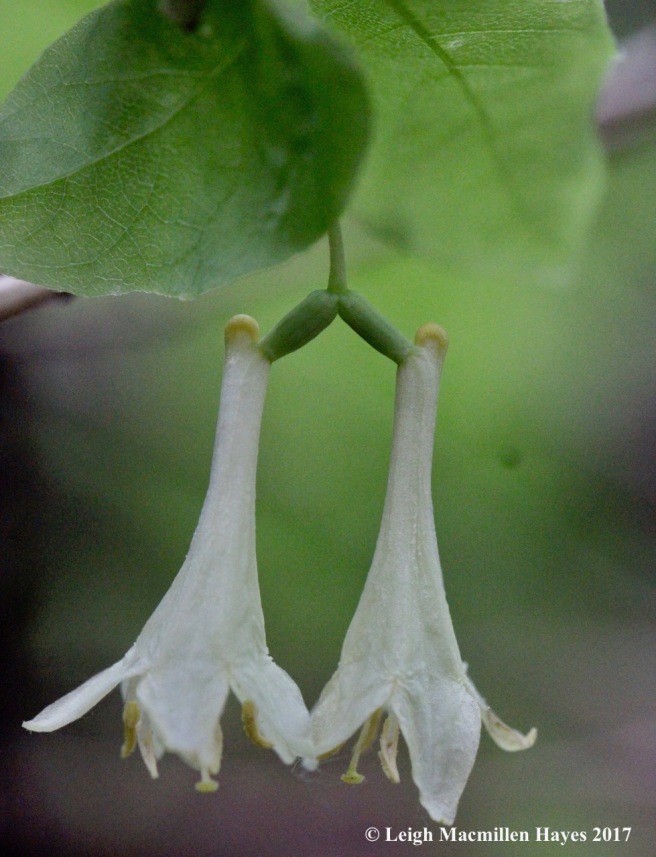
Like the rhodora, another member of the heath family in bloom was the leatherleaf–with bell-shaped flowers formed in leaf axils and dangling below the stem as if it was laundry hung out to dry. One way to differentiate this plant from the highbush blueberries that can be found throughout the preserve, are the alternate, upward-pointing leaves, which decrease in size as your eye moves toward the tip of the stem.

h-honeysuckle 1

Just before we stepped out onto the Quaking Bog boardwalk, Mary pointed out a native honeysuckle. In my memory bank, I couldn’t remember ever seeing it before, and if I had, well . . . I was glad to make its acquaintance again.

h-green frog 2

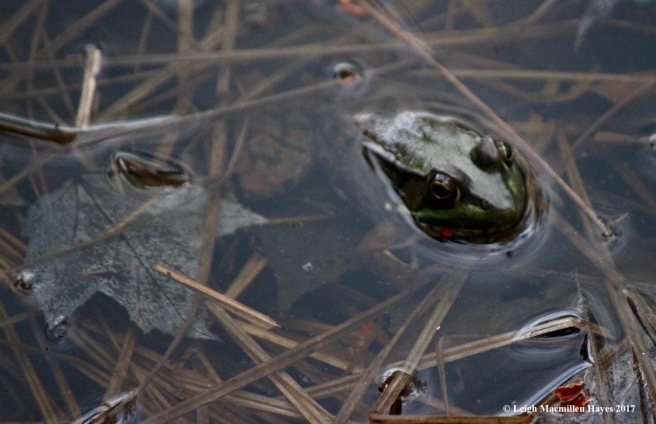
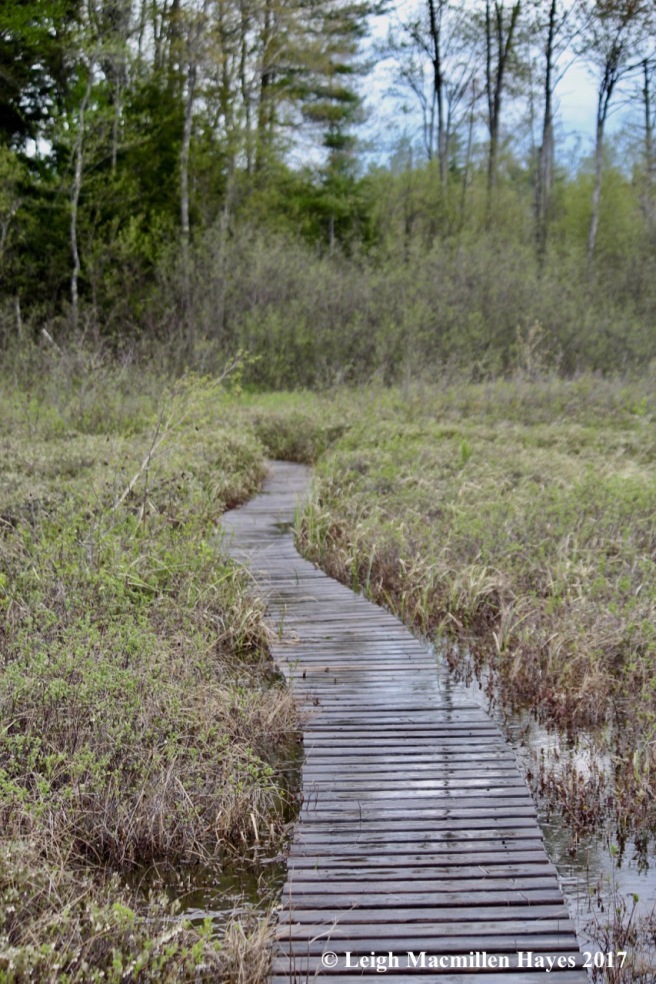
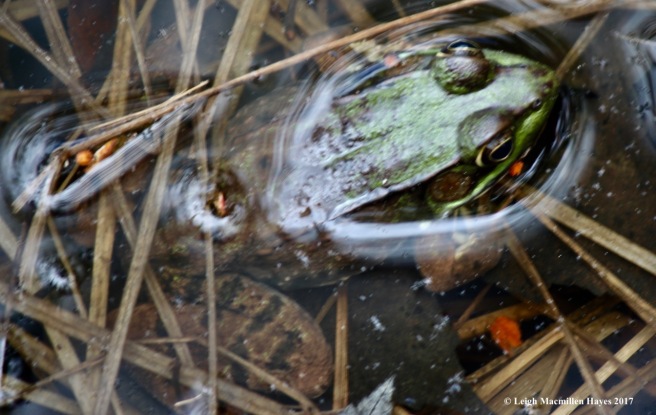
And then we stepped onto the boardwalk. Folks up front paused to admire a green snake, while those of us in the back noticed a green frog. It stayed as calm as possible in hopes that we wouldn’t see it. Nice try.

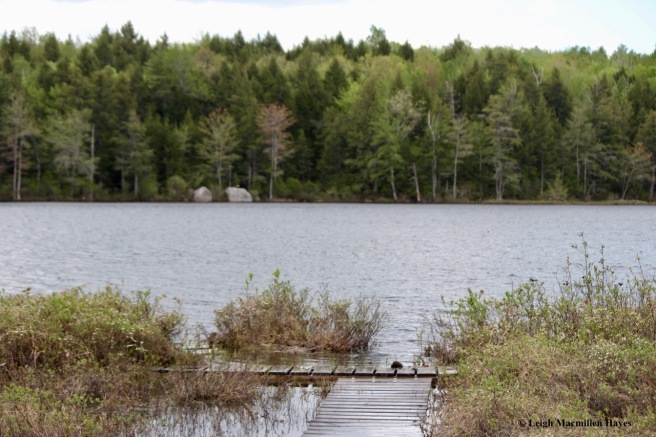
H-Holt Pond

Like all ponds and lakes right now, the water level remains high and so walking the boardwalk meant wet hiking boots.

h-quaking bog 2

But that didn’t stop some of us. Fortunately, mine are waterproof.

h-green frog

Just before we stepped from the boardwalk back onto land, I saw that the frog was still there.

h-hobblebush flowers 1

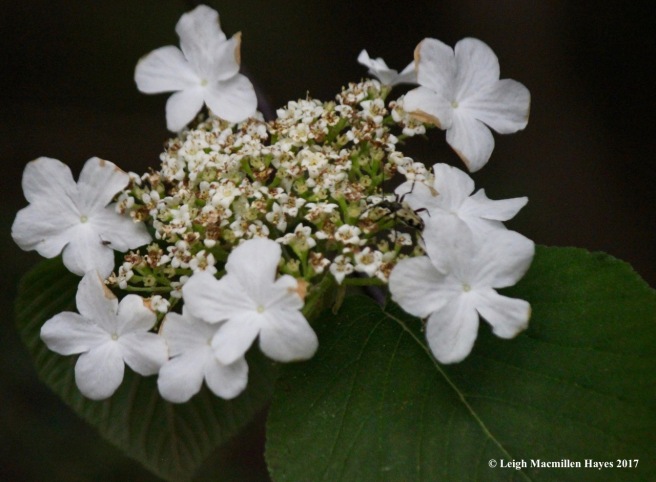
On the trail again, another showy flower called for our attention–hobblebush.

h-hobblebush 1

While some looked fresh, others were beginning to pass and their fruits will soon form. We noted the sterile outer blooms that surround the inner array of small fertile flowers. And a beetle paying a visit.

h-Mayfly1

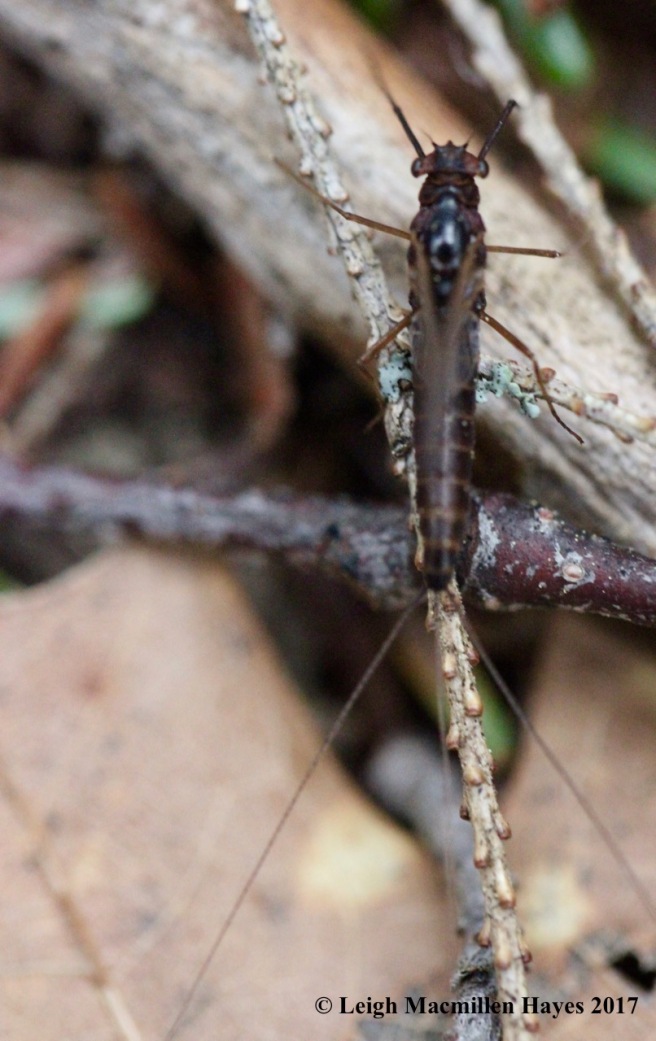
Speaking of insects, a slight movement on the ground pulled us earthward.

h-mayfly 2

We’d found a Mayfly–perhaps just emerged and its wings drying.

h-Indian Cucumber root 1

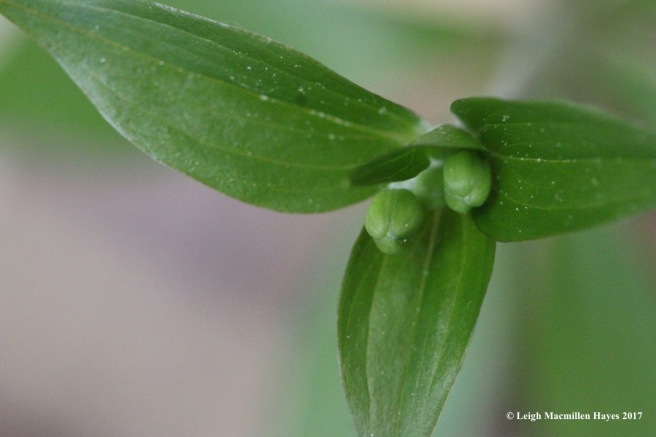
In the last wooded section we would cover for the day, we noticed that the two-tiered Indian Cucumber Roots have a few buds. I can’t wait for them to flower soon.

h-goldthread 2

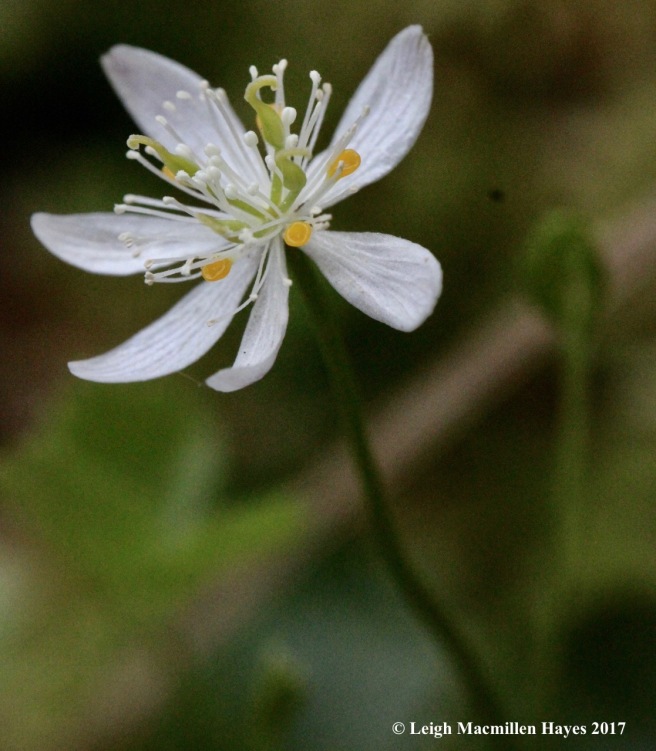
Among the flowers that I’ll always associate with Ursula because she’s the first to have introduced me to them, is the goldthread, so named for its golden-colored root. We usually identify it by its cilantro-shaped leaves, but right now the dainty flowers are not to be missed. What looks like petals are actually sepals and there can be five to seven of them. And stamen–many. Goldthread can feature 5-25 stamen.

h-goldthread 3

Even the number of yellow-and-green pistils can vary from three to seven. Ah nature–forever making us think.

h-dwarf ginseng 1

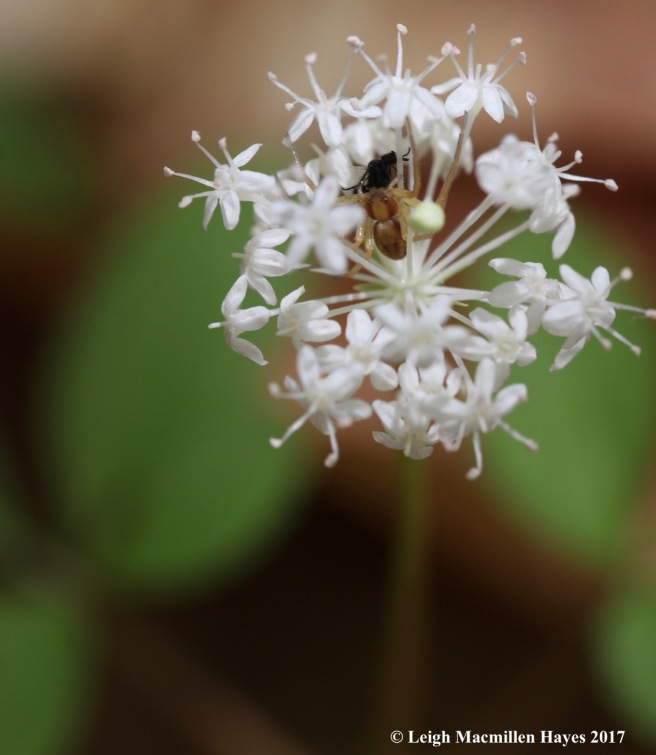
The other plant I associate with Ursula is dwarf ginseng. Its explosive umbel consists of many flowers. And in this one, a dining crab spider.

h-spring tail wave

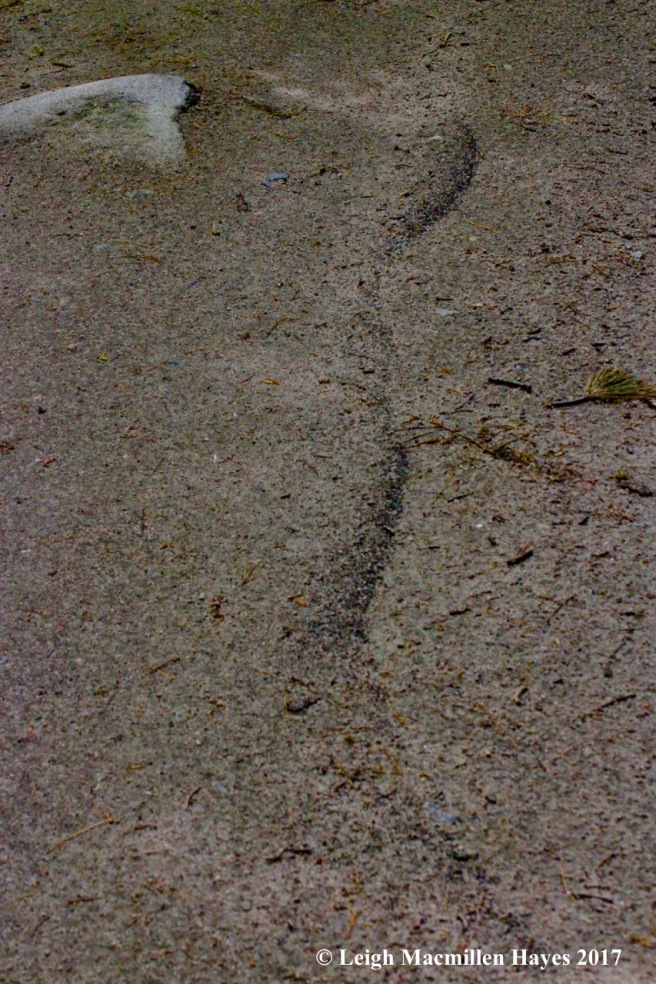
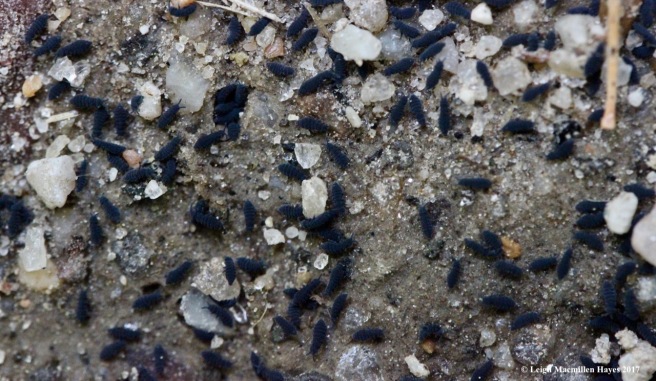
Finally, we found our way to Grist Mill Road and headed back toward the parking lot. But even on the road we found something to wonder about when one member of our group pointed to the curvy black design. In the past, I’ve always dismissed it as some sort of mineral associated with the dirt.

h-spring tails on sand1

Today, I learned it was none other than those good old spring tails or snow fleas we associate with late winter, but are really present all year. Something new to notice going forward.

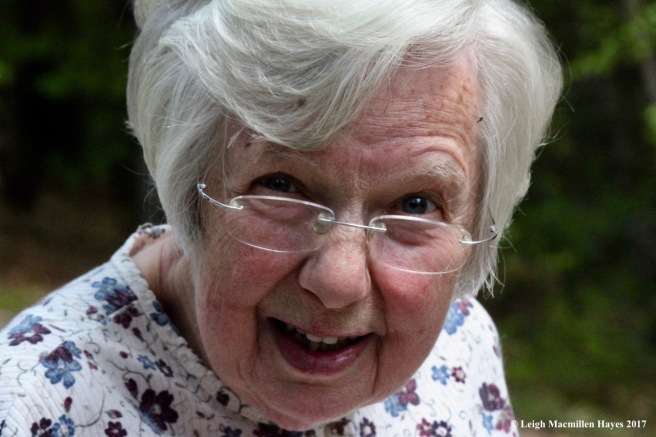
h-Ursula1

At the end of our walk we all gave thanks to Mary and Ursula. We’d come away with refreshers and new learnings.

And we’d been reminded by Ursula that though she and her husband, Wolfgang, can no longer get out as often as they’d like, after sixty years of marriage they still have fun reminiscing about their many explorations together. A goal for all of us to set.

Most often this wildflower and bird enthusiast walks vicariously with me as she reads my blog entries, but today it was my immense pleasure to walk with her. Thank you, Ursula, for once again sharing your love of all things natural with the rest of us . . . and your optimistic philosophy of life.

Oh and a question for Wolfgang, while Ursula walked with us, did you get on the treadmill?

“The Actual World”

In this morning’s newspaper I read an article about the loss of natural sound because we have created so much people noise. It took me back to a time about forty years ago when I think I first actually paid attention by sitting alone in the woods and listening–hearing the soft rustle of grass blades, chirp of the crickets, buzz of mosquitoes and vroom of a truck in the distance. I can still envision that spot on a hillside where I closed my eyes to the sun and tried to zone in only on sound–to let go of the rest of the world and focus on that one sense.

And so I took that thought with me this morning when I joined others to bird at the Bob Dunning Bridge, one of the entrances to Bridgton’s Pondicherry Park.

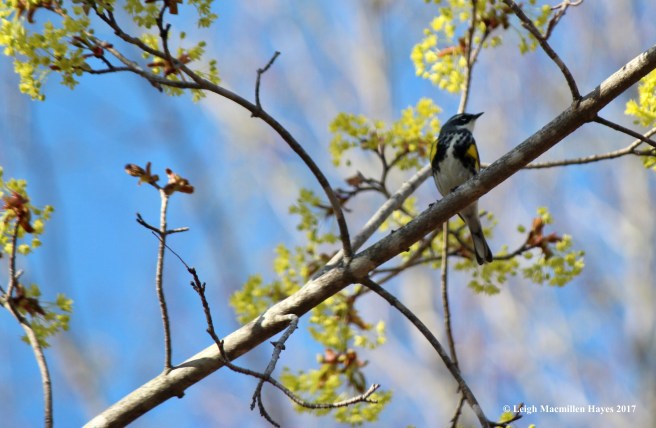
p-yellow-rumped warbler

Truth be known, I also went birding at the bridge early yesterday morning when the sun shone brilliantly and a yellow-rumped warbler posed for an instant.

p-bridge 1

Today dawned raw and overcast. And at first, the birds weren’t all that song-filled or even evident.

p-baltimore 6

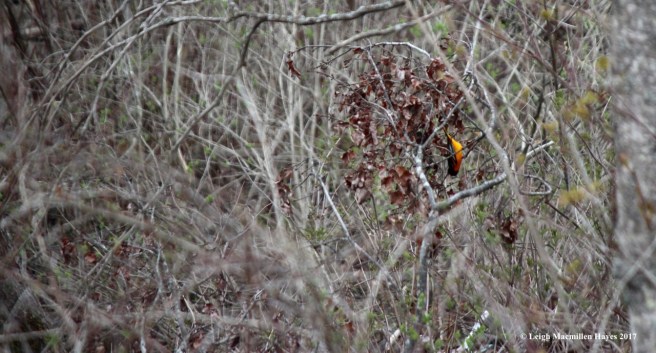
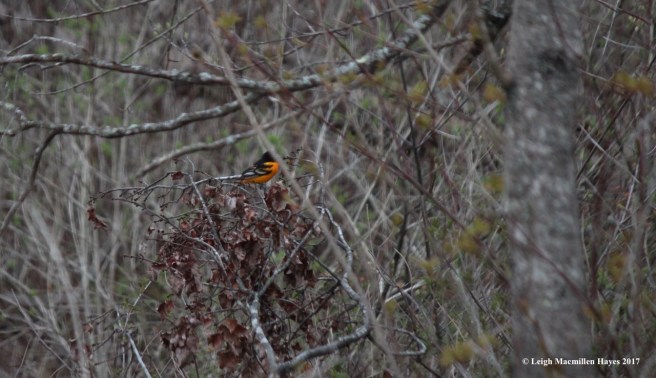
But then we heard one on high and our natural high kicked in. A Baltimore oriole whistled its melodious tune and we swooned.

p-phoebe right

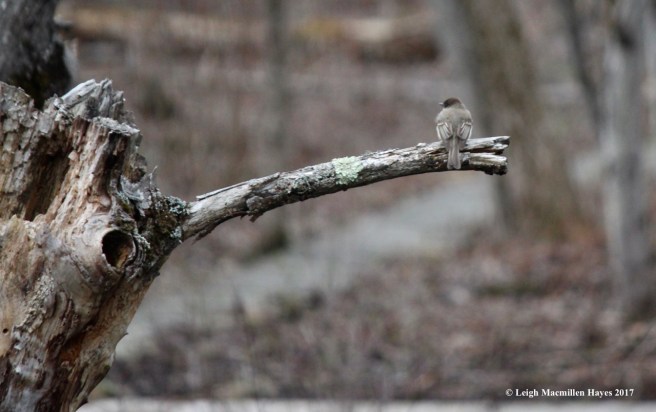
We watched an Eastern phoebe flick its tail as it looked to the right . . .

p-phoebe left

and then to the left. Because of the morning’s chill, the bugs upon which it feeds seemed non-existent to start.

p-phoebee flying

But, perhaps it knew otherwise.

p-song swallow 2

What we knew was that the temp climbed a wee bit and bird song increased, including that of the ever sweet song sparrow. Yes, we could hear the sounds of this sleepy, western Maine town since we were only a block from Main Street, but the songbirds shared their voices and for us–we focused on those delightful tunes as we tried to figure out who we could hear but not see.

p-catbird 1

One such resident arrived this past week, like many other snowbirds (people residents who winter south of Maine– or is it south of New England?). We recognized the catbird first by its cat-like mewing and then we spotted two along the stonewall and in the brushy shrubs.

p-catbird flying

Like all birds, however, they didn’t sit still. We did note, though, that they spent most of their time on the other side of the bridge in an area where they frequently nest.

p-song sparrow 1

And speaking of nesting, the song sparrow moved from its perch to the ground where it joined others as they scratched about and filled their beaks with potential materials to add to their new home.

p-song sparrow 3

I love that from above, it blended in with its surroundings. A good thing when you are but a wee bird.

p-feathers

That being said, not all went undiscovered and we noted that some joules were passed from one bird to another–energy flowing through the cycle.

p-baltimore upside down

Eventually, one of our favorites of the day moved closer and we watched it for some time as it worked upside down and then . . .

p-baltimore 3

right side up. Again, we wondered if the oriole was working at the dried leaves and also seeking nesting material.

p-yellow warbler

And finally, a song a few of us heard when we first arrived showed its face–“Sweet, sweet, sweet, I’m so sweet,” evolved into a yellow warbler, or two or three.

p-Norway maple flowers 2

Because we were there and looking, other members of the world showed their faces, such as the flowers of Norway maples and . . .

p-box elder flowers

box elders.

p-elm leaves

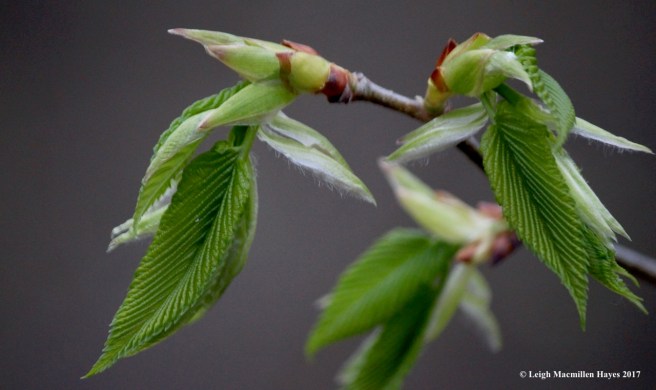
We noted the emerging American elm leaves, already highlighting their sandpaper texture and asymmetrical base.

p-butternut

And then we got stumped momentarily by the butternut (aka white walnut ), but it’s the eyebrows above the monkey face leaf scar that spoke to its name. Less than a month ago, Jinny Mae and I discovered its cousin, black walnut at Narramissic. Both are not all that common in the woods, but both grow in places where human impact is more evident. That being said, human impact is evident the world ’round.

p-plaque

Eventually, all good things must come to an end and it was time for those gathered to move along into our days. But . . . we’d had the joy of spending a couple of early morning hours, whether in the sun or not, coming into contact with sight and sound and texture. We’d met the actual world and we loved making its acquaintance.

p-Mary 1

Thanks be to Mary Jewett of Lakes Environmental Association for offering these community birding events. And for her patience with us amateurs as she teaches us the finer points of identification.


Books of May: Vernal Pools

I had two books to choose from and couldn’t decide which one to promote as the Book of May, and so . . . I chose both.

And it seems only right that both should be presented, for though they aren’t about the flowers or birds or leaves that are making our days brighter, they are about one of my other favorite May events. Yes, we celebrate Big Night in April, that night or those nights, when amphibians cross the roads as they return to their natal vernal pools to continue the life cycle. But it’s in May that so much growth occurs within those pools and if we take the time to notice, we can watch it all happen–changing daily. And the more we understand what we are looking at, well . . . the more we get it. (“Stating the obvious again, Mom,” our two twenty-something sons would say if they were to read this. But they don’t so I can get away with it.)

Enough said. The May Books of the Month are . . . the following:

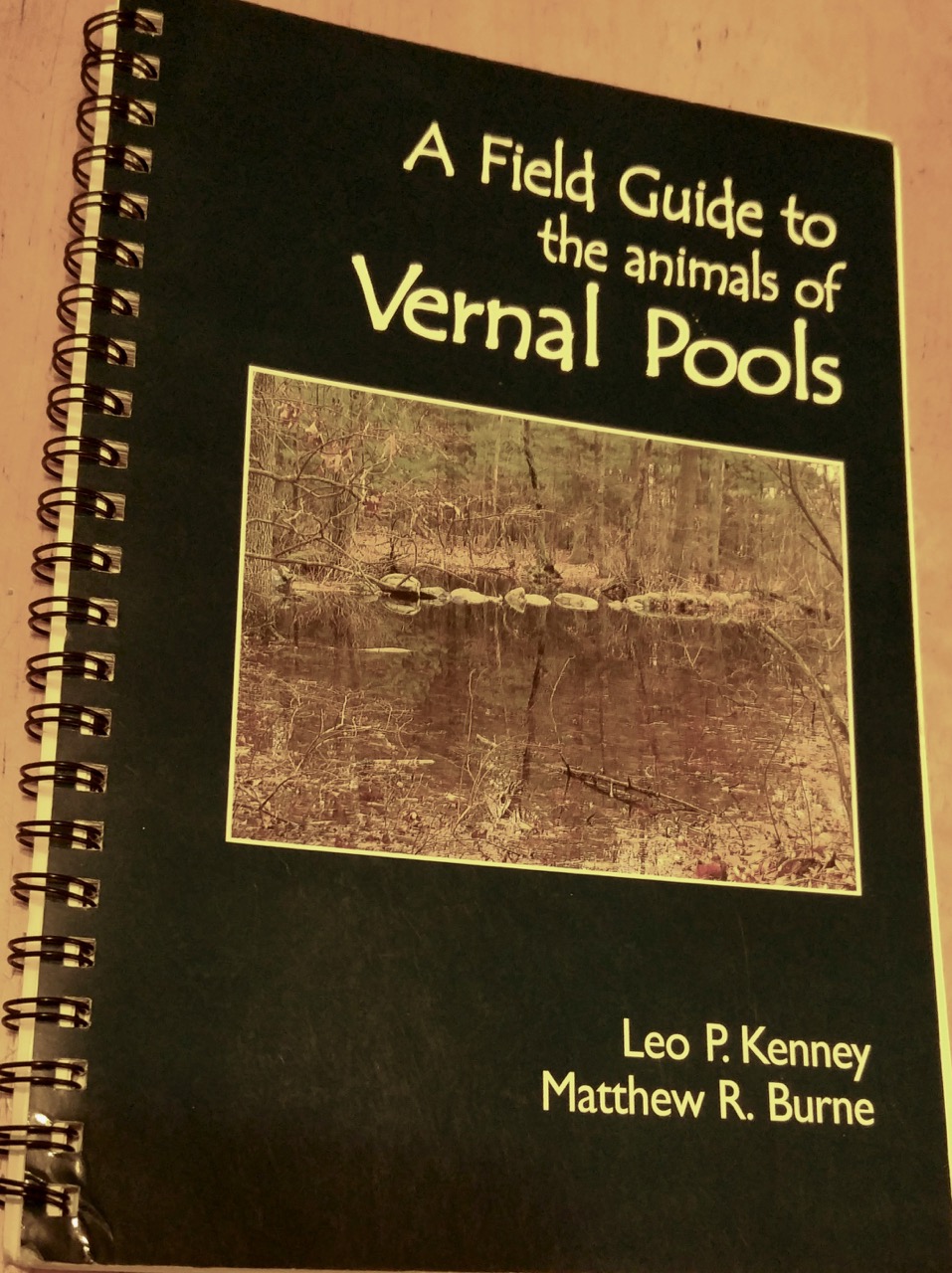
A Field Guide to the animals of Vernal Pools

and

s-MAAR (2)

Maine Amphibians and Reptiles.

The former, A Field Guide to the animals of Vernal Pools by Leo P. Kenney and Matthew R. Burne, is about 8″ x 5″ and fits easily into any pack I decide to carry. Its pages are glossy, so I don’t worry too much about it getting ruined if I get it wet. And though it was written to represent Massachusetts, most of the species described match what Maine vernal pools have to offer.

s-MAAP frogs:toads (1)

After an introduction to vernal pools, their indicator (obligate) species, protection, importance and human impacts upon them, there is a pictorial guide to the adult amphibians and reptiles. This is a quick and easy reference, and especially useful when trying to determine the difference between species, e.g. bullfrogs and green frogs or leopard frogs and pickerel frogs. Besides frogs, it includes salamanders, snakes and turtles.

s-MAAR sallies (2)

And then there are more descriptive pages for each species. These have helped me over the years to gain a better understanding of what I’m looking at.

s-sallie eggs 1

Even today, when Jinny Mae and I discovered these spotted salamander eggs, I loved that we could see that gelatinous matrix that surrounded the individual eggs.

s-wood frog eggs

And the book has helped me recognize the difference between those salamander eggs and these wood frog eggs.

In the field, there’s so much more to see, including the invertebrates that inhabit the pool, and ever so slowly I’m learning to identify them as well–you know, predaceous diving beetles, damselfly larvae, water scorpions, backswimmers, water striders . . . the list goes on. Each of them is featured in the back of the book with a photograph and paragraph or two describing their larval and adult forms.

Maine Amphibians and Reptiles, edited by Malcolm L. Hunter, Aram J.K. Calhoun and Mark McCollugh, is my at-home reference book. Well, sometimes it goes for a ride in my truck, but usually, it’s left at home because it’s larger and offers a much more in-depth take on amphibians and reptiles, their habitats and conservation. Besides a photo gallery, each amphibian and reptile that makes its home in Maine is featured, with thorough descriptions, taxonomic status, distribution, reproduction, habitat, diet, and interactions with people and other animals. There are sketches and maps to further enhance the information presented. And it’s all quite readable.

s-MAAR recordings 2 (1)

One of the best features of this book (and unfortunately, mine is cracked) is the CD at the end. Yes, you can actually listen to the individual species so that when you hear them in the day or night, you might begin to recognize them, much as you would a bird, by their voices before you spy them.

In the past few years, the vernal pool that I study frequently, has dried up before the amphibians have matured. I find solace in the fact that even when the pool dries up, the species growing there still provide nourishment and pass on energy to their consumers.

But . . . maybe this year will be different. We had a lot of snow, and now a lot of rain. Maybe this will be the year the amphibians and insects that reside in the pool will actually mature and hop or fly out.

It all begins with MAY.

The Books of May:

A Field Guide of the animals of Vernal Pools, by Leo P. Kenney and Matthew R. Burne, available through the Massachusetts Division of Fisheries & Wildlife’s Natural Heritage & Endangered Species Program.  (Curiously, the copy I own was from the third printing in MAY 2009)

Maine Amphibians and Reptiles, edited by Malcolm L. Hunter, Jr., Aram J.K. Calhoun, and Mark McCollugh, The University of Maine Press, Orono, 1999. (I purchased my copy at Bridgton Books.)

Water Works

With rain drops come life and rebirth. And so it seems as our world explodes with the return of birds and vibrant blossoms of daffodils in the garden. The grass is, well, grass green–a brilliant green with hues of gold or purple, depending on the time of day. And ever so slowly, tiny leaves emerge on the maples and aspens.

w-rookery

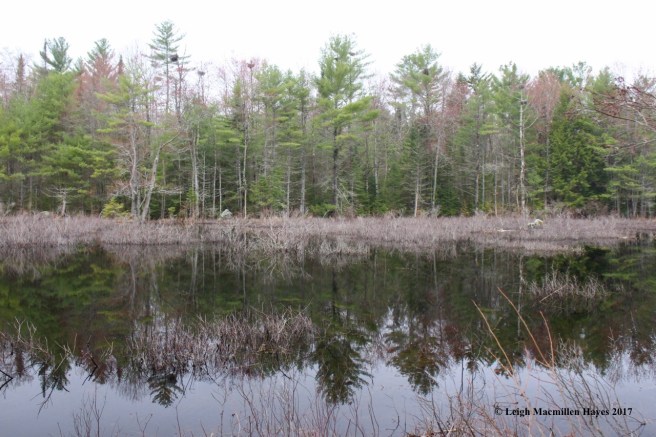
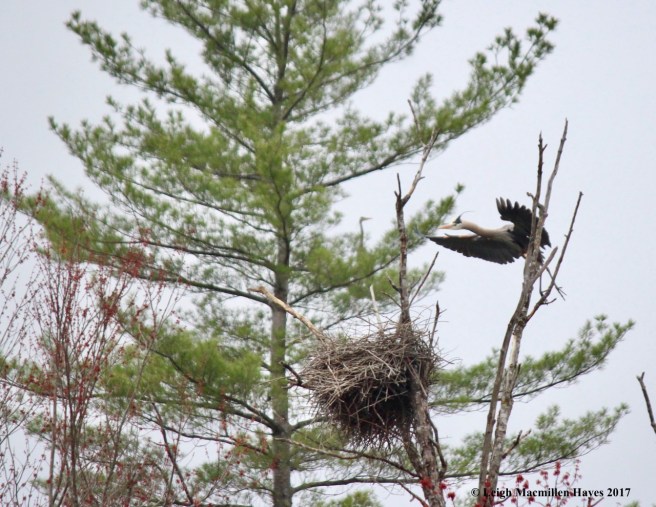
But it’s life in and around water that captured most of my focus today. Following a prehike for a Greater Lovell Land Trust walk, I had the opportunity to check on a heron rookery. A friend and I stood hidden among the trees.

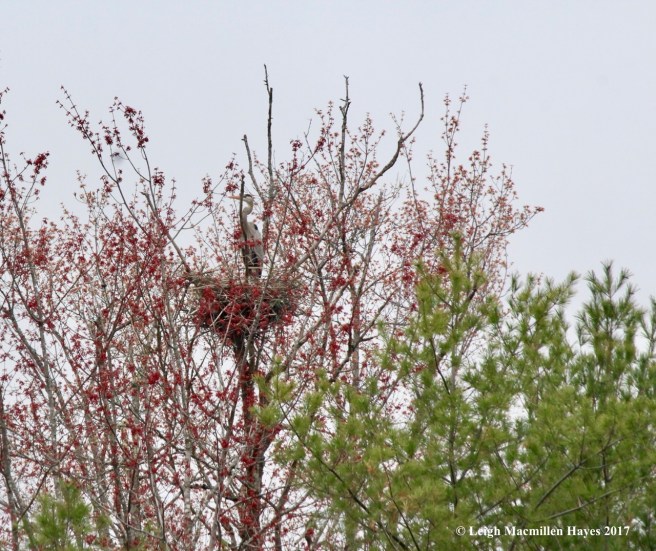
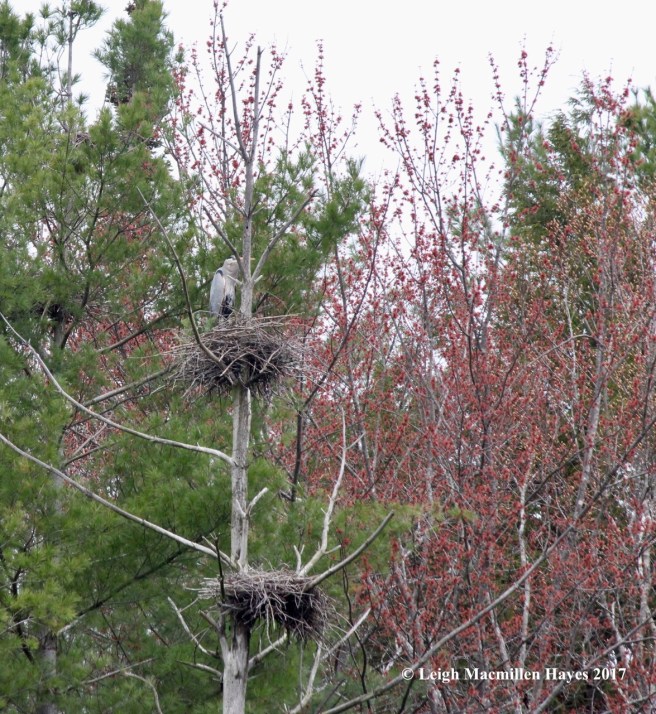
Rookeries are one of my favorite places to hang out. By the same token, I seldom do because its important not to disturb these giant birds during their nesting season. But–today’s visit, like all of my rookery visits, was for a citizen science project affiliated with Maine Inland Fisheries and Wildlife: the Heron Observation Network or HERON, counts on volunteers to count on heron–their nests, number of birds, number perhaps sitting on eggs, number of fledglings, etc.

w-heron incoming

We frequently see Great Blue Herons flying overhead or fishing in ponds and lakes, but it’s watching them come into their nests, in their pterodactyl form, that I find so wild.

w-heron standing

And then they stand. Tall. Silent. We do the same.

w-heron on nest

Watching. Listening. Wondering.

w-reflection

All the while, we have time to reflect and enjoy the reflected.

w-beaver lodge

And notice–cut saplings piled horizontally, an anomaly in this space . . . or is it?  More than herons call this place home.

w-hobblebush

At last we need to bushwhack back, but pause a few times to appreciate other forms of life that spring forth near the water, including this hobblebush.

w-snake 1a

And a garter snake, its movement catching our attention. And then it froze in place, in hopes we wouldn’t notice.

w-vp

Back on the homefront, I moseyed out to the vernal pool. As I approached, I noticed a lack of sound, but did see movement when I was only steps away.

w-wood frog eggs

I was thrilled to note signs of previous action as the number of wood frog egg masses had increased.

w-sallie eggs

The same was true of the spotted salamander eggs, though the number in each clump seemed quite minimal. The opaque outer coating was clearly visible, that gelatin-like mass that surrounds these eggs.

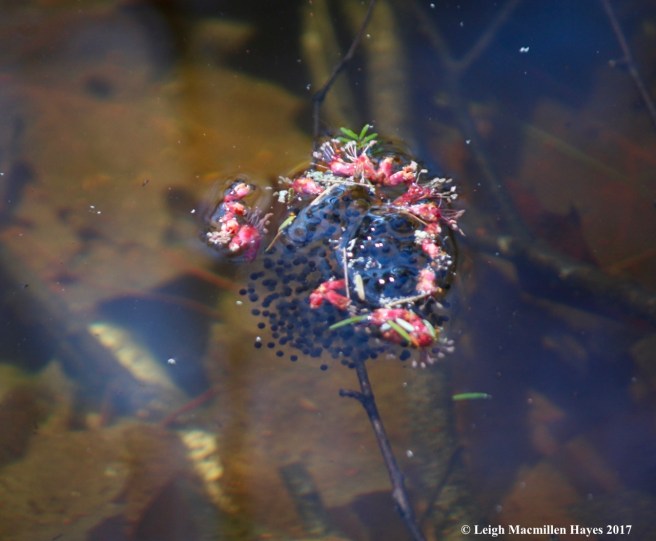
w-frog eggs?

As I admired all the dropped red maple flowers that decorated the water, I spied something else. Or at least I think it’s something else. Perhaps mere bubbles floated atop the dried leaf, but I suspected eggs of another kind. I’ve never before noticed spring peeper eggs and wondered, could these be such? Here’s hoping Loon Echo Land Trust’s biologist, Paul Miller, will chime in.

w-spring peeper eggs in mix?

From what I’ve read in A Field Guide to the animals of Vernal Pools by Leo P. Kenney and Matthew R. Burne, “tiny peeper eggs may be deposited in small clusters or as single eggs attached to aquatic vegetation.” I placed a red arrow on this photo pointing to a couple more. And there are others in the photo, hiding in a “Where’s Waldo” fashion.

w-water strider and mosquito larvae

Circling around the pool, I noted some mosquito larvae and a few water striders.

But I also came upon one disturbing sight. A dead frog. Only a week ago, a friend in Cumberland discovered four dead frogs in a pool. In an e-mail exchange, Dr. Fred Cichocki explained to her, “Chytrid fungus is one potential and troubling cause of amphibian deaths. Another, and one we should all be aware of and be on the lookout for (especially in southern Maine) is ranavirus. It mainly affects woodfrogs (why no one knows) and primarily in the tadpole stage, where there may be 99+% mortality! The obvious symptoms are hemoragic lesions in the abdomen, and a behavior much like whale beaching, where the infected tadpoles swim onto the shore, turn belly up and expire en masse. Definitive identification requires either DNA sequencing or Electron Microscopic examination of tissue to reveal the characteristic virus particles. Once a pond or pool has ranavirus in it, it is probably impossible to erradicate (except maybe through frog attrition.) Ranavirus epidemics occur worldwide and are spreading, especially here in the Northeast.”

My dead frog was an adult. As were my friend’s. At the pool today, I was once again reminded that nature happens. And that it isn’t always pretty. Thankfully, I did spy a couple of live frogs.

w-snake 5

As I walked away from the pond, another garter snake.

w-snake 2

It was on the hunt.

Life and rebirth–the keys to spring. And sometimes, death so others may eat. But other times, death for reasons unknown. These aquatic sites offer an amazing biodiversity–and leave me with questions and understandings. Water works–I’m just not always sure how.


Into Focus

Sunshine. Spring sunshine. Need I say more. No, but I will as I bring the focus to two of my favorite watering holes.

h-Mount Wash

Of course, a visit to my first pond isn’t complete without a pause to recognize the power and the powerful.

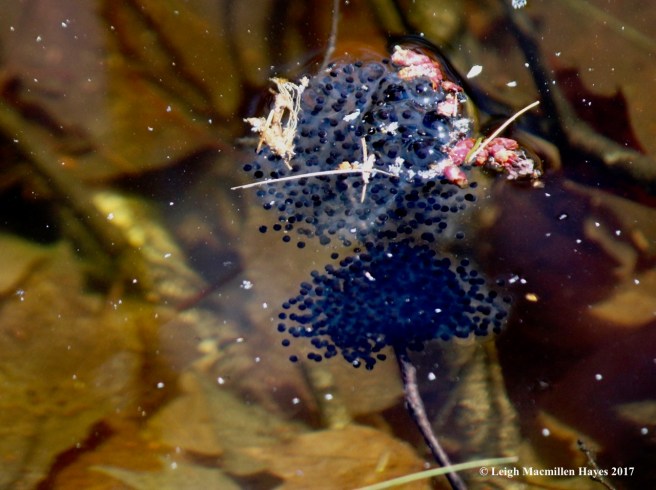
h-wood frog eggs 1

As I approached the vernal pool, I heard not a sound. But, my heart filled when I spotted a clump of wood frog eggs.

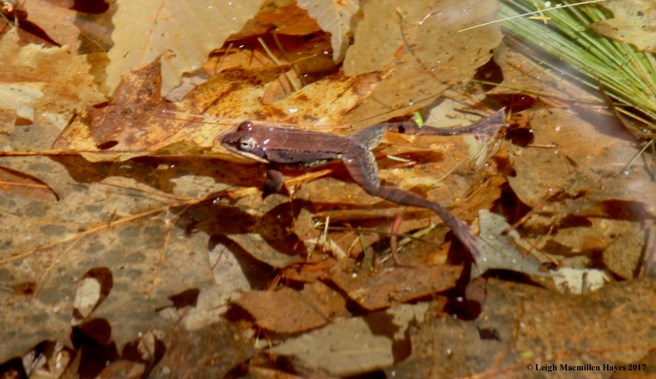
h-wood frog 1

When our sons were youngsters, we always called it the frog pond rather than the vernal pool. And so it is . . . both.

h-willow pollination

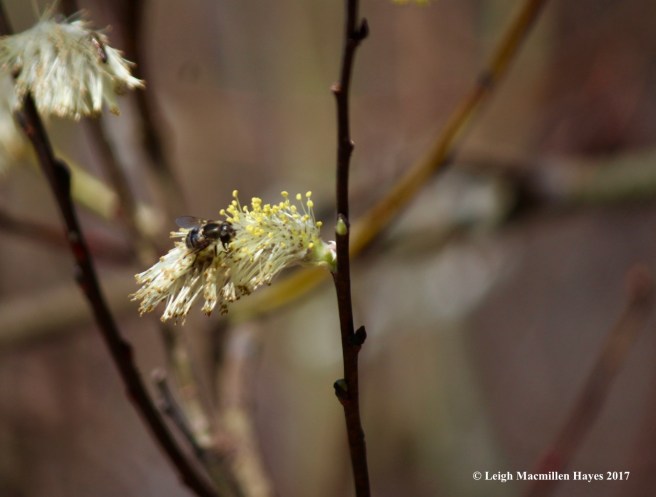
After an hour spent in the pond’s midst, I drove to another–Holt Pond–where I decided to park on the corner of Perley and Grist Mill Roads. I wasn’t sure of the conditions on Grist Mill Road and figured that provided the perfect excuse for a walk and an opportunity to take in the sights along the way. Stepping out of the truck, pussy willows called to me . . . and to their pollinators.

h-queen anne's lace

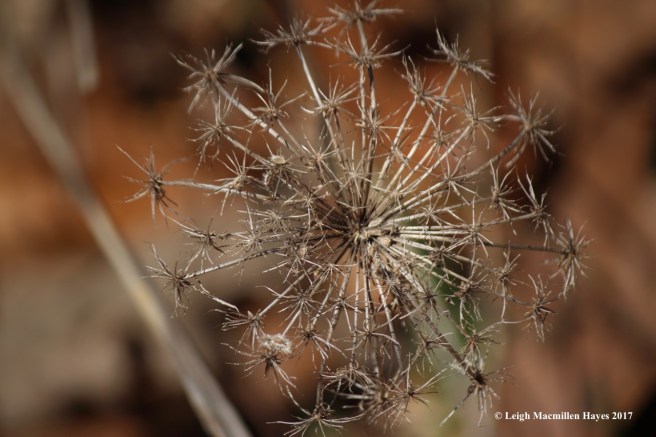
And on the corner, a dried Queen Anne’s lace displayed its fireworks formation.

h-sensitive fern frond

There were sensitive fern fronds, their beads still encapsulating many cases containing dust-like spores.

h-beaked hazelnut

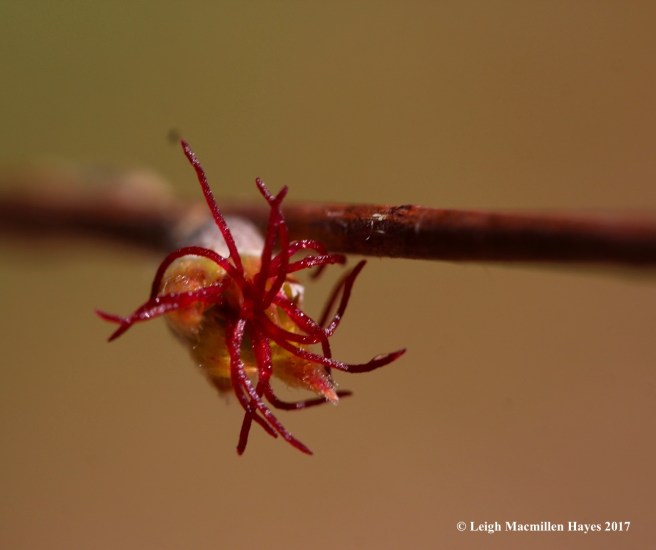
And I even found a few beaked hazelnuts still showing off their minute magenta flowers.

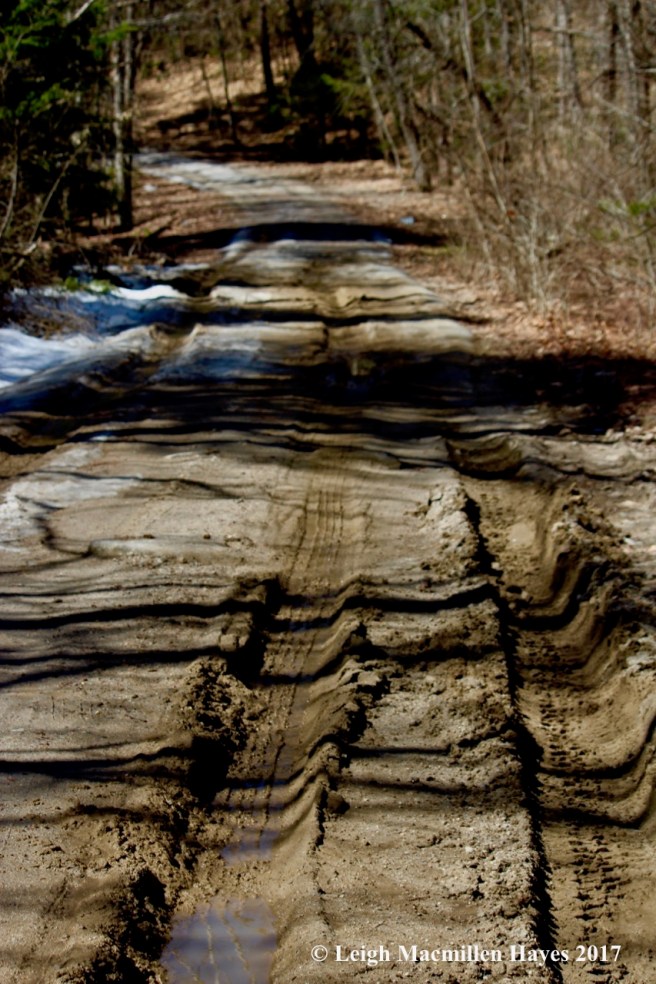
h-Grist Mill Road

I knew by my observations that I’d made the right decision to walk in–both in my findings and in the road conditions.

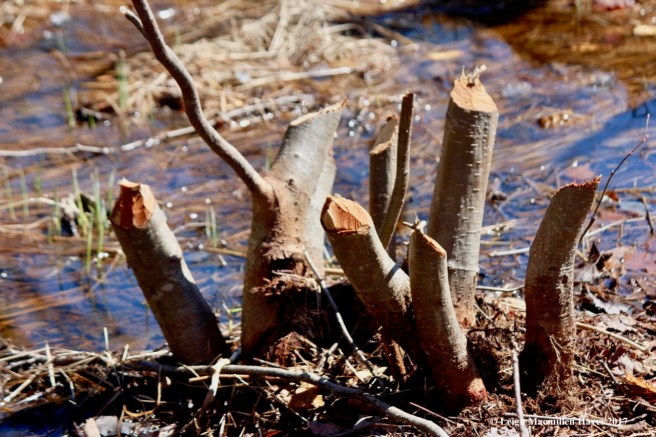
h-beaver works1

After following the initial trail and climbing over the stonewall, I was about to step onto the first boardwalk when I realized the beavers had been busy.

h-board walk-first section

The water was high as I quietly moved along the board walk, but not too high.

h-pitchers under water1

Although in some cases pitchers were submersed in the wet goodness.

h-speckled alder 1

The speckled alders didn’t mind for they love wet feet.

h-Muddy River

I stepped out to the Muddy River and listened to the chickadees sell cheeseburgers galore.

h-beaver lodge

And then I turned in the opposite direction to admire the beaver lodge and winter feeding pile beside it.

h-Boardwalk through red maple swamp 1

On the next boardwalk, the beauty of the red maple swamp surrounded me again.

h-Red Maple Swamp 1

Layers and colors spoke to the community and season.

h-red maple in swamp

And standing like sentries were the red maples for which it is named.

h-moose scat

It was here that I found evidence of another visitor, albeit this past winter–moose scat.

h-blueberry bud

And noted the swelling buds of highbush blueberries–their season in the offing.

h-Quaking Bog 2

After passing through the woodlands a couple of times in between the swamp journey, I at last reached the quaking bog and Holt Pond.

h-cranberries

Beside the board walk, last autumn’s cranberries floated in the water.

h-pitcher 2

And more pitcher plants showed off their hairy entrance ways.

h-pitcher flower

Withered pitcher plant flowers dangled in their woody fashion–as beautiful in death as in full bloom.

h-Holt Pond south

By the time I reached the T on the boardwalk, I was standing atop it, but in six inches of water–thankful for my rain boots.

h-Holt Pond to Five Fields

And thankful for the opportunity to stand there on a gorgeous spring day as I looked toward Five Fields Farm.

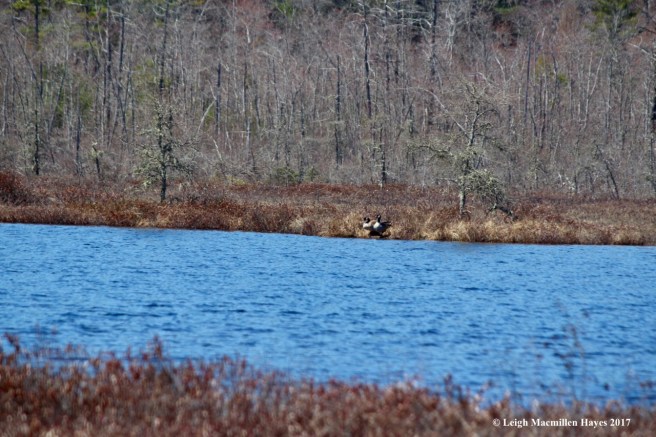
h-Canada Geese

In that very view–two Canada geese. I wondered if they’d found a nest site.

h-dragonfly exoskeleton 2

Also in view, last year’s dragonfly exoskeleton that bobbed in the water flowing over the boardwalk.

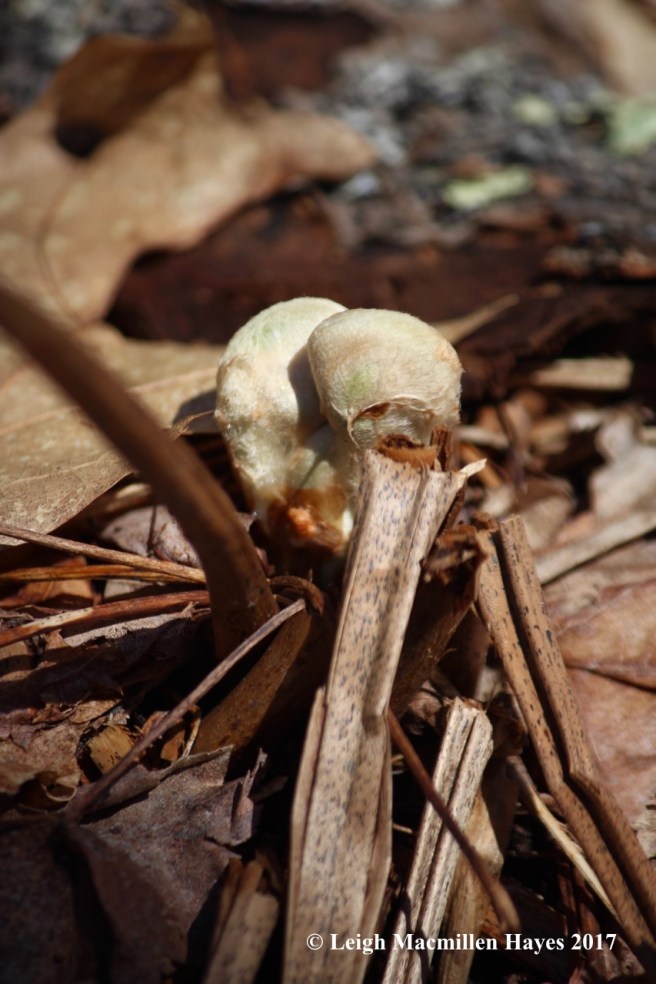
h-cinnamon crosier 1

On the way back, I stopped once again. My first photo call was an ostrich fern that I didn’t realize grew there. See why you should walk in rather than drive? That photo didn’t come out so well, but I was standing in an area filled with cinnamon ferns and suddenly realized I was looking at my first crosiers of the season.

I was actually down by a stream beside the road when I found these. A truck came along and the driver paused. He and his friend thought I was fishing and were going to ask what I’d caught. “Only photos,” I said playfully.

h-garter snake 1

Upon returning home I decided to visit the frog pond one more time, thinking the lighting would be different. At the end of the cowpath I found a garter snake enjoying the warmth of the sun . . . and probably a few insects.

h-wood frog eggs 2

When I’d walked to the pond this morning, I was surprised at how quiet it was. That changed this afternoon as a chorus of wrucks added music to my day. And another egg mass had been added to the display.

h-wood frog 2

Of course, all quieted down once I arrived, but I waited . . . and realized the pond really is full of life.

I’d spent the day beside my favorite ponds and was well rewarded. I’d also played with my camera settings, avoiding auto-focus all day. I’ve got a lot to learn, but hey, isn’t that what it’s all about?

A Good Mourning Mondate

A good mourning? Indeed it was. Yesterday we celebrated Easter and the resurrection. Today we celebrated an opportunity to climb our favorite mountain.

p-Mountain stream

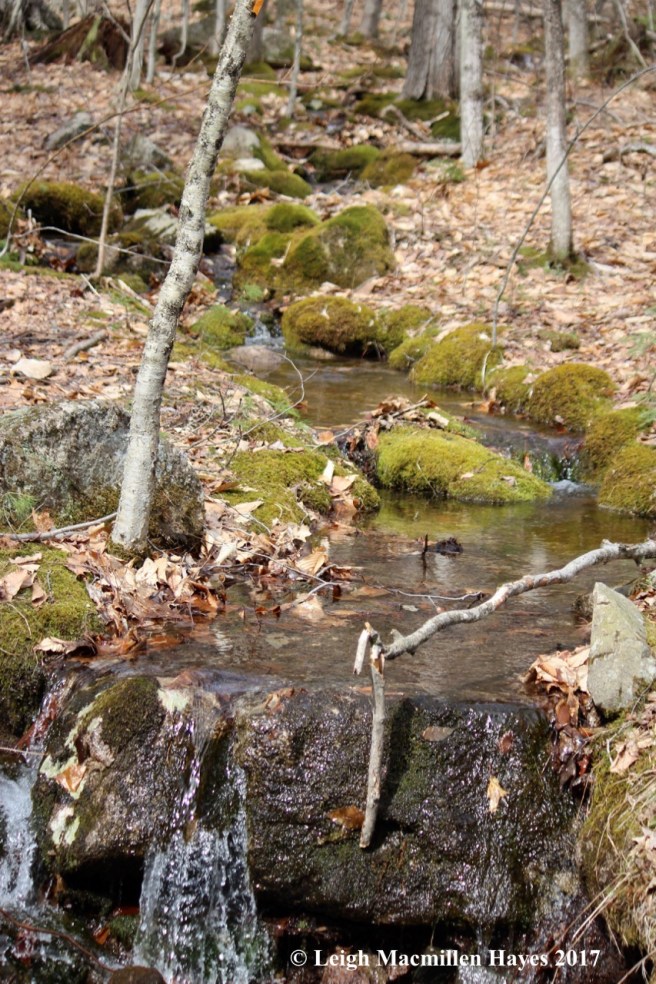
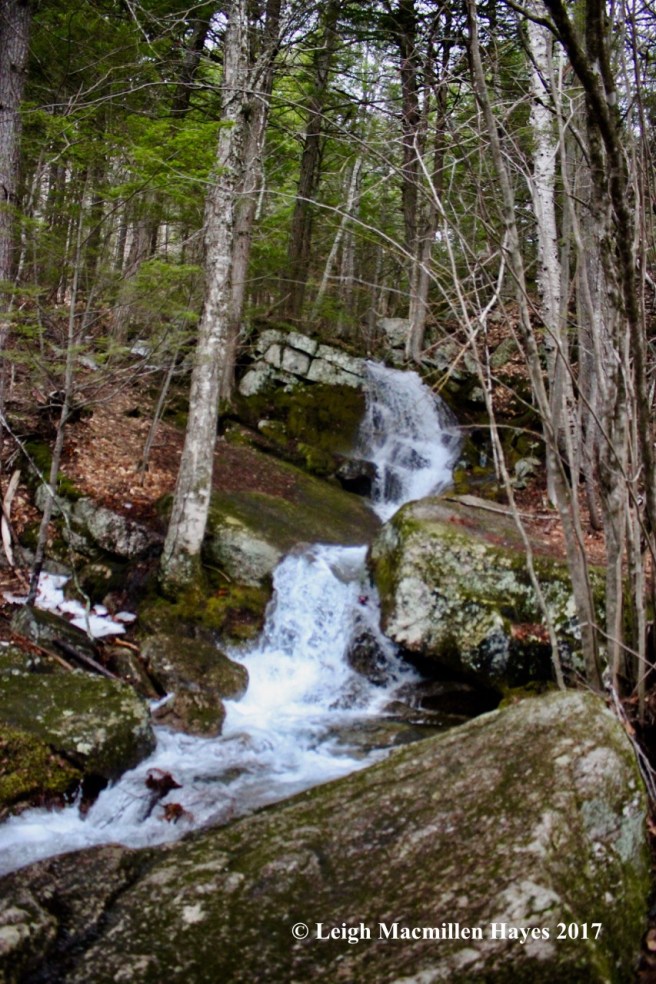
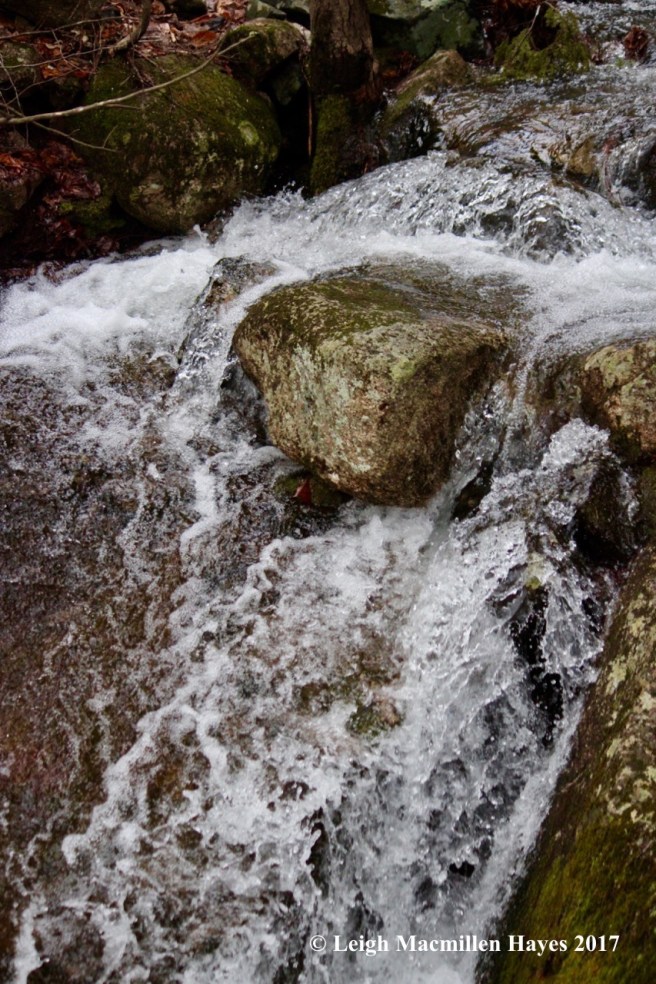
And so we parked the truck at Loon Echo Land Trust’s Ledges Trail parking lot on Mountain Road in Denmark and then walked 1.5 miles back to the trailhead we chose to make our ascension up Pleasant Mountain. Along the way, mountain streams quickly moved the meltwater downward toward Moose Pond, where it will mingle with the lake water and eventually find its way to another stream and then the Saco River and finally out to sea. And whether via future raindrops or snowflakes or even fog, traces of the same water molecules may again find their way down these streams.

p-bald peak trail

At last we reached the trail head for the Bald Peak Trail, where less than a week ago Marita and I had to climb over a tall snowbank to reach the path.

p-ice chunk

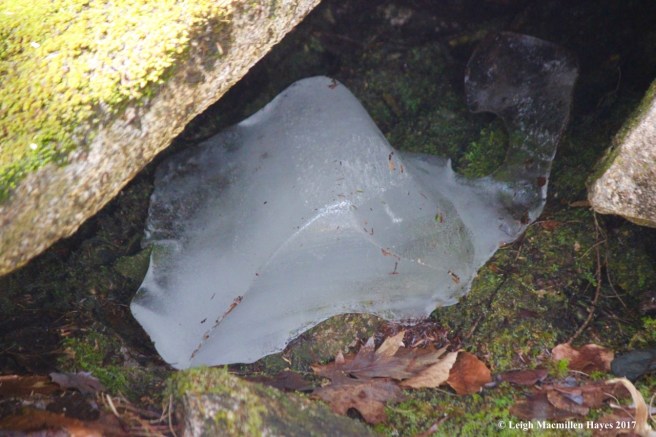
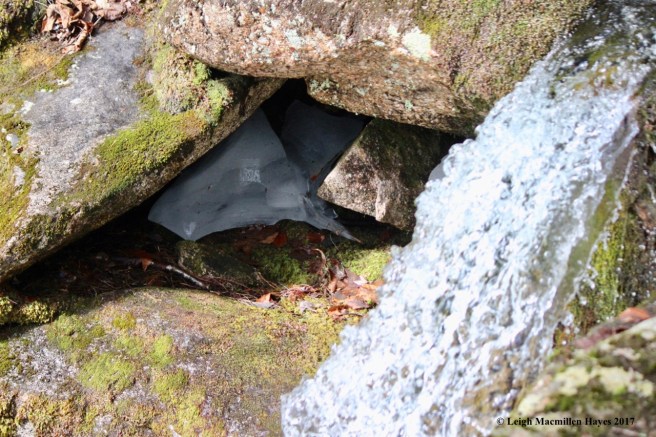
As we climbed and paused to admire the water flowing beside us, I noted differences between last week and today, including the shrinking of an ice chunk tucked under a rock. Ever so slowly, it joined the forces of downward motion, as if letting go was meant to happen with care.

p-Needles Eye

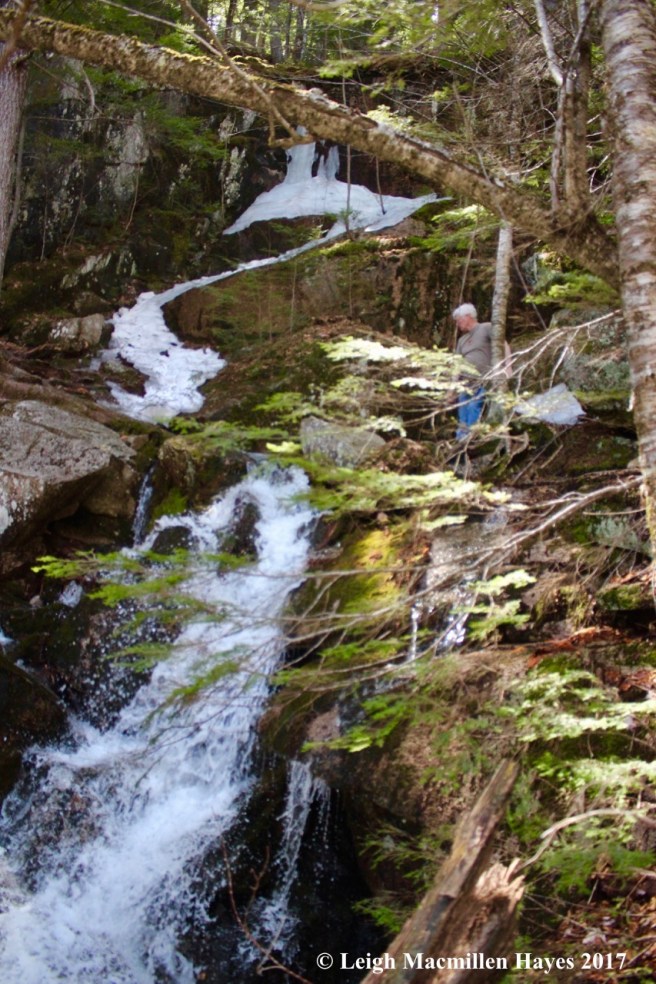
And then at the spur, my guy and I turned left to Needles Eye. Some ice and snow still covered parts of the path, but it was much easier to negotiate than last week. And he did. I followed him, but didn’t need to step into the chasm since I’d just been there. (wink) Instead, I climbed below to try to capture the world above.

p-returning from Needles Eye

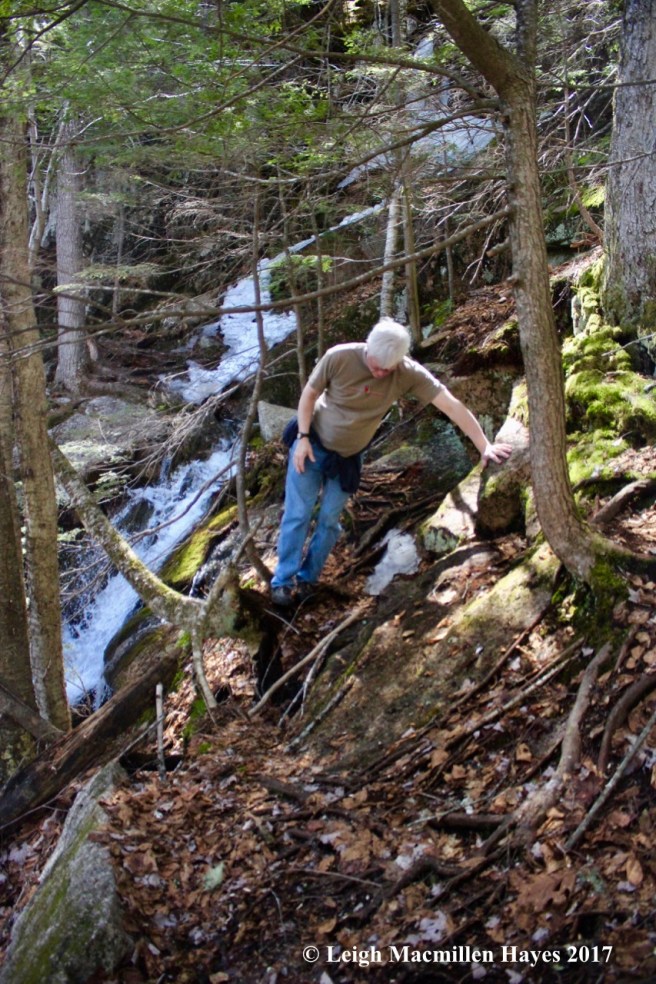
And then I rejoined my guy and wished I’d taken a photo of this section last week for today’s conditions didn’t reflect the same treacherous stretch Marita and I worked our way across.

p-snow on trail

We continued up the trail, where snow and ice were more prevalent. Though we had micro-spikes in our pack, we managed to avoid wearing them. And only once did I completely sink in–just below Big Bald Peak. I actually went up to my thigh, so deep was the snow. And cold. But I was hot, so it felt refreshing.

p-pileated scat

But before we reached the sharp left turn on Big Bald Peak, we noticed tons of chips at the base of a hemlock tree. Such a discovery invited a closer look–and I spied the largest pileated woodpecker scat I’d ever seen. Later on, when we were almost at the Fire Warden’s Trail, we saw two hikers on their way down and I quickly realized one was my dear friend Joan–another lover of scat and all things mammalian. Of course I told her what to look for as she and her hiking friend headed down the Balk Peak Trail. And I just received an e-mail from her: “Deb and I saw it! It was huge! She was so excited to see all the little ant bodies!” Indeed.

p-Mt Wash from top of Bald Peak Trail

The wind blew fiercely when we reached Big Bald, where white and red pines framed a view of another big bald–Mount Washington in the distance.

p-view from lunch rock 2 (1)

Not far along the trail, we found lunch rock in a section that offered some protection from the gusty wind. It was the perfect place to enjoy our PB&Js followed by Cadbury Digestives (thanks sis).

p-view from lunch rock

Through the trees, we could again see the mighty mountain to our west.

p-blueberries 1

And at our feet–blueberry buds galore. My guy began to see blue where no blue yet exists–the promise was enough.

p-along ridge line

Walking along the ridge line was like a walk in the park. At times, where the sun didn’t hit the northwest sides of ravines, we found more snow, but more often than not, the trail was neither icy nor muddy.

p-wood frogs

It was in one of the ravines, however, that we heard a song of spring–the wruck of the wood frogs singing from a vernal pool located below. A first for us this year and we were happy to be in the presence of such a sound.

p-fire tower 1

It seemed like in no time, we approached the main summit where the iconic fire tower still stands tall.

p-summit 6 (1)

We took in the view toward Brownfield and beyond.

p-summit toward Washington

And again looked toward Mount Washington.

p-Mt Wash1

Even upon the mighty one, we could see the snow has melted gradually. But our stay wasn’t any longer than a few minutes for the wind was hat-stealing strong and I had to chase mine.

p-hiking down ledges

And so down Ledges Trail we descended in order to complete our loop. Here we rarely saw signs of snow or ice.

p-ledge view 1

The southern basin of Moose Pond stretched before us, most of its surface still covered with the grainy gray ice of spring. Any day now, ice out will be declared, late as it is.

p-tent caterpillars

It was on the ledges that I noticed tent caterpillars already at work.

p-red maple 1

Thankfully, there were more pleasant sights to note, including the first flowers of red maples.

p-striped maple buds

And along the trail below the ledges, plenty of striped maples showed off their swelling buds.

p-acorn

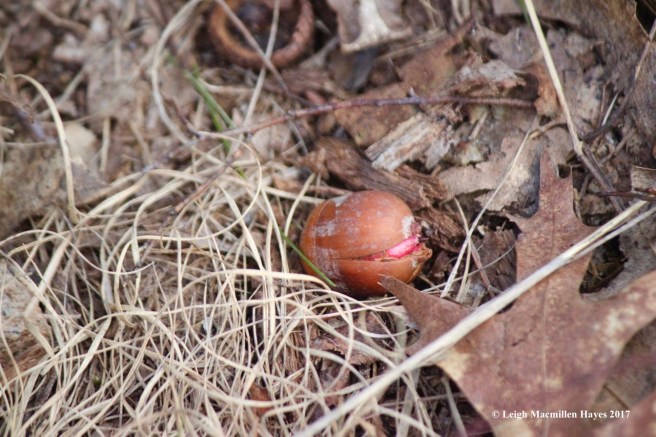
Last summer, the oaks produced a mast crop and those not consumed by the squirrels and turkeys have reached germination. This one made a good choice about a place to lay down its roots–hope burst forth.

p-beaked hazelnut 2

As we neared the end of the trail, I began to notice the beaked hazelnuts and savored  their tiny blooms of magenta ribbons. And we could hear spring peepers. So many good sights and sounds along our journey.

p-mourning cloak 1

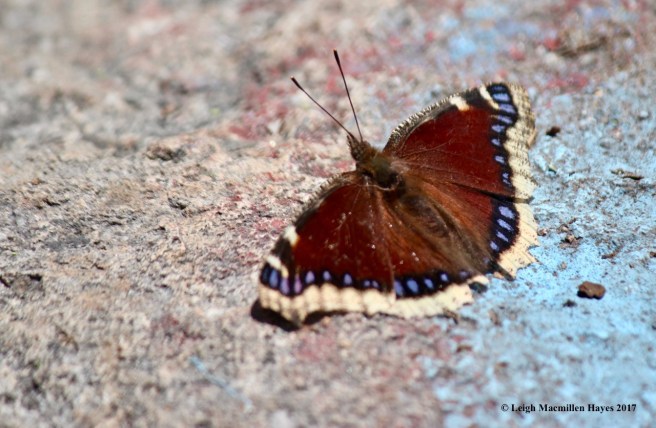
On each trail we hiked today, we were also blessed with butterfly sightings. It’s always a joy to see these beauties, who actually overwinter as adults in tree cavities, behind loose bark, or anywhere they can survive out of the wind and without being consumed by predators. They survive by cryopreservation–the process of freezing biological material at extreme temperatures. In Britain, their common name is Camberwell Beauty. In North America, we know them as Mourning Cloaks–so named for their coloration that resembled the traditional cloak one used to wear when in mourning.

I think I may have to stick with Camberwell Beauty for a name, given those velvety brown wings accented by the line of black with azure dots and accordian yellow edge. What’s to mourn about it?

So we didn’t. Instead, we enjoyed a good morning Mondate–and afternoon.

A Blue Bird Kind of Good Friday

When Jinnie Mae picked me up this morning, our destination was the Narrow Gauge Trail. But somewhere between here and there, she pulled a U-turn and drove to Narramissic Farm owned by the Bridgton Historical Society.

It had been just over a year since I last visited and I wanted to show her the shagbark hickory buds. And maybe even the bear trap.

n-Pleasant Mtn to Narramissic1

We crossed the field behind the house and started off on the path to the quarry and bear trap, but snow and water in the woods resulted in another U-turn. We’d been talking so much, we’d hardly noticed our surroundings, but the view stopped us in our tracks.

n-Pleasant Mountain

To the left, the long ridge line of Pleasant Mountain, where the ski trails of Shawnee Peak Ski Area made themselves known.

n-Narramissic

And in front of us, the Temperance Barn and Peabody-Fitch homestead, built in 1797. We had the place to ourselves and reveled in the quiet of the day–when we weren’t talking, that is.

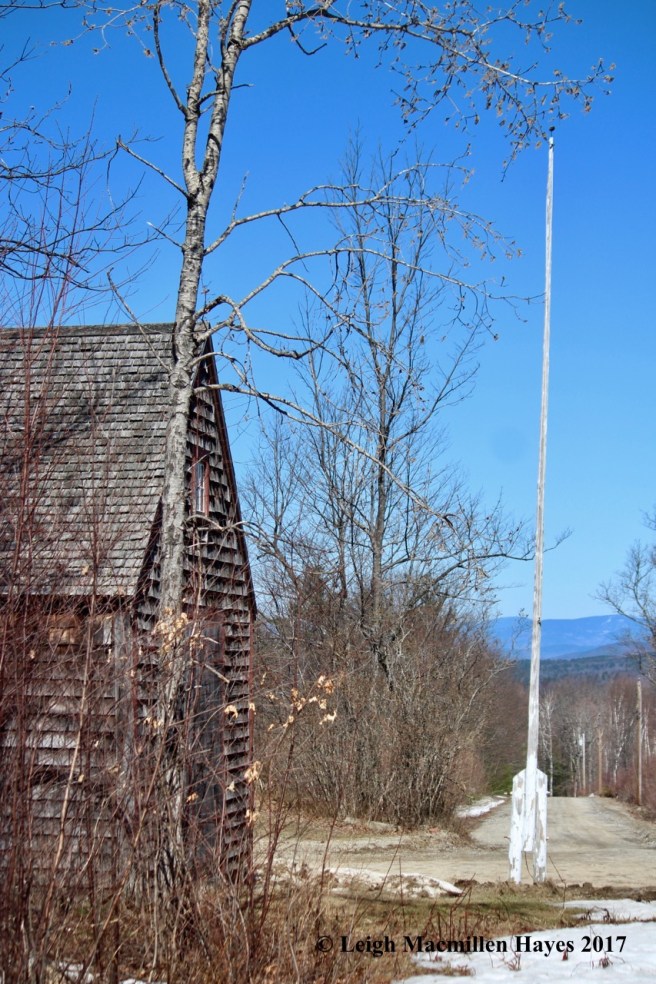
n-shop and flagpole

Heading to the road for our tree bud search, we passed by the blacksmith shop where horseshoes were probably made in the day.

n-temperance barn

And at the Temperance Barn, so named “because it was raised without the traditional barrel of rum,” I can never resist admiring the structure even though it’s in great need of repair.

n-ash tags

And then we were stumped by a flowering tree. It sure looked like an ash as Jinnie Mae suggested, but what were those lacy tips? What came to my mind first were the tags on red oaks that I didn’t understand a few years ago until a friend helped me realize that they were leaf stems left behind when the wind finally claimed the dried leaves. Was this the same?

n-double-wide stonewall

Climbing onto the double-wide wall, I took a closer look.

n-white ash danglers 1

Turns out Jinnie Mae was right. But my question still remains. Were these the stems of the ash samaras or compound leaves?* For some reason I’ve never before seen them left behind. Ah, there are so many things to discover in this world.

n-black walnut 3

We continued down the road, noting budding pussy willows and flowering red maples. And then I spied the bulbous buds I wanted to show her. Only, it turns out that we hadn’t reached the hickory trees yet.

b-black walnut leaf scar 2

The monkey face leaf scar should have been a clue. But my brain was stuck in hickory mode and I completely forgot that black walnut leaves leave such a formation. At home, I pulled out Forest Trees of Maine and then seesawed between black walnut and butternut (aka white walnut). Both feature leaf scars shaped like a monkey’s face. But the top of the leaf scar serves as the give away–this one did not have thick fuzzy eyebrows like a butternut, so I’m going out on a limb and declaring this a black walnut.

n-shagbark bud hairy 1

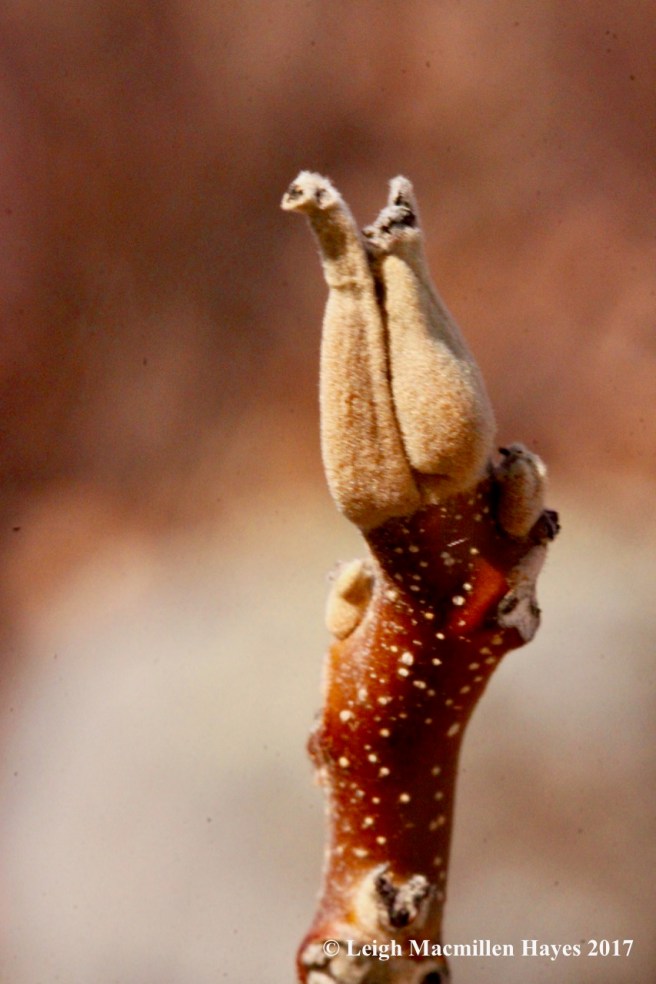
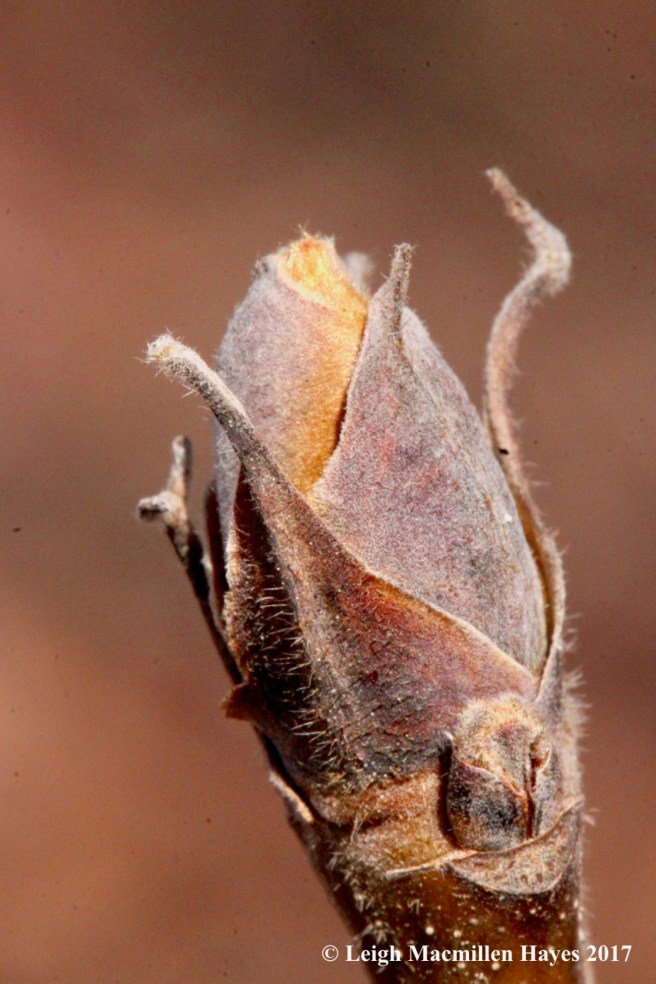
A bit further down the road we spotted more bulbous buds. These were definitely the ones I was looking for–shagbark hickory. In the moment and because the two trees weren’t close together, we thought they were all one in the same. But hindsight being 20/20 as it is, the photographs tell the story.

n-shagbark bud 6

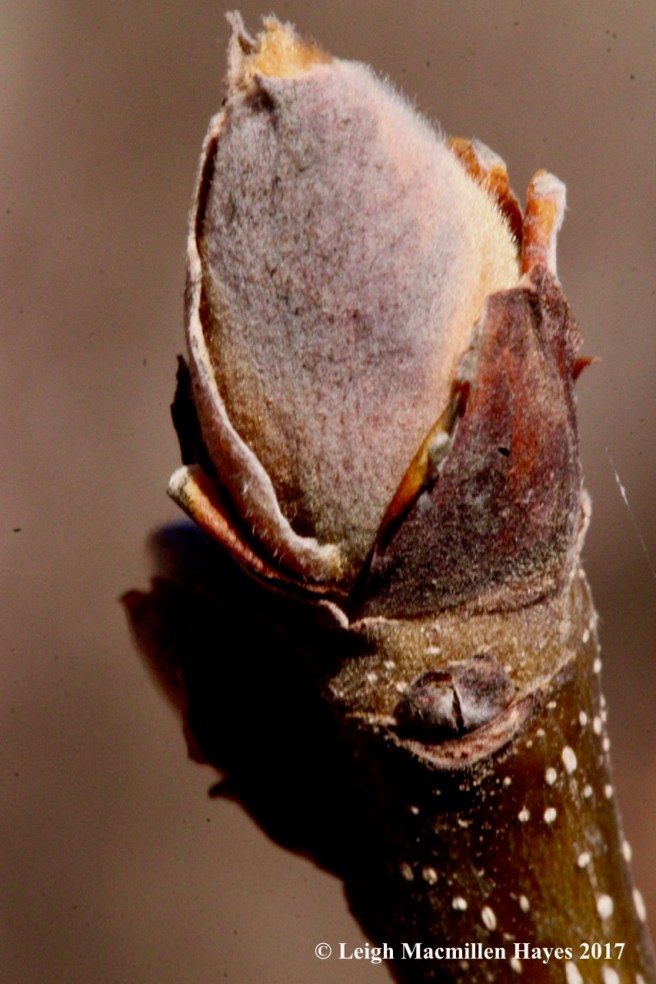
The subtle colors and fuzziness wowed us and we both took numerous photos.

n-shagbark leaf scar1

Then there were the leaf scars–definitely more heart-shaped than the previous trees.  And lacking that smiling face. We smiled for them.

n-Long Lake below

It wasn’t enough to find the small saplings beside the road and so we crossed another field in search of the mother tree.

n-grasshopper 1

Along the way, Jinnie Mae spotted a wee grasshopper–the first of the season for us.

n-shagbark bark from distance

And then her newly trained shagbark hickory eyes keyed in on the momma.

n-shagbark bark 3

If you go, it’s located behind the barn.

n-shagbark bark 5

And shouts its name in presentation.

n-shagbark bark 4

Looking upward, we could see the bulbous buds on the twig tips contrasted against the bright blue sky.

n-bluebird

Happiness is a blue bird kind of day–sweetened by time spent exploring with Jinnie Mae, making discoveries and watching bluebirds move between the field and the trees. Indeed it was a Good Friday.

Now we need to return and find the mother black walnut.

*Thanks for Maine Master Naturalist Pam Davis for IDing the ash strand as the rachis of the compound leaf. She reminded me that I have seen these on the ground in the fall. But–to be still dangling from the tree was new to my eyes and mind.


A Wiser Soul

It all began when I stepped out the back door just before six o’clock this morning. From the treeline I heard a barred owl call, “Who cooks for you? Who cooks for you all?” I could have returned to bed then, happy for the opportunity to hear such a wise one.

n-Northern Flicker

Not long after that, as I passed by a window in the butler’s pantry (no, we don’t have a butler, just an old farmhouse), a splash of red on the ground drew my focus–a Northern flicker had stopped by to feed. Notice the subtle curve of its bill? The better to dig up ants and beetles, as is the custom of this ground-feeding woodpecker.

n-water coursing 2

An hour or so later, I met my friend, Marita, for a hike up the Bald Peak trail at Pleasant Mountain. Our destination–not the summit as we had a time constraint–but rather, Needles Eye.

n-beside the brook

Our climb included frequent stops at vantage points to take in the sound and beauty of the place.

n-water art 2

The flow of the living water and its ever changing presentation mesmerized us much as leaping flames do.

n-water art

It spiraled over the rocks like a sculpture in fluid motion.

n-ice hiding

And while so much poured forth and wound its way down the mountain stream,

n-ice at Needles Eye

some remained frozen in time.

n-crossing toward Needles Eye

At the sign pointing toward Needles Eye, we crossed a stream and then worked our way across the short spur to the narrow formation of rocks that water threads through.

I should qualify that. Marita sauntered across the ice and snow, seeking the wee bit of dirt and leaves at the edge of the trail. It’s a steep edge and even on a summer day, I pick my way carefully over rocks and tree roots. Today, my brain suggested I call it good and sit still. But, she’s a good friend, and realizing my trepidation (I’d forewarned her), she spoke to me calmly about each foot placement, and even turned back to demonstrate exactly what I should do, waited patiently as my brain shouted, “Don’t do it!” and my heart said, “I think you can, I think you can,” and offered a hand when necessary.

n-marita 3 (1)

Together, we did it. This photo is Marita’s as I didn’t want to change my camera lens once we stood in the chasm and watched the water fall.

n-inside the needle

On a summer day, it’s a delightfully damp place to rest before continuing up the mountain. Sometimes, there’s only a hint of a stream. Today, it was equally enchanting–perhaps we should have bowed in respect of the beauty and power before us. And just maybe we did.

n-climbing down 2

Returning on the spur, Marita again came to my aid. And then we hiked a bit further up until time forced us to head down again.

n-morning light

The descent seemed easier as the snow had softened a bit in the two hours we’d spent enjoying each other’s company and filling our senses with the sights and sounds surrounding us.

n-vp visit

Back at home, I was pulled out the door again and made my way to the vernal pool. Ever so gradually, the ice is melting.

n-crack across vp

And across the center, a crack divided it in two from east to west, while a line between the sunshine and shade completed the quadrants from north to south.

n-snowfleas 2

Piles of pepper, aka springtails, floated on melted water atop the ice.

n-snowfleas

Others clustered on the open water at the pool’s edge. Other than that, I could see no action. Every day, however, will bring something new so I know I’ll check back frequently.

n-our house:field

Leaving the pool behind, I headed toward the area where I’d heard the barred owl several hours earlier–and I called. It didn’t respond. But, I reminded myself that this morning’s greeting was enough.

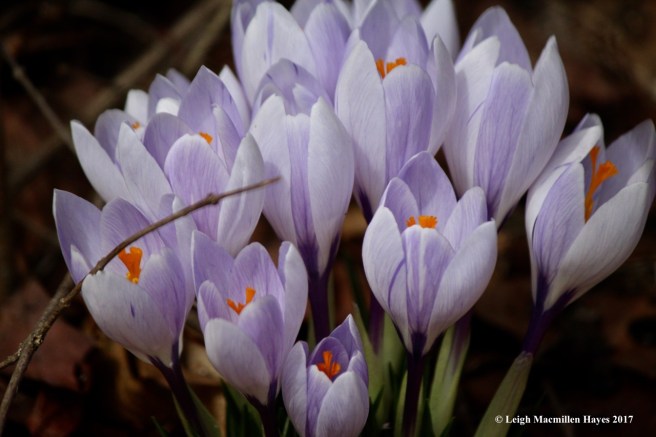
n-crocuses1

Returning home again, I couldn’t resist the crocuses that I first noticed yesterday. In the past few days, the snow has receded quickly and with today’s light, these spring beauties finally opened.

n-first daffy--a double

And then, in the garden beside the house, I found one more surprise–a double daffodil blossoming under some leaves. In this season of watching with wonder, my heart was full.

n-Marita

This day will stick with me for its offerings and I’ll be forever grateful to Marita . . .

n-marita 4 (1)

for without her help, I wouldn’t have had the gumption to stand in the Needles Eye. She is a kind and funny and wise(r) soul. And I am blessed by our friendship.

P.S. Two minutes after posting this blog, a woodchuck ran across the deck–headed toward the barn, of course.


Just Around the Bend

Due to the generosity of friends, this afternoon I picked up some items for the Lakes Environmental Association’s silent/live auction to be held at the Stone Mountain Arts Center on July 14th. And one of those pick-ups put me in the Horseshoe Pond area where a mourning cloak butterfly danced in the sky as I drove down the dirt road. Alas, I couldn’t photograph it, so it will have to remain in my mind’s eye, but I was excited for it was the first sighting of the season–a harbinger of spring.

w-Horseshoe Pond 1

Back at the boat landing by Horseshoe Pond, I parked, donned my Boggs, and hoped for another butterfly sighting. It wasn’t to be, but the view was worth a pause as I looked at the left portion of this upside-down, U-shaped pond.

w-Sucker Brook from the culvert

The water roared through the culvert and I walked to the other side of the road, where the pond outlet becomes Sucker Brook–which overflowed its main bed.

w-Sucker Brook 2

My friends suggested I might need snowshoes, but of course, I’d left them home. They were right. I should have worn them and dig post holes I did as I followed the brook. Of course, first I had to climb over the dirt-covered snowy embankment by the road in order to get onto the trail at the Greater Lovell Land Trust’s Wilson Wing Moose Pond Bog Preserve. It was worth the effort.

w-snow layers by yellow birch

One of my favorite spots along the brook is this yellow birch tree, which typically stands on stilts atop a rock at the water’s edge. Who would know? For now, those spindly legs are still blanketed under layers of snow.

w-squirrel works

I expected the tracking conditions to be better than they were, but instead needed to focus on signs if I wanted to figure out what mammals came before me. Several middens of cone scales spoke of red squirrels. And there was deer scat nearby.

w-hobblebush 1

Because this is a moist area, hobblebush grows here and I couldn’t resist an opportunity to enjoy its sculptural structure created by downy-coated leaf buds.

w-hobblebush 2

Equally beautiful were the expanding flowers–globe-like in appearance, with subtle hints of green.

w-Wilson Wing Moose Pond Bog

And at the viewing platform, I was forced to climb up. Last year, Moose Pond Bog was a shrunken wetland, or so it seemed given the drought. Today–water, water, everywhere.

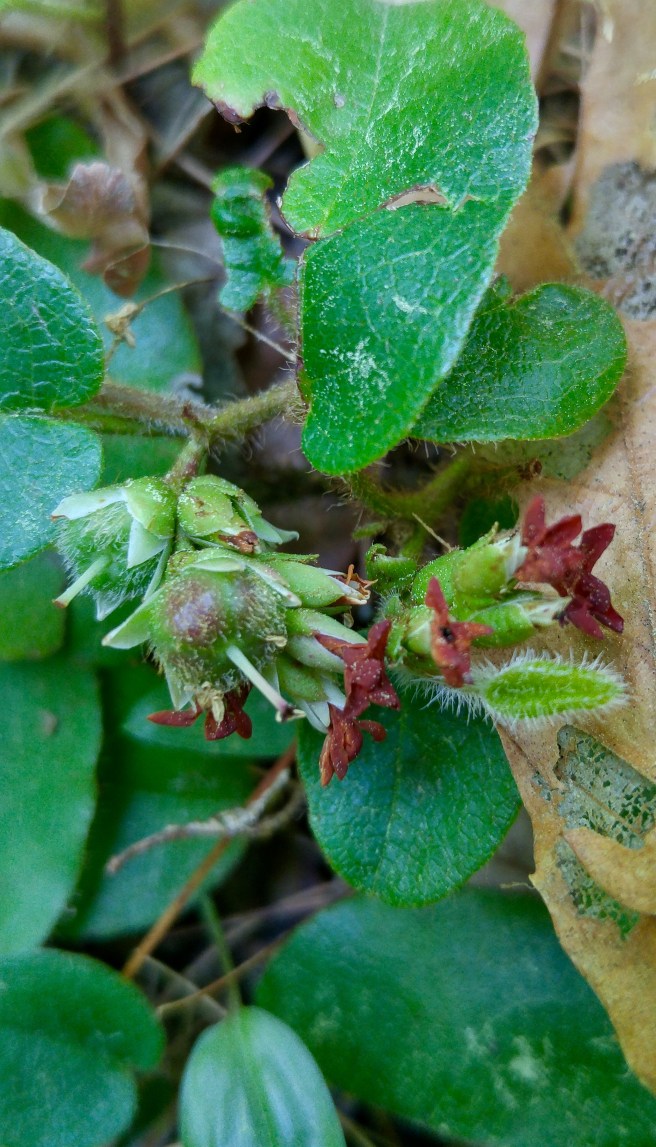
w-wintergreen

Back down the stairs, I searched about in a few sunny spots where the snow had melted. That’s when I spied last year’s berry dangling from a plant still sporting its maroon coloration of winterberry.

w-trailing arbutus leaves

And near it–a sight for spring-needy eyes . . .

w-trailing arbutus buds

trailing arbutus leaves and flower buds. Yes, Virginia, spring will come to western Maine. And we’ll all appreciate it more for it’s a season that never likes to rush.

w-mourning dove feather 1

I continued on and when I paused to look at some common polypody ferns that decorate a boulder, I spotted something else.

w-feathers 3

Feathers of varying sizes were scattered about.

w-mourning dove 1

A mourning dove had served as dinner. But for whom? No matter. Taking advantage,  snow fleas hunted for their own form of sustenance on the only part of the bird left behind.

w-stream 1

Before I climbed up to the road at the end of the trail, I had one more stream to cross–it’s usually a mere trickle, but not today.

w-tinderconks1

Rather than backtrack, I chose to walk the road–a much easier substrate. It was along there that I saw numerous tinderconks decorating one tree. Though they are also known as horse’s hoof, these reminded me more of elephant feet with big toes protruding at the base.

w-dragonfly spot

Back by my truck, I looked for the mourning cloak again–to no avail. Instead, my eyes were drawn to the reflection and memories of dragonfly hunting in this very spot last summer.

w-shimmering heat of the day

And when I looked back out on the pond, I could see the shimmering effect that occurs when the heat of the day meets the cold of the ice. The temperature reached into the 80˚s today. The meltdown has begun. It won’t be long now. From what I saw, spring truly is just around the bend.

Dear Aunt Ruth

My memories are snapshots of times spent with you and Uncle Bob and all the cousins. I loved visiting your home–whether we drove down the long road and driveway with Dad or walked via the old dump road and skeet field with Mom. Each time we arrived, you welcomed us with grace and your unassuming manner.

I remember sipping lemonade on the back porch, riding the wooden horse, and checking on Dale’s bunnies, especially Peter who soon became Mrs. Peter. I remember lunches at your kitchen table, and the time we bit into our tuna sandwiches only to discover the bread was filled with ants. Why that sticks with me, I don’t know, but we all thought it was funny. I remember family reunions, where food and laughter and aunts and uncles and cousins were abundant. Eventually, it evolved into a musical gathering–such was the talent of the clan.

But most of all, I remember your flower and vegetable gardens and your love of all things natural.

p-kiosk

And so today, as my guy and I ventured to a park we’d never before visited, I took you with us. I wanted to share with you our findings, just as you used to share stories of your gardens and wildlife sightings with us in Christmas cards after I moved north.

p-moose trail

Our first observation–a moose! Well, not really.

p-deer tracks

But we did see evidence of deer and I knew you’d be glad they were running away–leaving your gardens alone. Oh, and those pesky raccoons! Raising eight children didn’t seem to phase you, but those raccoons in the corn field–that did rattle you.

p-gardens on high

The gardens in these woods differ from yours–and right now, given the snow cover, the only ones visible were high up in pine trees, where yesterday’s snow offered nourishment to the mosses and lichens that grow there.

p-locust legume-like seed pod

We did, however, find one similarity–the legume-like seed pod from a locust tree. It’s almost time to sow the peas.

p-apples

In these woods, we also found a symbol of the past–it was once farmland as signified by the apple trees. If memory serves me right, there was a very climbable apple tree beside your driveway.

p-hidden acorn

And then we spied one impossible possibility–an acorn tucked into red maple bark. How did it get there? And will it germinate? If it does, what then?  I trust, you too, would have noticed such and wondered.

p-pratt brook 2

We followed the trails through the woods and sometimes beside the brook for which the property was named–Pratt Brook. It was a bit more bubbly than the creek in your yard, but such is the snow melt right now.

p-artist conks

Along the way, I noted a family of artist conks decorating a tree. And, that, of course, brought to mind the box of colored pencils you (or perhaps it was the cousins, though Neal had no qualms about telling us that our gifts were really chosen by you) gave me long ago. I cherished that box and used those pencils with care. They lasted into my early adulthood.

p-colors 1 (1)

And then my guy gifted me another box, which I again revere. One of my favorite pastimes is to sit and sketch and then add a dash of color. Whenever I do, Aunt Ruth, you are with me.

p-powerline

For a while we followed the power line trail, aka Bear Trail. As you can see, we tramped in the footsteps of many others who’ve traveled this way just today–via skis, snowshoes and hiking boots like us. We were an hour from home and close to the ocean, so the snow level was about six inches compared to at least two feet we walk upon daily. But today’s sun warmed us and initiated a meltdown.

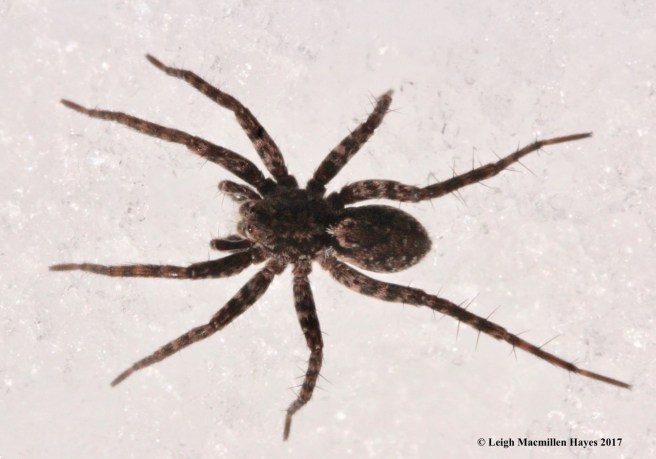
p-spider

I didn’t mind being on the power line for a bit, for it was here that we saw our only sign of wildlife.

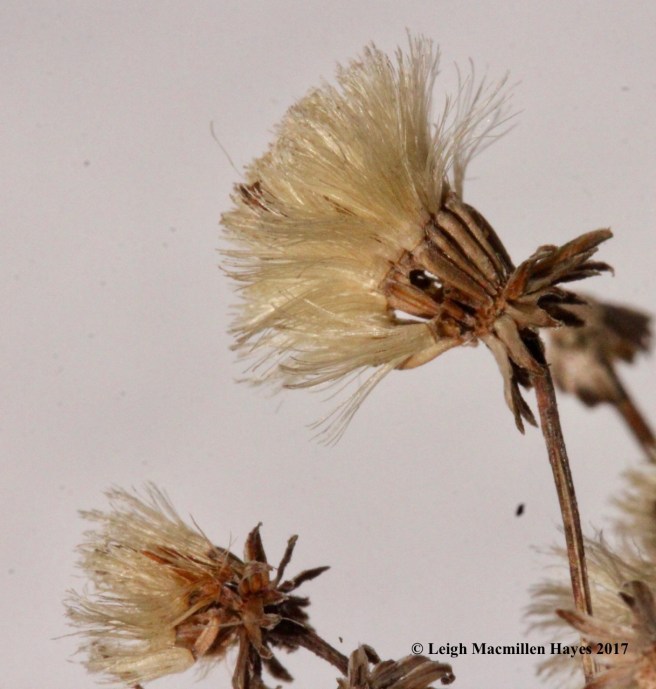
p-aster 1

It was also the spot where I knew we’d find wildflowers–and I wasn’t disappointed. Asters like these, and goldenrods, spireas and berries displayed their winter forms.

p-beetle 3

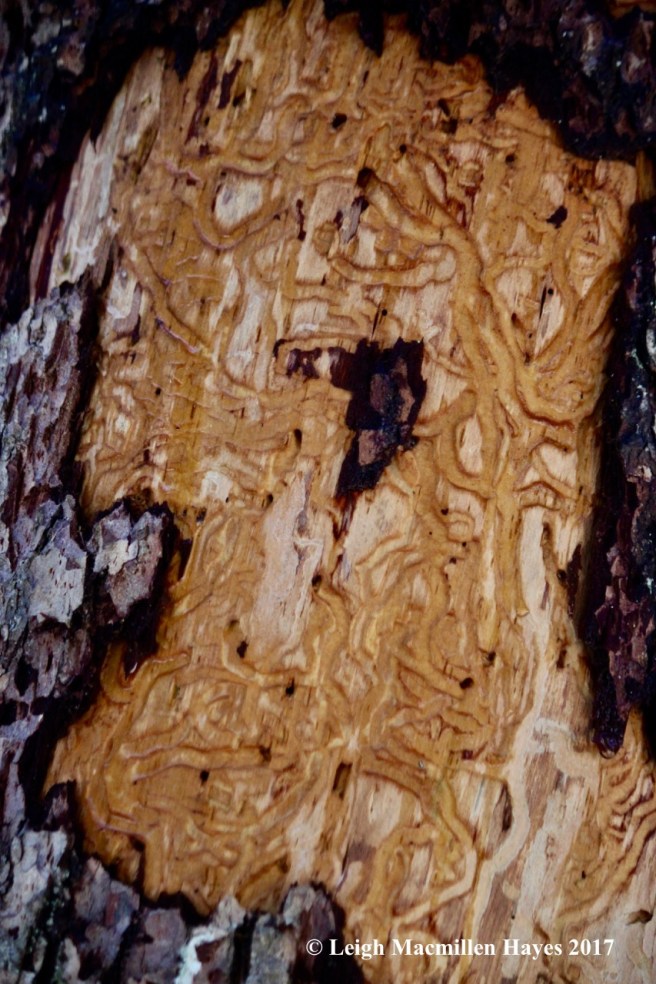
Back into the woods, we were almost done, when we spied this woodwork, carved by bark beetles.

p-bark beetles 1 (1)

And I was again reminded of my past observations when I moved a log and discovered a gnawer on the job.

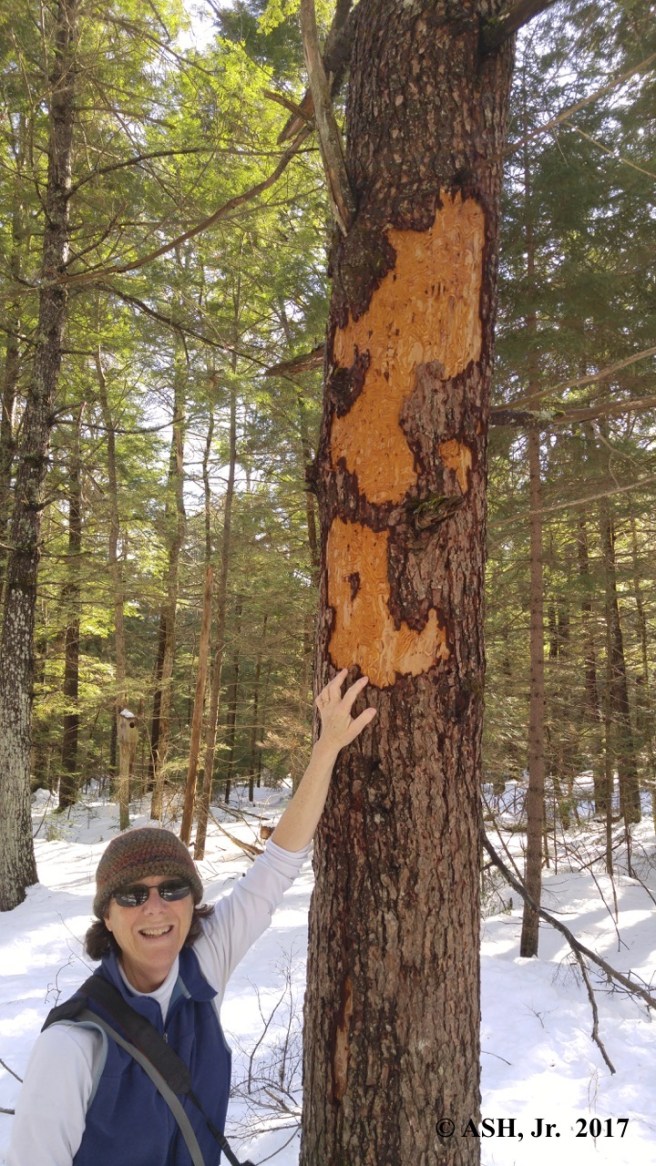
p-me

The intricate work reminded me of Uncle Bob’s woodworking skills and I knew you’d appreciate that. You’d also appreciate that as I write, my guy is watching a National Geographic show about Wild Scotland.

Thanks for the memories, Aunt Ruth. And thanks for making time for us and showing an interest in all that we did–always as curious about our adventures as those of your brood. You were a remarkable woman and a genuine Yankee whom I was blessed to have as a part of my life.

Fondly, Leigh


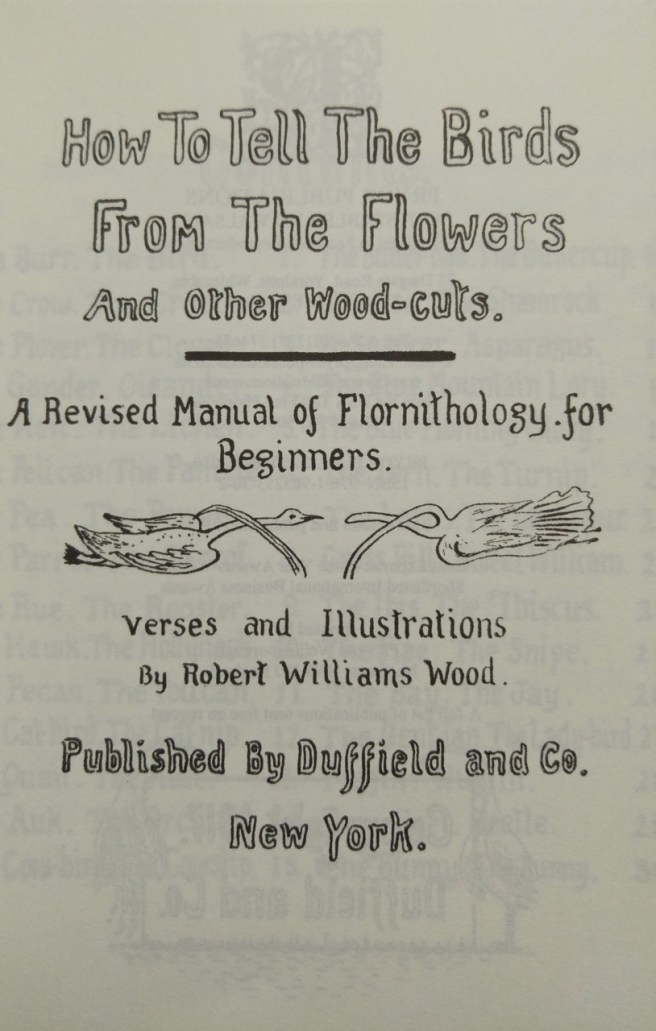
Book of April: How to tell the Birds from the Flowers

It’s April Fools’ Day and I can’t think of a more appropriate book to share as Mother Nature showers snow upon us than How to tell the Birds from the Flowers and other wood-cuts by Robert Williams Wood.

b-11 (1)

A friend found this delightful little ditty at an independent book store in Brattleboro, Vermont, several months ago and couldn’t resist purchasing it for me. Thank you, A.J. 

Can you see from the cover what Wood had in mind? 

b-9 (1)

And his language–Flornithology? Oh my. Artistic license met poetic license. 

The first edition was published in 1917–in Kent, England. According to a little research, Mr. Wood was born in England, but went on to become a physicist at Johns Hopkins. And they say (whoever they are) that he had no sense of humor.

Read on: 

b-8 (1)

b-7 (1)

After this introduction, it gets even better (in my humble opinion). 

b-6 (1)

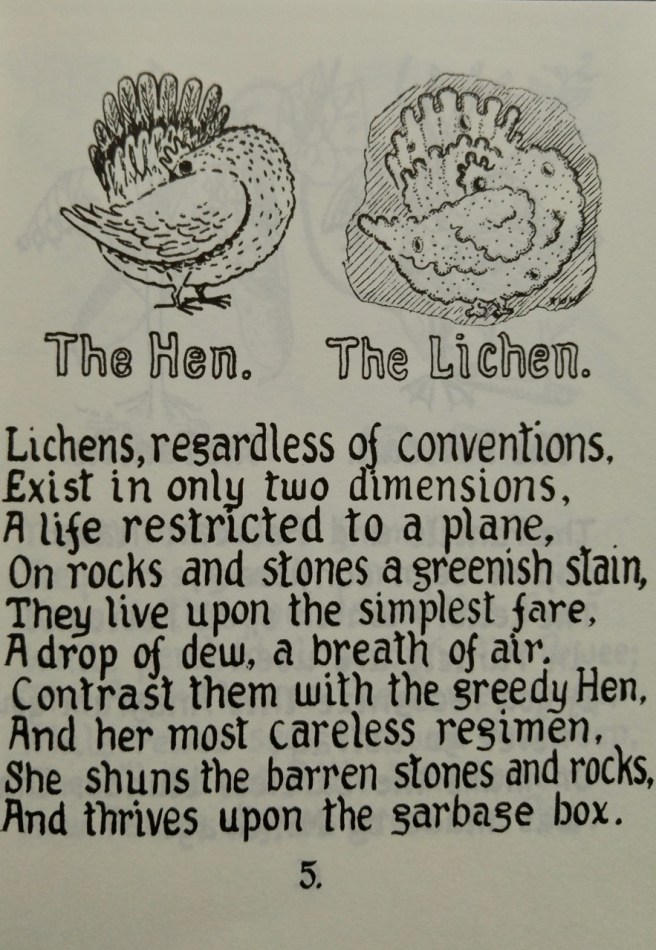
Whimsical rhymes and . . .

b-5 (1)

clever sketches;

b-2 (1)

Similarities and . . .

b-4 (1)

differences.

b-1 (1)

All found in the natural world. 

b-3 (1)

Doesn’t this just make you smile? The man lacked a sense of humor? Hardly.

And we know the Mother Nature also has a sense of humor. This isn’t the first time it has snowed on April first.

At the back of the book is a list of other facsimile reissues from Pryor Publications. Here are a few titles worth considering: Punishments in the Olden Times, Manners for Women, Manners for Men, A Plain Cookery Book for the Working Class and Why Not Eat Insects.

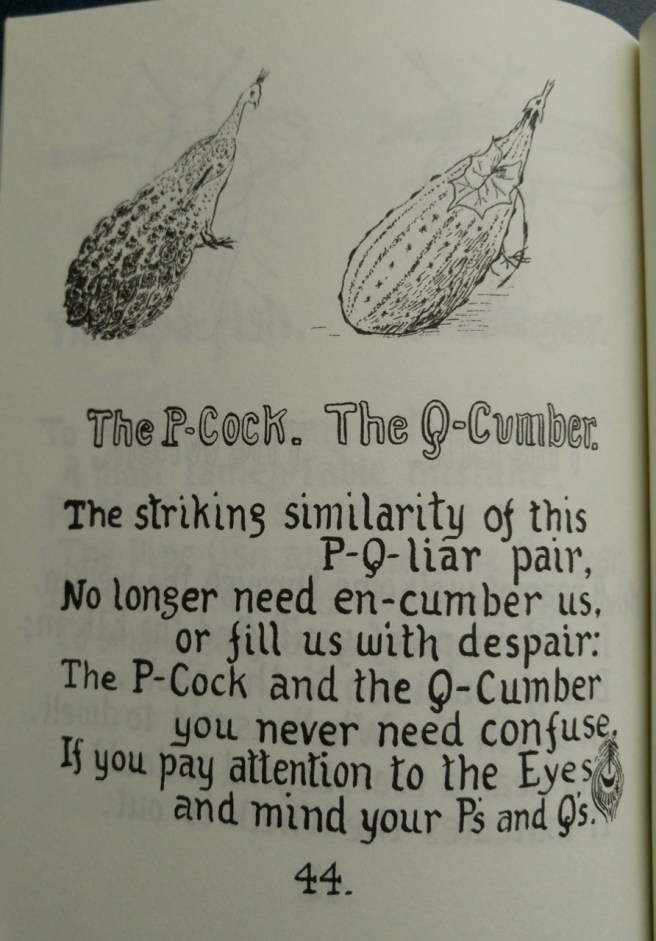
And on the back cover: “This updated edition originally published in 1917 now includes how to tell ‘The Eel from the Elephant,’ ‘The P-Cock from the Q-Cumber’ and ‘The Elk from the Whelk’ to name but a few. This book will be invaluable to those who are short sighted or just plain confused, the rest of you may even find it amusing.”

I think I fall into the latter group and that’s what A.J. had in mind (right?) when she gifted it to me because I find it quite amusing. 

Happy April Fools’ Day. 

How to tell the Birds from the Flowers and other wood-cuts (is he referring to himself?), versus and illustrations by Robert Williams Wood, 1917.

Changing Focus Sundate

Because we’d traversed the trails along the western portion of Sebago Lake State Park a few weeks ago, my guy and I thought we’d try the eastern portion today. The sun shone brilliantly and there was a slight breeze as we drove down the park road to the boat launch parking lot.

s-map (1)

Studying the map, we decided to follow the Outer Loop in a counter-clockwise fashion.

s-following my guy (1)

Snowshoes were a must, but the trail was well traveled. My guy’s attire spoke to the breeze and a bit of a chill that greeted us.

s-songo 6 (1)

Whenever we could, we took in the view of the Songo River that winds its way from nearby Brandy Pond in Naples to Sebago Lake on the Casco side of the park. This river has been the focus of the Lakes Environmental Association for the past ten years as it was once heavily infested with variable-leaf milfoil. Thanks to LEA’s good works, the invasive aquatic plant has been eradicated, though the milfoil crew conducts routine check-ups each summer.

s-sandbar 2 (1)

When we reached the lake, we chose a diversion and followed the trail along the sandbar.

s-Songo from sandbar (1)

It offered a backward view of the lagoon and we could hear Canada geese honking from the open water.

s-picnic tables (1)

And then we turned and headed to the beach. The park service grooms the trails for cross-country skiers and snowshoers, making for an easy hike when we stayed on trail, which we did for the most part today. Picnic tables and outdoor grills were abundant and we had our choice.

s-Sebago lunch view

We chose one in the sun for it had little snow on it. This was our lunch view. As Maine’s second largest lake, Sebago Lake is twelve miles long and covers a surface area of 45.6 square miles. The maximum depth is over 300 feet and its mean depth is just over 100 feet. The 105-mile shoreline touches the towns of Naples, Casco, Raymond, Windham, Standish, Sebago, and Frye Island. All that and we’ve never spent any time on it. We’ll have to fix that in the future.

s-water (1)

Water clarity is excellent and the bottom can be viewed at 45 feet. That’s all good news for Portland and surrounding towns for the lake is the source of their drinking water–thanks to the Portland Water District.

s-songo river out of focus

We followed the trail along the boundary of the park, passing through hemlock groves and mixed hardwood communities. But really, there wasn’t much change in the terrain and we decided we much preferred the west side. A couple of hours later, we were happy to be back beside the Songo River, having completed the loop. And we were ready to change our focus.

s-wasp 3

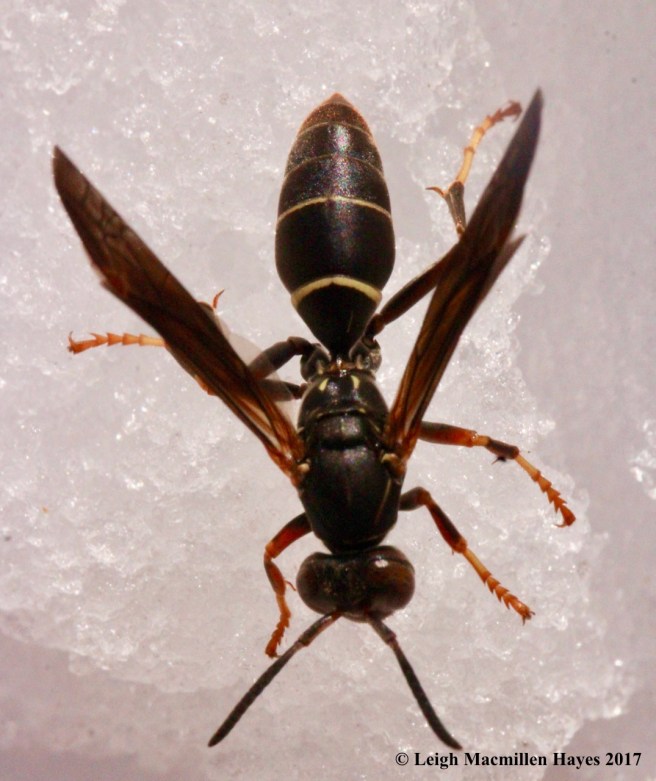
Back at home, my guy decided to revamp our grill. And I decided to snowshoe some more. By 2:30, the temp had risen into the 40˚s and I didn’t bother with a jacket or gloves. Right off the deck, I found my first great find–a wasp moving sluggishly on the snow’s surface. Those wee claws at the end of its foot (tarsus) must have been frozen.

s-script lichen

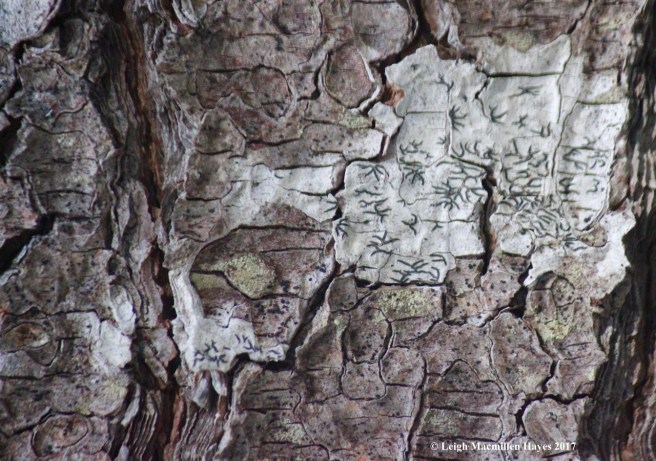
I didn’t go far, but spent lots of time in quiet admiration. There were things to notice, like many, many mammal tracks. And this crustose lichen which is a script lichen. It’s “script” could easily be mistaken for a branching plant.

s-oak gall

Each time I stopped, I wondered what I might see that I hadn’t viewed before. And I wasn’t disappointed. One oak had several twigs with woody growth forms where buds should have been swelling. I decided they were galls and conducted some research when I returned home. I think the tumor-like swelling is a gouty gall that grows on oaks. Apparently, it’s created by a wasp. Hmmm. Not the one I saw, but a tiny wasp of the cynipidae family. The galls provide food and protection for the developing larvae.

s-red bud insect

I found another protective covering on the maleberry that grows near the cowpath. I’m not sure what insect created this cozy home, but being in the wind tunnel that comes down the powerline, its rather impressive that it still exists.

s-vernal pool

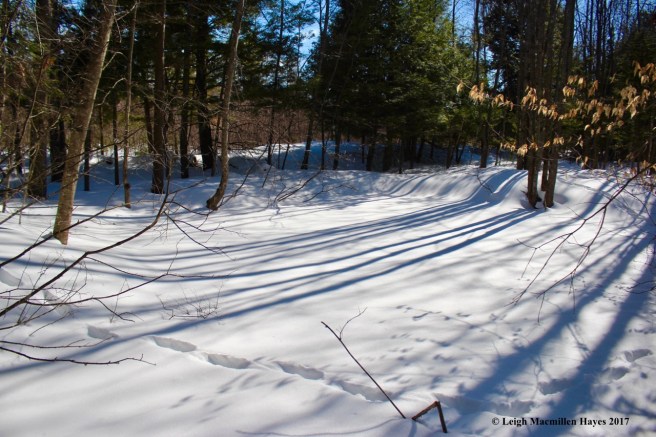
My last stop was the vernal pool. I wasn’t the only one who paid a visit. I found snowshoe tracks created by a neighbor who had stopped by to look and deer tracks that crossed the front edge of the pool. I think the snow will melt eventually and life will begin again for the spring peepers, wood frogs and salamanders–it always does.

I’ve said it before and I’ll say it again. I love winter. But . . . I can feel a change of focus in the air and see it in all that surrounds me. I guess that’s why I love being a New Englander.


Book of March: Upstream

As friends often do, one, whom we fondly call Señora because she was our sons’ high school Spanish teacher, recommended a book to me.

And as I often do, I visited my favorite independent bookstore, Bridgton Books, took a quick look and made a purchase.

m-cover-1

Book of March: Upstream

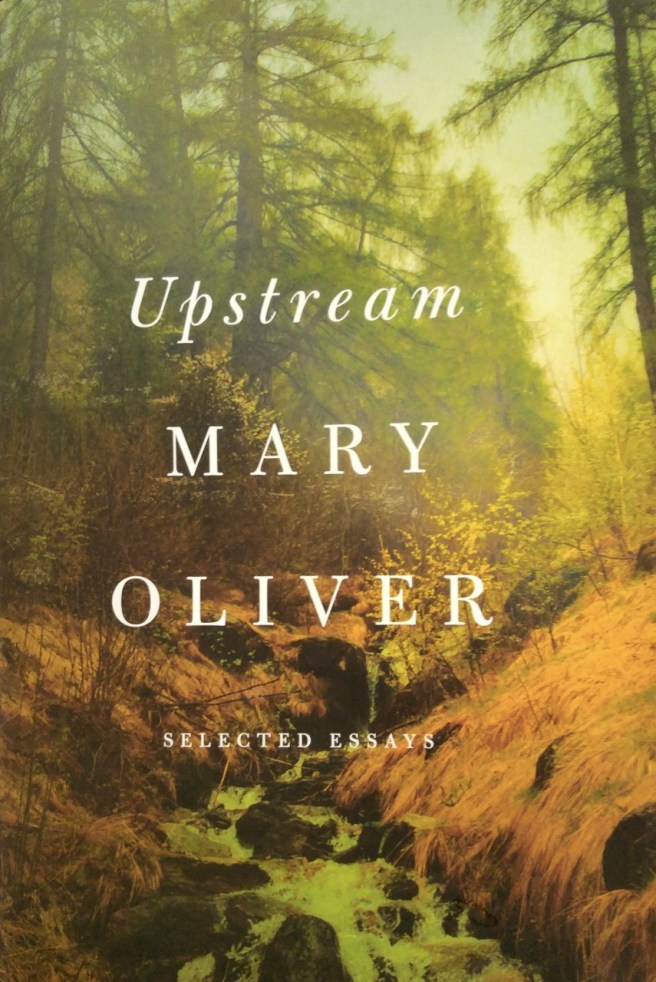
Upstream by Mary Oliver is a collection of essays, many which she previously published elsewhere. In 175 pages, the essays span a lifetime of writing–but even more so a lifetime of living. And noticing. And contemplating. And wondering. And making connections. And wondering some more. But all the time, believing, even in that which she could not see or quite comprehend.

She speaks to the writing process, a process I have embraced for what seems like forever. Only a few minutes ago I shared with a friend that a final draft is never really final. Each time we return to the words, we find other ways of playing with them.

She speaks to the natural world that she has spent a lifetime observing and recreates it on the printed page with elaborate detail. And so, with each sentence, I travel beside her, whether she wants me to or not, for Ms. Oliver embraces solo moments of exploration. I get that.

She speaks of Emerson and Whitman and Wordsworth and Poe. And actually, about the latter, she turns my head for she writes about him with such compassion.

She speaks of the reality of the universe and reminds us to exist. She is. We are.

She speaks of observing a mother spider and her egg sacs in the cellar of a rented home over the course of several months, and I sense her wonder. As a child, I was afraid of those cellar spiders. As an adult, I’m intrigued by them.

And so today, I took Ms. Oliver with me when I stepped into the woods.

m-fog

It was a snow-eating foggy  sort of day and the dampness grazed my cheeks.

m-preweb-raindrops-and-crosses

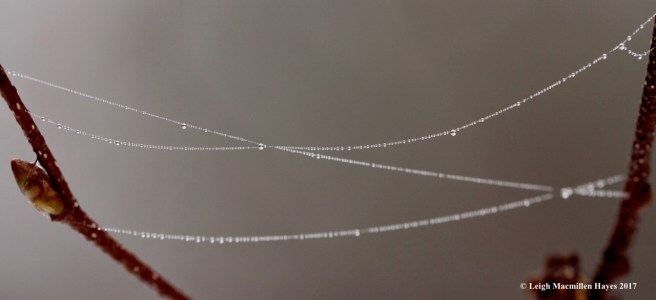
As my snowshoes slapped the hardened snow pack, rain drops drew my focus. On this particular pine sapling, I was drawn to the crosses formed by raindrops and needles, which seemed apropos given that today is Ash Wednesday. And then I noticed the spider silk.

m-web-1a

Every where I turned, long beaded strands of miniature raindrops connected one branch to the next.

m-web-connections-2

What I soon realized, however, was that the strands weren’t merely on single trees. Each tree was connected to the next throughout the forest. As I moved slowly about, I inadvertently snapped some of those lines and felt a sense of sorrow for all that work lost.

m-leaf-attachment

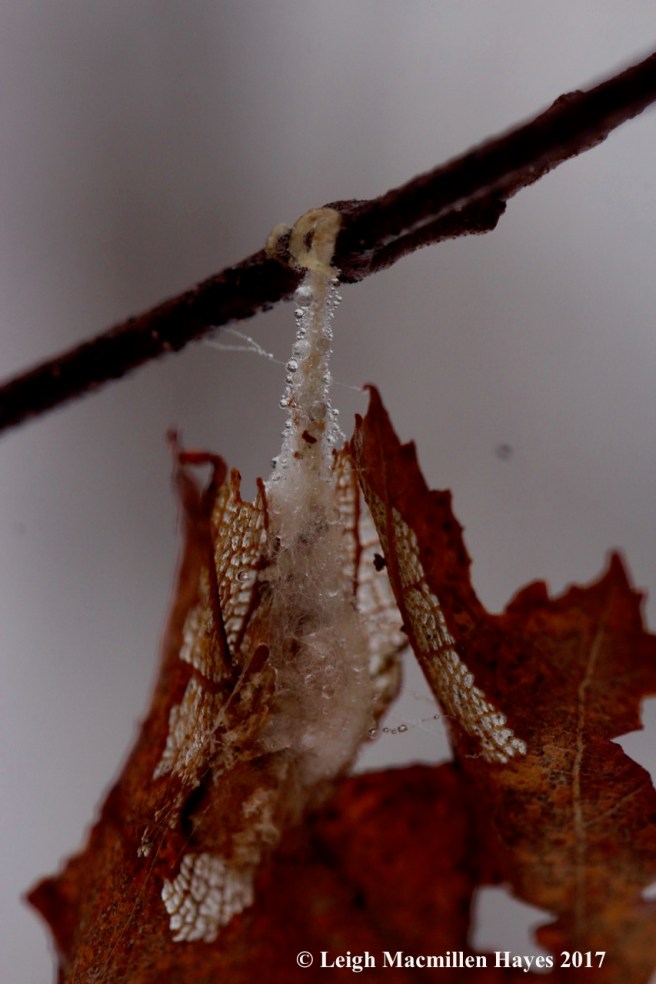
And because I was looking, I found other curious sites that I didn’t expect. That is one of the take-away messages of Ms. Oliver’s book–get outside and even if you are searching for something specific that you may not find, it’s what you see along the way that is more important.

m-page

As I often do when a book such as this one pulls me in, I turn back the bottoms of pages to remind myself that there are passages I will want to revisit. If the corner is turned back and back again, as this one, it means there is something to reread on this page and the one to follow.

For me, Upstream is that type of a book. It’s broken into five sections. Ah, the word broken–it doesn’t feel right in that last sentence because there is nothing broken about the book. Perhaps divided is a better word. Or maybe there’s another that will come to me eventually. That’s the thing about the writing process–it’s never final as I said above. Anyway, I found myself relating to each section with a different part of my soul.

m-rain-drop-globe

And give thanks that Ms. Oliver chose to share her reflections in this manner. I also thank Señora for the recommendation.

Upstream by Mary Oliver, Penguin Press, 2016

The Second Anniversary of Wondermyway

Milestones are always important as they mark significant events in our lives. And for me, such an event occurs today as I celebrate the second anniversary of the day wondermyway.com was born.

Since I was in elementary school and made few and far between entries into a chunky journal bound in a green cover (which I still own), to the first empty book journal my sister gave me when I graduated from high school, to a variety of travelogues and other journals I’ve filled from cover to cover,  I’ve recorded my life’s journey from time to time.

The most satisfying for me has been this very blog, to which I’ve added numerous events and discoveries, both natural and historical, over the last two years. As personal as it all is, I’ve taken a leap of faith by sharing it with you. And you have been gracious enough to read it, and comment on it, and “like” it, and sometimes “love” it, and offer me suggestions, corrections and gentle nudges.

Thank  you for following along on the journey. It’s been scary to put myself out there, but I have.

And now, I thought I’d review some favorite finds I noted in posts over the past year. My learnings have been many and it’s been fun to review all that I’ve seen and thought and admired and wondered about. I hope you’ll feel the same and will continue to follow along and comment and share those that you enjoy with your family and friends.

Here’s my countdown , or maybe I should say my count up of favorite moments in time over the past year:

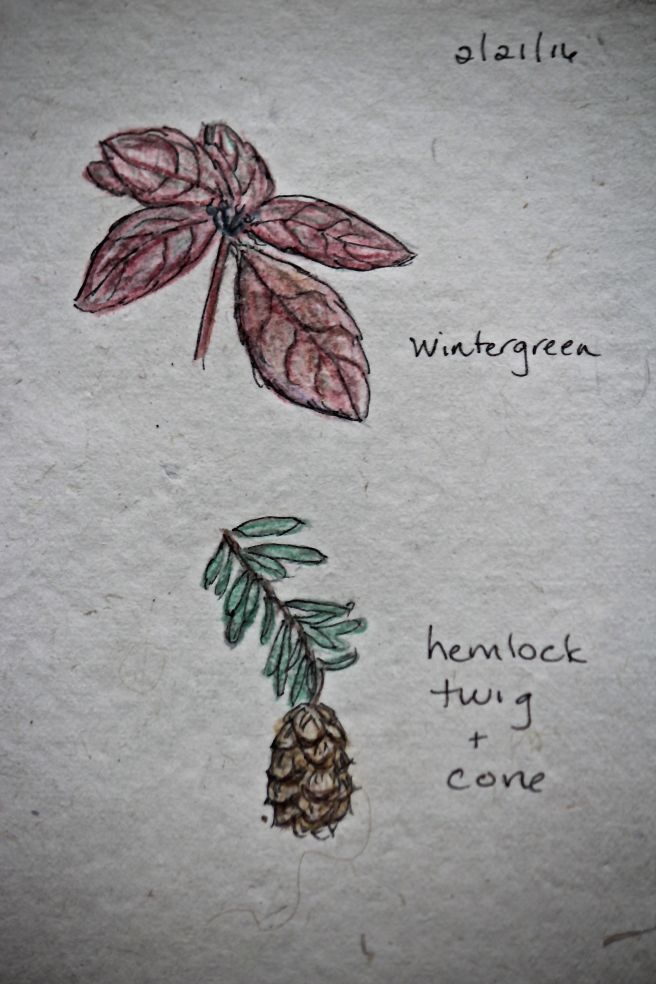
Feb 21, 2016: Celebrating a Year of Wonder-filled Wanders
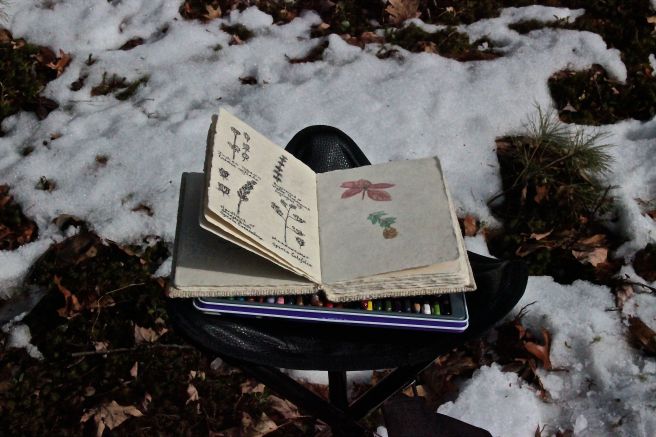
b-sit spot

b-sketch 1

I made time one year ago to sit and sketch–one of my favorite activities. To be still and embrace life around me. To notice. And commemorate.

February 28 2016: Gallivanting Around Great Brook

h-yellow and white partners

Usually, we drive the forest road in to the gate on Hut Road in Stoneham, but in winter it isn’t passable, and thus one must walk–which means paying attention to things you might not normally notice, such as this: a special relationship between a yellow birch and a white pine. Rooted in place, they embrace and share nutrients. Forever conjoined, they’ll dance through life together.

March 18, 2016: On the Verge of Change
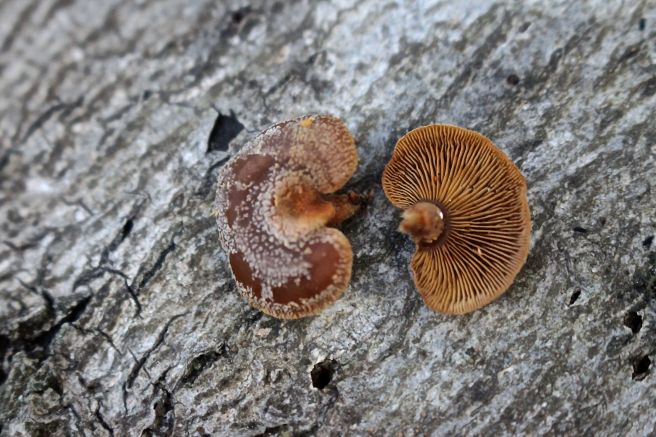
b-panellus stipticus?

While exploring the Greater Lovell Land Trust‘s  Back Pond Reserve in Stoneham with my friend, Parker,  who is a master mycologist, he found Panellus stipticus, a bioluminescent species. Check out those gills on the underside. According to Lawrence Millman in his book Fascinating Fungi of New England, ” . . . specimens in the Northeast glow more obviously than specimens in other parts of North America.” So if you are ever in these woods late at night, don’t be freaked out by a light greenish glow. It just might be nature’s night light.

March 22 2016: Wet Feet at Brownfield Bog

b-pellet

When I first spied this lump of gray I assumed it was a dead mouse. I know, I know–I should never assume because I risk “making an ass out of u and me.” And so I took a closer look. And noticed tons of bones and those orange teeth. An owl pellet filled with the remains of dinner. Owl pellets are extra cool and dissecting one is even cooler. I collected this one but haven’t dissected it because I think it makes for a great teaching tool as is. If you want to see it, just ask.

April 13, 2016: So Many Quacks

v-egg mass 1

At the vernal pool, or frog pond as we’ve always fondly referred to it, just steps from our property, I kept a keen eye on the situation last spring. In general, each mass laid by  female wood frogs was attached to a twig or branch. They tend to take advantage of the same site for attachment and usually in a warm, sunny spot.

A couple of masses were positioned independent of the rest, like this one–embraced in oak and maple leaves. Eventually, they’ll gain a greenish tinge from algae, which actually helps to camouflage them. One of the many wonders is that any given mass may contain up to 1,000 eggs–from a two-to-three-inch frog.

April 28, 2016: The Big, The Little and Everything in Between

b-bear2

The phone rang as I stepped out of the shower and a male voice yammered away about something in the snow and it had come last night and I had to get there quickly. My friend, Dick,  was standing in a friend’s yard about a half mile from here and looking at bear tracks in the snow.

As he knew he would, he had me on the word “bear.” His voice was urgent as he insisted I stop everything and get to his friend’s house. “I just need to dry my hair and then I’ll be right there,” I said. Deadlines loomed before me but bear tracks won my internal war. Dick suggested I just wrap a towel around my head. Really, that’s what I should have done because my hair has no sense of style whether wet or dry, so after a few minutes I said the heck with it and popped into my truck, camera and trackards in hand.

May 21, 2016: Wallowing in Wonder

p-ph dragon ending 4

Along Perky’s Path at the GLLT’s Heald and Bradley Ponds Preserve, a bunch of us had the honor to watch a dragonfly split open its exoskeleton and emerge from the nymph stage. Of course, we were standing by a beaver pond, and so it seemed only appropriate that it would use the top of a sapling cut by a beaver. As it inflated the wings with blood pressure, they began to extend.

May 31, 2016: Slippers Fit for a Princess–Including Cinderella

p-ph lady y 15

Members of the Orchid family, lady’s slippers feature the typical three petals in an atypical fashion. The pouch (or slipper or moccasin), called the labellum, is actually one petal–inflated and veined. With a purplish tint, the petals and sepals twist and turn offering their own take on a ballroom dance. From every angle, it’s simply elegant.

June 10, 2016: The Main(e) Exotics

snake2

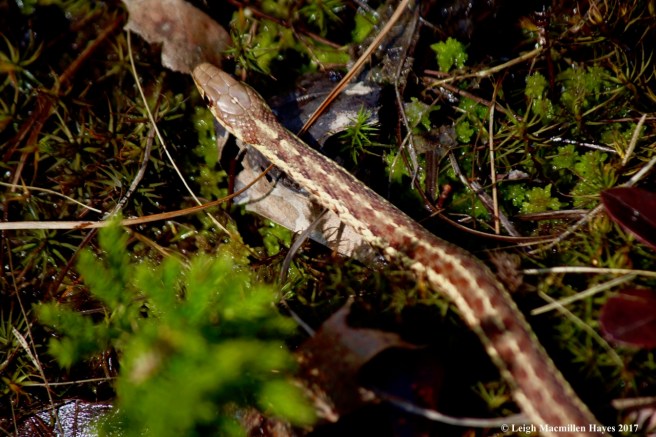
At Lakes Environmental Association‘s Holt Pond Preserve, a friend and I had moved from the swamp to the first hemlock hummock and chatted about natural communities when suddenly we realize we were being hissed at. Its coloration threw us off and beautiful though it was, the hairs on the back of our necks stood on end. Apparently we made it feel likewise. And so we retreated. It was a common garter, but really, there didn’t seem anything common about it in the moment.

June 18, 2016: Paying Attention

partridge berry

j- trailing 2 (1)

j-  trailing 7 (1)

In May, trailing arbutus wowed us by its gentle white and pale pink flowers. In June,  they faded to a rusty tone. And some transformed into swollen round seed pods–a first for me to see.

The sepals curled away to reveal the white fleshy fruit speckled with tiny brown seeds. It was well worth getting down on knees to look through a hand lens–especially since ants, chipmunks and mice find these to be a delicacy so they wouldn’t last long.

July 9, 2016: Wondering About Nature’s Complexity
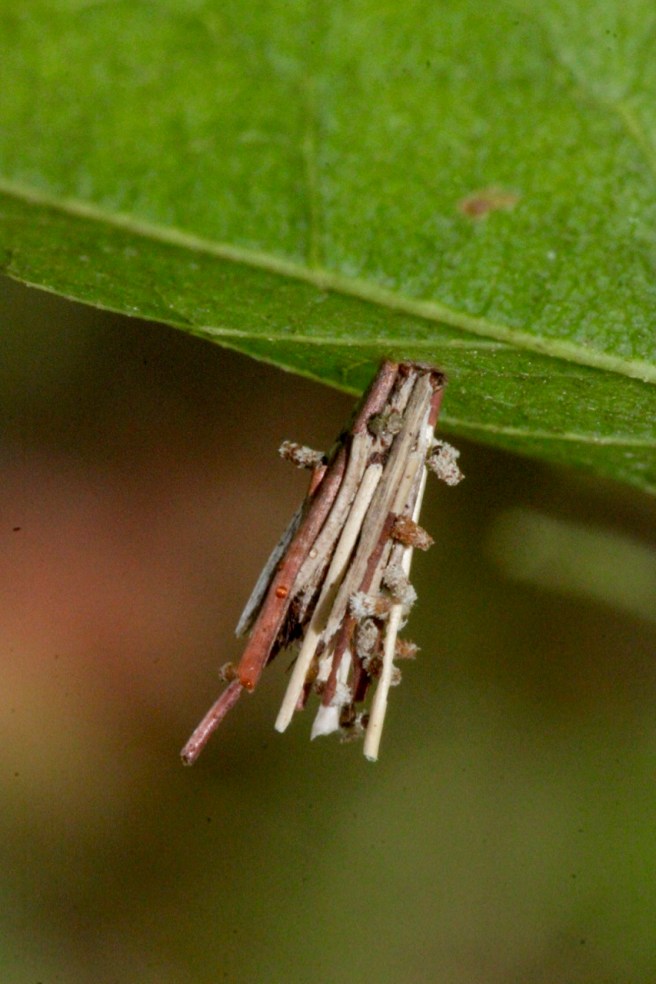
img_1364-1

I posed a question this day: So dear reader, I enjoy teaching you, but now need you to teach me. I found this under another leaf on a shrub. And I often see the same thing stuck to our house. It reminds me of a caddisfly case. What is it?

And fellow Master Naturalist Pam Davis responded: Check out bagworm moths to see if it might be an answer to the stick thing on the leaf and your house. Here’s a discussion: http://nature.gardenweb.com/discussions/2237505/not-a-bug-maybe-a-gall and a Wikipedia link: https://en.wikipedia.org/wiki/Bagworm_moth

Indeed.

July 27, 2016: Searching for the Source of Sweetness
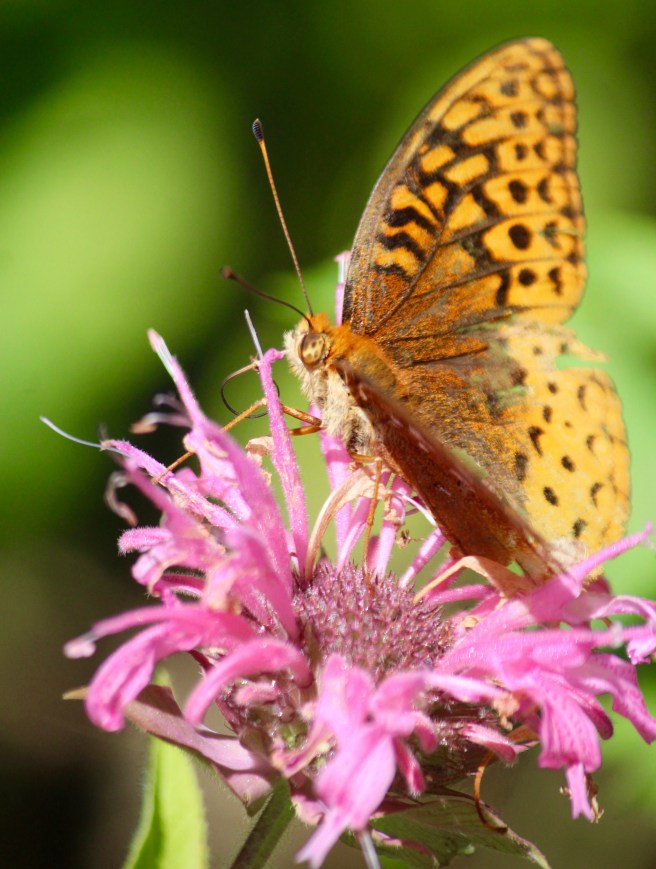
w-frit 2

It was no mistake the this fritillary butterfly chose the beebalm on which to land. Check out its mouth. A butterfly feeds through a coiled mouth part called a proboscis. When not in use, the proboscis recoils and is tucked into position against the butterfly’s head.

August 21, 2016: Sundae School

n-Indian pipe bee 1

My lessons began immediately. What to my wondering eye should appear, but a bee pollinating an Indian Pipe. And in the middle of the afternoon. Huh? I’ve always heard that they are pollinated by moths or flies at night. Of course, upon further research, I learned that bees and skipper butterflies have been known to pay a visit to the translucent flowers. Add that to the memory bank.

August 27, 2016: Halting Beside Holt Pond

h-pitcher  flower up close

Halting–prone to pauses or breaks. I didn’t break, but I certainly was prone to pauses as I moved along the trails and boardwalks at the Holt Pond Preserve in South Bridgton. One of my first stops–to admire the pitcher plant flowers in their August form. When I took a closer look, I realized that the seeds were developing–certainly a WOW moment in the world of wonder.

September 9, 2016: Golden Rulers

g-assassin-1

What first caught my eye was a bee that dangled upside down. And then I spied the green legs of an assassin bug. What? Yup, an assassin bug. I believe this one is a nymph. Regardless of age, here’s the scoop: Assassin bugs are proficient at capturing and feeding on a wide variety of prey. Though they are good for the garden, they also sometimes choose the wrong species like this bee. The unsuspecting prey is captured with a quick stab of the bug’s curved proboscis or straw-like mouthpart. Once I saw this, I continued to return for a couple of hours, so stay tuned.

September 15, 2016: The Wonders of Kezar River Reserve
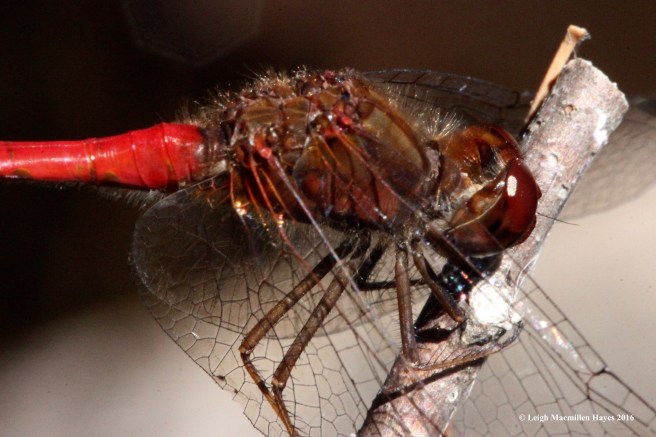
k-ruby-1

My favorite wonder of the day . . . moments spent up close with a meadowhawk.

October 17, 2016: Everybody Loves Raymond? Mondate

r-mushroom-growth

My guy and I discovered several of these examples of fungi on fungi at Loon Echo Land Trust‘s Raymond Community Forest and had no idea what they were–so I sent the photos to Parker and Jimmie Veitch, of White Mountain Mushrooms, and Jimmie responded with this explanation:

“That’s what mycologists call “rosecomb” mutation, where a mushroom’s gills start forming on the cap in a really mutated fashion. It’s been reported in many mushroom species but I haven’t seen it in this one (Armillaria AKA honey mushrooms). As far as I know, no secondary fungus is involved.

The suspected cause (not so nice) is ‘hydrocarbons, phenols and other compounds contaminating the casing or contacting the mushroom surface. Diesel oil, exhaust from engines, and petroleum-based pesticides are thought to be the principal source.'”

October 22, 2016: Cloaked By the Morning Mist
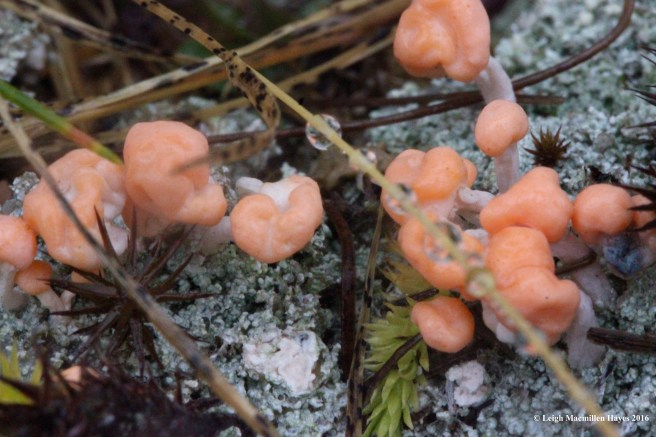
u-candy-2

On a rainy day adventure with the Upper Saco Valley Land Trust in nearby New Hampshire, we paused to admire candy lichen, a crustose (think–flattish or crust-like) lichen with green to bluish-green coloration. Its fruiting bodies, however, are candy-pinkish berets atop stalks, even reflected in the raindrops.

November 6, 2016: Focus on the Forest Foliage
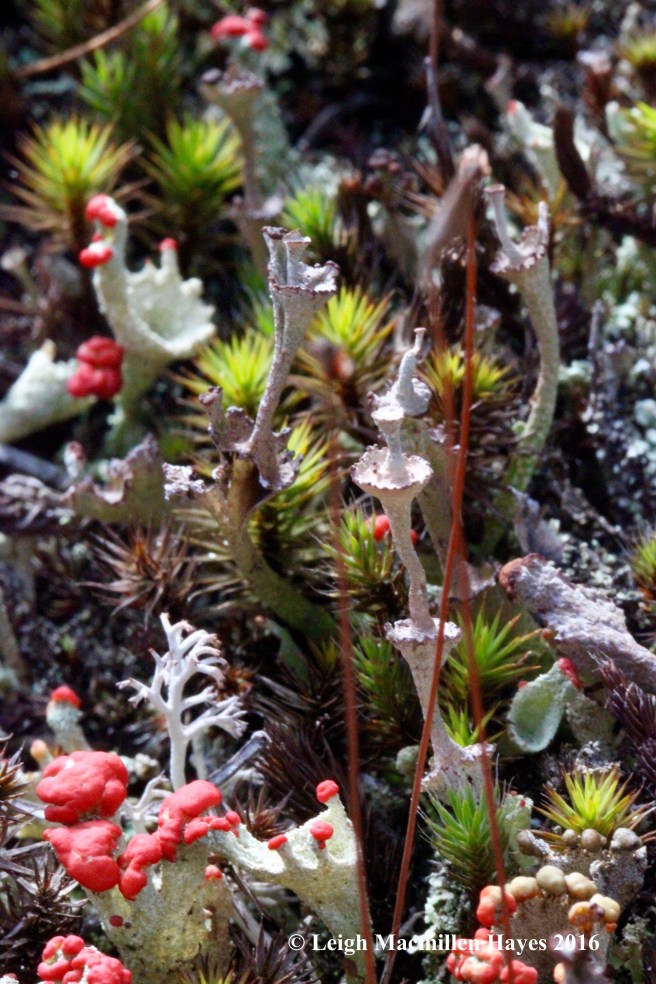
j-lichens-galore

And then . . . and then . . . and then just as our eyes trained on the red caps before us, something else made itself known. We spied another lichen that I’ve only seen once before: Cladonia cervicornis ssp. verticillate.

Its growth formation is rather unique. In one sense, it reminded me of a sombrero, but in another sense, I saw fountains stacked one atop another, each giving forth life in their own unique fashion. But rather than being called Fountain Lichen, its common name is Ladder Lichen–perhaps referring to the fact that the pixies can easily climb up and up and up again.

November 20, 2016: Forever a Student
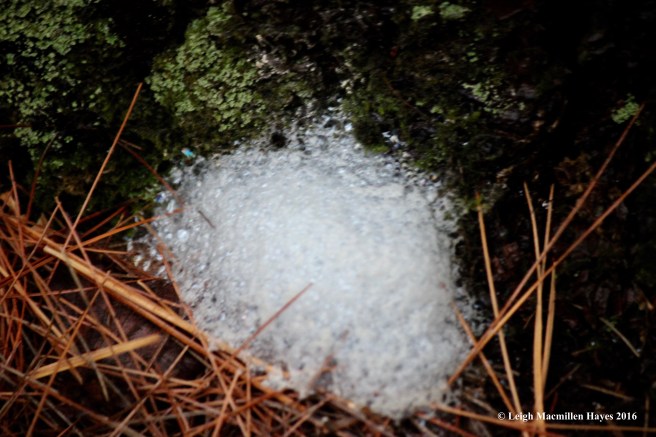
h-pine-suds

A sight I was hoping for presented itself when I returned to our woodlot–froth at the base of a pine tree. It’s not unusual and occurs following a rain event such as we’d had all night and morning. So what causes the tree to froth? Well, like all lessons, there are several possibilities. Maine Master Naturalist Science Advisor Fred Cichocki recently had this to say about it: “I’ve noticed this phenomenon often, and in every case I’ve seen it’s associated with white pine, and always after a dry spell followed by heavy rain. Now, conifers, especially, produce hydrocarbons called terpenes (it’s what gives them their lovely pine, balsam and fir scent). These hydrocarbons are hydrophobic by nature and form immiscible films on water. During a heavy rain, water running down the trunk of a white pine picks up terpenes on the way. Air (having accumulated in bark spaces, channels, etc. perhaps under slight pressure) then “bubbles” through terpene-water films producing a froth. Recall the cleaning products PineSol, and the like. They are made from terpenes, and produce copious bubbles when shaken. One could get the same result directly by shaking terpentine in water, or by bubbling air through a terpentine-water mixture with a straw . . . Of course, it may be that other substances (salts, etc.) enhance the frothing.”

No matter how much I have learned on this life-long course, there’s always more. I certainly don’t have all the answers and for that I am thankful. I’m forever a student.

December 4, 2016: The Art of Nature

s-tree-ring-labyrinth

Some cut stumps reminded me of the circular movement leading toward the center of a labyrinth–appearing quick and easy, and yet providing a time to slow down while following the path.

December 23, 2016: Won’t You Be My Neighbor

m-print

I followed the porcupine trail along his regular route and over the stonewall only to discover prints I’ve never met before. My first impression was raccoon, but the shape of the prints and the trail didn’t match up in my brain. More and more people have mentioned opossum sightings in the past few years, but I’ve only seen one or two–flattened on the road. Today, in our very woods, opossum prints.

January 19, 2017: Keep an Open Mind

o-deer

While I always head out with expectations of what my forest wanderings will offer, I’m happily surprised time and time again with the gifts received.

And so it was the other day when a friend and I happened upon this trophy in an area I’ve only visited a few times. We’d been noting the abundant amount of deer tracks and realized we were between their bedding and feeding areas and then voila–this sweet sight sitting atop the snow. It now adorns a bookcase in my office, a wonder-filled addition to my mini natural history museum. (I’m trying to give Henry, Jessie, Violet, and Benny of the Boxcar Children series a run for their money in creating such a museum.)

January 25, 2017: On the Prowl at Heald and Bradley Ponds Reserve

w-tube-moth-2

Notice how these pine needles are clumped together? What I learned from Mary Holland, author of Naturally Curious,  is that these are tubes or tunnels created by the Pine Tube Moth. Last summer, larvae hatched from eggs deposited on the needles. They used silk to bind the needles together, thus forming a hollow tube. Notice the browned tips–that’s due to the larvae feeding on them. Eventually the overwintering larvae will pupate within the tube and in April when I come back to check on the vernal pool, I need to remember to pay attention, for that’s when they’ll emerge. Two generations occur each year and those that overwinter are the second generation. The good news, says Holland, is that “Pine Tube Moths are not considered a significant pest.” I only found the tubes on two young trees, but suspect there are more to be seen.

February 8, 2017: Embracing the Calm
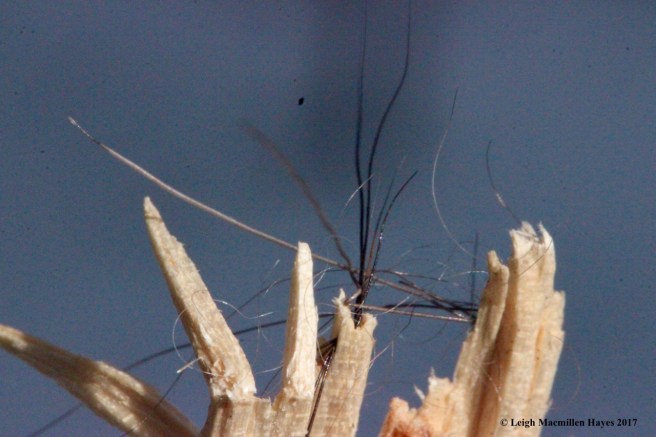
h-moose-hair-2

A bull moose, like a buck deer, thrashes bushes and small saplings when the velvet on its antlers dries. It could be that the velvet itches. But it could also be a response to increasing testosterone and the need to scent mark.

February 16, 2017: When Life Gives You Flakes
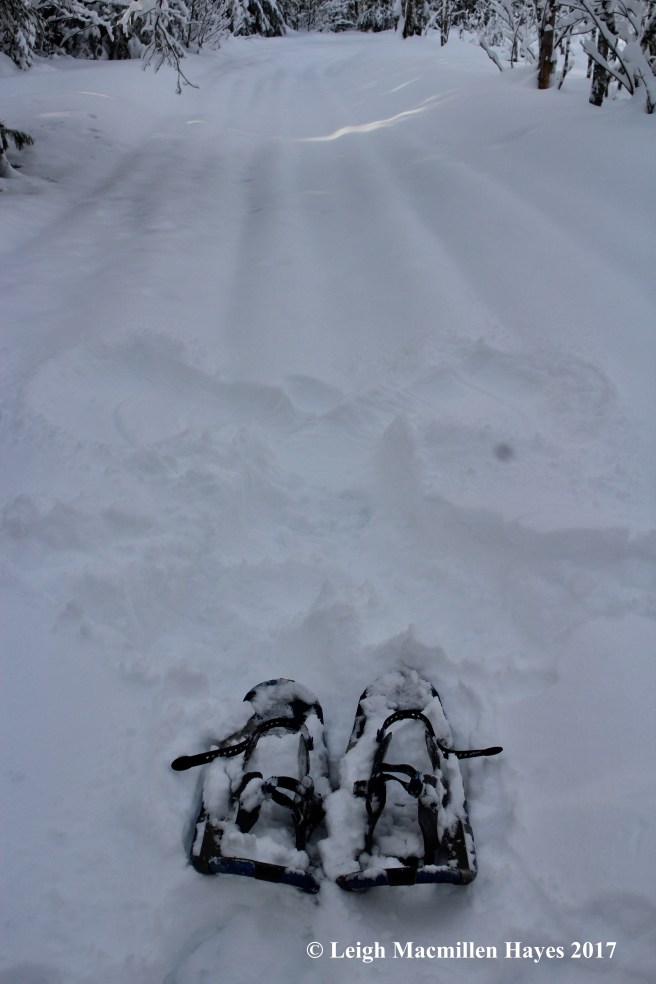
s-snow-angel-in-trail

When life gives you flakes . . . make a snow angel in the middle of the trail.

To all who have read this far, thanks again for taking a trip down memory lane today and sticking with me these past two years. I sincerely hope you’ll continue to share the trail as I wander and wonder–my way.

And to wondermyway.com–Happy Second Anniversary!
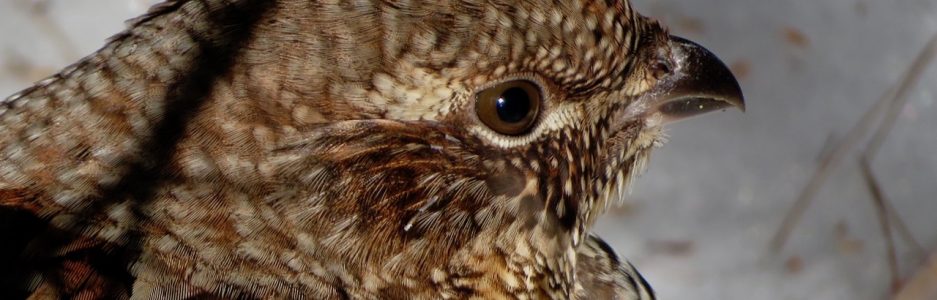


The BOF of Ron’s Loop

Huh? The BOF of Ron’s Loop? What in the world is that all about. Read on, if you dare.

r-kiosk

This morning dawned bright and chilly, just perfect for a tracking expedition with my friend, Joan, along Ron’s Loop at Back Pond Reserve in North Waterford/Stoneham. It’s a Greater Lovell Land Trust property that we love to visit. Then again, is there a GLLT property we don’t like? Uhuh.

r-bobcat

The snow was crusty and we were able to snowshoe atop it for most of the way. The same was true for many of the mammals that traveled about–including the bobcat whose print was difficult to see, but that’s because of the conditions. We went off trail and followed it for quite a ways, hoping to find other signs it left behind, but no such luck today.

r-otter-1

It did lead us to the stream that flows toward Five Kezar Ponds and we recognized the filled-in evidence that an otter had been this way. Based on the bobcat conditions, we assumed it had moved through recently, quite possibly last night or this morning. But the otter had visited after the last snowstorm, but before Tuesday’s ice storm, such were its offerings.

r-woolly-first

Eventually, we returned to the trail and continued on our merry way. But then we came upon a beech tree that begged noticing. In the reserve are a number of bear paw trees, though I have yet to find one along Ron’s Loop. And we didn’t today.

It was the fuzziness of a large clump of small white specks that drew our attention. Beech scale insect or more technically, Cryptococcus fagisuga, is a tiny insect that sucks sugar and other nutrients from beech trees only. In the summer, wingless larvae hatch and crawl (the only mobile stage of this insect) during their first instar stage of development. They search for suitable feeding spots such as cracks or crevices in the bark. What struck us today was the size of the colony.

r-woolly-1

A waxy substance secreted from its glands allows the insect to survive the winter months under a protective woolly-like coat.

r-frullania-liverwort-and-scale-insects

Even the frullania liverwort showed a contrast with the white filaments. By spring, the beech scale insect will molt into its second, legless nymph stage and emerge. Immediately, it will start sucking the sap through its tubular mouthpart or stylet. That instar stage doesn’t last long, and quickly it will become a mature female. For the rest of its life it will remain sedentary, but repeatedly remove and reinsert its piercing stylet, wounding the tree and providing entry points for fungi to enter. An interesting fact about beech scale insects–its a world of females who reproduce by parthenogenesis; there are no known males.

r-beech-hell

At Ron’s Loop a sign refers to what happens to the beech trees once the scale insect has set up housekeeping.

r-beech-bark-4

They feed on trees that are at least thirty years old. Beech bark is typically smooth from a tender age to the end of its long life. But the scale insects puncture holes and . . . when two or more gather and withdraw fluids from the vascular tissues in close proximity with each other, those vascular cells collapse and cease to function.

r-beech-bark-3

Fissures form in the bark’s surface.

r-beech-bark-2

The stage is set for one or two Nectria fungal pathogens to take advantage of the wound sites. Their spores, transported by wind or insects, germinate, enter the wounds and their hyphae colonize the vascular tissues, eventually killing patches of inner bark.

r-beech-bark-5

The bark develops cankers that can expand and join together. Photosynthetic activity decreases and limbs die and break off.

r-beech-snap

r-beech-snap-2

Some trees survive for a while, but others, possibly due to environmental stresses, die within five to ten years, their crowns and upper trunks snapping off. We call that beech snap.

The scale insect is non-native to Maine, having arrived here via Nova Scotia and before that Europe. Consequently, except for a species of lady bugs, there is no known predator to reduce its number. Fortunately, some trees are resistant and the current thinking it is to leave those trees intact and hope that they disperse seeds that produce more resistant trees.

r-hoar-frost1

Another fortunate thing is that there is so much more to see at Ron’s Loop. We spied some hoar frost surrounding a small hole and imagined a vole or some other little brown thing snuggled below the snow’s surface.

r-hoar-frost-and-feeding-area

In fact, we found other examples of the same; this particular mound featured not only the frost, but also served as the site of dining table–for a red squirrel.

r-otter-slide

All in all, the tracking was good. We found plenty of otter slides and knew where it bounded. We also saw evidence of snowshoe hare, deer, mice and possibly fisher, though that too was diluted by the ice storm.

r-otter-x-2

Did I say plenty of otter sign? In fact, let’s make that otters with an s.

r-running-water

The mammal activity was prime because the property offers a mountain, ledges, streams and is located by five ponds.

r-ice-on-flow

Most often when we’ve traveled this way during the winter months, we cross the streams with little hesitation.

r-ice-flow-2

Today, we admired the ice formations and the flow, which we hope bodes well for all forms of life and puts an end to the drought.

r-stream-crossing-at-end

Our finally crossing was the most difficult due to lack of ice. But the water is shallow in this spot for the most part and it’s not far from the end of the trail.

Truth be known, we didn’t actually cross here. Instead, we found some rocks a wee bit upstream and made our precarious way across,  one of us almost falling in and the other climbing up the steep bank on hands and knees–not easy when donning snowshoes. BOF could have stood for big old fools. But we survived and highly recommend sticking with the trail crossing, even if your shoes get a wee bit wet.

r-snow-level

Back in the parking area where we could not park, the trail sign provided an indication of the current snow depth.

As for Joan and me, we spent three hours examining the beech trees, exclaiming over the tracks we found, especially those of the bobcat and otter (we’d like to be reincarnated as otters–if we have a choice), and rejoicing in the flow of the water. The BOF of Ron’s Loop.


Walking With(out) Kyan

One of these days I’ll get to explore the route I traveled today with my young neighbor, Kyan, who is recovering from a blood marrow transplant. In the meantime, I took him along with me in spirit.k-1

Our first stop–the frog pond, aka vernal pool, that we both love. After all the recent rain, it has once again filled with water.

k-2

As I stood before it and thought about spring moments spent observing the wood frogs that use this pool as a breeding place, I wondered if I’d see any action. I wasn’t disappointed–springtails and mosquito larvae. When I return with Ky in tow, I’ll pull out the small shovel I carry so we can scoop these up for a closer look. Of course, he’ll probably need to remind me to do that. Such is age.

k-3

And then I retraced my steps, dodging puddles at first because I had my hiking boots on. Oh, they’re waterproof, but suddenly the water is deep in spots. I’m not complaining–by any means!
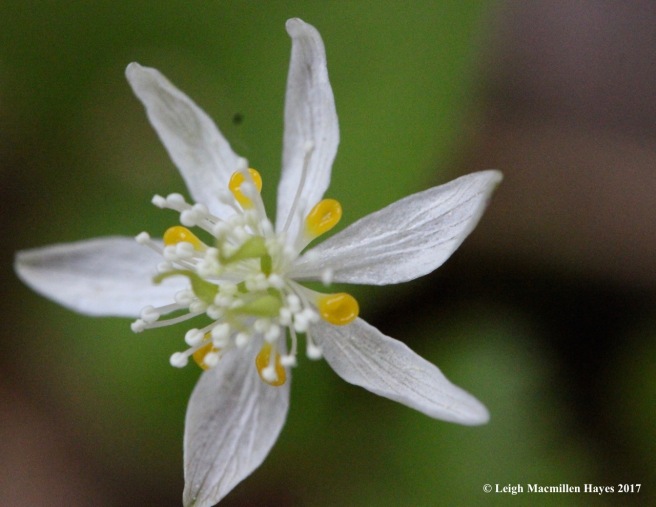
k-4

Rather than my woodlot trail, I decided to cross the field that Ky’s grandfather owns as I headed home to change into my Boggs. And so I happened upon a mystery. What was this white stuff? Fur? No. Fungi? Maybe. Stay tuned? I hope you will. Had Kyan actually been with me, I’ve a feeling he could have told me right off.

k-5

Back on the trail, where the puddles were shaded, nature presented its artistic flair.

k-6

I trust Ky would have appreciated the various forms the ice took. Had he been with me, we could have stomped our feet through the ice and felt its thickness. But then again, he may not have wanted to ruin such beauty.

k-7

k-8

k-9

That being said, over the course of several hours, I found plenty of puddles that were ice free and walking through them was the easiest mode of travel. Plus . . . who doesn’t love to jump in a puddle, right Ky?

k-10

Had Ky been with me, we would have marveled at all the tracks left behind by creatures who passed in the night or early morning hours.

k-11

And I’d have shown him how to make a positive ID of a print, in this case–Eastern Coyote. We’d have looked at the key characteristics, like the winged ball of the pad, the x between toes and pad, the symmetrical front toes and inward facing nails. And I would have shared my Trackards with him so we could both better understand how the critters with whom we share this space move about.

k-12

In this case, it appeared there were several coyotes and they shared a brief tussle.

k-13

We’d have looked at the contents of coyote scat, of which I saw tons. Ky would have reminded me that the apple skins meant the coyote visited the neighborhood orchard.

k-14

k-15

And I would shared with him that the grassy scat meant perhaps one of the coyotes had an upset stomach. If you are grossed out by the scat, please forgive me. But . . . it’s natural. It’s a sign. It tells a story. And Ky is 12. Then again, I’m in my late 50s–and I LOVE scat.

k-16

Had Ky been with me, we’d have wondered about the swatch of hair deep in the woods. And maybe we would have looked around more than I did to search for other signs of why the hair was left behind.

k-17

Had Ky been with me, we would have noted numerous deer tracks as well. And coyote tracks in the same vicinity.

k-18

We’d have seen where the deer browsed.

k-19

And where one rubbed its antlers–perhaps leaving an important scent for others to note.

k-20

Had Ky been with me, we would have seen some downed hemlock twigs.

k-21

And known to look for their comma-shaped scat.

k-22

Had Ky been with me, we would have found a bunch of puff balls or stink bombs.

k-23

And most definitely we would have poked them with our feet and watched the spores flow out like a cloud.

k-24

Had Ky been with me, we would have noticed the little things, like a peeled acorn stuck in a tree and wondered how it go there.

k-25

We would have enjoyed not only the sight of the Auricularia auricula-judae or brown jelly fungus, but also it’s other common name–wood ear because indeed it does resemble an ear.

k-26

Had Ky been with me, we would have felt bad for the wee shrew that took one for the family’s sake. Despite releasing a toxin that prevented his predator from consuming him, he still died from the attack. But perhaps his siblings and parents will not be attacked by the same predator–a lesson learned. Maybe. And we would have marveled at what a long nose he had and what tiny ears.

k-27

Had Ky been with me, we might have bushwhacked, only getting fake lost on our way home. If he wasn’t comfortable doing that, however, we most certainly would have turned back and followed the trail.

k-28

And finally, had Ky been with me and we had bushwhacked, he might have noted some white fluff on the ground, the same as what I saw in the field earlier. And then he would have noticed the source.

k-29

One never knows what one might discover deep in the woods. Had Ky been with me, would he have recognized Myrtle? Was it a dog toy at one time? If so, how did it find its way to the middle of nowhere? I know–it walked. But really, it was over a half hour from home and the terrain not easy, yet I found no other stuffing. Of course, it could have traveled a different route than I took.

At the beginning of today’s journey I’d thought about seeking out the color orange again in honor of Ky, but perhaps he’s tired of orange. And it was much more fun looking for things I thought Ky might appreciate had he been beside me. I know he’ll see things I’ve never noticed and I can’t wait to learn from him. Perhaps soon we can venture together, maybe once the ground is frozen and snow falls. Or in the spring.

One of these days, I will surely walk with Kyan.


Ho-Ho-Ho Ho Hoing Away

I remember a time when a Pileated Woodpecker sighting was rare. And now, it’s a daily event, but one which I still feel blessed to experience.

h-pileated

Stepping out the door this afternoon, I immediately heard one hammering and realized another was drumming in a nearby tree. Within minutes, a third flew in and birds #2 & 3 sang their eerie tune as they approached #1. He chased the couple and they flew off, their flight strong, and marked with slow, irregular woodpeckery flaps.

h-woodpecker-hole-1

After watching #1 for a bit, I went in search of woodpecker happenings scattered throughout our woodlot. Though they’ll eat lots of wood-boring insects and occasionally berries, seeds and suet, carpenter ants are their mainstay. Better in a woodpecker’s stomach than our home. Sometimes the holes they create are about six inches across and almost as deep.

h-woody-condo-2

h-woody-condo

And those holes became homes for other critters occasionally, so when friends and I see trees such as these, we think of them as condominiums providing living quarters perhaps for small birds and little brown things (mice). Included in these condo units are some smaller round holes, created by the Hairy and Downy Woodpeckers that also live in our neighborhood.

h-wood-chisel

Occasionally I come across trees such as this one that hadn’t been so much excavated as chiseled. Woodpeckers are just that–peckers of wood. They don’t eat the wood. But to get at their preferred food, they must hammer, chisel and chip the bark.

h-woodchips

At the base, always a scattering of wood chips. I, of course, cannot pass up any opportunity to search through the chips in hopes of locating scat. I was not rewarded with such a find today.

h-hole-in-snag

Leaving dead snags encourages woodpecker activity. They become prime locations to forage, roost and maybe even nest, though I hardly think this snag was large enough to serve as the latter.

h-pinesap

While I was out there, I did stop to admire a few other sights including the now woody structure of pinesap;

h-winterberry

winterberries contrasted against the wee bit of snow that still graces patches of ground;

h-deer-tracks

deer tracks indicating we’d had visitors during the night;

h-violet-upper

h-violet-toothed-under

and a tree skirt of violet-toothed polypores. They are rather like the Lays Potato Chips of the natural world. You can never have just one. (Note: I’m not talking about eating them, but rather how they grow.)

h-woody

It’s been said that Pileated Woodpeckers are skittish. That’s not always the case. I’ve stood beneath one for over twenty minutes, the bird intent on its work and seemingly oblivious to my presence.

The next time you are in the woods and hear the ho-ho-ho ho ho, ho-ho-ho ho hoing that reminds you of that cartoon character, Woody Woodpecker, take a look around. You, too, might be blessed. And don’t forget to check for scat. ;-)

Forever a Student

Once the rain let up, I donned my Boggs and headed out the door in mid-afternoon, not sure where exactly I was headed. But after reaching the snowmobile trail, I decided to turn south. Since the spring, I’ve been to the vernal pool on the neighboring property numerous times, but not much beyond in that direction.

h-new-bridge

Part of the reason was that a local industry, of which we now have so few, was constructing a new building and had cut off the trail. Oh, I could have bushwhacked around the project, but the other part of the reason is that it’s a heavy tick zone and I normally avoid it come warmer weather. Given the new building, I wasn’t sure what to expect today, but as I passed through the stonewall, I discovered they’d added a bridge over a new water diversion and the trail was open. I’m glad for the small industry, but simultaneously sad that the willows are gone. No more pussy willows in the spring. Or willow galls, though I suppose that’s good news. And who knows, perhaps some viable willow seeds will spring forth in this place–a hypothesis to be tested.

h-artist-conk-top

After crossing behind the building, I moved through an opening in the next stone wall, and felt right at home again–in one of my local classrooms. This is one where I’m often the solo student, as was the case today.

h-artist-conk-2

I revisited an old stump, where art class was about to begin. The underside of the artist’s conk welcomed a sketch, but I left the canvas blank for another day.

h-gate

In social studies class, I took a look at former land uses. The wall opening and split stone gate bars helped me envision the fields that once were cleared. I followed several walls, which switched from single to double and even double-double, or so it seemed as one section was at least six feet wide and a football field long (The New England Patriots are winning in CA right now!). Barbed wire indicated the need to keep animals out and flat land with trees not a hundred years old spoke to the land’s former plowed use.

h-vp

A few minutes later, I moved over an old rock mound and stood before my science teacher–another vernal pool. As I recalled, this one dries out early in the season and grasses and other vegetation grow prolifically here. But unlike the smaller pool closer to home, this one held some water from the recent rain.

h-boots

As any student should, I stepped through the door and sunk my feet into class.

h-cinnamon-fern

Cinnamon ferns reminded me that they keep their fuzziness right up to the end.

h-birdnest-1

I wondered about strips of paper birch dangling from a young sapling and then realized I was looking at the remains of a nest–maybe a vireo.

h-seeds

I questioned how the long-beaked sedge seedheads came to be bent over–by weather or wildlife or just because their time had come?

h-vp-bulrush-a-grass

While bulrushes (actually a grass) offered flowing fountains pouring into the future, their seeds still clung–as did a spider web.

h-vp-steeplebush-web

And more spiders eluded me, though their webs stood strong among the steeplebush capsules.

h-vp-crystal-ballseeds

A few raindrops dangled like ornaments from a holiday decoration.

h-vp-backside-of-sensitive-fern-beads

And bead-like spore structures on sensitive fern’s fertile stalk waited for another day to spread their good news.

h-lichen-or-fungus-2

I finally left the vernal pool, but before heading back down the hallway, small salmon-colored growths stopped me. Lichen? Fungi? I didn’t think I’d ever seen it before and so it was a new lesson.

h-lichen-or-fungus

My first thought–lichen. In a way, it resembled the tops of British Soldiers that grow prolifically here. But my latest thought is red tree brain fungi (Peniophora rufa) . I may be wrong, but that’s what being a student is all about.

h-woodpecker-1

With each new lesson, I was also thankful for those that were reinforced, such as the chisel-like and shredded works of pileated woodpeckers. I used to think such trees were the result of bear activity.

h-woodpecker-2

I’m always awed by the resulting sculpture left behind by those powerful birds–their strong beaks stabbing away at the bark until they’ve consumed a meal of carpenter ants and beetles. Thankfully, their skulls are thick and spongy–allowing their brains to absorb the impact of such repeated drilling.

h-field-succession-layers

At a field, I paused to admire the layers–a testament to field succession. These woods are constantly changing.

h-male-turkey-scat-j

One thing that doesn’t change is the signature of a Tom Turkey–usually offered in straight or J formation.

h-slime-3

h-tubifera-ferruginosa

h-slime-2

At another wetland, I poked around and then my eye focused in on something decorating a fallen tree. A slime mold perhaps? Red raspberry slime? In one rendition it seemed to have a crater-like surface, while another was more flower-like with petals spraying from a center.

h-hemlock-cinnamon

At last I entered a hemlock forest where the cinnamon inner bark stood out on the wet trees. If not for the scales, I realized it would be easy to confuse this bark with that of red oak, but a quick look up the trunk and the answer was obvious.

h-striped-maple-seeds

As I walked back toward home, I looked along parts of the trail I’d skipped while exploring in the woods. And I wasn’t disappointed when I discovered one of the few striped maple trees–still bearing the seeds it produced last year. Why did they cling still? When released, will they be viable?

h-pine-suds

And then, a sight I was hoping for presented itself when I returned to our woodlot. Froth at the base of a pine tree. It’s not unusual and occurs following a rain event such as we’d had all night and morning. I had hoped to see some foam today, and felt rewarded for my efforts. So what causes the tree to froth? Well, like all lessons, there are several possibilities. Maine Master Naturalist Science Advisor Fred Cichocki recently had this to say about it: “I’ve noticed this phenomenon often, and in every case I’ve seen it’s associated with white pine, and always after a dry spell followed by heavy rain. Now, conifers, especially, produce hydrocarbons called terpenes (it’s what gives them their lovely pine, balsam and fir scent). These hydrocarbons are hydrophobic by nature and form immiscible films on water. During a heavy rain, water running down the trunk of a white pine picks up terpenes on the way. Air (having accumulated in bark spaces, channels, etc. perhaps under slight pressure) then “bubbles” through terpene-water films producing a froth. Recall the cleaning products PineSol, and the like. They are made from terpenes, and produce copious bubbles when shaken. One could get the same result directly by shaking terpentine in water, or by bubbling air through a terpentine-water mixture with a straw  . . .  Of course, it may be that other substances (salts, etc.) enhance the frothing.”

No matter how much I have learned on this life-long course, there’s always more. I certainly don’t have all the answers and for that I am thankful. I’m forever a student.


So Many Unknowns

On this historic election day, a few friends and I took to the woods with the intention of absorbing not only the sun’s heat, but the warmth of each others company. Yes, occasionally our conversation turned to politics and wonder about the future, but for the most part, we just wanted to wander together.

h-vp-1

Our first spot for consideration–a vernal pool tucked away in the woods.

h-vp-2

In true v.p. behavior, it dried up during the summer drought, though as we moved about we experienced a sinking feeling–muck obscured by grasses and leaves. This particular pool is home to fairy shrimp and their eggs cases are protected under the leaf litter until water returns. The amazing thing about fairy shrimp–those eggs can survive long periods of drying and freezing. We trust we’ll have the opportunity to meet the next generation.

h-wintergreen-1

Sometimes our eyes were tricked by what we viewed and we questioned how things could be so.

h-wintergreen-with-candelabra

But upon a closer examination of the facts, we realized that a club moss was merely growing near the wintergreen and the wintergreen hadn’t taken on a strange candelabra form.

h-clearing

Our questions continued, however. Why was the ground completely cleared in the middle of the trail? Mammal behavior? We noted boot prints and wondered about human interaction. Finally, we moved on, unable to understand the reasoning, but knew that there are some things we’ll never fully comprehend.

h-green-oak-leaf

In another place, we noticed a green red-oak leaf. A holdout perhaps that preferred the way things had been and didn’t want to follow the rest of the group?

h-hawkweed-1

Occasionally, we calmly debated the structures before us as we considered shape and hairiness and growth pattern and location before we determined species–in this case, hawkweed.

h-wood-art-1

And other times, no need for questions, no need for answers. Pure admiration for the presentation was enough.

h-ladybird-beetle

When we were again drawn in for a closer look, in this case at the white fuzzy beech scale insect, we suddenly realized there was so much more to observe, such as the black ladybird beetle.

h-spiny-leaf-beetleladybird-hatching-from-pupa-stage

And then, something we didn’t understand at all. What was this spiny creature? And what was emerging from it? We left with that question floating among us. It wasn’t until doing some research later that I came to what may be the answer. Was it a ladybird beetle emerging from the pupa stage? How I wish we could go back and find it again and look at it with a different mindset.

h-alt-dog-lichen-1

Drawing close to the finish of our journey together, we spied something we’ve passed many times before, but never noticed.

h-alt-dog-lichen-2

Again, we’ll need to revisit the mossy boulder, but we determined it was a dog lichen. Why dog? Was it so named for the white “fang” like rhizines on its lower surface?  Or did the lobes remind someone of dog ears? Based on the large, fan-like shape, my leaning is toward Peltigera membranacea or Membrane Dog Lichen. But, I could be easily swayed on its ID.

h-milkweed

A short walk and hours later, we finally passed a field of milkweed, their seeds blowing in the slight breeze like flags on a pole.

It was time to say goodbye to friends who will head south this weekend before I headed back to “reality” and colored in those little ovals.

I think we all came away thankful for the questions raised and knowledge shared, but still . . . so many unknowns.