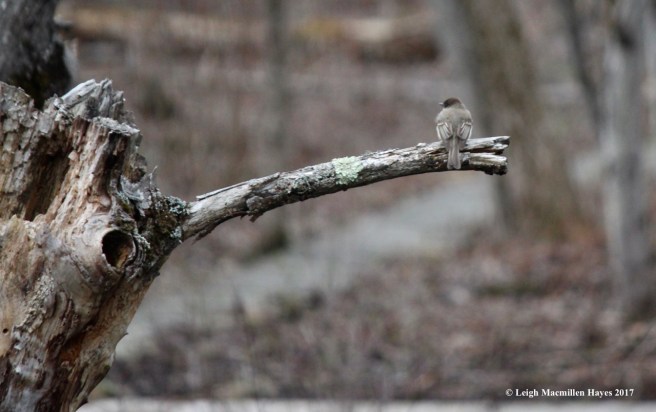
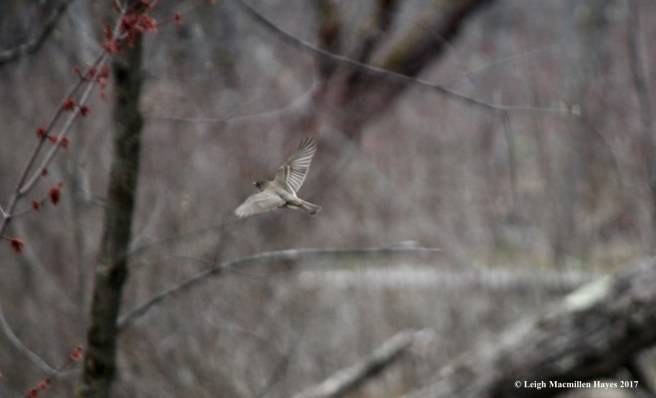
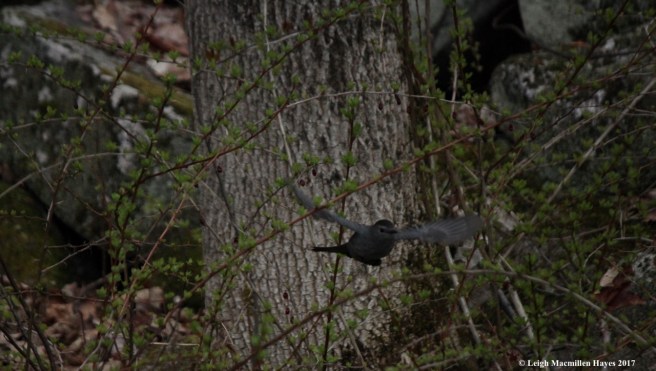
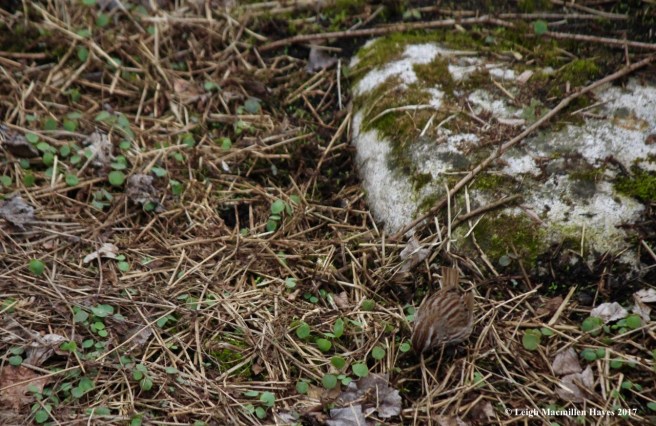
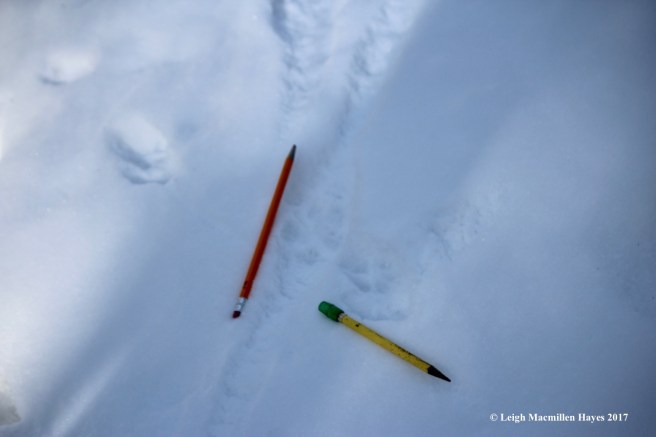
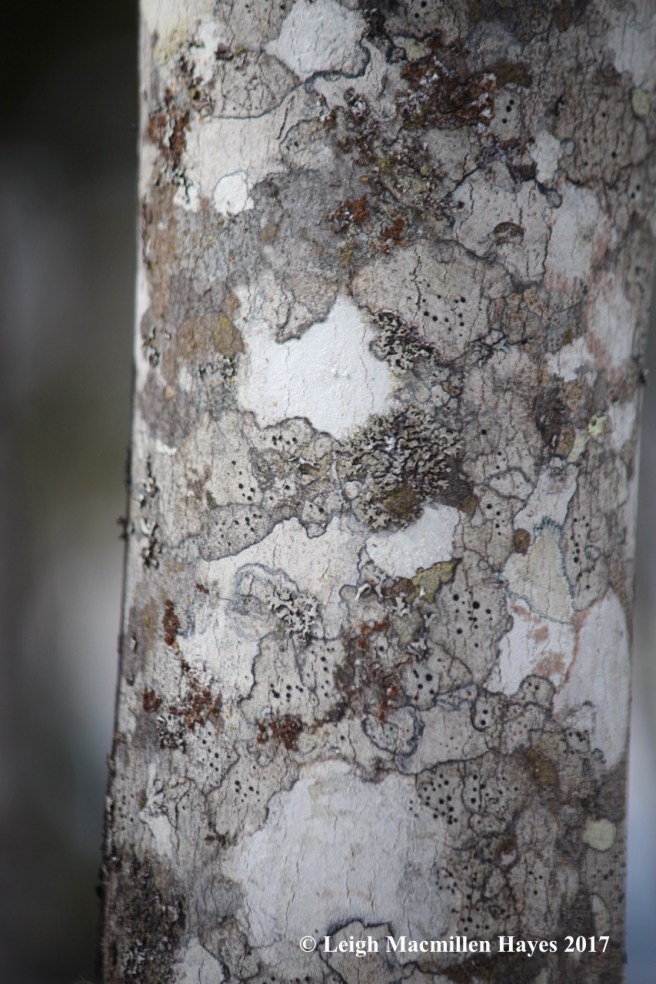
B is for . . .

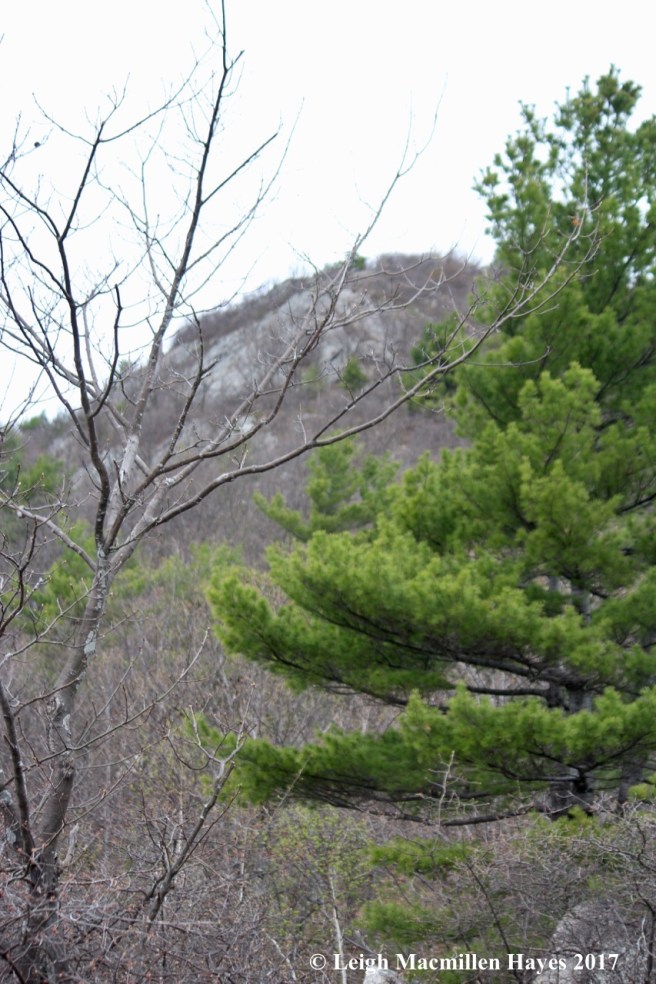
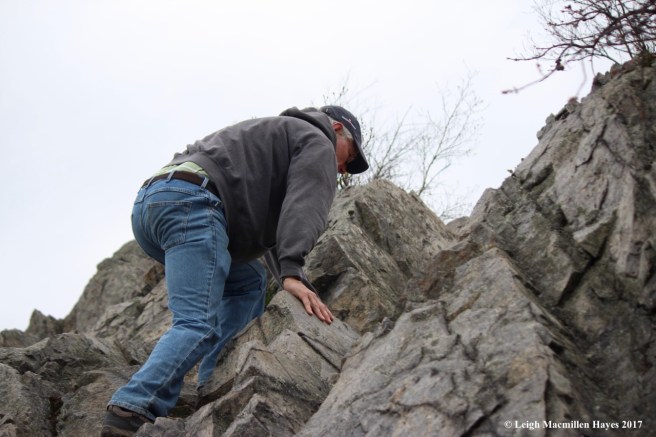
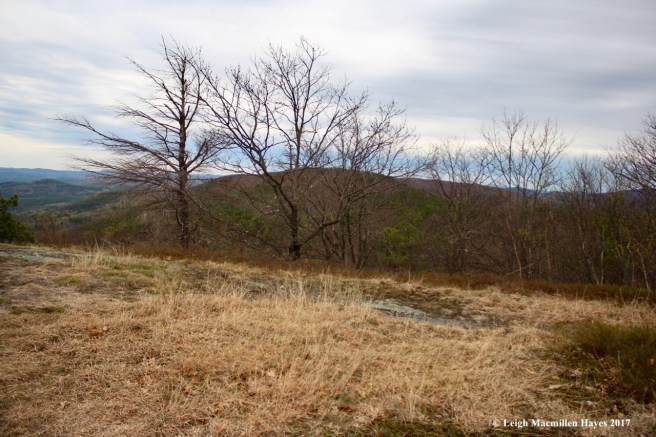
Our original plan was to hike to the summit of Blueberry Mountain in Evans Notch today,  following the White Cairn trail up and Stone House Trail down. But . . . so many were the cars on Stone House Road, that we decided to go with Plan B.

And so up Route 113 I drove, turning left just before crossing from New Hampshire back into Maine.

b-view from Basin

By the parking lot for The Basin, we pulled out our lunch and set up camp temporarily at a picnic table as we enjoyed the view of the manmade pond and Sugarloaf Mountain before us.

b-basin rim

The Basin is a low-elevation glacial cirque carved out of the east side of the Baldface-Royce range. Though we’ve visited the pond on numerous occasions, we’d only hiked the trails circling it once before. And as we recalled while sharing a brain in the memory department, that had been thirteen years ago when our oldest son was in seventh grade. It was a fine September day and we’d headed off to climb the Basin Trail. At first, we couldn’t find the brook crossing, so eventually we made our own. And, what we didn’t realize that day was that at the top of said trail we should have turned around and descended. Instead, in our ignorance, we’d continued on the Basin Rim Trail, assuming they were one in the same. Not so. Hours later, we practically slid down one of the Royce trails, splashed across another brook, bushwhacked to the road and followed it down as quickly as we could to our vehicle. It was late in the afternoon and we knew that our seventh grader was anxiously waiting for us . . . because it was also the very day that he could receive his school-supplied Apple computer if his parents attended an after-school meeting with him. That was pre-cell phone time in our lives and we didn’t have enough change for the one pay phone at the Stow Corner Store, which happened to be closed. We raced home, found he wasn’t there and while my guy went in search of our younger son, I zoomed to the middle school, sweaty, muddy and bloody (from a few encounters with branches and rocks), to find that my sister-in-law who teaches there had stood in as a surrogate until I arrived. Today we carried a map.

b-trail sign

And knew what Rim junction meant.

b-hobblebush1

As the north wind blew, it felt rather autumn like and added to our memory bank, while also the perfect day for a hike. And the hobblebush berries and leaves showed off their almost autumn colors.

b-trillium 1

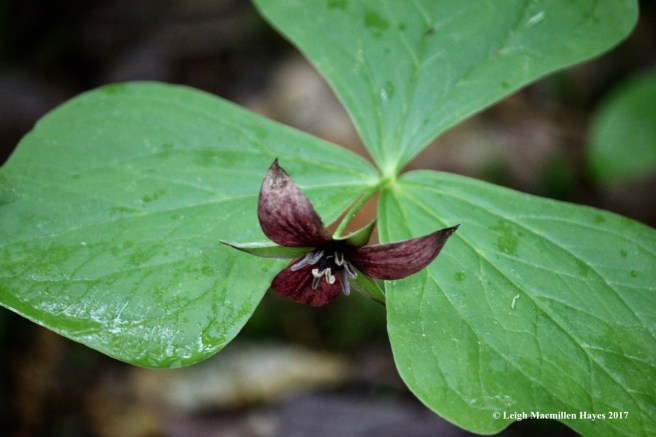
Berries were abundant–especially upon red trillium,

b-bunchberries

bunchberry,

b-doll's eye 1

and white baneberry (doll’s eyes–can you see why?).

b-following the yellow brick road

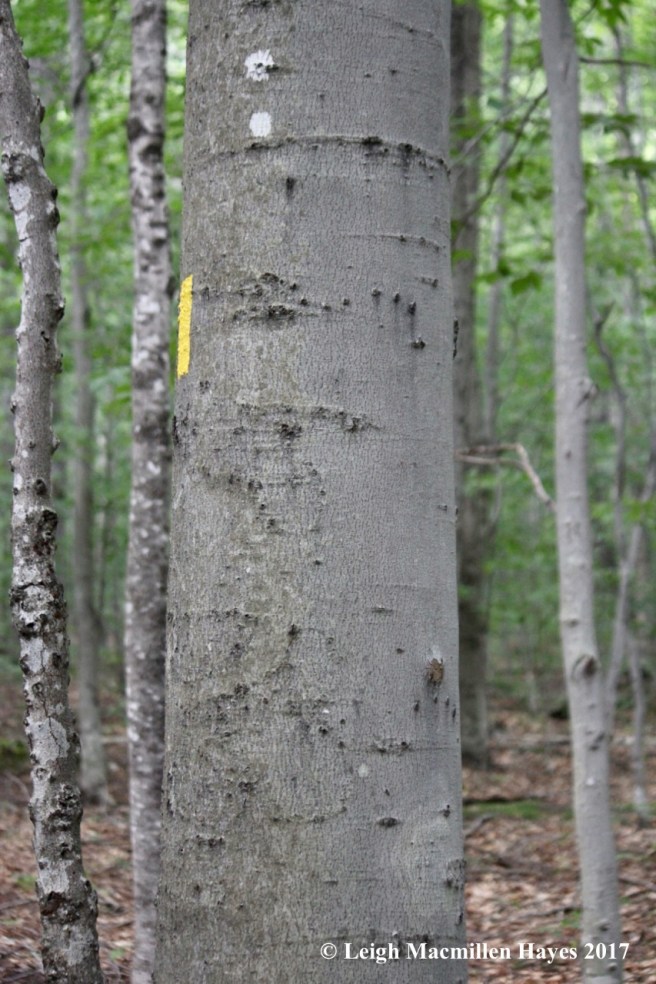
The trail was easy at the  start, switching from roots to stones to rocks before climbing. Since we’d attended Lake Region Community Theatre‘s fine performance of The Wizard of Oz last night and the trail blazes were yellow, it felt a bit like we were following the yellow brick road.

b-hermit fall sign

At about the one-mile mark, we chose the Hermit Falls loop.

b-lower hermit falls

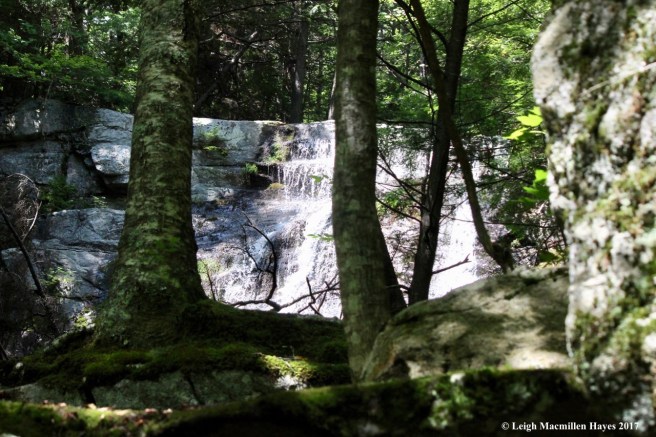
Water poured over the lower falls,

b-Hermit Falls

and from there we spied the upper.

b-Hermit Falls 2

Though a couple of fallen trees crossed the waterway, the view and sound were pleasing to our senses. It was at this point that our climb became steeper.

b-bear tree 1

We spend a lot of time looking down when climbing up, but because we were in a beech forest I knew I had to look–for bear claw trees. And I wasn’t disappointed.

b-bear paw 2

Even in the upper trunk we could see the marks left behind.

b-maple division

And then my guy pointed out another tree he thought I should note–it looked rather like a burl gone bad. We don’t know what happened, but the final result was rather gnarly, and still the tree continued to grow and produced leaves.

b1-boulders

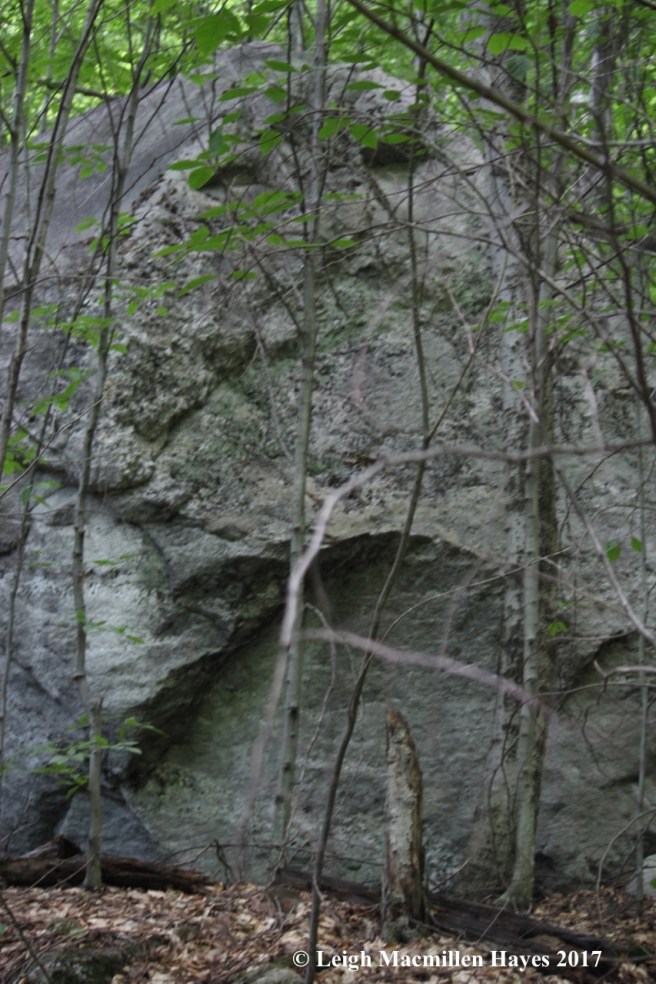
Huge boulders littered the woods as we continued our climb.

b-light at the end of the tunnel

Closer to the summit, the trail followed a rather precarious shelf beside the base of a big headwall cliff–I didn’t take time to photograph it for I was focused on each step, but at last we saw the light at the end of the tunnel.

b-summit which way should we go?

Before stepping out to the viewpoint, we walked ahead to the spot where we’d erred thirteen years ago. Today it’s well marked. In fact, this junction includes five options and my guy took the time to point in each direction. Our choice: to return from whence we’d come–behind us.

b1-summit 1 (1)

At last, we turned back to take in the view from the Basin below us to Pleasant Mountain on our far right. We noted a cloud casting its shadow over Blueberry Mountain and trust we would have been blown off had we stuck with Plan A.

b-summit blue bead garden

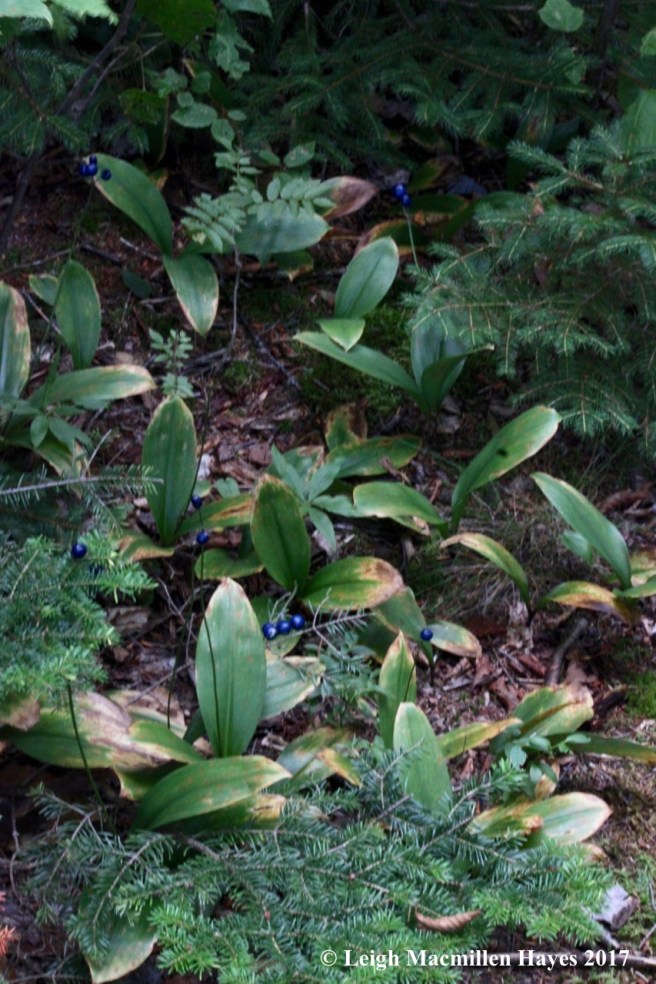
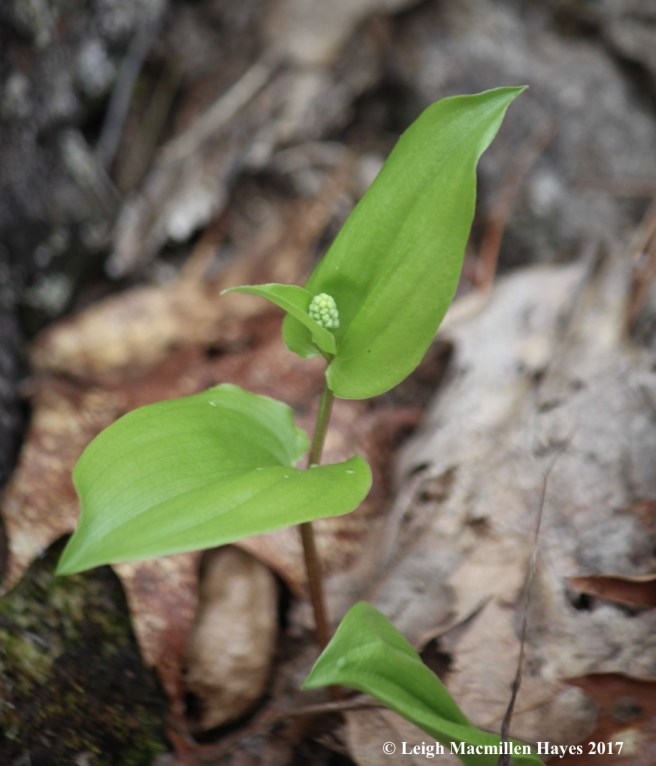
Though we’d brought containers to pick blueberries, that wasn’t to be. But at the summit we noted a blue of a different hue, a blue-bead lily garden by our feet,

b-summit mountain ash berries

and mountain ash berries maturing above our heads.

b-velvety fairy fan fungi 1

Finally, we started down. After the initial scramble on the rocks and roots just below the summit, I once again turned my attention to the life around me and realized I’d missed this display of fungi on the way up–velvet stalked fairy fan mushrooms (Spathularia velutipes). They actually reminded me of miniature cowboy finger puppets donning oversized hats.

b-bear tree on way down

And . . . another bear claw tree–this one highlighted with a trail blaze. How sweet is that?

Follow the yellow brick road.

b-back on flat ground

At last we were back on flattish ground and made our usual mad dash out.

b1-deer hill bog 4 (1)

As we drove home, I gave my guy a choice–ice cream at the Stow Corner Store or turn onto Deer Hill Road (actually a road of many names) to the bog and then to Evergreen Valley. He said the choice was all mine and so I chose the latter. And as I knew it would because it always does, it made me want to return when I have time on my hands. I will–that is a promise to myself.

b-bull frog 1

Today’s stop included a chorus of bullfrogs–adding to my list of finds beginning with the letter B.

b-bye

As it worked out, we were glad we followed Plan B.

B is for . . . The Basin and the bog and all that we saw in between.

Thanks for stopping by.

Bye bye!


Swamp People

The phone rang as I was getting ready this morning and I don’t usually answer those with IDs such as “Private Caller,” but I did. And that made all the difference. Alanna Doughty was on the other end of the “line” and wanted me to know that this morning’s Lakes Environmental Association walk to explore the wetland plants at Holt Pond was still a go. She also asked if I wanted to borrow a pair of waders. Indeed, I did.

About 30 minutes later a group of eight had gathered at the preserve parking lot despite the raindrops. A few didn’t learn about the event until they read a description in this week’s Bridgton News, and so though they were prepared with raincoats and bug spray, they didn’t have Bogg boots or waders, but Alanna had brought along a few extra pairs and most made do. One gentleman had large feet and said he didn’t mind getting his sneakers wet. Such was the spirit of the morning.

p-red maple swamp

Without much further ado, we stomped down the trail and then slipped off it, through the woods and directly into the red maple swamp . . .

p-blue flag iris

where raindrops enhanced the dainty leaves of the blue-flag iris. Going off trail offers a certain liberating feeling.

p-pitcher plant

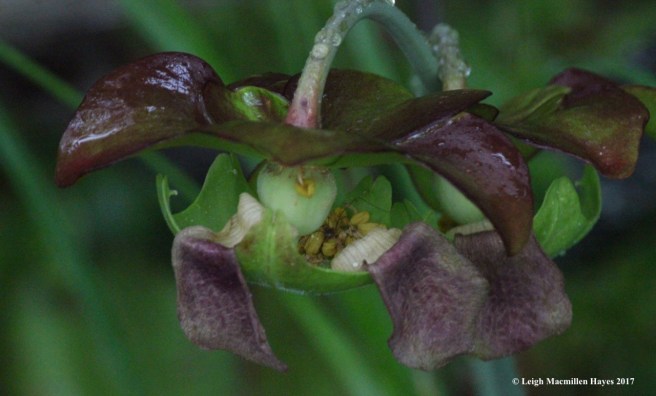
It also offers different species. Our movement was interrupted frequently by our findings, and as we stopped to determine the identification of a shrub that stumped us for a while, another plant drew our attention. Holt Pond is home to many pitcher plants, but this one cast its spell upon us for the curvy flower stems and new urn-shaped leaves. Most often, the stems stand stalwart.

p-pitcher spider

The otherworldly flowers protect friendly pollinators from accidentally being consumed. Unlike the pit trap below, aka the urn-shaped or pitcher leaves, the flowers are friendly and provide bees and other insects with nectar and pollen. This morning a spider wandered within, stepping on fallen anthers.

p-pitcher 4

I’ve forever found it a wonder that the extremely large style sits below the rest of the structure in order to capture pollen in its upside-down umbrella shape.

p-pitcher flower 1

Though those flowers have aged, their leathery sepals remained, fading from red to magenta. Below the sepals the large swollen ovary may house as many as 300 tiny seeds.

p-working our way through the swamp

After a long period of admiration, we finally pulled ourselves away and continued our tramp, finding our way through the swamp. And only briefly did we feel fake lost, but knew that wherever we came out, we’d recognize our position and continue the journey.

p-Great St. Johnswort

Among the sphagnum moss grew Great St. Johnswort not yet in flower.

p-slug

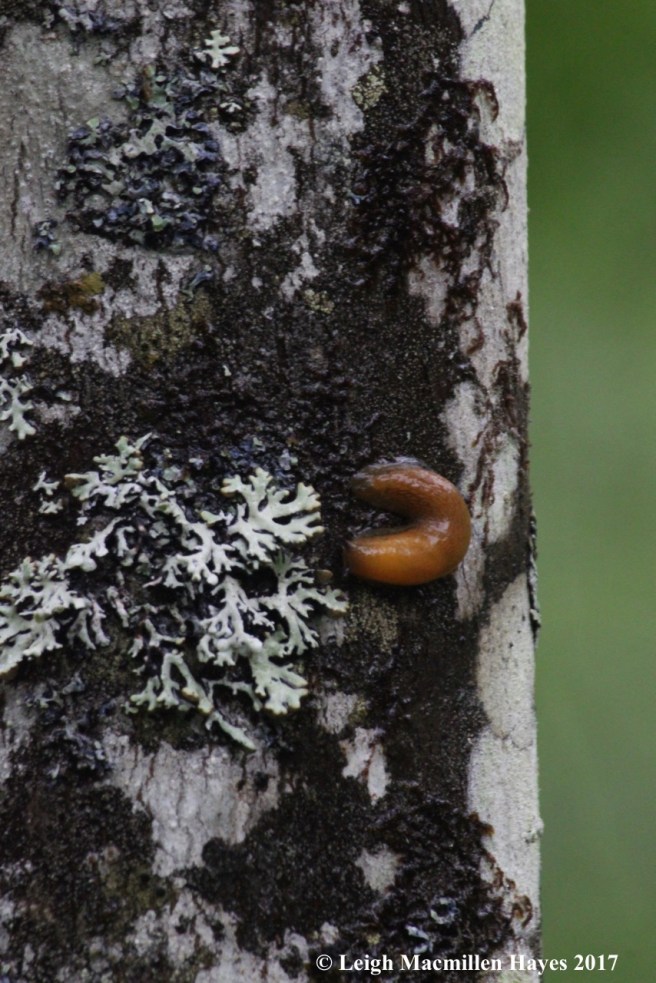
And slugs dined.

p-grasses, sedges and rushes

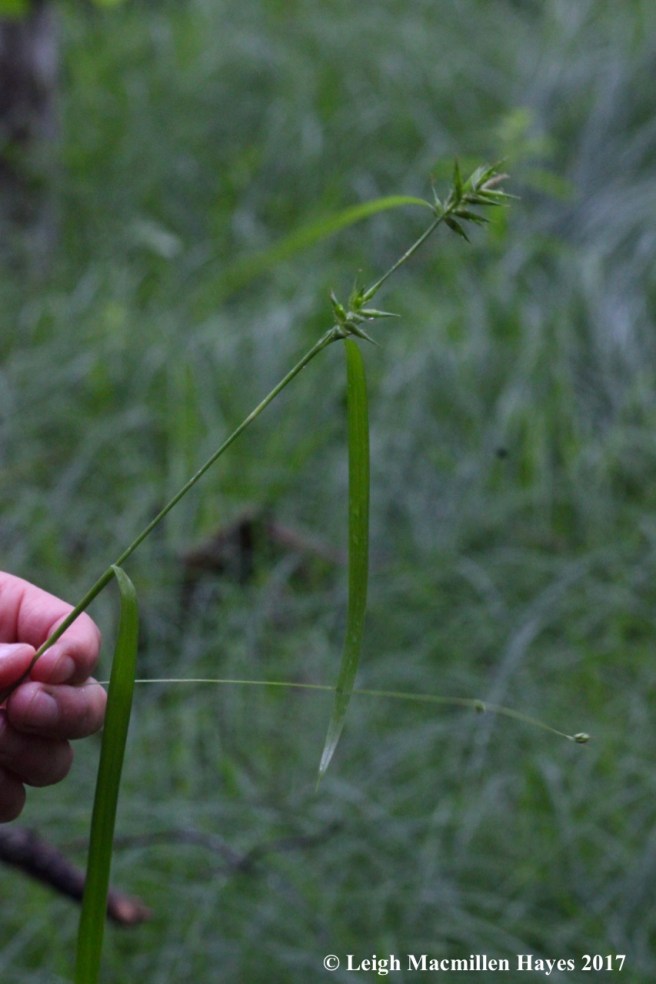
There were maples of course, and gray birches and speckled alders and royal and cinnamon ferns. But, there were also grasses and sedges and maybe even rushes. When at last we left the swamp and found ourselves on Tire Alley, about where we wanted to be, Alanna shared the ditty that helps us to maybe not name a particular species, but at least to know where to begin: Sedges have edges, rushes are round, grasses have joints all the way to the ground. Of course, she passed around examples so everyone could feel the edges of the sedge and see the joints on the grass.

p-Alanna describing hobbleush flowers

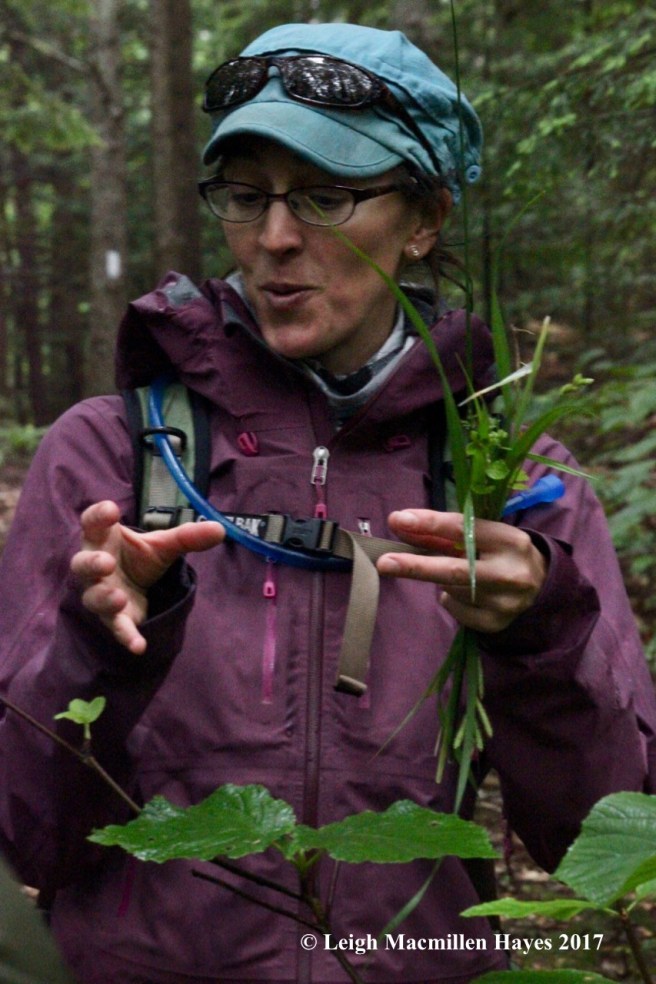
Then she stopped to describe the former flower of hobblebush, and I noticed the bouquet in her hand had expanded–her collection intended for further study later in the day.

p-slime mold on birch

We were about to head from the trail into the quaking bog by Holt Pond when Mary Jewett spied a growth on an old birch tree.

p-slime mold 2

My best guess was a slime mold for it looked like the Son of Blob had arrived. She and I both touched it and the outer coating fell off. It was rather creepy.

p-dark green fritillary caterpillars

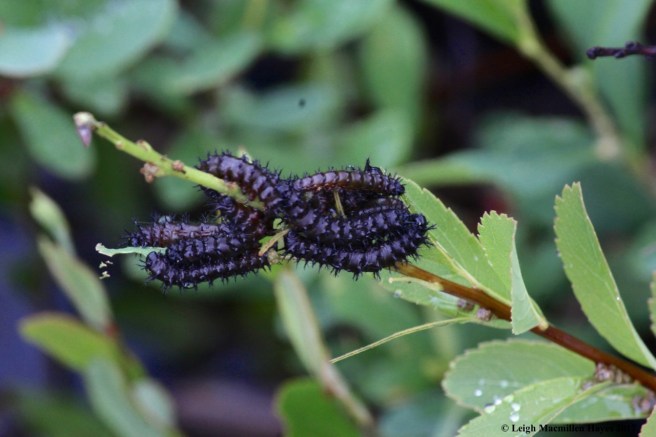
At that point, we did a 180˚ turn and started out onto the quaking bog, literally, but a few in the front decided it wasn’t quite what they had bargained for since the water was especially deep. So, Alanna and Mary ventured that way and I joined the rest for a walk on the boardwalk, which was wet as well, but a bit more stable. Along the way, we spotted caterpillars actively consuming spirea leaves. Upon later research, I determined they were dark green fritillary caterpillars that will soon metamorph into those beautiful orange butterflies that we often mistake for monarchs. (Note: I spotted a monarch on milkweed not yet in bloom yesterday)

p-bog rosemary

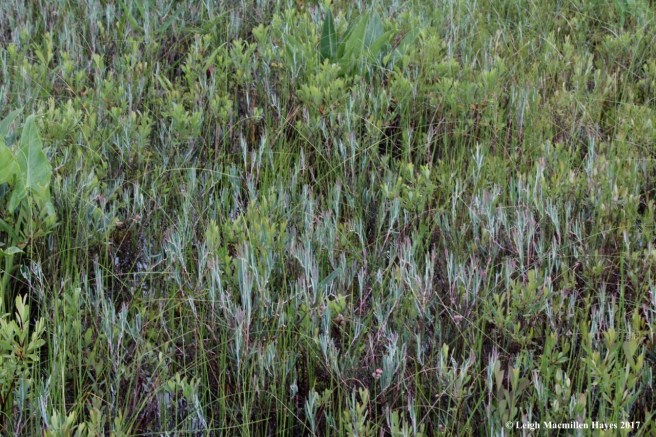
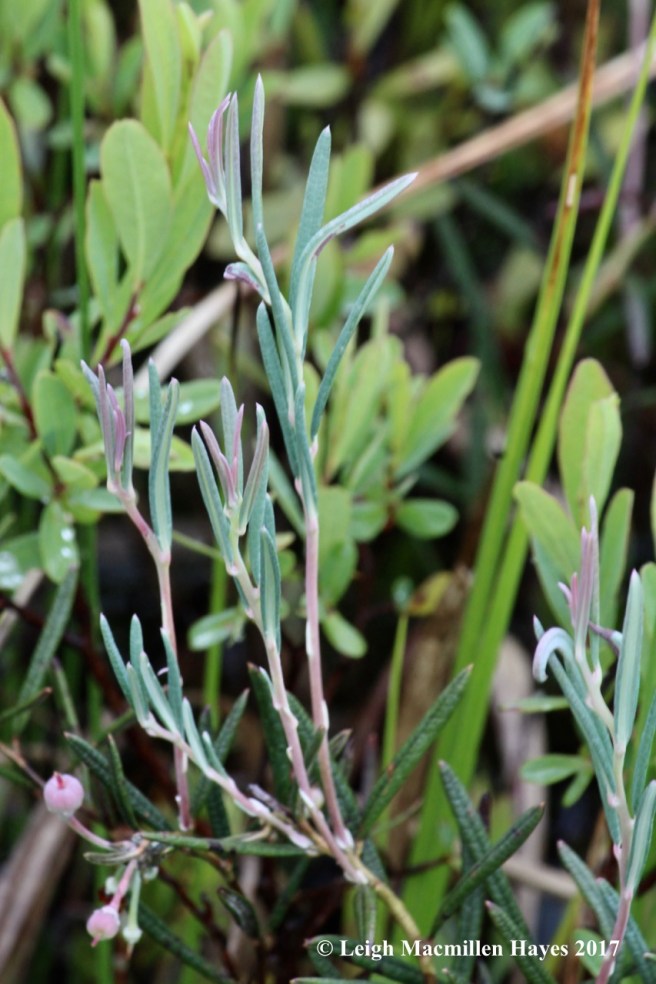
Among the many plants growing on the quaking bog, the bog rosemary stood out with its bluish gray leaves.

p-bog rosemary 1

Newer leaves formed at the top, giving off a reddish hue and adding to their distinctiveness.

p-bog rosemary 2

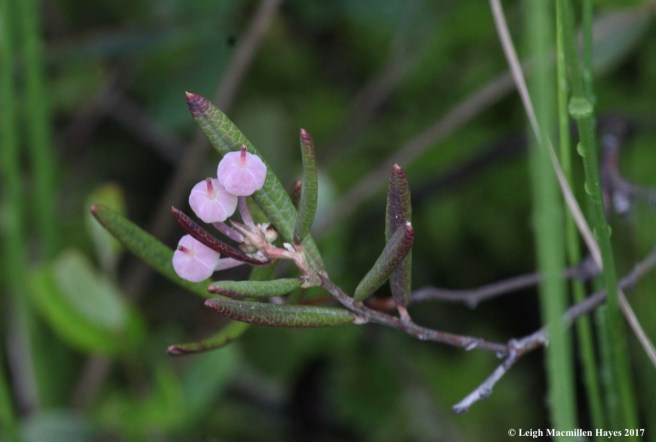
The netlike venation on the leaves was also noticeable and though the blooms have passed, the pretty pink fruits hadn’t yet matured into brown capsules.

p-sundew with Mary

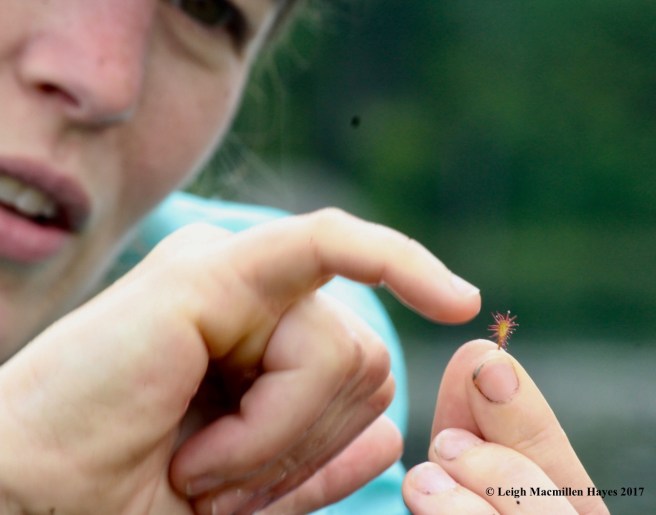
Since we’d seen the pitcher plants, Mary wanted to find the sundews that grew near the boardwalk. With the high water as a result of a beaver dam on the Muddy River, it’s been  hard to spot the sundews, but she persevered and located one, showing off its glistening tentacles intended to capture small insects. Should one land on the tiny leaf, the insect’s feet become ensnared in the sticky secretion and the end is eminent. Within mere minutes the tentacles curl around the victim and suck the nutrients out of it.

p-snakeskin 1

Meanwhile, Alanna continued to wander off the boardwalk and suddenly she discovered a shed snake skin. I had intended to join her, but I have to say that though I wore hip waders and my feet and legs were mighty dry, I could feel the bog quake with each step and I didn’t get far. Blame it on my camera, but I didn’t want to risk a fall. And do you know that squelchy sound of pulling a foot out of several inches of mud? That’s how it was when I tried to get back on the boardwalk. It’s not just a few plants that are carnivorous–it’s the entire bog.

p-snake skin 1

Never fear. We all survived and she brought the skin back for us to admire.

p-black chokeberry 1

We stayed on the boardwalk and trail as we finally looped back and still, there was much to see. The shrub that had stumped us when we first spotted the pitcher plant in the red maple swamp suddenly spoke its name and we knew we were looking at the fruits of the black chokeberry. Only a week or two ago we’d admired their flowers.

p-serviceberry 2

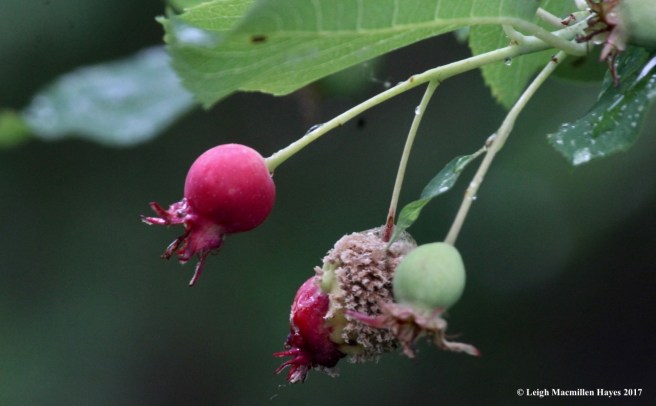
And then there was the berry that reminded us of a rose hip, as it should for it was in the rose family.

p-service berry gall?

Its ripening pomes will eventually turn purplish-black. But . . . we spied something we weren’t familiar with at all–do you see the growth on one? It rather reminded me of the Son of Blob slime mold we’d seen earlier and must have been a gall. Nature certainly provides as many questions as answers.

p-Northern Arrowwood

All spring and summer the flowers of the bog change by the week, or so it seems. This week, the Northern arrowwood was showing off its creamy-white blooms.

p-sheep laurel 2

And the sheep laurel, its fuchsia-colored blossoms.

p-bog monster web

For three hours we oohed and aahed and had great fun. We made one last stop before returning to the parking lot for the spirit in the hemlock called out to us–seemingly doing its own oohing and aahing.

Such were the offerings of the preserve this morning. And the people who gathered . . . I only knew Alanna and Mary before we began, but because of our shared experience the group was quite chummy by the time we were ready to depart. That’s what I love about walks such as this where complete strangers become instant friends, even if it’s only in the moment.

Swamp people . . . don’t mind rain or mosquitoes or wet feet. Swamp people . . . get to move where the spirit takes them. Swamp people . . .  find joy and wonder along the way.


“Hey You!”

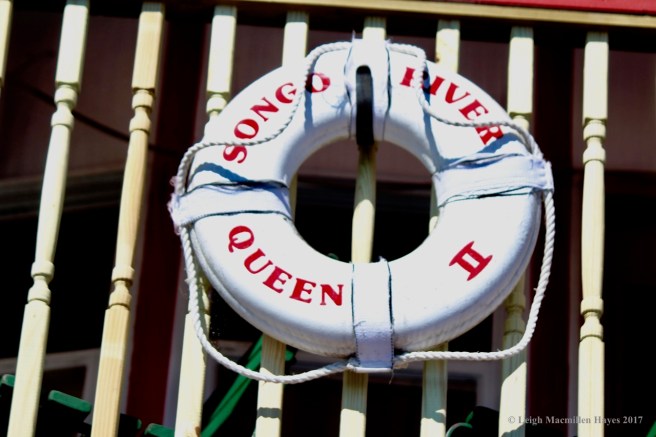
Shouts of “Hey You!” echoed across Long Lake in Naples, Maine, this morning as sixth grade students from Oxford Hills enjoyed a cruise sponsored by the Lakes Environmental Association aboard the Songo River Queen II, a replica of the famed Mississippi River Paddle Wheelers. For the past twenty years or so, LEA has offered this event to those who have completed the Living Connections Program in the Lake Region Schools and as a special program for students from several other districts, such as Oxford Hills.

l-Songo River Queen II

This culminating activity brings all the lessons students have learned about shoreland zoning and water quality to life in an engaging and interactive way.

l-Long Lake

After what seemed like months of rain, it was a beautiful morning as Captain Kent steered the boat away from the dock and onto the 11-mile-long lake.

l-Mary 1

As the tour began, LEA’s talented teacher/naturalist Mary Jewett, quizzed the kids.

l-prizes

They expressed their knowledge about watersheds, lake hydrology, phosphorus and other nutrients, chlorophyll, algal blooms, vegetated buffers, erosion control, thermocline, stratification and turnover, and received prizes for each correct answer. I’m always impressed by their responses.

l-vegetative buffer

They’re able to point out vegetated buffers . . .

l-grandfathered cabin

and recognize that some lakefront properties built within the 100-foot setback are older than the shoreland zoning law and therefore grandfathered.

l-station 1, sand 1

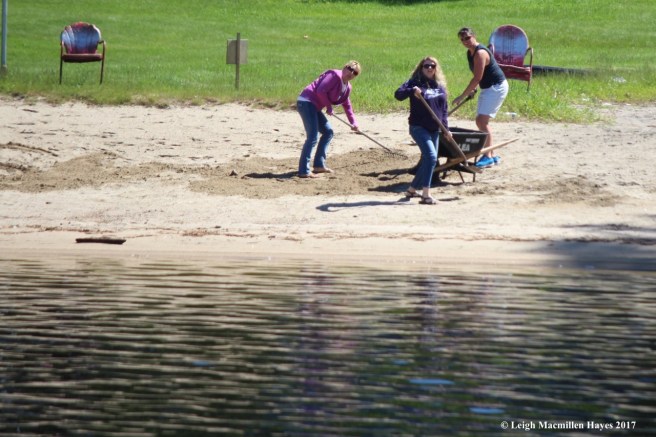
In the midst of it all, Captain Kent suddenly made Mary aware of a violation occurring on shore. Several women shoveled sand out of a wheelbarrow and spread it with rakes.

l-station 1, sand 2

Encouraged by Mary, the kids shouted, “Hey You!” The women continued to spread the sand so the kids shouted again—only this time they were even louder. On shore, the culprits looked surprised. Using the loudspeaker system, Mary explained that it’s illegal to add sand to the beach.

l-station 1, sand 3

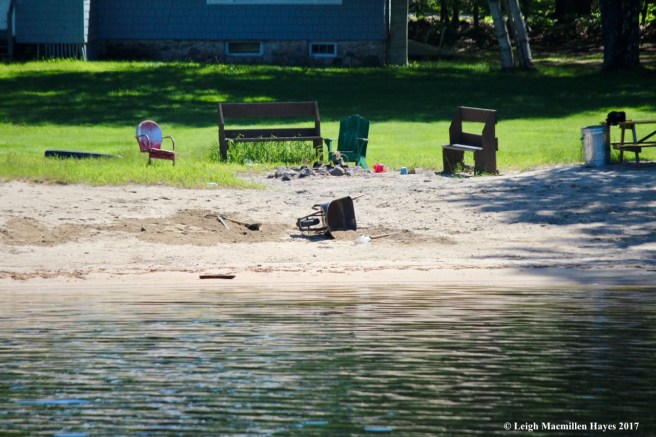
The women quickly retreated, dumping the wheelbarrow in the process. The kids caught on that this was a role playing situation, but it created opportunities to discuss the implications–such as the fact that dumping sand can cause significant problems for the lake because it contains phosphorus, which contributes to decreased water clarity and algal blooms. Wildlife is also affected, e.g. decreased spawning habitat for fish, and increased opportunities for invasive aquatic plants like variable-leaf milfoil.

l-station 2, fertilizer and spray

Mary continued to question the kids as the boat poked along, until another “Hey You!” moment. One woman was spotted spreading fertilizer (flour in this case) with a flourish, while another sprayed what appeared to be weedkiller on the vegetative buffer. The kids were reminded that topical fertilizers often contain phosphorus and other nutrients that wash into the lakes.

l-station 2, cutting grass too short

At the same property, a man mowed the lawn using the lowest setting (or so it looked from the boat). Short grass is even more likely to allow those nutrients to wash into the water.

l-station 3, trimming vegetative buffer

The next violation involved a group of people trimming and removing the vegetated buffer. The students know the buffer is the last line of defense between a home and the lake because it provides a filter for any run-off, thus helping to keep excessive nutrients, sediment and storm water out of the lake. Native trees, shrubs, flowers and ground cover should be left in place.

l-station 3, running 1

Like the other offenders, this group hastily ran away . . .

l-station 3, hiding

and hid behind the trees.

l-Mount Washington
Following the third stop, the boat paused in the middle of the lake, where Mount Washington was visible. Students rotated through water testing stations where they practiced using such devices as a secchi disk, dissolved oxygen meter, Van Dorn water sampler, and core sampler. I was in charge of the core sampler and we talked about how the hose is lowered to one meter below the thermocline, that mid-point at which the temperature decreases and sunlight cannot penetrate. (Think about doing a cannon ball off the dock and hitting the spot where the temperature is suddenly freezing–or so it feels on a hot summer day.) We talked about how the water is tested in a lab for chlorophyll, phosphorus, pH, color and more. And then they tried gathering a water sample. One student lowered the weighted end of the clear, plastic hose into the water, while the others held onto the rest of it. When I said “Crimp and cover,” a second student crimped the hose and a third covered the far end. Quickly, the first student raised the weighted end, the other two let go and working together, all raised the hose high and tried to “walk” the water down it and into a container. Today, I think we gathered the most water I’ve seen in all the years I’ve volunteered for this activity.

l-pencils

Once students had rotated through all of the stations, Mary’s quiz continued as we traveled along the eastern shore. Volunteers asked questions, though I let Mary ask mine, and again the students who answered correctly were rewarded.

l-station 4, trees 1

Because they were on the lookout, one of the kids noticed people wearing hardhats and attempting to cut pine trees within mere feet of the lake.

l-station 4, Anne, who me?

They are quickly admonished by this now savvy group, though the “workers” couldn’t believe they’re being picked upon. Mary did remind the kids that shoreland zoning laws do allow homeowners to limb up to 1/3 the height of a tree in order to maintain a view.

l-station 5, Matt 2

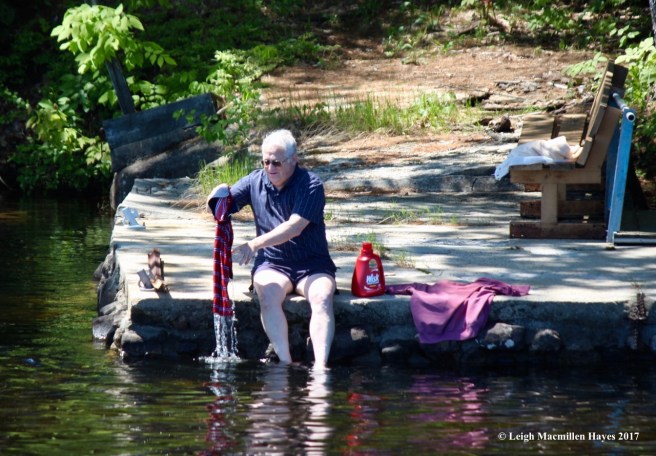
Close by, a man washed his laundry—yes, in the water. Under state law, it is illegal to intentionally introduce foreign substances, including soap, into the water. (He was supposed to “bathe,” but the temperature is a wee bit chilly yet.)

l-party 1

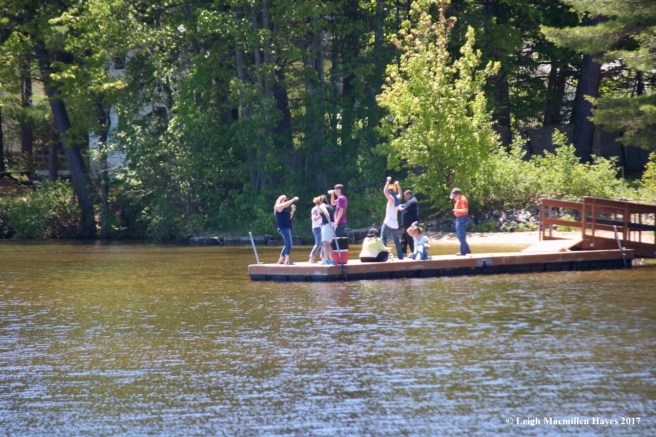
It didn’t end there. As the boat passed by the Naples Town Beach, the kids noticed a group gathered on the dock drinking and then tossing empty cans.

l-party 4

You know by now what happened.

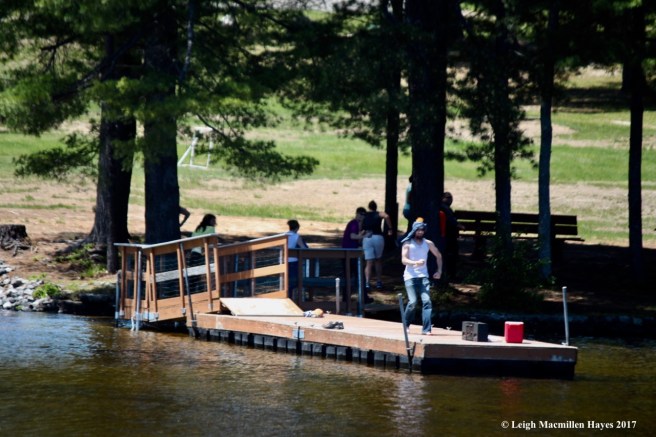
l-party 6

Though one guy did run back . . .

l-party 8

to get the boom box.

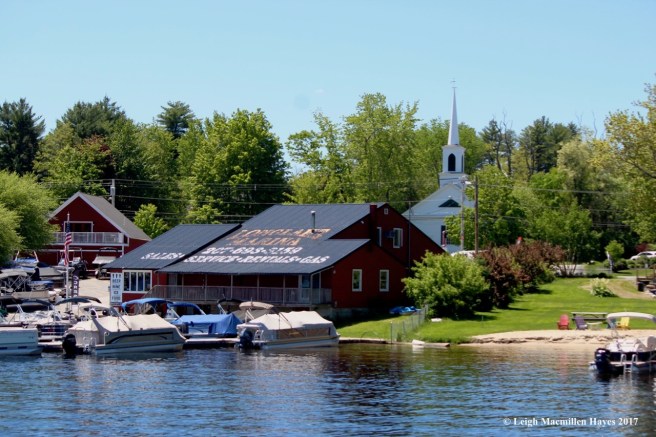
l-Naples, church, marina

At last Kent steered the boat back toward the dock.

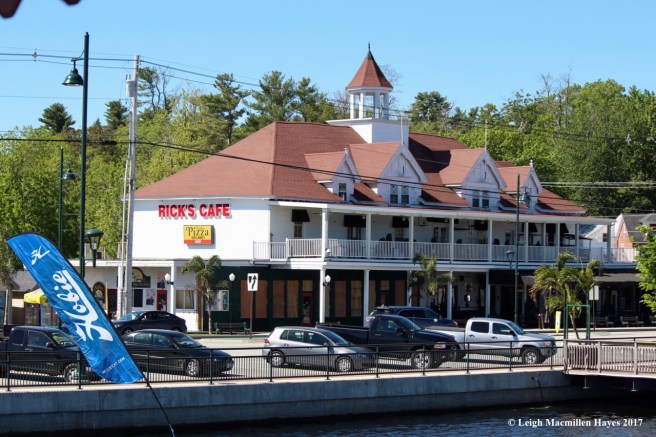
l-Rick's Cafe

The cruise had come to an end, but by seeing the volunteer actors on shore, students made the connection between their in-class learning and real life situations when it comes to water quality.

l-dragonfly exoskeleton

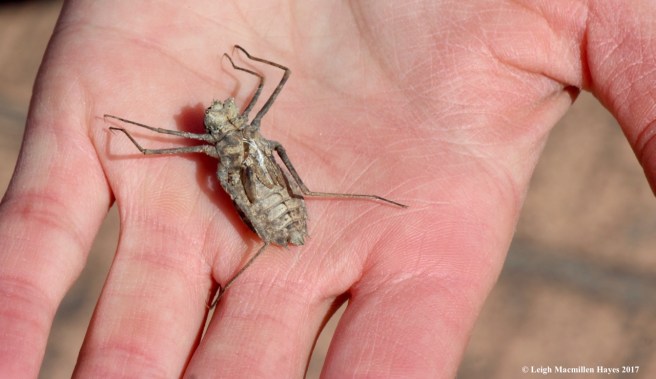
Oh, and before we had initially headed out, Mary spotted a huge dragonfly exoskeleton by the causeway and LEA’s Education Director, Alanna Doughty, climbed over the railing to fetch it. As Mary pointed out to the kids when she held the exoskeleton up, this is what it’s all about–clean water for aquatic species and for us.

Hey You! Think about your actions and be the difference.

At a Snail’s Pace

The mosquitoes were thick. The ground damp. But the rain held off and so four docents and I met at the Greater Lovell Land Trust‘s Flat Hill parking lot at the end of Heald Pond Road.

p-beaked hazelnuts forming

From the getgo, our fun began as we spotted numerous beaked hazelnuts forming–the trick is to pay attention to them and watch their continued growth, for in a flash, or so it seems, they’ll mature and . . . disappear. The nuts those hairy beaks cover are favorites for wildlife and we human folk also like them.

p-red trillium

Our mission was to get reacquainted with the spring flowers–some being obvious to us like the red trillium, though the fact that it was still in bloom offered a delightful surprise. We chatted about the fact that its also known as Stinking Benjamin for its undelightful odor, but try as we might and we did again today, none of us have ever been offended by it. Apparently, they smell like rotting meat, but you can’t prove it by us.

p-fringed polygala

Here and there we were awed by the delicate fringed polygala, aka gaywings. They did remind us of birds with crazy head dresses taking off in flight.

p-false solomon seal

As we shared brains and practiced relearning species before the next season gives us even more, we felt proud to quickly ID a false solomon seal, aka wild spikenard, before it had fully flowered. It’s the cluster of flowers on the end branch, the arching, zigzag stem and long oblong leaves that stand out in our minds.

p-Rose Twisted Stalk or Rosybells

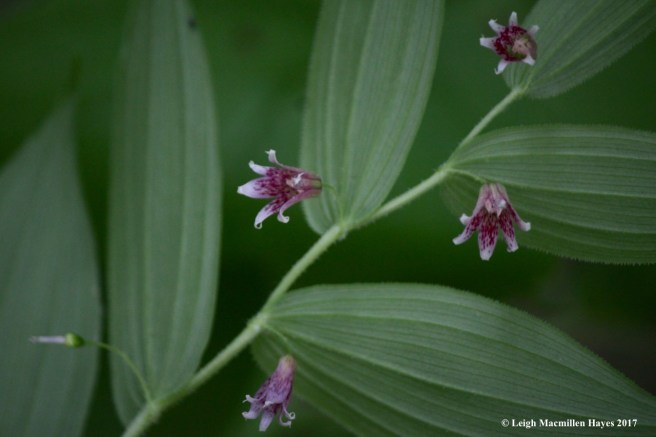
A seal of another sort, the rose twisted stalk, aka rosybells, also adorned the trail. Pam held the stalk up so we could look at the bell-shaped flowers that dangled below.  Notice how the leaves are green below and stalkless but don’t necessarily clasp the stem–as opposed to twisted stalk (white mandarin), which features greenish flowers dangling below and stalkless leaves that do clasp the stem. Plus the latter’s leaves have a white bloom on the underside. We didn’t see any twisted stalk, but were tickled with our rosybell finds.

p-raindrops all in a row

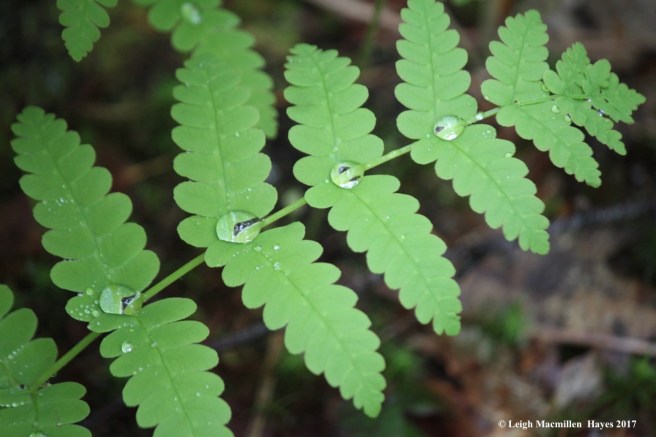
Periodically, we stopped to examine ferns, or quiz each other on the ID. But sometimes, it was just fun to notice presentations, including raindrops all in a row.

p-beech fern

And though a couple of our fern experts couldn’t be with us, Joan was and she loves nothing more than squatting beside them with the Fern Finder to determine a species, including the long beech fern.

p-clitonia 2

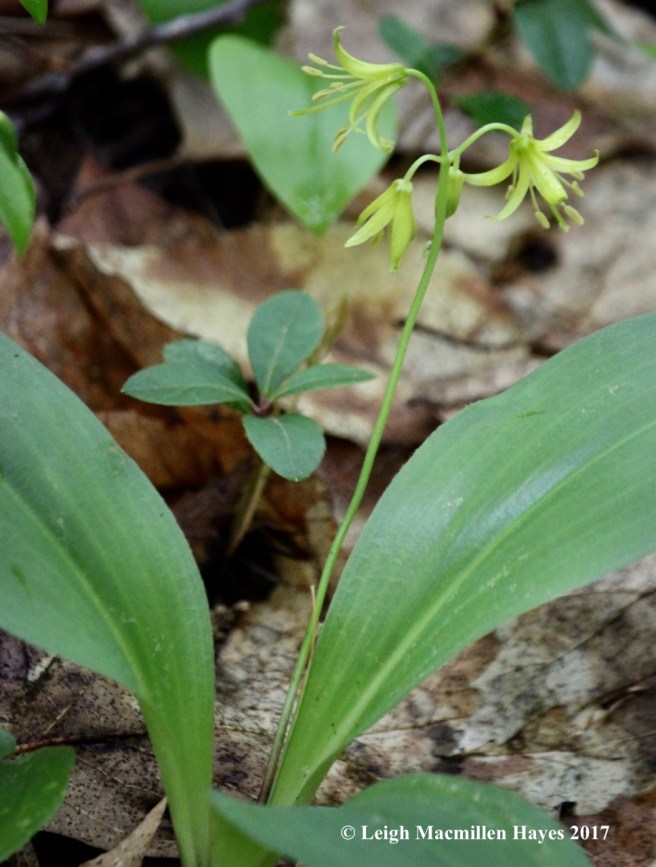
It was while looking at bracken ferns that Mary and Nancy spotted the greenish yellow flowers of clintonia. We were excited because we’d seen plenty of plants, but these were the first in flower, and they were well hidden.

p-clintonia flowers

Yellow clintonia is also called bluebead for the fruit that develops is a porcelain blue bead-like berry. Check out those pistils (she’s a pistil) dangling below the stamen, their anthers coated in pollen. Bring on the bees and the beads.

p-baby toad

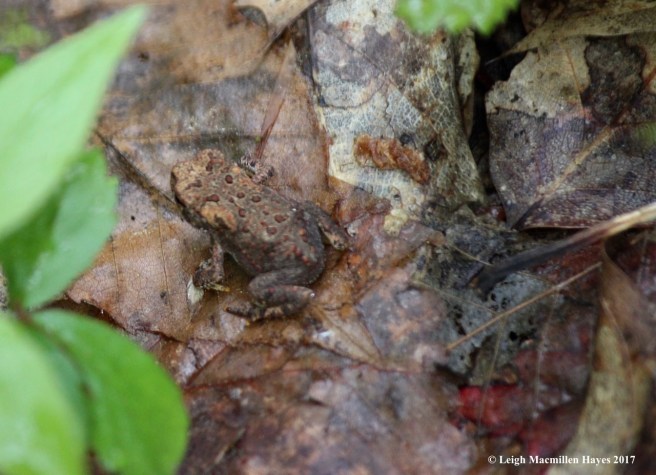
Suddenly, we discovered movement at our feet and saw our first baby toad of the season. It’s diminutive size and obvious camouflage made it difficult to see, but unlike the adult members of its family who will freeze in position, thus allowing us to study them further, this little one wanted to escape as quickly as possible. Smart move on its part.

p-bench view

Only about two hours later we’d covered maybe a half mile and found our way to the bench that overlooks the swampy area surrounding the brook between the beaver pond and Bradley Pond.

p-red maple leaves

We sat below a red maple and listened to a chorus of birds–and gave thanks for the food supply. Let them eat bugs. We offered up a few mosquitoes.

p-red-winged blackbird

A red-winged blackbird flirted with us, showing off its bright red shoulder and yellow wing bar as it flew from shrub to shrub. The five of us swooned.

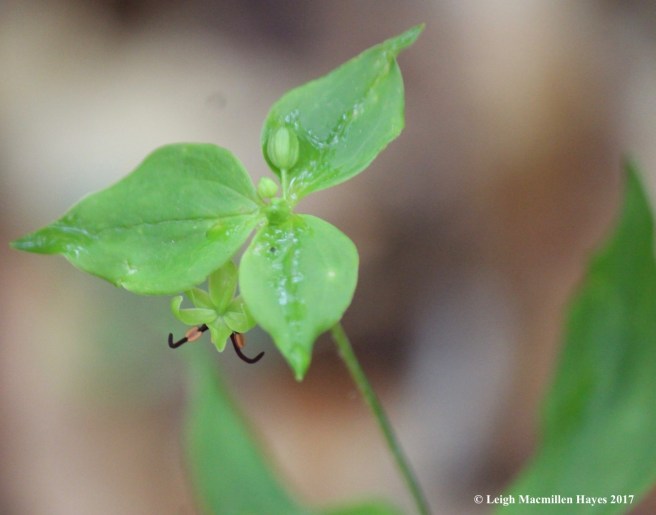
p-Indian Cucumber pre-flower

All along the path, we’d spotted Indian Cucumber Roots with their buds formed atop the second layer of their double-decker formation. When we finally stepped from the bench back to the trail, we noted a couple of the buds were beginning to dangle below the second story, meaning the blossoming season would soon be upon us.

p-Indian Cucumber flower 2

And just like that . . .

p-Indian Cucumber flowering

Voilà. I’m of the belief that if this flower doesn’t make you wonder, nothing will.

p-beaver pond view

Our next stop was at the bridges that cross below the beaver pond. We’d been looking for fresh beaver works all the while, but only discovered the work that had been completed over a year ago.

p-royal fern crown

There was still plenty to see, including the fertile crowns atop royal ferns,

p-jack-in-the-pulpit 2

a small jack-in-the-pulpit,

p-mayfly hitchhiker

and a mayfly that chose Pam’s jacket to rest upon.

p-foamflower 1

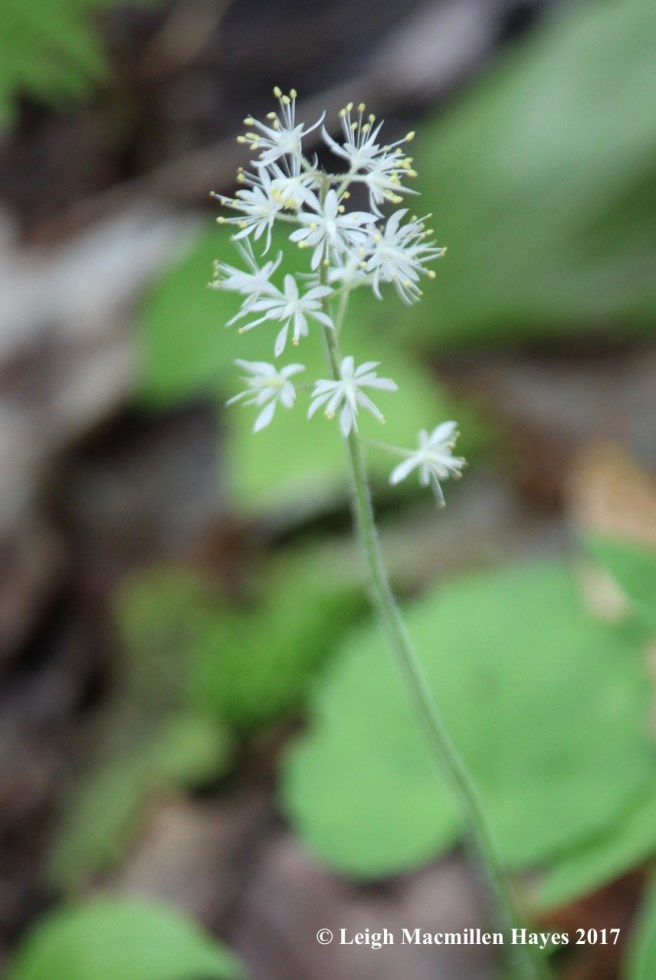
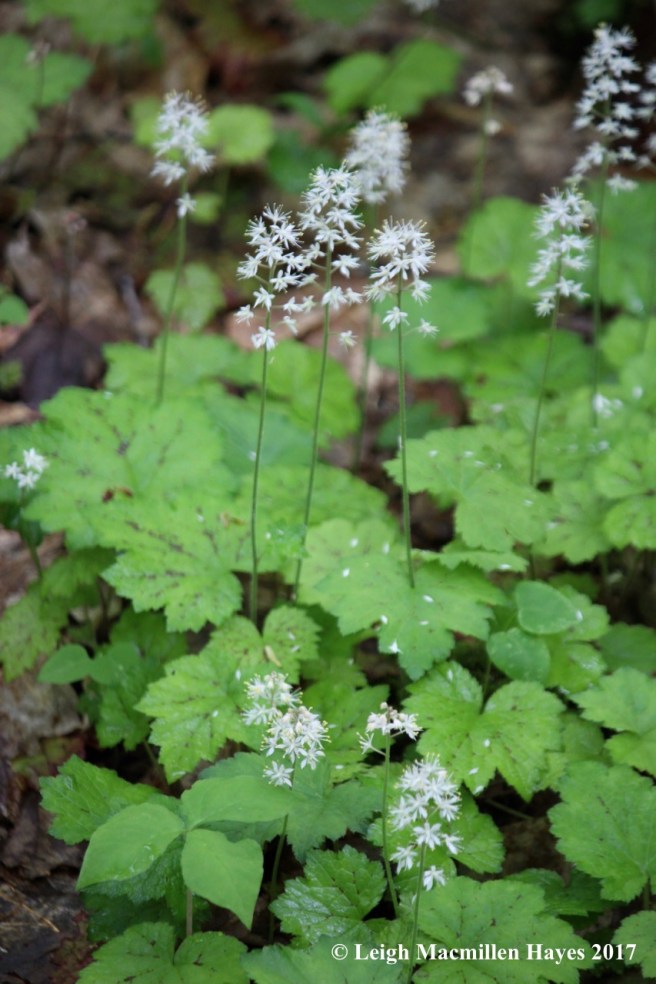
One of our many finds included foam-flower, with its cluster of star-shaped white flowers and conspicuous stamens. According to Mary Holland in her book, Naturally Curious Day by Day, “Its genus name, Tiarella, is the Greek word “tiara,” a word for a turban worn by ancient Persians which bears some resemblance to the shape of this flower’s pistil.”

p-foamflower carpet

Tiara or not, we were quite taken with a carpet of it.

p-snail

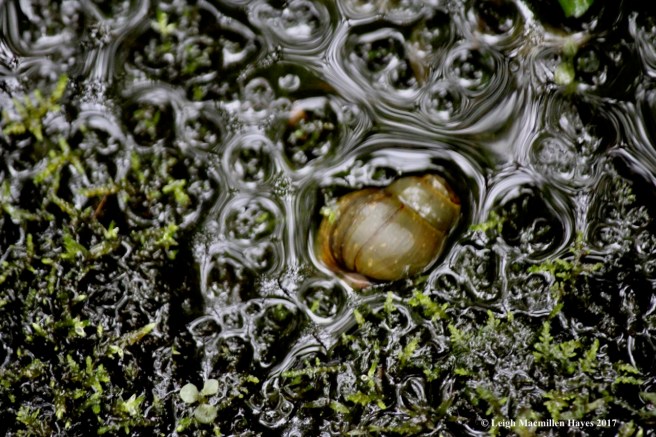
Those were only a few of the findings we saw as we moved at a snail’s pace during our three hour tour along Perky’s Path. Each time we visit, we say, “This is my favorite property.” That is . . . until we visit another one of the GLLT properties.

On the Rocks at Pemaquid Point

Yesterday dawned cool, sunshiny and slightly breezy–the perfect day for a 2+ hour drive and an outdoor exploration. And so I had the extreme pleasure of joining a small group of naturalists for a geology lesson offered by one of our colleagues, Denise Bluhm, at Pemaquid Point in mid-coast Maine.

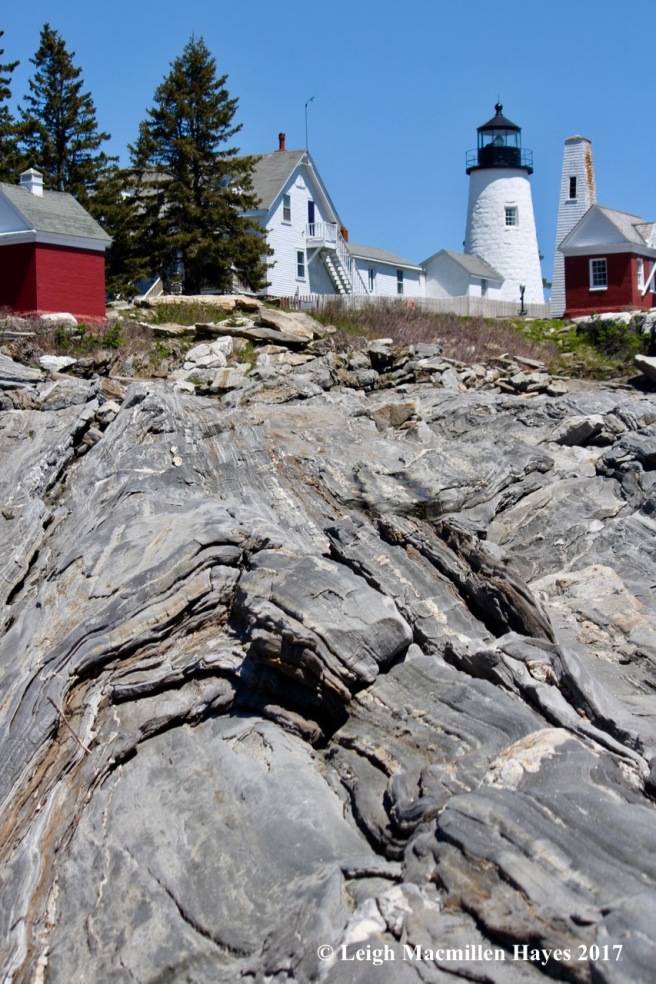
p1a-Pemaquid Point Lighthouse

The lighthouse is one of 57 still active along the Maine coast and it’s this very one that is featured on the state quarter. It was manned from 1927-1934, but has been on automatic ever since.

p2-Pemaquid Point on map

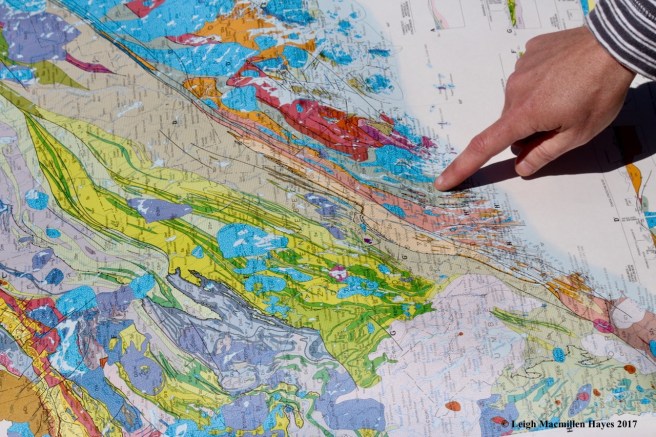
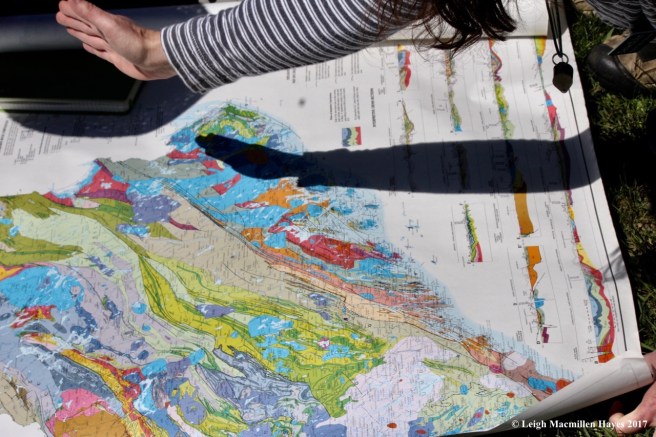
But that wasn’t our focal point. Instead, we’d gathered to learn about the rocky coast below. After reviewing the definition of mineral (naturally occurring solid, distinctive physical properties, e.g. cleavage, hardness, crystal form and color, and characteristic chemical formation) and rock (one or more minerals together, aka mineral soup), Denise pulled out a geologic map of Maine and pointed to our location.

p3-map :Brunswick formation direction

She then oriented us northeastward and helped us understand that we were standing on what is known as the Bucksport formation, a deposit of sandstone and mudstone metamorphosed into a flaky shist. And then she took us through geological history, providing a refresher on plate tectonics and the story of Maine’s creation–beginning 550 million years ago when our state was just a twinkle in the eyes of creation.

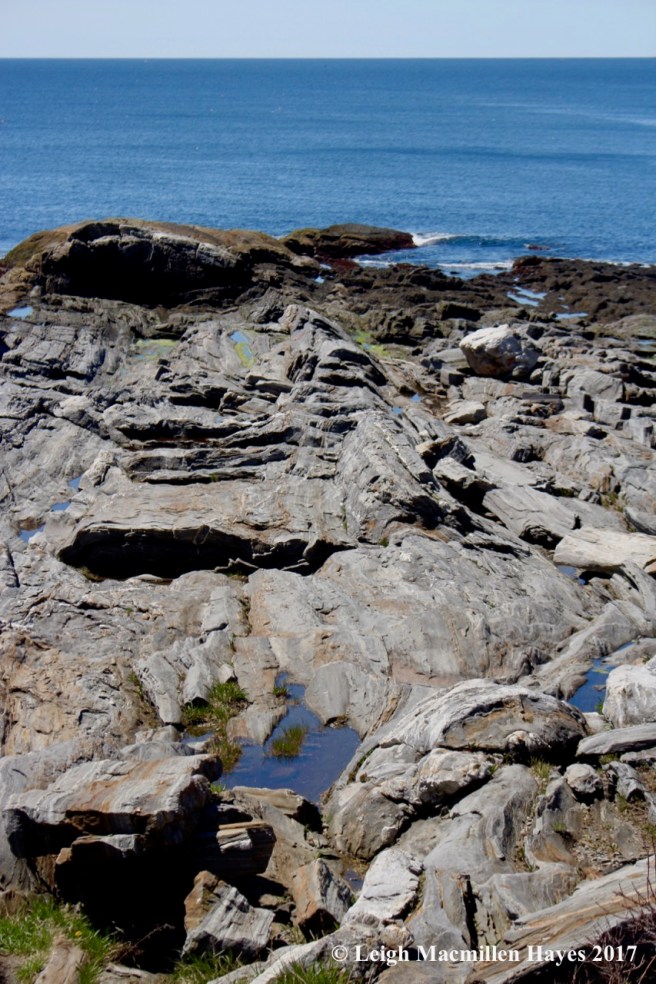
p4--do you see the fold?

Stepping below the lighthouse, Denise asked if we saw the fold. I thought I knew what she pointed to, but . . .

p5-layers in beds

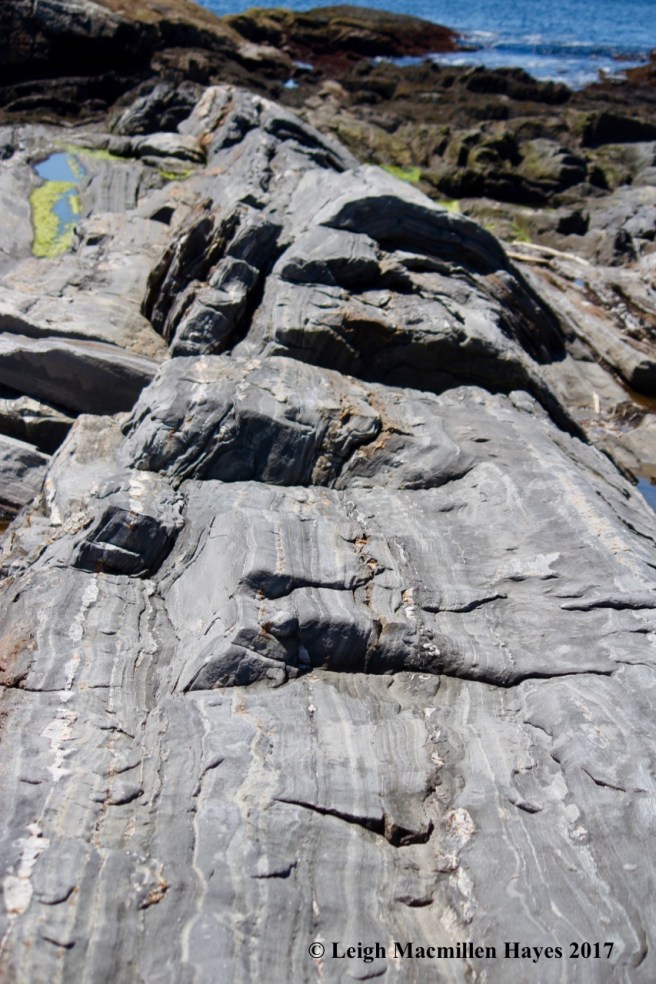
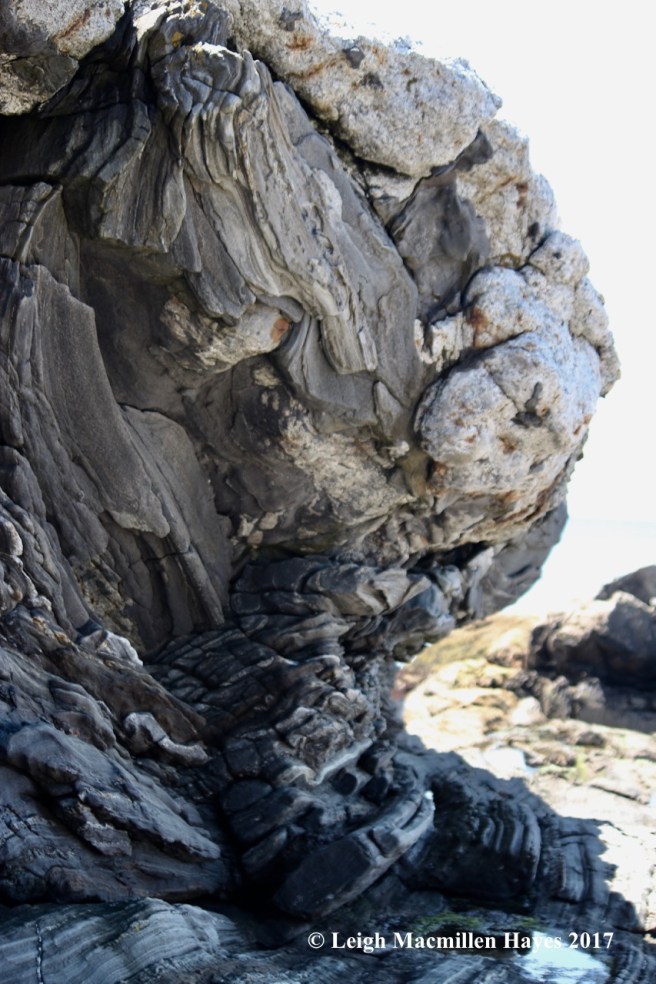
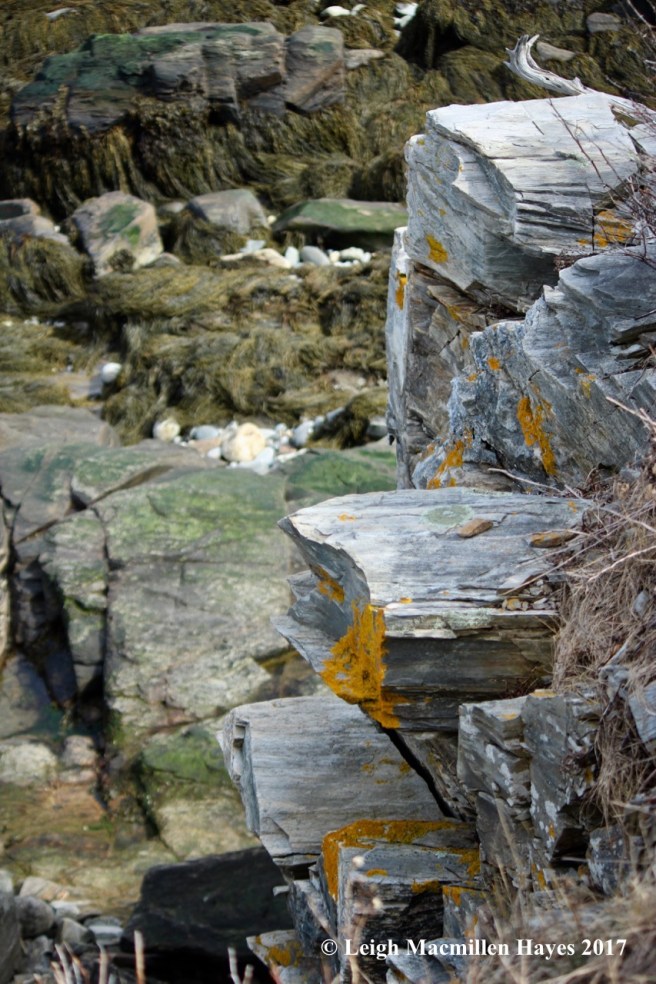
it took more of her insight to fully form the picture for me. The metamorphic rock, it turns out, is on its side due to intense pressure in its long-term history and thus we could examine its layers, much like the rings on a tree. That doesn’t mean I could age it, but just understand that over time various pressures and results of heating and cooling events caused the variation in color and mineral size of the bands. Lighter gray=sand and silt (composed of sea sediments), Medium gray=quartz, feldspar and biotite mica (black). Darker gray=more biotite. Greenish-gray=limy sand and silt. Rust=iron. All of it equals a gneiss (nice) or layered formation with foliation.

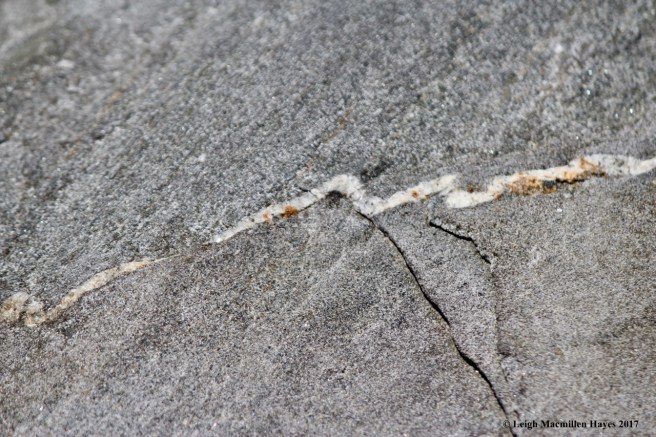
p6-zigzag

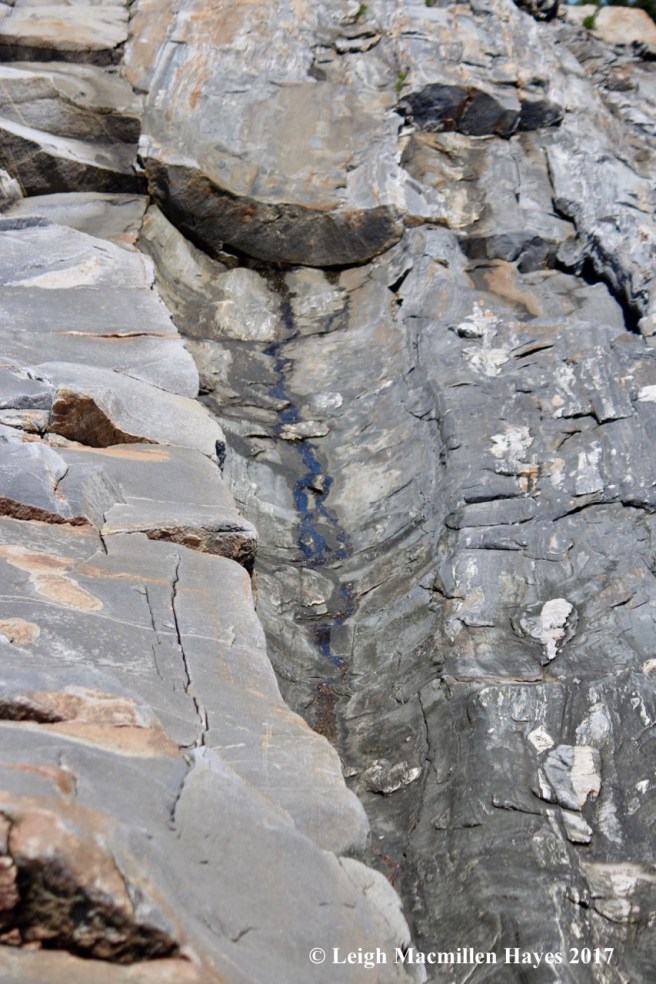
I think one of my favorite learnings came from the sills and dikes that show their faces throughout the rock. Sills are parallel or perpendicular intrusions while dikes run off parallel. And this particular dike featured a zigzag created by a continental collision. The Z-fold, as she referred to it, was caused by a right lateral shear. Who knew?

p9-first fold understanding

My understanding of the first fold Denise had pointed to began to develop more fully when she pulled out a geological compass and measured the angle of the rock to the left and then we could see the same angle on the far right and suddenly in my mind’s eye was the arc that has since eroded. With that came the new knowledge that more moons ago than my brain can comprehend, mountains reached six miles above and natural forces had eroded their 12,000-foot structures.

p10-dike to lighthouse

We crossed the rock from feature to feature, occasionally looking back at the lighthouse to note characteristics, such as the igneous dike (lighter color) that cuts across the metamorphic rock and leads to the buildings. Being made of granite, it offers a solid foundation for the tower.

p11-Denise on fold

And then our great leader led us to her favorite feature–the greatest fold in Maine.

p11a-the fold

Though the rocks were originally horizontal in nature, intense pressure and heat at some point in their lifetime forced such folds.

p12-everyone on fold

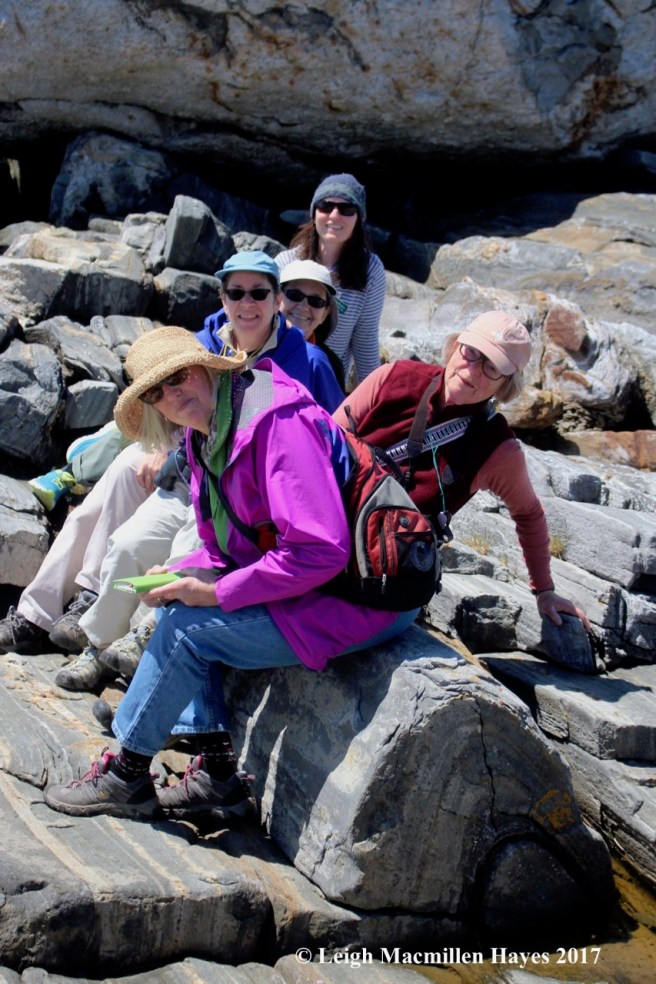
It was worth a photo call for Denise, Sharon, Judy, Karen and Penny–all sharing a brain with me for the day.

p13-the big dike

From there, we had a great view of the large granite-topped sill that is harder and thus more resistant to erosion.

p14-sunburst lichen

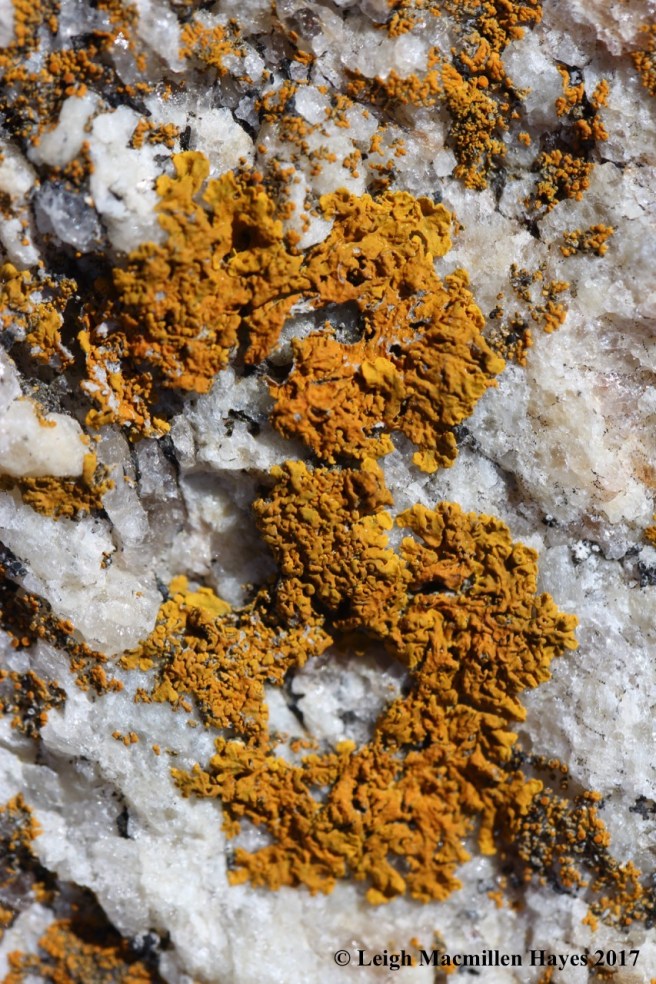
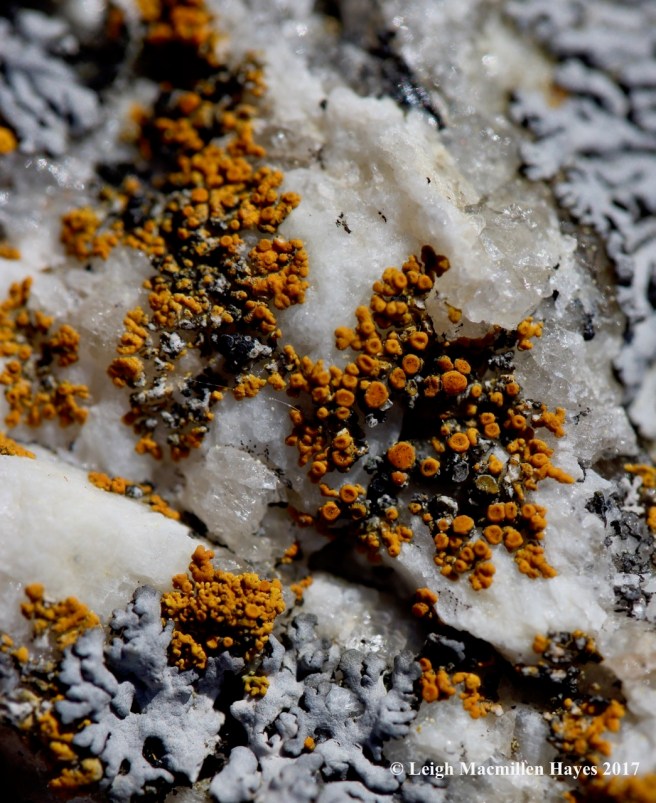
As we made our way back across to it, we paused to look at quartz, feldspar and biotite mica–but lichens such as the sunburst also caught our attention.

p15-lichen disks

Don’t tell Denise. But do check out those fruiting bodies–the apothecia.

p16-fold looking toward lighthouse

Suddenly, our eyes and brains recognized the fold formation throughout.

p19-Karen at dike

At the huge sill, Karen posed to give a sense of height. (Ignore photo light)

p22-bucksport layers

And then we looked at its structure–metamorphic below and granite pegmatite with huge crystals above.

p23-swirls

We noted swirls and imagined silly putty (invented in a barn in my hometown of North Branford, Connecticut).

p24-under the sill

And stood in awe of life.

p25-large crystals

I mentioned the large crystals–evidenced here. Far larger than the 2.5 centimeters that defines a pegmatite.

p26-Denise again

Denise showed us some popcorn migmatite and how the schist and pegmatite formed together.

p29-igneous rock formation 2

One of our next stops was atop a jetty–so different in structure. This is an example of an igneous rock intrusion created deep underground.

p30-trough of a syncline

To its side we could see a trough–known geologically as a syncline.

p33--garnets

Through her eyes, we spotted red specks of garnet.

p33--buodoin--sausage 1

And began to understand the pinching and swelling from compression and shearing to the Northeast that formed sausage-shaped boudins.

p31a--pressure formation

Closer to the lighthouse, we noted the isoclinal folds Denise referred to as S-folds (compared to the Z-folds we’d seen earlier).

p35--view

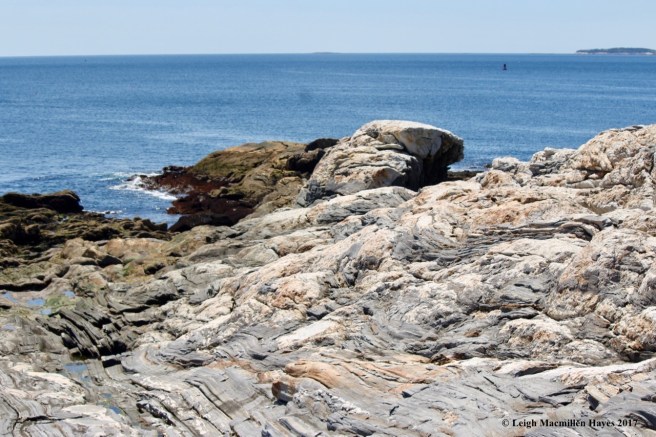
Before the day began, this was a great example of the rocky coast of Maine.

p36--view from lighthouse

But when we climbed the lighthouse tower after our lesson, we looked below with brand new eyes and understandings (and still so much more to learn and wrap our brains around).

Thankful were we for our day spent in wonder on the rocks at Pemaquid Point with Denise.


Slog Through The Bog

She said she’d call a half hour before heading to the bog so I should probably sleep in my hiking clothes and boots. And she was right! I was just about to take a bagel out of the toaster oven when the phone rang. “We’re going to the bog at 9:00. Can you join us?” Thirty-five minutes later I pulled into her driveway, excited because it was a chance to explore Brownfield Bog with about-to-become Maine Master Naturalist Kathy McGreavy and her daughter, Dr. Bridie McGreavy.

b-bog from road

From there we drove to Bog Road and parked at the beginning since conditions were dicey, but also because it gave us a chance to walk and listen–almost immediately we heard a barred owl. And then the warblers greeted us.

b-sky and water

Brownfield Bog, aka Major Gregory Sanborn WMA, encompasses 6,000 acres of wetland. And on any given day, the sky tells its story above and below. Of course, we thought we were going to get poured upon when we first met, but the mist soon evaporated and sun warmed us enough that we shed a few layers.

b-common yellow throat 2

The initial stretch of our journey found us moving at a fast pace, but once we reached the second gate,

b-Bridie McGreavy

our inclination was to slow down.

b-Kathy

To stop, look and listen.

b-common yellow throat 1

The chestnut streaks on the yellow warbler matched the emerging red maple leaves.

b-oriole 2

And I can never spend enough time with a Baltimore oriole, forever wowed by its color.

b-oriole singing

And its voice.

b-catbird

Birds flitted about and flew overhead, but occasionally one, such as this catbird, paused and posed.

b-willows and birches

Most of the songbirds were feeding and perhaps nesting in the land of the willows, birch and maples.

b-willow pine cone gall caused by midge

Others also sought homes here, like the gall gnat midge that overwintered in a pinecone-like structure created with leaves by the reaction to a chemical released by the larva. I’m forever amazed about how nature works.

b-song sparrow

Eventually, we followed the song sparrows as they led us down the cobbled road.

b-road 1

The current was strong in places . . .

b-deep water

and water deep.

b-scenery1

But the views . . .

b-Pleasant Mtn and Bog

worth every step.

b-maple samara

Sometimes, our focus was upon the ground, where we spotted a few small red maple samaras.

b-coyote scat

And scat–including this double offering of coyote deposits.

b-coyote scat toenail

And among it–a toe nail first spied by Bridie. I chuckled to myself when we got down to look at this, for Bridie first introduced me to the finer qualities of scat when she worked at Lakes Environmental Association. She also taught me to track mammals. And . . . the crème de la crème–to sniff fox pee. Ah, the delights we have shared–they are many and having an opportunity to walk with her today brought them all flooding back.

b-ribbon snake

We decided to put our blinders on so we could continue without any pauses, but then Bridie’s eagle eyes zeroed in on movement. Her mom and I saw the movement as well, but we had to really focus in order to find the creator among the dried vegetation.

b-ribbon 2

And we did–a ribbon snake, who happens to be a great reason for preserving this property because its a species of special concern in Maine.

b-Pleasant Mtn

At times, Pleasant Mountain was the featured backdrop.

b-Canada geese

And Canada geese swam in the foreground.

b-beaver mound

Everywhere, beaver works were obvious and scent mounds growing in size.

b-oak 1 (1)

After a couple of hours, we reached our turn-around point at the old oak tree.

b-beaver lodge

As we looked across, one of the beaver lodges stood above the water level.

b-bog 3

But Kathy and Bridie both reminded me that another was still submerged due to this spring’s high water level.

b-cuckoo nest remnants

Finally, we did our best to bee-line back. But Kathy showed me one more great find that had been pointed out to her by Mary Jewett last year–the straggly stick structure of a cuckoo’s nest. Certainly worth a wonder. (The other wonder–when we first arrived at the bog this morning, Mary was just leaving.)

b-spoon jar 2

Our entire morning had been worth a wonder and then another occurred when we returned to Kathy’s house. While I said goodbye to Bridie, who is an Assistant Professor of Environmental Communication in the Department of Communication and Journalism at the University of Maine, her mom slipped into the house. When Kathy returned, she handed me this spoon pot filled with daffodils from her garden. She’s a potter and owner of Saco River Pottery. Though I love to give her fine art as presents, I only own one other piece. This one now stands proudly on our kitchen counter, holding the utensils as it was intended. It will forever remind me of the McGreavys and the day I first saw a dragonfly emerge from its exoskeleton–at the bog with Bridie; and the day I spent with Kathy as I interviewed her for a magazine article about creating pottery–and she let me try my hand at the wheel; and so many other memories of time spent with these ladies, but especially today–for the opportunity to slog through the bog with the two of them.


“The Actual World”

In this morning’s newspaper I read an article about the loss of natural sound because we have created so much people noise. It took me back to a time about forty years ago when I think I first actually paid attention by sitting alone in the woods and listening–hearing the soft rustle of grass blades, chirp of the crickets, buzz of mosquitoes and vroom of a truck in the distance. I can still envision that spot on a hillside where I closed my eyes to the sun and tried to zone in only on sound–to let go of the rest of the world and focus on that one sense.

And so I took that thought with me this morning when I joined others to bird at the Bob Dunning Bridge, one of the entrances to Bridgton’s Pondicherry Park.

p-yellow-rumped warbler

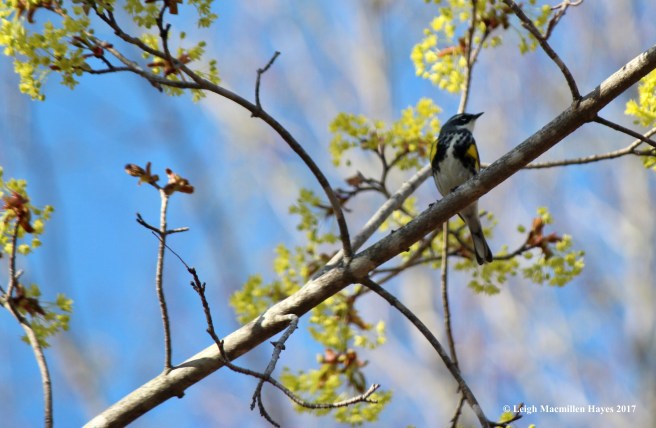
Truth be known, I also went birding at the bridge early yesterday morning when the sun shone brilliantly and a yellow-rumped warbler posed for an instant.

p-bridge 1

Today dawned raw and overcast. And at first, the birds weren’t all that song-filled or even evident.

p-baltimore 6

But then we heard one on high and our natural high kicked in. A Baltimore oriole whistled its melodious tune and we swooned.

p-phoebe right

We watched an Eastern phoebe flick its tail as it looked to the right . . .

p-phoebe left

and then to the left. Because of the morning’s chill, the bugs upon which it feeds seemed non-existent to start.

p-phoebee flying

But, perhaps it knew otherwise.

p-song swallow 2

What we knew was that the temp climbed a wee bit and bird song increased, including that of the ever sweet song sparrow. Yes, we could hear the sounds of this sleepy, western Maine town since we were only a block from Main Street, but the songbirds shared their voices and for us–we focused on those delightful tunes as we tried to figure out who we could hear but not see.

p-catbird 1

One such resident arrived this past week, like many other snowbirds (people residents who winter south of Maine– or is it south of New England?). We recognized the catbird first by its cat-like mewing and then we spotted two along the stonewall and in the brushy shrubs.

p-catbird flying

Like all birds, however, they didn’t sit still. We did note, though, that they spent most of their time on the other side of the bridge in an area where they frequently nest.

p-song sparrow 1

And speaking of nesting, the song sparrow moved from its perch to the ground where it joined others as they scratched about and filled their beaks with potential materials to add to their new home.

p-song sparrow 3

I love that from above, it blended in with its surroundings. A good thing when you are but a wee bird.

p-feathers

That being said, not all went undiscovered and we noted that some joules were passed from one bird to another–energy flowing through the cycle.

p-baltimore upside down

Eventually, one of our favorites of the day moved closer and we watched it for some time as it worked upside down and then . . .

p-baltimore 3

right side up. Again, we wondered if the oriole was working at the dried leaves and also seeking nesting material.

p-yellow warbler

And finally, a song a few of us heard when we first arrived showed its face–“Sweet, sweet, sweet, I’m so sweet,” evolved into a yellow warbler, or two or three.

p-Norway maple flowers 2

Because we were there and looking, other members of the world showed their faces, such as the flowers of Norway maples and . . .

p-box elder flowers

box elders.

p-elm leaves

We noted the emerging American elm leaves, already highlighting their sandpaper texture and asymmetrical base.

p-butternut

And then we got stumped momentarily by the butternut (aka white walnut ), but it’s the eyebrows above the monkey face leaf scar that spoke to its name. Less than a month ago, Jinny Mae and I discovered its cousin, black walnut at Narramissic. Both are not all that common in the woods, but both grow in places where human impact is more evident. That being said, human impact is evident the world ’round.

p-plaque

Eventually, all good things must come to an end and it was time for those gathered to move along into our days. But . . . we’d had the joy of spending a couple of early morning hours, whether in the sun or not, coming into contact with sight and sound and texture. We’d met the actual world and we loved making its acquaintance.

p-Mary 1

Thanks be to Mary Jewett of Lakes Environmental Association for offering these community birding events. And for her patience with us amateurs as she teaches us the finer points of identification.


Love/Hate Sundate

Some days are made for hikes and today was one of them. The temperature was right–in the upper 40˚s-low 50˚s. No sun. And no bugs.

So, after church, my guy and I drove to the trailhead for Burnt Meadow Mountain in Brownfield, Maine. At the signs indicating the trail splits in two–North Peak to our right, Twin Brook to the left, we knew we planned on covering the loop, but my guy stopped and asked which way I wanted to ascend the mountain.

Nose scrunched, I replied, “North Peak.”

He chuckled for he knows my love/hate relationship with this mountain.

b-red oak leaves

Today my love began with the new leaves, like that of the red oak,

b-red maple1

red maple,

b-striped maple

striped maple,

b-beech leaves 1

and beech. I worshiped them all for their subtle colors and textures. Spring is the time of year that reminds us to live in the moment, for the natural world demonstrates constant change.

b-trailing arbutus

And then there were the flowers, like the trailing arbutus, aka mayflower.

b-Canada mayflower

And another of a similar name, Canada mayflower.

b-shad 1

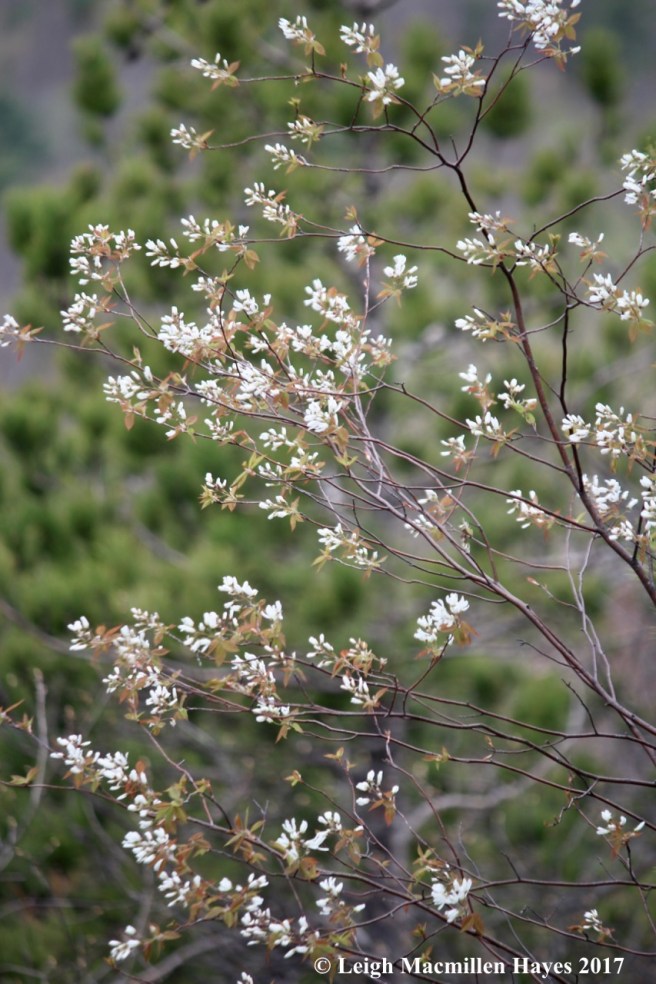
In the shrub layer, occasionally we came upon the beauty of serviceberry or shadbush flowers flowing in the breeze, exhibiting their own take on these fleeting moments.

b-early saxifrage

And cleaving to the rocks as we climbed, early saxifrage. It’s also known as rockbreaker for this habit, and perhaps suggested the Latin name–Saxifraga virginiensis. Saxum-rock and frangere-to break. A funny name for an uncommon display.

b-summit ahead

I did my best admiring my surroundings for I knew what awaited. My guy paused as the summit came into sight,  expecting me to comment. For once, I kept quiet.

b-summit climb

And then, when the time arrived, we both channeled our inner mountain goat and sought hand holds and foot holds as we scrambled up the nasty dash to the top. Ha ha. It’s difficult to scramble when your heart pounds while your body quivers. This is the section I most hate–and as I always told our sons when they were youngsters, hate is a strong word. I knew I could do this for I’ve done it many times before, so I tried not to take too long as I considered my next move. Plus, rain drops began to fall and I didn’t want to be stuck contemplating on slippery granite. But still.

b-lunch rock

Finally–success. We’d reached the flattened top of the mountain–such a welcome relief after that horrible section. You’d think it was miles long the way I carry on about it. The rain drops ceased and we sat on lunch rock to dine–dirty hands and knees our badges of honor.

b-summit 1

Our view from the rock–looking back toward our point of ascension.

b-summit 2

And forward toward Stone Mountain. After lunch, our plan was to follow the Twin Brooks Trail that passes through the saddle between Burnt Meadow and Stone.

b-summit 3

And to our right–looking toward the White Mountains.

b-summit trees:layers

Though the view is almost 350˚, our immediate view behind lunch rock offered layers of life–blueberries, a young paper birch and a white pine.

b-twin brooks trail down

At last we started down. The Twin Brooks Trail is longer, but less of a struggle. That being said, it’s not a walk in the park as there are constant roots and rocks seeking attention.

b-mt washington1

But occasionally there are views. I was afraid we might not see Mount Washington today, but it didn’t disappoint.

b-birch catkin1

On the way down, we were in the land of the birch, their catkins growing long . . .

b-birch catkin pollen

and exploding with life-giving pollen.

b-viola

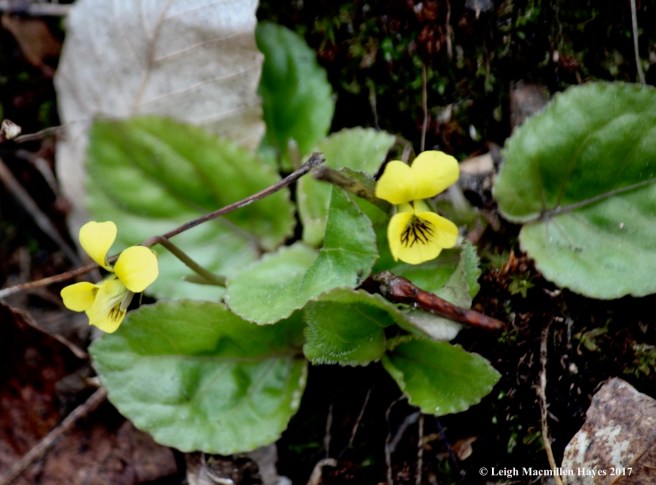
There were violas to admire.

b-shad 2

And more shadbush.

b-bear claws 1

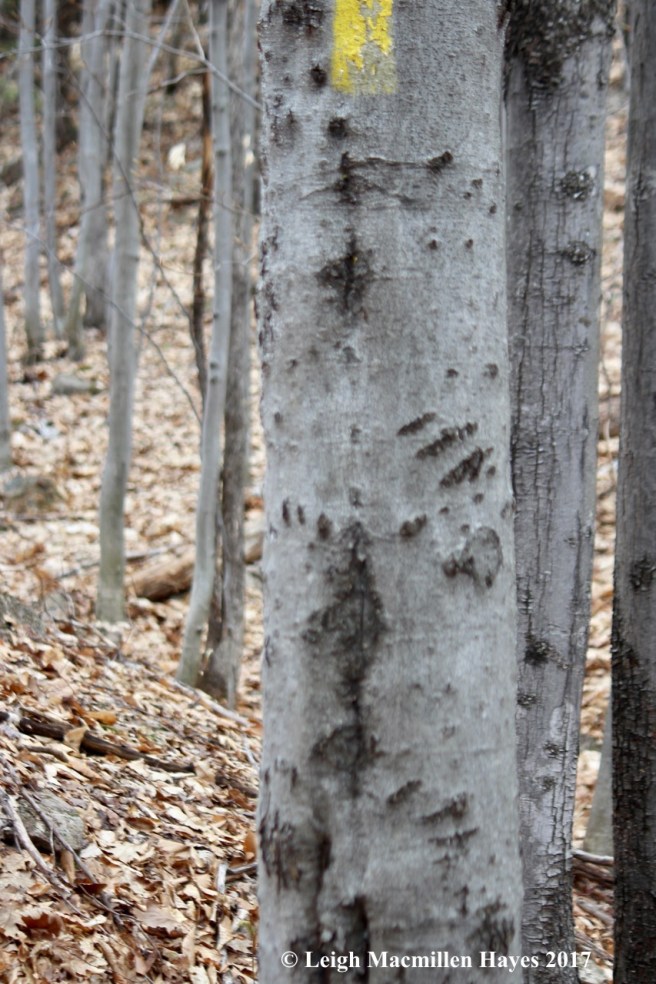
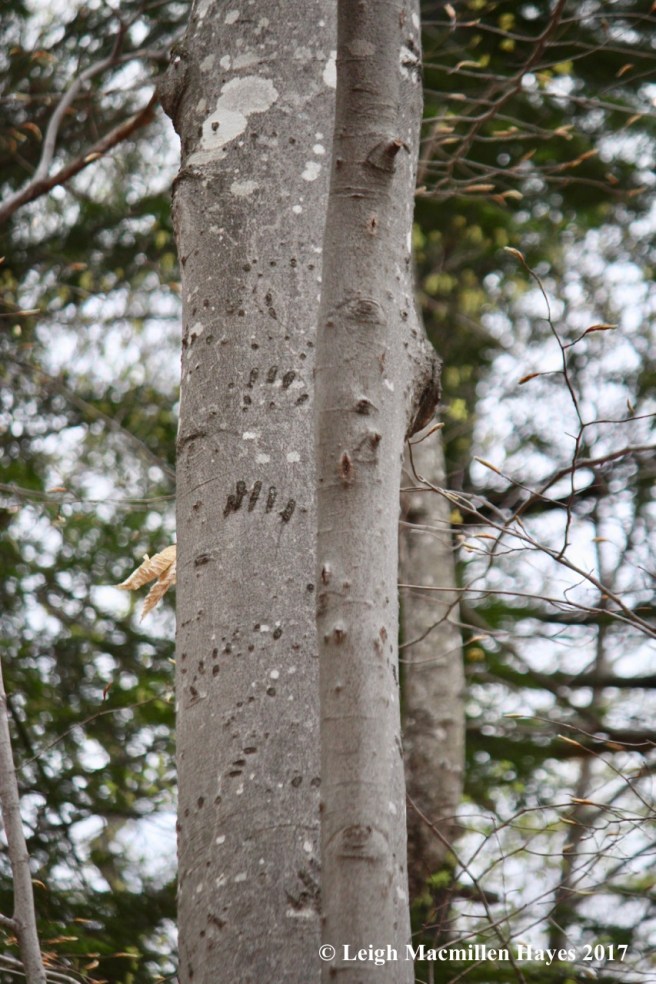
But one of my other favorite things about this trail is the bear claw trees. No matter how many times I see them, they still bring a smile to my heart–and face. And a memory of seeing a bear on the North Peak trail one summer–it sauntered past us, not seeming to care that we were there. I suspect its belly was stuffed with blueberries.

b-twin brook 1

As we continued to descend, we soon heard the sound of one of the brooks for which the trail is named. Quite often on this trail, the water barely trickles, but today it rushed over the moss-covered rocks.

b-logging

Continuing on, we remembered that two hikers we meet at the start said there had been some logging and sometimes it was difficult to follow the trail. At last, my guy found the area they’d referenced. The trails are on private land and so while we couldn’t find some familiar landmarks, we nevertheless were thankful that we were still able to hike there. And, we were mindful to look for the yellow blazes as we stepped over some slash. It was quite doable.

b-bear tree 2:eye level

The result–a bear tree we hadn’t seen before was revealed.

b-bear tree 2:looking up

It must have offered plenty to eat in the past for the tree was well climbed all the way to its crown. Maybe we’d once met the very bear.  Maybe not. Who knows. But it’s worth a wonder.

b-bear of a different sort

A bear of another kind also left behind a sign of its presence. We obviously weren’t the only ones who headed to the mountain for a date.

b-bear tree 3

In one last spot a short way from finishing the loop, we found our last bear tree–again seen because of the logging. I suspect there are many more in these woods and hope they don’t all get cut.

Emerging leaves. Spring flowers. Jagged outcropping. Flowing water. Bear trees.

Really, it was a love/hate/love Sundate–joyfully spent with my guy.


Rocky Mondate

It’s a game we play every Monday and it begins on Sunday. The first one to ask, “Where are we going to hike tomorrow?” wins. That person doesn’t have to choose the location and therefore can’t be held responsible if it turns out to be a lousy decision. Yesterday, I won. But my guy’s destination was rather vague–the coast, he said.

And so I drove this morning, awaiting directions from him.

4.-Prouts-Neck-map-720x595

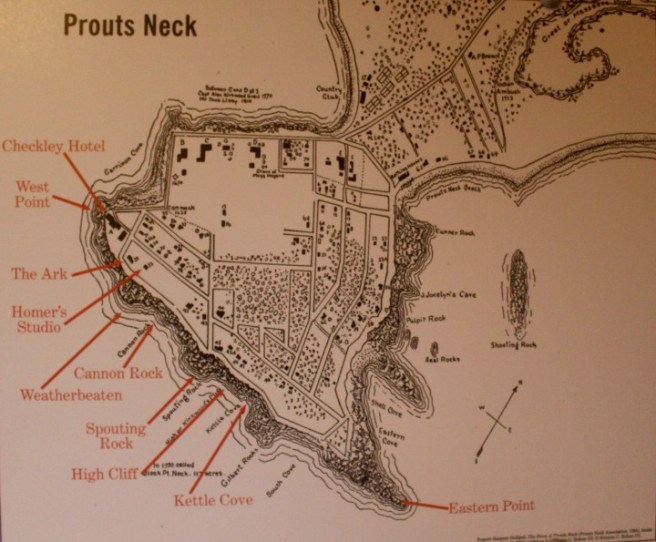
After a few interesting turns, our destination: Prouts Neck in Scarborough, Maine.

p-footsteps

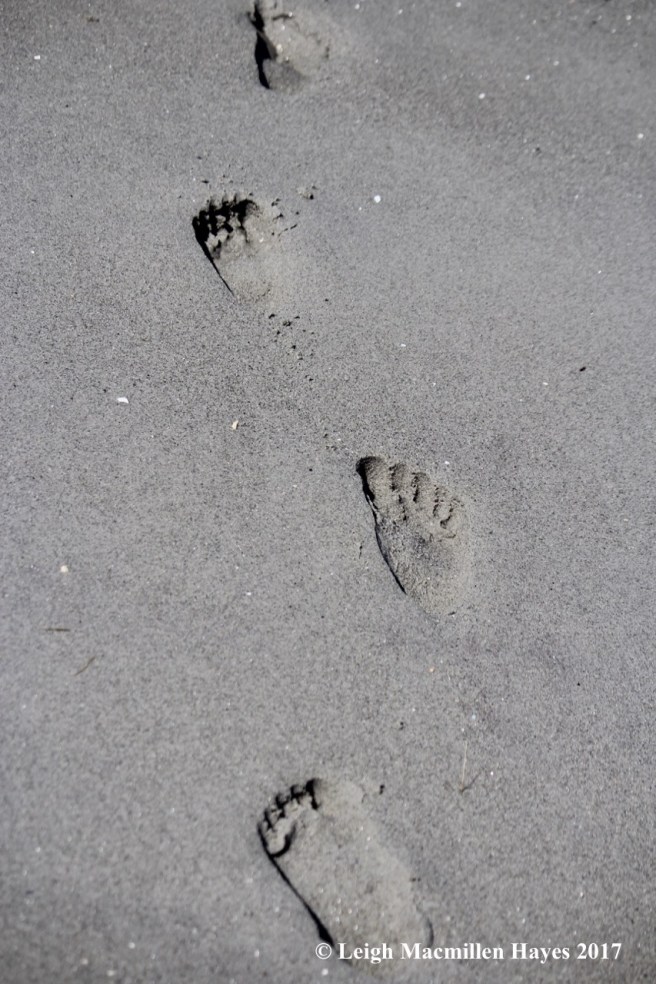
Our journey began at the Ferry Beach parking lot as the tide ebbed. We followed in the footsteps of those who passed before, ever mindful that along the beach our story, like theirs,  would be washed away in a matter of hours.

p-grasses

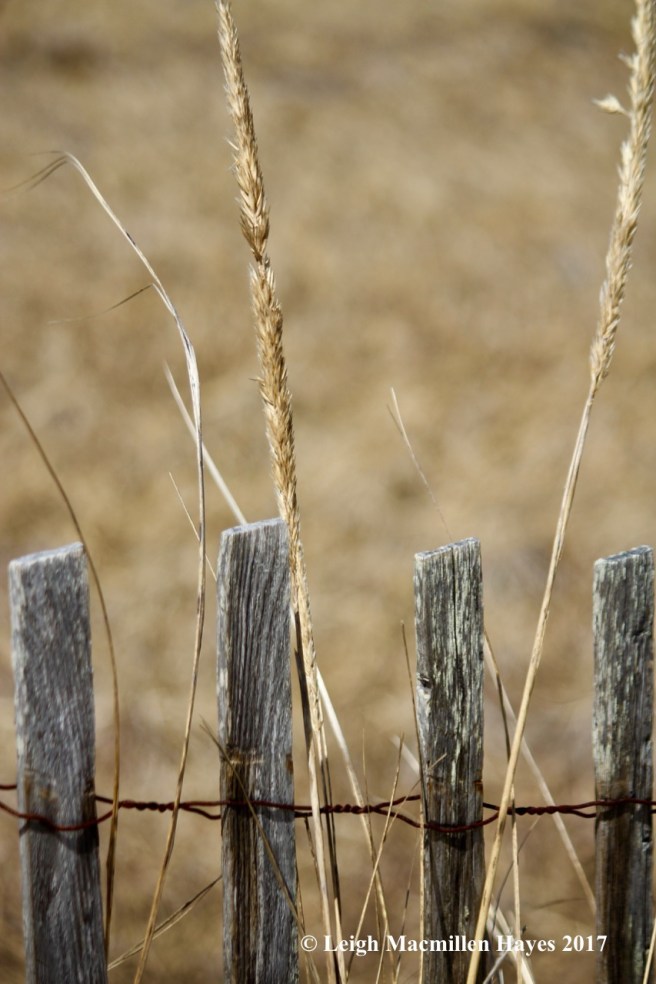
But some things stand forever, or so it seems.

p-lobster boat

As we walked along, the Jessica Heather and other lobster boats swayed and bobbed at their anchors with pride.

p-snow fence 2

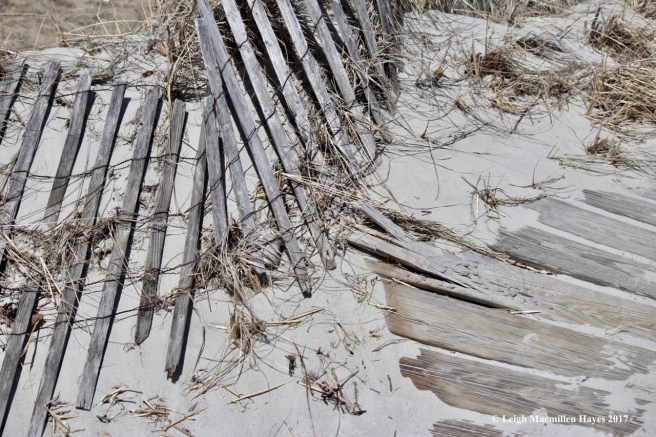
And at the end of the beach, we followed a well-weathered boardwalk up to the road. Snow fence and walkway seemed to speak to destruction dictated by the sea–though its our experience that neither of these have been replaced in years.

p-Scarborough River

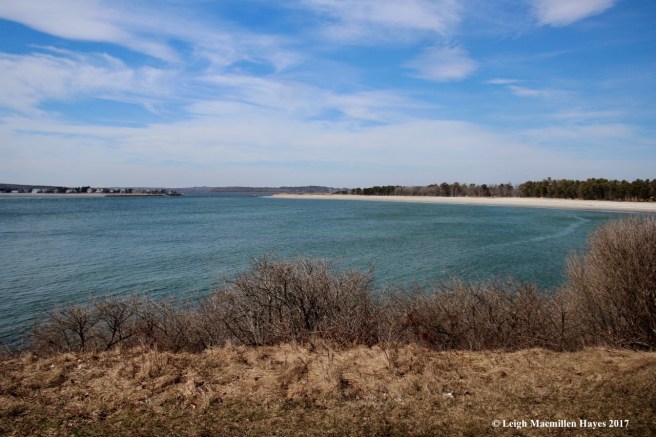
For a brief stretch by the Black Point Inn, we walked along the road, where we glanced back at our starting point and the mouth of the Nonesuch River. Though the foliage spoke otherwise, the water colors indicated this just might be the Bermuda of the North. Well, maybe.

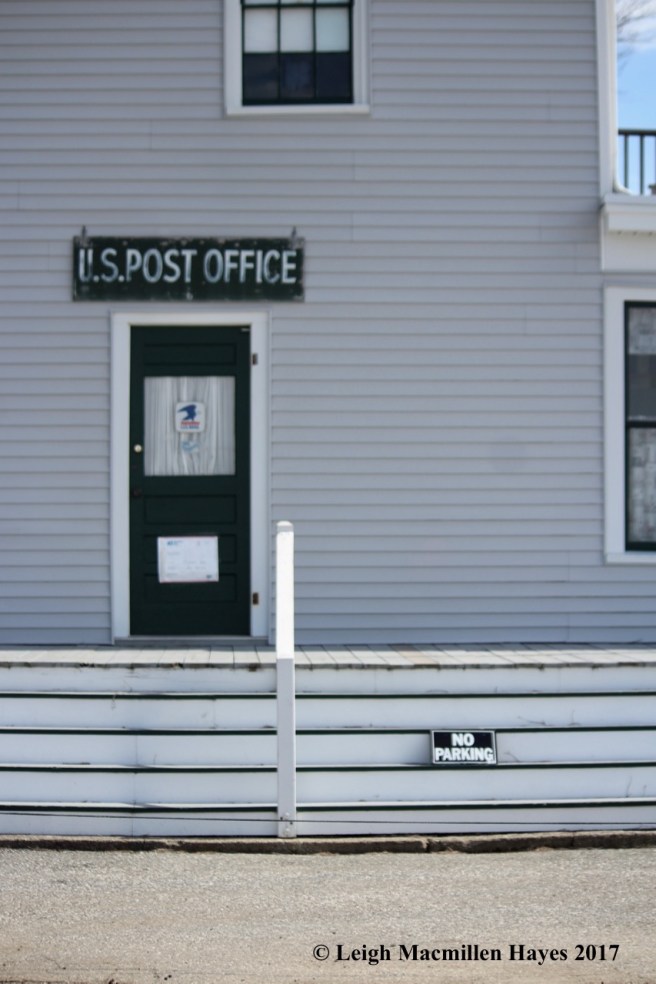
p-PO

But more likely, the post office told the real story–shuttered for the season.

p-cliff walk sign

At the top of the road, we found the next leg of our trip–the Prouts Neck Cliff Walk.

p-Winslow Homer

Prouts Neck features a community of summer “cottages.” One of the most famous among them is the studio of Winslow Homer. In the late 1800s, Homer hired John Calvin Stevens, a Portland architect known for the “Shingle Style,” to transform a carriage house near his parents’ home into a studio and residence. This provided the vantage point and workspace for his paintings from 1884 until he died in 1910. And inspiration. He walked this path daily.

p-Allen's prints

I’m always fascinated when I realize that our breathe and footsteps mingle with so many who also passed by. They flow in and out with the wind and tide and are forever intertwined.

p-rocky coast of Maine, Mom

Along the walk, we found the rocky coast of Maine,

p-rocks 1

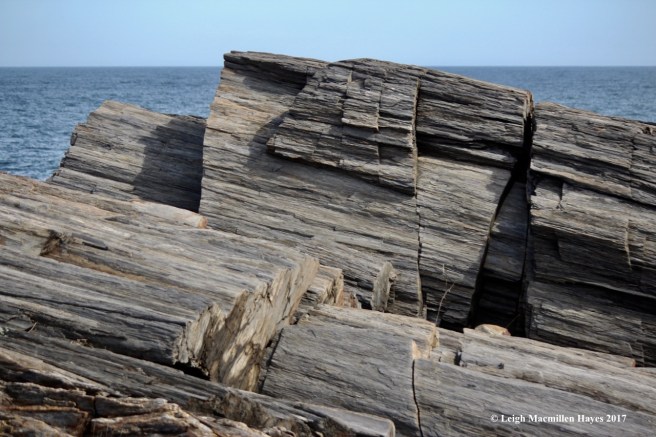
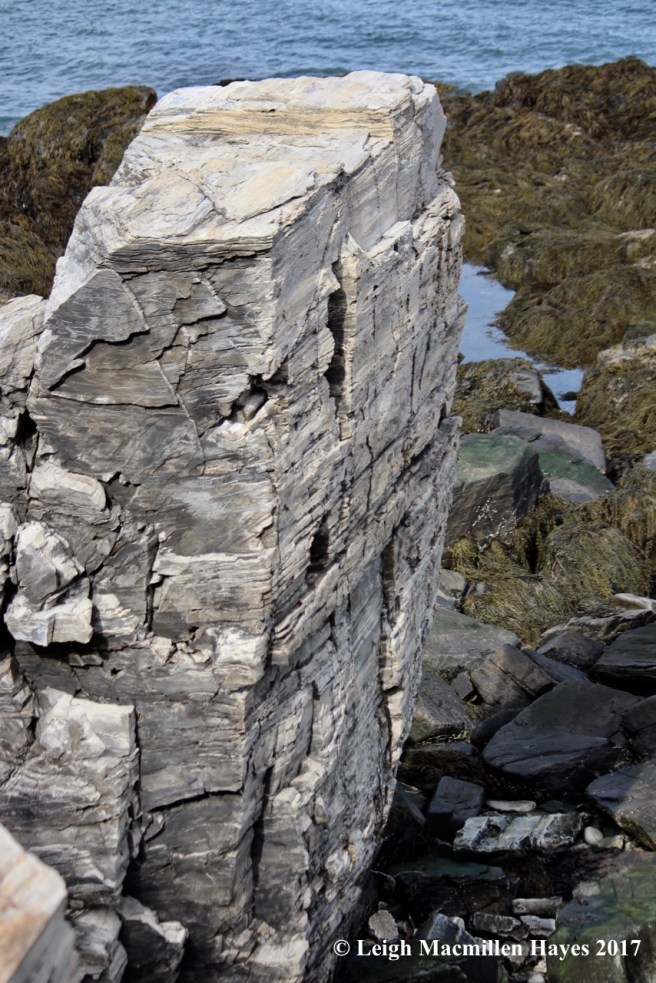
where the volcanic rock highlighted by the ocean waters offered layers of stories told with sharp contrasts.

p-rocky coast 2

It’s places like this that I’m forever reminded of my mother who was fascinated by such.

p-walking the plank

At times we walked on those rocks, and other times through muck. Given that mud season is upon us, we were thankful for those who’ve added board to the walkway.

p-northern bayberry leaves

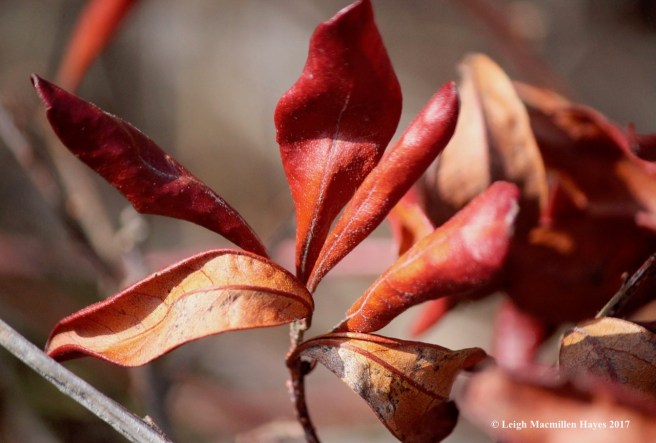
Among the trailside offerings, we spotted the rusty leaves of Northern Bayberry.

p-rose hips, Dad

They were often mixed in with the rose hips of beach roses. In the summer, this trail buzzes with pollinators, but for now it’s all a memory. And for me, another memory was evoked–my father eating the rose hips as we walked along the beach in Clinton, Connecticut, during my youth.

My guy and I both grew up along the coast–he on Cape Cod and me in Connecticut. Since then, the forest and mountains have called our names, but whenever we stop by the sea, it shares moments with us–including smells and sounds that feel oh so familiar.

p-waves 1

Part of the memory includes . . .

p-waves 2

waves crashing . . .

p-waves 3

and swallowing up all in their path.

p-searching

The substrate changed with the tide along this path and suddenly we found ourselves in a rock garden. And my heart envy announced itself. While I’ve always collected sea glass, others have collected heart-shaped rocks. This seemed like a prime location to find such and so I put my guy on the assignment and was totally amazed that he embraced it.

p-rough-edged heart:fox face

Our search turned up a few examples–the first rather angled and reminiscent of a fox’s profile.

p-heart 2, getting closer

The second more rounded.

p-heart 3

And the third, a more golden presentation.

p-sunburst lichen

The good news about our inspection of life at our feet–the sunshine lichens on the rocks around us.

p-sunburst lichen disks1

Some were abundant with fertile disks.

p-sunburst last

And they seemed to appreciate the layers of this seaside location.

p-white segmented 1

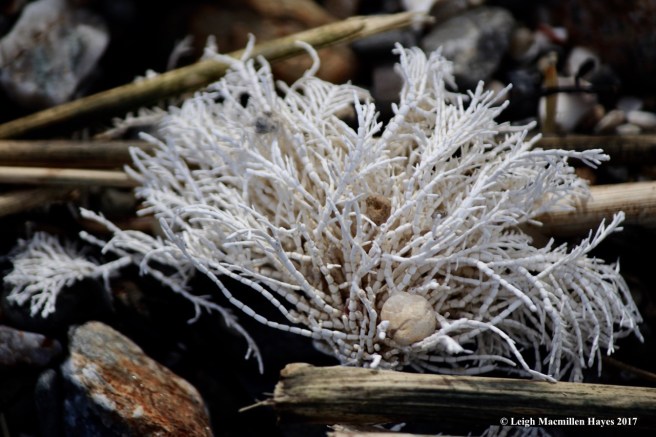
Because we were looking down, we spied other things we may have missed–including this white, segmented structure that reminded me of a fruticose lichen meets seaweed meets coral. My hope is that Maine Master Naturalist and seaweed expert, Davida, will come through for me and ID this one.

p-stick figure

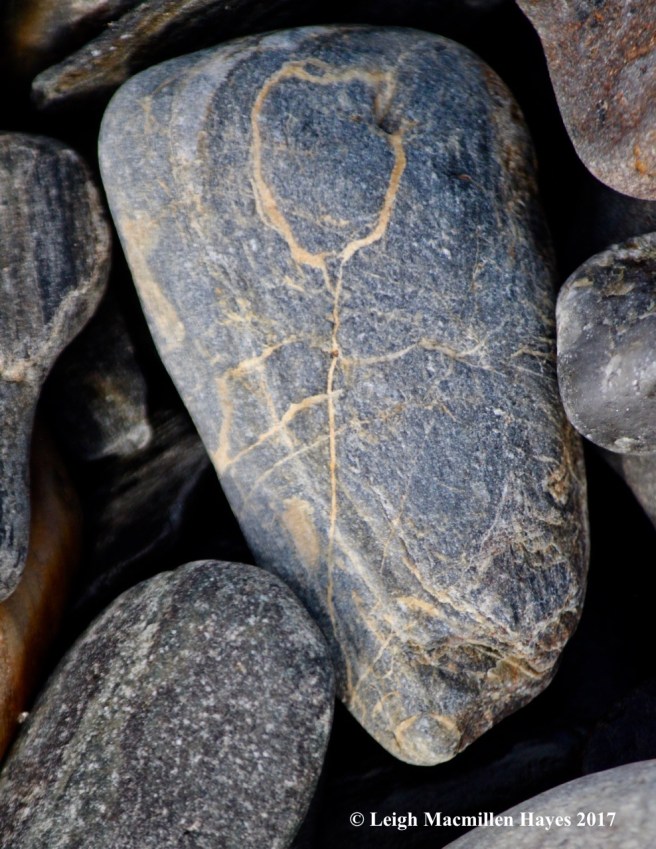
We also found a few stick figures among the offerings.

p-architecture

As we rounded the corner at Eastern Point, the architecture changed.

p-white rocks 2 (1)

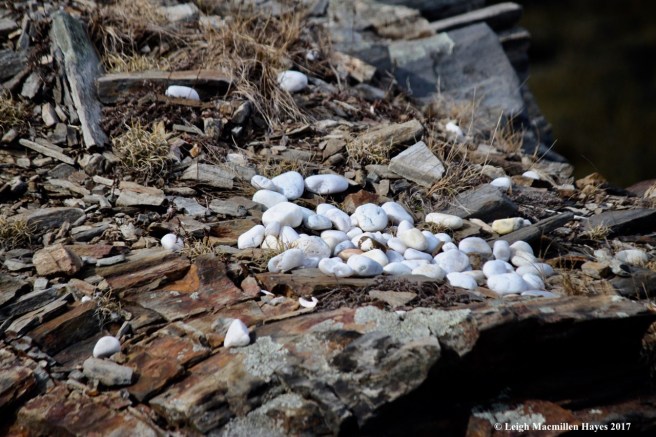
On an equally high spot as Scarborough Beach came into view, we spied a sight we didn’t understand.

p-white rocks 2

Turns out it was all white rocks. But, how did they get there? Human? Bird? Seriously? We questioned it because the pile was on a spot that neither of us could have accessed, given our fear of heights.

p-oogling the cottages

All along the way, we paused to admire the boarded up summer homes–especially in awe of the architecture noted in those built long ago.

p-castle 1

Almost at the end, this newer castle came into view. We recalled seeing it under construction last year.

p-sand castle

My guy thought he could live in their guest house. For me, a simple sand castle would do.

p-pump house

At the official end of the trail, we once again stopped to admire the old pump house made of local stone with a colorful slate roof.

p-Scarborough Beach

And though we wanted to continue along Scarborough Beach, time was getting away from us and so we followed the road back to our truck.

p-clamming

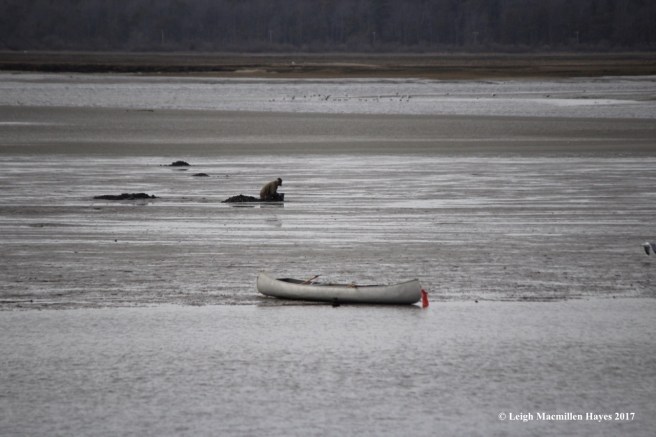
Completing the circle, the tide was out on Nonesuch River and we could see someone clamming on the sandbar.

p-heart--last photo

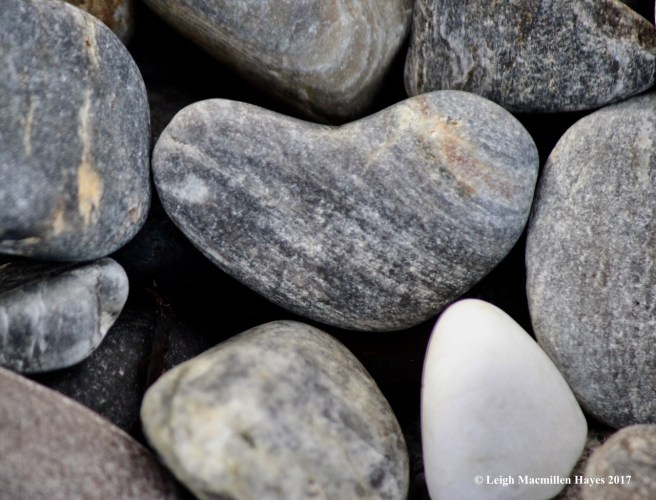
We didn’t dig up any clams, but we did pick up this stone–a rocky heart that symbolized our Mondate. Prouts Neck was the perfect decision–thanks to my guy.


Dear Aunt Ruth

My memories are snapshots of times spent with you and Uncle Bob and all the cousins. I loved visiting your home–whether we drove down the long road and driveway with Dad or walked via the old dump road and skeet field with Mom. Each time we arrived, you welcomed us with grace and your unassuming manner.

I remember sipping lemonade on the back porch, riding the wooden horse, and checking on Dale’s bunnies, especially Peter who soon became Mrs. Peter. I remember lunches at your kitchen table, and the time we bit into our tuna sandwiches only to discover the bread was filled with ants. Why that sticks with me, I don’t know, but we all thought it was funny. I remember family reunions, where food and laughter and aunts and uncles and cousins were abundant. Eventually, it evolved into a musical gathering–such was the talent of the clan.

But most of all, I remember your flower and vegetable gardens and your love of all things natural.

p-kiosk

And so today, as my guy and I ventured to a park we’d never before visited, I took you with us. I wanted to share with you our findings, just as you used to share stories of your gardens and wildlife sightings with us in Christmas cards after I moved north.

p-moose trail

Our first observation–a moose! Well, not really.

p-deer tracks

But we did see evidence of deer and I knew you’d be glad they were running away–leaving your gardens alone. Oh, and those pesky raccoons! Raising eight children didn’t seem to phase you, but those raccoons in the corn field–that did rattle you.

p-gardens on high

The gardens in these woods differ from yours–and right now, given the snow cover, the only ones visible were high up in pine trees, where yesterday’s snow offered nourishment to the mosses and lichens that grow there.

p-locust legume-like seed pod

We did, however, find one similarity–the legume-like seed pod from a locust tree. It’s almost time to sow the peas.

p-apples

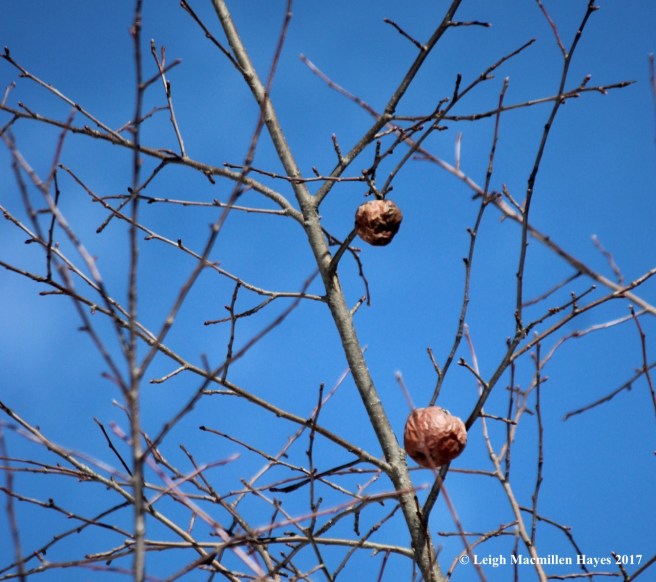
In these woods, we also found a symbol of the past–it was once farmland as signified by the apple trees. If memory serves me right, there was a very climbable apple tree beside your driveway.

p-hidden acorn

And then we spied one impossible possibility–an acorn tucked into red maple bark. How did it get there? And will it germinate? If it does, what then?  I trust, you too, would have noticed such and wondered.

p-pratt brook 2

We followed the trails through the woods and sometimes beside the brook for which the property was named–Pratt Brook. It was a bit more bubbly than the creek in your yard, but such is the snow melt right now.

p-artist conks

Along the way, I noted a family of artist conks decorating a tree. And, that, of course, brought to mind the box of colored pencils you (or perhaps it was the cousins, though Neal had no qualms about telling us that our gifts were really chosen by you) gave me long ago. I cherished that box and used those pencils with care. They lasted into my early adulthood.

p-colors 1 (1)

And then my guy gifted me another box, which I again revere. One of my favorite pastimes is to sit and sketch and then add a dash of color. Whenever I do, Aunt Ruth, you are with me.

p-powerline

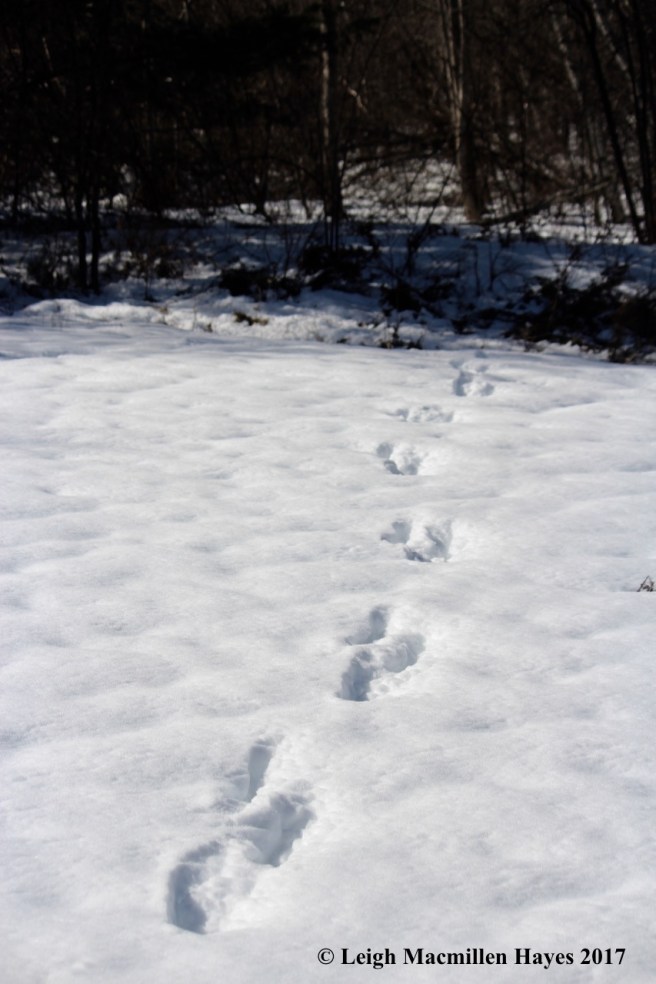
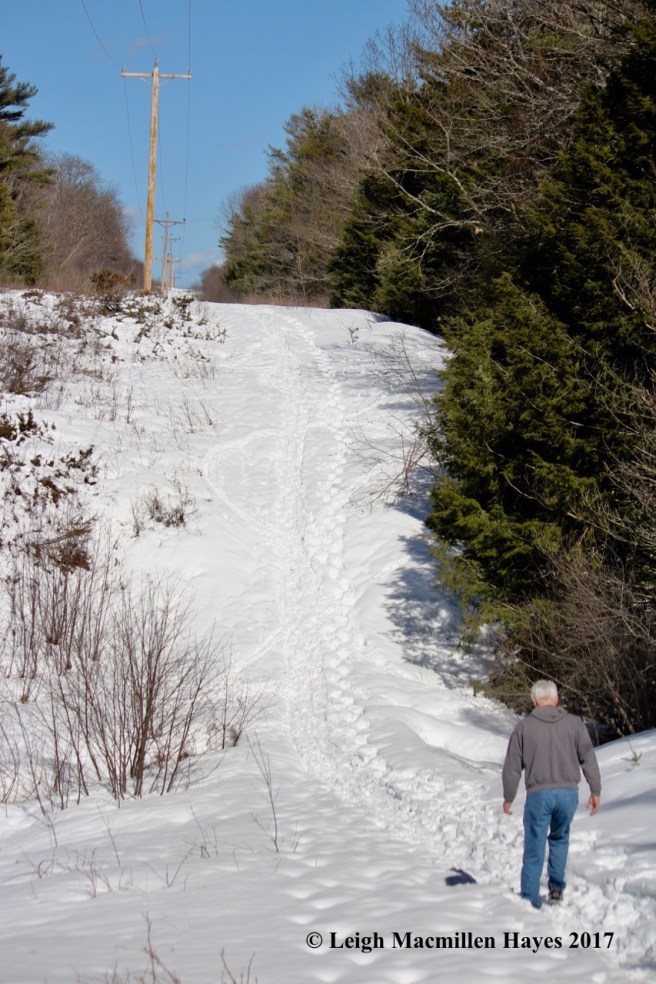
For a while we followed the power line trail, aka Bear Trail. As you can see, we tramped in the footsteps of many others who’ve traveled this way just today–via skis, snowshoes and hiking boots like us. We were an hour from home and close to the ocean, so the snow level was about six inches compared to at least two feet we walk upon daily. But today’s sun warmed us and initiated a meltdown.

p-spider

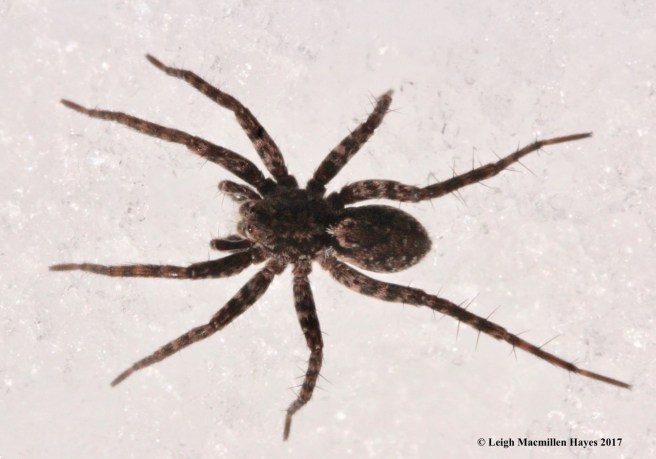
I didn’t mind being on the power line for a bit, for it was here that we saw our only sign of wildlife.

p-aster 1

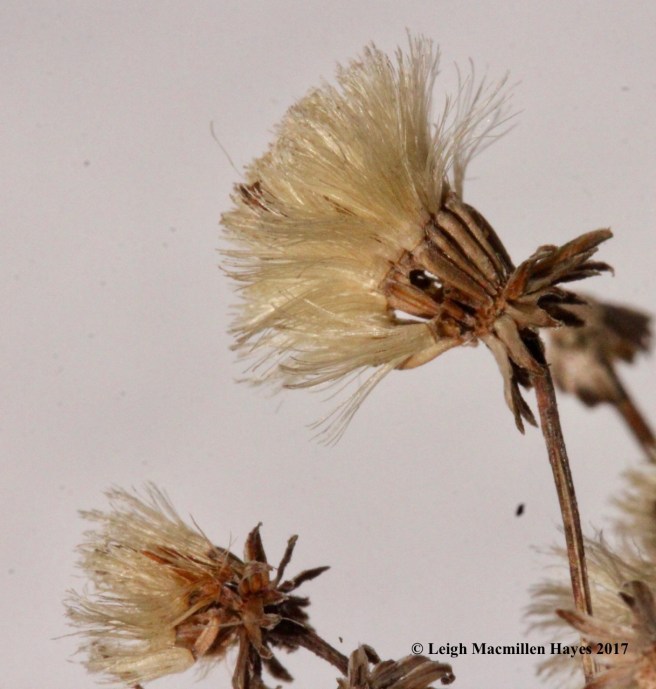
It was also the spot where I knew we’d find wildflowers–and I wasn’t disappointed. Asters like these, and goldenrods, spireas and berries displayed their winter forms.

p-beetle 3

Back into the woods, we were almost done, when we spied this woodwork, carved by bark beetles.

p-bark beetles 1 (1)

And I was again reminded of my past observations when I moved a log and discovered a gnawer on the job.

p-me

The intricate work reminded me of Uncle Bob’s woodworking skills and I knew you’d appreciate that. You’d also appreciate that as I write, my guy is watching a National Geographic show about Wild Scotland.

Thanks for the memories, Aunt Ruth. And thanks for making time for us and showing an interest in all that we did–always as curious about our adventures as those of your brood. You were a remarkable woman and a genuine Yankee whom I was blessed to have as a part of my life.

Fondly, Leigh


Morning Glory at Kezar River Reserve

Some mornings the hallelujahs spring forth from my being–and fortunately not from my vocal cords.

k-Kezar River sign

Today was one of those days as I ventured down the snowmobile trail, aka Parnes Landing Road, at the Greater Lovell Land Trust’s Kezar River Reserve. Just past the kiosk, I veered to the left to follow the GLLT’s trail into the woods.

k-jelly topside1

Within steps I was greeted by Auricularia auriula, a jelly ear fungus. The sun’s beams revealed veins reminiscent of stained glass windows and polished woodwork in an older church.

k-jelly under 2

Flipping the fallen oak branch to look at the underside revealed an equally, if not more beautiful design with its frosted outline.

k-wintergreen

On a steep hill beside Kezar River, actually the sloped side of a ravine I’d never hiked upon before, a southerly orientation presented lives past and present.

k-bench

Below, at the point where the trail, road and river meet, few have paused recently, including no sign of otter.

k-river view

But many have zoomed by with a need to reach the next destination as fast as possible.

k-ravine 1

I followed their tracks a little way out and peeked into the second ravine from a vantage point seldom celebrated.

k-big tooth aspen leaf

And then I headed back up the road to the next trail intersection. At my feet, form bespoke name, such is the manner of the big tooth aspen.

k-ravine 2

Down into the second ravine I tromped as I made my way to view the outlet from the other side.

k-otter 1

Because of the snow’s depth, I traveled to places less frequented and beside the stream I noted previous action. Lots of it.

k-otter activity1

And I spied evidence of the creator–whose prints were hard to distinguish, but other signs easily discernible.

k-my otterness

In my attempt to take a closer look, I practiced my inner otter and managed to find the water and leave my own set of muddy, though not quite webbed, prints. I laughed aloud as I pulled myself up and gave thanks for remembering to bring my hiking pole. Fortunately, the breakthrough was the only sign I left behind.

k-nature's snowball

Heading up the ravine, I smiled at the sight of the universe having fun–nature rolled her own snowballs–perhaps in preparation to build a snow woman.

k-pine cathedral

Through the cathedral of pines I continued–always looking up . . .

k-ice art

and down, where intricate patterns formed naturally in the ice offered a feathery look at the world below.

k-paper birch lateral bud

Sometimes, I stopped to spend a few moments with family members . . .

k-yellow birch

taking time to marvel in their similarities and differences as they stood side by side.

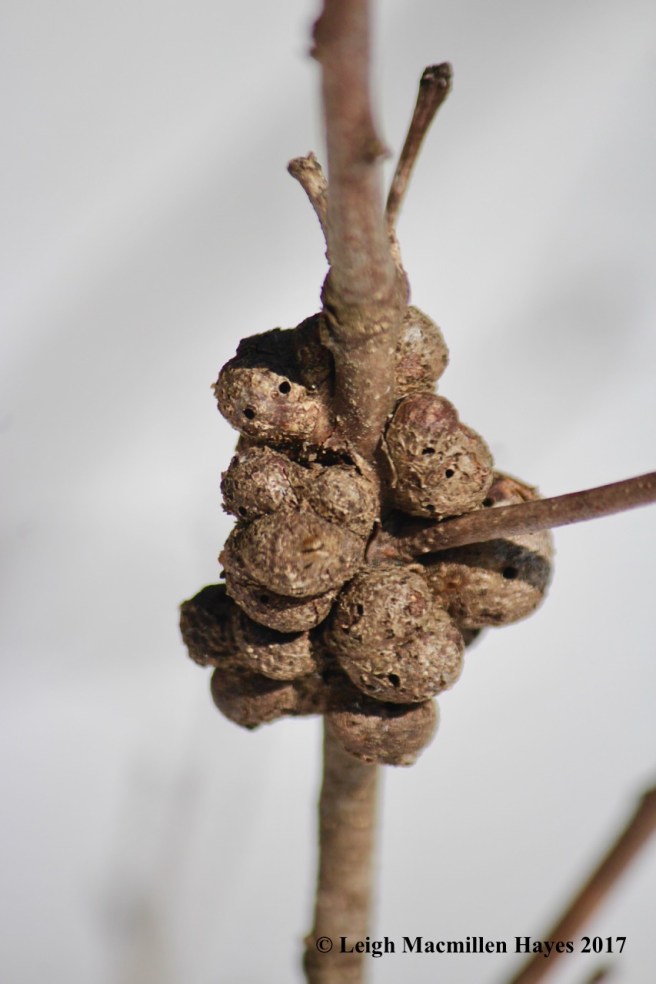
k-oak gall

And it seems there are many hosts throughout our woodlands that offer a spot for others to evolve.

k-oak crown

Despite or perhaps because of that, knowing they’d offered a helping hand, the oaks sported their crowns proudly.

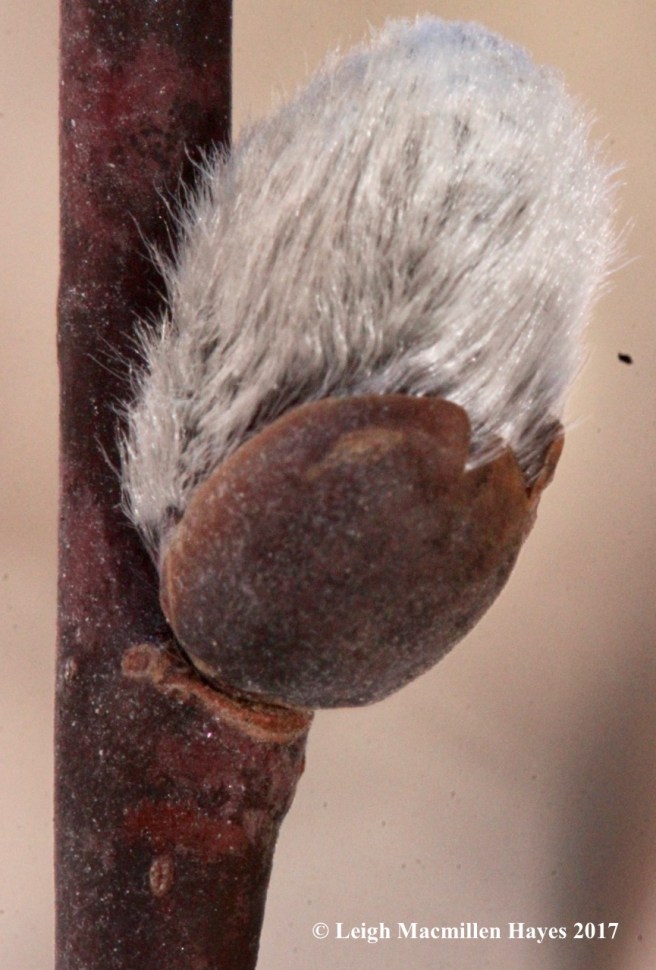
k-pussy willow

Quite unexpectedly, I stumbled upon a picture of youth that warms my heart endlessly.

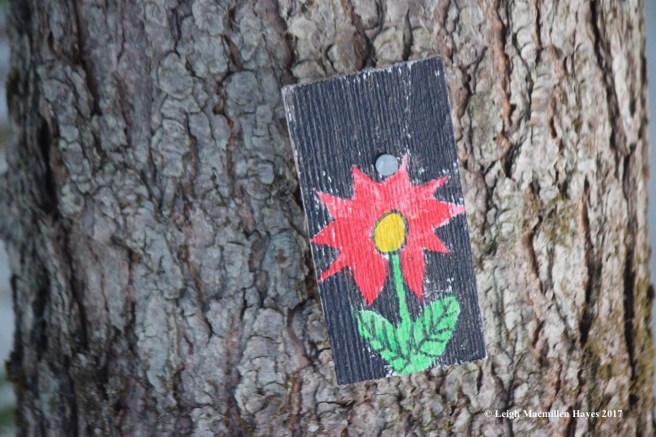
k-flowers in bloom

My journey wasn’t long, such is the trail. It’s decorated with small bright signs painted by local youngsters. Though I wouldn’t want to see these on every trail, they make me smile as I enjoy their colorful renditions of the natural world.

Not a picture of a morning glory, certainly, but a morning full of glory as I wandered and wondered and sang hallelujah along the trail at Kezar River Reserve.


The Sun Always Shines

In the grayness of the day sunlight lit my way.

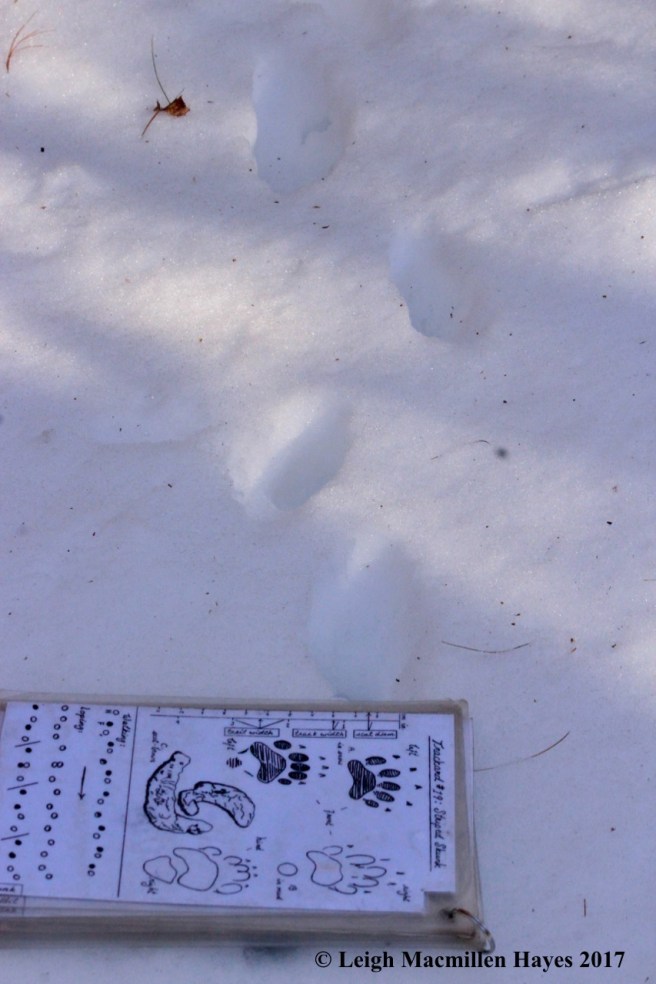
o-skunk tracks

Oh, it wasn’t as bright as yesterday when I wandered in brilliant light under clear blue skies and saw hints of spring, including skunk prints in the snow,

o-algae

and some blue-green algae in a vernal pool that is slowly opening up.

o-ice goddess

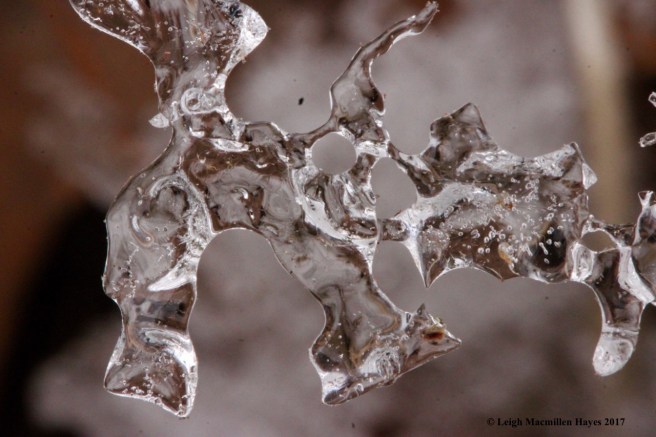
But given the temperature and wind, the ice goddess reminded me that winter prevailed.

b-deer 2

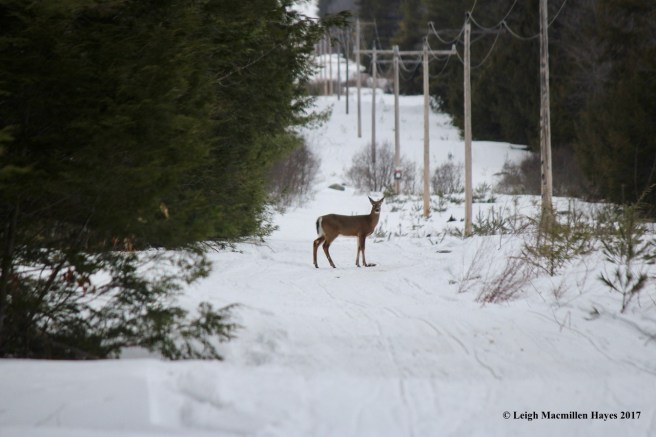
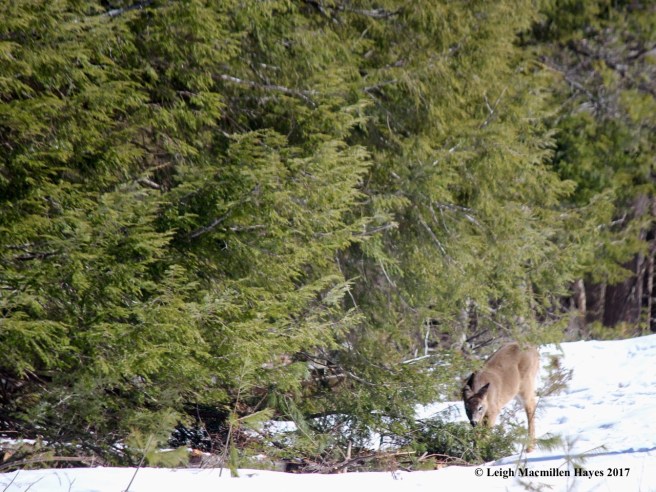
This morning presented a different picture that didn’t feature Mount Washington in the background because it was obscured by clouds. Rather than don my snowshoes, I decided to stick to the snowmobile trail for the most part. I wasn’t the only one who ventured that way. Because I wasn’t making as much noise as usual, the deer didn’t hear me approach. And so we stood for many minutes contemplating each other. I didn’t want to scare her for I knew she wouldn’t just stick to the trail and the snow depth continues to be such that she sinks with each step. It was in those shared moments that I began to think about energy and how much she put forth all winter and now continues to do the same as spring evolves. Every day I spy more and more young hemlocks trunks that have been scraped. She and her family are feeding on sunlight, which first feed the insects in the soil and then the trees. At each stage or tropic level of the food chain only ten percent of biomass from the previous level is retained. Thus, a thousand pounds of plant biomass is necessary to support a hundred pounds of an herbivore–that’s a lot of little buds for a deer.

b-bobcat prints

Eventually, she made her way across the powerline and joined her family. I decided to turn around so I wouldn’t disturb them further. And it’s then that I recognized some prints I’d missed previously. My micro-spike print is on the left, beside those of a carnivore–a bobcat, or rather, two. Usually bobcats travel in a solitary manner, but their breeding season is upon them. And those thousand pounds of plant biomass that supported  a hundred pounds of herbivore, in turn support ten pounds of carnivore. The hunt becomes important.

b-motherwort

I did find a few spots where the snow had melted and winter weeds, such as this motherwort, provided hints of future buffet items for the herbivores and omnivores to consume.

b-junco and hemlock needle

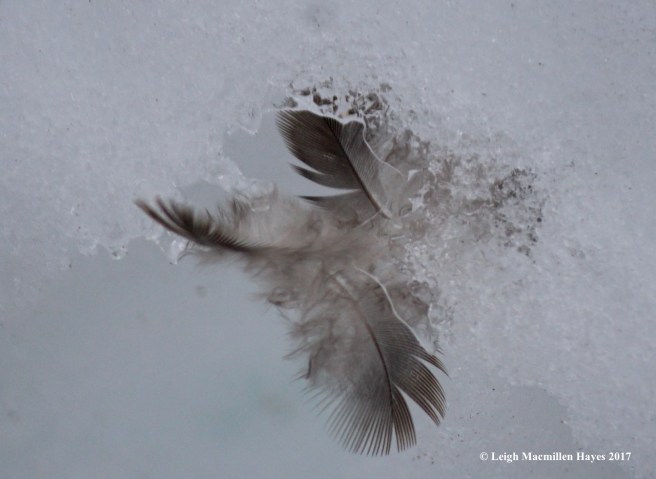
And then I came upon junco feathers and knew that a different consumer had benefited from the sunlight offered forth by this little bird. The hemlock needle provides a perspective of size.

b-junco feathers 2

Despite its demise, the feathers surrounded by melting snow created an artistic arrangement. That was my attempt at positive thinking, for like us, all things must eat to survive.

b-white ash opposite

And then a few producers caught my attention and I found myself focusing on young trees and shrubs. I’ve walked past this young tree numerous times and never saw it until today.

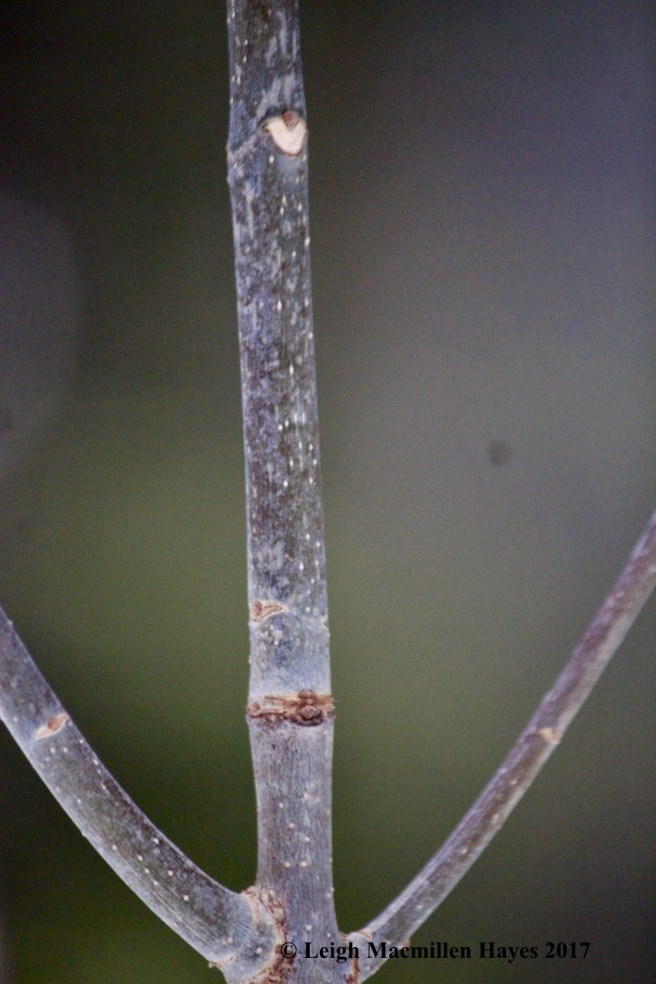
b-ash 2

White ash or green? They both look similar, but the leaf scar is the giveaway. It’s shaped like a C or misshapen horseshoe with a deep notch at the top.

b-ash bud

And its terminal bud is domed. In these woods, the ash trees aren’t a preferred food source of the deer–lucky for them.

b-silky 2

Nearby, another neighbor caught my attention and it, too, I hadn’t met before.

b-silky dogwood 1

My assumption was dogwood, given the bright red/purpishish color of its shrubby stems, long-gone fruits and opposite leaf buds. But–red osier or silky? I’ve leaned toward the latter but will have to pay attention as the season moves forward. These did seem to tickle the herbivores fancy from time to time, though not nearly as much as the maples that grow nearby.

b-peanut

As I headed toward home, I stumbled upon another site I’ve seen frequently all winter. Actually for the past few winters. There must be a peanut plantation somewhere in these woods. That, or the blue jays have discovered a good source at someone’s bird feeder.

b-ice goddess

Before heading indoors, I paused to acknowledge another ice goddess, one who also knows the sun’s power and found relief in today’s shadows . . .

b-snow

and flakes. It’s snowing again, this fourth day of spring. Liquid sunshine, for the snow also provides nourishment to all who live here.

You see, the sun always shines . . . even when you can’t feel the warmth of its rays.


Spring In Our Steps Mondate

Our usual celebration of the vernal equinox begins with a hike up Bald Pate Mountain with Loon Echo Land Trust, but either we missed it or we slept through it this morning even though we awoke before sunrise. Given that, we chose a different summit on which to welcome this new season.

a-kiosk

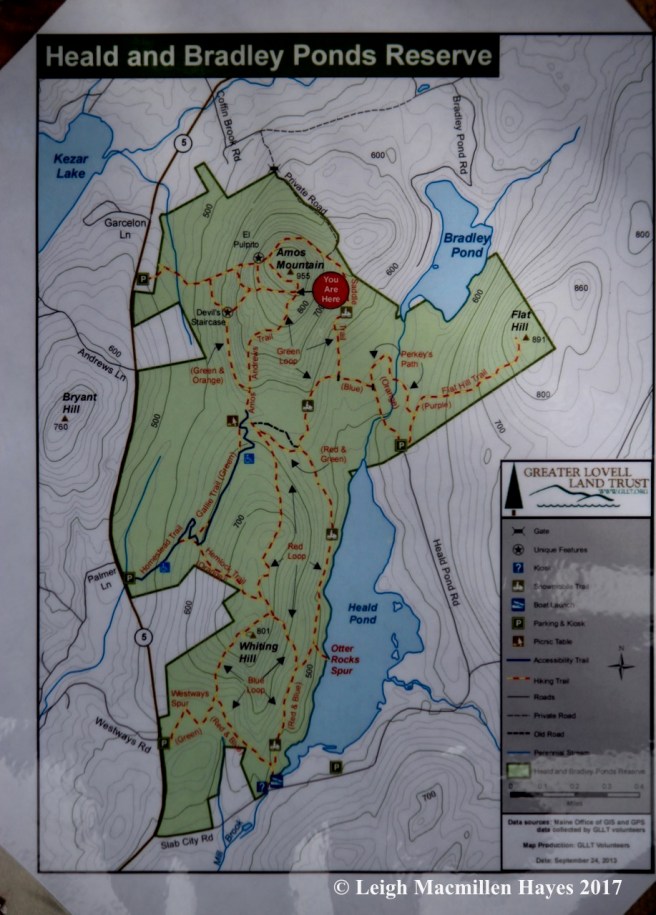
Our great debate, be it all one-sided, centered around which trail to follow in order to reach the top of the Greater Lovell Land Trust‘s Amos Mountain. Knowing that the route from the Flat Hill parking lot would be mostly via the snowmobile trail, we (or I) decided on the Gallie Trail located off Route 5.

a-breaking trail

From the start the snow was a bit crusty and hadn’t been traversed since the last storm, though a few critters had crossed it. We plodded along at breakneck speed, my guy trudging first while I followed and packed those spots between his prints.

a-beech scale 1

The hike begins with a gradual rise, but still I welcomed opportunities to take a rest, so quickly were we moving. It was the white target on beech bark that slowed me down. I knew what I was looking at but hadn’t seen it in this formation previously. In several spots on this tree, the beech scale insect presented itself in bull’s eye formation as it filled in small crevices on the bark.

a-beech scale 3

All winter the insects, in their nymph stage, have been blanketed with a wooly wax. Now that it’s spring, I need to keep an eye on this tree for the nymphs will emerge as short-lived second instars that will soon molt to become adult females. Will I see it happen? Will I know what stage I’m looking at? Stay tuned.

a-picnic table

My guy tolerated my curiosity and then we moved on, bypassing the old foundations where I suspect everyone was undercover. Certainly, the picnic table at the base of the Amos Andrews Trail had kept warm all winter.

a-Amos Mtn sign

A picture of the man for whom the mountain was named hangs from a tree by the table.

a-rock walls

And along the way, terraced stonewalls on the east side speak to his occupation.

a-rock tripe

It was a boulder on the west side of the trail, though, that made me stop again. This time I really needed a break. The temperature had risen and black snow pants were absorbing the heat. Gloves–off. Hat–off. Sweater and turtleneck sleeves–pushed up. What caught my eye was the rock tripe that showed off its dry and wet forms. Lichens come in a variety of colors, but once wet, they turn green as the algal component kicks into action. Snow topped the boulder and its melting pathway was obvious.

a-approaching summit

I wasn’t the only one who was shedding clothing as we neared the summit.

a-sweet fern

Just before we got there, I spied some dried sweet fern leaves poking out of the snow. Sweet fern is a woody plant, rather than a fern, and its developing catkins were a sign of the transition that is slowly occurring. The good news about sweet fern is that not only does it smell wonderful, but it’s also a good insect repellent.

a-tent caterpillar egg mass 1

Speaking of insects, next to the sweet fern I saw this tent caterpillar mass–a matrix of 150-400 eggs. It’s a shiny, varnished structure that encircles the branch and is a bit wider than a pencil.  The sweet fern won’t have any influence on the tent caterpillars or beech scale insects, but will help keep mosquitoes at bay.

a-You Are Here map

An hour after starting, we reached the summit, having followed the Homestead, Gallie and  Amos Andrews Trails.

a-lunch rock

Lunch bench offered a great spot to sit and cool down.

a-summit view of two lakes

And take in the view–of Heald Pond on the left and Kezar Lake on the right, plus the mountains beyond.

am-1

Our trek down was like a walk in the park and we practically floated. The snow had softened and our trail was packed making for a quick descent.

a-yellow birch

But, we still had one more stop to make and I reminded my guy to turn left at the yellow birch–the most beautiful yellow birch on this route.

a-spring 1

I wanted to locate this very spot that is off the beaten path.

a-spring 2

And I wasn’t disappointed as we watched the water boil up through the sand in mesmerizing  movement. We’d found the spring once again.

Indeed, we found spring in our steps on this Mondate.


The Irish Colors

With so much snow still on the ground, it’s easy to see the landscape as a monochrome palette of grays. And so I set out on this St. Patrick’s Day to find some color.

f-bridge

My destination was the Greater Lovell Land Trust‘s Flat Hill trail and Perky’s Path from the end of Heald Pond Road. The parking lot is almost non-existent, so much snow do we have. And the bridge crossing tricky.

f-cherry bark

As I climbed upward, the thought that some see the world as black (cherry) and . . .

f-paper birch 1

white (paper birch) kept racing through my brain.

f-gray birch 1

And then there are those who accept that gray areas exist (gray birch–a brother of paper birch from another mother).

f-yellow birch bark

Textures visible in shadows reflected differences (yellow birch–a cousin),

f-hop hornbeam

even among family members (hop hornbeam–also a birch relative.)

f-mink tracks

It may have seemed there wasn’t much new to see and wonder about, but . . .

f-mink prints

the straddle (width from outside of one print in a set to outside of the other) and angle of these prints told a different story. A mink had crossed the trail. (My mitten had to hold the Trackard in place or it would have slid down the trail.)

f-porcupine trail

Nearing the top, I went in search of another mammal who has frequented this area for years–and I wasn’t disappointed. The porcupine trough was fresh.

f-view from Flat Hill

And then I reached the summit of Flat Hill (forever an oxymoron) and the whites, greens, browns and blues of mountains and sky opened before me. There was even a hint of red in swelling buds.

f-downhill from Flat Hill

The wind was cold, so I didn’t pause for long. Instead, I retraced my own tracks down the hill.

f-orange trail

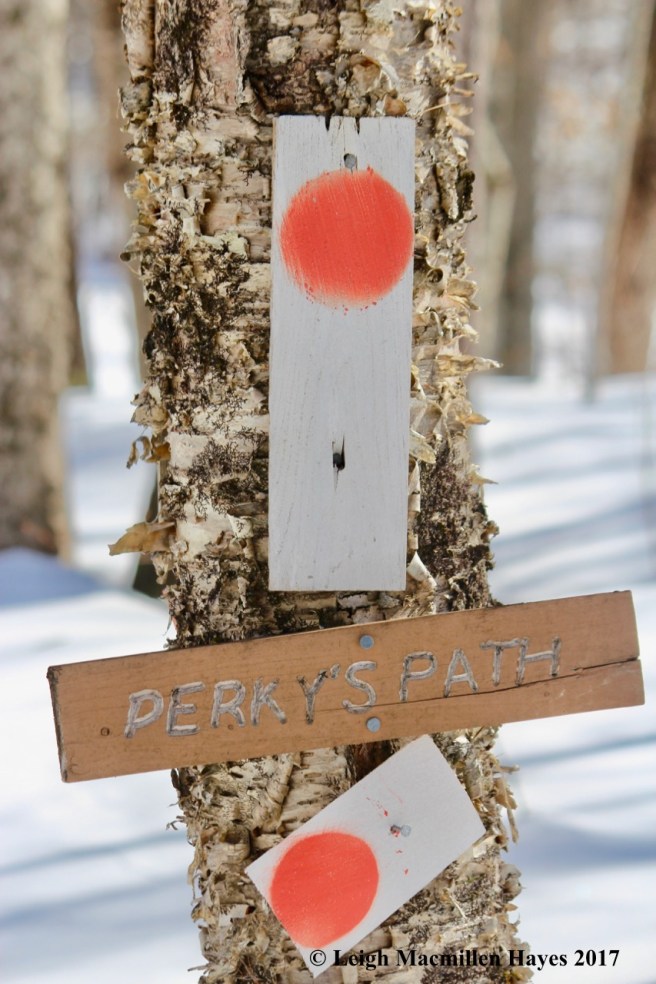
And then I turned onto the orange trail that is Perky’s Path and realized the symbolism of the color and this day. My Scottish ancestors smiled down on me.

f-beaver lodge

I’m always drawn to the wetland and had to take a peek at the beaver lodge, which remained snow covered, indicating that no one was home. But there again, the sky enhanced my view.

f-wetland from bridge

The path leads to another set of small bridges, and there I stood for a while, taking in the peacefulness and beauty before me. Oh, and the warmth of the sun as its strong rays embraced me.

f-chickadee 1

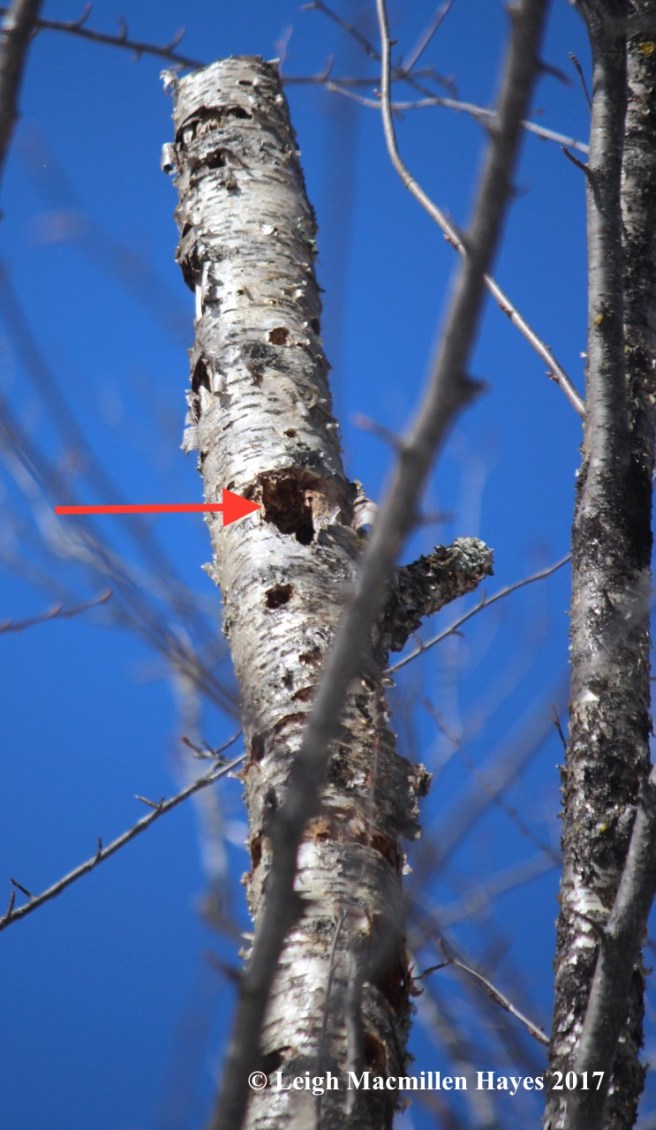
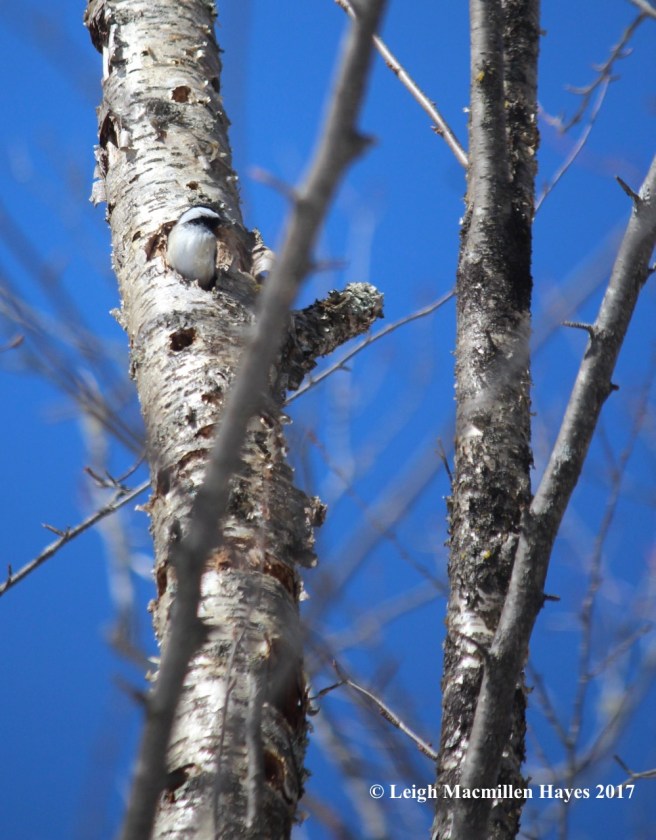
While I stood and listened, a chickadee called and I watched as it entered a hole in the birch snag. This was a wow moment, for though I know birds use old pileated holes, I rarely see them come and go.

f-chickadee 3

Out he popped, giving a curious look–perhaps because I was pishing.

f-chickadee 2

He paused for a moment and then flew off, chickadee-dee-deeing across the bright blue sky.

f-brook view

I, too, took off, but not before enjoying a few more reflective moments.

f-ice swirls

The juxtaposition of snow, hemlock branches, water and ice created colorful swirls of artistic design beyond understanding.

f-wintergreen

And then I found a few wintergreen plants, their waxy leaves transforming from winter maroon to summer green.

f-beaked hazelnut

On my way out, I stopped to examine a few buds–and catkins, in this case. I love winter, but I am beginning to crave color and beaked hazelnuts will be among the first to flower.

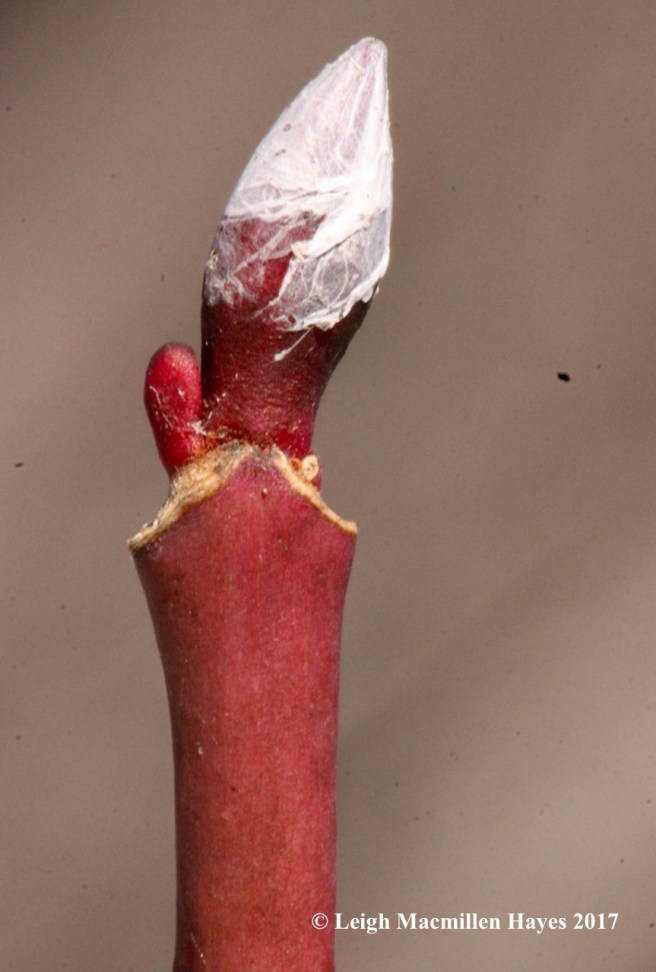
f-striped maple bud1

A striped maple showed off its waxy buds, leaf scars and growth rings. The bud reminded me of hands in prayer–perhaps worshipping the patron saint of Ireland.

f-striped maple covered

One bud was sheathed in white. Even with my hand lens, I couldn’t figure it out. I’d like to think it was an angelic covering, but suspect it is a cocoon.

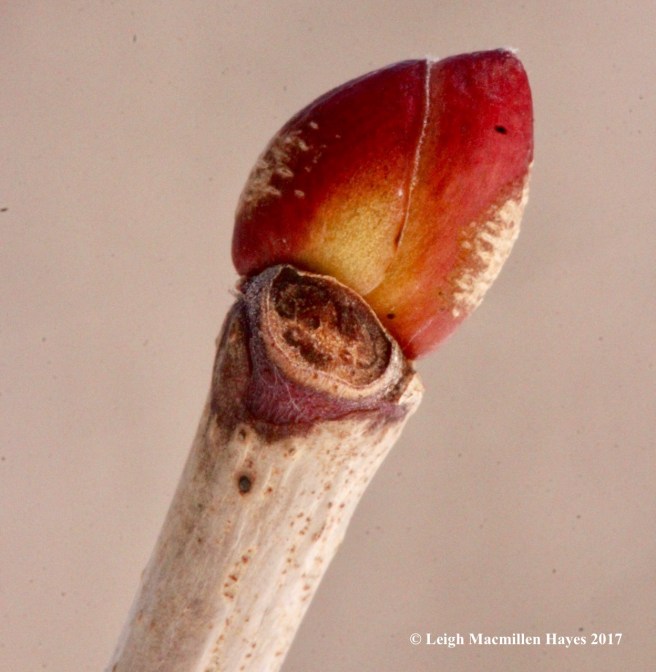
f-basswood 2

And then there were the bulbous bright buds on the basswood tree.

f-basswood lateral bud

Indeed, they were a sight to behold. Though winter reduced the color palette to the essentials, slowly the transition to spring has begun.

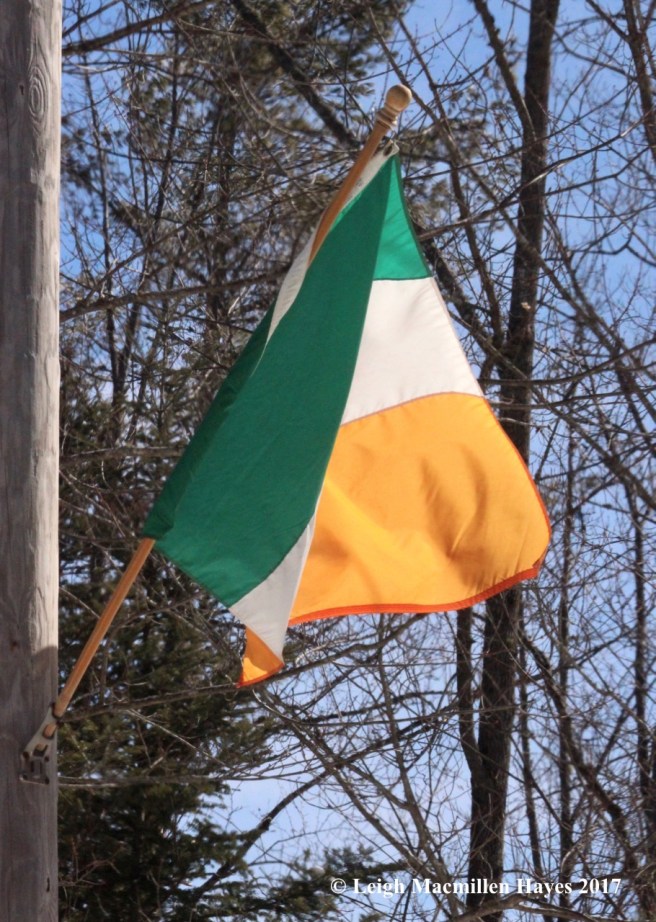
f-Irish flag in breeze

My journey was done, but I made one more stop along Route 5, where Irish flags flapped in the breeze to commemorate this day. The Irish color–where white signifies the truce between the Orange and the Green.

I always wear a hint of orange on this day in contrast to my Irish guy’s green. And I remind him that St. Patrick was born in Scotland.


Beware the Ides of March

As I write, snow flurries float earthward landing atop the almost two feet of snow we received yesterday. Perhaps I should have heeded the soothsayer who warned Julius Caesar to “Beware the ides of March,” in Act 1, Scene 1 of Shakespeare’s play about the Roman politician. 

But I didn’t. I stepped out the door this morning and took my friend, Judy Lynne, with me for today is her birthday, thus making March 15 a day of celebration rather than one to be dreaded.  

As for “ides,” that word refers to the day in the middle of the month. Every month has a day that divides it in half, therefore, every month has an ides. But still, in the play it sounds so ominous–and is eventually.

And as for Judy, she missed the blizzard (and all our winter weather) because she teaches in China. And she is not at all like the Roman soldiers. Rather, Judy embraces every person and critter around the world and sheds love wherever she goes. 

p-porky

Since she can’t be in western Maine to enjoy the results of a late season storm, she’ll have to travel vicariously–beginning with the porcupine who didn’t let a little snow stop him from plowing through. Those of us who know Judy travel in a similar manner as she shows us parts  of the world we may never actually visit. 

p-Mount Wash

The view of Mount Washington will help her get her bearings. It is this and Pleasant Mountain and our orientation to them on the horizon that help us recognize our place in the world.

p-snowshoe hare

I didn’t expect to see many tracks this morning, but was pleasantly surprised. Besides the porcupine, I saw deer, mouse, red and gray squirrel, chipmunk and these. I can’t give you lobsters for your birthday, Judy, but I can give you the lobster-like prints of snowshoe hare. 

p-AMC bridge

I often don’t know where I’m headed when I walk out the door, and today was no different. This journey took me into Pondicherry Park where I stopped by the AMC bridge and thought about Judy’s ability to cross bridges with people of other cultures, no matter how deep the snow may be.

p-AMC bench

Today, however, if she wanted to pause after making such a crossing, she’d need a shovel, such was the depth on the bench by the bridge.

p-willet brook from bench site

Together, we headed down the trail to the viewpoint beside Willet Brook. Judy is an artist and I had visions of her recreating this scene of winter snow and spring ice. This picture of transitions reminded me of the changes in her life as she interviews for jobs in other countries.

p-Willet 2

The change will be difficult as she leaves behind friendships formed in the last five years, but I trust in reflection she’ll know she’s making the right choice.

p-false tinderconk

As I snowshoed, I found a few things I knew, but didn’t necessarily understand. Bumps in the road you might say, Jude, or at least on the spore surface of a false tinderconk.

p-hammered, green shield and cocoon

Because she loves design and has an insatiable curiosity, I knew she’d enjoy taking a look at the shield lichens, both hammered and common green.

p-cocoon 2

And that would have brought her to notice something else on the bark. She’d have laughed as I stuck my chin against the tree to get a closer look at the silky-hair cocoon embedded on the lichen. Perhaps a tussock moth?

p- Hooded Merganzer

As I wound my way back, I checked Willet Brook again–and spied a hooded merganser swimming away, its crest described as a hammerhead. Hammershield, hammerhead. Methinks Judy will nail down a new job soon.

p-beech bud breaking

And then there was the beech bud already breaking–I’ve seen this happen in previous years; a few scales bursting open before their time.  For Judy, it would have turned into a science lesson for her Chinese high school students. And perhaps a drawing lesson for art class.

p-deer, maple leaves on ground

Throughout the park, I didn’t roam alone for deer tracks were obvious everywhere and I saw three of the creators. But it was the leaves atop the snow that made me pause and I’m sure Judy would have done the same.

p-maple leaves

Occasionally I spot a single withered maple leaf on a tree, but this tree was covered and it made no sense. Maples aren’t typically marcescent–they don’t retain their leaves like beech and oak. It wasn’t until I stepped back and looked at the tree that I finally understood; this was a branch that had fallen when the tree was still in leaf and the deer browsed the tips of some branches, though I trust they didn’t find much nutrition for they moved on. I laughed again and heard Judy roar with me.

p-deer crossing stream:watercress

At the stream below the spring, I noticed the deer had walked right through the water to get to the other side.

p-watercress 1

I couldn’t tell for sure, but trust they sampled some wild watercress that grows freely there. And I thought of the foods Judy has sampled during her time in China and other travels.

p-deer crossing bridge

Not all of the deer chose to walk through the water. Some actually crossed the bridge. It struck me that they learned to use it to get to the other side. Judy has learned so much about herself and the world as she’s crossed bridges I’ll never set foot on.

p-dunning bridge 1

The best bridge of all awaited, its roof supporting the weight of the snow. This bridge was built by many to honor a community member, whose wife just happened to be the reason Judy and I met 25 years ago. Wow–it’s been that long since we practiced breathing techniques in Lamaze class .

p-snow on Dunning bridge

One of the cool things this morning because I was the first one there, the peaks and valleys left behind by the storm. If she’d been here, Judy would have taken the very same photo.

p-ducks 1

I went to the bridge to see the other ducks that frequent this location. The sight of the snow-topped rocks and vegetation made me think of frosting and guess who also teaches a cooking class–yup, Judy.

p-ducks 4, black:mallard hybrid?

Within the mix, what I think are two black ducks. I’m still learning my birds, but it did look like one may be a hybrid–a cross between a black duck and a mallard. Of course, I could be wrong on all accounts. No matter–what does matter is that they all get along and that’s what is important to Judy. She’s also a great believer in random acts of kindness and has performed so many good deeds for others.

p-robins 2

I was almost home when I saw some color in the gray birches–more color than the berries being eaten.

p-robin 3

A flock of robins dined on the “junk” food of the bird world–bittersweet berries.

p-robin 1

After one drank some snow, it showed off its rufous-colored breast, reminiscent of Judy’s red hair.

This one posed atop the snow-covered branch seemed a mighty fine representation of our move from one season to the next. (Or might it be one country to the next, Jude?)

In the end, today’s journey reminded me once again to Be Aware–the eyes of March. And be thankful.

I am thankful for my friend, Judy Lynne, born on the Ides of March, but not actually reading this until the day after her birthday. I’ll be forever in awe of her.

Beautiful Maine Mondate

Some Monday’s we look for new places to explore or mountains to climb, but today found us visiting an old favorite that is gorgeous in any season.

s1-Stone House Road 1

Because it’s still winter (and she’s not letting go right away), we knew our hike would be extended by more than a mile on either end. We parked by the Leach Link Trail on Stone House Road and followed the telephone poles in.

s2-bear number

These are my favorite telephone poles in the world–well, for today that is, for they show the works of the clever bears that inhabit this place. The wood has been scratched and bitten, while the shiny pole number was mutilated. This was pole 5. I suppose it still is.

s3-bear hair

Hair sticks out from splinters. Bear hair.

s4-more bear hair

We found lots of it on several poles today. More than we’ve seen in the past.

s6-another pole

I’m thinking that the bears in the area have a fondness for 5. Or a dislike, for pole 15 also received rough treatment. There are more, but it was on 5 and 15 that we noticed the number destruction.

s8-bear dogs

Despite that, the bears in this area are most welcome. Because the signs are new, I asked my guy what he thought the bears will do when they emerge from their dens soon. In my mind, I saw a similar behavior to the other poles and imagined that when we return again we’ll see that the signs have also been destroyed because that’s what bears do. My guy’s response, “Clap.” Indeed, they should.

s9-gate

At last we reached the gate where we usually park to hike the Stone House property and Blueberry Mountain trails. The Stone House property encompasses about 890 acres surrounded by the White Mountain National Forest. In 2011, the owners, David Cromwell and Sharon Landry, established a conservation easement held by the Greater Lovell Land Trust. The easement allows for traditional uses including commercial agriculture and forestry, but prohibits development and subdivision in perpetuity. Thus we have both this couple and the GLLT to thank for today’s adventure.

s10-black cherry bark

When we finally reached the Shell Pond trailhead, a black cherry immediately jumped out at me. The property was last logged in 1977 and features a mix of hard and softwoods. My bark eyes love the diversity.

s11a-birch and red maple

And my bark mind appreciates the kindred spirit of the trees that manage to support each other despite their differences–in this case a beech and red maple.

s14-pileated works

I’m not the only one who likes bark–the work of pileated woodpeckers,

s15-porcupine

porcupines,

s16-beaver works

beavers,

s13-yellow birch burl

and even insects was evident throughout our three-hour tour.

s17-Yale blue

As we hiked, my dad was also on my brain. I’d received a message this morning from his former boss at Yale University who fondly recalled Dad and his brother Bob. Though quiet men, he and his brother had a twinkle in their eyes, a love for music, especially opera, and always a good joke or prank up their sleeves.

When I saw this tree in the shape of a Y, I knew it was for Dad. Even the sky spoke of the university–though several shades lighter than Yale blue. And with that came the memory that any paint my father mixed had a touch of Yale blue in it–thus was his way. It was all meant to be for Mr. Cromwell, the property owner, is associated with Yale.

s18-my guy

I couldn’t help but think that Dad would have loved the idea of our Mondates. He also would have loved my guy, but sadly they never met. Dad died of a heart attack only days before he and Mom were to spend a weekend with me in Maine–thirty years ago.  But, my guy continues to wear a Yale sweatshirt when he runs, which he did this morning. In that way, he’s made his own connection. Yeah–that’s my guy!

s19-pond views

Now that I’m writing through tears, I’ll get back to the trail, which is delightful in winter because it offers more views of Shell Pond below.

s20-cliff views

And the icy ledges above. Later in our journey, I noted the trail to the ledges had been well used–probably by rock/ice climbers.

s22-water 1

Trail conditions were such that we walked on top of the hardened snow, though I did wear micro-spikes for the entire tour. Someone waited to put his on and did a little slipping and sliding along the way. Brook crossings required stepping low and high, so deep is the snow still.

s23-ice castle

While I marveled at a castle made of ice,

s24-Christmas tree

my guy spotted a Christmas tree.

s25-polypody

We even found a few hints of green. These polypody ferns were opened, indicating warmer temps and today we certainly noted the difference compared to the brisk weekend.

s26-polypody

Of course, on another rock, some were still curled in their cold formation. They were under a hemlock and more shaded.

s27-partridgeberry

Any bit of green is a welcome sight about now and I was surprised to see partridgeberry poking through the snow.

s28-lunch bench

At last we reached lunch bench, which my guy stood upon. Yup, that’s the granite bench under his feet.

s29-lunch

We sat on it to eat our PB&J (with butter for me, of course) sandwiches. And tried to keep from sliding right down to the pond.

s30-Shell Pond

Lunch view included Shell Pond and the Baldfaces in the background. All along, we’d noted mice, squirrel, mink, fisher, coyote, bobcat, ruffed grouse, turkey and moose tracks. But as we ate we listened to the whales groan–so moaned the ice in the afternoon sun.

s31-brook

A short time later we reached Rattlesnake Brook and the orchard, where the natural community transitioned and appeared almost bucolic.

s32-ostrich fern

One of my favorite finds along this section is the ostrich fern. The structure of its fertile frond makes me smile.

s33-airfield

From the orchard we moved on to the old airfield and wondered if the family ever flies to their summer home. Though I don’t think it’s used these days, the airstrip was apparently built in the 1940s by the military for practice landings and takeoffs during World War II.

Again, the views were breathtaking.

s34-stone house and Blueberry Mtn

As hikers, we’re reminded by signs to stay on the marked trails, thus protecting the land and giving the family some space. I’m in awe of their home. The Stone House was built in the early 1850s by Abel Andrews. He quarried the large, hand-hewn granite slabs from Rattlesnake Mountain and built the 40-foot by 25-foot house for his wife and thirteen children.

s35-another wetland

I did stay on the trail most of the time, but occasionally I heard the landscape calling my name and had to investigate. Fortunately, my guy stayed on the trail all the time and kept us honest.

s36-Beautiful Maine

We walked back out to the truck and then decided to take a quick detour before driving home. Being on Stone House Road, we were only a mile from the winter closure point for Route 113 in the White Mountain National Forest. The road forms the state line between Maine and New Hampshire for several miles. And then it passes into Maine at the gate by the Cold River Campground and The Basin. And it’s there that you’ll find this iconic sign.

Welcome to Beautiful Maine and another scenic Mondate.


Because I Wandered

It’s still cold and blustery. Oh, we had warm spells in January and February. But now it’s March. And it’s Maine. So wind chill in negative to single digits shouldn’t come as a surprise. Nor should the impending Nor’easter predicted for this week. Only more than a foot of snow possible.

Today’s cold wasn’t nearly as frigid as yesterday’s and when I stepped out the back door, I could feel the warmth of the sun penetrating my outer being. It worked wonders for my inner being as well.

o-quaking aspen

My first stop was beside the quaking aspen tree. Yesterday, some Maine Master Naturalist students and I examined tree buds and their characteristics. I love looking at these and do so every day since the tree is right off our back deck.

Varnished scales protect the  aspen’s leaf and flower buds as they lay dormant through the winter. Its flower is produced within a catkin and already the cottony part of the seeds is appearing, much like a pussy willow.

o-striped maple

As I moved into the woodlot, I stopped to re-admire the only striped maple that grows here. Last year a deer used the lower portion of the bark as an antler rub. Yesterday, as we stopped to look at the characteristics of its bark, we noticed it’s been used most recently as deer food. This tree is barely larger than the circle formed within my thumb and pointer finger–and I have small hands. How much more deer attention can it take?

o-gray fox tracks

As I looked at the striped maple, my eyes were drawn to the activity of another mammal. Out came my Trackards and I took measurements. I knew by the walking pattern that it was a canine. And I knew by the size that it was a fox. But red or gray was the question. I suspected the latter because I could see details clearly in the soft snow atop the hardened crust.

o-gray fox prints

Measurements and a look at a bunch of prints confirmed my suspicion. Rather than stay on the path, I decided to backtrack the fox’s trail.

o-gray fox and coyote 1

Within minutes, I realized another mammal had traveled in the opposite direction. Also a canine.

o-gray fox and coyote intersect

And atop a double-wide stone wall, I found where the coyote (follow the red pencil) and gray fox (yellow) crossed paths. Not at the same time, I’m sure, but given the track conditions, I don’t think they were too far apart. We saw neither set of tracks as we examined trees and lichens in the same area yesterday.

o-gray fox sat and peed

I also found where the fox sat and then peed. Not much odor–in case you’re wondering.

o-turkey plus

My journey took me across a few more stone walls and through a hemlock grove. I lost the fox, but followed the coyote and then I found others including squirrels, deer and turkeys.

o-turkey wings

It looked like the turkeys had been dancing on an ice-covered puddle. And then perhaps they took off for the wing marks were well defined. Did they fly because the coyote approached? Or was there another reason? Time to head up into the trees for the night, maybe? It’s difficult work for these hefty birds to lift off.

o-many travelers

Everywhere I went, others had been before me. It seemed the prey followed the old logging routes and predators crossed.

o-bs lichen

My own wander became a bushwhack meander. And a few lichens called me in for a closer look. My inclination was to quickly brush off all the gray foliose (leaf like) lichens as weedy hammered shield, but I suspect there was some bottleshield lichen in the mix and realize I need to look again. I’m forever a student–thankfully.

o-crustose mosaic

While there were specks of shield lichens on a young maple tree, the variety of flattened crustose lichens covered so much of the trunk that it was almost difficult to distinguish the bark color.  The mosaic pattern suggested a painting–naturally.

o-beech 1

The buds and leaves of the beech trees also asked to be noticed. It’s been my experience that younger American beech keep their leaves throughout the winter–perhaps because their buds are lower to the ground and therefore easy targets for hungry herbivores. There are other theories as well, but I think it’s key to note that it’s the younger trees who keep their leaves, or in the case of this one, those that remain were on the lower branches.

o-beech leaves

They remain until the tree buds begin to break or leaf out. The word to describe this leaf retention is marcescent (mahr-ses-uh nt), which means withering but not falling off. Their rattling in the slightest breeze may be enough to keep those herbivores at bay.

o-beech 4

In the tree’s silhouette, the pointed buds stood out,

o-beech scales


each one a cylinder of overlapping scales in opposite orientation on a hairy stem.

o-witch hazel leaves

That, of course, led me to another marcescent tree that loves this wet woodland, the witch hazel. Its leaves have always intrigued me with their wavy margins and asymmetrical base. But it’s the winter color of the withered leaves that I also find attractive.

o-witch hazel scalpel

And its naked buds, which don’t have waxy scales like the aspen or beech. Somehow the fuzzy hairs must provide enough protection for the winter months.

o-witch hazel bracts

Everything is fuzzy on a witch hazel, including the bracts left from last fall’s ribbony flowers,

o-witch hazel pods

and the woody, two-seeded pods that ripen a year after the flowers have formed. These split open in the fall as the seeds were forcibly ejected.

o-moose scat

I wandered for hours and miles and never saw any prints from the moose that frequented these woods earlier in the season. But, where the snow had melted under a spruce, I found evidence that blended in with the leaf litter.

o-moose browse

And in an area I used to frequent prior to the logging operation of the last few years, I found more sign. The ruler is mine and this side shows centimeters.

o-coyote x2

When I reached the former log landing, my coyote friend made its presence known again. Actually, one became two as they had walked in single file and then split apart several times. They were on the hunt and a snowshoe hare was in the vicinity.

o-cherry

I followed the main logging trail for a while and then turned off to explore unknown territory. But . . . before turning, it was the maroonish color of the cherry bark that warranted attention. And the lenticels–raised, elongated and horizontal imprinted on my brain.

o-deciduous forest

My meanderings continued and again I saw lots of predator and prey activity. Even a porcupine, though that shouldn’t come as a surprise. Finally, I walked into an area of young red oak, red maple and gray birch and knew I was approaching familiar ground. And so I stepped onto the snowmobile trail.

o-deer 1

All along, I’d thought about the many tracks I’d seen, but no mammals . . . until I approached our cowpath. I wasn’t the only one headed that way.

o-deer browsing first

The deer herd seems to have survived this winter well. I’ve yet to find evidence that suggests otherwise.

o-deer browsing

And I felt blessed that I was able to move as close as possible despite the crunching of the snow beneath my feet. The wind was in my favor. And then, it heard me, flashed its white tail and ran down the cowpath. Perhaps we should rename it the deer path for a cow hasn’t walked on it in decades, but like me, the deer use it almost daily.

My day was made because I wandered.


Focusing Our Eyes at Wilson Wing

I almost canceled our Tuesday Tramp this morning. The weather seemed iffy and though that doesn’t often stop us, road conditions do. But Mary and I exchanged a few e-mails and decided that even though we were the only two available, we’d go for it.

w1--deer 1

As we made up our minds, I watched another who also experienced some indecision. Lately, eight deer have spent many moments in the field and our yard, nipping buds along the edge.

w2-deer 2

While the rest of its clan was further out, this one came over the stone wall.

w3a--deer 3a

For me, it was a matter of watching how its legs worked and where it placed its cloven toes.

w4-deer 5

About to visit some trees, it turned suddenly when it realized it was being stalked–not by me but rather a neighbor’s cat. Well, maybe I was as well, but I was indoors.

w6-deer 6

Gingerly, it moved in for a closer look.

w7-deer 7

Tail down, it seemed curious to make a new acquaintance. And the big, tough cat–it ran home.

w8--Sucker Brook 1

And so, I packed up and met Mary for our adventure at the Greater Lovell Land Trust’s  Wilson Wing Moose Pond Bog Preserve on Horseshoe Pond Road in Lovell. We’d had a dusting of snow overnight and weren’t sure what to expect. Always expect the unexpected.

From the start, we found older coyote tracks that we decided to follow. Those led us to mink tracks that began near Sucker Brook. For a while, we followed both as they ran parallel, the mink tracks being much fresher. And then we stood in one spot and realized we were encircled by coyote, mink, red squirrel and short or long-tailed weasel tracks. We could have gone home then, but of course we didn’t.

w9-ice skirt

We decided to follow the brook for a while, hoping to see otter tracks and a slide. Instead, we were treated to aprons of ice surrounding boulders and tree roots.

w10-hoar ice

Some hoar frost at a hole made us wonder who might be within.

w11-mink tracks with tail drag

And our eyes again recognized that we were still on the trail of the coyote and mink. All along, we were curious to see the drag marks left behind by the mink’s tail. Unless it was carrying something–another option.

w12-Sucker Brook 2

As we stood and looked about, movement caught our eyes and we realized we were looking at the mink. Unfortunately, neither of us thought to capture it in a photograph, but it will remain forever in our mind’s eye. While I did exactly what I tell others not to do–tried to follow it for a couple of minutes–Mary stood and listened. A sound above make her crick her neck.

w13-black backed woodpecker

On a dead trunk, a woodpecker foraged among the bark scales. We watched it for a while, trying to note its features from below and we then moved on.

w14--hobblebush

My visits to Wilson Wing are never complete without a stop to worship the hobblebush. For those anticipating spring, it’s only a few weeks away. It won’t be long and these naked leaf and flower buds will unfurl and I’m sure I’ll share their blooming glory with you.

w15-Moose Pond Bog

Another stop that I can’t pass by is a climb up the stairs to the platform–the perfect viewing spot for the bog.

w16-car

Finally, we continued along the trail and I realized my focal points were redundant of all past visits, but it’s fun to view some of these in various seasons. For those who know, this is the old blue vehicle.

w17-lungwort

And right near it, my favorite of all foliose lichens–lungwort, indicative of unpolluted air. At Wilson Wing–indeed.

w18-hemlock catkins ;-)

We crossed the last little stream, found some deer tracks and a beaver chew, and then decided to follow the trail back rather than the road. One of our stops included admiring the hemlock catkins. (Smiley face)

w19-black backed 2

And then we returned to the woodpecker. By now he was our woodpecker, just as the mink that we saw and other critters we didn’t see were also “our mink” and “our coyote,” etc. It’s amazing how even when we don’t see the mammal, recognizing that it has passed through is enough to excite us. But this bird . . . oh my.

w20-black backed 3

We noted the orangey yellow crown as it cocked its head.

w26-black backed 8

Its face was black and white, including a black mustache and white eye line.

w22--black backed 5

We were surprised by its stocky build.

w24-black backed 6

And those black and white barred sides or flanks weren’t like the woodpeckers we normally see.

w25-black backed 7

It worked constantly, flaking the scales off the trunk as it searched for insect larvae.

w27-black backed 9

Cinnamon colored underbark revealed itself where the bird had recently excavated.

w28-black backed 10

As it contemplated its next move, it didn’t seem to mind our admiration.

w30-black backed 11

With its strong beak, it probed and probed.

w31-black backed 12

Then held its head back and . . .

w32-black backed 13

probed some more.

w33-black backed 14

First it cocked its head to the right.

w36-black backed 17

And then back to the left.

w38-blackbacked 18

Frequently, it paused for a brief break. Or perhaps it was dining and we didn’t know it.

w40-black backed 21

We were mesmerized.

w39-black backed 20

And delighted . . .  for we’d had the opportunity to focus our eyes on so many wonders, but especially the mink and this . . . a black-backed woodpecker. This was a rare opportunity for these birds seldom show themselves, especially this far south–all the more reason to be thankful that we decided to go for it and focus our eyes on the nature of Wilson Wing Moose Pond Bog Preserve.

Hiking the West Mondate

How could it be? We realized this past week that we’d only hiked in Sebago Lake State Park together once–thirty years ago. Oh, I’ve skied there, visited friends who were camping, and participated in several eighth grade class picnics back in my public education days.  But today we decided to remedy our hiking opportunity–or lack thereof.

s-sebago-sign

Our intention wasn’t to camp, but rather to explore the trails that circle around and cut through the 1,400-acre property. For those of you who know my guy, though we certainly haven’t spent a lot of time in the park, he does feel a certain affinity–to the brown stain that the park staff purchases in five gallon buckets from his hardware store. :-)

s-boundary-blazes

After looking at a map near the entry booth, we headed off on a trail marked with orange blazes. Or so we thought. Until we realized we were following the boundary. But all the orange paint made me think of our young neighbor, Kyan, and as it turns out he was on my brain for a great reason–he’s been in remission for the past six months following his bone marrow transplant and today had his central line removed. No wonder we spent an hour following those orange blazes. All the while, however, we did think the trails were poorly marked.

s-high-point-1

Unwittingly, we spotted a bit of brown–on the picnic table. We appeared to be on a high spot, home to the table and a cairn garden.

s-cairns-3

I’m of several minds when it comes to cairns. I know that some are historical and symbolic and others mark trails, but these, though each different in sculptural form, bothered me.

s-cairn

While my guy saw them as offering hikers something to do, I saw them as disruptive to the natural landscape. That being said, the landscape was formed by a glacier and these pieces spoke to the bedrock geology of the Sebago pluton with their pinkish coloration.

s-kneeling-before-map

Turns out we were at the summit of the Lookout Trail, the highest point in the park at 499 feet. And behind the cairn park, we found the trail itself, blazed with red triangles, which we followed down to the campground road where we found a map–worth kneeling and worshiping. Well, actually, given the snow depth, that was the easiest way to read it. From that point forward, we found “You Are Here” maps whenever trails intersected, though we did tend to wander off occasionally.

s-ice-bubbles

Over a brook, where balls of ice formed,

s-artist-conks

past artist conks decorating a decaying birch tree,

s-locust-bark

and through woods featuring the braided ridges of black locust bark, we hiked.

s-tree-silhouette

And then we reached the beach. On Sebago Lake.

s-rocky-coast-of-maine

We’d arrived at Witch Cove Beach.

s-waves-and-wind

The wind had kicked up the waves and it felt almost ocean like. Almost.

s-maple-and-pitch

Certainly, tree roots beside the lake spoke to wave action and higher tides (no, the lake doesn’t have a tide, but in storms and floods it must surge higher). Beside the water, a red maple and pitch pine tree embraced from their root source.

s-pitch-pine-bark-1

The bark of the pitch pine featured its reddish plates surrounded by deep furrows.

s-red-pine-bark

While it’s similar to red pine bark that grows nearby, there are subtle differences–red pine bark being plated but much thinner and tighter to the trunk. Plus, the pitch pine has bundles of three needles, while the red features two needles.

s-pitch-pine-growth

The other unique characteristic of pitch pines, their epicormic sprouting of needles on the trunk that grow from dormant buds on the bark.

s-sand-prints

Eventually, we moved on, leaving prints in our wake.

s-beach

Our substrate switched from snow to sand and back to snow, which we much preferred.

s-beach-eyes

Before we turned away from the beach, we found the sand goddess eyeing the world. Again, we noted the orange and thought of Ky, but didn’t truly realize its significance.

s-lunch-table

Into the picnic area we moved, after watching a few deer who eventually flashed their white tails before moving on. Lunch table beckoned us. It needs some fresh stain–there’s job security in that thought–for the park staff and my guy.

s-buried-table-2

Some tables spoke to the snow depth.

s-cache-fest

After we finished our sandwiches, we discovered that others had used the picnic ground–for a cache site. Somewhere in the park, at least one red squirrel prospered through the winter.

s-glacial-kettle

Our journey took us past the glacial kettle formed by the melting of large blocks of ice.

s-map

And then we figured out our final trails to follow.

s-songo-river

We crossed Thompson Point Road and followed the oxbows and meandering of Songo River, which actually proved to be bittersweet. I’d only been on the river twice and both with the milfoil team of the Lakes Environmental Association. As we hiked beside it today, I recognized various points Adam Perron, the milfoil dude had pointed out. Again I say, RIP Adam.

s-beaver-bog-from-table

At last we reached Horseshoe Bog, home to one of those picnic tables needing work. You know who spied it from a mile off.

s-beaver-works-3

He also spied the work of others and eagerly showed me.

s-beaver-teeth

My what big teeth grooves a beaver leaves.

s-beaver-works-4

It left its mark everywhere.

s-beaver-5

And sometimes such works met the forces of nature and all was well that ended well.

s-spur-trail

The same could be said for us. We began the day on a trail that wasn’t and ended by trying to follow a spur trail out, that we couldn’t quite locate (except for the sign at the beginning that identified it as a spur trail) and so we bushwhacked and then an anomaly caught our eyes–snow on a structure, which turned out to be the entry booth from which we’d begun our expedition.

As it turns out, we realized that our adventure thirty years ago was on the east (Casco) side of the park and this was our first visit to the west (Naples) side. Here’s hoping it doesn’t take us thirty more years to return for another Mondate–indeed.


The Second Anniversary of Wondermyway

Milestones are always important as they mark significant events in our lives. And for me, such an event occurs today as I celebrate the second anniversary of the day wondermyway.com was born.

Since I was in elementary school and made few and far between entries into a chunky journal bound in a green cover (which I still own), to the first empty book journal my sister gave me when I graduated from high school, to a variety of travelogues and other journals I’ve filled from cover to cover,  I’ve recorded my life’s journey from time to time.

The most satisfying for me has been this very blog, to which I’ve added numerous events and discoveries, both natural and historical, over the last two years. As personal as it all is, I’ve taken a leap of faith by sharing it with you. And you have been gracious enough to read it, and comment on it, and “like” it, and sometimes “love” it, and offer me suggestions, corrections and gentle nudges.

Thank  you for following along on the journey. It’s been scary to put myself out there, but I have.

And now, I thought I’d review some favorite finds I noted in posts over the past year. My learnings have been many and it’s been fun to review all that I’ve seen and thought and admired and wondered about. I hope you’ll feel the same and will continue to follow along and comment and share those that you enjoy with your family and friends.

Here’s my countdown , or maybe I should say my count up of favorite moments in time over the past year:

Feb 21, 2016: Celebrating a Year of Wonder-filled Wanders
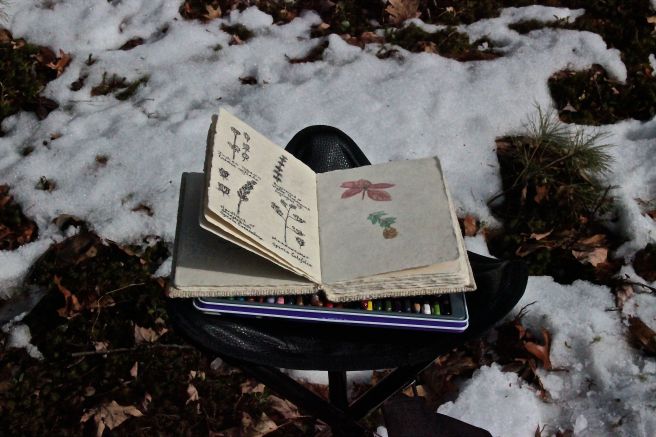
b-sit spot

b-sketch 1

I made time one year ago to sit and sketch–one of my favorite activities. To be still and embrace life around me. To notice. And commemorate.

February 28 2016: Gallivanting Around Great Brook

h-yellow and white partners

Usually, we drive the forest road in to the gate on Hut Road in Stoneham, but in winter it isn’t passable, and thus one must walk–which means paying attention to things you might not normally notice, such as this: a special relationship between a yellow birch and a white pine. Rooted in place, they embrace and share nutrients. Forever conjoined, they’ll dance through life together.

March 18, 2016: On the Verge of Change
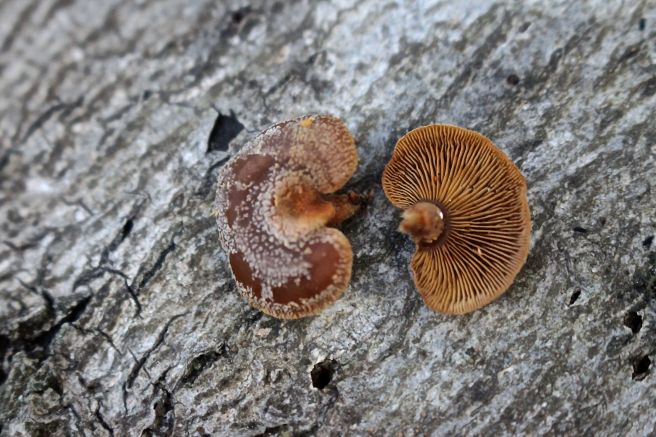
b-panellus stipticus?

While exploring the Greater Lovell Land Trust‘s  Back Pond Reserve in Stoneham with my friend, Parker,  who is a master mycologist, he found Panellus stipticus, a bioluminescent species. Check out those gills on the underside. According to Lawrence Millman in his book Fascinating Fungi of New England, ” . . . specimens in the Northeast glow more obviously than specimens in other parts of North America.” So if you are ever in these woods late at night, don’t be freaked out by a light greenish glow. It just might be nature’s night light.

March 22 2016: Wet Feet at Brownfield Bog

b-pellet

When I first spied this lump of gray I assumed it was a dead mouse. I know, I know–I should never assume because I risk “making an ass out of u and me.” And so I took a closer look. And noticed tons of bones and those orange teeth. An owl pellet filled with the remains of dinner. Owl pellets are extra cool and dissecting one is even cooler. I collected this one but haven’t dissected it because I think it makes for a great teaching tool as is. If you want to see it, just ask.

April 13, 2016: So Many Quacks

v-egg mass 1

At the vernal pool, or frog pond as we’ve always fondly referred to it, just steps from our property, I kept a keen eye on the situation last spring. In general, each mass laid by  female wood frogs was attached to a twig or branch. They tend to take advantage of the same site for attachment and usually in a warm, sunny spot.

A couple of masses were positioned independent of the rest, like this one–embraced in oak and maple leaves. Eventually, they’ll gain a greenish tinge from algae, which actually helps to camouflage them. One of the many wonders is that any given mass may contain up to 1,000 eggs–from a two-to-three-inch frog.

April 28, 2016: The Big, The Little and Everything in Between

b-bear2

The phone rang as I stepped out of the shower and a male voice yammered away about something in the snow and it had come last night and I had to get there quickly. My friend, Dick,  was standing in a friend’s yard about a half mile from here and looking at bear tracks in the snow.

As he knew he would, he had me on the word “bear.” His voice was urgent as he insisted I stop everything and get to his friend’s house. “I just need to dry my hair and then I’ll be right there,” I said. Deadlines loomed before me but bear tracks won my internal war. Dick suggested I just wrap a towel around my head. Really, that’s what I should have done because my hair has no sense of style whether wet or dry, so after a few minutes I said the heck with it and popped into my truck, camera and trackards in hand.

May 21, 2016: Wallowing in Wonder

p-ph dragon ending 4

Along Perky’s Path at the GLLT’s Heald and Bradley Ponds Preserve, a bunch of us had the honor to watch a dragonfly split open its exoskeleton and emerge from the nymph stage. Of course, we were standing by a beaver pond, and so it seemed only appropriate that it would use the top of a sapling cut by a beaver. As it inflated the wings with blood pressure, they began to extend.

May 31, 2016: Slippers Fit for a Princess–Including Cinderella

p-ph lady y 15

Members of the Orchid family, lady’s slippers feature the typical three petals in an atypical fashion. The pouch (or slipper or moccasin), called the labellum, is actually one petal–inflated and veined. With a purplish tint, the petals and sepals twist and turn offering their own take on a ballroom dance. From every angle, it’s simply elegant.

June 10, 2016: The Main(e) Exotics

snake2

At Lakes Environmental Association‘s Holt Pond Preserve, a friend and I had moved from the swamp to the first hemlock hummock and chatted about natural communities when suddenly we realize we were being hissed at. Its coloration threw us off and beautiful though it was, the hairs on the back of our necks stood on end. Apparently we made it feel likewise. And so we retreated. It was a common garter, but really, there didn’t seem anything common about it in the moment.

June 18, 2016: Paying Attention

partridge berry

j- trailing 2 (1)

j-  trailing 7 (1)

In May, trailing arbutus wowed us by its gentle white and pale pink flowers. In June,  they faded to a rusty tone. And some transformed into swollen round seed pods–a first for me to see.

The sepals curled away to reveal the white fleshy fruit speckled with tiny brown seeds. It was well worth getting down on knees to look through a hand lens–especially since ants, chipmunks and mice find these to be a delicacy so they wouldn’t last long.

July 9, 2016: Wondering About Nature’s Complexity
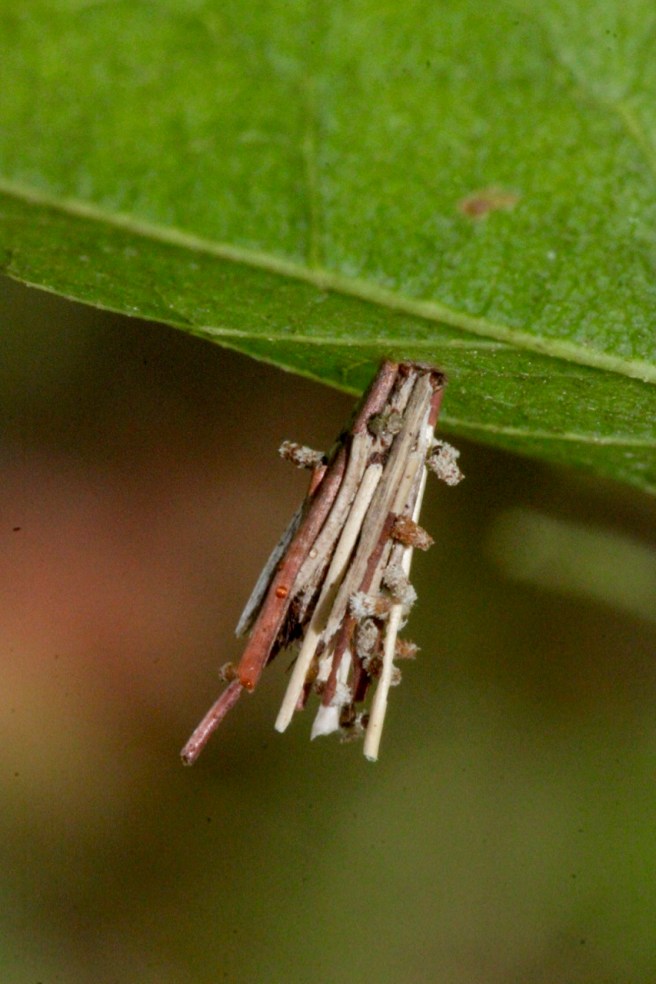
img_1364-1

I posed a question this day: So dear reader, I enjoy teaching you, but now need you to teach me. I found this under another leaf on a shrub. And I often see the same thing stuck to our house. It reminds me of a caddisfly case. What is it?

And fellow Master Naturalist Pam Davis responded: Check out bagworm moths to see if it might be an answer to the stick thing on the leaf and your house. Here’s a discussion: http://nature.gardenweb.com/discussions/2237505/not-a-bug-maybe-a-gall and a Wikipedia link: https://en.wikipedia.org/wiki/Bagworm_moth

Indeed.

July 27, 2016: Searching for the Source of Sweetness
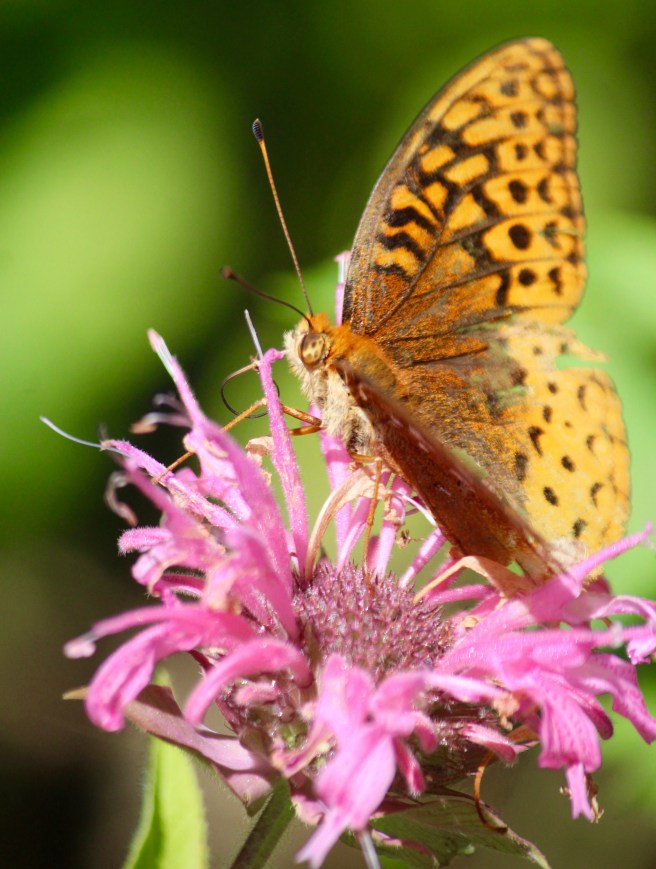
w-frit 2

It was no mistake the this fritillary butterfly chose the beebalm on which to land. Check out its mouth. A butterfly feeds through a coiled mouth part called a proboscis. When not in use, the proboscis recoils and is tucked into position against the butterfly’s head.

August 21, 2016: Sundae School

n-Indian pipe bee 1

My lessons began immediately. What to my wondering eye should appear, but a bee pollinating an Indian Pipe. And in the middle of the afternoon. Huh? I’ve always heard that they are pollinated by moths or flies at night. Of course, upon further research, I learned that bees and skipper butterflies have been known to pay a visit to the translucent flowers. Add that to the memory bank.

August 27, 2016: Halting Beside Holt Pond

h-pitcher  flower up close

Halting–prone to pauses or breaks. I didn’t break, but I certainly was prone to pauses as I moved along the trails and boardwalks at the Holt Pond Preserve in South Bridgton. One of my first stops–to admire the pitcher plant flowers in their August form. When I took a closer look, I realized that the seeds were developing–certainly a WOW moment in the world of wonder.

September 9, 2016: Golden Rulers

g-assassin-1

What first caught my eye was a bee that dangled upside down. And then I spied the green legs of an assassin bug. What? Yup, an assassin bug. I believe this one is a nymph. Regardless of age, here’s the scoop: Assassin bugs are proficient at capturing and feeding on a wide variety of prey. Though they are good for the garden, they also sometimes choose the wrong species like this bee. The unsuspecting prey is captured with a quick stab of the bug’s curved proboscis or straw-like mouthpart. Once I saw this, I continued to return for a couple of hours, so stay tuned.

September 15, 2016: The Wonders of Kezar River Reserve
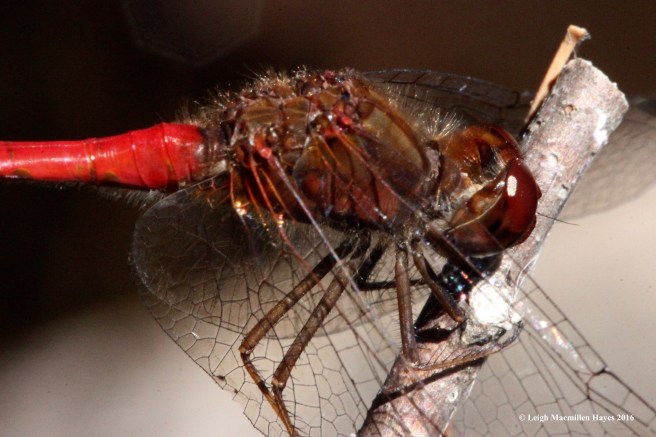
k-ruby-1

My favorite wonder of the day . . . moments spent up close with a meadowhawk.

October 17, 2016: Everybody Loves Raymond? Mondate

r-mushroom-growth

My guy and I discovered several of these examples of fungi on fungi at Loon Echo Land Trust‘s Raymond Community Forest and had no idea what they were–so I sent the photos to Parker and Jimmie Veitch, of White Mountain Mushrooms, and Jimmie responded with this explanation:

“That’s what mycologists call “rosecomb” mutation, where a mushroom’s gills start forming on the cap in a really mutated fashion. It’s been reported in many mushroom species but I haven’t seen it in this one (Armillaria AKA honey mushrooms). As far as I know, no secondary fungus is involved.

The suspected cause (not so nice) is ‘hydrocarbons, phenols and other compounds contaminating the casing or contacting the mushroom surface. Diesel oil, exhaust from engines, and petroleum-based pesticides are thought to be the principal source.'”

October 22, 2016: Cloaked By the Morning Mist
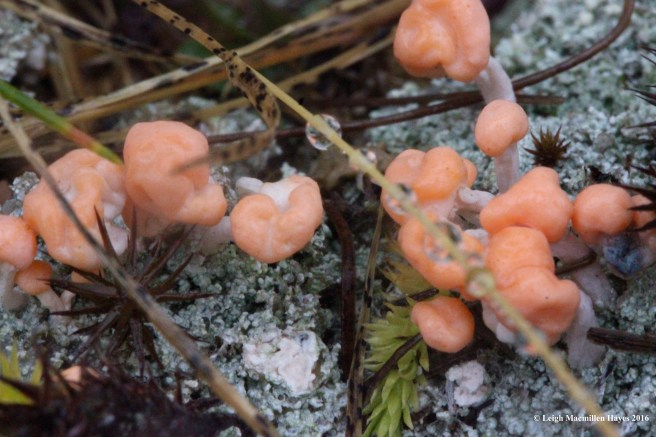
u-candy-2

On a rainy day adventure with the Upper Saco Valley Land Trust in nearby New Hampshire, we paused to admire candy lichen, a crustose (think–flattish or crust-like) lichen with green to bluish-green coloration. Its fruiting bodies, however, are candy-pinkish berets atop stalks, even reflected in the raindrops.

November 6, 2016: Focus on the Forest Foliage
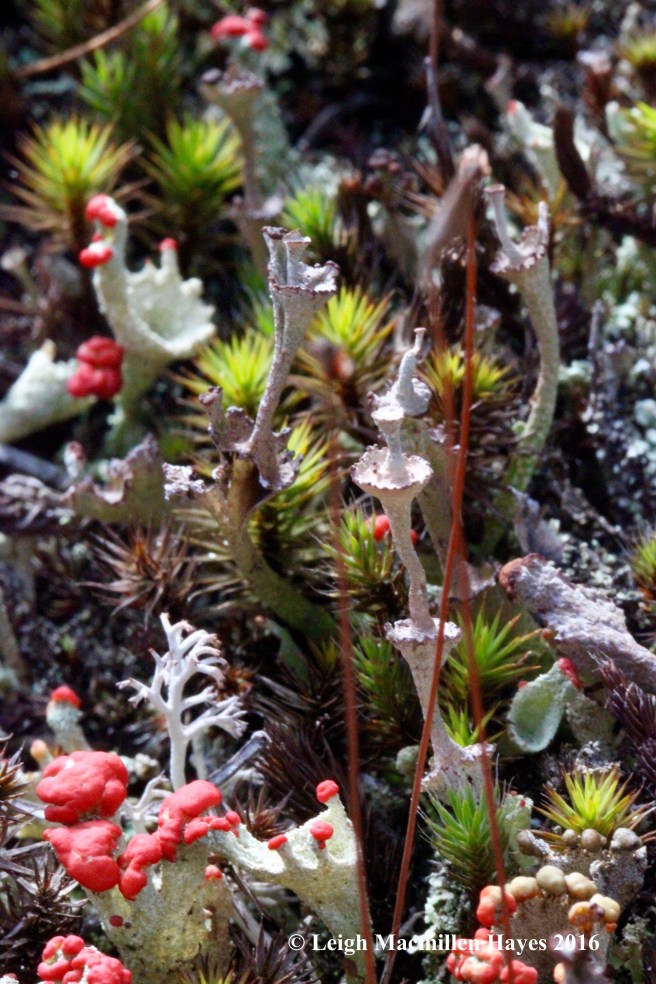
j-lichens-galore

And then . . . and then . . . and then just as our eyes trained on the red caps before us, something else made itself known. We spied another lichen that I’ve only seen once before: Cladonia cervicornis ssp. verticillate.

Its growth formation is rather unique. In one sense, it reminded me of a sombrero, but in another sense, I saw fountains stacked one atop another, each giving forth life in their own unique fashion. But rather than being called Fountain Lichen, its common name is Ladder Lichen–perhaps referring to the fact that the pixies can easily climb up and up and up again.

November 20, 2016: Forever a Student
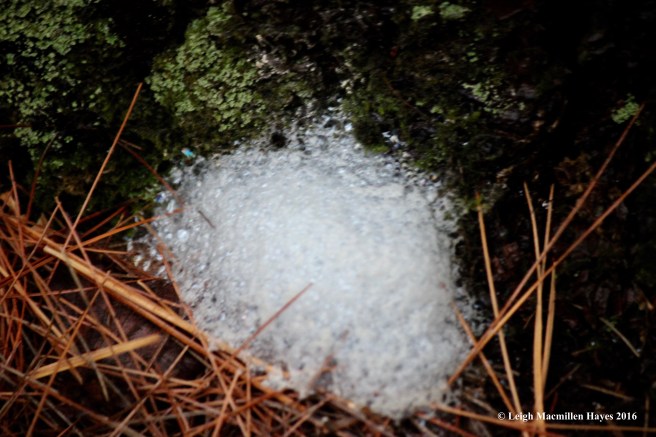
h-pine-suds

A sight I was hoping for presented itself when I returned to our woodlot–froth at the base of a pine tree. It’s not unusual and occurs following a rain event such as we’d had all night and morning. So what causes the tree to froth? Well, like all lessons, there are several possibilities. Maine Master Naturalist Science Advisor Fred Cichocki recently had this to say about it: “I’ve noticed this phenomenon often, and in every case I’ve seen it’s associated with white pine, and always after a dry spell followed by heavy rain. Now, conifers, especially, produce hydrocarbons called terpenes (it’s what gives them their lovely pine, balsam and fir scent). These hydrocarbons are hydrophobic by nature and form immiscible films on water. During a heavy rain, water running down the trunk of a white pine picks up terpenes on the way. Air (having accumulated in bark spaces, channels, etc. perhaps under slight pressure) then “bubbles” through terpene-water films producing a froth. Recall the cleaning products PineSol, and the like. They are made from terpenes, and produce copious bubbles when shaken. One could get the same result directly by shaking terpentine in water, or by bubbling air through a terpentine-water mixture with a straw . . . Of course, it may be that other substances (salts, etc.) enhance the frothing.”

No matter how much I have learned on this life-long course, there’s always more. I certainly don’t have all the answers and for that I am thankful. I’m forever a student.

December 4, 2016: The Art of Nature

s-tree-ring-labyrinth

Some cut stumps reminded me of the circular movement leading toward the center of a labyrinth–appearing quick and easy, and yet providing a time to slow down while following the path.

December 23, 2016: Won’t You Be My Neighbor

m-print

I followed the porcupine trail along his regular route and over the stonewall only to discover prints I’ve never met before. My first impression was raccoon, but the shape of the prints and the trail didn’t match up in my brain. More and more people have mentioned opossum sightings in the past few years, but I’ve only seen one or two–flattened on the road. Today, in our very woods, opossum prints.

January 19, 2017: Keep an Open Mind

o-deer

While I always head out with expectations of what my forest wanderings will offer, I’m happily surprised time and time again with the gifts received.

And so it was the other day when a friend and I happened upon this trophy in an area I’ve only visited a few times. We’d been noting the abundant amount of deer tracks and realized we were between their bedding and feeding areas and then voila–this sweet sight sitting atop the snow. It now adorns a bookcase in my office, a wonder-filled addition to my mini natural history museum. (I’m trying to give Henry, Jessie, Violet, and Benny of the Boxcar Children series a run for their money in creating such a museum.)

January 25, 2017: On the Prowl at Heald and Bradley Ponds Reserve

w-tube-moth-2

Notice how these pine needles are clumped together? What I learned from Mary Holland, author of Naturally Curious,  is that these are tubes or tunnels created by the Pine Tube Moth. Last summer, larvae hatched from eggs deposited on the needles. They used silk to bind the needles together, thus forming a hollow tube. Notice the browned tips–that’s due to the larvae feeding on them. Eventually the overwintering larvae will pupate within the tube and in April when I come back to check on the vernal pool, I need to remember to pay attention, for that’s when they’ll emerge. Two generations occur each year and those that overwinter are the second generation. The good news, says Holland, is that “Pine Tube Moths are not considered a significant pest.” I only found the tubes on two young trees, but suspect there are more to be seen.

February 8, 2017: Embracing the Calm
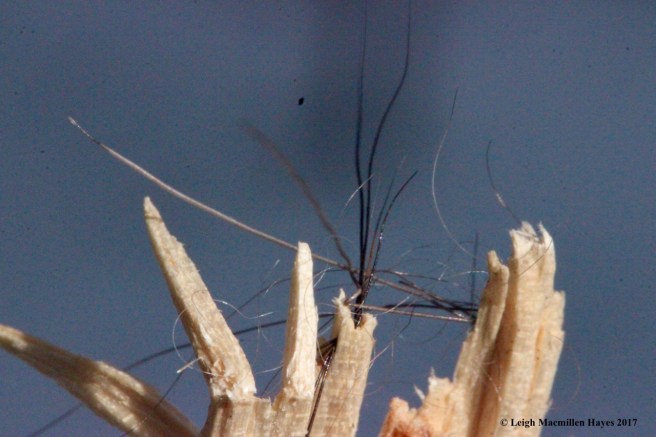
h-moose-hair-2

A bull moose, like a buck deer, thrashes bushes and small saplings when the velvet on its antlers dries. It could be that the velvet itches. But it could also be a response to increasing testosterone and the need to scent mark.

February 16, 2017: When Life Gives You Flakes
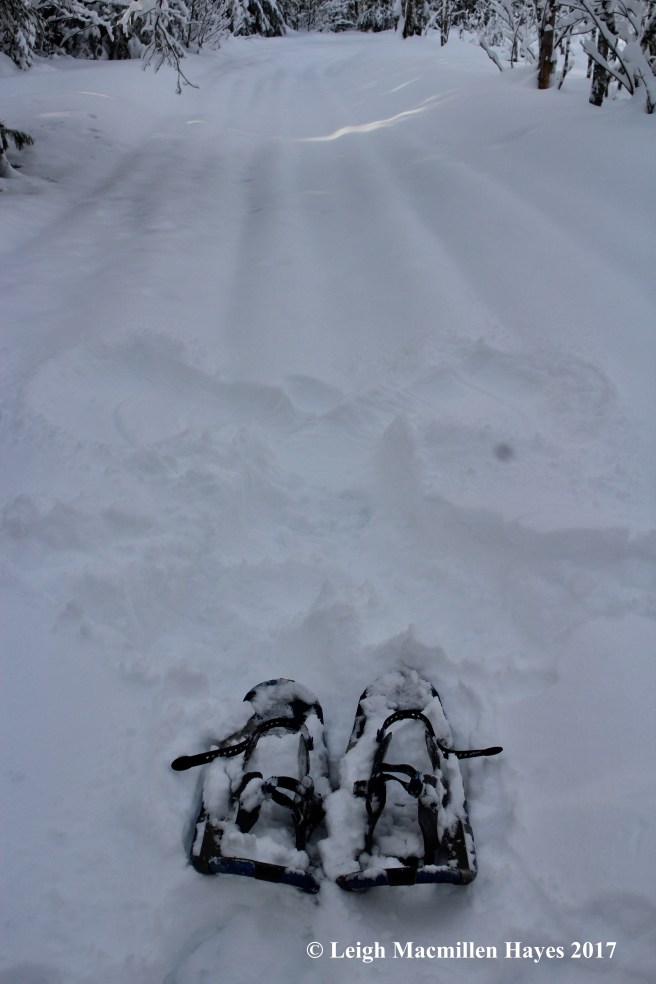
s-snow-angel-in-trail

When life gives you flakes . . . make a snow angel in the middle of the trail.

To all who have read this far, thanks again for taking a trip down memory lane today and sticking with me these past two years. I sincerely hope you’ll continue to share the trail as I wander and wonder–my way.

And to wondermyway.com–Happy Second Anniversary!