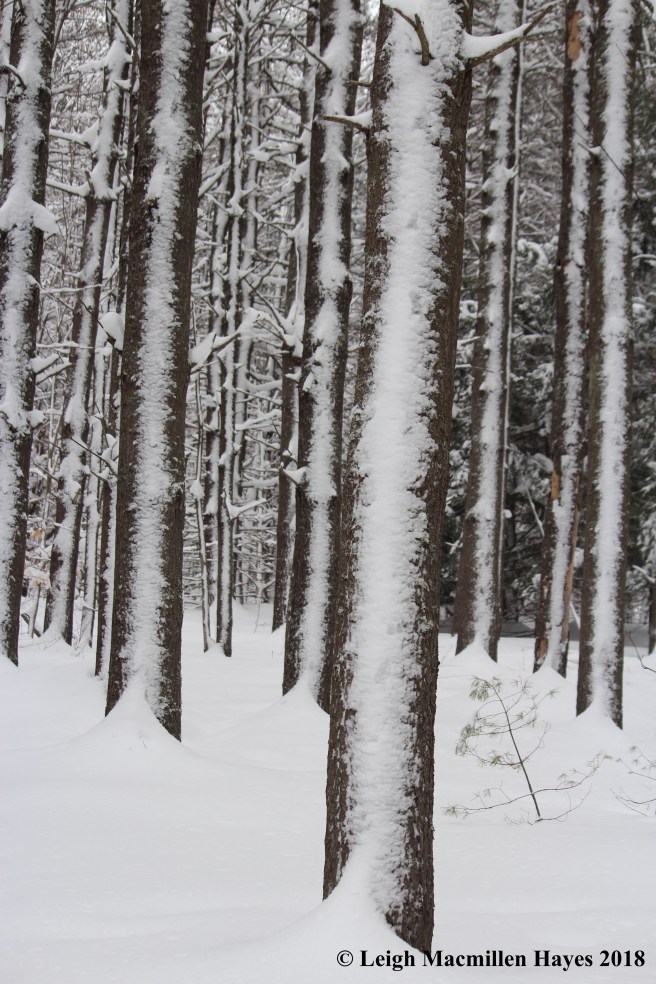
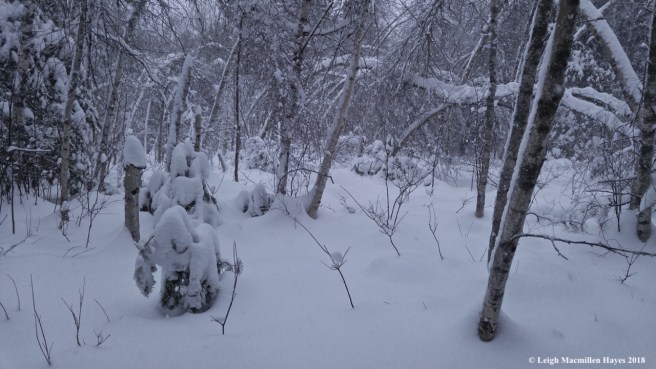
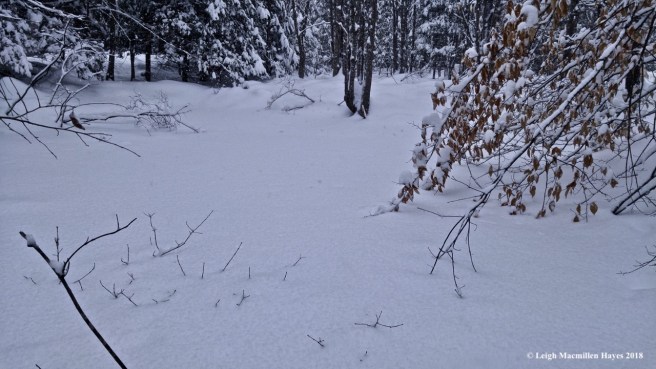
Climbing Higher Mondate

The old adage, “If at first you don’t succeed, try, try again, ” could be aptly applied to the first part of today’s hike for we’d tried to locate the Millard Chandler Feldspar Mine (aka North Star Mine) in Evans Notch two weeks ago but missed a turn along the way. This time, we made sure to pay close attention as friends had given us specific directions.

e1--making the left turn at the National Forest Boundary

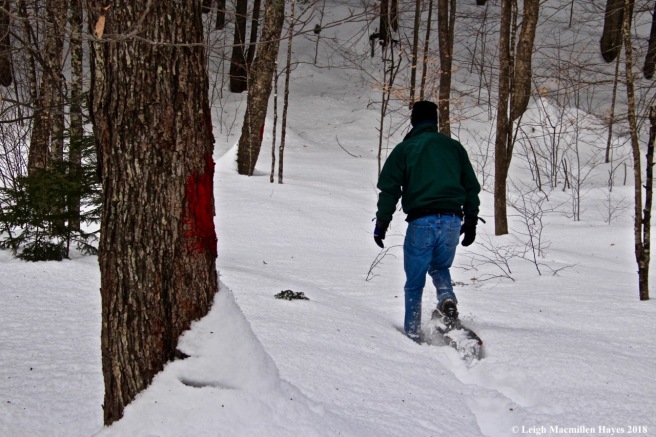
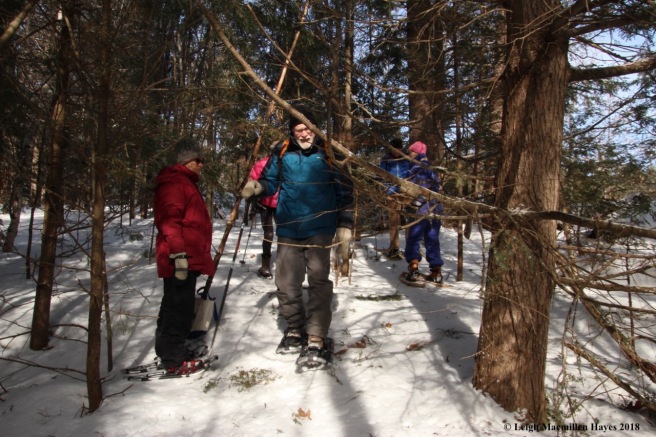
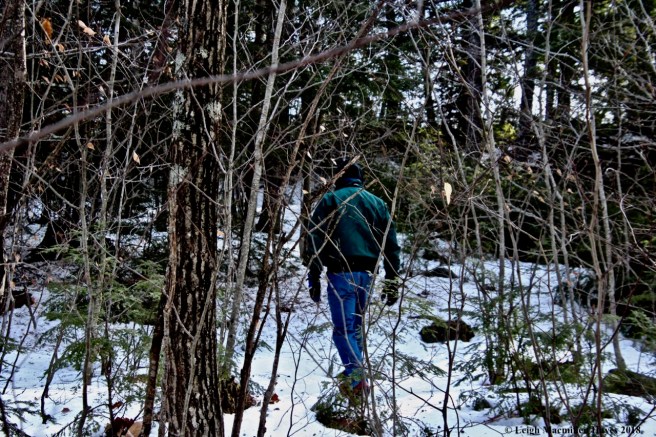
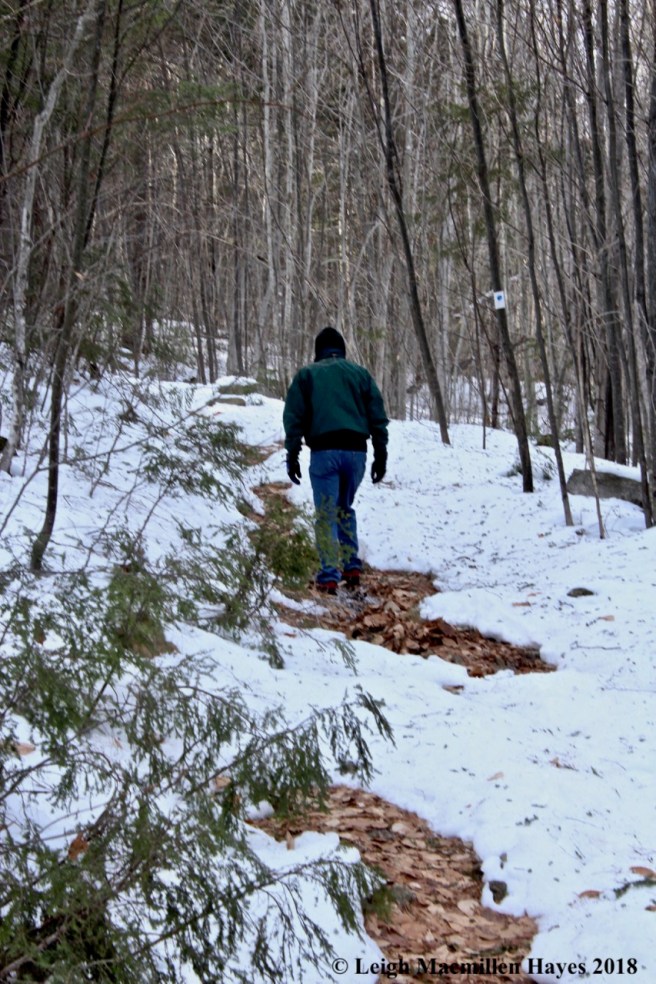
As they’d told us, we remembered to turn left at the National Forest boundary and followed the line to the base of the mountain, breaking trail all the way.

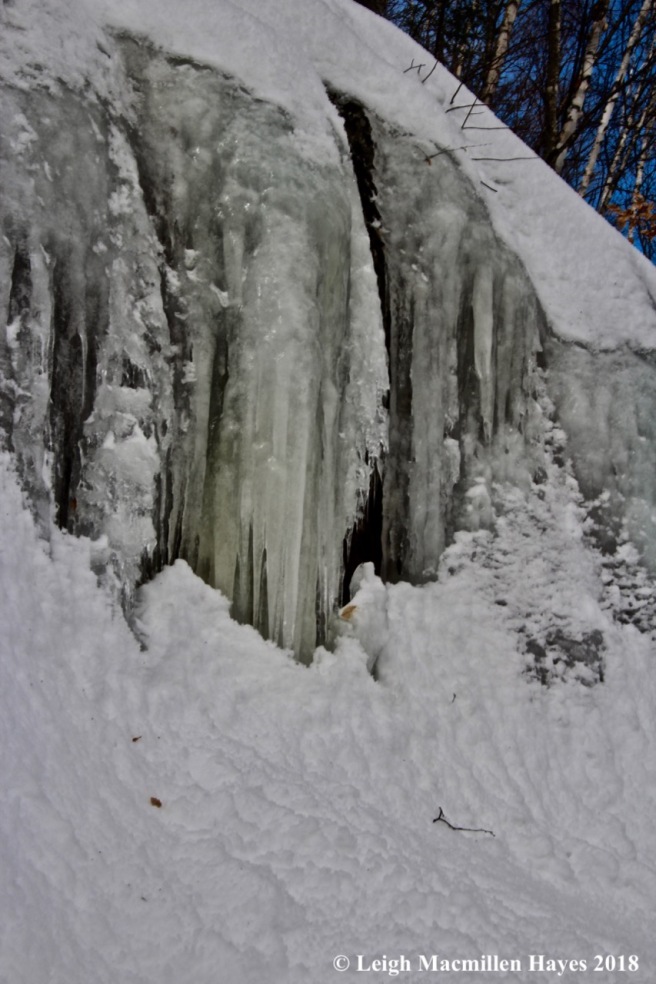
e2-first ice formation

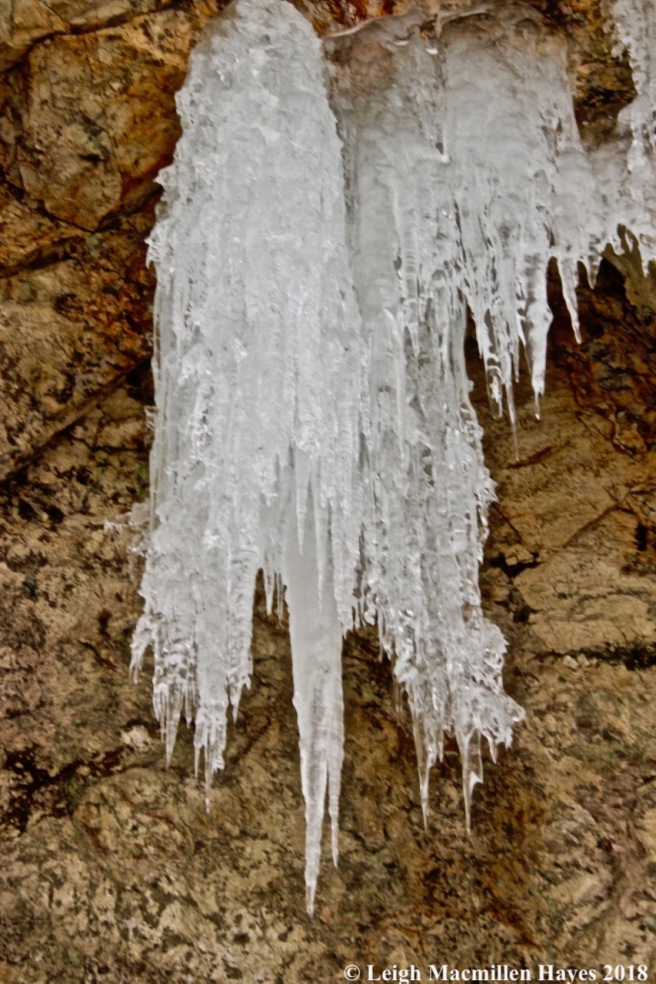
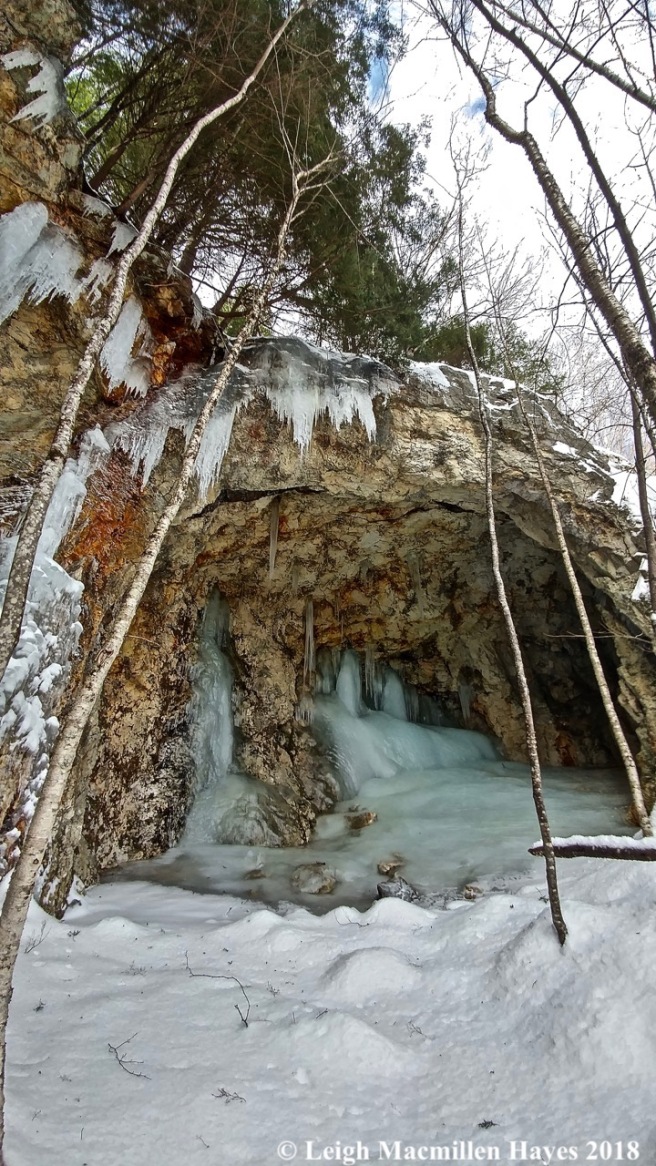
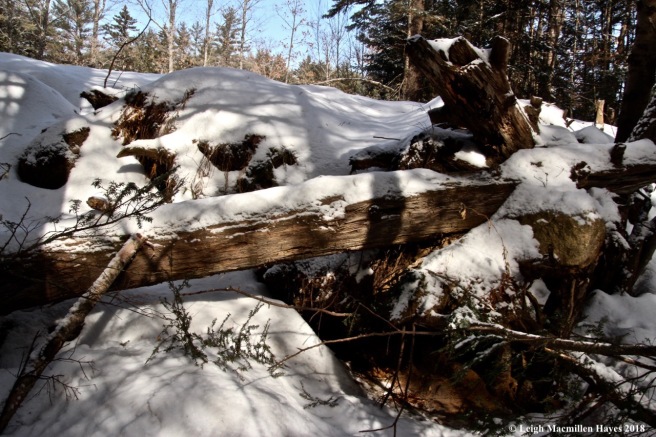
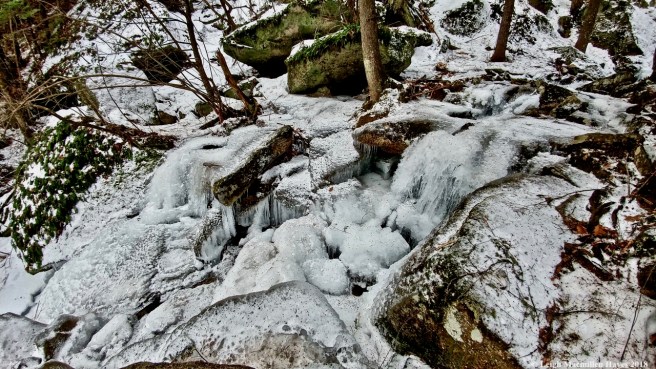
Eventually, we realized we were on an old cart path and followed as it zigzagged up. And then we reached a boulder covered in ice. Don’t get me wrong–I love the relationship of rock and ice, but . . . was this what we’d climbed up to see?

e3-looking for more

My guy peeked around the corner and encouraged me to follow.

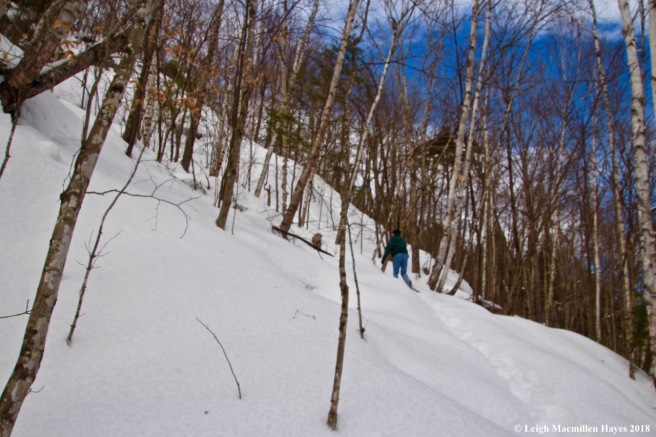
e4-climbing higher

The first rock with ice was a tease and he could see what he thought was the mine up above. And so we climbed higher.

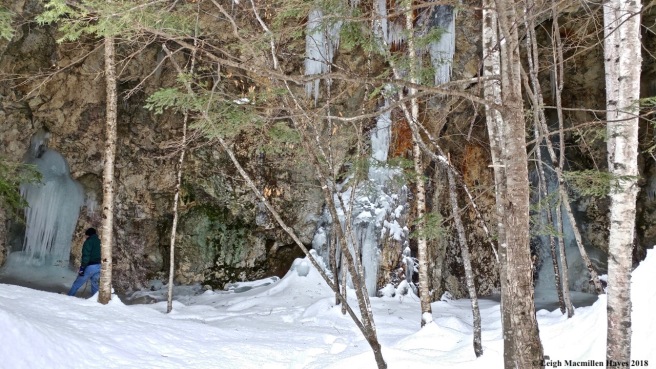
e6-mine 2

Voilà. At last we found the actual mine. Can you see my guy? His height provided perspective.

e7-sense of height

He stood in awe before the fountain of youth frozen in time.

e9-looking upward

My eyes were drawn skyward to the chandeliers that dangled above. My guy did urge me to move out of the way for he feared one might come crashing down.

e14-chandelier

But I took one more photo before heeding his words of caution.

e15-fallen ice

We noted that some had fallen previously and sat like broken glassware upon the mine floor.

e10-icicles up close (snowfleas as well)

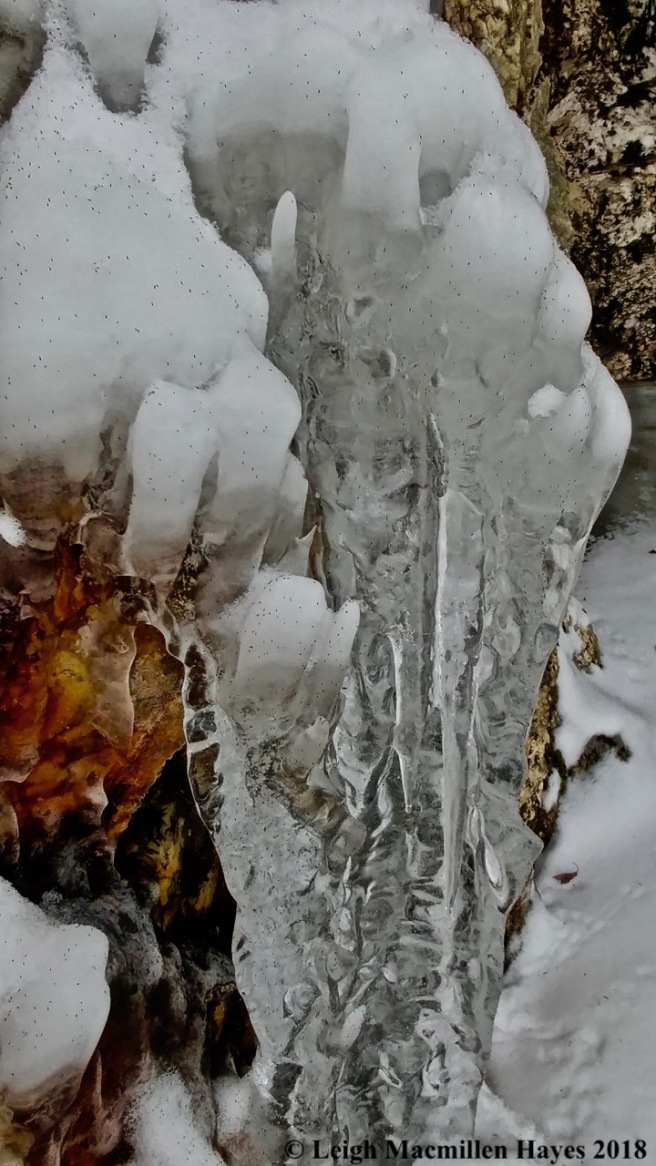
Even the snowfleas or spring tails wanted to be part of the display. Do you see them? The little specks that look like black pepper?

e11-dike 1

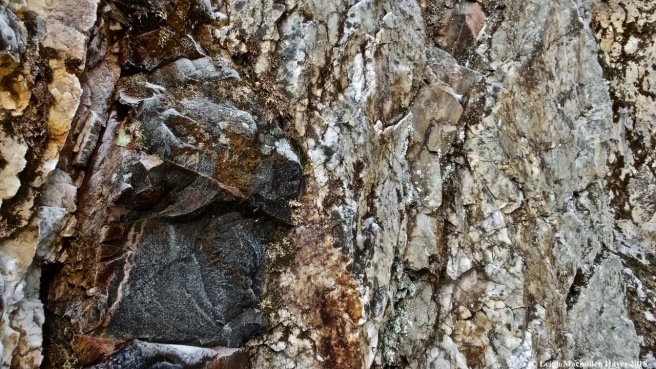
I was so taken with the ice sculptures that I almost forgot about the mine itself. Millard Chandler was a descendent of one of the founding families of Chatham, New Hampshire, where the mine is located. Originally, it was mined for mica. From a Geological Survey Professional Paper, I learned that prior to World War II it was mined for feldspar by the Whitehall Company, Inc.

e12-icicles

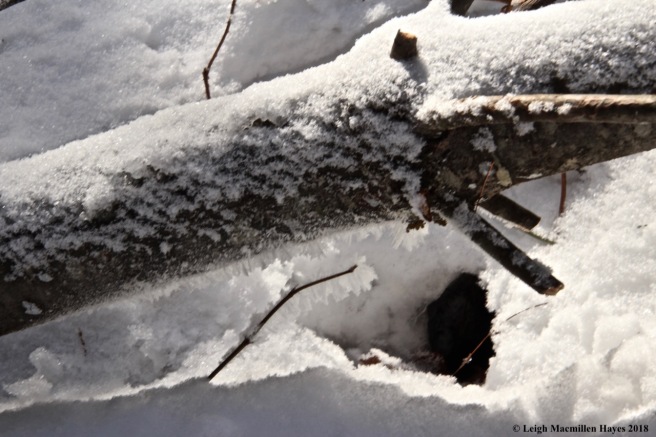
Today, the only mining that took place was initiated by the water and we could hear it trickling under the ice.

e16-christmas fern

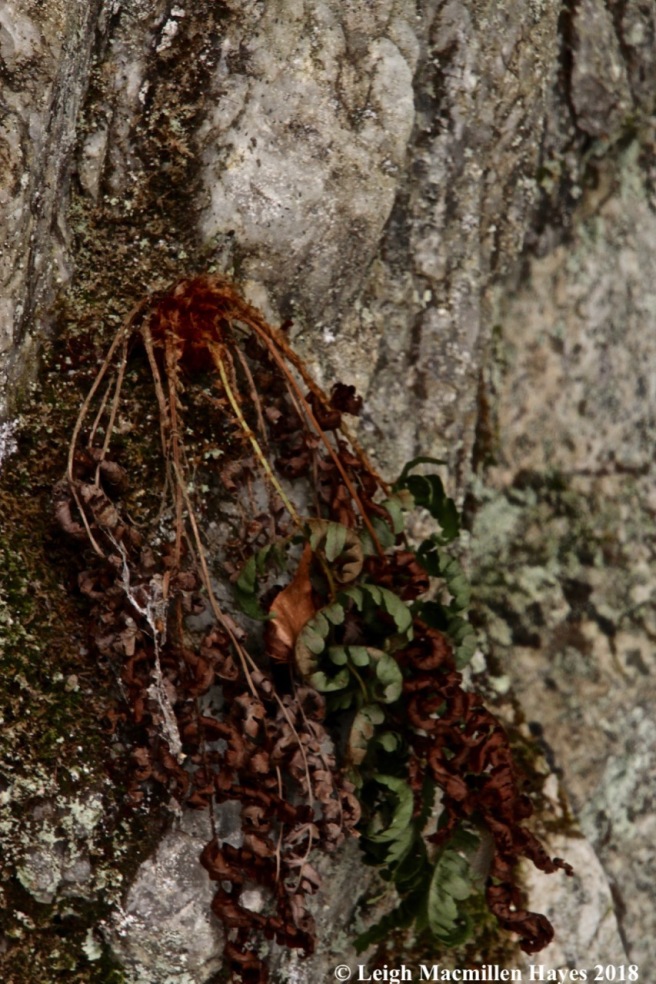
It seemed, however, that there wasn’t enough water as a Christmas Fern struggled to survive.

e13-junco prints

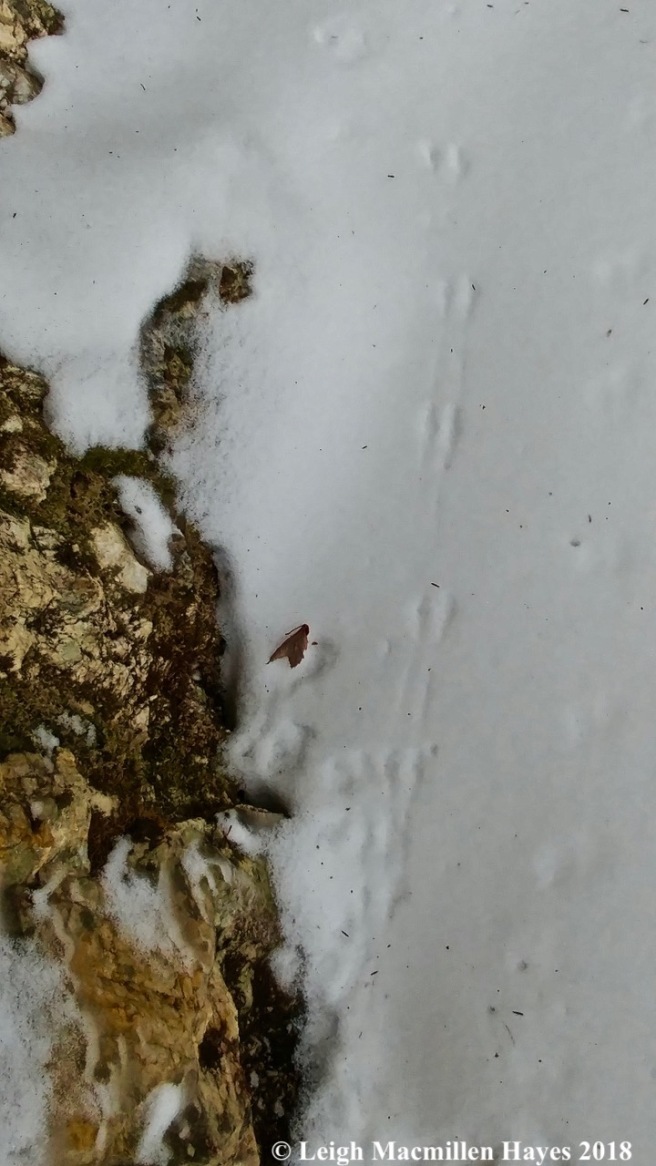
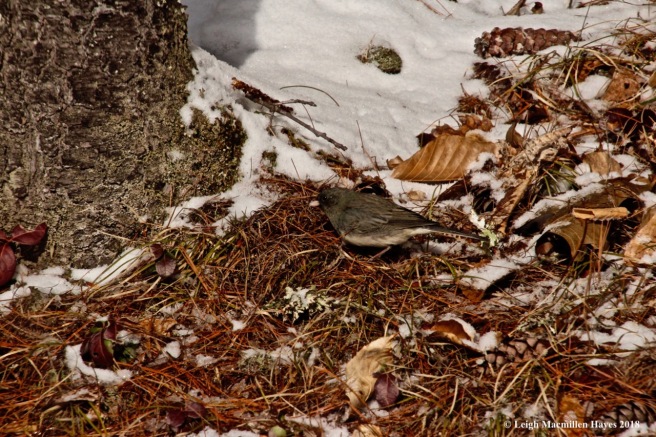
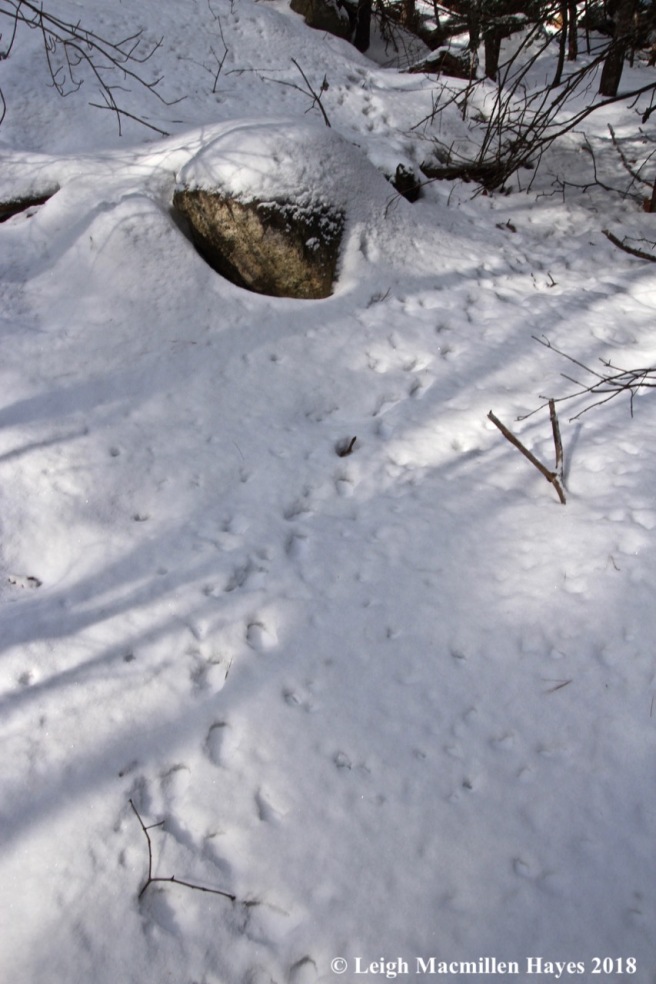
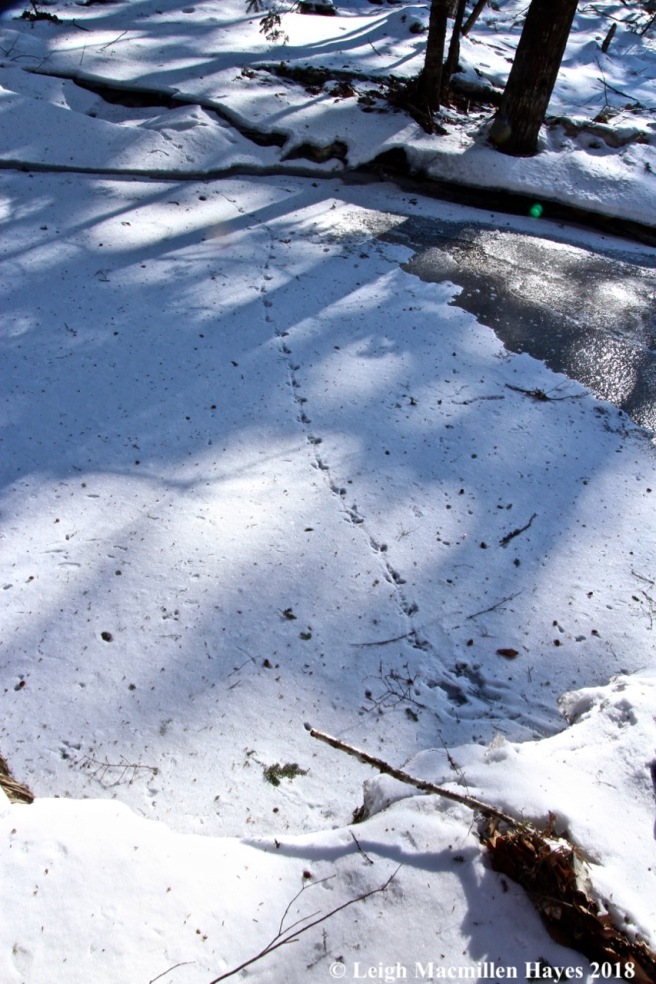
Finally, we followed the Junco tracks and made our exit.

e19-leaving the mine

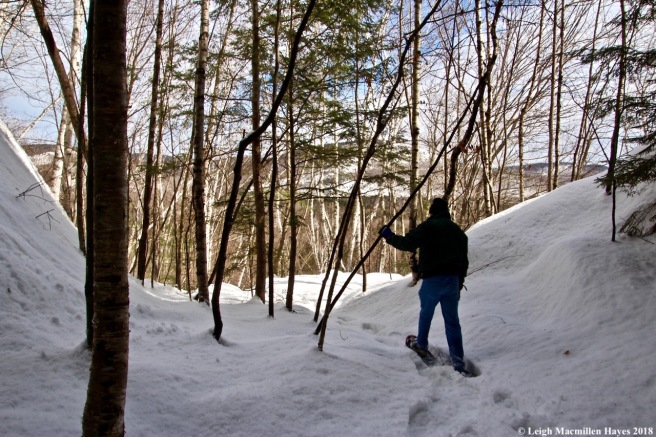
It was almost like a different world awaited us outside the mine.

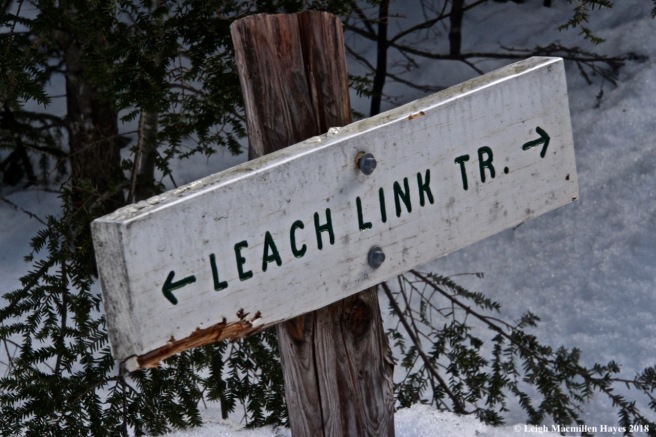
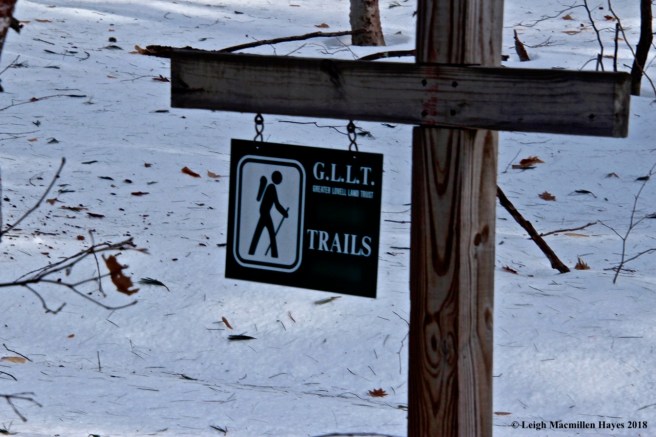
e21-Leach Link Trail sign

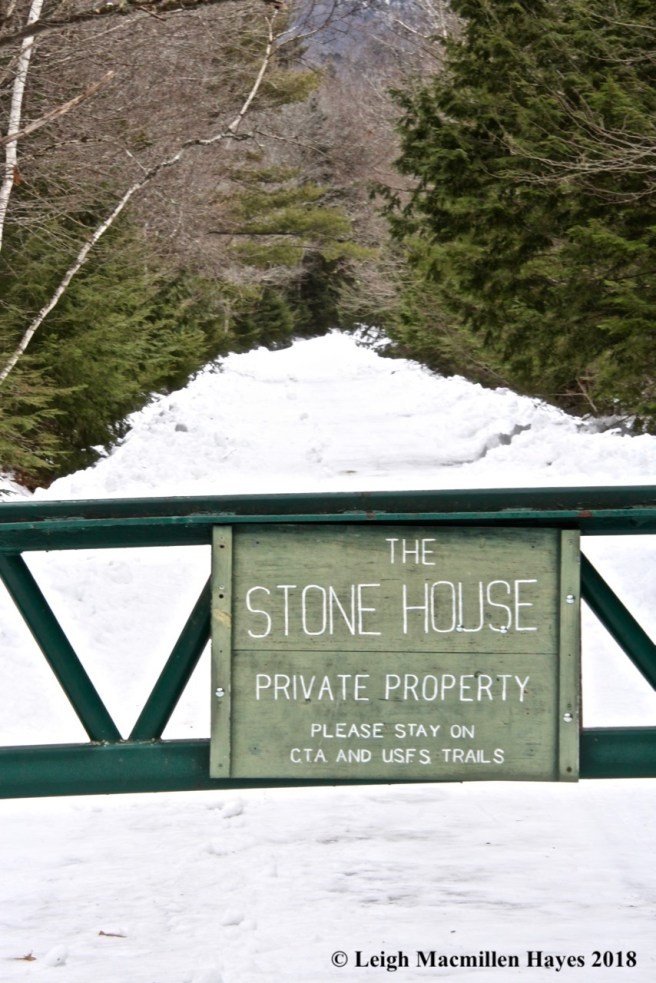
From there we drove back down Route 113 to Stone House Road and ate a quick lunch in my truck before heading to the trailhead for the Leach Link Trail that follows Cold River.

e22-bear claw marks

It seems like every time we visit this area we find evidence of the bears who live here. Notice the nail marks on the sign. Typical behavior for a black bear–to attack something in the woods that is different than the norm. Not only do they like telephone poles, but trail signs often take a beating as well.

e23-hemlock crack

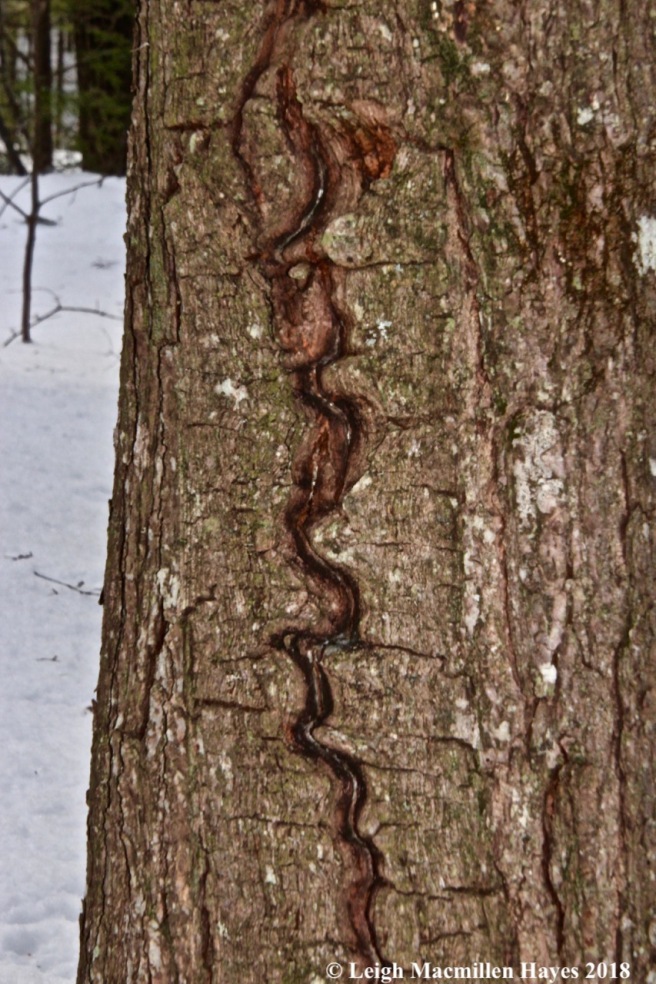
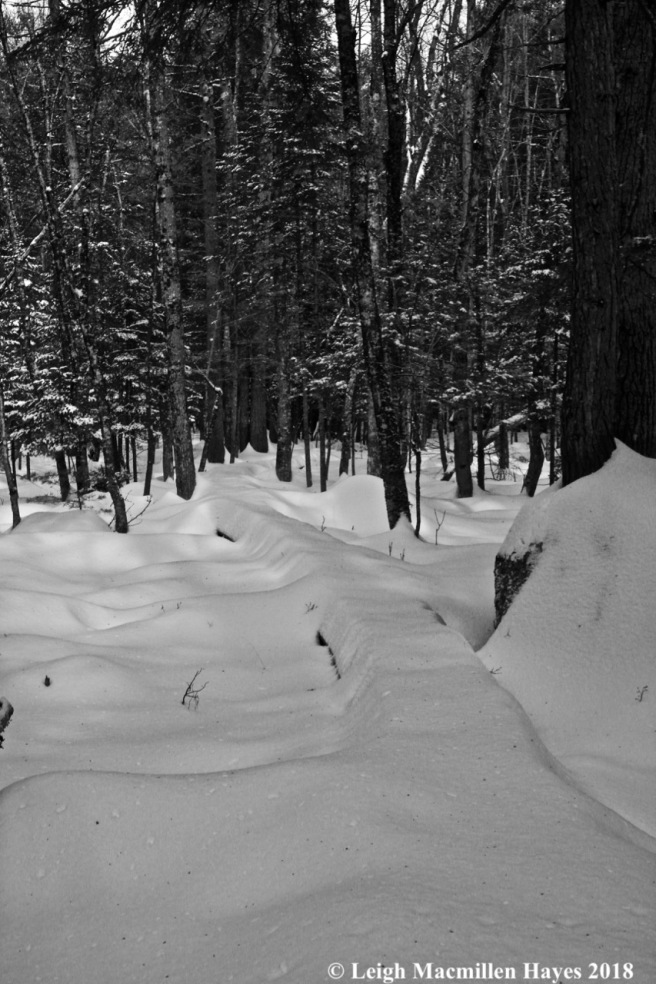
Again, we had to break trail, which we took turns doing because the snow was deep enough to tire us out. For the most part, we passed through a hemlock and spruce forest. I’m always amazed at how a hemlock tree tries to heal a wound left by a frost crack. Just like my snow pants absorb the sun’s heat, the dark bark of the trees also absorb sunlight, but they don’t have a heated home to return to once night falls and temperatures plunge. I understand how the constant thawing/freezing cycle creates cracks–but I don’t understand why the hemlock portrays the squiggly line, while frost cracks on other trees tend to be much straighter. Then again, all tree species have their own patterns and idiosyncrasies. Maybe I just have to accept that this is the way it is. And move on.

e23-snow aprons

We did. But I stopped our forward movement again. Snow had piled high at the base of the trees following the two snowstorms we received this past week. At first, it appeared that the aprons the trees wore were on the north side. But then, in one grove it seemed obvious that my theory had been proven wrong for some aprons faced west and others east. Oh well.

e26-chester dam

Just over a mile later we reached the Chester Memorial Bridge by the AMC camp. The bridge was given in memory of Mabel Chester, one of the camp’s founders.

e27-Cold River flowing south

Cold River flowed south below the dam. And we turned east.

e29-My guy at the summit

We hadn’t intended to, but ended up hiking to the summit of Little Deer Hill. Our visit was short because it was there that the northwest wind slapped our faces and tried to whip off our hats.

e29-Baldfaces

A few photos and then we quickly descended back into the forest, where we couldn’t feel the wind’s force to the same degree. We practically ran as we followed the trail we’d previously carved.

e30-stop ahead

It seemed like time passed quickly as we reached the snowmobile trail once again and saw the sign reminding us to stop ahead. The truck was parked near the trail’s stop sign and our trip was done.

e5-mine 1

We enjoyed the afternoon hike, but as we reflected on our day, it was the mine that will stand out most in our minds. Thanks to Linda, Miriam, and Dave for providing us with the incentive to visit and correcting our directions.

Climbing higher on this Mondate was certainly worth it.


Make Your Own Impressions

A couple of us were honored this morning to share the trail with ten homeschooled kids ranging in age from about four to teenagers. There was even a babe in his mom’s arms, but he choose to sleep through most of our journey as we looked for tracks at Western Foothills Land Trust’s Shepard’s Farm Preserve.

s1-into shepard's farm family preserve

I was wowed by these kids for their knowledge about the natural world was impressive. It was obvious that they’ve spent a lot of time outside not only due to all they had observed and the stories they told me, but also because it was quite cold and they never complained.

s2-the bog and deer tracks

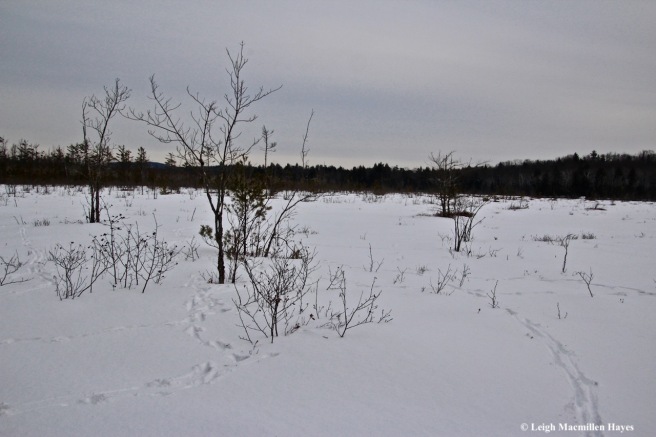
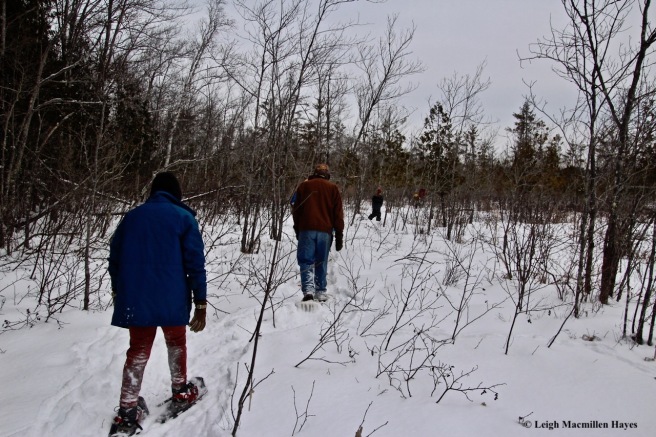
Through a mixed forest and into the bog we searched for and followed tracks–of mice and deer.

s3-into the bog

We so wanted to see those left behind by a predator and thought for sure we would since the deer tracks were plentiful, but today that wasn’t meant to be. We did find where the deer had browsed, peed, scatted and slept.

s4-curious kids

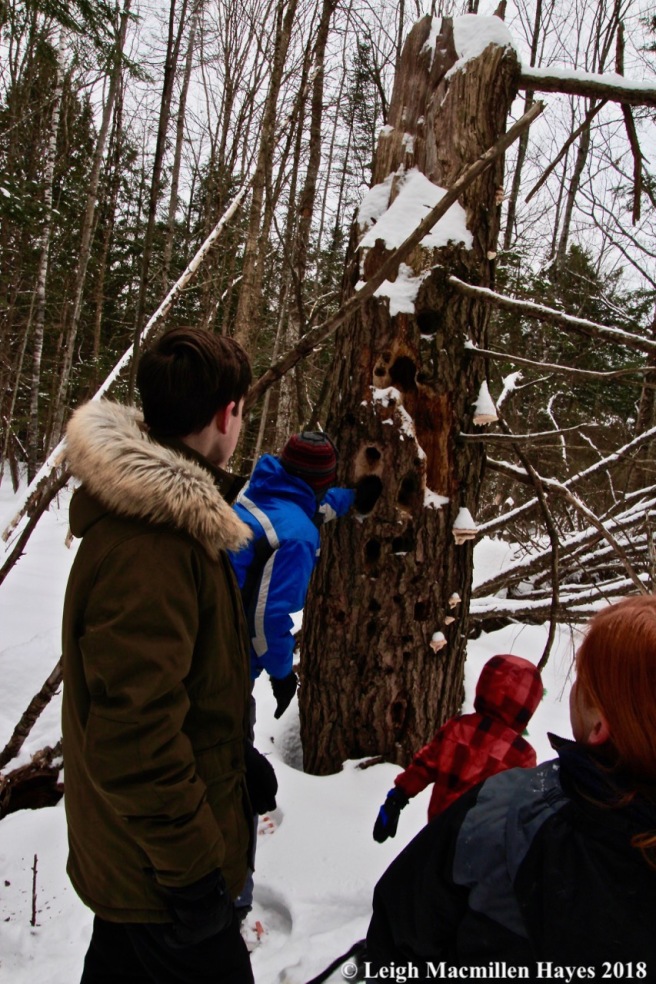
The kids’ curiosity was for more than just tracks and so we stood in awe of a pileated woodpecker tree.

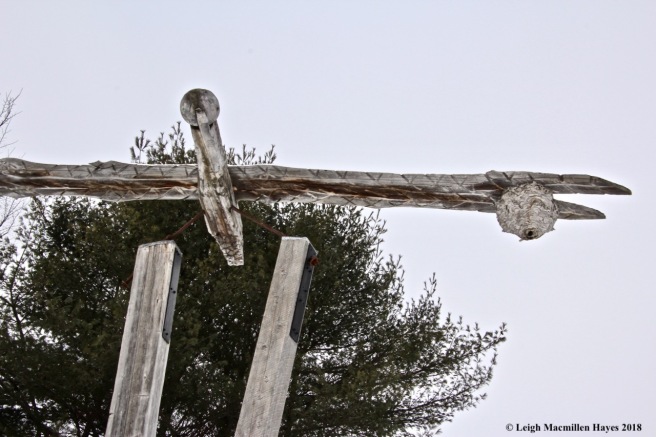
s8-hornet's nest

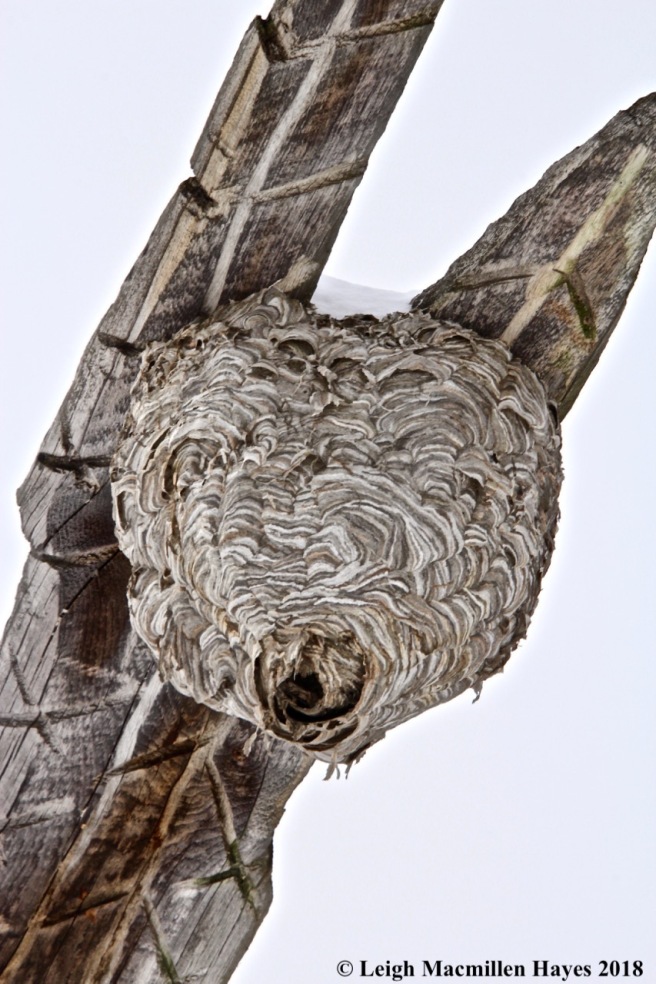
And a hornet’s nest.

s9-hornest nest in flight

The nest was flying high–on the underwing of a bird sculpture–reminiscent of a certain Tesla Roadster on a rocket.

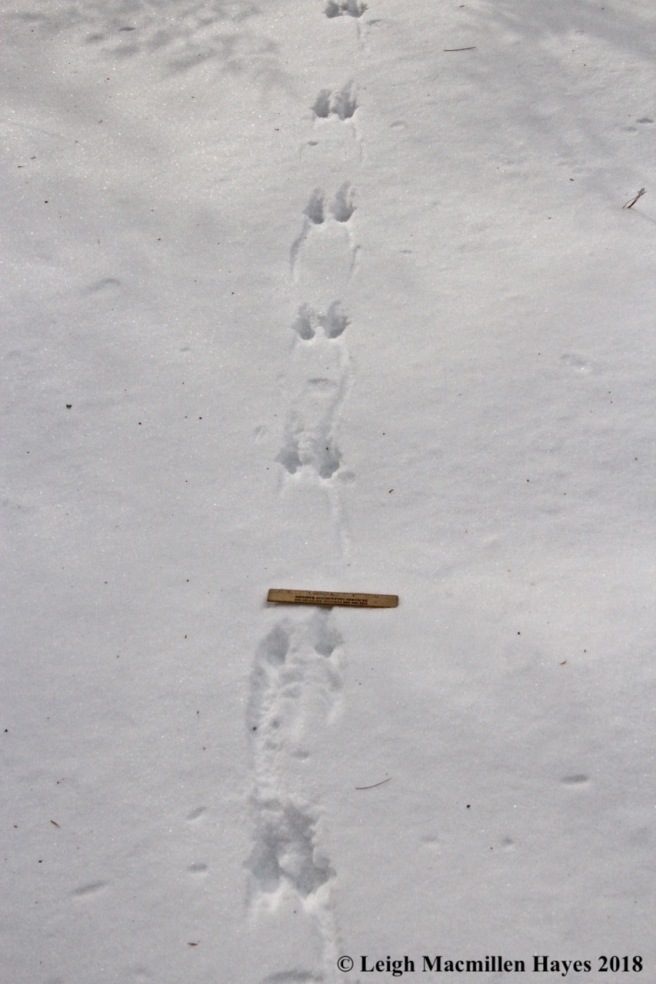
s10-flying squirrel tracks

After showing them some plaster casts of prints and my scat collection back in the parking lot, we said our goodbyes and I drove on to meet my friend, Jinny Mae.

Not long into our time together, we squealed with delight when we thought we’d made a new discovery. We found squirrel tracks that started about ten feet from any tree and as we looked at the overall pattern we noticed that there were arced lines between the sets of prints that appeared different from the lines behind the sets that we typically encounter. Our brains and hearts worked in unison and we determined that we’d found a trail left behind by a flying squirrel. It was a first for both of us. But . . . as we continued on we began to question our conclusion and we switched back to red squirrel. I don’t know. What I do know is that it was a squirrel. And maybe that’s enough.

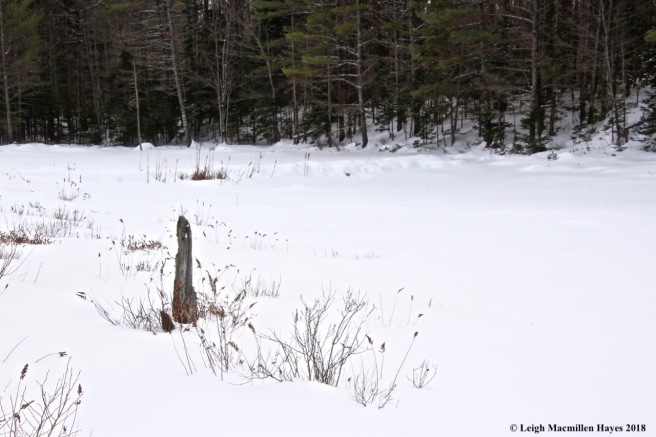
s13-beaver dam

We made our way to a beaver pond, again hopeful for interesting tracks, but our best finds were squirrel and mice. Oh, and a domestic dog and its skiing partner.

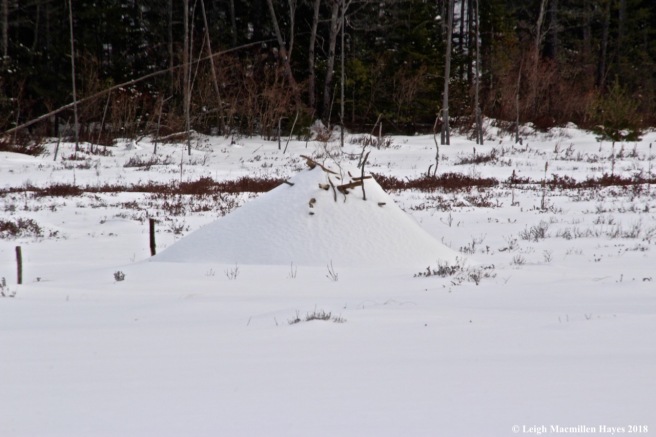
s22-beaver lodge

We did spy a lodge that we thought might be active, but didn’t risk the journey to check on it for we found ourselves sinking deeper than our comfort zone.

s12-steeple bush gone awry

As we made our way off of the pond, a steeple bush came to our attention–its erect structure gone awry. Uh oh. Had it done something wrong?

s14-pileated woodpecker

And then we heard a pileated woodpecker that we finally spied on a distant tree. Though we both have the good fortune to see them often, we were still thrilled and amazed at its size.

s15-brook

Our next stop was beside the brook that flows out of the pond. I was with Jinny Mae so it was no surprise that we stood for a long time, listening and admiring.

s17-ice

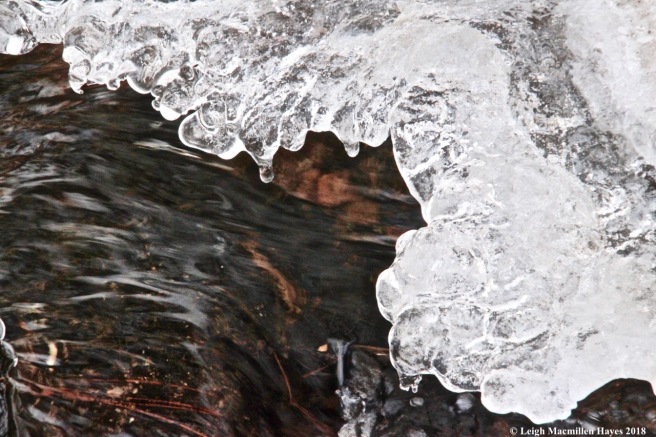
Ice and water always fill us with wonder . . .

s23-ice 3

and awe.

s20-shadows

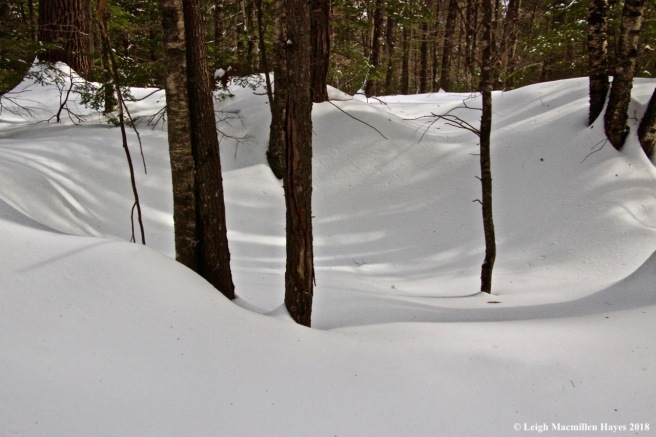
Shadows and textures do as well.

s19-lungwort

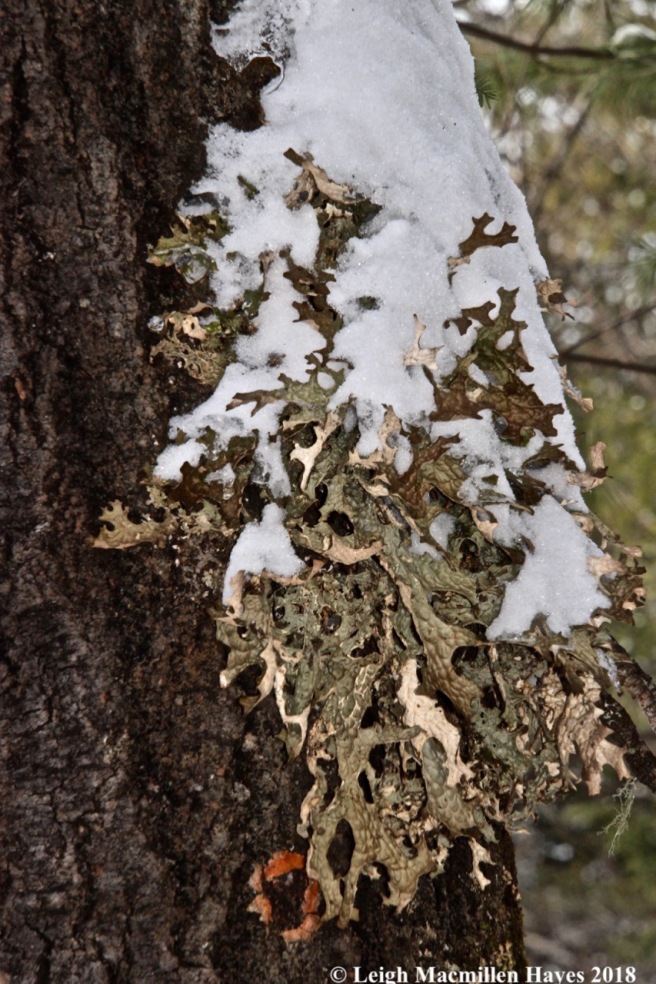
And not to be left out, lungwort.

s5-creating a snow angel

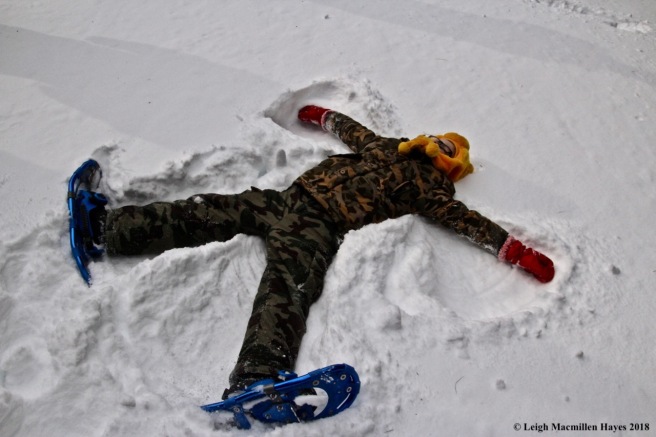
The tracking wasn’t so great, but at the end of the day we’d all delighted in the discoveries and questions and understandings and connections we’d made. And the fun we’d had in doing so.

s7-snow angel

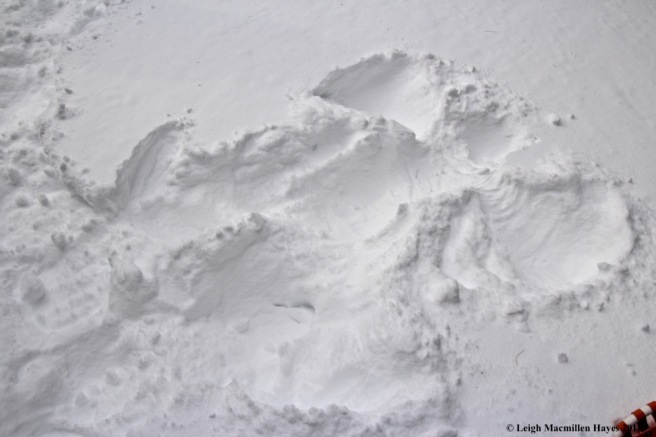
When life gives you snow–make your own impressions.

Hardly Monochrome

My world always takes on a different look following a storm and today was no different. Yesterday we were graced with a foot of fluffy snow. And so it was with joy that I strapped on my snowshoes.

p1-window art

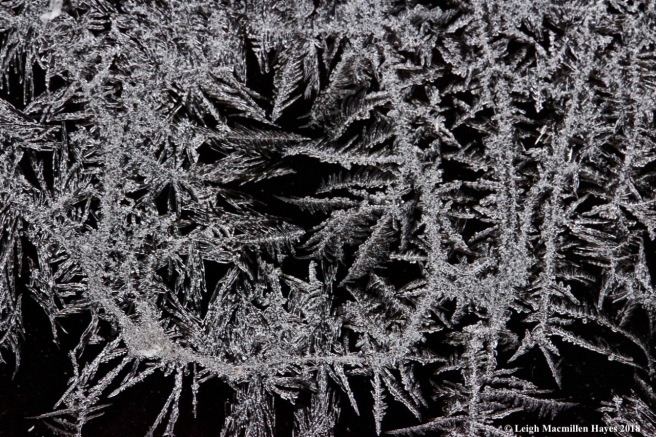
As I passed by the barn, I noted fresh porcupine tracks, but it was a window on the attached shed that drew my awe. I’ve seen the frost resemble ferns, flowers and trees before, but today’s display reminded me of moss.

p2-stonewall

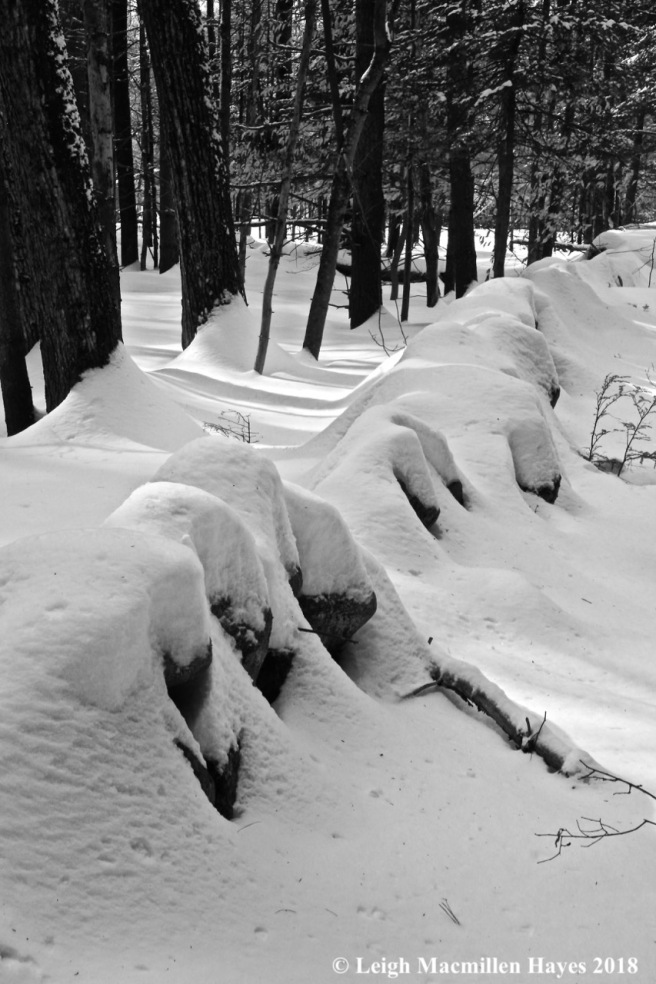
Marshmallows seemed to have capped the stonewall along the cow path.

p3-hairy woodpecker

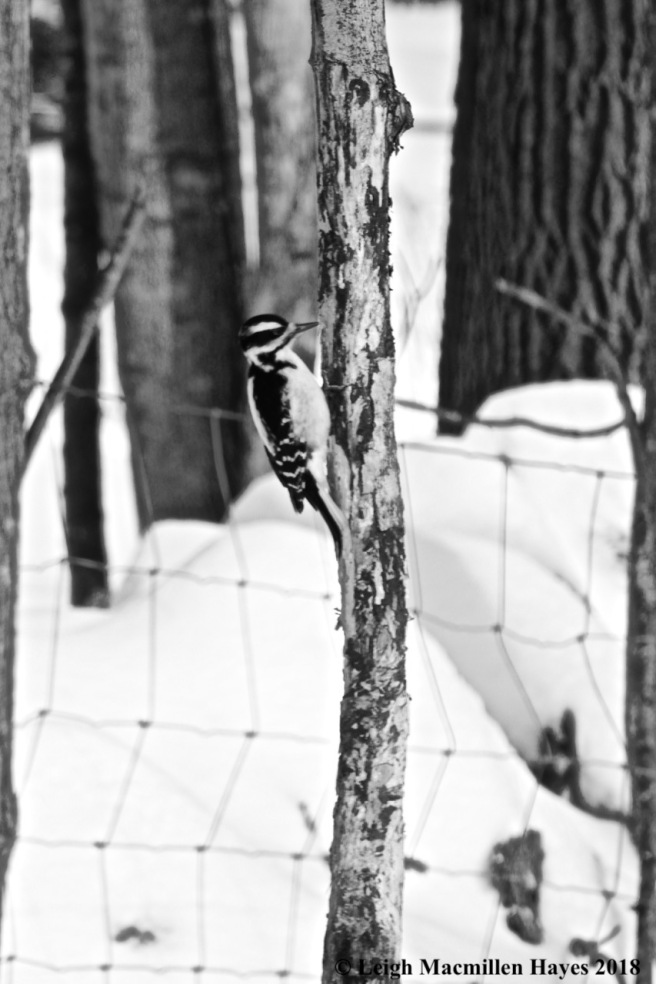
Into Pondicherry Park I headed and immediately was greeted by the sound of a hairy woodpecker chiseling away.

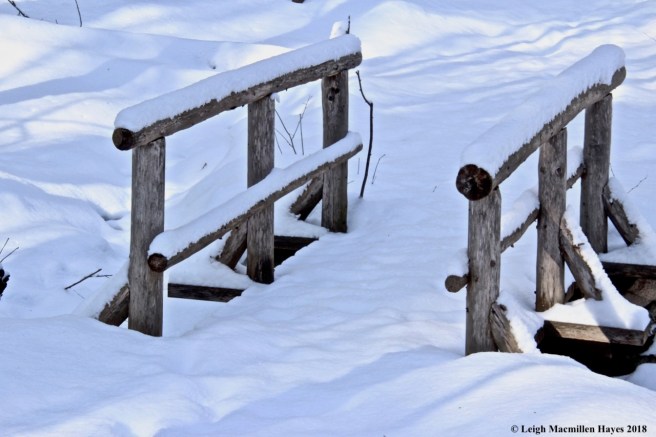
p4-bridge

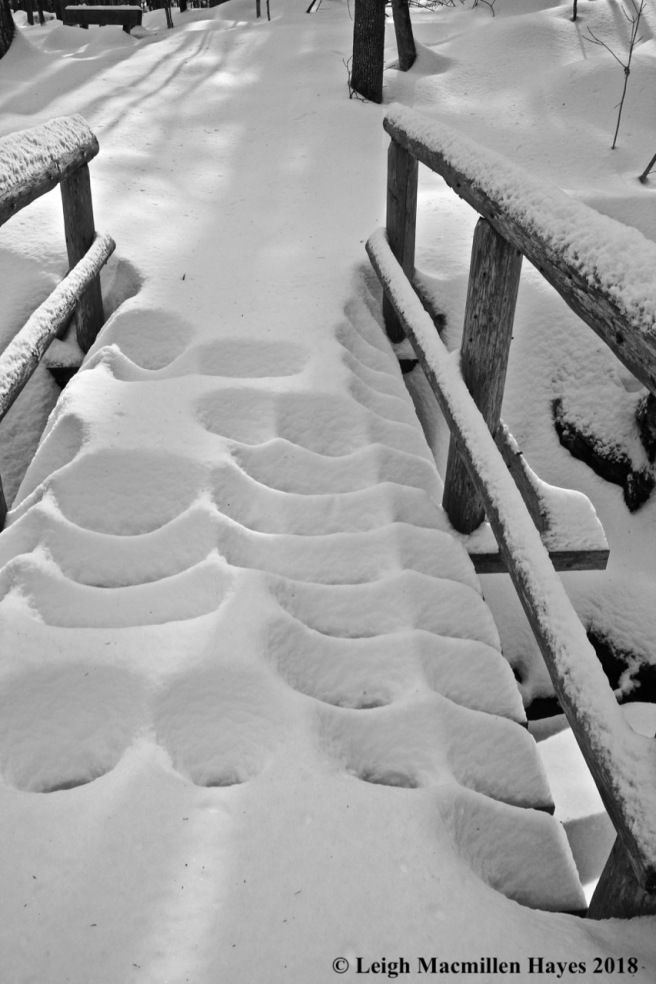
The park receives a lot of visitors each year, but on this day I was tickled to be the first to make tracks.

p6-vehicle

My goal was to join others at Lakes Environmental Association’s Maine Lake Science Center for a tramp along the Pinehaven Trail, but we decided to go off trail at times to see what we might see.

p7-Anne and Alanna

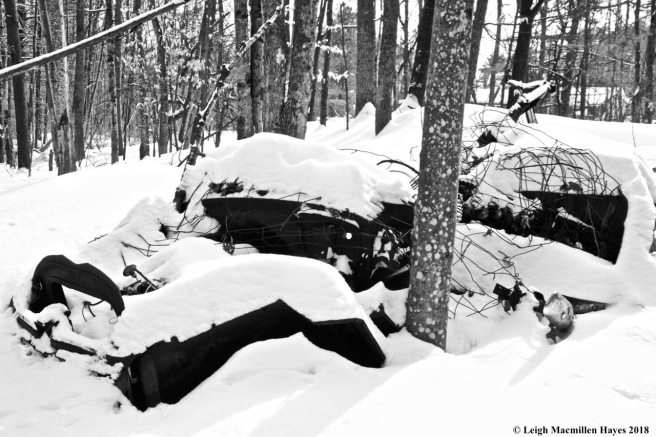
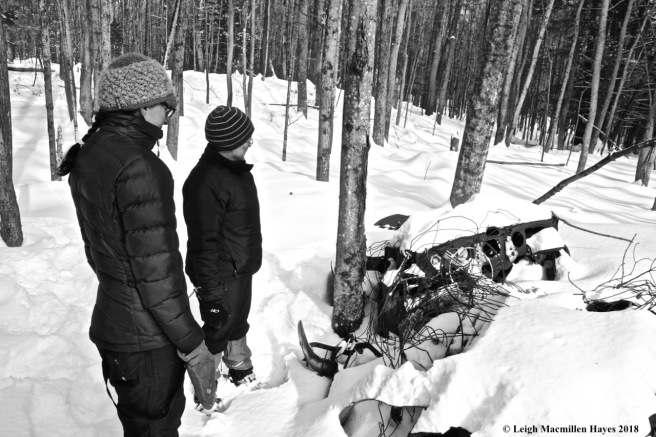
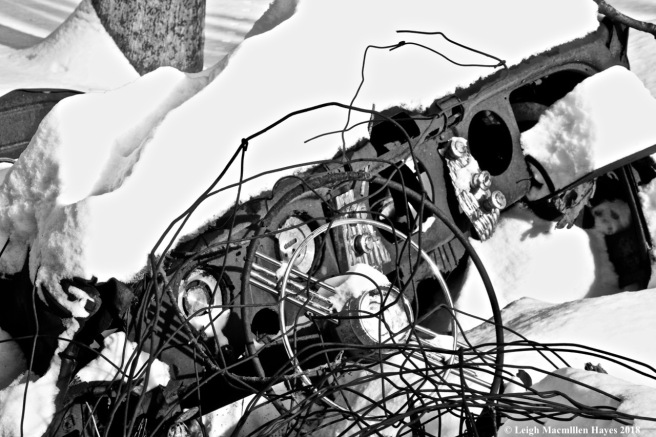
I had the extreme pleasure of exploring with these two fine women, Alanna, LEA’s education director, and Anne, chair of LEA’s environmental education advisory committee. So we wondered about this vehicle. Its age. How and why it ended up where it was. We had no answers, but the squirrels and mice didn’t seem to mind its presence for their tracks led in and out. We did note some tangled fencing added to the mix.

p8-fencing

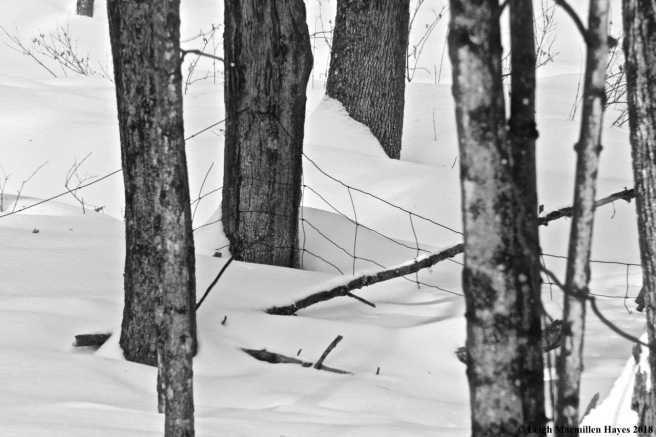
But it made sense because we were on land formerly used for farming and Alanna pointed out a section of fencing that a tree had embraced behind us.

p9-steering wheel and radio

We were busy chatting, but had we paused, perhaps we would have heard tunes pouring forth from the radio. Then again . . . maybe not.

p10-boardwalk

I spent an hour with them and then departed via the boardwalk below the science center building. It’s one of my favorite places.

p12-polypody fern

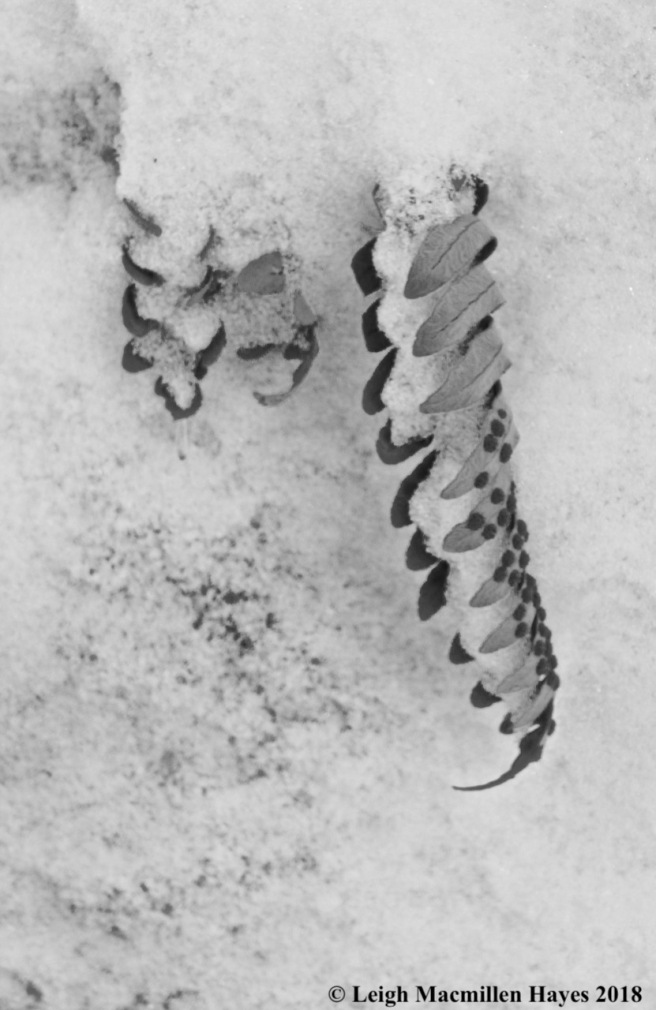
And no venture forth is complete without stopping to admire the polypody fern that dangles from a boulder, curled up as it was because of the cool temps.

p13-mossman surrenders

A wee bit further I almost passed by Moss Monster for he was hiding under his winter blanket and all that showed forth was a small balsam held tightly in his hand. I wished him sweet dreams until we meet again.

p13-tinderconk

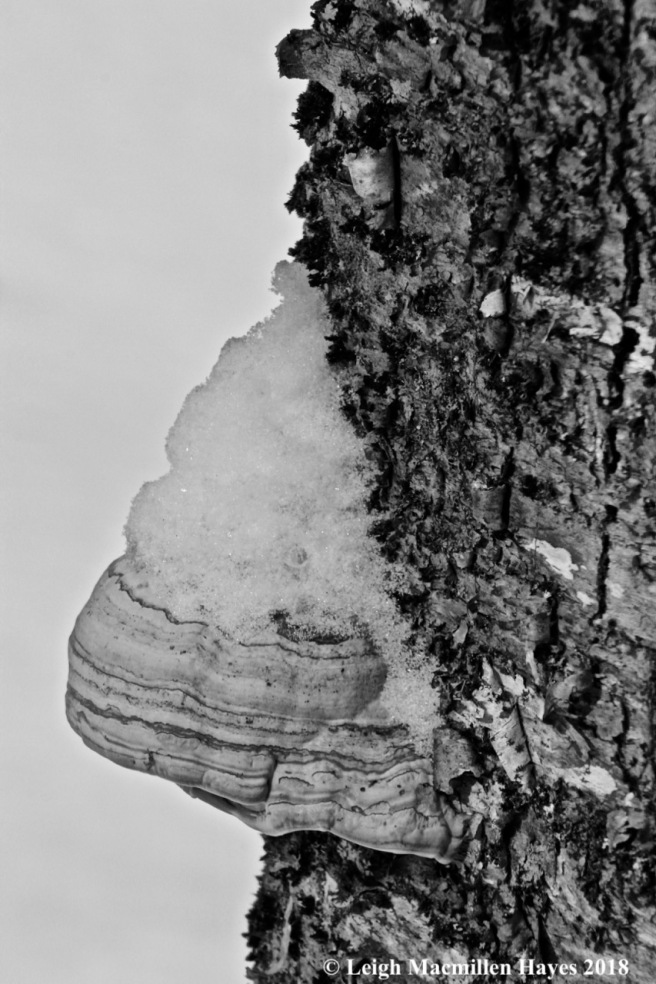
Just as I moved from the boardwalk back into Pondicherry Park, I spied several tinder conks upon a yellow birch, their lines reminding me of oyster shells and a yearning I’ve had recently to spend some time at the ocean surfaced again. I love the woods, but do need that salt air fix every once in a while.

p14-Owl?

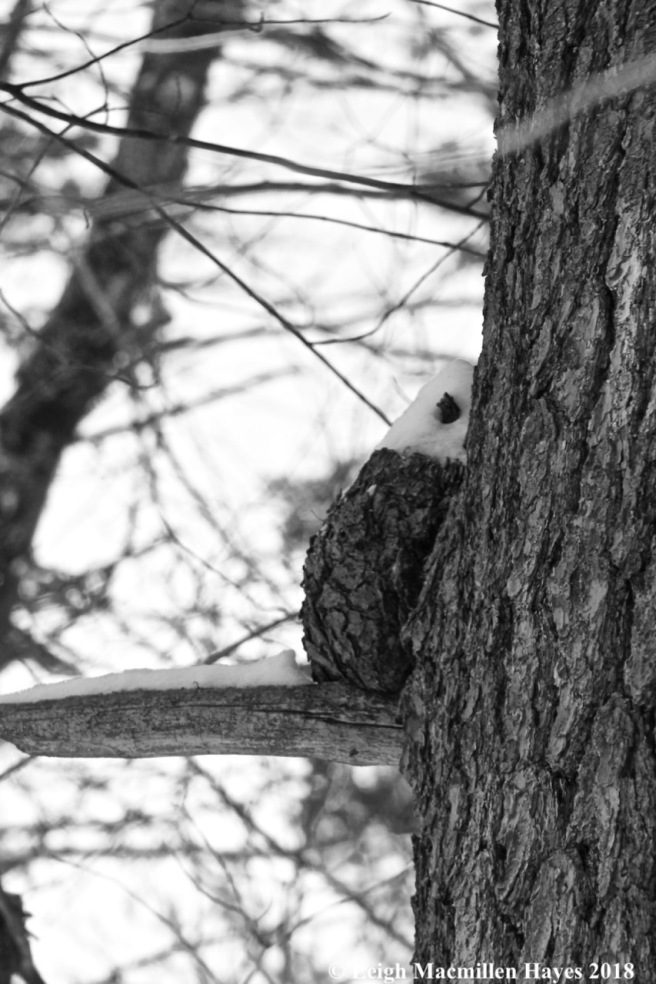
Slowly, I made my way beside Willet Brook and then Stevens Brook–looking about to see what I might see. And then I stopped. Could it be? Nope. As much as I wanted to spy an owl, all I found was a burl topped with snow upon a white pine trunk. It sure looked like a bird sitting on a branch. Wishful thinking.

p14-male mallards

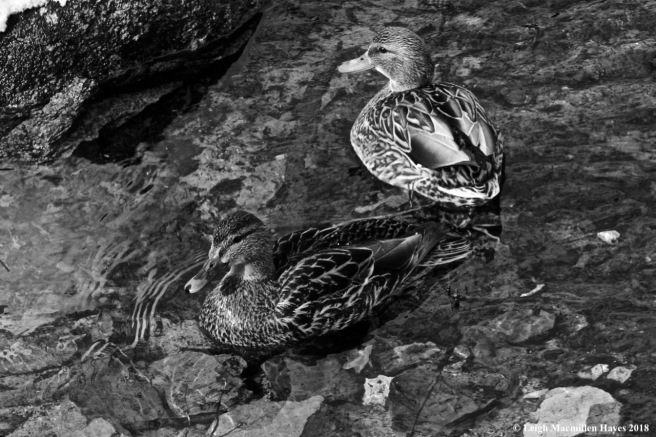
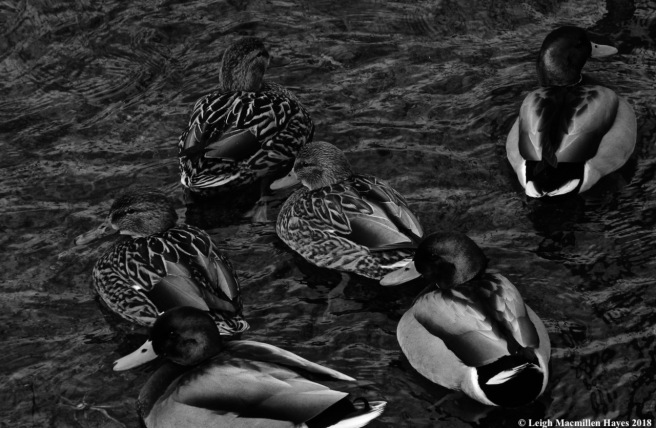
I did find other birds, though, in the form of mallards.

p15-male:female mallards

There were plenty of them and I could have watched all day as they treaded water and occasionally nipped each other or gave chase.

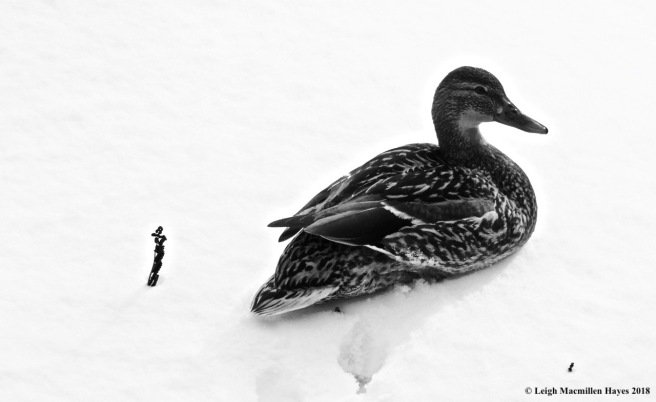
p16-male mallard on snow

One handsome guy moved onto a snow bank and appeared to smile over his companions for a few minutes–king of the hill.

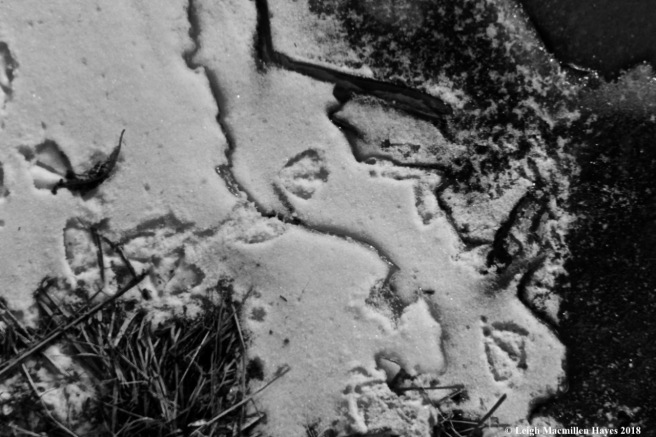
p17--duck prints

And then they all moved off, but left behind their prints–just for me ;-)

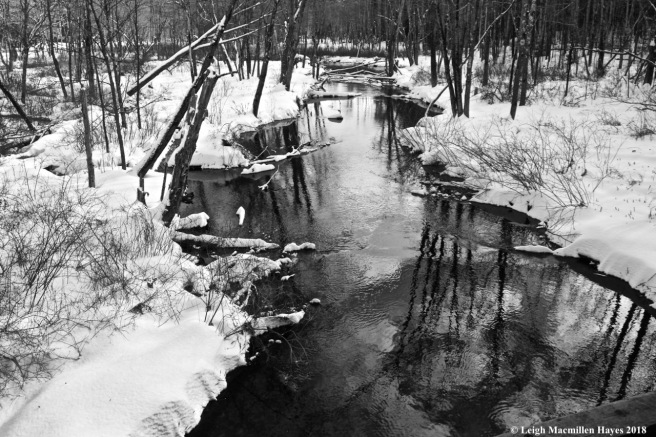
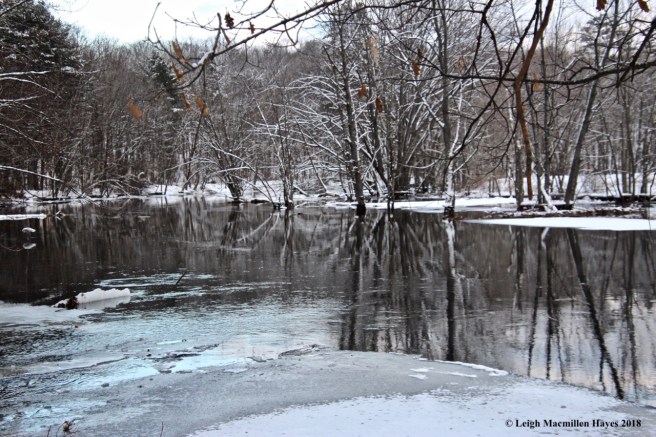
p18-Stevens Brook

My lunch break miraculously turned into a three hour tour that I chose to illustrate in black and white, with shades of gray in between. It was a lovely day enhanced by all that snow. And hardly monochromatic.

Satiating Our Curiosity at Long Meadow Brook Reserve

Two weeks ago I traveled the trail at the Greater Lovell Land Trust’s Long Meadow Brook with several friends and much of our wonder was captured by intermingling lines.

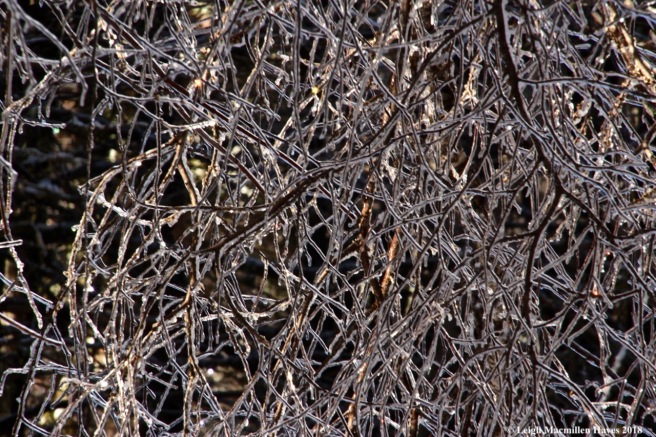
l-ice lines

All felt quite magical on that crisp January day as the encrusted twigs and buds offered a brilliant display.

l-snowbirds in the ice castle

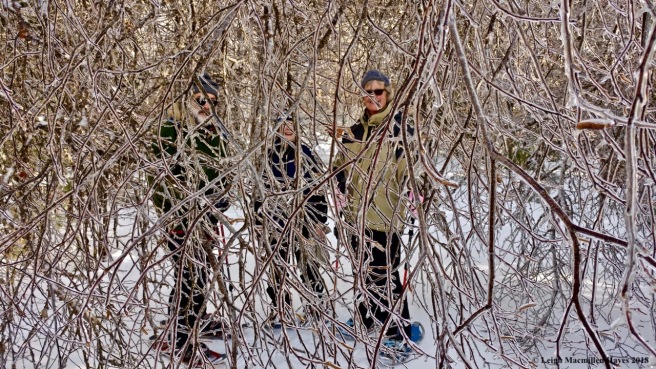
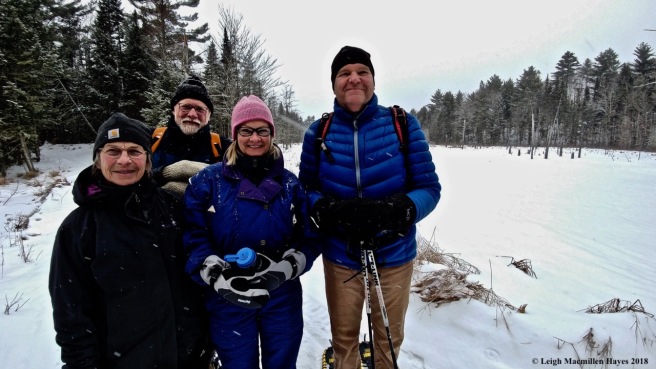
It was made even more special because two of the three with whom I tramped were snowbirds who experienced the awe of our winter world. Despite all their layers, they  felt like royalty living in an ice castle, glass slippers and all. (Don’t be fooled into thinking those are snowshoes strapped to their boots or winter hats rather than crowns.)

l-Long Meadow Brook 2

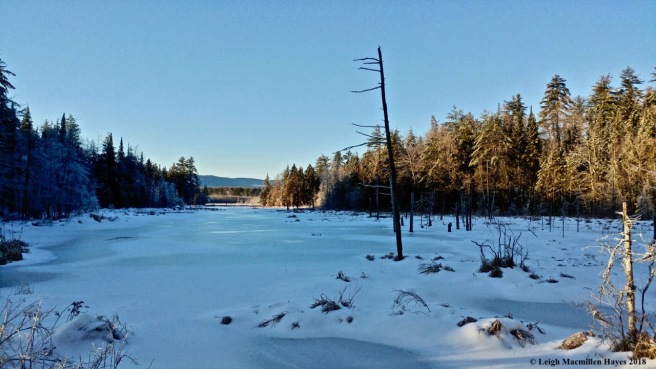
We made our way to the dam by the brook as the sun shifted lower and shadows lengthened. It didn’t matter for the sky was clear and we celebrated exploring the winter world of Lovell.

l-porky den 1:25:18

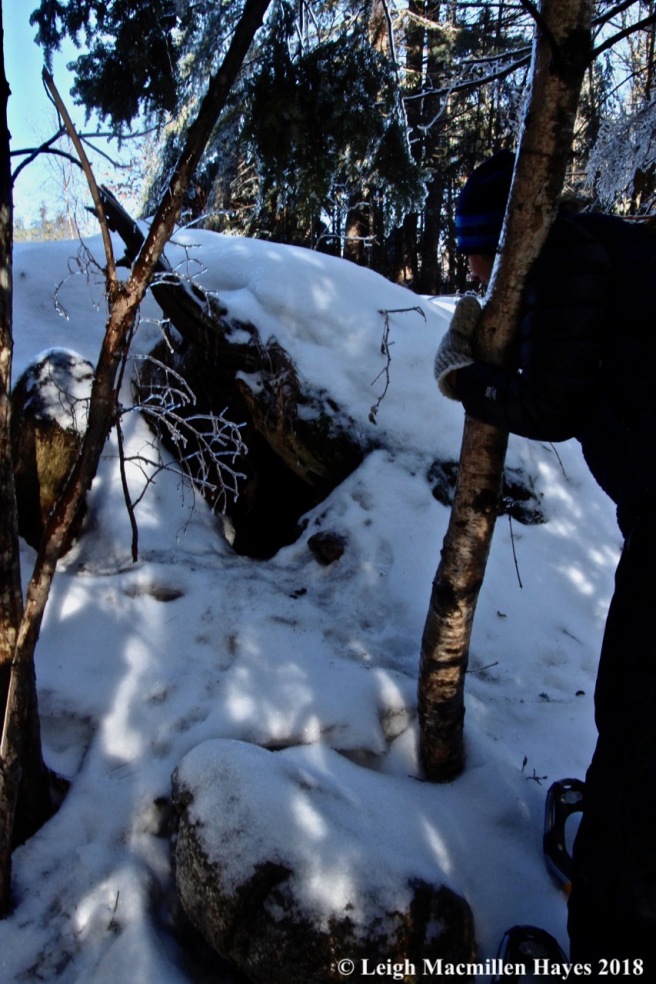
And then we backtracked a bit before crossing a property under conservation easement with the land trust and visited a porcupine condominium located in a large stump dump. The porkys didn’t let us down and we found prints leading into and out of seven or eight entry ways, along with downed hemlock twigs and scat. All perfect porcupine sign.

l-squirrel 1

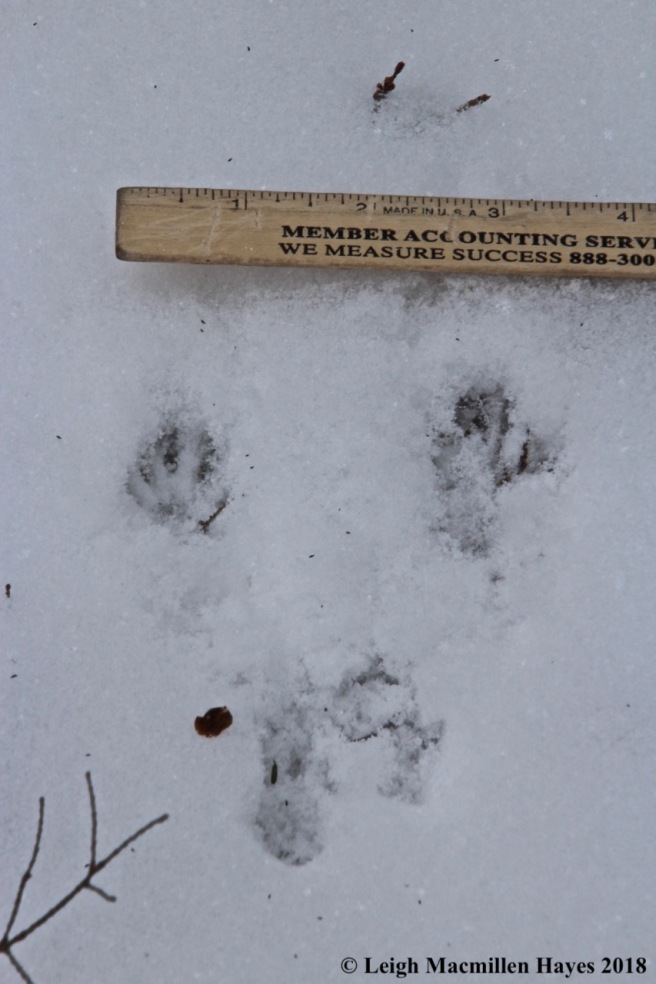
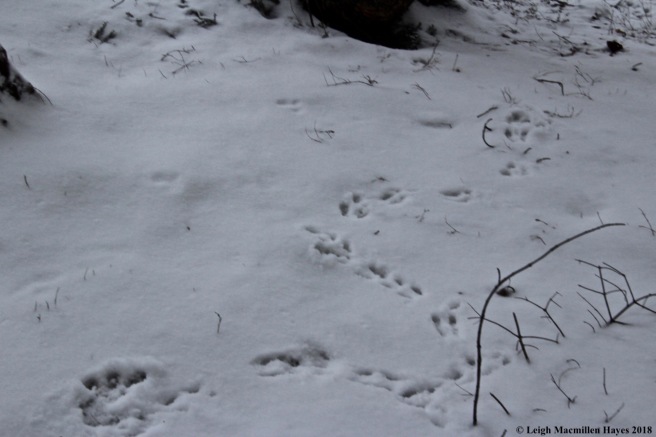
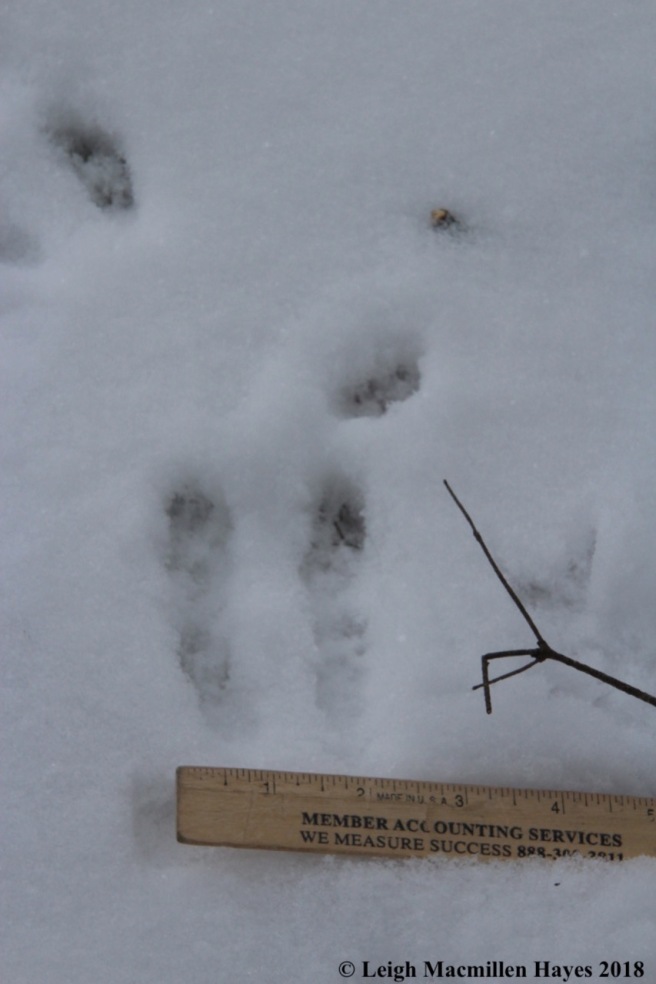
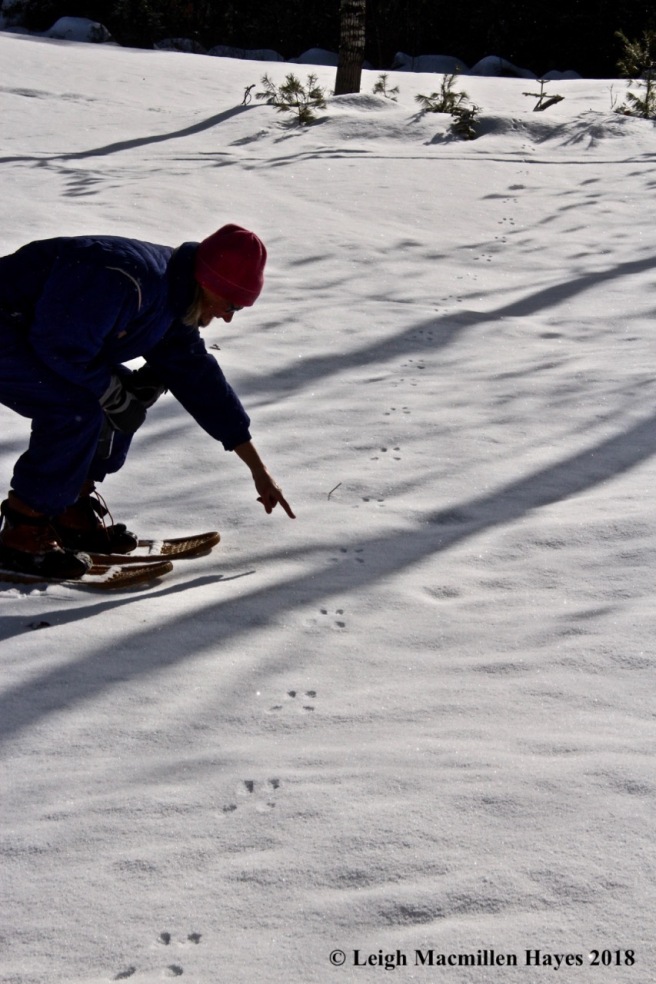
Since then, we’ve experienced a variety of mixed winter weather, but this past weekend a couple of inches of snow fell, making for great tracking conditions, such as this group made by a red squirrel, the two smaller feet being its front feet, which landed first, before the larger hind feet swung around and landed in front–the typical pattern left behind by a hopper or leaper. Its toes pointed toward my ruler, thus indicating the direction of travel.

l-chipmunk prints 1

Because it had been warm over the weekend, chipmunks made a brief appearance–rather than being true hibernators, they are light sleepers and will move about in the chambers within their tunnels. Occasionally, during a thaw, they’ll even venture out to forage for fresh seeds.

l-chipmunk prints 2

Notice how the straddle is about two inches, while the red squirrel above exhibited a straddle of about three inches. Straddle being the measurement from the outside of the left hind foot to the outside of the right hind foot. In case you are wondering, the measurement for gray squirrels is about four inches.

l-coyote track

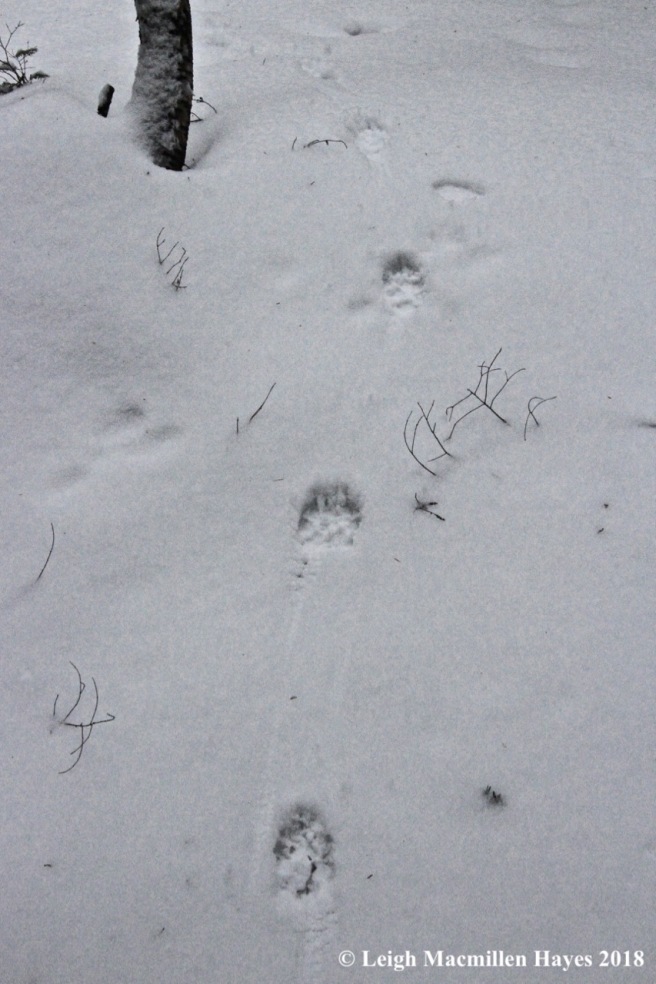
And then I came upon tracks so fresh that I was certain I might spy the two coyotes who traveled before me, but as is most often the case, I didn’t see them.

Following the snow, we had another downpour and everything changed. But then the temperature dipped again.

l-few Tuesday Trackers

And so today when the GLLT’s Tuesday Trackers took to the trail at Long Meadow Brook Reserve, we were sure we’d find a plethora of well-made tracks. Only two problems. One: by the time Kathy, Dick, Mary, Russ, and I arrived, it was snowing lightly. And two: not too many mammals had been on the move in the last day or so. At least not in that neck of the woods.

l-Long Meadow Brook 1

We beelined (sort of, for we did stop to look at deer tracks) down to the old beaver dam hoping for otter sign or that of other weasels. Nada. Instead, we took in the view to the north.

l-Long Meadow Brook south

And then to the south.

l-beech leaf 2

And headed toward the porcupine condo. But along the way, a couple of other things caught our attention, including a beech tree getting a head start on the next season.

l-pitch pine 3

And a pitch pine that was the gnarliest any of us had ever seen. Pitch pine needles, in bundles of three, grow on the branches but may also sprout on the trunk–a unique feature making for easy identification among the evergreens. But so many? On branches?

l-junco

At last we reached a field where we welcomed sunshine to warm us up and noticed a few feathered friends. More than one junco scratched some bare ground in search of seeds.

l-squirrel pattern

As we crossed the field we rejoiced to have the track pattern of a gray squirrel to admire. Small things made us happy.

l-lorax tree

And then, at the top of one of the stump dumps we stood in awe of the Lorax tree. Only several branches had small fans of needles left; all the rest having been devoured by the local residents living below.

l-porky hemlock twigs

As we made our way into the hemlock grove to take a closer look, we spied what we believed to be a bobcat track based on straddle and stride, the latter being the distance from the toes of one print to the toes of the next print in the zigzag line. The overall impressions were a bit diluted indicating they were a few days old, but we’ve seen the same in this area before and the measurements led us to that conclusion. We also spotted downed hemlock twigs featuring the characteristic 45˚angled cut made by a porcupine.

l-porky tracks?

By this time, our group had increased by two when Alice and Saranne joined us for the trip into the porcupine haven.

l-porky den:stump dump

We peeked into holes, but suspected the homemakers had entered inner chambers.

l-porky tracks 2

We did find telltale tracks filled with the morning’s flurries, but still demonstrating their pigeon-toed pattern. And we saw that the bobcat had checked the holes as well before it moved on.

l-porky hole:hoar frost

We decided to move on as well, climbing up onto the stump dump, but with a word of caution to watch out for steam holes. Hoar frost surrounded the holes and gave us further reason to believe that indeed the condo was occupied.

l-porky tracks around downed limb

The very branch under which we saw one hole had fallen from a white pine. All around it were more porcupine prints.

l-porky chews

As for the white pine’s needles–think of them as dinner. The same was true of a bent red oak branch and its buds. A little variety in the diet.

l-bench

We too were ready to eat and so we headed out.

Another three hour tour and our curiosity was satiated at Long Meadow Brook Reserve and the adjacent property.  A couple of benches await at Long Meadow Brook should you want to pause and take in the wonders yourself.


Endowing the Future

The morning began with a Greater Lovell Land Trust guided hike into the wetland of the John A. Segur West Preserve on New Road in Lovell.

w-shrike kill still in tree

Despite the cold temp, there were eleven of us along for the journey. To stay warm, we made a sort of beeline to the wetland, but stopped a few times, including to measure the straddle of mink tracks, and then to see if a shrike’s deposit we’d spotted a few weeks ago was still pinned to a tree in the log landing. It was, which wasn’t a surprise. As Dave, one of our docents commented, shrikes are not all that common here so it may have left this  dinner behind before it moved on. But, we wondered–why hadn’t a blue jay or another bird taken advantage of the free meal?

w-ruffed grouse tracks

From the landing, we moved on toward Bradley Brook, where we spotted tracks left behind by ruffed grouse, mink, deer, and a kazillion squirrels. But, other than the mink, no predator tracks, which was curious.

w-snowshoe hare print

Out on the wetland, we noticed where a hare had packed the substrate and yesterday’s wind blew any soft snow away creating a raised impression.

w-Dave channeling his inner deer

It was there, also, that docent Dave, bent down in the background,  demonstrated how a deer rubs its forehead against tree bark–leaving behind information about its health and wealth.

w-squirrel bridge

Our plan had been to venture further into the wetland to make more observations, but ice conditions were such that we didn’t dare. Instead, we returned to the brook and followed it back, noting ice bridges that none of us dared to cross. We left that action to the squirrels.

w-Robie Meadow 3

The John A. Segur West property was a new one on my guy’s list, and so we went with that theme and after lunch I dragged him to two other land trust properties. Our first stop was at Western Foothills Land Trust’s Robie Meadow on Scribner’s Mill Road in Harrison.

Again, given the brook that we’d have to cross, we paused and decided to enjoy the view from the edge.

w-fox track to brook 2

Throughout the property we did note the usual squirrel tracks and red fox. As we walked beside the brook, I hoped for others that weren’t to be, but at a spot where last week on a walk co-hosted by the GLLT and WFLT, we’d noted a pathway to the water created by either coyote or fox and a bobcat traveling back and forth to the water. Today–fresh red fox tracks.

w-red fox print

The size of individual prints, fuzzy appearance due to a hairy foot, and chevron feature of the foot pad all spoke to its maker.

w-deer ribs and fox track1

As we made our way back to the road, we stopped by a kill sight discovered last weekend. The ribs and backbone of a deer reached toward the sky. And right behind–more fresh red fox tracks. The fox had paused briefly before journeying on in search of a new food source.

w-red pine plantation beside Crooked River

Our final destination was across Scribner’s Mill Road to Loon Echo Land Trust’s Crooked River Forest Preserve-Intervale.  Neither of us had ventured forth on this property previously. While no true trails yet existed, the logging roads were easy to follow and we chose that route because we wanted to get down to Crooked River. As we approached the river, we realized we had traveled through a red pine plantation.

w-white pine at LELT

Right by the river, we discovered a white pine that had lost its terminal leader, thus allowing lower whorls to reach skyward. As my guy said, it looked like a great climbing tree–had we been so inspired. Blame it on the cold. Blame it on our age. We passed up the opportunity.

w-Crooked River 1

The river, so named Crooked for its meandering nature, offered a mixture of ice and open water.

w-fox prints and pee

And everywhere throughout the property we found evidence of red foxes, including prints and pee.

w-coyote bed

We also noted a spot where a coyote paused for a bit, so smooth and indented was the impression left behind. I threw a mitten down temporarily to give a sense of the bed size.

w-Crooked River 2

Though we eventually crossed over the LELT boundary, we had followed a snowmobile trail, and so we decided to see where it would lead–hopeful we wouldn’t find ourselves in someone’s back yard.

w-Scribners Mill bridge

Our worries were squelched when we spied the Scribner’s Mill bridge in the distance.

w-mill:blacksmith shop

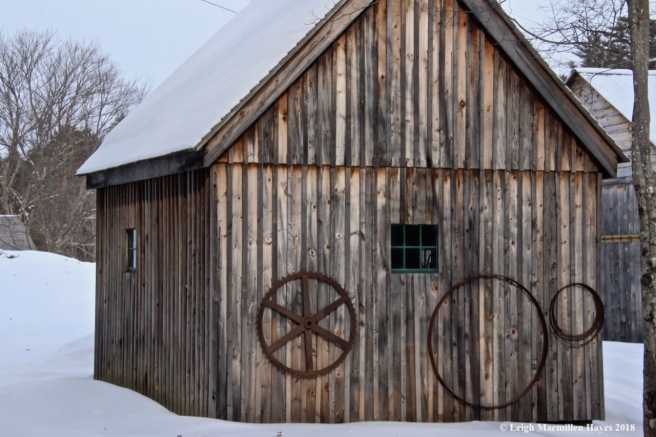
And soon came up beside the old blacksmith shop.

w-mill sign

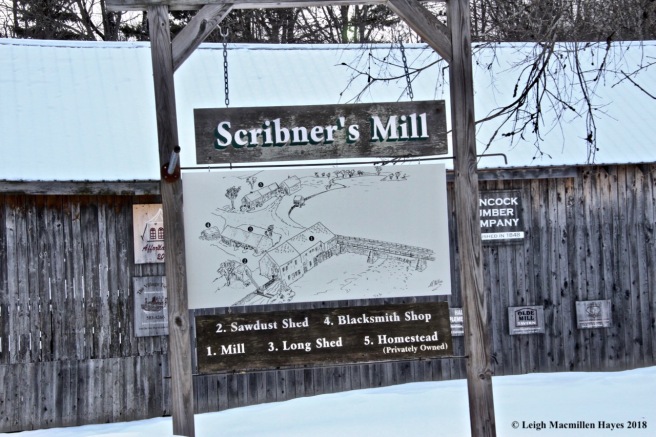
The mill complex was built in 1847. Three generations of Scribners operated it continuously until 1962.

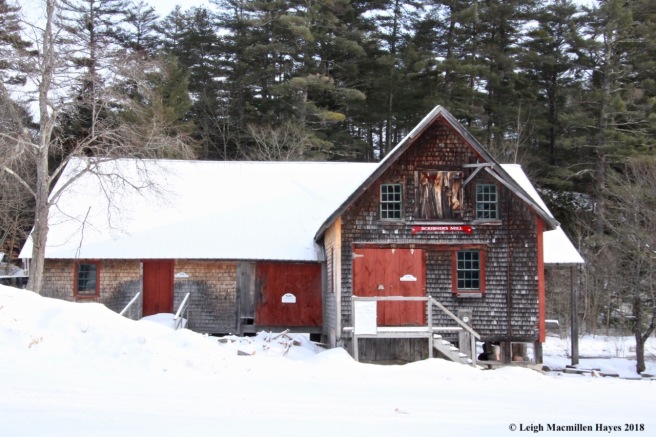
w-mill

In its heyday, the mill produced clapboards, shingles, barrels, and lumber. The Scribner’s Mill Preservation, Inc. formed in 1975 with the mission to transform it into an accurately reconstructed saw mill powered by water.

w-mill:signs

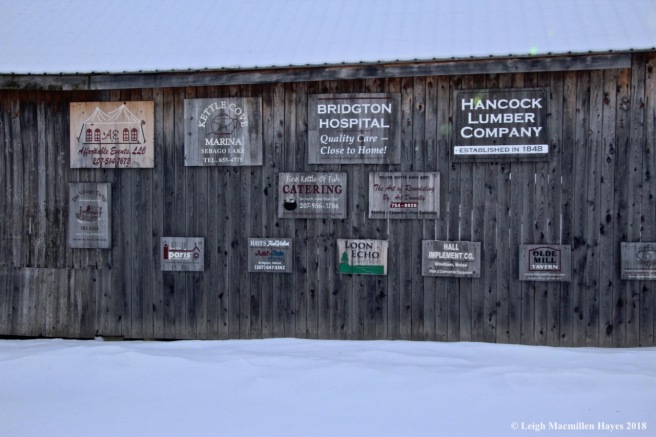
As we stood and looked at the ads of local businesses on the long shed (including one we know intimately), we wondered about the annual “Back to the Past” Celebration that used to be held each August. During that weekend, we recalled how we’d watched the machinery at work. The lathe workshop and the blacksmith shop were also open. Tours of the homestead included exhibits and demonstrations of traditional crafts such as weaving, spinning, rug-hooking and quilting.

w-mill from bridge 2

Today, all was idle. Except for the water.

w-mill from bridge 3

It swirled by, carrying memories of the past into the future.

And we gave thanks for the opportunity to visit properties owned by three different local land trusts who do the same as they carry memories of the past forward for future generations.

Land trusts work with community members to acquire land for permanent conservation through purchases and donations. They also create legal and binding conservation easements that allow residents to protect land holdings in perpetuity, while retaining private ownership. Scenic views, wildlife corridors, flora and fauna, and topography remain, subject only to the whims of nature itself, which is ever-changing.

Conserving the land doesn’t mean it can’t be touched. The organizations develop management plans and steward the land. Timber harvesting, farming, residency and recreation continue, while specific wildlife habitat, wetlands, unique natural resources and endangered or rare species are protected. And in the process, they strengthen our towns. Ultimately, they give us a better sense of our place in Maine and opportunities to interact with the wild.

Our local land trusts offer numerous hikes open to everyone, providing a great way to explore and learn more about the diversity of the natural communities.

Even though we can’t all endow the future of our properties, we can get involved to ensure that these organizations continue to protect land for future generations of humans and wildlife.


A Special Mondate

Our plan was to hike up Blueberry Mountain and continue on to the summit of Speckled in Evans Notch today, but as we drove toward the White Mountains I mentioned that a friend had shared a photograph of ice inside a mine near the Basin on Route 113. And so in an instant said plan changed.

b1-sign

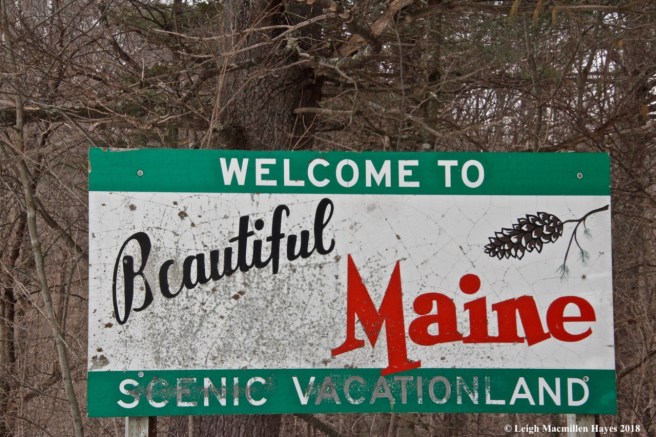
We parked near the iconic Welcome to Beautiful Maine sign and ventured off in search of the mine. Of course, I’d forgotten where exactly it was located, so we walked about a mile on a snowmobile trail until we spied private land in front of us. That was our turn around point, but . . . me thinks we should have continued because I later learned that the mine sits between public and private property.

b2-gray birch

We didn’t mind for we knew we’d return with more accurate directions. It wasn’t the first time we’ve erred. And besides, the gray birches were beautiful.

b3-lemonade stand

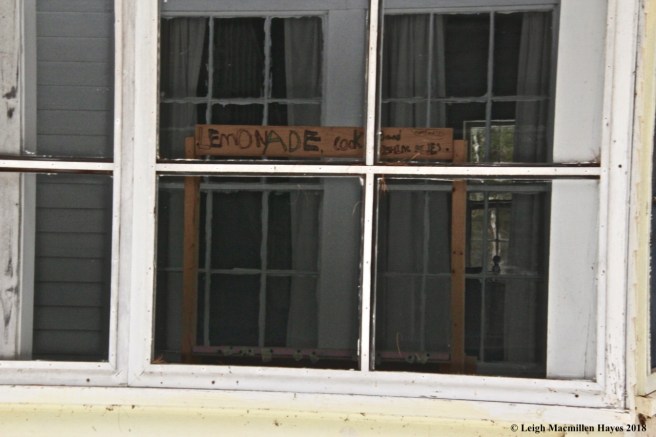
After we’d covered about three miles, we headed back to the truck and drove to Stone House Road, where we parked near the trailhead for the Leach Link Trail. We could have continued toward the Stone House since for the first time ever, it was plowed, but the lane was narrow and had we met another vehicle, it would have been a challenge to back up. Besides, I love to walk the road for there’s always something to see . . . like the lemonade stand. Who knew?

b5-Pole #15

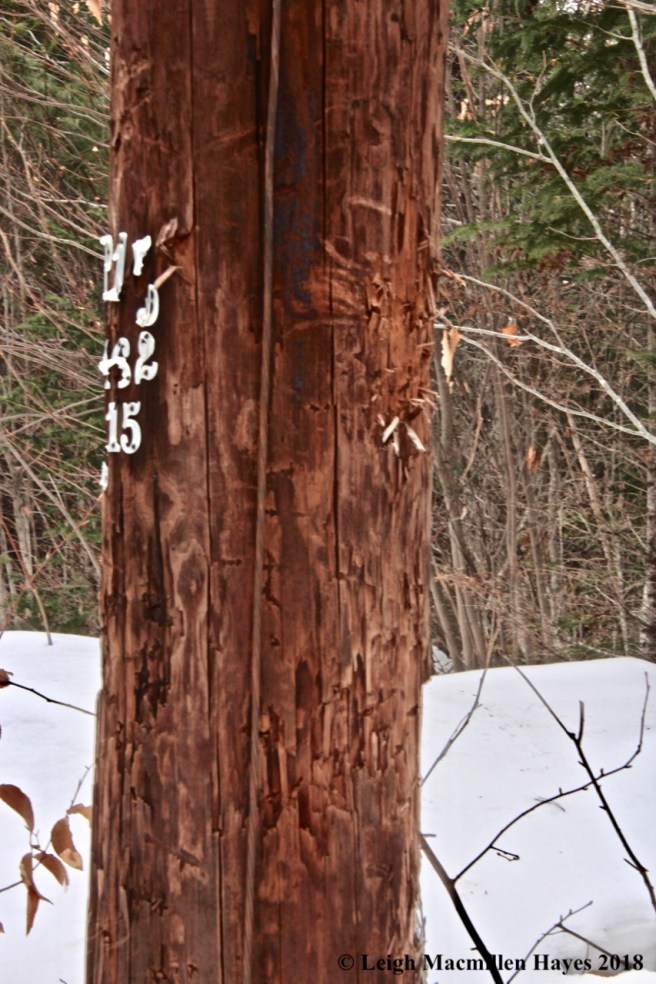
My other favorite sight along the road–telephone poles. In the past year the poles had received more attention–from black bears. Last year it seemed that any number with a 5 in it drew the most attention. Smart bears around here.

b6-pole 17 1

But it appeared that the bear(s) had added a new number to their count–#7, or in this case, #17.

b7-pole 17 2

I didn’t have my macro lens with me, but found bear hair attached to some of the scrapes. It was light colored, indicating it had bleached out in the sun.

So why telephone poles? It’s my understanding that males rub their shoulders and neck to leave a scent and may also claw and bite a pole during mating season. Bites leave nearly horizontal dots and dashes–can you see them? Think of the bear’s upper and lower canine teeth meeting. How cool is that?

Eventually, I promised my guy that I’d stop pausing to check on and photograph them, but he noted that I couldn’t resist every time we passed by one. I was just looking.

b9-Stone House Road

To my guy’s relief, we soon reached the gate, where the power line went underground.

b10-balds

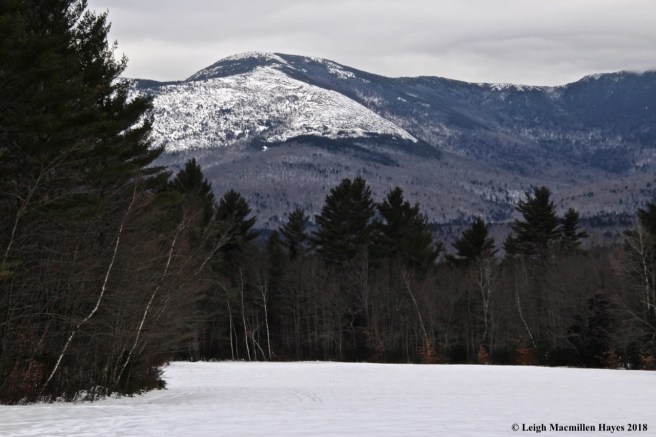
Near the airfield, we turned and paused to enjoy the view of the Baldfaces, and promised ourselves a return to those trails in the late spring or summer.

b11-gorge 1

Our choice of trails today was the Stone House Trail. And no hike up is complete without a stop at Rattlesnake Gorge. First we looked north.

b11a-water racing

Ice and water, ice and water–I couldn’t get enough of the freeze and flow.

b11d-gorge 3

And then we looked south–with continued awe.

b13-pool view

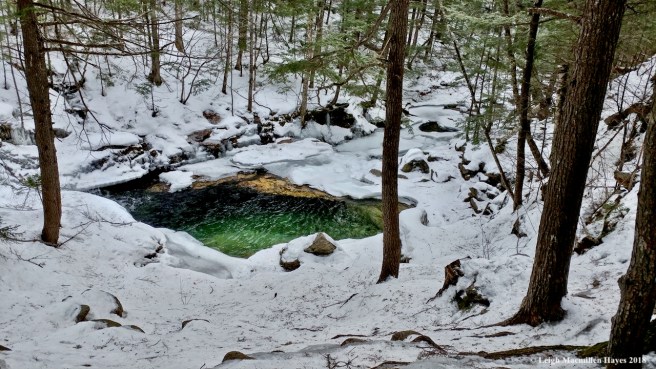
We’d thought about eating lunch at the gorge, but moved on up the trail. From lunch log, where we dined on peanut butter and blueberry jam sandwiches, we took in the view of  Rattlesnake Pool.

b12-rattlesnake pool

Any time of year it’s a magical place, but on a winter day–ah . . .

b12-emerald pool

that emerald color.

b14-rocks in brook

The brook above offered its own touch of wonder.

b17-hiking up

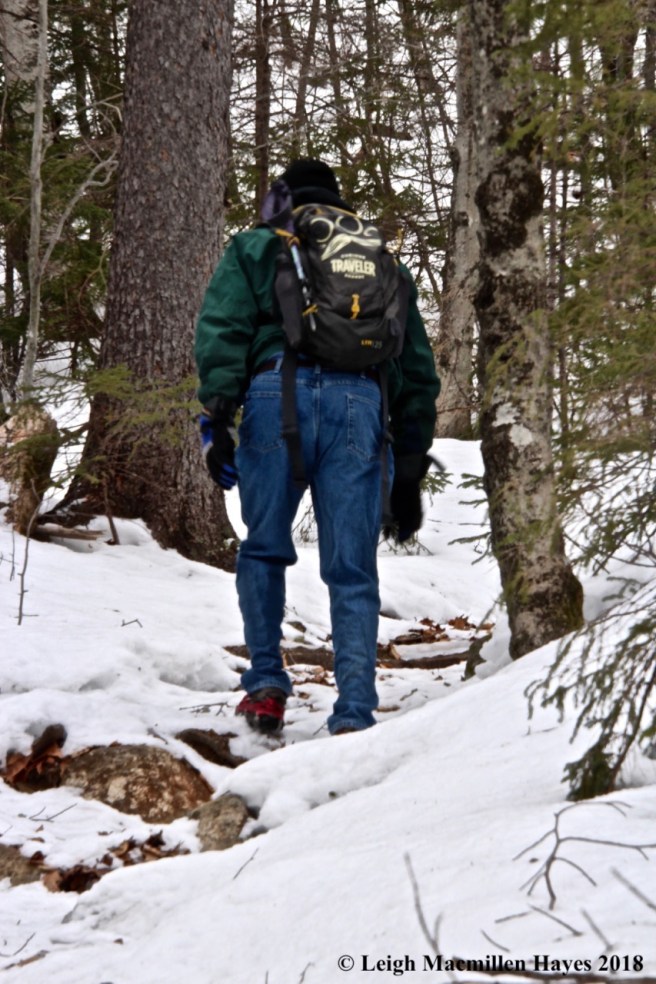
After lunch, we continued our climb on conditions that ranged from ice to snow to bare rocks. But mostly ice and snow. Microspikes served us well.

b16-Caribou sign

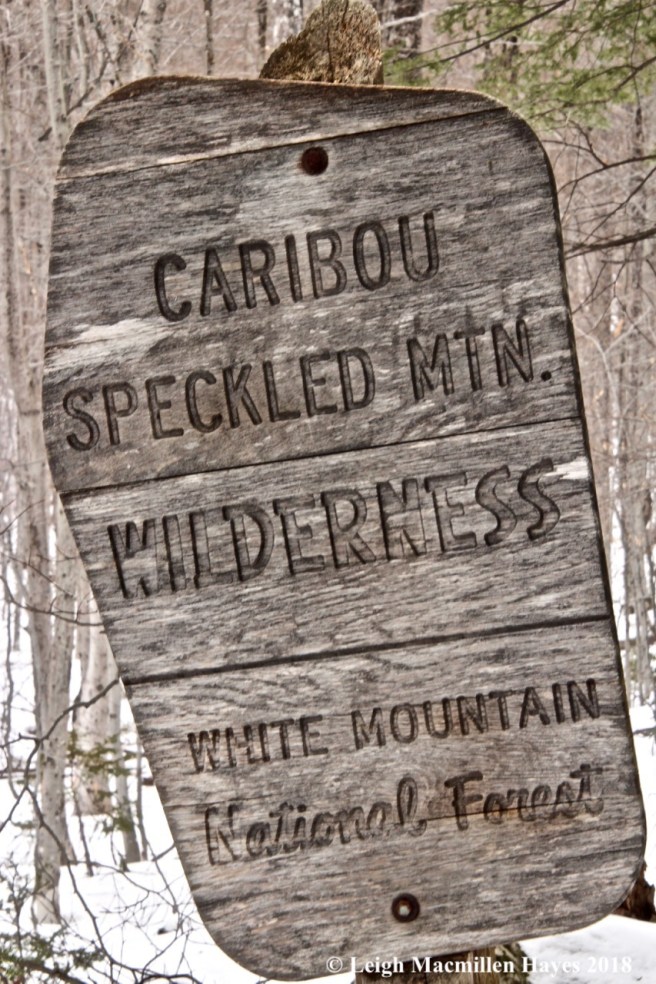
At last we crossed from the Stone House property into the White Mountain National Forest as denoted by a rustic sign.

b16-arrow

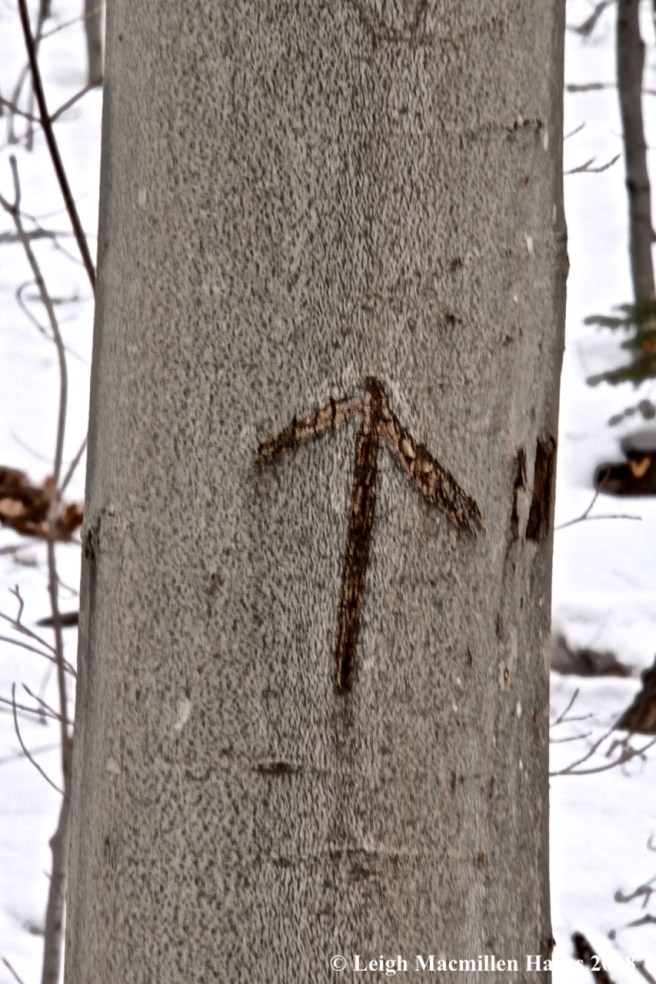
All along we searched beech bark for bear sign. And found one–a very smart bear had left a sign indeed–indicating the way of the trail. We kept climbing.

b20-cairns

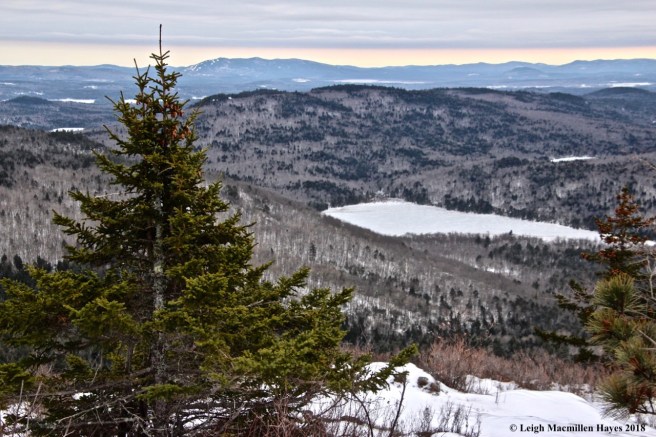
At last we reached the summit. It was later in the afternoon than we’d intended when our morning began because of our mine mission, and so we decided to skip Speckled Mountain, but were happy to check out the views from Blueberry. On the Lookout Loop we did get off trail for a bit as we missed a cairn buried under the snow. At that point we did a lot of post holing, sinking as we did to our knees and above. But finally we found the right trail.

b19-spruce

It’s there that the red spruces grew–their yellow green needles pointing toward the tip of the branches and dangling reddish-brown cones seeping sap.

b21-view 1

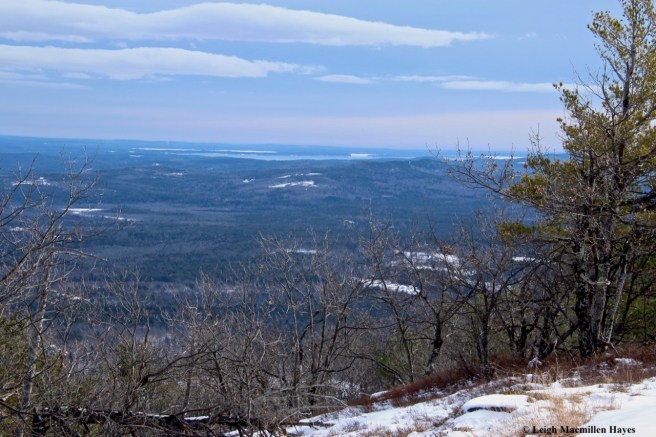
And then we found the view that stretched from Pleasant Mountain (our hometown mountain) on the left to Kearsarge on the right.

b22-Shell Pond and Pleasant Mountain

Below us, Shell Pond on the Stone House Property, showed off its conch shell shape.

b23-Kearsarge

We took one last look at the mountains and valleys under a blanket of clouds before following the loop back to the main trail and retracing our steps down.

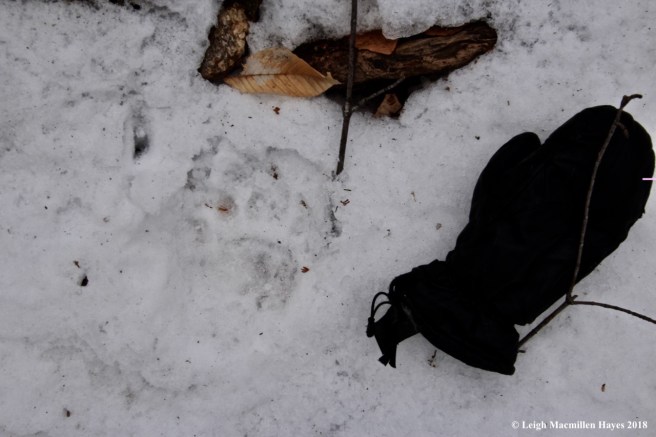
b24-bear tracks

It was on the down that I got my guy to stop and examine a mammal track with me. I’d noticed it on the way up and he’d been ahead, but we both remembered that it was located at the point where the community switched from hardwoods to soft. Do you see the large prints? And distance between. It had been warmer yesterday and those prints looked like they’d been created then.

b18-bear print

Black bear prints! Oh my!

It was the five large toes that first drew my attention as we climbed up. Was I seeing what I thought I was seeing? The pattern of the overall track was a bit different than what I’ve seen in the past where the rear foot oversteps the front foot because in snow black bears tend to direct register like coyotes, foxes and bobcats–one foot landing on snow pre-packed by another foot.

Bears are not true hibernators and this guy or gal must have been out foraging during yesterday’s thaw.

We didn’t find any bear paw trees or see the actual bear, but we were thrilled with our telephone pole signs and the prints left behind.

Indeed, it was a beary special Mondate on Blueberry Mountain.

(Corny humor comes with teacher training)


Forever Green

According to a Cherokee legend, one cold season an injured sparrow knew he could not fly south with his family, so he bid them farewell and went in search of a place to survive.

Sparrow asked Oak to shelter him among its leaves so he might heal and greet his family upon their return in the spring.

But being a crusty old tree, Oak didn’t wish to have a winter house guest and so he turned Sparrow away.

Downtrodden, Sparrow approached Maple. Sweet as she might be, Maple also turned Sparrow away.

And so it went. Sparrow was turned down by each tree he visited, until there was only Pine left to ask for help.

Pine listened to Sparrow’s pleas and his heart heard Sparrow’s plight. And though Pine knew his leaves were tiny and more like needles, and his branches not as many as the others, he welcomed Sparrow to join him for the cold season.

As hoped, Sparrow healed and greeted his family the following spring.

Creator heard and saw all that had happened and called a great council of the Trees. In his address, he rebuked them for they’d been given so much and would not share the least of what they had with Sparrow in his time of need. Therefore, from that day forward, when cold came upon the land, their leaves would wither, die and blow away.

Creator then spoke to Pine, praising him for being the least among the trees, and yet giving so much. And so, Pine was honored to remain forever green.
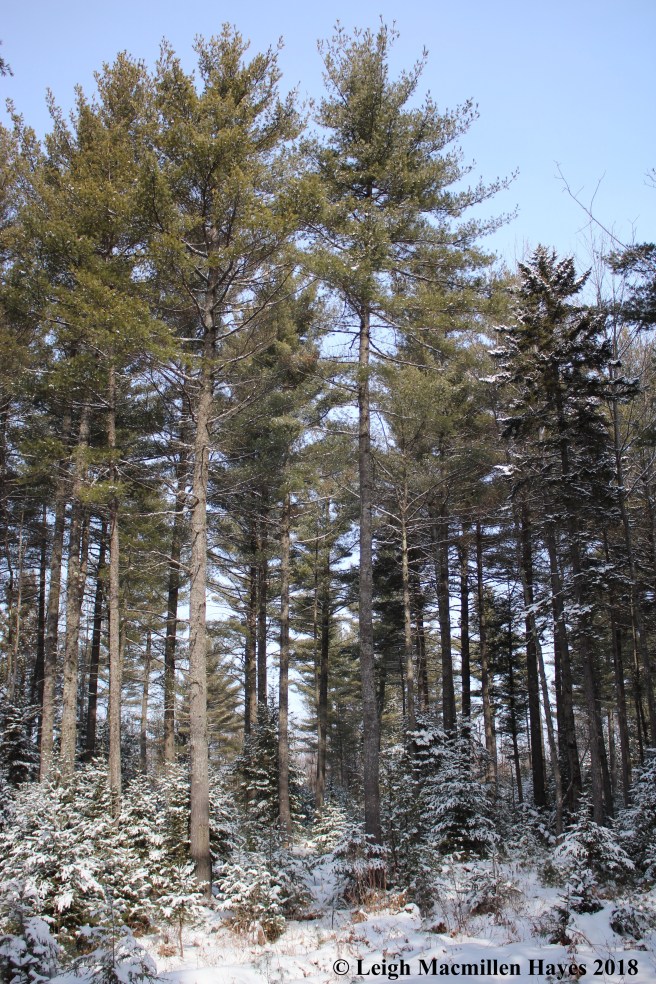
e-eastern white pine magestic.jpg

The Eastern white pine (Pinus strobus), strikes me as the majestic tree of our forest. Of course, it was once even more majestic. In the 1600s, the British Royal Navy blazed all of those two feet or more in diameter and within three miles of water with the broad arrow indicating they were to be cut, harvested and sent to England for ship masts. The blaze became known as the King’s Arrow in honor of King George I. At that time, the trees may have been 300-400 years old and over 200 feet tall. The oldest and tallest white pines in our current landscape are 80-100 years old and maybe about 100 feet tall.
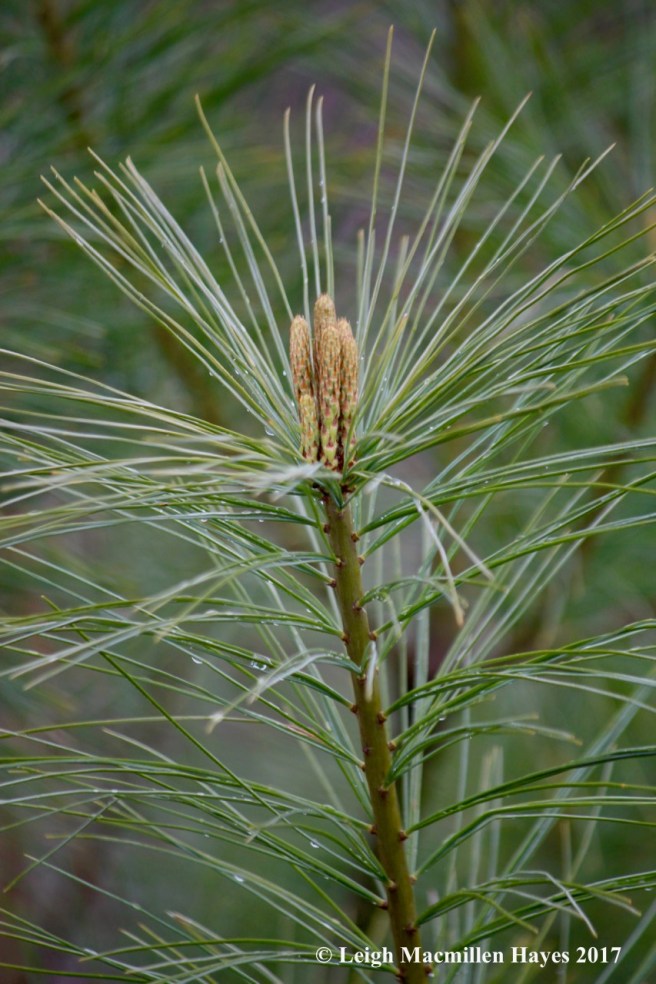
v-white pine

The three to five-inch white pine needles are blueish-green and bound in bundles of five. That’s easy to remember for you can spell both the tree’s name W-H-I-T-E with each needle or M-A-I-N-E for the white pine is our state tree.
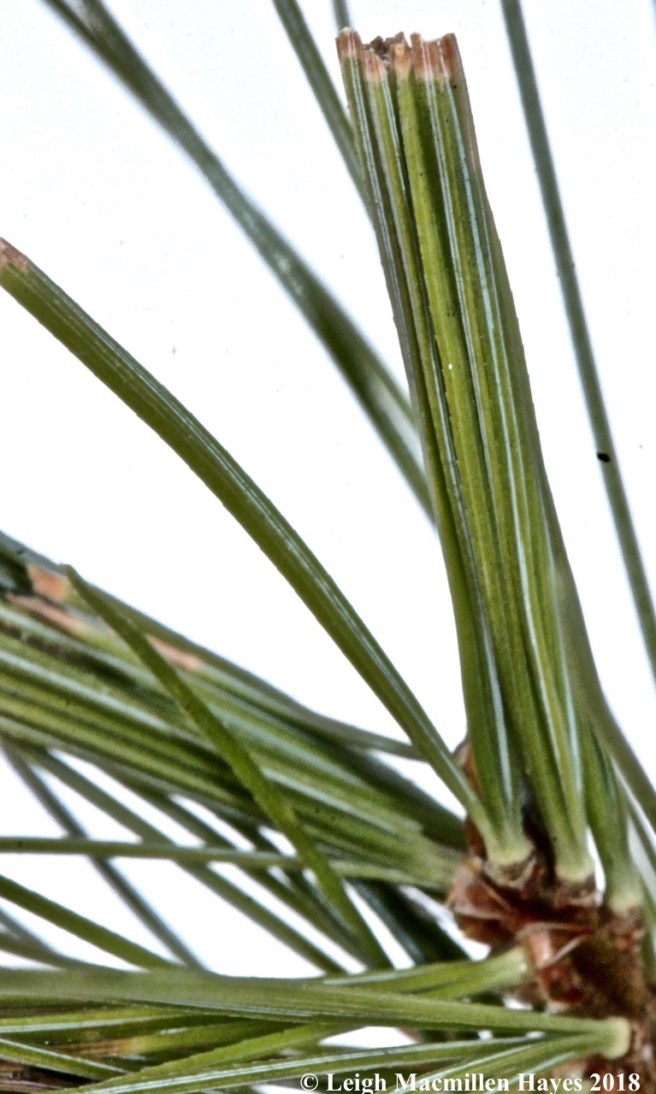
e-pine tube insect

Occasionally, I’ve spotted trees with clumps of needles stuck together in such a way that they formed tubes. Actually, they were the tunnels created by the pine tube moth. Larvae hatched from eggs deposited on the needles during the summer. They used silk to bind the needles together, thus forming a hollow tube. Notice the browned tips–that’s due to the larvae feeding on them. Eventually the overwintering larvae pupate within the tube and emerge in April. Two generations occur each year and those that overwinter are the second generation. Fortunately, they don’t seem to harm the trees.

e-pine whorls

In addition, the arrangement of branches is another important feature of this white pines for they are arranged in whorls radiating from the tree’s trunk like spokes on a bicycle wheel, with each whorl representing one year’s growth. Sometimes on older trees that grew beside stone walls in pastures, the older branches remain and when topped with snow look like a spiral stairway to heaven.

e-lines in white pine bark

On younger white pines, the bark has a greenish hue, but as the trees mature the bark turns dark gray to reddish-brown and forms into thick, vertical scales with furrows between. Upon the flattened ridges of the scales, look for a pattern of horizontal lines reminiscent of the lines on notebook paper.
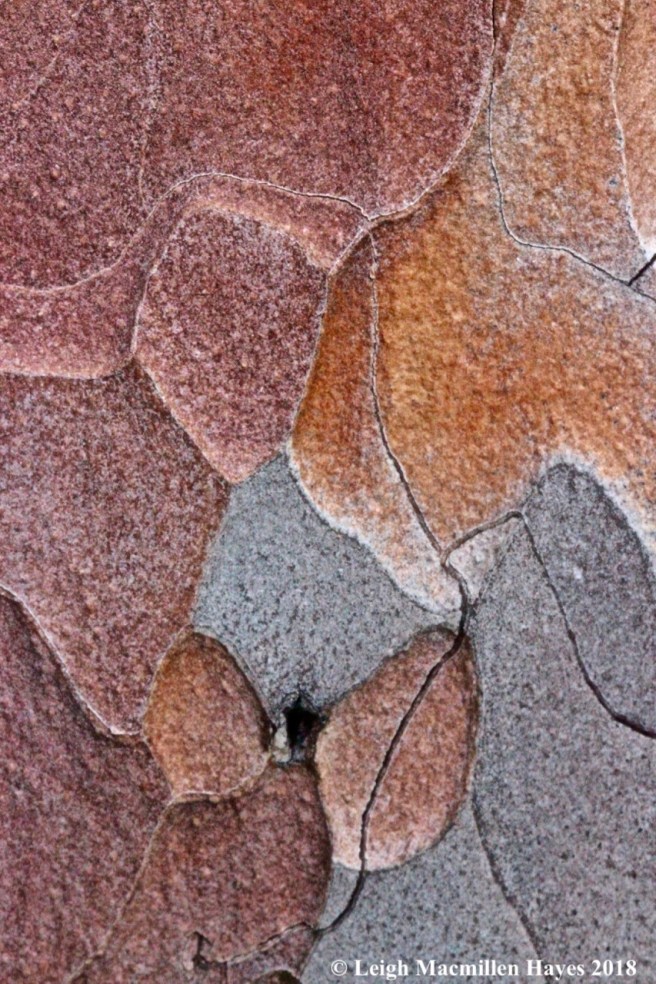
e-red pine bark

Red pine (Pinus resinosa) is a favorite of mine because of its bark, which reminds me of a jigsaw puzzle. Ranging in colors from faded orange to mottled red and grayish brown, its flaky flat scales hug the tree.
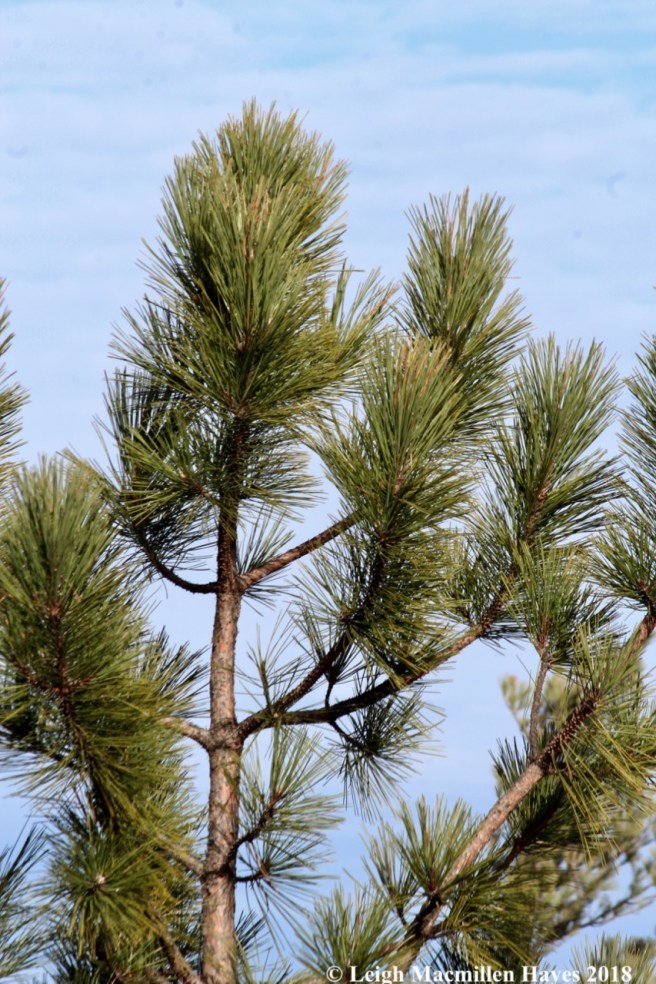
e-red pine needles, chimney sweep

In a perfect world, red pine would produce three needles/bundle to spell R-E-D. Alas, the world isn’t perfect, nor is that the case with this tree. Instead, it has two dark green needles that are twice as long as those on a white pine and quite stiff. In fact, while a white pine’s needles are soft and flexible, bend a red pine needle and it will snap in half. Because of the needle arrangement on these two members of the Pinus family, from a distance I can name them. To my eyes, a white pine’s branch tips look like bottle brushes, while a red pine’s remind me of the brush Bert used to sweep chimney’s in Disney’s Mary Poppins.
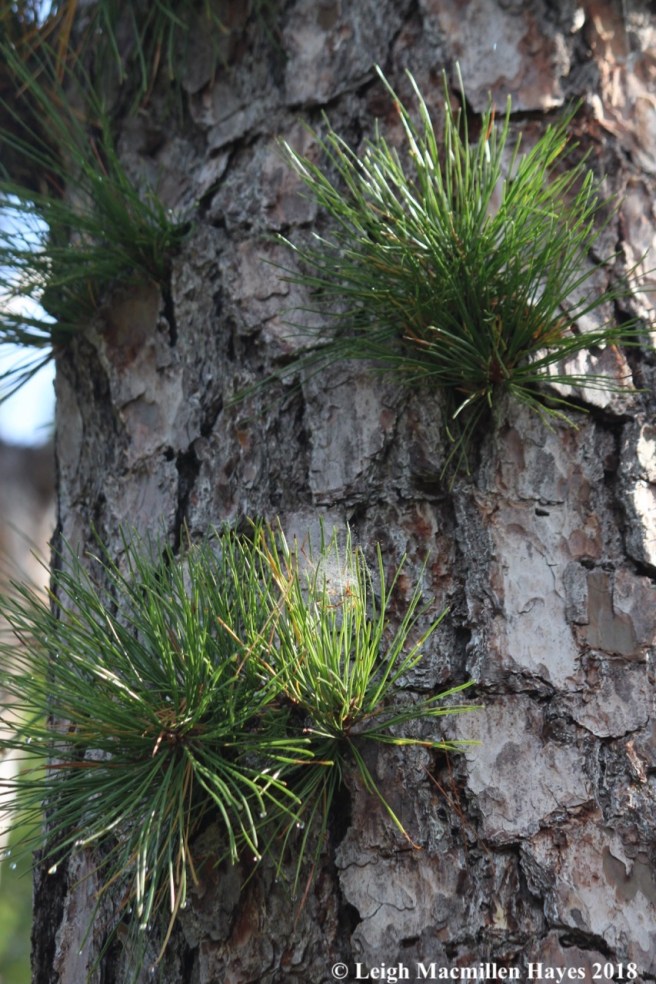
e-pitch pine needles on trunk

Another common pine in our area of Maine is pitch pine (Pinus rigida). This one is easy to confuse with red pine because the bark looks similar in color, though it strikes me as forming thicker plates. The name, pitch, refers to the high amount of resin within this tree.

It’s the needles of pitch pine that also add to its identification for they grow in bundles of three, like a pitchfork’s tines. The unique thing about this tree is that not only do the stiff, dark yellow-green needles grow on the branches, but they also grow on the trunk. If you spy a tree that you think may be a Red Pine, scan upward and if you see green needles along the trunk, then you’ve discovered a Pitch Pine.

Pitch pine is an important species for it is the only pine that is well adapted to fire and can even resprout.

e-jack pine

Finally, for our native pines, and I can only think of a few local places where I’ve seen these, including along the Foster Pond Outlook Trail at Bald Pate Mountain in South Bridgton, is Jack pine (Pinus banksiana). It seems to prefer the coast and central northern Maine. But . . . walk Loon Echo Land Trust’s trail at Bald Pate, and see if you can spot them.

Jack pine has two yellow-green to dark green needles in each bundle so an easy way to remember its name: Jack and Jill. I don’t know about you, but I love mnemonic devices.

e-white pine cone, red pine cone, hemlock cone

One last way to differentiate the pine trees is by their cones. Cones are the fruits of the trees and they consist of scales that protect seeds. When conditions are right, the scales will open to release the seeds, which have wings much like a maple samara, allowing them to flutter off in the wind and find their own spot upon which to grow. The line-up in this photo from left to right: white pine, red pine, hemlock.

e-white pine with two year old cones

White pine is easy to ID for it produces long, narrow cones, often coated with white sap. It takes two years for a white pine cone to mature.
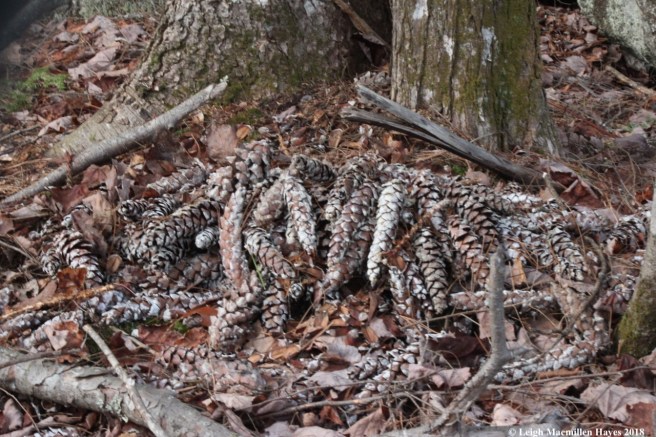
e-pine cone midden

Red squirrels are known to gather mature cones and store them in a cache for winter consumption. During the winter, the squirrels tunnel under the snow to access the cache, then climb up to a high spot and remove each scale to reach the seeds. Left behind is a midden or garbage pile of scales and center cob of the cone.

e-red pine cone and needles

Red pine cones are about two inches long and egg-shaped on short stalks.
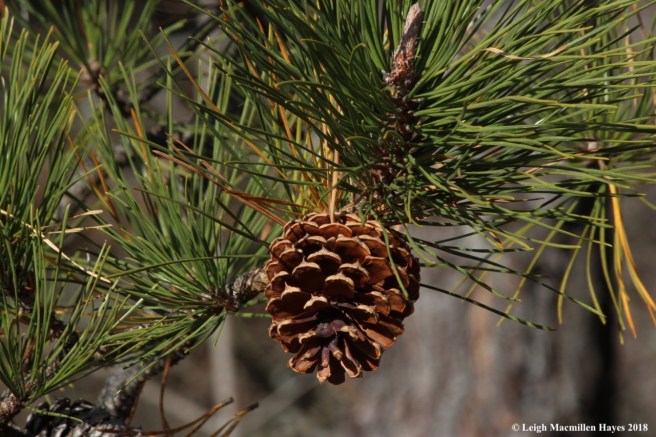
e-pitch pine cone 1

You can barely see the stalk of pitch pine cones that tend to be clustered together, but their key feature is the rigid prickle atop each scale tip. On Jack pines, the cones are about two inches long and slightly curved like a comma.

Before I move on to the other evergreens, I need to make one point. Members of the Pinus family produce pinecones. All other evergreens produce cones, but they aren’t pinecones because they don’t grow on pine trees.

e-mixed forest 2

Eastern hemlock (Tsuga canadensis) grows almost as abundantly as white pine. Often white pine, hemlock, balsam fir and spruce saplings can be observed growing together, and a perfect classroom situation evolves.
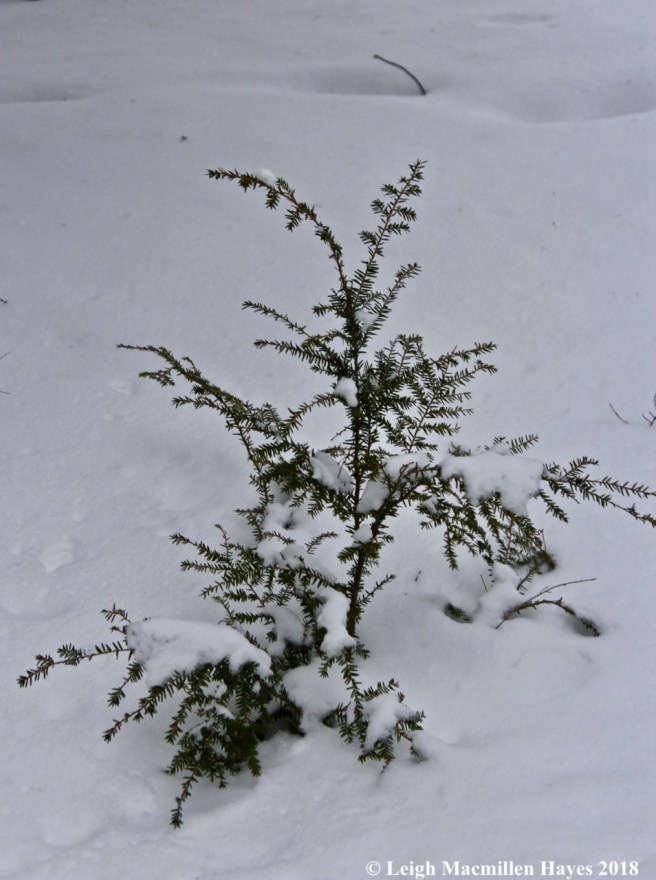
e1-drooping hemlock

The hemlock is easy to ID once you realize its characteristics. To begin with, and especially noticeable in younger trees, is the drooping terminal shoot. In fact, all of the branches droop, providing the overall effect of a graceful tree.

e-hemlock gathering snow

Those sturdy, down-sweeping boughs also hold snow, thus creating the perfect spot for deer to hunker down under on a winter night.

e-hemlock porcupine evidence below hemlocks

Another mammal that takes advantage of the hemlock is the porcupine. If you spy nipped twigs on the ground surrounding a hemlock, then it’s best to look up and make sure you won’t become a pin cushion should the animal fall.
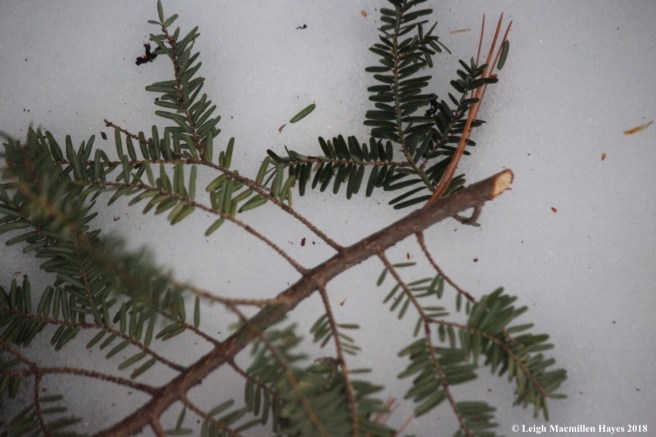
e-hemlock porcupine

Typically, the downed hemlock twig features a cut made at a 45˚ angle.

e-hemlock petioles (stems) and stomata lines

The half-inch hemlock needles taper to a dull point. You may only see this with a hand lens, but each needle is attached to the twig by a short stem, aka petiole. And the needles extend outwards from both sides of a twig, thus giving it an overall flat appearance.

e-inner bark of hemlock

The bark on a hemlock, initially grayish and smooth, becomes cinnamon brown and scaly with age. I also enjoy looking at the inner bark that might be exposed by an injury, for its features various shades of reddish purple.

e-hemlock cones

Hemlock cones are petite in comparison to pinecones, at only .75 inch in length. In the spring, their scales are blue-green, maturing to a tan by autumn.
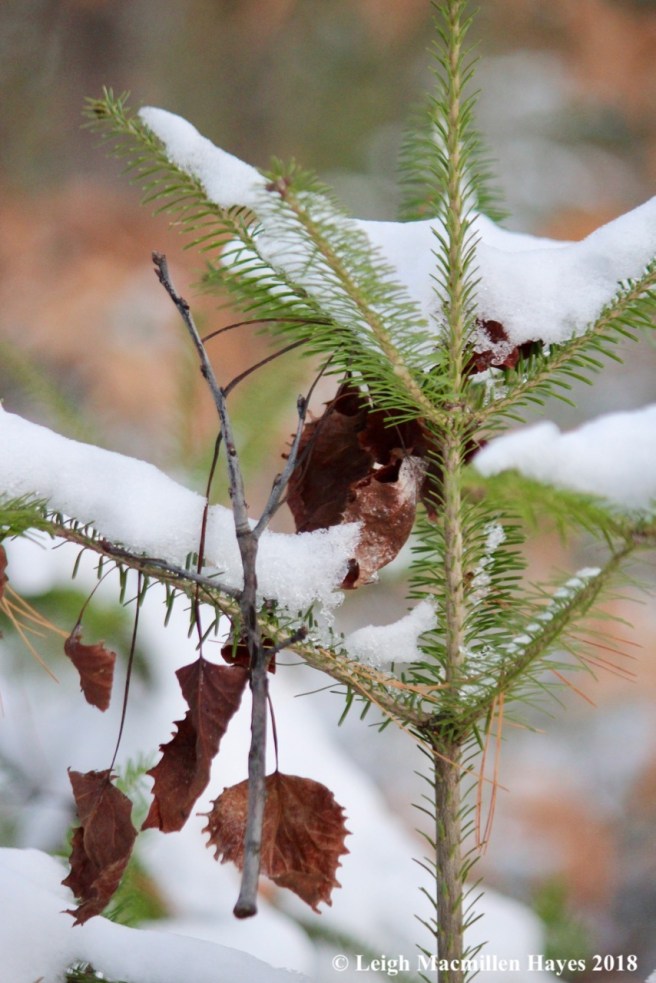
e-balsam fir standing upright

While the hemlock droops, a balsam fir (Albies balsamea) stands straight and tall as it forms a spire with a symmetrical crown.
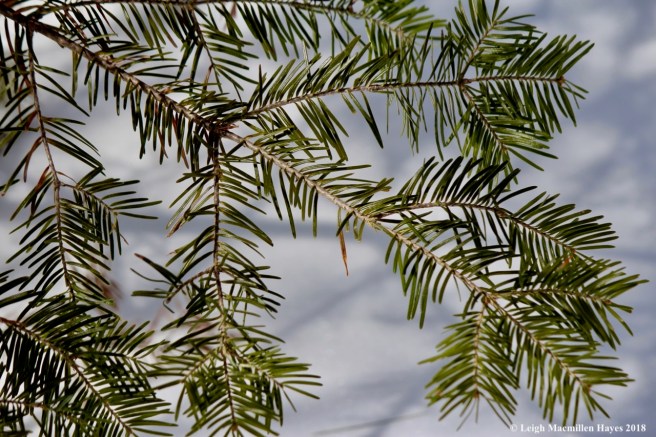
e-balsam fir needles

Like the hemlock, the needles are flat, but they differ in that they attach directly to the twig, are about an inch in length and some have a notch at the blunt end. The upper side is a shiny dark green, while the underside is silvery-blue.

e1-balsam bark

The pale gray to green-brown bark of balsam fir is also different than the other evergreens. It has raised dashes, aka lenticels. All trees have lenticels that allow for the exchange of gases. On some trees, however, the lenticels are more noticeable. Balsam fir bark also is riddled with bumps or resin-filled blisters. Poke one with a stick and watch the pitch ooze out. Beware, it’s very sticky. And it smells like Christmas.

e-balsam fir cones

One other unique characteristic of a fir tree is that the cones point upward rather than dangling down. That, in itself, offers an easy ID.

e-spruce

The next family, the Picea or spruces, I find more difficult to distinguish in a crowd. Like balsam fir, the leaders or top sections point skyward giving it an overall pyramid shape, but its the idiosyncrasies within the family that sometimes stump me.
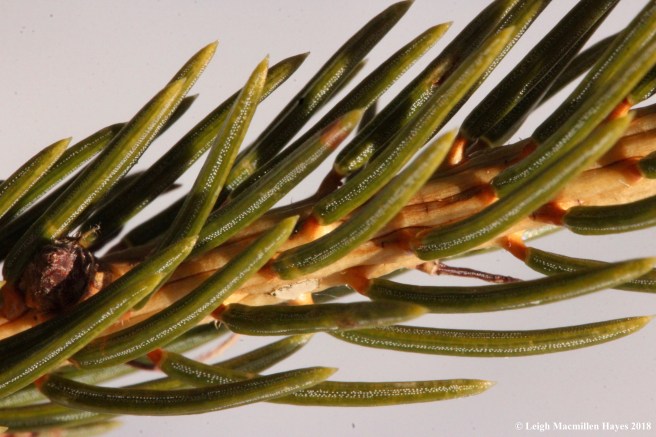
e-spiky spruce

The one thing I am certain of is that they are spruces if their needles are sharp and pointed. Shake hands with a branch and if it hurts, it’s a spruce.
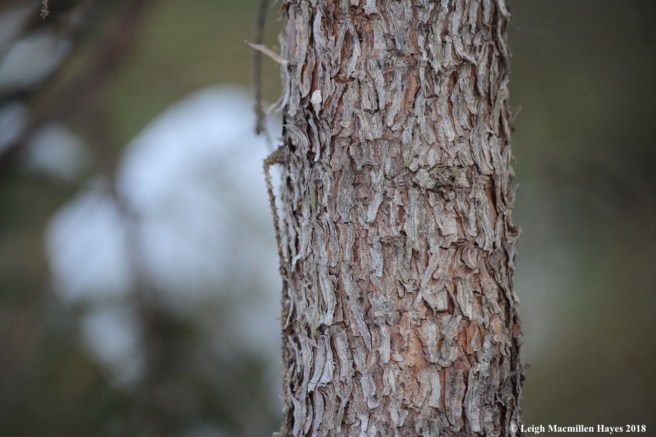
e1-spruce bark

Spruce bark is broken into irregularly-shaped scales in general, and white spruce bark is gray to reddish-brown.

Again, I’m brought to things to remember when trying to determine whether I am looking at a fir or spruce—firs are friendly, spruces are spiky. Fir needles are flat, spruce needles are square.

The only cedar tree native to western Maine is the Northern white cedar. Whenever I sniff its fragrant scent, I’m reminded of my mother’s cedar chest and the treasures it stored.

e-Northern white cedar leaves and cones

Northern white cedar (Thuja occidentalis) is also known as Eastern arborvitae. Its scale-like leaves appear opposite each other along the twig and have short, blunt points.

The cones are about a half inch long, oblong in shape and borne upright on the branches. Their scales are leathery, red-brown and notched. They also have a small spine on the tip.
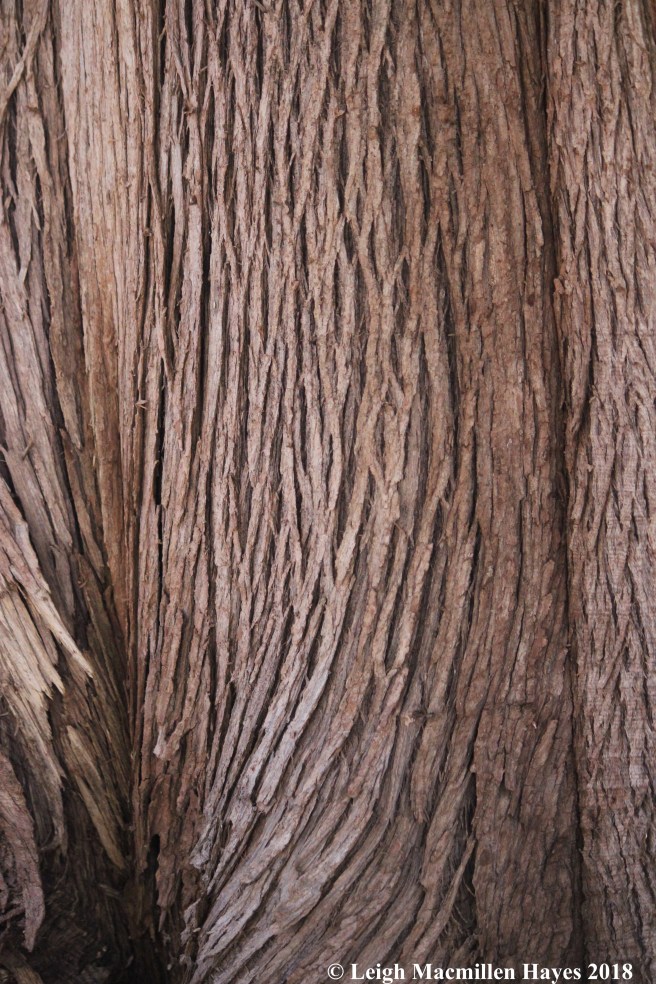
e-Northern white cedar bark 2

Again, the bark is fibrous, red-brown, which weathers to gray and features a diamond-shaped pattern. This small to medium-sized tree looks like a pyramid with a broad base and rounded top. It often features several main trunks.

And then there’s the tamarack.
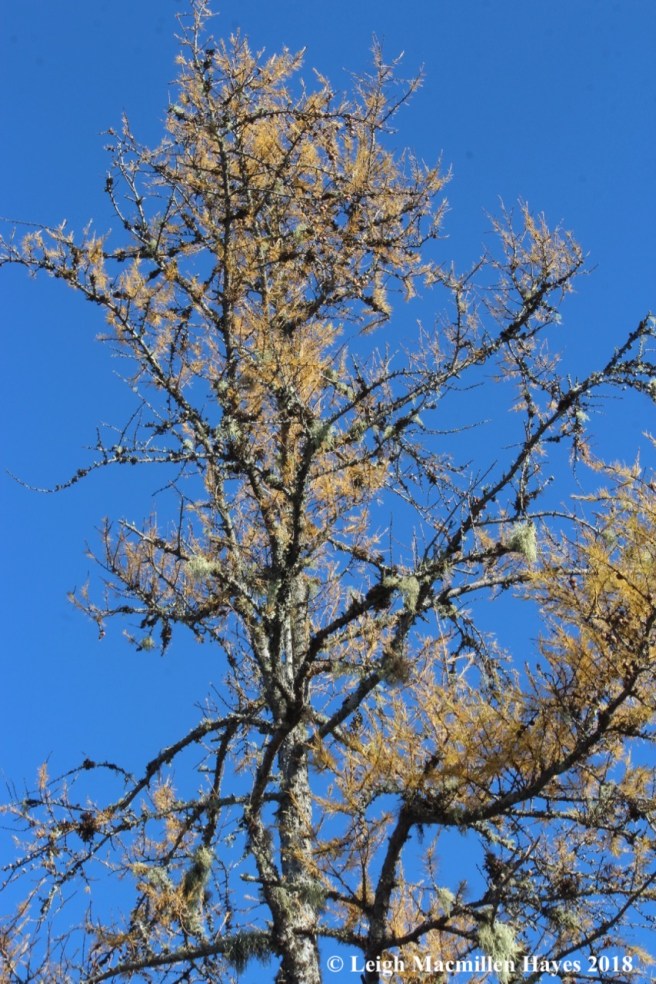
e-tamarack in fall

A tamarack or Larix laricina is a native deciduous conifer because it sheds its needles each fall, after they’ve turned a golden yellow, therefore it’s not really an evergreen.

e-winter

I know how easy it is to look at the winterscape and think that everything looks the same in the almost monochromatic mosaic we call the woods.

e-spring 1

But even in spring, as buds give way to leaves,

e-summer evergreens

summer when so many greens dominate our world,
e-fall 2

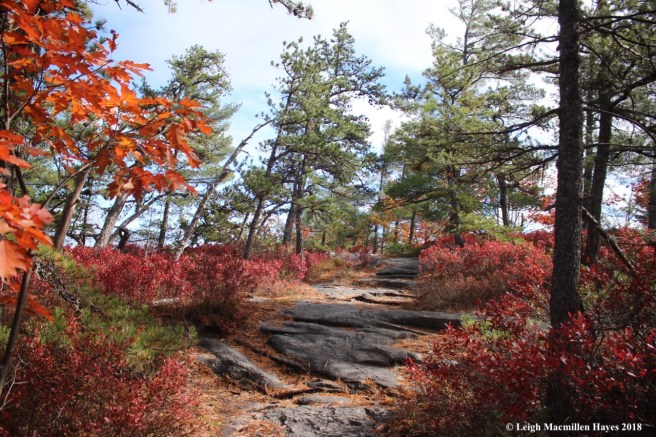
fall, when evergreens provide a contrast for autumn’s foliage,

e-fall 3

and late fall, when the evergreens continue to be green as the broad leaves drop, these trees make a statement in the landscape.

Thanks to Creator, they are forever green.
 

Winter Reins

While snowstorms are my favorite winter weather events, I don’t always get what I want. Such was the case today. Only a few days ago, as I checked Weather Underground for updates, it looked like we’d receive 4-6 inches of snow. But, the closer the day drew, the lesser the snow amount and more the chance for mixed precipitation.

i-hemlock

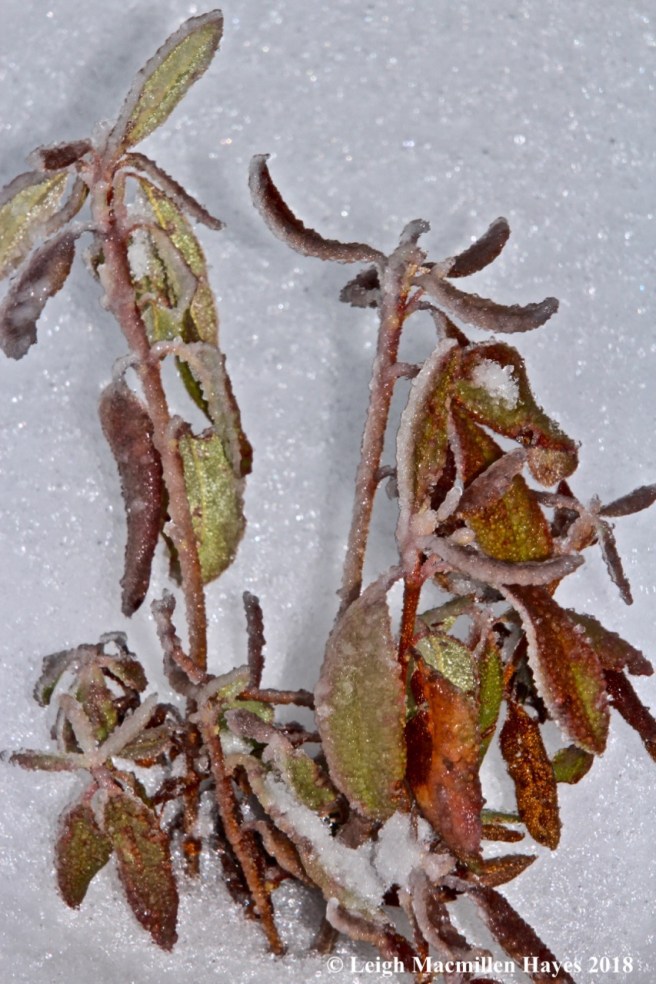
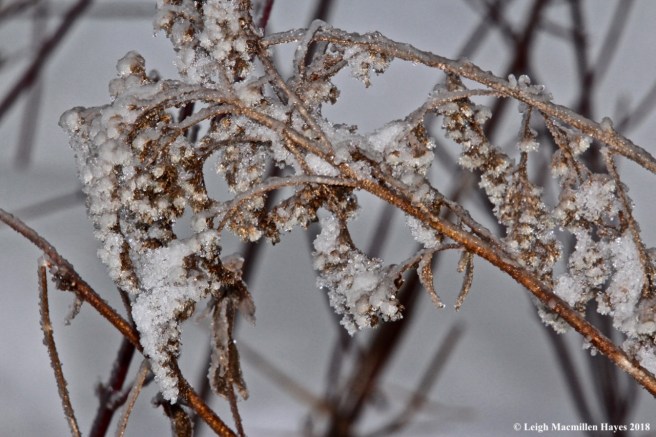
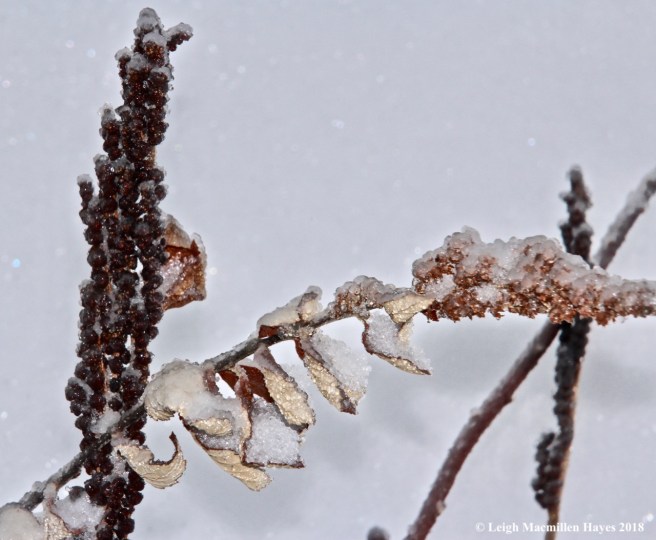
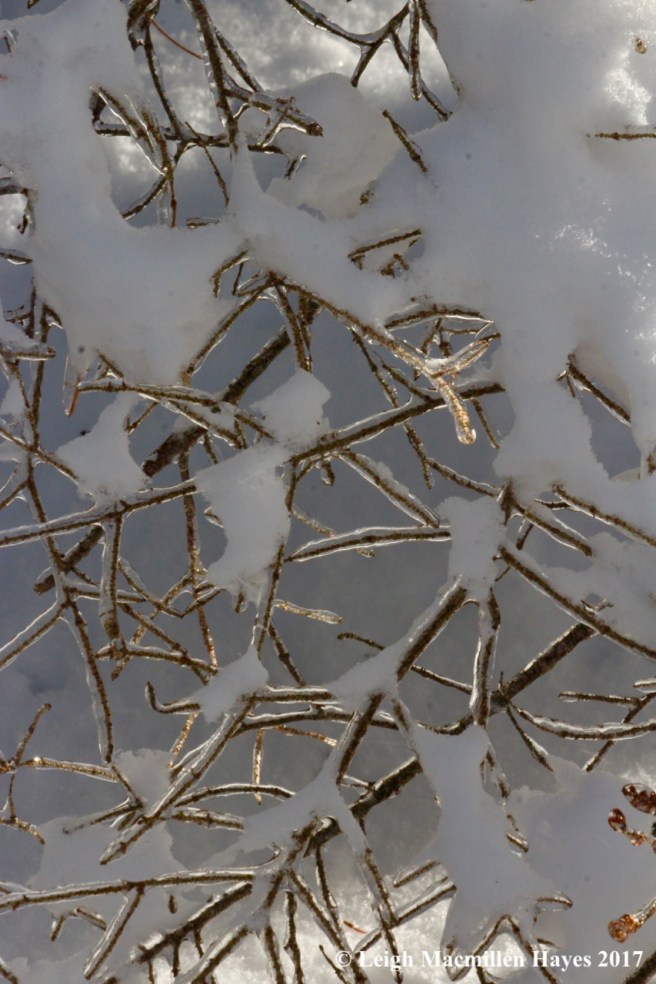
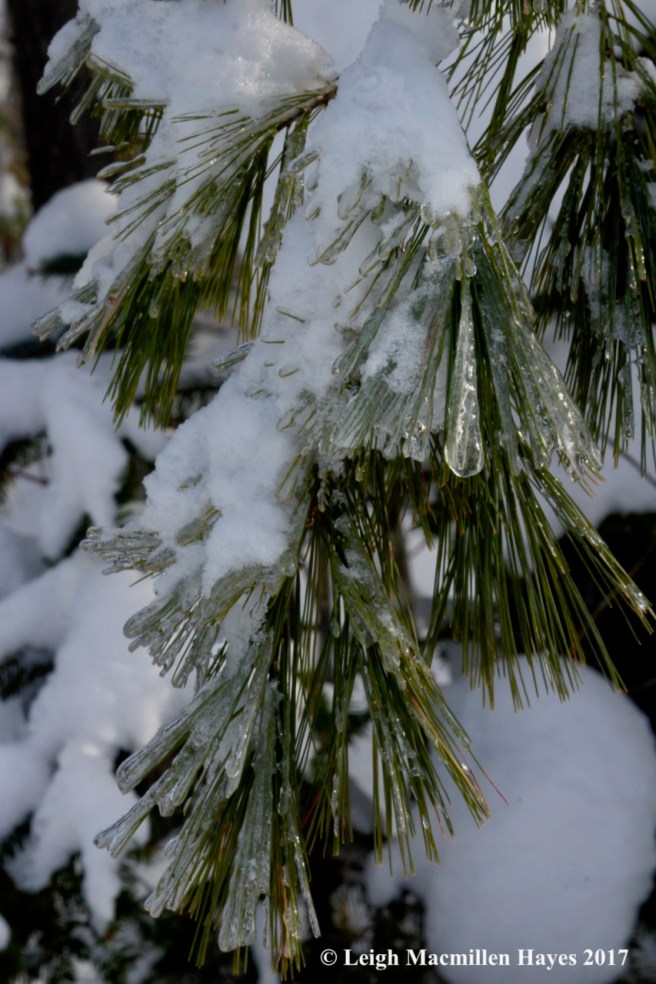
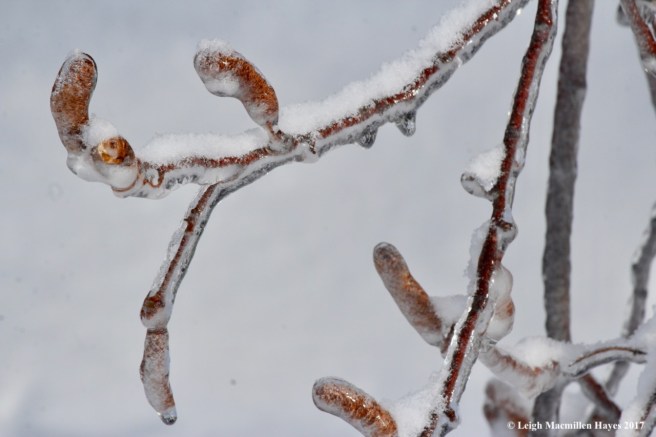
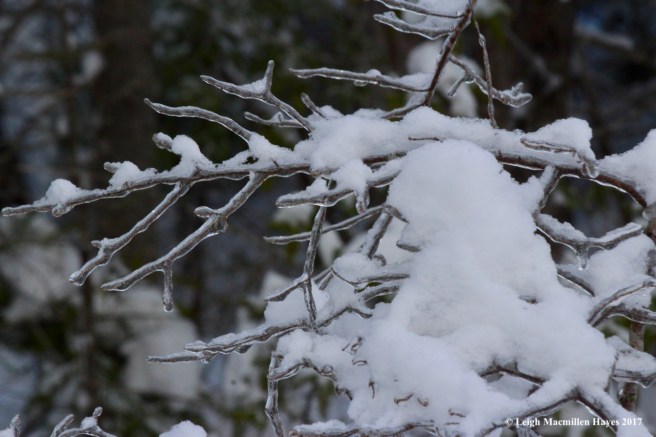
Such mixed precip brings its own frosty coating, layering branches with icy crystals.

i-sheep laurel

Even the springy look of the sheep laurel was enhanced by its temporary trimmings.

i-goldenrod

While the goldenrod appeared to shout out its name despite its winter form.

i-intersection of sensitive fern and steeplebush

And steeplebush found a couple of friends offering support among the sensitive fern fronds.

i-witch hazel

The day’s glaze outlined the wavy margins of withering witch hazel leaves still holding fast.

i-home

And my world slowly transformed. I couldn’t resist the opportunity to watch the changes occur.

i-goldfinch1

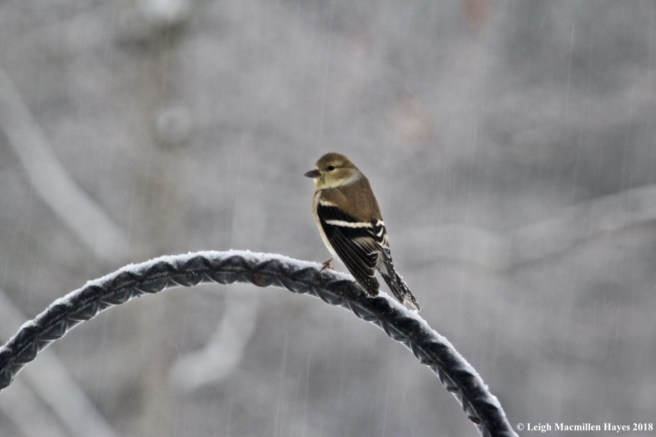
As for the backyard birds, they just kept coming, from goldfinches to . . .

i-white-throated sparrow

white-throated sparrows,

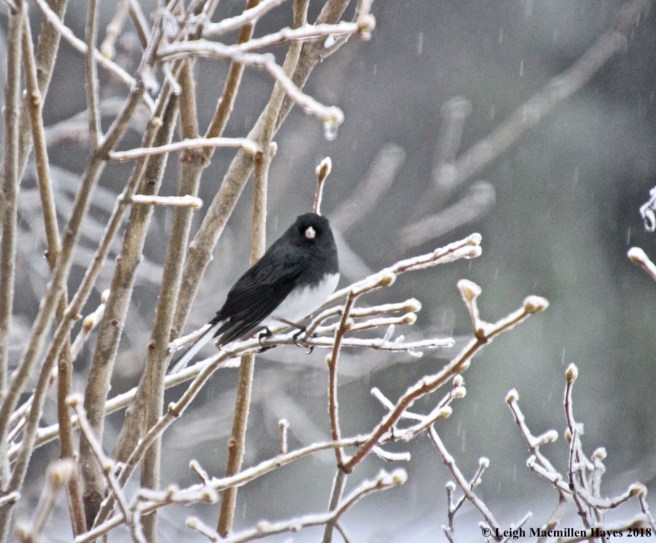
i-junco 1

juncos,

i-junco 2

and more juncos,

i-male cardinal

Mr. cardinal . . .

i-female cardinal

and the Mrs.,

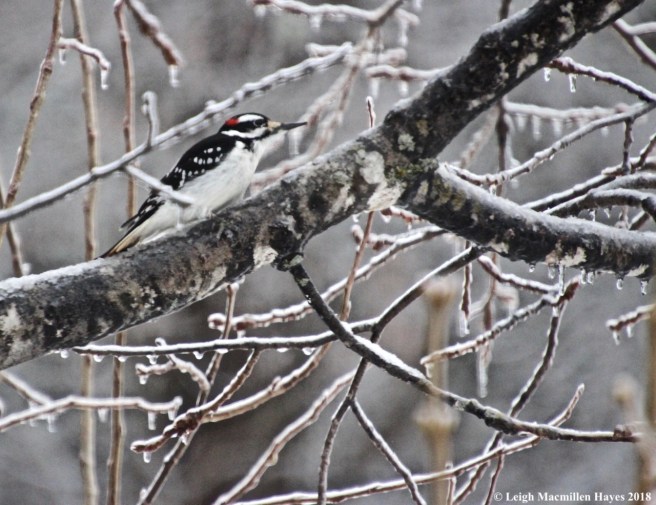
i-hairy woodpecker

plus a male hairy woodpecker,

i-bluejays and icicles

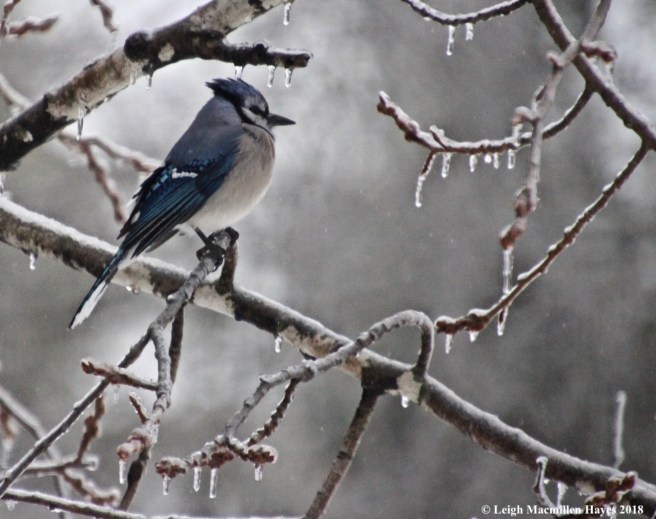
and any number of bluejays.

i-blue jays 1

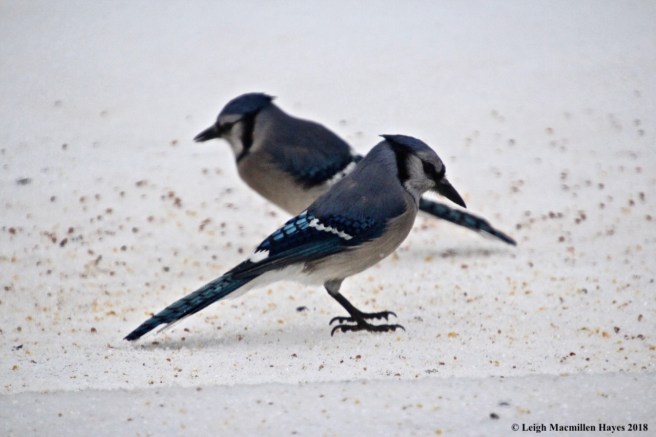
There were more visitors as well, including a purple finch, a couple of chickadees, and a flock of turkeys. All, like these bluejays, studied either the feeders or the seeds I’d spread on the ground . . . contemplating I suppose.

i-blue jays 2

And then making a choice. Over and over again.

i-hydrangea 1

As the day wore on, the icicles grew longer and last summer’s hydrangea flowers glowed below their frozen outwear.

i-white pine

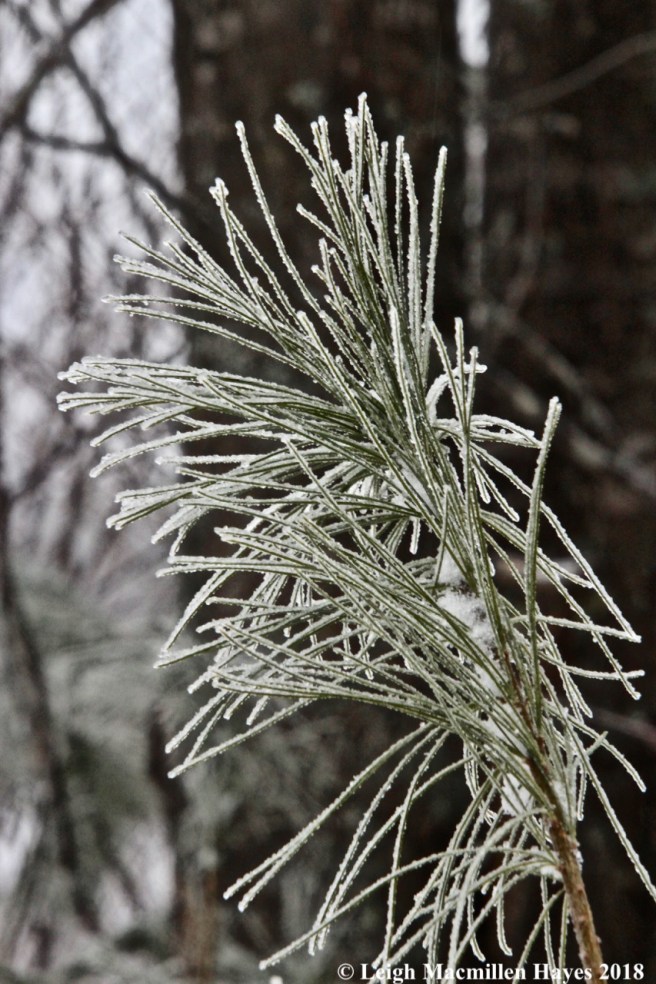
In the morning, the white pine needles sported only a thin layer of ice.

i-white pine 1

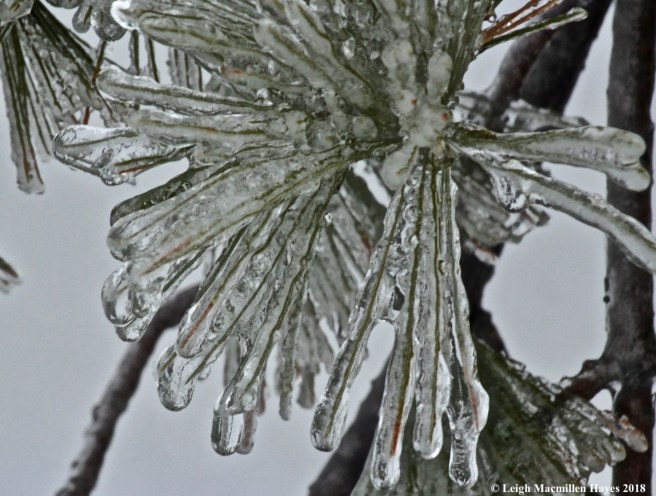
But by the afternoon, they began to sag beneath the weight of their heavy blankets.

i-red oak 1

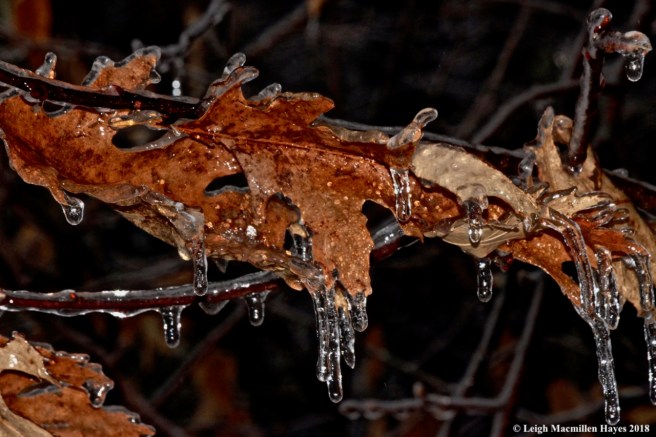
The bristly points of marcescent red oak leaves grew into long rounded fingers dangling below.

a-aster

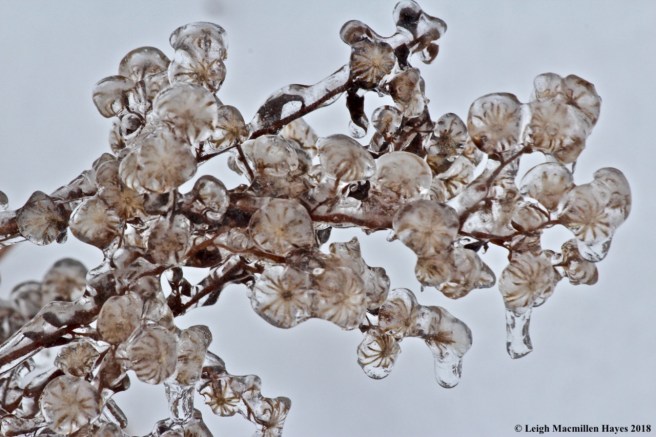
Yesterday’s flower brackets looked more like a cluster of tiny bioluminescent jellyfish today.

i-still sleeting?

It was a day of constant change creating its own beauty.

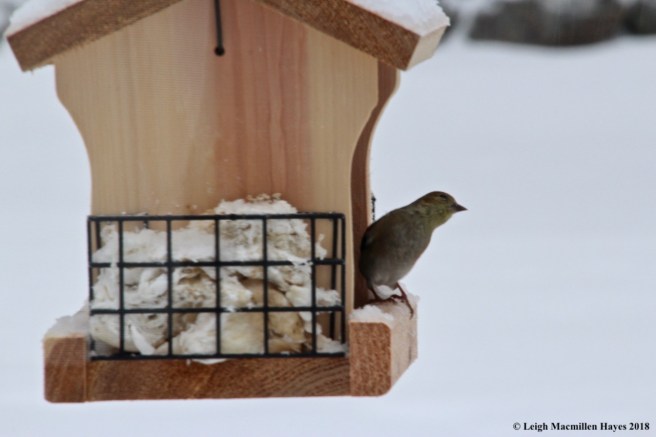
Periodically, like me, the goldfinch checked on the weather.

As the ice turned to sleet and then rain, he and I both knew that winter still reins.

Sunday’s Point of View

After church we had exactly five hours to pack our lunches, drive to the trailhead and complete our trek. After all, the New England Patriot’s were scheduled to play the Jacksonville Jaguars in the AFC Championship game at 3pm and we intended to be in the audience–from the comfort of our couch, of course.

p1-pleasant mountain sign

By 10:30, we’d pulled into the Ledges Trail parking lot on Mountain Road in Denmark (Denmark, Maine, that is) and began the one and a half mile walk back down the road. Our intended route along the trails of Pleasant Mountain in Loon Echo’s preserve was to climb up the Bald Peak Trail to the fire tower at the summit and then follow the Ledges Trail down. We love hiking a circular route, and like to get the road walk out of the way first.

p2-mountain stream

We had no idea what trail conditions would be like, but decided on micro-spikes, which proved to be the best choice. Beside the trail, the mountain stream was layered thick with icy sculptures.

p3-brook ice

Everywhere we looked, the water had frozen into a variety of formations.

p4-Needle's Eye

Less than a half mile up, we came to the sign for Needle’s Eye.

“Do you want to go in?” I asked my guy.

“It’s up to you,” he replied for he knows my love/hate relationship with the spur path to the geological feature.

“Let’s try,” I said.

p5-Needle's Eye

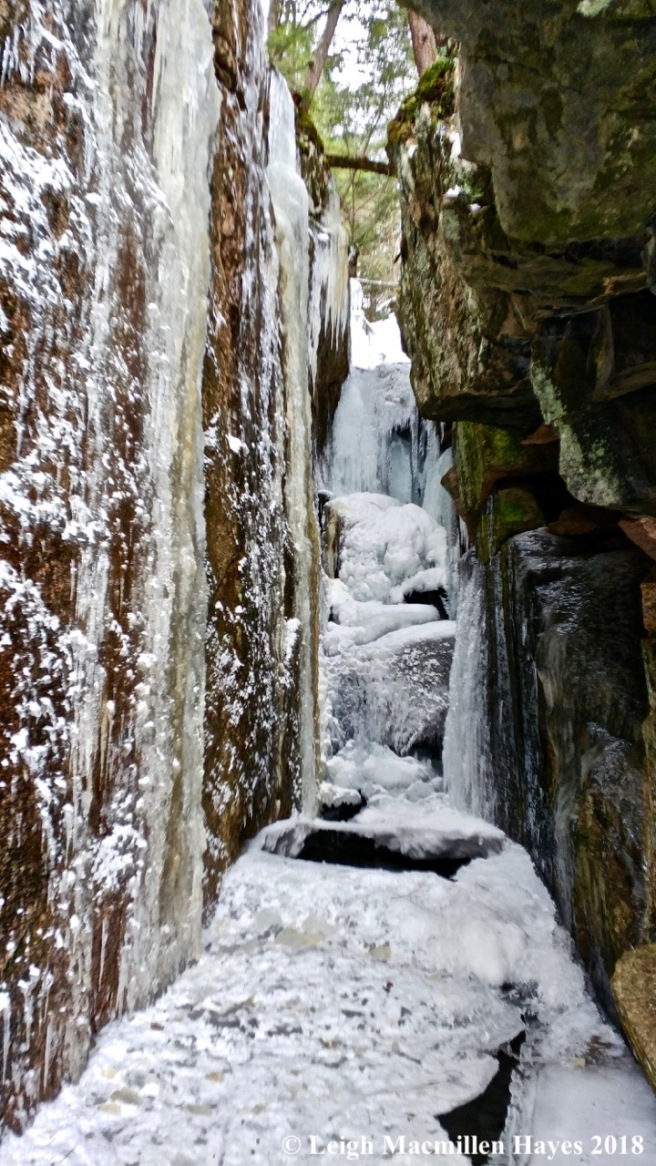
Somehow, we made it to the chasm in only a few minutes. And then we stood in awe, rejoicing that we’d made the effort for we were well rewarded.

p6-ice of the needle

At the back of the eye, the waterfall stood still for a moment. Eventually, we made our way back to the main trail, and I’m proud to say I only exclaimed once when a tree that I grabbed wiggled. I thought of my friend, Marita, and her patience with me last spring when my brain didn’t want me to venture forth along the spur.

p8-ice layers

Upward we continued, chuckling as we always do at the sign for Sue’s Way that also indicated we would reach the intersection of the North Ridge Trail in three tenths of a mile. Somehow, that three tenths always feels like three miles. Is it really only three tenths of a mile, we wondered.

p7-Sabattus Island on Moose Pond

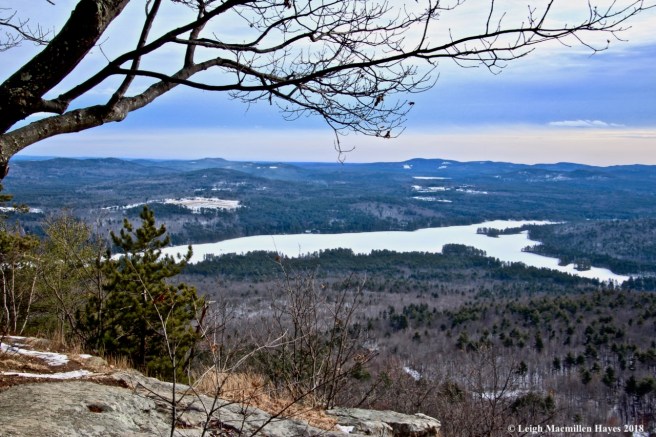
We were rewarded again, however, when we did pass by the intersection and continued on to the summit of Big Bald Peak. It’s always a spot to stop and look back at Moose Pond below where we could see our camp and Sabatis Island.

p8a-lunch rock looking north

It was just beyond that stop that we found lunch rock. Our view to the northwest was a bit obscured by the pines, but they helped block the breeze, so we didn’t mind.

p8-fire tower in distance

And to the southwest, the ridgeline we intended to walk. We could even see the fire warden’s tower at the main summit.

p9-crossing the ridge

After lunch, across the ridge we trekked, enjoying the sights along the way.

p10-Sebago Lake's open water

In the distance, we could see Sebago Lake and noted its open water which evoked a conversation about global warming. Many thought this would be the year it finally froze over again, but . . . not to be.

p11-racing through blueberry patch

Because trail conditions on the ridge were favorable, we moved quickly–practically running through the blueberry fields that will call my guy’s name come July.

p12-the tower

In what seemed like no time, we turned left onto the Fire Warden’s Trail and then made our way up to the iconic tower that was built in 1920. My hope is that it will still stand stalwart in 2020 and celebrate its one hundredth birthday.

p13-summit view toward Washington

Sometimes the summit view includes Mount Washington, but today the summits of the Presidentials were hidden in clouds.

p14-red pine scale

One scene that didn’t make us happy was that of the red pines. About five years ago I noted their decline and communicated with a forester who was studying red pine scale. Since then, most of the trees have been infested by the tiny insect and died.

p14-Southwest Ridge and sky

A much prettier picture we saw as we began our descent down the Ledges Trail, where the sky displayed a rainbow of colors above the Southwest summit of the mountain.

p15-Moose Pond from the ledges

As we made our way down, we paused as we always do along the ledges for which the trail was named. The south basin of Moose Pond dominated the vantage point.

p16-smiley face and heart

Along the entire route, we only met a few other hiking parties, but one apparently enjoyed the journey as much as we did and left smiles for our hearts.

p17-Needle's Eye

We arrived home with ten minutes to spare until kickoff.

Before the game began, we both agreed that our favorite point of view for this Sunday  was Needle’s Eye.

And now, the Patriot’s just defeated Jacksonville. That may mean two other scenes compete for today’s fav–when #24 Gilmore blocked Jacksonville’s final pass or Bill Belichick showed emotion before the game officially ended.


Clockwise Circumnavigation of Holt Pond

Though we were headed to a place we frequent, we thought we’d change up our trek by hiking in the direction that is opposite our norm along the trail system.

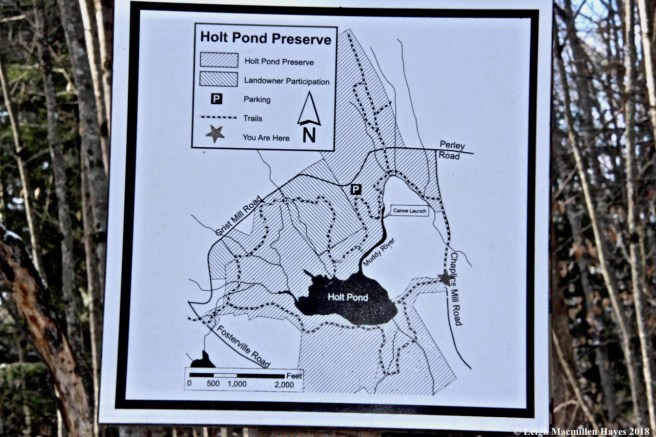
h14-trail map

And so for us, 12 o’clock was at the point where the trail was closest to Grist Mill Road. As we stepped on to it, I wore micro-spikes and my guy just his hiking boots. Within about fifty feet, I’d already banged snow off my spikes twice and decided they’d serve me better by being in my backpack.

h1-Following the boardwalk

It meant being aware of the boardwalks, most of which were covered with ice and snow, and post holing occasionally, but even if we’d worn snowshoes, we’d have ended up taking them off for the temp was in the 40˚s and snow not too deep.

h2-bear

One of the things I love about visiting a place often is that each time it has something different to offer. As we made our way to one and two o’clock on the map and passed through a hemlock grove, we discovered a bear den. Bears don’t always hibernate in caves and this one chose an old tree stump to spend the winter.

h3-quaking bog

I was with my guy, so it was no surprise that within no time we were at 3 o’clock, where we had to shuffle across the ice covered boardwalk in the quaking bog.

h4-bog rosemary

On the way back to the main trail, I mentioned that I’d be a bit slower, for there were reasons to take notice, like the bog rosemary leaves . . .

h5-pitcher plant flower pod

and dried pods of a pitcher plant.

h6-snowshoe hare tracks

Moving on toward 3:15 on the map, we began to notice snow lobsters everywhere. This particular hare, whose pattern reminded me of our marine crustaceans, had come from the quaking bog and passed into the red maple swamp. Do you see the pattern I’m referring to? The snowshoe hare had hopped toward the point where I stood, its front feet landing on a diagonal first, while its larger back feet swung around and landed in front. Consequently, the front feet served as the lobster’s tail, and the hind feet its claws.

h7-through the red maple swamp

Through the red maple swamp we journeyed to 3:30 with my guy obliterating more snowshoe hare prints as he went. Notice how his tracks were rather sloppy–he was again trying to keep from slipping off the icy boardwalk.

h9-two lodges

At about 4:00 by following the map, we stepped precariously onto the boardwalk that led to the Muddy River. Where once stood one beaver lodge, there were two–and both looked active.

h10-river to pond

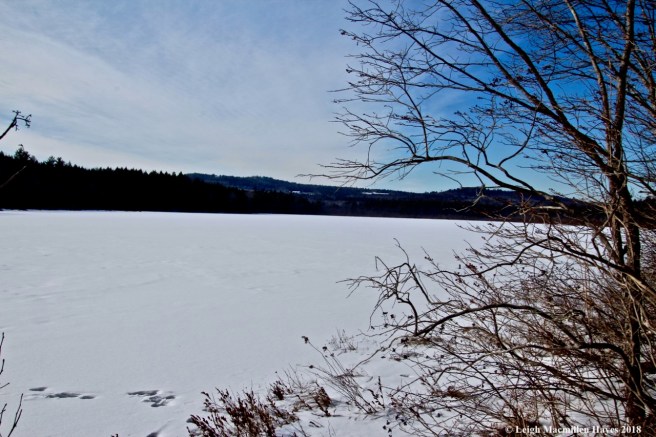
In the opposite direction, we looked out to Holt Pond, from which the frozen river formed.

h11-canoe

The canoe launch, further along the river, is located at 4:30. The only ones using it recently were some red squirrels who had created a midden beneath. But should you choose to venture out, bring your own pfd and paddle.

h12-beaver dam

As we moved on toward 5:00, we began to encounter beaver dams–at least three of them, for so active had been this community of large rodents.

h13-mink tracks

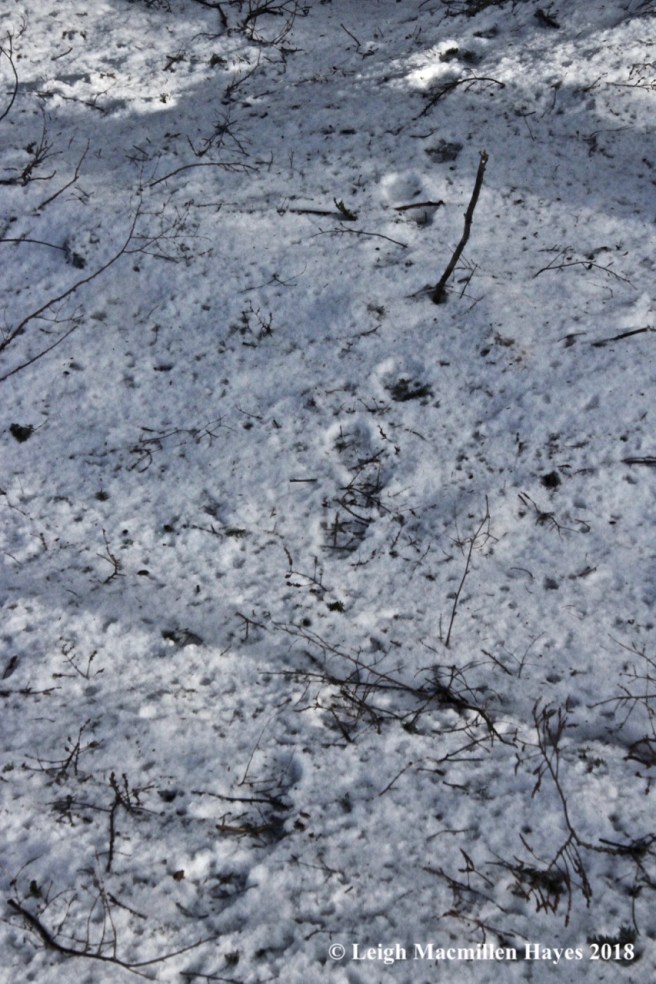
And at 5:30, as we followed the river out to Chaplins Mill Road, we started to encounter tracks on a diagonal that spoke of their creator–a mink. Notice how one print in each pair is just ahead of the second. That’s a typical characteristic for all members of the mustelid or weasel family.

h16-southern end of Holt Pond

Lunch stump was at 6:00, where the trail veered back off Chaplins Mill Road and returned to the pond. As we ate, we realized we weren’t the only ones who chose to dine in this spot, such were the pinecone caches under every white pine and hemlock.

h17-mink

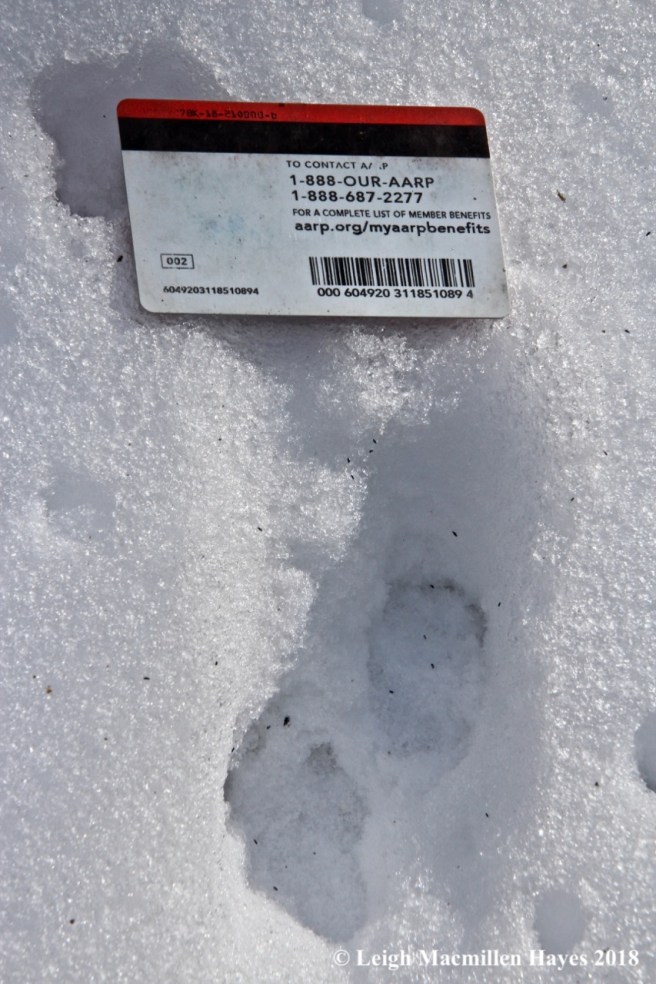
Continuing on toward 7:00, we spied more mink tracks. I didn’t have my usual tracking gear with me, but the AARP card measured about three inches, the trail width or straddle of a bounding mink.

h18-mink

For straddle, we typically measure the distance from the outside of one foot to the outside of the other within a set of prints. Stride, or the distance from one set of prints to the next, varies greatly with bounders like a mink, so that’s not important. But that diagonal orientation–rather consistent.

h21-snow and ribbon lichen

As we made our way toward 8:00, a hemlock tree gave me pause–for the intersection of lines and color upon its bark–the vertical white snow enhanced the horizontal green ribbon lichen.

h22-fisher tracks

By 8:45, we had reached the northern end of the pond, which was to our right. It was there that we realized another traveler had joined the dance–as evidenced by its larger prints. A fisher.

h23-fox

And then we kept encountering a red fox from 9:00 on. Well, not the fox exactly, but its own telltale prints.

h24-water obstacle

All along, we wondered what we’d encounter at our 10:00 point, the trail intersection closest to Fosterville Road. We could hear the water before we saw it. And then my guy met it up close and personal, breaking through ice and coming up with wet feet. I, too, had one wet foot for one of my Sorel boots had a blowout and the upper split from the sole–a major disappointment for though the boots are old, they have plenty of traction left.

h25-water over boardwalk

Anyway, we contemplated the underwater boardwalk and knew we had an escape route behind us, for we could have walked up to the road. But . . . we didn’t. The water was about four inches deep and we went for it, figuring we were already wet and we only had about a half mile left to cover in the five mile journey.

h26-pileated tree

On the map, we were at 10:15 when my guy noted fresh pileated woodpecker works.

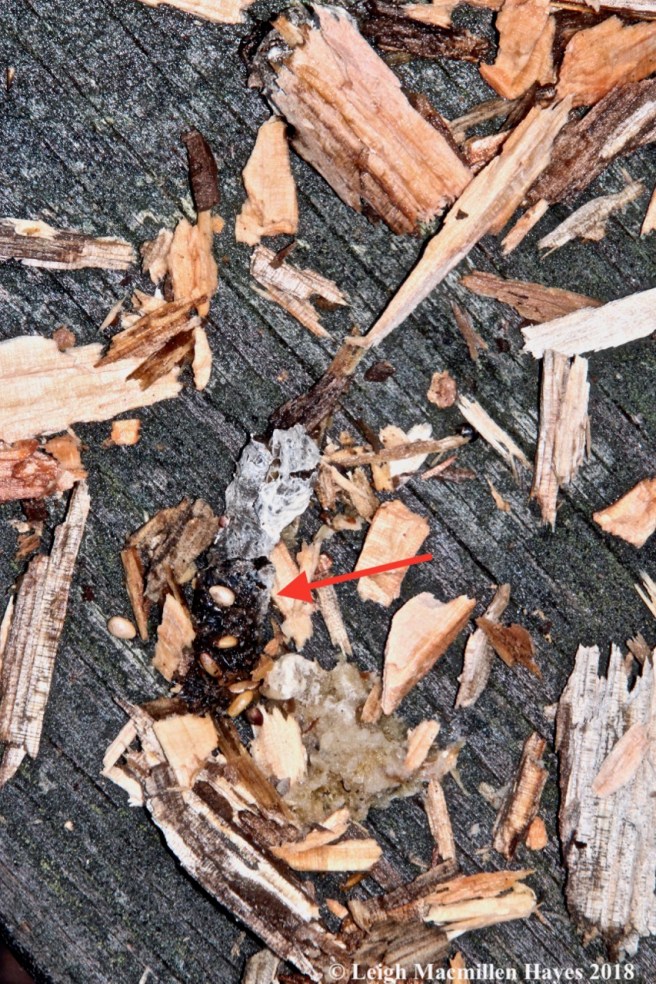
h27-pileated scat

I had to look. And wasn’t disappointed. Several scats were visible, filled with seeds and insect body parts.

h28-northern end

We moved on to 11:00 and passed through another red maple swamp . . .

h27-winterberry

where the color of winterberries had changed from bright red to wine,

h28-frozen mink tracks

frozen tracks spoke of an earlier journey by a mink,

h31-yellow warbler nest

and a yellow warbler nest remained attached in the crouch of a shrub.

h29-northern end of Holt Pond

Our last look at the pond was through the shrub level and though we couldn’t actually see it, we knew it was there, outlined to the south by the evergreens.

h33-my guy's print

At last I followed my guy out. We’d reached 12:00, the beginning and ending point of our clockwise circumnavigation around Holt Pond.


Winter Reflections

My world is always transformed during a snowstorm and even the day after. So it was that yesterday about four inches of the fluffy white stuff drifted down and created a wonderland effect.

a1-snowflackes on Queen Anne's Lace

Even this morning, the individual snowflakes were still visible in their crystalized form (and I kicked myself for not packing my macro lens.)

a2-coyote and red fox tracks

I began the day with a slow journey from home to Pondicherry Park, with the intention of meeting a hiking group. Along the way, I realized that others had trekked before me. Two red foxes and a coyote had crossed paths, forming an X that mimicked the X pattern in their individual footprints. (The bigger prints from upper left to lower right being the coyote; and the smaller prints from lower left to upper right being the two foxes.)

a3-red fox with chevron

In almost direct registration, a hind foot of the fox landed on snow previously packed down by the front foot, so what you see are the two prints. The top print was a bit fuzzy in formation for so much is the hair on the fox’s foot. Despite that, toe nails, toes and the chevron pad at the back, plus the X formation between toes and pad seemed obvious.

a4-Stevens Brook

As I made my way through the park, the morning light on Stevens Brook drew me off trail to the frozen edge. And ice along the bank indicated the change in water levels since the heavy rain of a few days ago.

a5-Bob Dunning Bridge

At last I reached the gateway to town, which is also the gateway to the park–the Bob Dunning Memorial Bridge. I have a great fondness for this bridge on many levels, including memories of Bob who passed away suddenly at least ten years ago, the barn-raising community effort to build it, and the fact that each beam represents a different tree, bark included. You can learn more about it by reading my previous blog post: Barking Up A Bridge.

a6-snow on bridge

And each time I walk across it, it seems to offer up something different. This morning, it was how the snow coated the railing. I think the artistic side of Bob would have approved.

a7-AMC group at bridge

On the other side, I met up with a group of seven women. Led by AMC volunteer JoAnne Diller, our intention was to tramp through the park following all the outer loops, including a link on the Lake Environmental Association‘s Pinehaven Trail at the Maine Lake Science Center. Along the way we visited with each other, enjoyed the beauty that surrounded us, and got some exercise.

a10-Stevens Brook

And then we returned to the bridge and parted ways. I choose to follow the inner trails home, pausing first to enjoy the color of Stevens Brook from the bridge’s center.

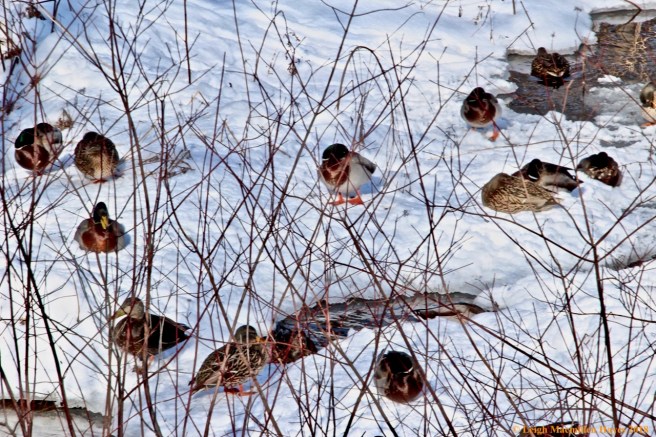
a8-mallards

And no winter visit to the park is complete without taking time to watch the ducks–and listen as well.

a8a-mallards

They gather by the dozens, some to rest while others seemed to be in constant motion.

a12-ice skirt

Before following the trails leading west and toward home, I returned to the scenic overlook where ice skirted a tree–again indicating that the water was recently much higher.

a13-eddy

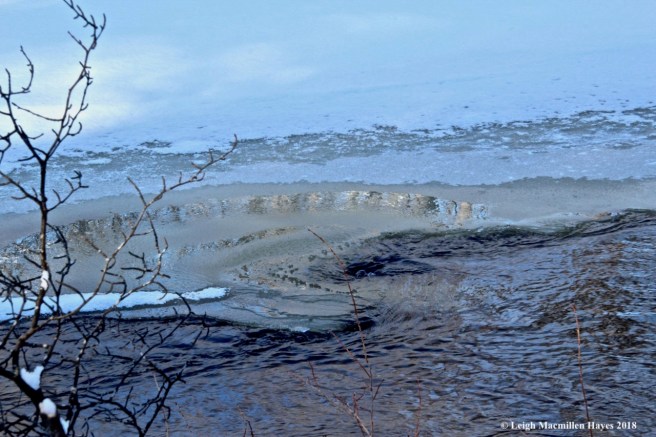
In the same spot I watched water swirl in a small eddy and am amazed that I’m not still standing there–mesmerized as I was by the action.

a14-yellow birch sculpture

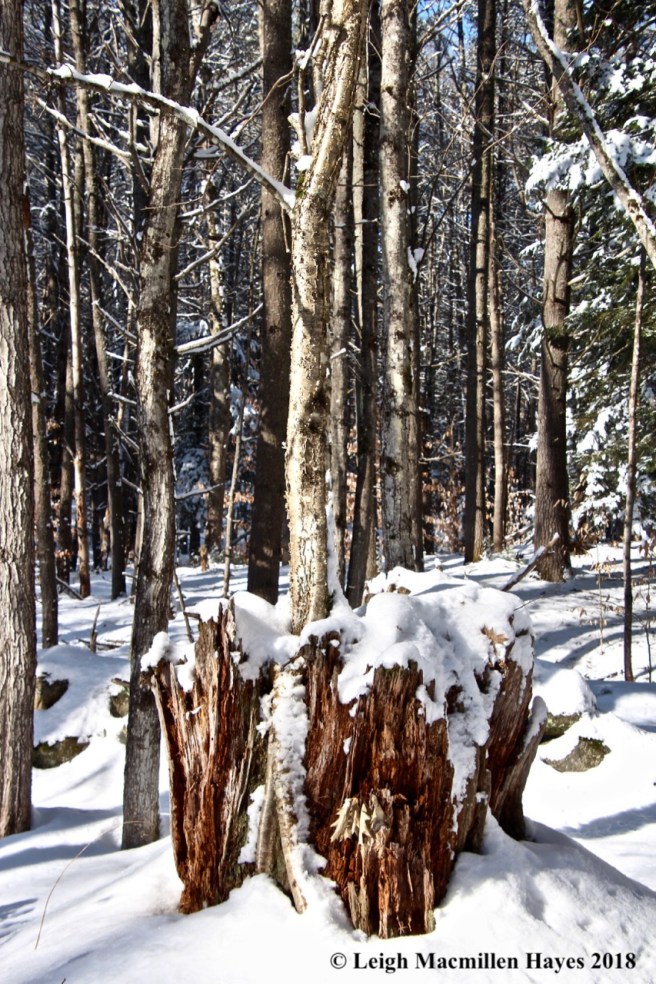
But my stomach was growling and so I continued on–stopping to admire another of nature’s wonders–a yellow birch that germinated atop an old pine stump and today stands as a sculpture of one member of the community supporting another despite their differences. Hmmmm.

a15-bench awaiting visitors

The trail I followed home was less traveled than the others and the snow a bit deeper because it hadn’t been packed down. When the park was first created by Lakes Environmental Association and  Loon Echo Land Trust, the AMC did some trail work and part of their offering was this bench. Though it hasn’t recently supported a weary traveler or one who just wants to set for a time, I trusted that day will soon come again.

a16-AMC bridge

I crossed the bridge near the bench, which was also built by the AMC crew. And from there, I headed home to lunch, but not without offering a smile of gratitude to JoAnne for continuing to volunteer to lead walks for the AMC and giving us all an excuse to enjoy the company of each other in this beautiful place.

a17-Saco Old Course

Later in the day I found myself in Lovell for a quick errand and the light was such that I felt the need to spend a little time beside the Old Course of the Saco River just down the road in North Fryeburg.

a18-Saco Old Course

The scene is never the same, nor is the light. What may have seemed monochromatic was hardly that.

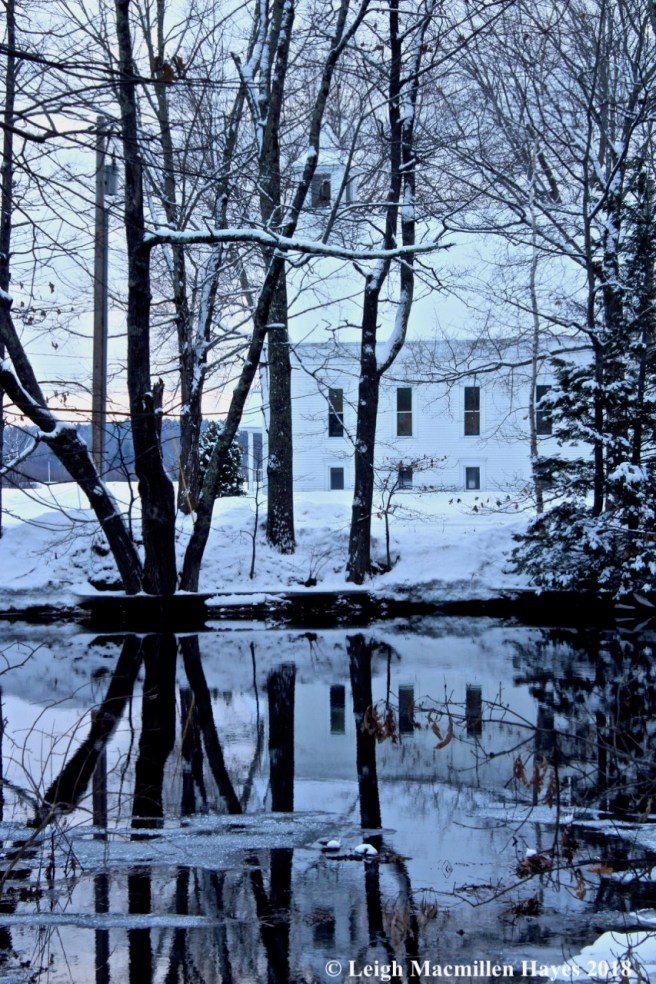
a19-church

As the sun began to set, the water still harbored reflective moments.

a20-setting sun

And it transformed some reflections from crisp representations into impressionistic paintings.

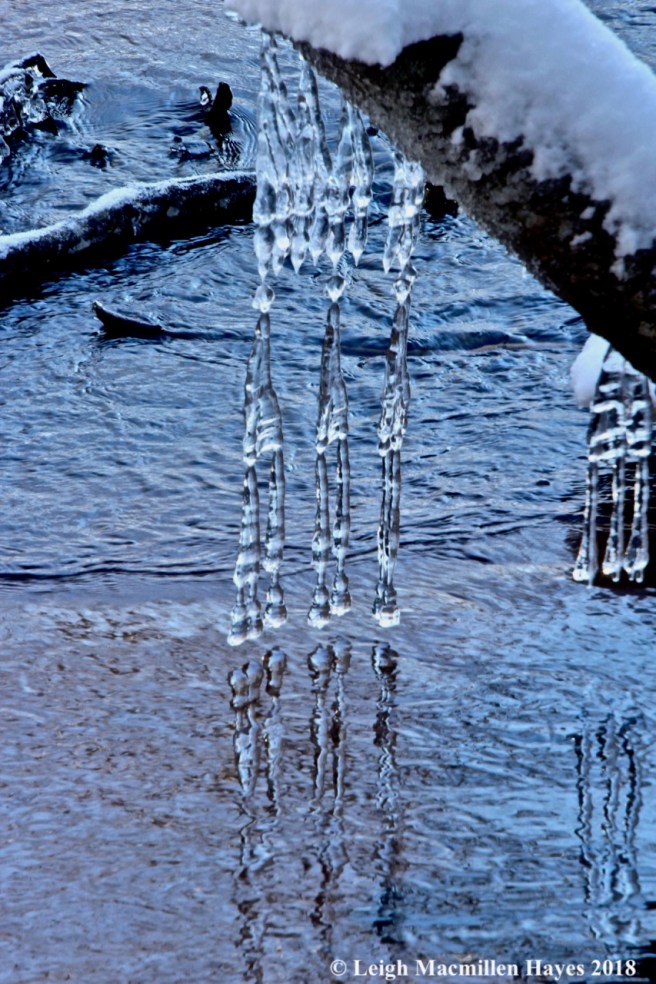
a11-ice chimes again

At the end of the day, however, my favorite reflection of all was one spied along Willet Brook in Pondicherry Park by Eleanor, a member of our morning AMC trek.

a9-ice chimes

Winter chimes. Winter reflections.


Finding Our Way at Back Pond Reserve Mondate

One of my favorite winter hikes upon property owned by the Greater Lovell Land Trust is at Back Pond Reserve in Stoneham. And so this morning I convinced my guy that it was the perfect trail for us to explore.

b1-the mountain trailhead

We parked on the Five Kezar Ponds Road near the trailhead for Ron’s Loop and then walked back to The Mountain Trail to begin our ascent. The reserve is a 259-acre property, with all but ten acres located on the north side of the road. The other ten south of the road will remain forever wild. Those latter ten acres were purchased in 1980 by twelve families who owned properties on Back Pond. Eighteen years later, they deeded the land to the GLLT. And then the Five Kezar Ponds Watershed Association generously helped the GLLT acquire the 249-acre piece through two purchases made in 2006 and 2010.

b2-poles at kiosk

At The Mountain Trail kiosk, plenty of information is available, including trail maps and walking sticks. The latter brought a smile to my face for it spoke to the continued generosity of those who know and love this land best.

b3-oak and beech leaves

Given the recent rain that drained our snow pack significantly and was then followed by another blast of arctic air, the trail was well packed. We could tell that a few others had traveled this way either with snowshoes or without–such were the impressions left behind. And within some of those impressions, beech and oak leaves gathered–speaking to the forest we were passing through.

b5-big toothed aspen

Not to be left out was the occasional big-toothed aspen leaf.

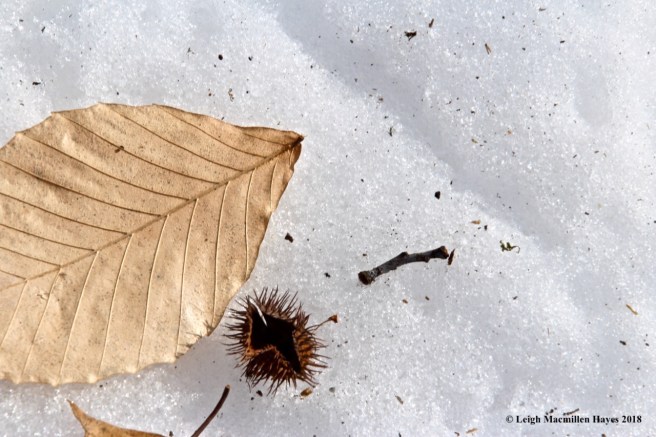
b6-beech leaf and husk

But really, it was the beech that we saw most often.

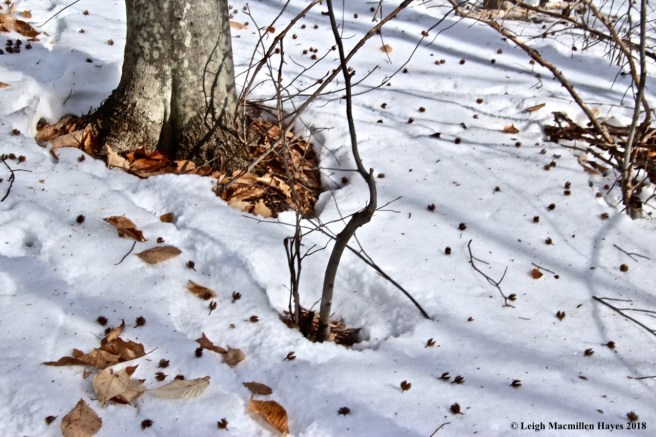
b6a-beech husks litter

And scattered everywhere–beech husks empty of seeds indicating it had been a mast crop year for this species. How viable the seeds were will remain to be seen.
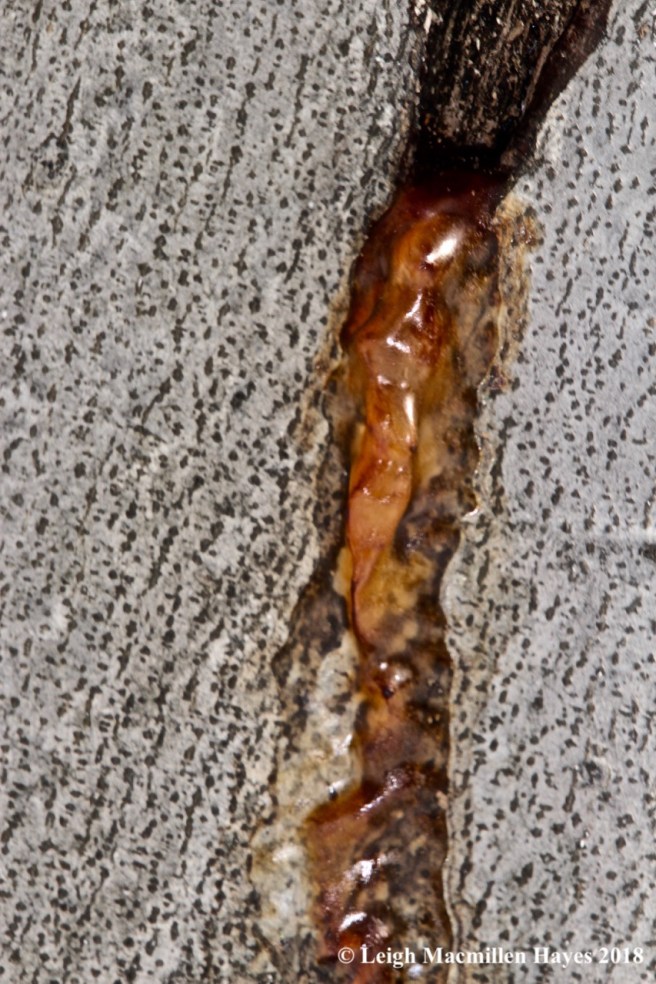
b11-beech sap

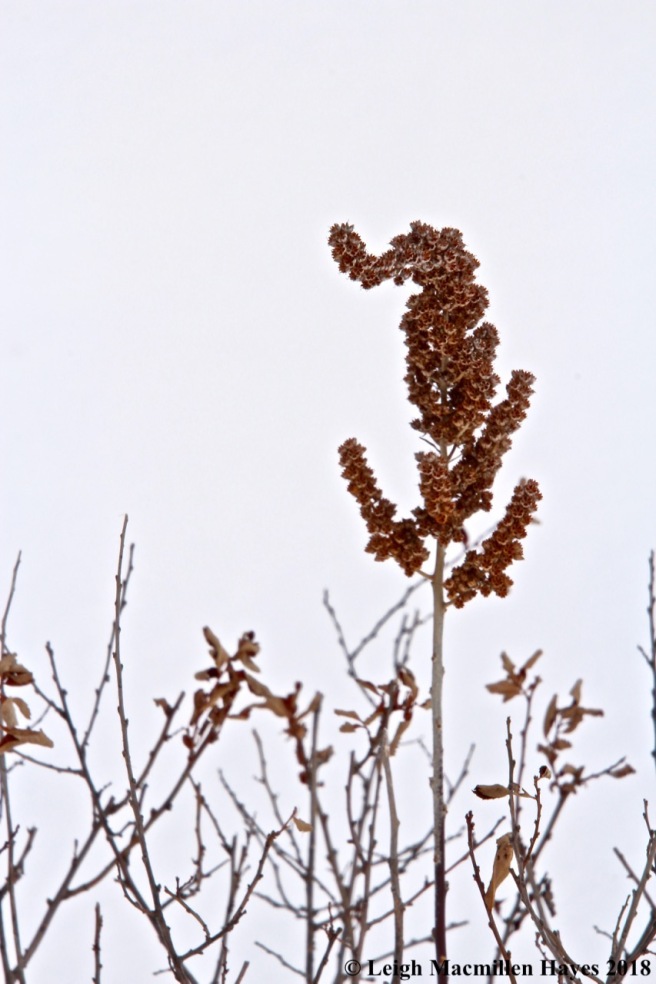
In old wounds on several of the beech trees, amber sap had flowed and reminded me that not all sap comes from maples.

b9-trail conditions varied

Where the sun had reached the trail, conditions varied.

b7-microspikes

As the lay of the land began to get steeper, my guy decided to don his micro-spikes. One of the thoughtful efforts found periodically along the way–benches provided in the name of Ron Gestwicki who had longed served as president of the Five Kezars Watershed Association. A perfect place to rest, take in the surrounding beauty, or slip on micro-spikes.

b8-microspikes

I wore mine from the get-go and have found them the easier way to travel the past two days. It’s kind of like adding chains to the tires of a plow truck. With the spikes digging in, though I had a pole attached to our backpack I didn’t need to use it.

b10-trail makrers

The Mountain Trail is blazed with blue dots and someone used ingenuity to attach a fallen sign to a twig.

b12-turn onto old jeep road

It didn’t take long to reach the old jeep road that led to the summit. We made the left hand turn, but had a mind to go off trail for a bit.

b13-bear tree

Our first turn was to the left for we knew that bear trees stood tall there–at least for now because some looked like they were in rough shape given the beech scale disease that affected them.

b14-sidetracked to right

And then we headed off to the right, bushwhacking our way to a bit of a ledge where we hoped to find signs of a bobcat. I’m forever hopeful, but once again we came up empty handed. Previously, we had seen tracks and scat crossing the trail in numerous places, so we probably weren’t too far off with our speculation.

b15-ledge view

What we did find, a first view of the ponds below . . .

b16-trailing arbutus

and a certain sign of spring recently exposed in the form of trailing arbutus.

b17-back on trail

Finally, we headed back to the main trail and continued to climb toward the summit.

b18-porky prints

Though in general, tracking conditions weren’t great, we did find one expected customer–porcupine. It seems any time we travel this trail we find porcupine evidence.

b20-5 Kezars 1

At last, we reached lunch rock, where the view stretched from a few of the ponds across to Shawnee Peak Ski Area at Pleasant Mountain.

b22-Kearsarge and beyond

The Presidentials came into sight.

b23-Mount Washington in mix

And, of course, Mount Washington, which also displayed less of a snowpack.

b25-orange trail

From the summit, rather than hike back down the same trail, we turned to the backside and followed the orange connecting trail.

b26-swampy area

It’s fun for the community switches from hemlocks, pines and spruces to a small boggy area that offered a challenging crossing and finally back to beech and oak.

b27-beech sap again

And among those beech trees, another that had fallen and leaked sap from its butt end, plus . . .

b28-bear trees

more bear trees.

b29-brook crossing

On the downslope, we heard water running and wondered what our first brook crossing would be like. In the past, we either used a rickety old bridge, or tried not to use it.

b31-old bridge

Today, my guy went across first, and found pieces of the old bridge buried in snow. We knew we were better off without it.

b30-ice and water

I, of course, needed to stop and admire the flowing water and ice.

b32-more ice

Again and again.

b33-orange lichen

Much to our surprise, we found one more cool feature of this trail–the rare orange paintitous (is that a word?) crustose lichen. :-)
b35-turning onto Ron's Loop

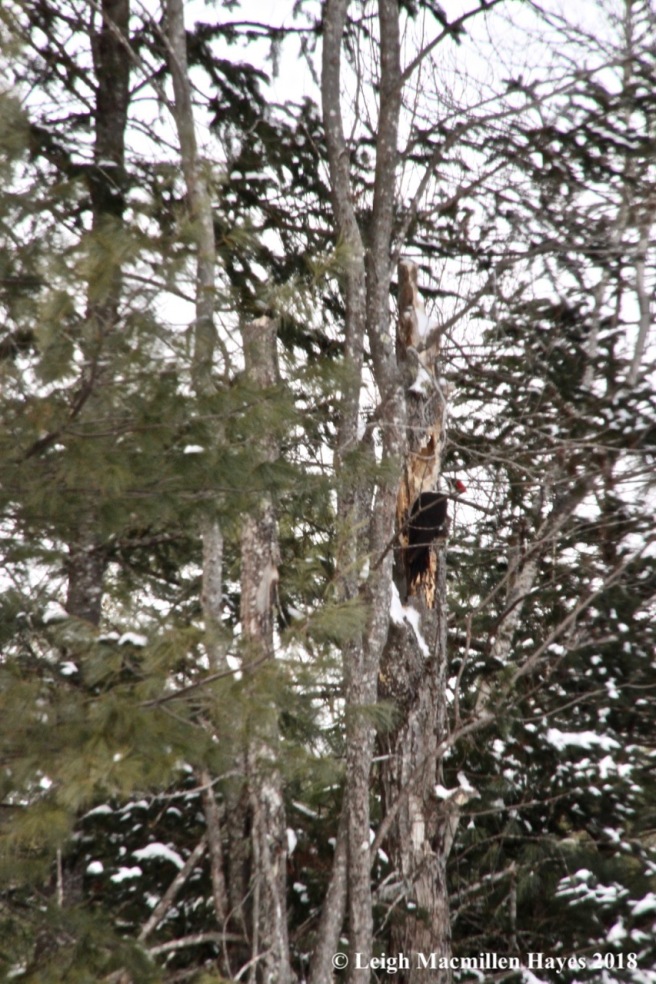
Not far from the rare find, we turned left and then right as we crossed the bridge and found ourselves on Ron’s Loop.

b36-brook and wetland

Below the bridge, the wetland bespoke more of the melt down efforts. In the past, we’ve found plenty of otter prints and slides in this area. But today, it was difficult to distinguish anything.

b37-ruffed grouse scat

We did, however, find a pile of ruffed grouse scat!

b39-H is for Hemlock

And proof that H is for Hemlock. (And Hayes)

b40-new bridge

Finally, we reached the second bridge that took us back across the brook. The bridge was built this past summer by the GLLT interns and Back Pond Reserve stewards. We truly appreciated it for many a times during the winter, the crossing had been to wide and we’d gotten wet.

b41-which way should we go?

After completing the loop, we once again gave thanks for all those who had preserved the land and created the trails so that the mammals that call this place home and folks like us could journey there.

With ease we thoroughly enjoyed this Mondate as we found our way at Back Pond Reserve.


Melt Down

After a few weeks of extreme cold, January did what it always seems to do–cranked up the thermometer. That might have been okay except that with the warm temps (40˚s and above) came the rain. And with the rain came the fog. And with both disappeared the snow.
j1-soggy bluejay

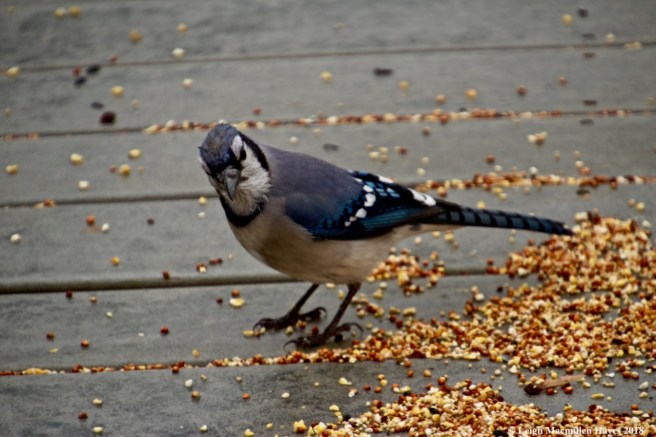
And so our deck was clear, except for the bird seed, of course. And a rather bedraggled bluejay. I’d noted in the past few days that all of the birds are much skinnier than I remembered, given that they didn’t need to puff out their feathers and insulate themselves from the cold.

j2-squirrel feast

The gray squirrels also came by, their mouths like vacuums as they scoffed much of the sunflower seed supply.

j3-squirrel feast 2

They, too, offered a rather bedraggled appearance, but the rain didn’t stop them from getting their fill.

j4-snow thaw and debris

And then, the rain ended, clouds moved swiftly southward, arctic wind gained strength, temperature dropped dramatically, and sun shone brilliantly. Abruptly, the thaw ended. That was fine with me for I was afraid we’d lose all of our snow cover. As it was, we lost well over a foot in the past two days. And what’s left was riddled with natural debris.

j6-vernal pool

I decided to check on the vernal pool, curious about its condition. As expected, it was still frozen, but with that yellowish brown ice of warmer days.

j7-leaves embedded in ice

Fallen leaves remained entrapped in the thin, mosaic layer.

j10-ice on ruts

Nearby, I found open water in many places; some of it with thin ice designs decorating the edges.

j25-ice

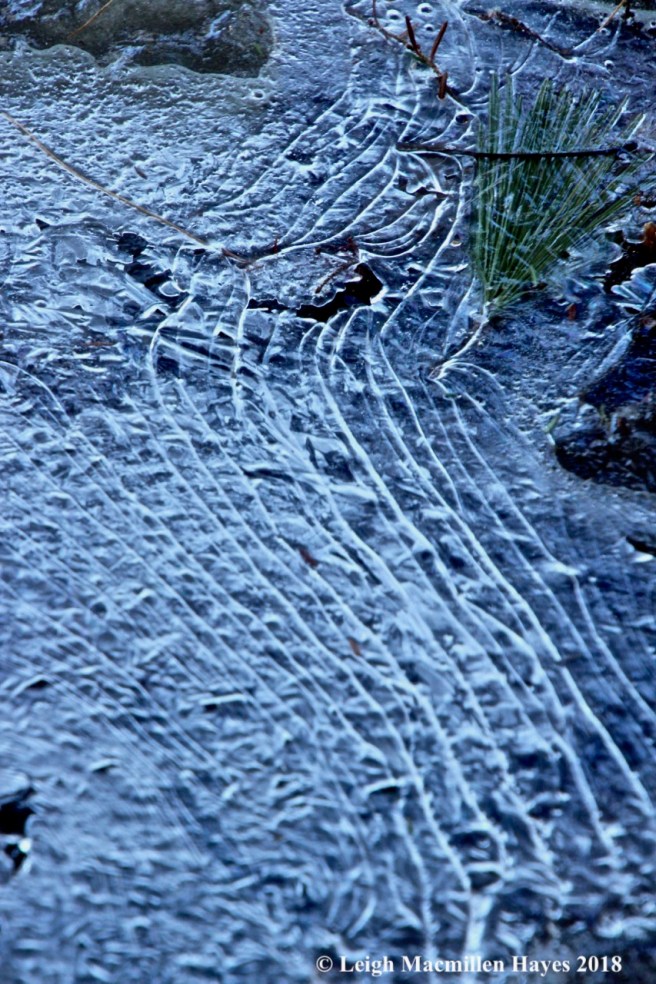
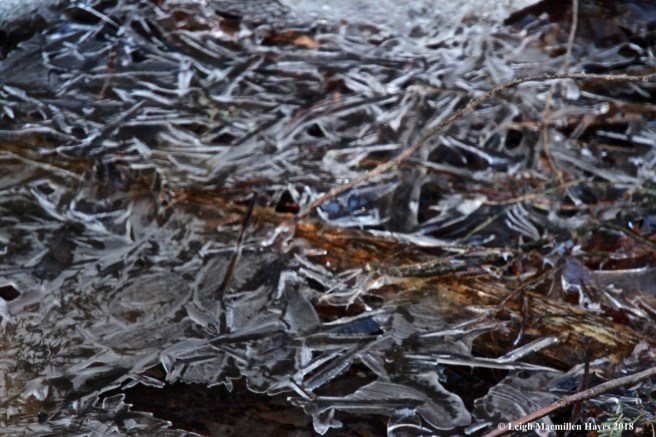
Ice forms in various ways . . .

j11-ice forms

and these three offerings were a few feet of each other.

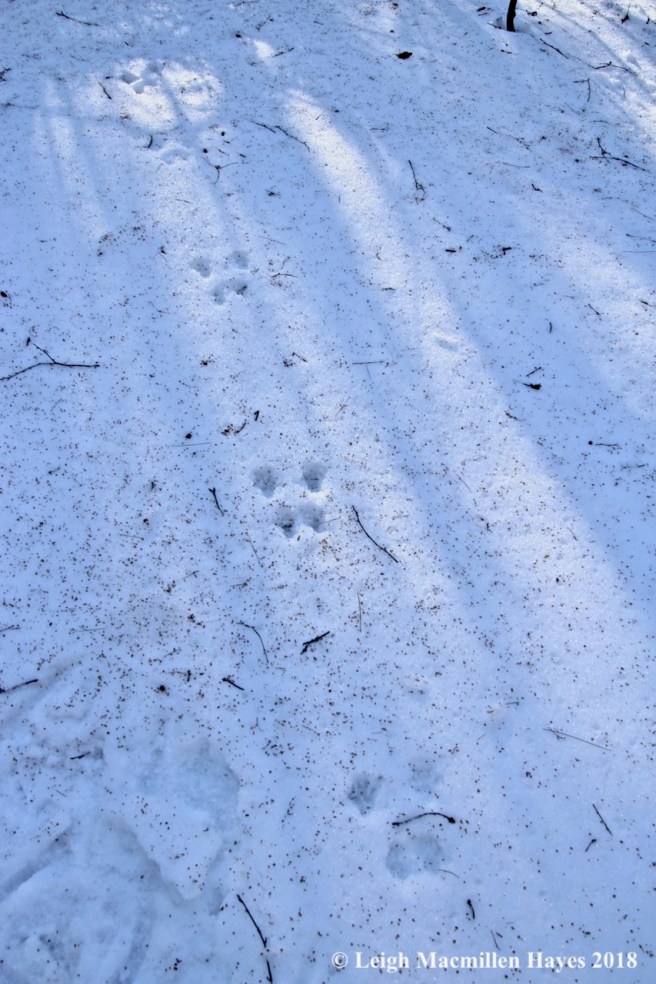
j8-squirrel tracks

I discovered the ice as I followed red squirrel tracks created when the snow was a wee bit softer. By the time I moved across it had started to freeze again and though my snowshoes made a lot of noise and got a wee bit wet and frosty, I was thankful for them as they made my tramp easier.

j9-squirell prints

The beauty of the squirrel prints was that their toes and toe nails showed. It’s a rare occasion when conditions are just right for good prints.

j12-my squirrel cache

My next destination was to check on the creator of the tracks. And I felt as if a sun spirit was doing the same. Meanwhile, the squirrel chatted at us from a nearby tree.

j14-cones exposed but not touched

The top of its pile had been exposed, but I suspected the cones hadn’t been touched. Instead, the snow had melted off of them. I think he’s saving this pile for another rainy day.

j15-midden exposed

In the meantime, he has been busy as demonstrated by a midden slowly growing near another of his stashes.

j16-turkey prints

I decide to let him feast in peace, and instead followed some turkey tracks to another location.

j11-witches butter fungi

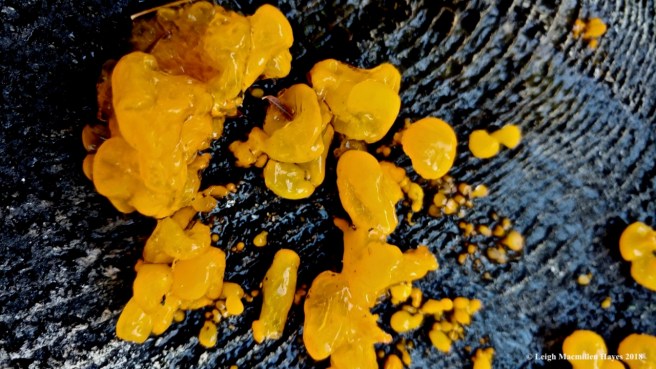
Along the way, it was the witches butter on an old pine stump that gave me pause. It’s also called orange jelly fungus and some say it looks like a brain. I wish I’d seen this small patch more recently, because I wondered if it had grown under the snow or if the melted snow and rain had affected it. Either way, it’s always a fun find and especially now as it adds a dash of color to our somewhat monochromatic landscape.

j17-pileated tree

My next great find was a pileated tree. I last saw it a few weeks ago, but it seemed to me that even more chiseling had taken place.

j18-pileated tree

At first, when I saw the gray wood above, I thought it might have been older work.

j19-pileated tree

And that the newer work was much lighter in color. Do you see the chisel mark? Just imagine the head banging that went into this masterpiece.

j20-pileated debris

Like the squirrel, a growing pile below added to the story. For me, it was the realization that the gray wood was excavated at the same time as the lighter wood. My new theory, the gray wood had been caused by a fungus or rot of some sort and then the insects followed and finally the woodpecker. If you know otherwise, please enlighten me for I want to understand. Of course, I looked for scat, but came up empty handed. Drats.

j21-second vernal pool

At last I reached a second vernal pool, though the going was a wee bit difficult given the conditions. This one was more open than the first.

j22-ice melting

And on this winter day that began with the tail end of a heat wave, but had chilled significantly, a watery reflection was a fun treat.

j23-sun setting behind vernal pool

On my way home, I made one more stop at the first vernal pool while the sun began to set behind it. I trust it will freeze up again, probably tonight.

What surprised me was how much had melted in the last two days. And from the looks of photos I’ve seen posted by others today, my neck of the woods shows only a wee bit of the January thaw.

We’ve had a melt down. Now it’s time for a freeze up.  Back into winter we shall go–thankfully.


The Day After the Bomb Cyclone

We survived yesterday’s blizzard, but I wondered about our neighborhood. Last night the winds howled and we watched snow blow from north to south on a horizontal plane.

b-snow cloaked well

As I headed out to check on the situation this morning, I noticed the cloaked well, so had the snow swirled about its structure.

b-stone wall

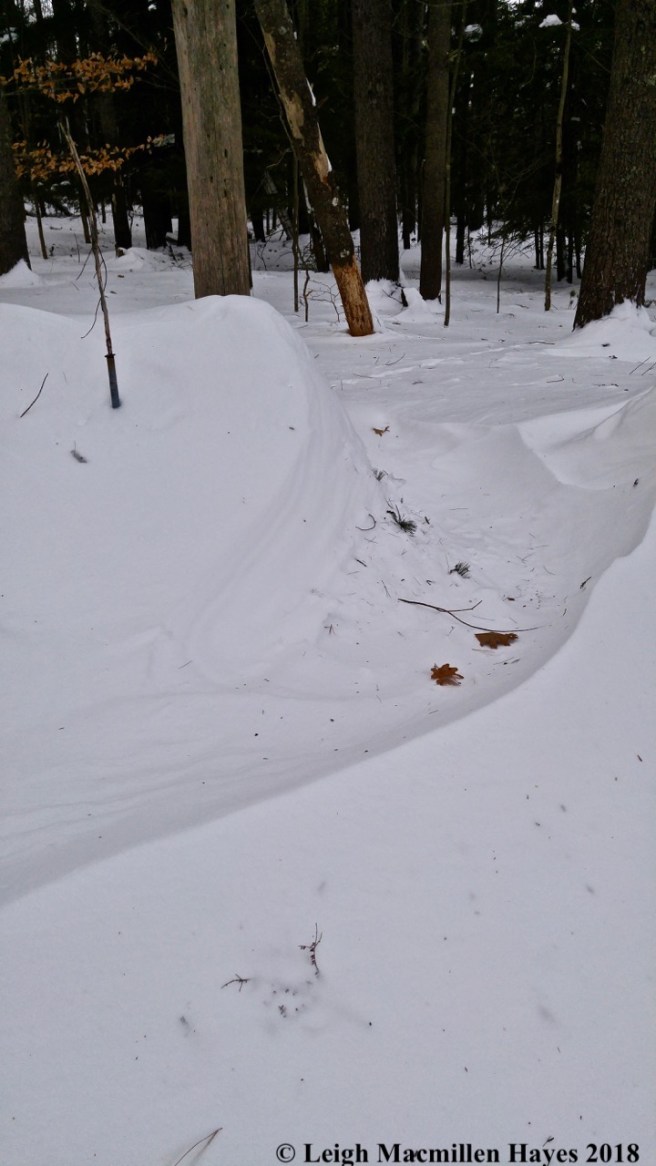
The pattern repeated itself in so many places including the gap in the stone wall.

b-pine needles in pileated woodpecker hole

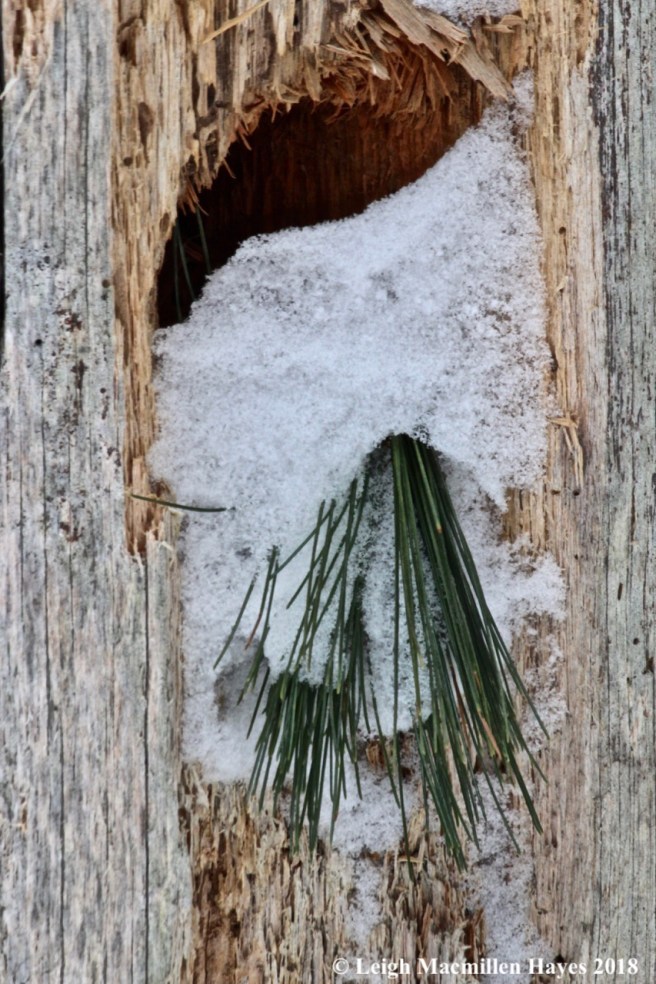
And in the aftermath came new ornamentation in unexpected places, like pine needles in an old pileated woodpecker hole,

b-witch hazel leaf

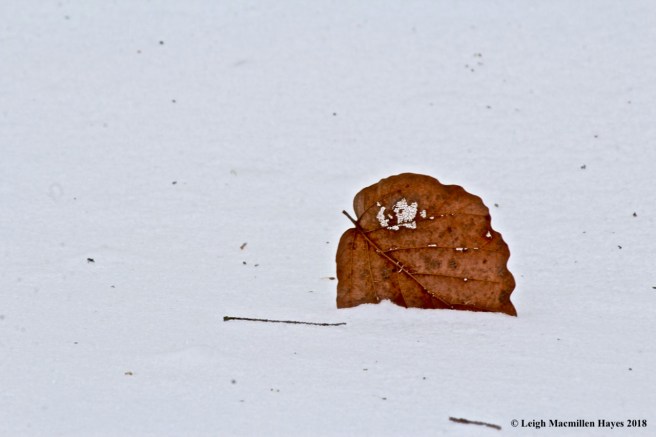
a single witch hazel leaf standing upright,

b-maple seed atop hemlock needles

and a maple seed resting upon a hemlock twig.

b-snow fort 1

There were snow forts in various forms–some with arches . . .

b-snow fort 2

and others with turrets.

b-ice march

Though much ice had finally fallen, some continued to march across twigs . . .

b-gray birch new catkin

and coat new catkins with an extra layer of protection against the frigid air.

b-gray birch catkins

Scattered about on top of the snow most everywhere I looked, however, were the scales of the fleur de lis and miniature seeds of various birches and cones scales and seeds of evergreens. Somehow, and perhaps its because the ice still held them in place, many catkins still hadn’t sent their tiny seeds flying. For the birds and mice who dine on them, a slowed dispersal might mean food security.

b-red squirrel hole and prints

I wondered about the mammals and saw only red and gray squirrel tracks, in this case a red who left its tunnel to bound across to another below a tree. Later, one gray squirrel hopped slowly through the deep snow. Eventually it climbed a tree and moved with much more agility across its branch highway.

b-deer bed

Deer were the only others that had moved. One had found the southern side of a tree to bed down for the night, such is the form you may see here, with the smooth side of its back being to the left. I could imagine the snow swirling about it, but trust that at the same time, the depth added an insulating quality.

b-deer fed on fungi

I wondered what the deer had been foraging since the acorns were becoming more difficult to acquire. Curiously, I found that several downed trees I knew had been covered with fungi were freshly excavated and harvested.

b-deer feast 1

Red maple bark . . .

b-deer feast 2

also showed signs of a recent dining experience.

b-common milkweed aphids

Back home after a few hours spent trudging through snow so deep that at times I was up to my knees despite my snowshoes, I made a point to visit one more spot beside the front door–where the milkweed grows. Do you see the two insects atop the pod? Those were Oleander aphids who fed on the plant previously.

b-common milkweed 1

Despite all the wind of yesterday and last night, I was surprised to discover that the seeds hadn’t all yet floated on to new homes.

b-common milkweed 2

Like so many others, they remained huddled together.

The day after the bomb cyclone or bombogenesis storm, so named because of the steep drop in atmospheric pressure that occurred, I discovered that most of the world was still curled up. With more wind and frigid air in the forecast, hunkering down is a grand idea.


Book of January: Winter World

It seemed only apropos as a blizzard intensifies that the January Book of the Month be Bernd Heinrich’s Winter World: the ingenuity of animal survival.

w-Winter World by Bernd Heinrich

In this very readable book, biologist and illustrator Heinrich takes us into the depths of animal adaptation that allows even the tiniest among us to deal with the elements in order to avoid freezing to death. Of course, some do. And others become food.

A main theme of the book is the yellow-crowned kinglet, a bird Heinrich describes as weighing as little as two pennies. I’ve only had the honor of observing these tiny birds a couple of times, but daily watch other birds puff out their feathers to insulate their bodies from the frigid temps we’ve experienced this winter.

w-snow on pines

The bird frenzy was crazy at the feeders all day today. And the blizzard conditions drew me outside for a while on a quest of my own to see what else I might observe. Other than lots of snow, I didn’t see much. A few chickadees flew in to check on me as they worked on hemlock cones–in their attempt to release seeds. And I startled a ruffed grouse, which in turn startled me.

w-no Mount Washington in sight

But really, the wind was strong and view at times quite limited.

w-gray birch

One of the curious things that Heinrich doesn’t address in this book is the affect of a changing habitat on survival. With all the snow and ice we’ve had, gray birches everywhere have bent with their burdens. I know this area to be frequented by snowshoe hares, but suspect that will change as the birches die and red maples take their  place.

w-deer tag

It’s also an area that the deer pass through, not stopping to rest for it’s a bit wet at times, but certainly pausing to browse.

w-deer rub

And leave behind their scent.

w-vernal pool

Nearby exists my favorite vernal pool. In chapter 13: Frozen Frogs on Ice, Heinrich addresses the chemistry that allows the wood frogs and peepers who will sing from this pool in the future to become frost-tolerant. “When the first ice crystals begin to form on or in the skin of a wood frog, it sets off an alarm reaction. Skin receptors relay the message of freezing to the central nervous system (CNS), and the CNS activates the adrenal medulla to release adrenaline into the bloodstream. When the adrenaline circulates to the liver, it there activates the enzymes that convert the liver’s stores of glycogen to glucose. In the wood frog, this response is massive and before the ice reaches the cells they become packed with glucose that acts as an antifreeze . . . in about fifteen hours, the frog is frozen solid except for the insides of its cells. Its heart stops. No more blood flows. It no longer breathes. By most definitions, it is dead. But it is prepared to again revive at a later date.” As he says, the wood frogs (and hibernating bears) are “biological marvels that challenge the limits of our believes of what seems possible.” 

w-goldenrod gall

There’s so much more in his book, including chapter 14: Insects: From the Diversity to the Limits, in which among other things he discusses the goldenrod gall fly larva that is “physiologically specialized to overwinter.” 

While I was out and about, I checked on the red squirrel cache I’ve been keeping an eye on. No action of any kind today. In fact, most critters seemed to have hunkered down to wait out the storm, huddled together in ground or tree holes and dens. Sometimes in the quiet of a snowstorm I meet deer, but not so today. With the wind whipping through the trees, large plops of snow whooshed off of hemlocks and pines, while shards of ice crackled and fell. A few times I felt like Chicken Little as a chunk hit my hat. All of that was reason enough to find a cozy spot.

w-blizzard of 2018

Finally, it was time for me to do the same. To return home, brew a cup of tea, and reread Bernd Heinrich’s book. It’s one of my favorites, although I also love The Geese of Beaver Bog, The Trees in My Forest, and A Year in the Maine Woods. (Note: my least favorite is Summer World. Not sure why, but try as I might, I can’t get through it.)

w-a smile and a wink

Winter World literally and figuratively makes me smile.

Winter World: The ingenuity of animal survival by Bernd Heinrich, published 2003, HarperCollins Publishers, Inc.

Tracker Tales

When I pulled into the Charlotte Hobbs Memorial Library parking lot this morning I didn’t expect any of the Greater Lovell Land Trust’s Tuesday Trackers to be waiting for me given that the temperature was at least -20˚. But, Jo Radner was ready and waiting. She joined me for the drive to the John A. Segur West property on New Road.

Standing in the small parking lot was Stephen Lewis, another diehard participant. And as  Jo and I fiddled with our snowshoes, Heinrich Wurm pulled in.

And so, we four intrepid trampers took off over the snowbank and immediately met some tracks. A little back tracking and attention to details helped us determine a bobcat had crossed the trail. There were red and later gray squirrel tracks, deer, and mice. Most were old for the animals, especially the squirrels and mice seemed to be hunkered down in their holes–certainly a good choice.

j-junco tracks and wing marks

By the time we reached the old log landing at the end of the trail, we noticed lots of junco tracks and their small wing impressions. Seeds aplenty were scattered across the snow. Our conversation soon turned from the little birds to an experience I had this past week when a saw-whet owl flew into a thick stand of hemlocks I was crashing through like a bull in a china shop. I had just finished saying that much to my surprise the bird flew in as I broke through the branches when one would expect a bird to quickly depart, when Steve pointed at something in our midst.

j-mouse discovery 1a

We all moved in for a closer look.

j-mouse discovery 2

A dead mouse splayed on the branch of a gray birch. My brain played with that sight over and over again. Yes, we’d seen numerous crazy mouse tracks left behind by either deer or white-footed mice–it’s difficult to determine which, for both have long tails that leave drag marks between their footprints. Jumping mice hibernate so they could be ruled out.  Jo asked if I could tell which of the other two it might be. I’m happy to say that even well-respected tracker Paul Rezendes, author of Tracking and the Art of Seeing, has this to say, “There are more than 120 different species of North American mice, and about half of them fall under the general rubric ‘white-footed mouse.’ The deer mouse is a type of white-footed mouse, and to me there is not perceptible difference in tracks. There are several anatomical differences, but these change from habitat to habitat. The white-footed mouse measures up to about seven and a half inches long (including its three-and-a-half inch tail) and weighs one-half to one ounce. Its color is gray or light brown to dull orange-brown above, with a white belly, throat, and, as its name implies, feet. The deer mouse is gray to reddish brown on its upper parts, including its tail, and white below, with longer hind feet and a tail usually longer than its body. Both animals have bicolored a bicolored tail.”

j1-mouse 1

Our next question was, “How did it get there?” My mind immediately went to a December 13 entry on page 419 in Mary Holland’s Naturally Curious Day by Day about butcher birds overwintering. Mary discusses how northern shrikes preferred food sources are other birds, mammals and insects. “This tundra-nesting bird comes as far south as New England in the winter, where it preys mainly on mice, voles, and small birds.” She goes on to explain that the bird often kills more than it can consume and leaves some food in the freezer for future feeding adventures. “The manner in which it stores this extra food is what gives it the nickname ‘butcher bird.’ It often impales prey on a thorn, broken branch, or even barbed wire, or it wedges prey into narrow V-shaped forks of branches, where it hangs until reclaimed by the shrike.”

Bingo! I think we figured out what we were seeing and in Mary Holland’s book we have my dear friend, mentor and former LEA and GLLT Education Director, Bridie McGreavy, PhD, to thank for the photo.

We could have turned around then, so thrilled were we, but we hadn’t even reached the wetland. And so, a quick check to make sure everyone was comfortable and on we trekked.

j-deer crossing Bradley Brook

When we found more deer tracks, we decided to follow them in search of beds. At that point we found no bedding areas, but did see that the deer had crossed Bradley Brook.

j-Bradley Brook frozen

It was the first time I’d ever seen the brook frozen over and we took advantage by making our way to the other side.

j-water on lungwort 1

We continued looking for tracks, but found other things as well, including dried lungwort. I mentioned that lungwort, like other bryophytes, will immediately photosynthesize when water is added. Jo wanted proof and so I had her pull out my water bottle and pour it over the leafy structure.

j-lungwort turning green

Within minutes . . .

j-lungwort magic

magic.

j-beaver works 1

As we crossed the wetland, we searched high and low for evidence of wildlife. Up high, chickadees and goldfinches sang from treetops. Down low–not a single track. We did find a few examples of beaver works.

j-beaver works 2

And we thought perhaps the lodges were active.

j-beaver works 3

We hoped.

j-checking the beaver lodge1

But our hope was dashed.

j-beaver lodge 2

No vent hole above and no evidence of life anywhere nearby. Perhaps they’d abandoned this for a second one we spied.

j-stone lodge

Only thing is that the second one also supported no mammal life at the moment, for it turned out not to be a lodge after all, but a boulder covered with snow.

j-beaver dam

Just beyond the boulder lodge, however, we found the old dam, which still stood strong.

j-sharing smiles at the dam

Our smiles were equally strong as we acknowledge what a fine day it had been and this would make the perfect turn around point.

j-Heinrich looking skyward

Jo and Steve took one last look at the brook below and Heiner turned his eyes skyward.

j-heading back

Heading back, we all did the same for we heard military planes flying overhead and could see their contrails.

j-looking north

But it was the cloud formation that really drew our attention.

j-clouds 2

Steve mentioned lenticular clouds and it seemed the perfect explanation given that these lens-shaped structures probably formed after the flow of air encountered Mount Washington.

j-mouse in tree crotch

Our journey back found us going off trail again, and we did find a couple of deer beds, but what will stand out in our brains for this day’s tramp–the mouse with the very long tail and tiny white feet. How it got there, we don’t know for sure, though the shrike story does make sense. What I am sure of is that it will become part of our tracker tales.


Celebrating First Day 2018 Lovell-Style

In the name of tradition, today the Greater Lovell Land Trust hosted a hike up Whiting Hill at the Heald and Bradley Ponds Reserve to welcome the new year. Last year’s inaugural hike attracted eight of us and the temp was so comfortable that we began to shed layers as we climbed. This year, six of us made the trek and conditions were a bit on the cool side–um, that would be an understatement.

f-Heald Pond dam

But . . . the crisp air enhanced the beauty all around us and we began with a brief stop to appreciate the dam. What we didn’t realize until a minute later was that we’d also startled some wood ducks who immediately flew off.

f-snowshoe journey up Whiting Hill Trail

Though our group was small, old friendships were renewed and new ones formed as we shared the trail.

f-otter trough 2

Periodically, we stopped to admire others who had carved their own trails. We read the stories of many mouse journeys, a fisher chasing a red fox, red and gray squirrel adventures and these–an otter bounding through the landscape.

f-otter trough 1

Otter troughs are about 6-10 inches wide, this one being the larger size. And in what can seem like two by two format, their front feet touch down as back feet rise, coming forward to land where the front feet had been just moments ago for they are bounders. Occasionally, this fun-loving critter chose to slide down on its belly.

f-summit achievement

By the time we reached the summit sign and turned right, we weren’t sure what to expect. Would it be so cold that we’d take a quick peek at the view and retreat? Would we be able to toast Lovell as planned?

f-who said it was cold?

As it turned out, a few in our group found their hands getting too warm, so welcomed a chance for a mitten break.

f-sit a minute

Others sat for a moment on the bench and left behind impressions.

f-hot water carafe

One of our docents had made pumpkin bread to enhance our toast and we brought a carafe full of hot water for cocoa or tea.

f-Heinrich filling cup

The water was very hot indeed and warmed us right up.

f-enjoying the summit and each other

And so it was with big grins that we shared camaraderie at the summit, enjoyed the view and noted the fact that it wasn’t too windy and the cold air was tolerable.

f-red fox print and pee

When we did finally pack up to make our descent, we snowshoed first over to the bench on the Heald Pond side of the summit, where last year we found a sacrificial squirrel upon the altar. Prints left behind indicated a fox had dined there. Of course, a few of us got excited about the kill site and perhaps scared others away from joining us again this year. But . . . we just like to know what the mammals have eaten.
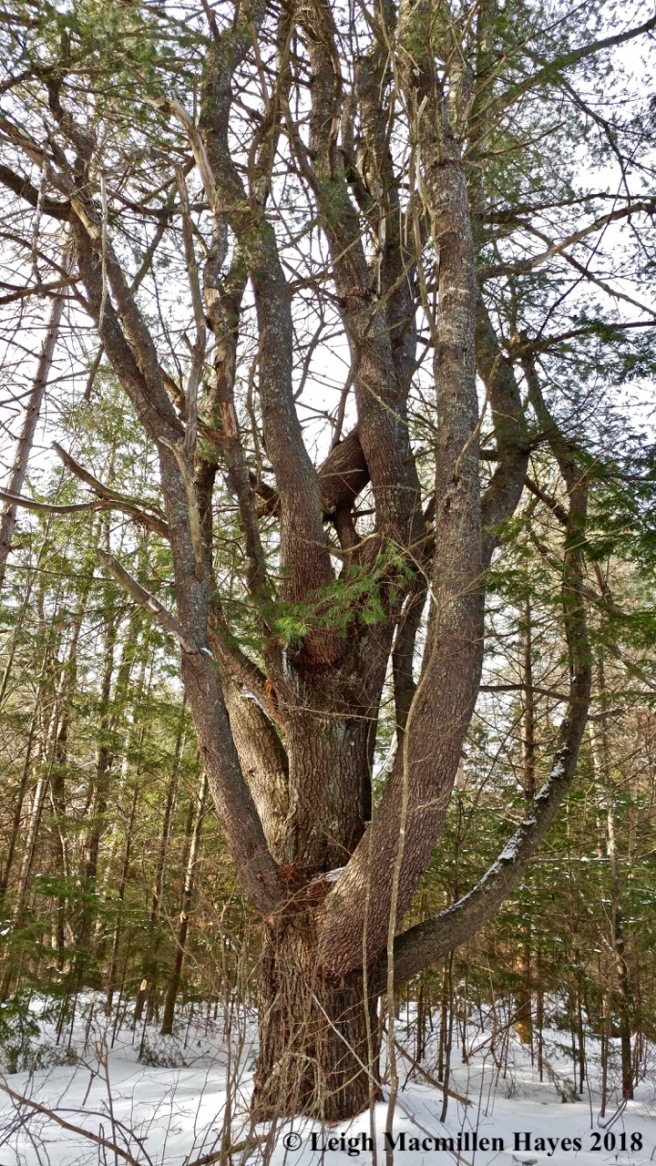
Today, an offering of another kind at the same bench. We found more fox prints all around it and as is typical on a raised object, a hint of pee–its skunky scent indicating it was a red fox. (Yes, I sniffed the pee. By the way, deer pee smells rather piney–just saying.)

f-deer trail

On the way down, more fox and mouse prints everywhere we looked, some old, others fresh. But also, deer tracks a few days old and filled with beech leaves that had recently blown down. It was much colder on our descent given that we were on the eastern side of the mountain and for the most part out of the sun.
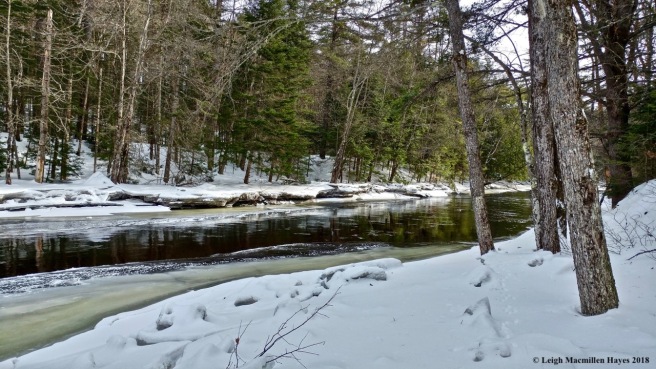
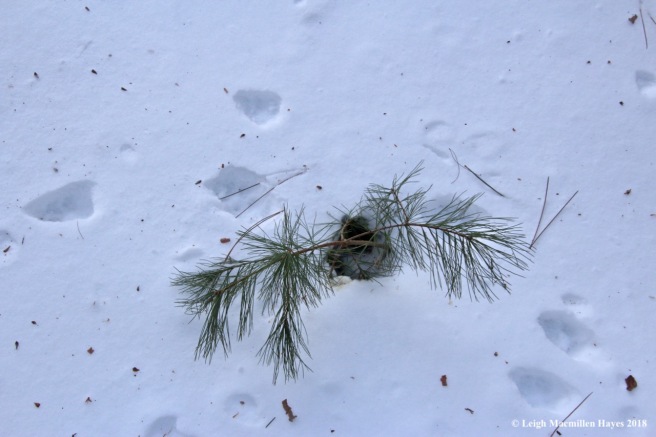
f-John Fox Homestead

But that didn’t stop us from making a quick trip to Otter Rocks where two members of our party told us they had the great joy of watching a couple of otters frolic last summer.

f-dragonfly exuvia, lichen and ice:snow on otter rock

We stepped onto the ice and looked back at the large, erratic boulder that marks the point, and reveled in the sight of lichens, dragonfly exuviae and ice displayed.

f-dragonfly exuvia 2

We always check the area for dragonfly exoskeletons but now that the ice has frozen, we can visit the rock’s backside for a change. A few remain, and it was easy to see the hole from which the dragonfly had cast off its external covering during last spring/summer’s moult.

f-Toasting Lovell

The temperature dropped drastically by Heald Pond and wind picked up, so we soon made our departure and headed back to the parking lot.

We were, however, tickled with the knowledge that we’d taken the opportunity to hike on this First Day of 2018. And while at the summit of Whiting Hill, on the count of three, we’d shouted Happy New Year to  Lovell, Stoneham, Stow and Sweden. Did you hear us?

The Sun Sets On 2017

Go without expectation I told a friend the other day. But I hardly take my own advice and so as I set out to snowshoe along the trails of Loon Echo Land Trust’s Bald Pate Mountain Preserve today, I silently hoped I’d spy a snowshoe hare or bobcat. Of course, both would have been over the top, but the possibility existed for their tracks were everywhere.

b1-Moose Trail sign

My first trail of choice was the Moose Trail. Maybe it was the snow cap atop the sign that helped me choose, but really, I like it because it circles halfway around the base of the mountain and then joins the South Loop Trail to complete the journey and ascend to the summit. Plus, it isn’t well traveled, except by critters. And so I went.

b5-q for question

Immediately, I saw a snowy Q and questioned what I’d see.

b2-spring is on the way

Despite the cold, there were signs of spring in many forms. One referenced a former use of the land.

b3-striped maple samaras

Another bespoke future offerings.

b4-water feathers

And a third bubbled up and created wispy feathers.

b6-nature's cathedral

Overhead, so much ice continued to cling to trees and jingled like a series of wind chimes along every path I traveled.

b8-porky 1

At last I was in an area of erratic boulders and certain that a bobcat was watching me. But . . . to my surprise a porcupine quickly waddled down its own well-packed trail.

b9-porky 2

In my excitement, I could barely focus.

b10-porky

I did hear other people approaching and so called ahead to warn them. Turns out that was a good thing for they had a dog companion. Porky actually crossed the man-made trail and continued on its way.

b11-porky trail

The other hikers and I stood and watched it and then examined the trail left behind by this pigeon-toed mammal. I’ve always thought that the tail left a swish, but this big guy held its tail high. I’m more inclined to think its toenails and quills are responsible for the lines between prints.

b13-Peabody Pond

At last I climbed upward and Peabody Pond came into view.

b14-Pebody and Sebago beyond

And in the distance Sebago Lake, not yet covered in ice, though I read in this morning’s paper that forecasters think this might be the year that it finally freezes over again.

b25-Hancock Pond

From the summit, I could hardly see the bald pate for which this mountain was named. But, the views outward included Hancock Pond.

b16-Mt Washington

And then Pleasant Mountain with Mount Washington in its saddle.

b18-trail to outlook

Rather than follow the Bob Chase Trail down, I chose the scenic overlook trail to the Foster Pond outlet.

b20-Foster Pond cairn

Shadows were growing longer and I didn’t stay long. At that point my camera battery began to die and so I placed it inside my mitten to take advantage of a hand warmer. And took it as a hint–my cheeks were also beginning to feel the cold.

b17-subtle signs

It was time to follow the subtle . . .

b22-home sign

and not so subtle signs home.

b23-sun setting

After all, the sun was setting on 2017.

b24-following porky

Tomorrow will dawn a new day and a new year.

Thanks to all who have wandered with me this past year. Here’s to a wonder-filled 2018.

Happy New Year!

Oh Baby!

It’s so cold outside that probably the smart thing to do would be to stay snuggled within, but I couldn’t.

a-bluejay with seed

After all, the birds were on the move, though they were a bit puffed up, a normal behavior when the temp is below zero. Their feathers help insulate them from the cold (and my hands understand that as they were tucked inside down-filled mittens). Fluffing up traps as much air as possible, thus keeping our avian friends warm.

s-robin

Their feathers are also waterproofed with an oil coating, a good thing on this not only frigid, but also slightly snowy day.

s-frost around squirrel homes

As I wandered, I noticed that the squirrels and maybe other small mammals had decided not to venture forth and found plenty of evidence that they were huddled inside. Ice crystals formed in holes beside trees, and . . .

s-frost by stone walls

openings in stonewalls . . .

s-frost again

reminded me of the feathery display on our windows on cold winter mornings. These were the mammals’ windows–such as they are.

s-stained glass

And speaking of windows and ice, which has lasted longer than usual following the Dec 23rd storm, everywhere branches reminded me of stained-glass leading highlighting the picture of our winter world.

s-red maple buds

But, here’s the thing about ice. Like feathers, it also serves as an insulator, keeping leaf and flower buds along tree branches protected from the cold. Oh, they have waxy coatings, but the ice adds another buffer.

s-beech bud

Some of the sights I saw today made me chuckle, like the beech bud poking through one of the tree’s marcescent leaves.

s-pinecone on maple

And a maple pinecone.

s-saw-whet owl 1

But my favorite find of all flew in while I was making my way rather nosily through a dense patch of hemlocks. Another where’s Waldo moment. Do you see it?

s-saw-whet owl 2

Yes, a Northern Saw-whet Owl! A first for me in the wild.

s-saw-whet 3

We shared about ten minutes together and it was definitely an “Oh baby!” occasion (which I reported to Jean Preis for our local Bird Count).

And with that, I’m proud to say, “It’s a boy!” The bird, I’m not sure. But I’m a great aunt to Baby Bud who was born at 12:24 this morning. May he develop a sense of wonder about the natural world and a love for winter.

The owl was the icing on the cake on this special day–Oh baby!


Peace on Earth

One touch of nature and it seems to me we’d be able to achieve world peace, that idealistic concept of happiness, freedom and cooperation among all peoples and all nations.

o-ice on beech leaves

On a frigid winter day it would be extraordinary if only we could encourage more people to step outside and observe the beauty of the natural world. Of course, all would need to be  dressed for the conditions so they felt comfortable, and appropriately equipped so they could travel with some ease, and . . . and . . .  and. But still, surrounded by leaves blanketed with snow, and icicles extended like fingers reaching out to others, how could anyone resist sharing a collective awe.

o-ice and snow illuminated by sun

Snow and ice and more snow. And suddenly, the world transformed and branches intertwined in ways we’ve not seen before and the same could be true for all of us. Perhaps the key is to figure out how much snow and ice and snow creates such interesting intersections. And how we can do the same–make interesting interactions.

o-ice on pine like Hawaiian grass skirts

Be they conifers wearing grass skirts,

o-birch catkins enclosed

or catkins wrapped in union suits, nothing went untouched in the Christmas weekend storms.

o-ice on maple

Frozen condensation clung . . .

o-ice drips

in various formations and reflected all sort of colors.

o-ice on usnea lichens

I wished I’d seen it all transpire. But I wasn’t able to until today and then, I was grateful for the opportunity and wonder of it all. I traveled alone, but in perfect hind sight, wish I’d invited another to join me.

o-ice above

To rejoice in those sparkling high above . . .

o-gray birch arches

and appreciate the burden of others bending low.

o-gray birches meet in the middle

To recognize new dance partners in the midst.

o-ice on pine finale

One step at a time. One look. One touch. One acknowledgement. One smile. And then two smiles. And three. And four. And many more.

Peace on Earth.

One touch of nature makes the whole world kin.

~William Shakespeare