Tracker Tales

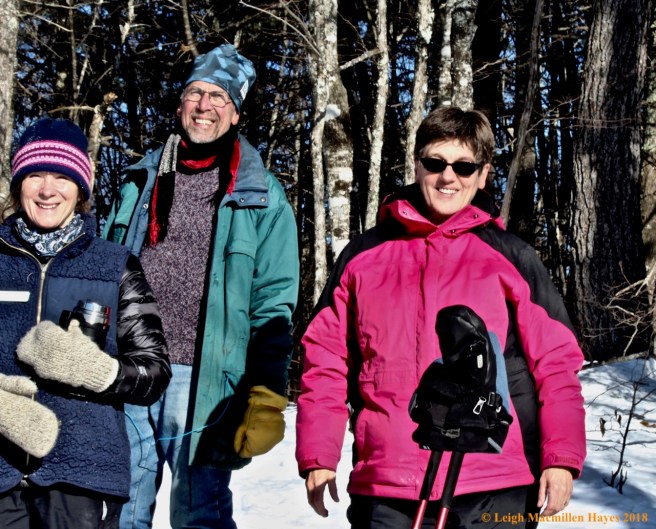
When I pulled into the Charlotte Hobbs Memorial Library parking lot this morning I didn’t expect any of the Greater Lovell Land Trust’s Tuesday Trackers to be waiting for me given that the temperature was at least -20˚. But, Jo Radner was ready and waiting. She joined me for the drive to the John A. Segur West property on New Road.

Standing in the small parking lot was Stephen Lewis, another diehard participant. And as  Jo and I fiddled with our snowshoes, Heinrich Wurm pulled in.

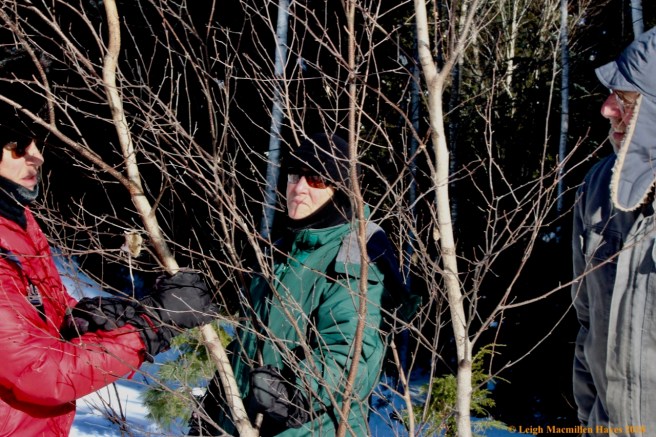
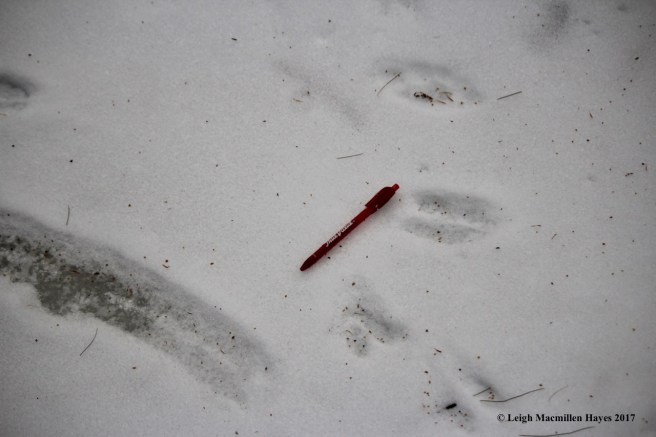
And so, we four intrepid trampers took off over the snowbank and immediately met some tracks. A little back tracking and attention to details helped us determine a bobcat had crossed the trail. There were red and later gray squirrel tracks, deer, and mice. Most were old for the animals, especially the squirrels and mice seemed to be hunkered down in their holes–certainly a good choice.

j-junco tracks and wing marks

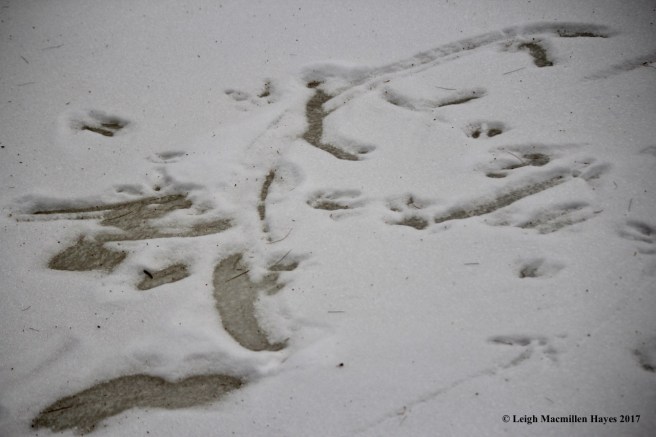
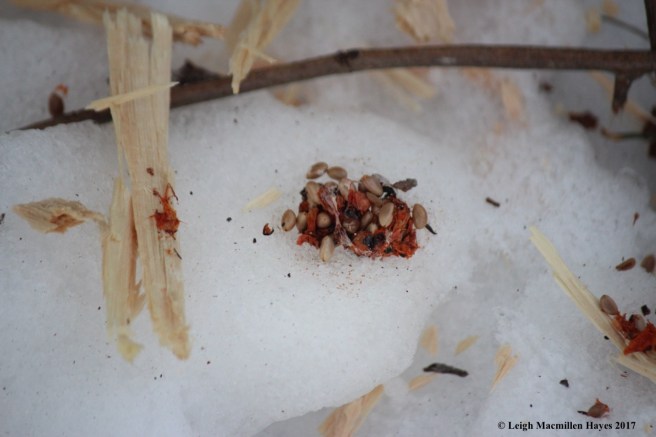
By the time we reached the old log landing at the end of the trail, we noticed lots of junco tracks and their small wing impressions. Seeds aplenty were scattered across the snow. Our conversation soon turned from the little birds to an experience I had this past week when a saw-whet owl flew into a thick stand of hemlocks I was crashing through like a bull in a china shop. I had just finished saying that much to my surprise the bird flew in as I broke through the branches when one would expect a bird to quickly depart, when Steve pointed at something in our midst.

j-mouse discovery 1a

We all moved in for a closer look.

j-mouse discovery 2

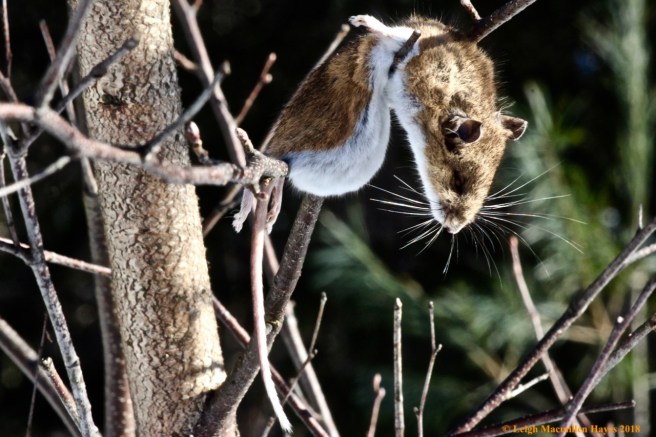
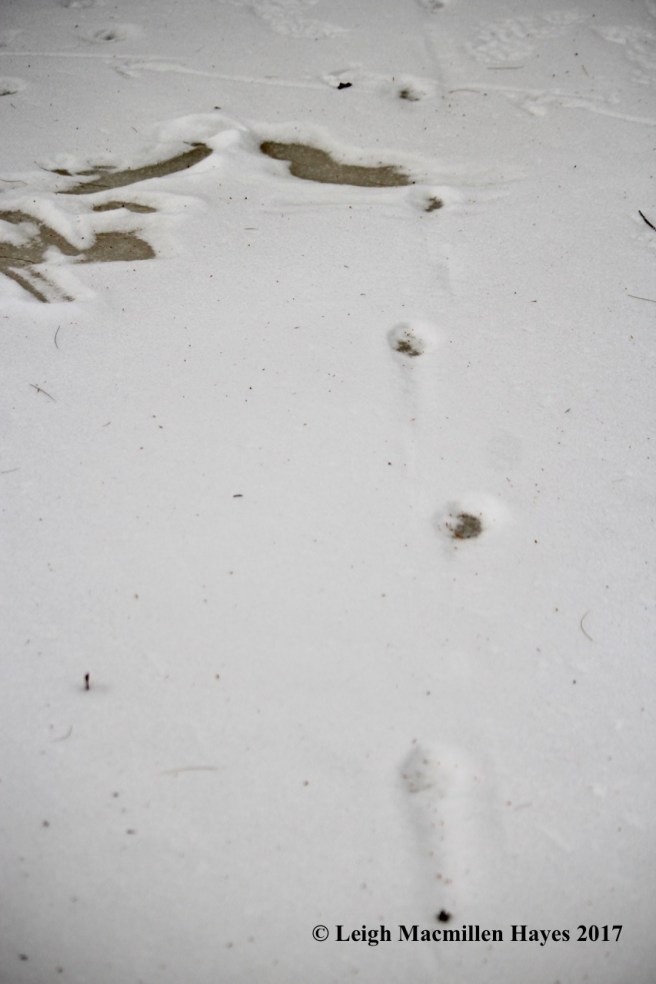
A dead mouse splayed on the branch of a gray birch. My brain played with that sight over and over again. Yes, we’d seen numerous crazy mouse tracks left behind by either deer or white-footed mice–it’s difficult to determine which, for both have long tails that leave drag marks between their footprints. Jumping mice hibernate so they could be ruled out.  Jo asked if I could tell which of the other two it might be. I’m happy to say that even well-respected tracker Paul Rezendes, author of Tracking and the Art of Seeing, has this to say, “There are more than 120 different species of North American mice, and about half of them fall under the general rubric ‘white-footed mouse.’ The deer mouse is a type of white-footed mouse, and to me there is not perceptible difference in tracks. There are several anatomical differences, but these change from habitat to habitat. The white-footed mouse measures up to about seven and a half inches long (including its three-and-a-half inch tail) and weighs one-half to one ounce. Its color is gray or light brown to dull orange-brown above, with a white belly, throat, and, as its name implies, feet. The deer mouse is gray to reddish brown on its upper parts, including its tail, and white below, with longer hind feet and a tail usually longer than its body. Both animals have bicolored a bicolored tail.”

j1-mouse 1

Our next question was, “How did it get there?” My mind immediately went to a December 13 entry on page 419 in Mary Holland’s Naturally Curious Day by Day about butcher birds overwintering. Mary discusses how northern shrikes preferred food sources are other birds, mammals and insects. “This tundra-nesting bird comes as far south as New England in the winter, where it preys mainly on mice, voles, and small birds.” She goes on to explain that the bird often kills more than it can consume and leaves some food in the freezer for future feeding adventures. “The manner in which it stores this extra food is what gives it the nickname ‘butcher bird.’ It often impales prey on a thorn, broken branch, or even barbed wire, or it wedges prey into narrow V-shaped forks of branches, where it hangs until reclaimed by the shrike.”

Bingo! I think we figured out what we were seeing and in Mary Holland’s book we have my dear friend, mentor and former LEA and GLLT Education Director, Bridie McGreavy, PhD, to thank for the photo.

We could have turned around then, so thrilled were we, but we hadn’t even reached the wetland. And so, a quick check to make sure everyone was comfortable and on we trekked.

j-deer crossing Bradley Brook

When we found more deer tracks, we decided to follow them in search of beds. At that point we found no bedding areas, but did see that the deer had crossed Bradley Brook.

j-Bradley Brook frozen

It was the first time I’d ever seen the brook frozen over and we took advantage by making our way to the other side.

j-water on lungwort 1

We continued looking for tracks, but found other things as well, including dried lungwort. I mentioned that lungwort, like other bryophytes, will immediately photosynthesize when water is added. Jo wanted proof and so I had her pull out my water bottle and pour it over the leafy structure.

j-lungwort turning green

Within minutes . . .

j-lungwort magic

magic.

j-beaver works 1

As we crossed the wetland, we searched high and low for evidence of wildlife. Up high, chickadees and goldfinches sang from treetops. Down low–not a single track. We did find a few examples of beaver works.

j-beaver works 2

And we thought perhaps the lodges were active.

j-beaver works 3

We hoped.

j-checking the beaver lodge1

But our hope was dashed.

j-beaver lodge 2

No vent hole above and no evidence of life anywhere nearby. Perhaps they’d abandoned this for a second one we spied.

j-stone lodge

Only thing is that the second one also supported no mammal life at the moment, for it turned out not to be a lodge after all, but a boulder covered with snow.

j-beaver dam

Just beyond the boulder lodge, however, we found the old dam, which still stood strong.

j-sharing smiles at the dam

Our smiles were equally strong as we acknowledge what a fine day it had been and this would make the perfect turn around point.

j-Heinrich looking skyward

Jo and Steve took one last look at the brook below and Heiner turned his eyes skyward.

j-heading back

Heading back, we all did the same for we heard military planes flying overhead and could see their contrails.

j-looking north

But it was the cloud formation that really drew our attention.

j-clouds 2

Steve mentioned lenticular clouds and it seemed the perfect explanation given that these lens-shaped structures probably formed after the flow of air encountered Mount Washington.

j-mouse in tree crotch

Our journey back found us going off trail again, and we did find a couple of deer beds, but what will stand out in our brains for this day’s tramp–the mouse with the very long tail and tiny white feet. How it got there, we don’t know for sure, though the shrike story does make sense. What I am sure of is that it will become part of our tracker tales.


Celebrating First Day 2018 Lovell-Style

In the name of tradition, today the Greater Lovell Land Trust hosted a hike up Whiting Hill at the Heald and Bradley Ponds Reserve to welcome the new year. Last year’s inaugural hike attracted eight of us and the temp was so comfortable that we began to shed layers as we climbed. This year, six of us made the trek and conditions were a bit on the cool side–um, that would be an understatement.

f-Heald Pond dam

But . . . the crisp air enhanced the beauty all around us and we began with a brief stop to appreciate the dam. What we didn’t realize until a minute later was that we’d also startled some wood ducks who immediately flew off.

f-snowshoe journey up Whiting Hill Trail

Though our group was small, old friendships were renewed and new ones formed as we shared the trail.

f-otter trough 2

Periodically, we stopped to admire others who had carved their own trails. We read the stories of many mouse journeys, a fisher chasing a red fox, red and gray squirrel adventures and these–an otter bounding through the landscape.

f-otter trough 1

Otter troughs are about 6-10 inches wide, this one being the larger size. And in what can seem like two by two format, their front feet touch down as back feet rise, coming forward to land where the front feet had been just moments ago for they are bounders. Occasionally, this fun-loving critter chose to slide down on its belly.

f-summit achievement

By the time we reached the summit sign and turned right, we weren’t sure what to expect. Would it be so cold that we’d take a quick peek at the view and retreat? Would we be able to toast Lovell as planned?

f-who said it was cold?

As it turned out, a few in our group found their hands getting too warm, so welcomed a chance for a mitten break.

f-sit a minute

Others sat for a moment on the bench and left behind impressions.

f-hot water carafe

One of our docents had made pumpkin bread to enhance our toast and we brought a carafe full of hot water for cocoa or tea.

f-Heinrich filling cup

The water was very hot indeed and warmed us right up.

f-enjoying the summit and each other

And so it was with big grins that we shared camaraderie at the summit, enjoyed the view and noted the fact that it wasn’t too windy and the cold air was tolerable.

f-red fox print and pee

When we did finally pack up to make our descent, we snowshoed first over to the bench on the Heald Pond side of the summit, where last year we found a sacrificial squirrel upon the altar. Prints left behind indicated a fox had dined there. Of course, a few of us got excited about the kill site and perhaps scared others away from joining us again this year. But . . . we just like to know what the mammals have eaten.

Today, an offering of another kind at the same bench. We found more fox prints all around it and as is typical on a raised object, a hint of pee–its skunky scent indicating it was a red fox. (Yes, I sniffed the pee. By the way, deer pee smells rather piney–just saying.)

f-deer trail

On the way down, more fox and mouse prints everywhere we looked, some old, others fresh. But also, deer tracks a few days old and filled with beech leaves that had recently blown down. It was much colder on our descent given that we were on the eastern side of the mountain and for the most part out of the sun.

f-John Fox Homestead

But that didn’t stop us from making a quick trip to Otter Rocks where two members of our party told us they had the great joy of watching a couple of otters frolic last summer.

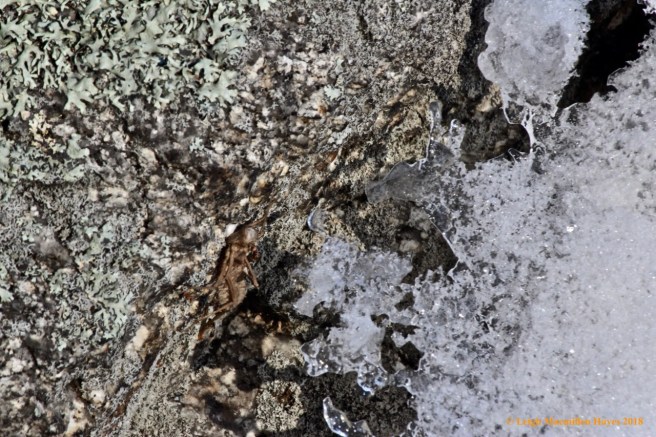
f-dragonfly exuvia, lichen and ice:snow on otter rock

We stepped onto the ice and looked back at the large, erratic boulder that marks the point, and reveled in the sight of lichens, dragonfly exuviae and ice displayed.

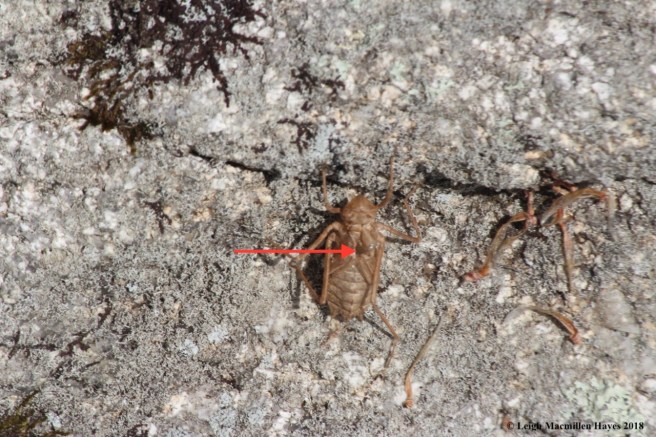
f-dragonfly exuvia 2

We always check the area for dragonfly exoskeletons but now that the ice has frozen, we can visit the rock’s backside for a change. A few remain, and it was easy to see the hole from which the dragonfly had cast off its external covering during last spring/summer’s moult.

f-Toasting Lovell

The temperature dropped drastically by Heald Pond and wind picked up, so we soon made our departure and headed back to the parking lot.

We were, however, tickled with the knowledge that we’d taken the opportunity to hike on this First Day of 2018. And while at the summit of Whiting Hill, on the count of three, we’d shouted Happy New Year to  Lovell, Stoneham, Stow and Sweden. Did you hear us?

Counting Birds

In the name of citizen science, Kathy McGreavy and I ventured forth at 8am this morning as the temperature hovered just above zero.

c1-map

Our eyes were on the birds within view along a route outlined in orange. Up and down roads we journeyed, stopping periodically to jump out of the truck and focus our binoculars on our feathered friends and then keep track of them on the list provided. At the same time, other groups traveled different routes within the circle and also tallied their discoveries.

c6-junco 1

Together, we saw blue jays, crows, robins, tufted titmice, a female cardinal, brown creeper, some chickadees, and lots of juncos. We also enjoyed driving down roads less traveled and reveled in the ice and snow-coated scenery before us.

c3-robin 1

At noon, Kathy had to depart and so I headed home for a quick lunch before venturing out again to finish up our tour. And at Salmon Point boat launch I was rewarded with more robins.

c4-northern flicker

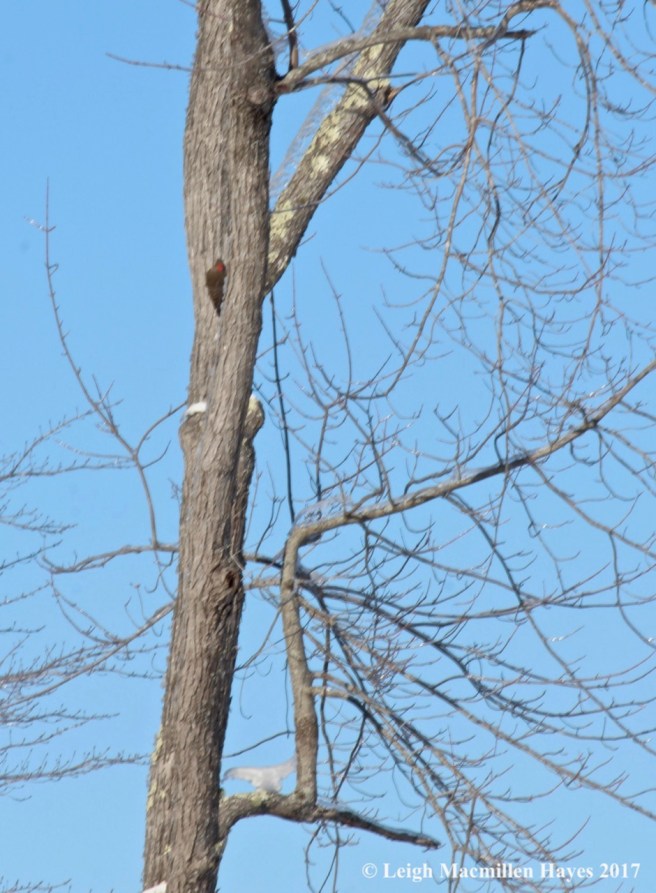
But my favorite spy of the day, two northern flickers at the outlet where Stevens Brook flows into Long Lake. I first spied one and then two on the trunk of a red maple. After a few minutes they flew below to dine on winterberries. But I wondered–northern flickers in December? They weren’t on the list, nor were they rare; just not typical winter visitors in western Maine.

c7-female downy woodpecker

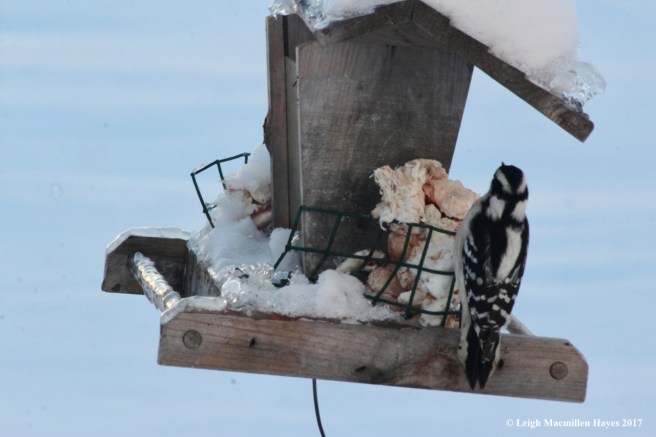
Seven and a half hours later, back at home, which was out of our part of the quadrant, a female downy woodpecker enjoyed some frozen suet. I couldn’t include it on the final report, but still . . .

c7-white-throated sparrow

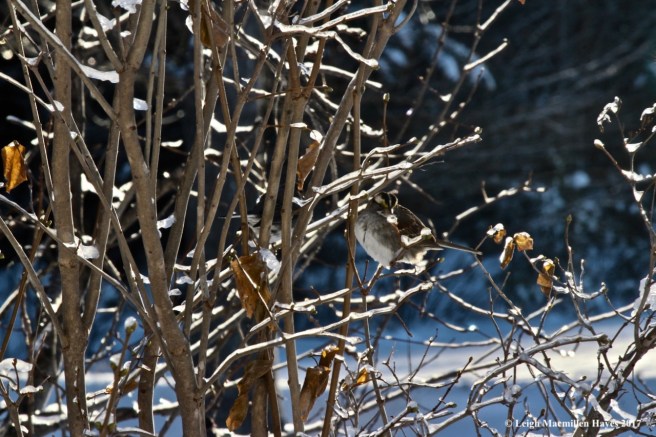
The same could be said for the white-throated sparrow that I frequently spot amongst the junco flock that partakes of our feeding station.

Participating in this citizen science project is great fun and I’m thankful it’s a winter tally for I can ID most of the species I see. Were it to occur in summer when all those warblers breed in this northern territory, my bird brain would be more challenged.

c2a-CMP dam

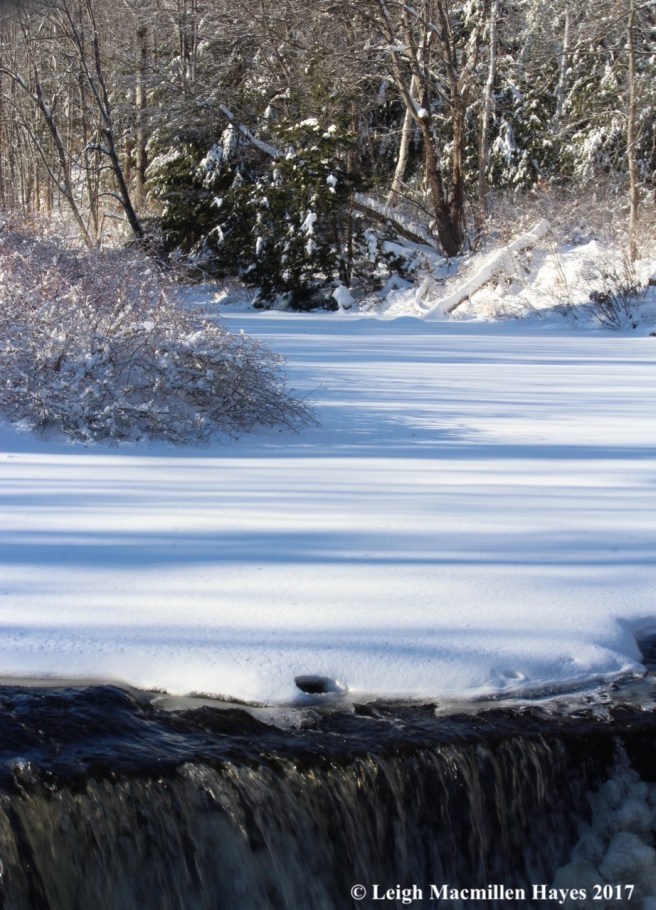
Another benefit of said participation is the opportunity to visit places such as the old dam on Stevens Brook during the winter season.

c2-otter slides

Because I was there, I saw tons of otter sign including numerous slides. A huge grin covered my face.

c5b-ice disk in Stevens Brook

And then, there was a certain rare sighting lower in the brook that drew my awe.

c5-ice disk 1

We had a form to complete for rare finds. But . . . it was for rare bird finds. Would my northern flickers suffice? I wasn’t sure and so filled in the information to be on the safe side. But . . . that which I saw in the brook itself was probably rarer.

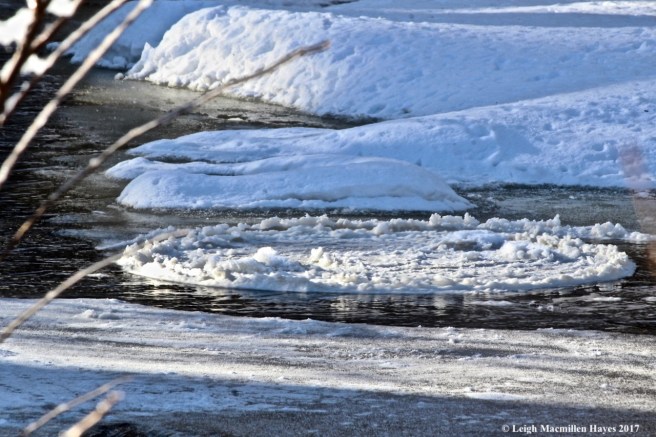
An ice disc.

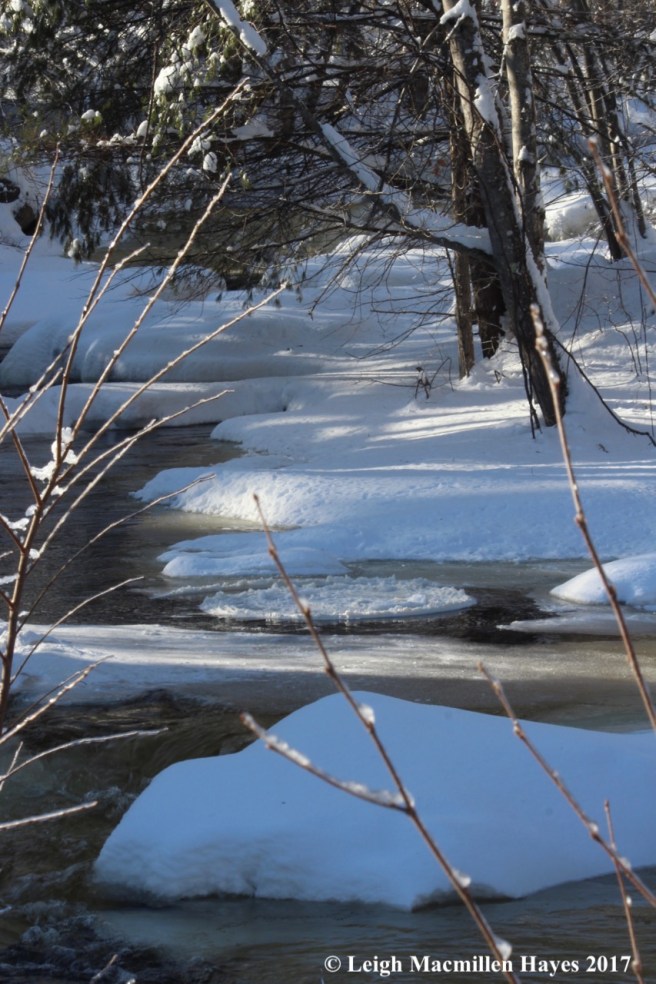
According to Mary Holland’s recent post about such on her Naturally Curious blog: “An ice disc is a large disc of ice spinning in a river. It’s thought that this relatively rare natural phenomenon is likely caused by cold, dense air coming in contact with an eddy in a river, forming discs ranging anywhere from 3 to 650 feet in diameter.

While eddies contribute to the spinning, they are not the only cause. If they were, small discs would spin faster than big discs, and this is not the case. Discs of all sizes rotate at roughly the same rate. One would also expect that discs in still water, where there aren’t any eddies, wouldn’t start spinning, but they do.

The melting of the ice disc contributes to its spinning as well. When an ice disc starts to melt, the melted ice water is denser than the ice, and thus sinks below the disc. This movement causes the water to spin, which in turn spins the disc.”

Common and rare–and another fabulous day spent participating in the Audubon Society’s Christmas Bird Count for 2017.


Keeping Watch

My feet itched to move along the forest floor and so I followed them and wondered where they might lead.

o-tree buds

The first stop was to examine tree leaf and flower buds packed inside their waxy scales where they will remain protected from the northerly winds until a date unknown.

o-hemlock cones

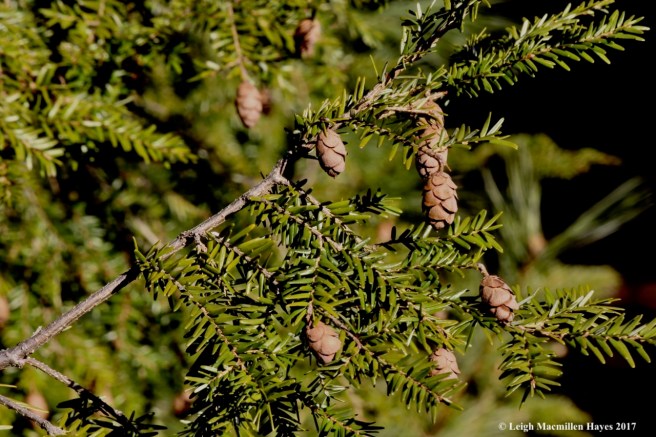
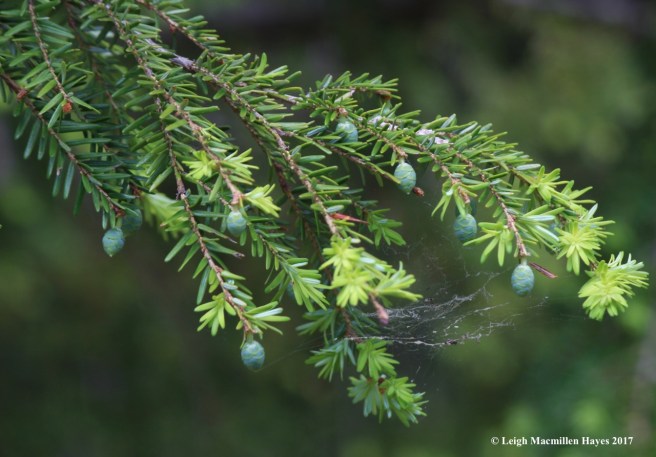
Beside the red maple, Eastern hemlock cones dangled like Christmas ornaments, with woody scales of their own protecting tiny seeds tucked inside until those northerly winds might release them.

o-squirrel dinner table

Everywhere, any possible surface, particularly those a bit raised, became a red squirrel dinner table meant for dining upon this year’s abundant supply of seeds.

o-squirrel chatter 1

And everywhere I was chastised by squirrel chatter for they seemed so sure I wanted to wrestle with them for a few nibbles.

o-upper side, maze polypore

I paused beside mazed polypores, so named . . .

o-underside, maze polypore

for their maze-like underside from which they release their spores.

o-forest 2

Sometimes, my feet moved with ease despite occasional walls of evergreens–and when I encountered such, I pushed on through.

o-slash

Other times, it was over logging slash that I trudged, my feet taking a moment to choose the right balancing spot.

o-watery trail

There was even some island hopping thrown into the mix.

o-bobcat scat

At last I reached a logging road and then different sights filled my heart with hope for I knew that though I saw more than a million red squirrels and heard a variety of birds, including a ruffed grouse, these woods are filled with life (and death). Based on the size and lack of bones, I think this was bobcat scat and the meal was a white-tailed deer.

o-coyote scat

There was coyote scat, both old and new.

o-fox scat

And fox scat reflecting a recent meal–perhaps Sunday dinner.

o-bobcat tracks

And where there is scat, there are tracks–most of the time.

o-moose tracks

Today, I saw signs of bobcat, moose (more than one), deer, fox and coyote and my heart rejoiced for I love tracking season. I also love knowing that these mammals continue to share this space with me–or perhaps it’s that I share this space with them. I think the latter is more likely. I’m just a visitor.

o-ice art 2

In places, ice also offered sights worth viewing. Atop a frozen puddle, those hemlock seeds I referred to earlier had found their release and their new home–temporarily at least.

o-ice art 1

Leaves, cones and seeds intermixed with the ice and created mosaics worth framing.

o-ice art 4

And branches and seeds imitated trees in another work of natural art.

o-ice art 3

But my favorite was the red maple leaf cut-out that reminded me of Christmas cookie cutters.

Even if roaming through the woods isn’t your comfort level, I encourage you to take a few moments to step outside and look around. In this season of hope, may nature help you find wonder and through that wonder may you find peace within.

Any way you can, please join me in keeping watch.


Snow White Magic

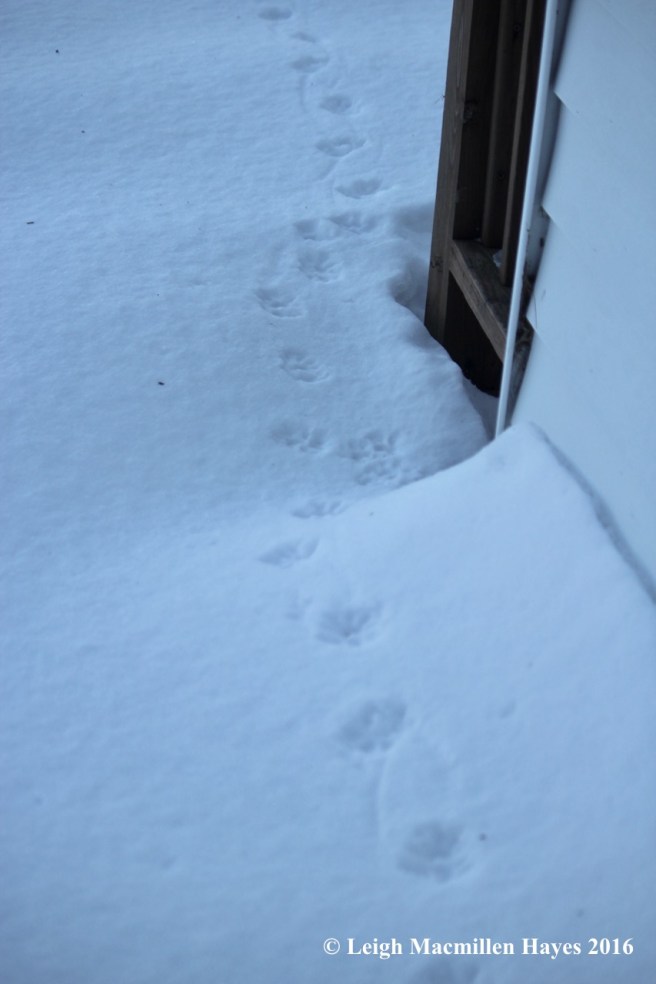
Our first official snow storm of the season left us with about an inch of the white stuff that makes me rejoice. And upon waking this morning and peeking out the window, the sight of porcupine tracks looping around the yard brought a smile to my face.

m-porcupine trail 1

I love the first snow storm for even though I have seen signs of the critters that pass this way, their tracks confirm my convictions. Over the years, I’ve come to recognize the prints and trail patterns, but as the snow gets deeper the tracks sometimes become more difficult to decipher. This one was easy due to its pigeon-toed sashay.

m-porcupine prints

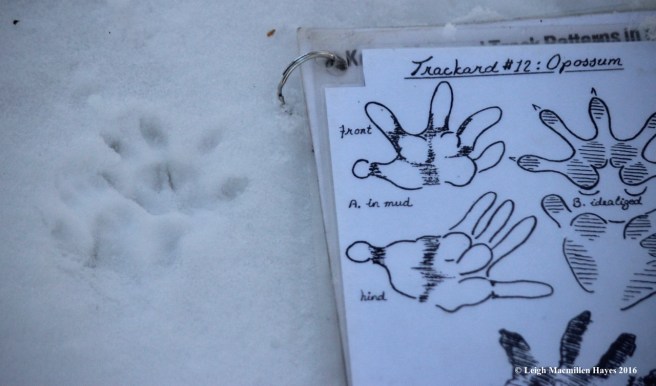
And then the individual prints, especially those that crossed the deck, showed the large foot pad and five toes with nails extended. A friend in Poland, Maine, sent me a couple of photos of the critter that crossed her deck this morning. She ID it herself, but wanted confirmation–for it was an opossum and a first for her.  I found my first opossum prints last December and wonder if I’ll have that opportunity again. Anything is possum-able.

m-worm and junco prints

Since the porcupine had drawn me out (and I noted that it disappeared under the barn–of course), I decided to head off into the woods. But before I left the yard, I spotted junco tracks–and . . .

m-worm

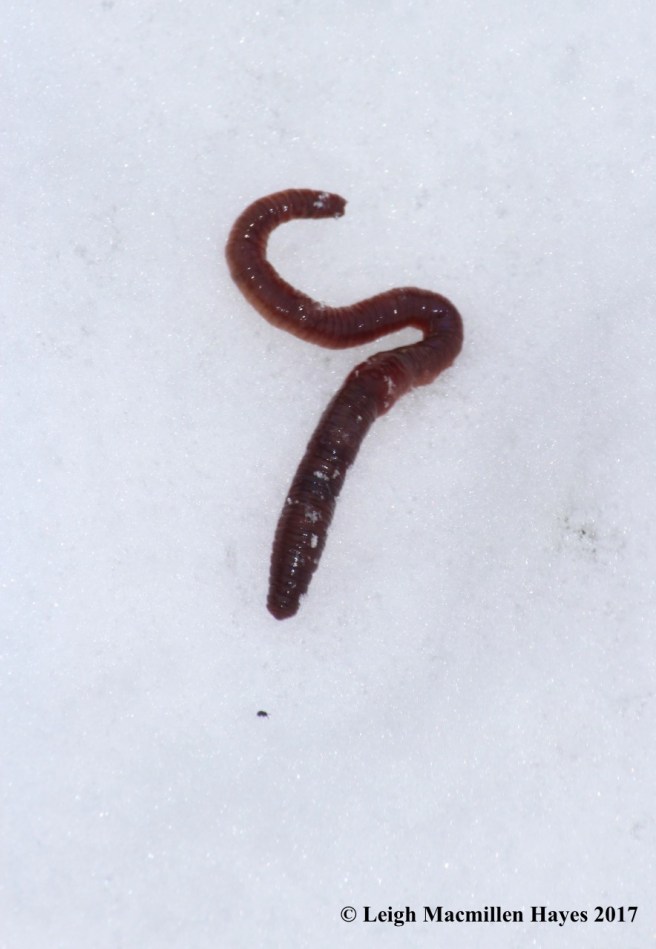
a couple of worms–frozen upon the snow. Juncos don’t eat worms; they look for fallen seeds. And so it seemed that the bird flew off before quite reaching the C-shaped worm. And this other worm was about a foot away from the first worm. Robins were in the yard last week, and I can only hope that they returned today for a frozen dinner awaited.

m-snow art 2

Into the woods I trudged, and the ever-changing colors and designs at my feet reminded me of works of art.

m-snow art 1

Some were palettes of mahoganies juxtaposed against white. A variety of textures gave the scene relief, much like an inlaid mosaic.

m-snow art intersections

Others embodied interconnections; a mingling of lines outlined for emphasis.

m-rock people

Along the cow path, I noticed the rock people for the first time, their mouths gaping open.

m-snow fleas

The minute snow fleas would hardly sustain them.

m-morning light

As it does, my trail crossed the line, where power seemed to originate with its source . . . the sun.

m-Mount Washington

And in the opposite direction, it flowed from pole to pole and onward . . . as if powering the mighty mountain.

m-pine sapling

My journey continued into the land of the pines and their saplings, momentarily coated with decorative baubles.

m-mini oaks

And the red oak saplings I’ve been watching looked more festive than ever.

m-squirrel tracks

I was on a mission and soon found what I was looking for. Some tracks that looked like exclamation points led me to another source of sustenance that I wanted to check on.

m-squirrel cache growing

The red squirrel’s cache had grown taller in the past week, but . . .

m-squirrel dining room

many pine seeds had been consumed in the refectory. All that remained were scales and cobs to show a number of dinners consumed.

m-squirrel rocks

The dining hall extended beyond the reaches of the cache, for every table available was a table used.

m-squirrel dinner in the future

As I walked back toward home, I discovered another table awaiting a guest.

m-beech sunshine

I was almost home when I stood under a beech tree. As winter embraces me, I find that their marcescent leaves create their own golden glow and warm my soul.

m-British soldier

One more sweet peek offered a tiny touch of red to today’s fading winterscape–for the British soldier lichens’ red caps announced their minute presence.

m-snow drops

And then this afternoon, I joined a few friends for a gallivant across the Wild Willy Wilderness Trail beside Province Brook in South Chatham, New Hampshire. And the snowdrops created their own works of art announcing that the meltdown was on.

m-pinwheel 1

As we walked, we noticed delicate parasol-shaped fungi fruiting.

m-pinwheel gills

Their common name is Pinwheel Marasius, but in my mind the shape of the umbrella-like top above the wiry stem looked like a parasol and so I called it such. But to add to the confusion, I first called it carousel. Word association might get me there eventually, but it wasn’t until I looked it up in Lawrence Millman’s Fascinating Fungi of New England, that I realized my confusion. One of the fun facts from Millman is worth quoting: “Resurrection! Shriveled and inconspicuous, Marasmius species are rarely noticed during dry weather, but after rainy periods the tiny fungi revive–hence the nickname ‘resurrection fungi.'” And if not rain, then snow will make them rise again!

m-liverwort magic 1

The water from the melting snow highlighted other lifeforms along the Wild Willy Wilderness Trail. Bazzania liverwort grew abundantly, but one in particular gave us pause . . .  for it glowed. And no matter what position we stood in to look at this worm-like beauty, it continued to glow as if it had a golden halo surrounding it. We had no answers–only questions and wonder.

m-glue fungi

Another find that had been marked with tape, for it too was special–a broken branch attached to a young tree. I’m stepping out on a limb here–pun intended, but I believe this was an example of a glue crust fungus that glues twigs together. Seriously? Yes.

m-Bob, Janet and Pam

It was getting dark when we finally found our way to Province Brook and marveled at the water and ice forms. It was also getting close to the moment when we’d need to say, “See you later,” to Bob and Pam, for they’ll be heading to warmer climes soon. But we know they’ll be back for a winter adventure and then before we know it, spring will be here. And then, we hope the brook will be full with spring run-off from all the snow that is in our future. Until then, see you later we also said to much of the snow for it had almost disappeared.

m-ice works 1

But the ice art will continue to grow.

m-Province Brook 1

And the snow white magic will capture our minds again . . . one flake at a time. And with it, the wonders of the world will continue to be revealed.


Marathon Mondate

As he’s done every year for the past however many, my guy is training for the Moose Pond Half Marathon, a race around Moose Pond in Bridgton and Denmark that supports the Shawnee Peak Adaptive Ski Program. The race is only two weeks away and so this morning he headed off to run ten miles. And afterward, he said he felt like he could have run the additional 3.1 miles that would complete the race. That being said, we headed west to join our friends, Pam and Bob, on a hike at a new preserve in New Hampshire.

The plan was to meet at the trailhead near Hurricane Mountain Road on the Chatham/Conway town line. We knew the road, but not the spot, and were racing to get there, so of course I drove right by. But . . . I spied Pam sitting in their car in the parking lot and probably burned some rubber as I came to a screeching halt and then quickly put the truck into reverse. Fortunately, my guy didn’t get whiplash. It’s a back road, so not well traveled, thus I could drive backwards for a hundred feet or more without any problem–thus is the way ’round these parts. And one of the reasons we love it so.

m-sign 1

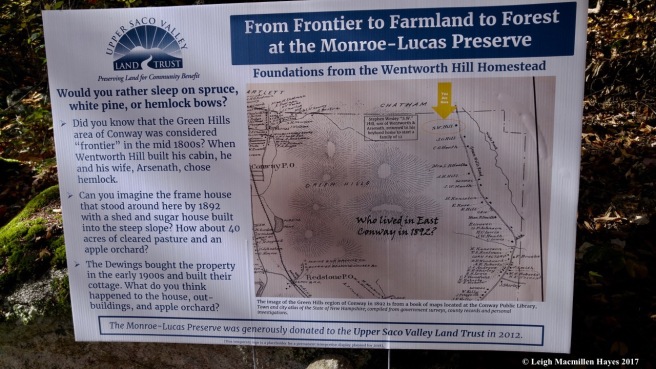
Another is that local land trusts preserve land for the benefit of the species who call this place home, both flora and fauna–and for us so that we, too, may benefit from time spent tramping along trails, making discoveries and forging friendships. The preserve we visited today isn’t quite open, but Pam said she’d heard they plan to open on November 4th. There were no signs on the kiosk or trail maps, but we quickly learned that none were necessary for the route was easy to follow. We were at the Monroe-Lucas Preserve, a 62-acre property donated to the Upper Saco Valley Land Trust.

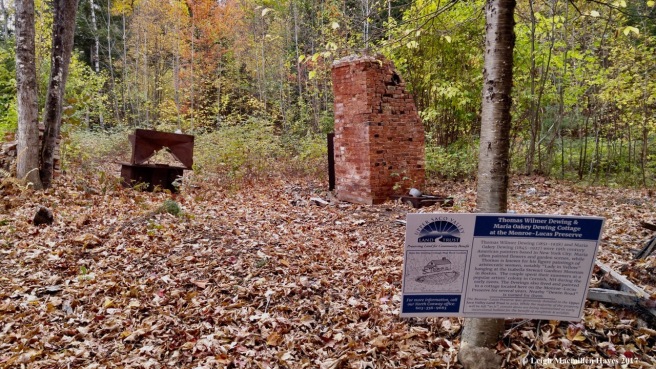
According to their website: “The land was given to USVLT by Barrett Lucas in honor of his wife, the late Leita Monroe Lucas. Leita’s family has deep roots in East Conway and Redstone, and her father, Ernest “Red” Monroe, also wanted to see the land preserved. Adjacent to the Conway Common Lands State Forest, The Nature Conservancy’s Green Hills Preserve, and the White Mountain National Forest, this parcel builds on an existing network of preserved land, and has wonderful opportunities for future trail development and increased public access. A branch of Weeks Brook also runs through the property, and the property lies within USVLT’s ‘Green Hills’ focus area. The site is also remarkable as the one-time summer residence of the American Impressionist painter Thomas Wilmer Dewing, and his fellow painter and wife, Maria Oakey Dewing. Their cottage, built in the late 1800s, fell into disrepair in the mid-1900s. Now only the chimney remains onsite.”

m-puff ball fungi 1

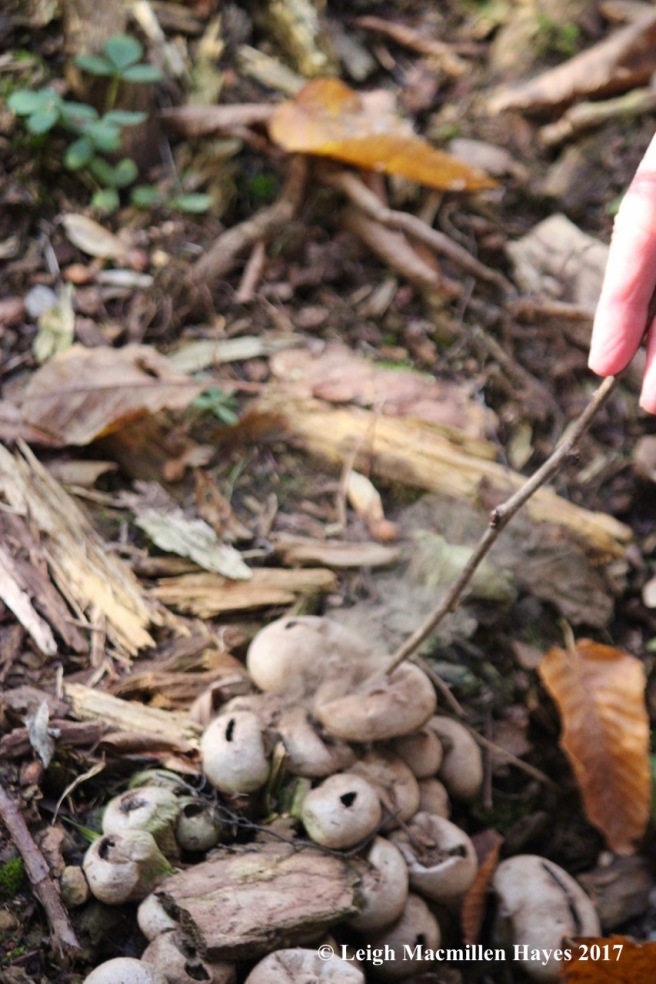
With Pam in the lead, we started up the trail and within minutes the fun began. She spotted a large patch of puff balls begging to be poked. The spores wafted up and away with hopes of finding the perfect place to grow nearby. We assume they will be successful, for within a fifteen foot area, we found patch after patch and knew we weren’t the first to encourage their spores to blow in the breeze.

m-bobcat print

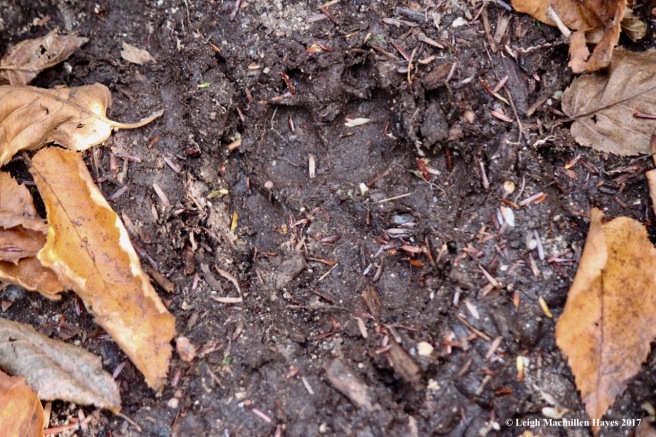
And then Pam began to spy prints in the mud. First, a moose. Then this bobcat–if you look closely, as we did, you may see the hind pad matted down; above that a raised ridge in the form of a C for cat; and four large toes, the two in the center being asymmetrical. Because it was a muddy substrate, we even saw nail marks, especially above the two center toes. Five feet further, we found deer prints. And so we rejoiced in the foresight of the Monroe-Lucas family to protect this land.

m-Weeks brook flowing 1

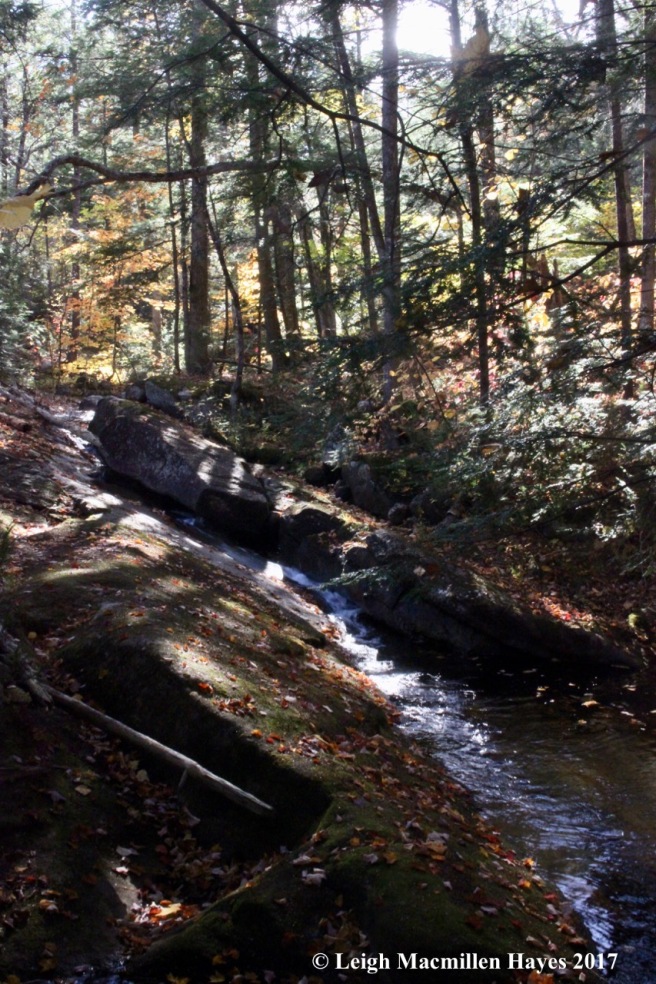
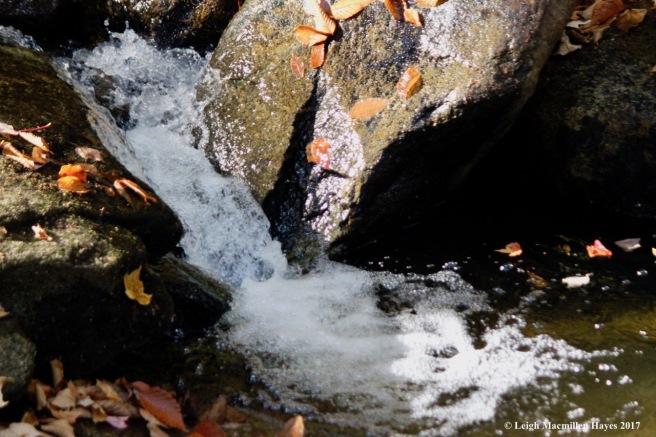
A bit further on, we heard the brook before we saw it–a branch of Weeks Brook that borders the property. We all stood beside and let it mesmerize us.

m-weeks brook 1c

We thought about its forceful action each spring and the eons it took to carve into the rocks along its banks.

m-weeks brook baths

We shared visions of a summer day spent sliding down its smooth channels and slipping into the pools below.

m-weeks brook between the rocks

And we marveled at the way it split the granite above . . .

m-weeks brook between 3

and flowed between the shelves.

m-weeks brook bubbles

All the while, it raced to the finish line and we could only assume it made good time.

m-hobblebush flower?

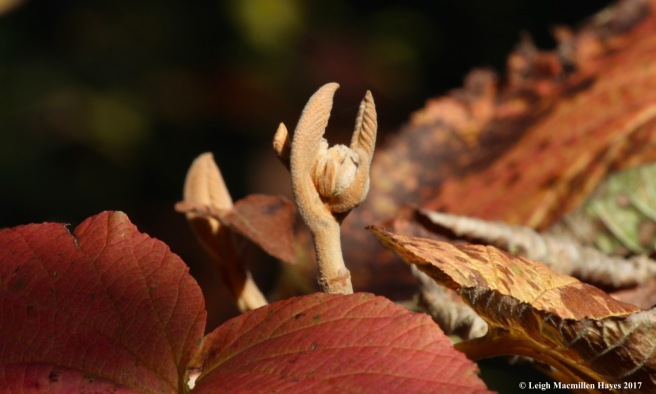
It was beside the brook where the hobblebush grew prolifically and offered a myriad of colors among their leaves and clasping or clapping hands among their buds. Because we were looking, we noticed one flower forming into its globe shape as it usually does in late winter. Was it confused?

m-hobblebush new leaf

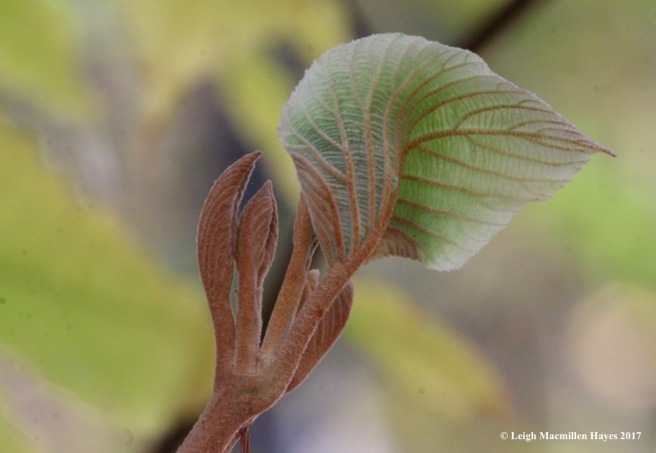
And on another, a new leaf.

m-hobblebush 2

Fortunately, most behaved as they should and gave us an autumnal display worth celebrating.

m-hobblebush:hemlock shadows

One even added some shadow play.

m-mount kearsarge

Eventually, we turned away from the brook and followed the trail down. A peak through the trees and we could see Mount Kearsarge across the way.

m-slime mold 1

On a tree stump, we found a couple of fascinating fungi including a slime mold all decked out for Halloween.

m-jelly fungi

And on the same stump, a display of jelly ear fungi.

m-old moose scat

Around the corner was more evidence of moose traffic, though since it was moss-covered, we decided it was a couple of years old. None of us could ever recall seeing moss grow on moose scat before, but it made perfect sense that it would be a suitable substrate. I did wonder how they’d categorize that on a moss ID key–grows on rock, tree, ground, moose scat?

m-pippsisewa

Our moments of awe weren’t over yet. We sent up three cheers for the pipsissewa and its seedpods (Bob, did you take one?),

m-red-belted polypore

and red-belted polypore.

m-frullania 2

And then Bob spied the frullania. The smaller, spider-webby display in the lower right hand corner is Frullania eboracensis, a liverwort with no common name. But the larger mass is known as Frullania asagrayana, so named for a botanist and natural history professor at Harvard University from 1842-1873–Asa Gray.

m-frullania

We all went in for a closer look at its worm-like leafy structure.

m-frullania and muy guy

Even my guy got into the act, much to his reluctance. And he was certain he didn’t need a lesson on how to use a hand lens. Thankfully, he doesn’t read these blog posts, so I can get away with this. Shhhh.

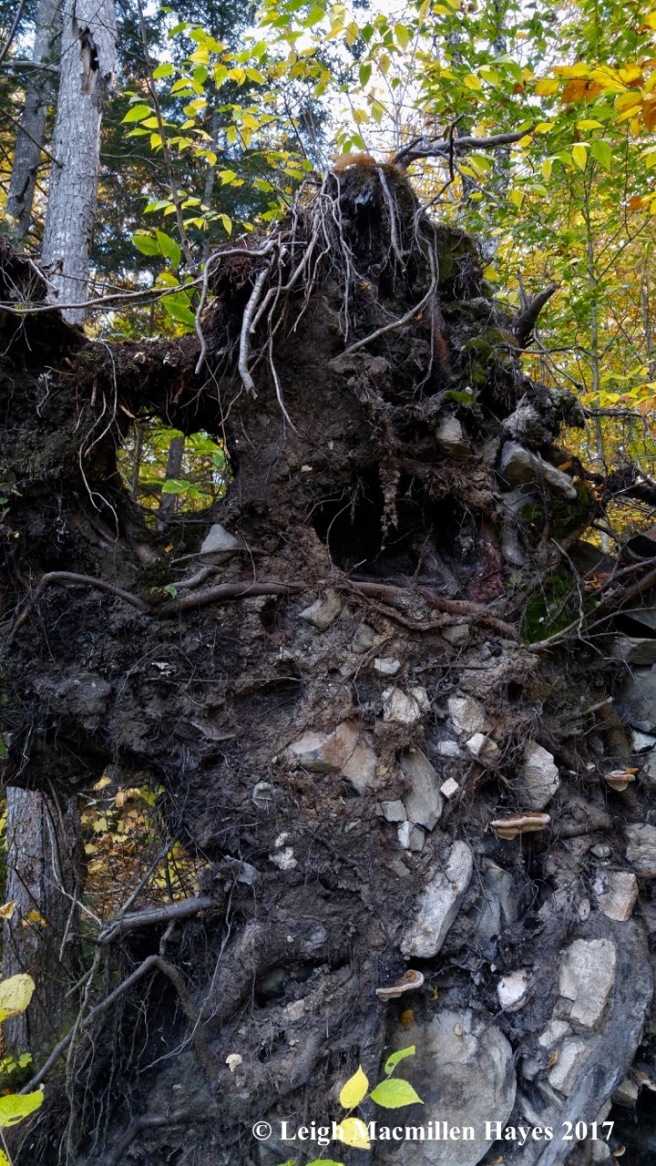
m-uprooted pine 1

Around the next bend, for the trail has enough S curves to make the descent easy, we came upon a white pine long since uprooted. Did anyone hear the crash?

m-uprooted picture frames

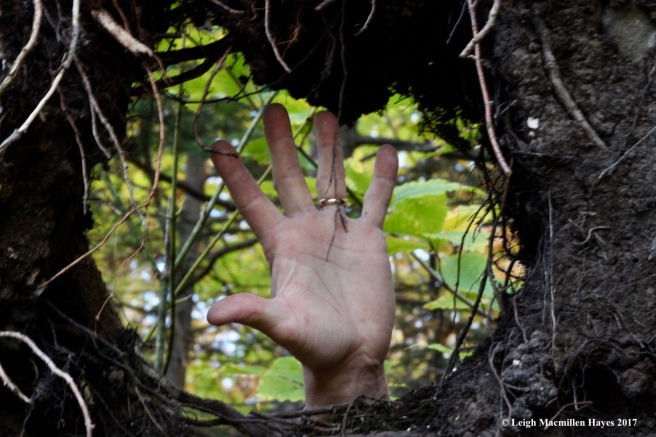
It offered a wonderful view–of more red-belted polypores, the root system and rocks, plus several windows on the world beyond.

m-photo frame hand

If you go, watch out . . . Thing of The Addams Family, might be lurking about.

m-Pam holding a huge striped maple leaf, Bob photobombing

Continuing on, we moved out of the hemlock and pine grove and back into the land of the broadleaves, including one with the broadest of them all–a huge striped maple leaf that Pam spotted; and Bob made sure to photo bomb the Kodak moment.

m-cottage sign 2

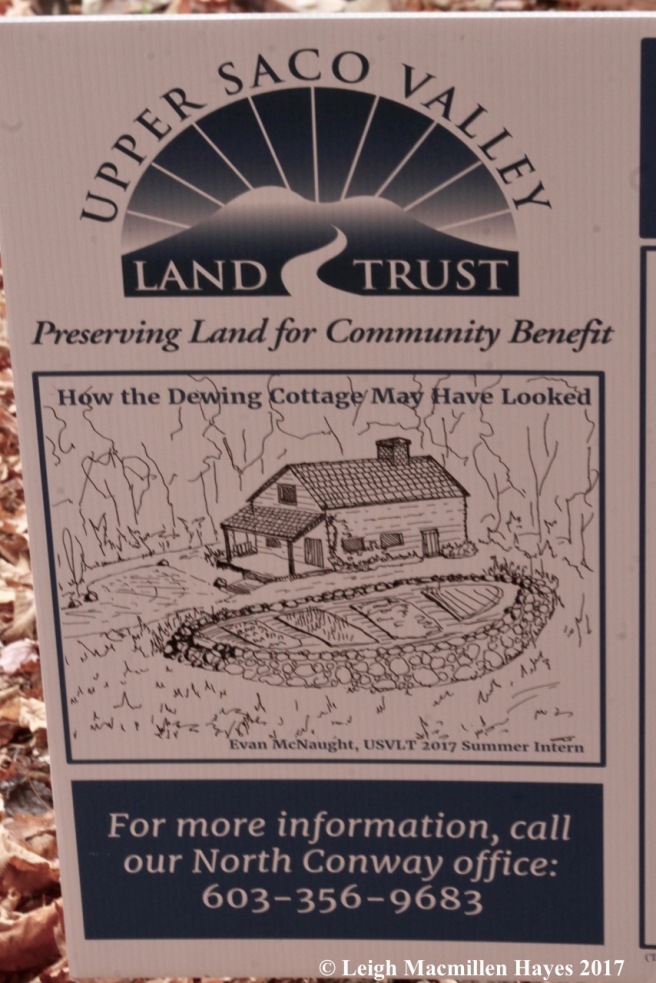
And then, as the trail evened out, we crossed a narrow gangplank to the location of the original cottage. According to a sign posted there, “Thomas Wilmer Dewing (1851-1938) and Maria Oakey Dewing (1845-1927) were 19th century American painters based in New York City. Maria often painted flowers and garden scenes, while Thomas is known for his figure paintings of aristocratic women, notably ‘Lady in Yellow’ hanging at the Isabella Steward Gardner Museum in Boston. The couple spent their summers at a popular artists’ colony in Cornish, NH, during the early 1900s. The Dewings also lived and painted in a cottage located here on the Monroe-Lucas Preserve for several years.

m-site of Dewing cottage 1

All that’s left is the chimney.

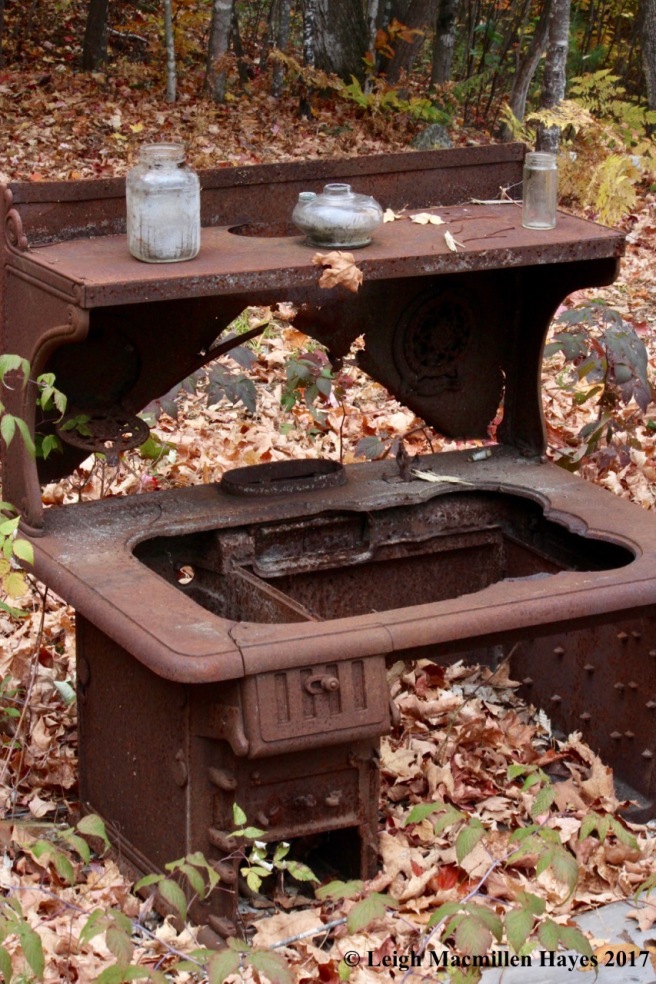
m-cottage stove

And some artifacts.

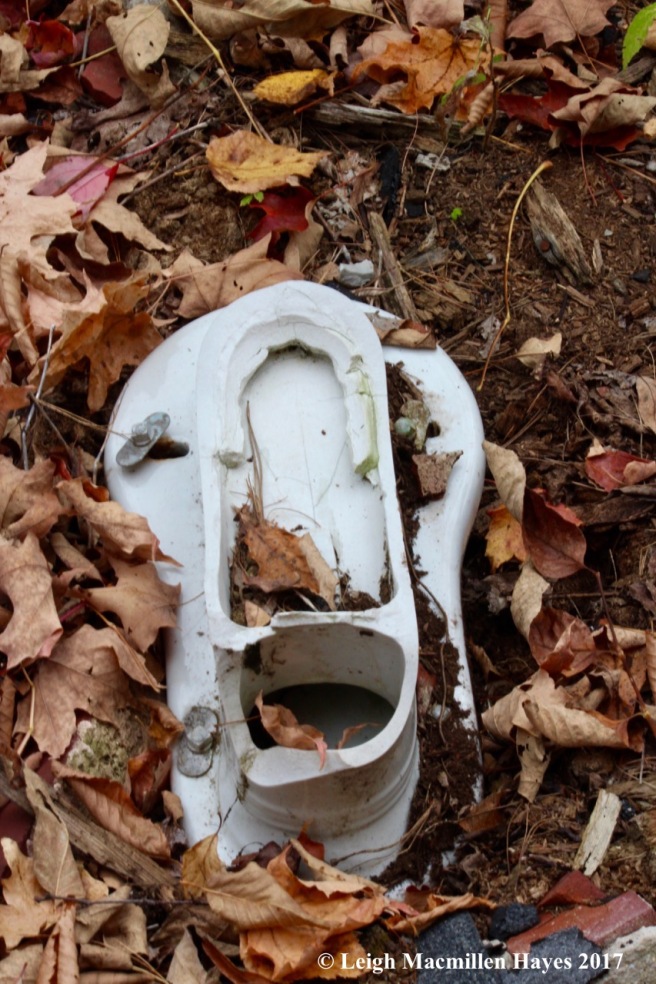
m-toilet

Including the john.

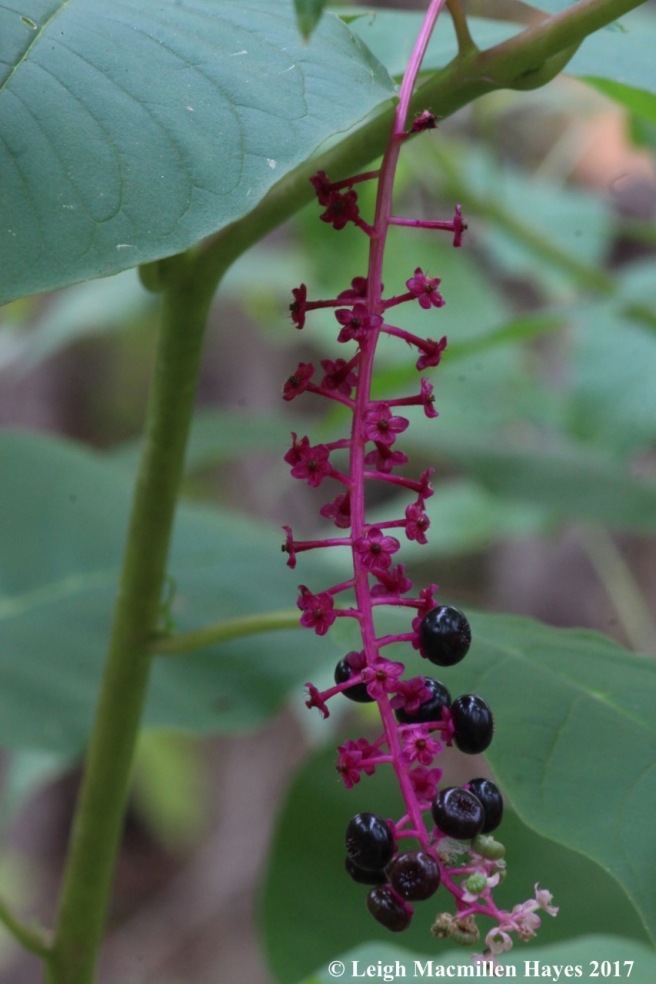
m-pokeweed

Our final view was a pokeweed still in flower and fruit. Again, we wondered about its timing, while appreciating its offering.

With that, we were back at the parking lot, where Bob informed us that our distance was just over a mile and time two hours–hardly record breaking. And hardly a “quickest to the destination hike” for my guy, but he kept finding stumps to sit upon as we gazed more intently on our surroundings; I think he secretly appreciated our slow pace and the opportunity to rest his legs.

If you want support his effort to raise funds for the Shawnee Peak Adaptive Ski Program, stop by and see him. Any and all donations are most welcome.

A Circle Completed

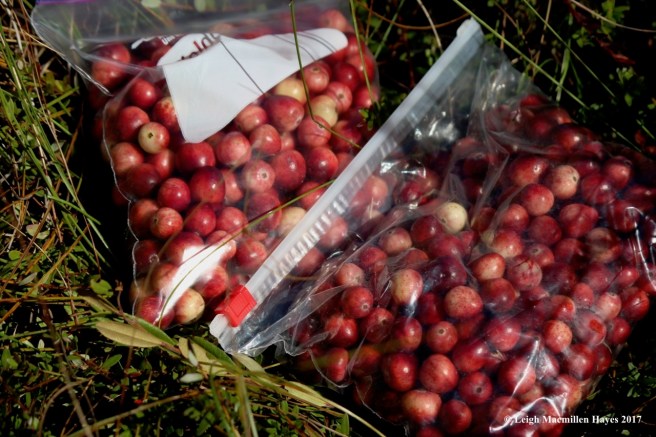
The day began with a reconnaissance mission to the Kezar Outlet Fen and a check on the cranberry crop. One of the most delightful ways to spend an early October morning is foraging for those little red balls of tartness and while my guy may have blue greed in his  need to pick every blueberry in sight, my greed turns red this time of year.

f2-winterberries

Of course, on the way to the fen, other red berries showed their shiny faces–and we rejoiced in their presence as well. Winterberries were they.

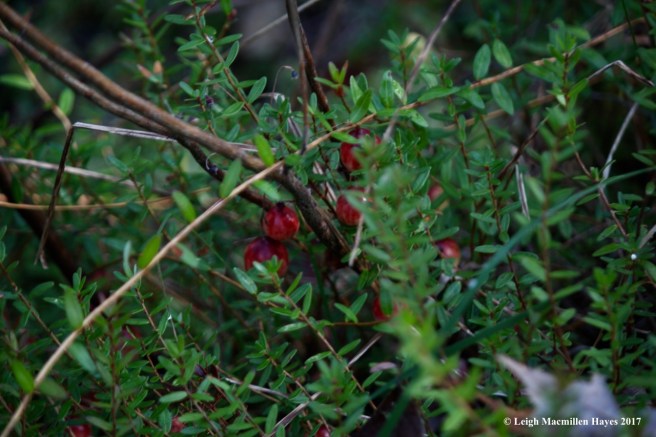
f4-cranberries 1

But it was those little gems that grew closer to the ground that caught our attention on this morning’s Greater Lovell Land Trust docent tramp. And like those who have come before, we each claimed a spot and made sure not to trespass in our quest to fill our bags with such redness.

f6-cranberries

It didn’t take long. And really, there is no better way to spend the morning . . .

f3-kettle hole

for this is a place to share the joy of foraging, the beauty of place, and the conversation of friendships.

m1-abandoned lodge 1

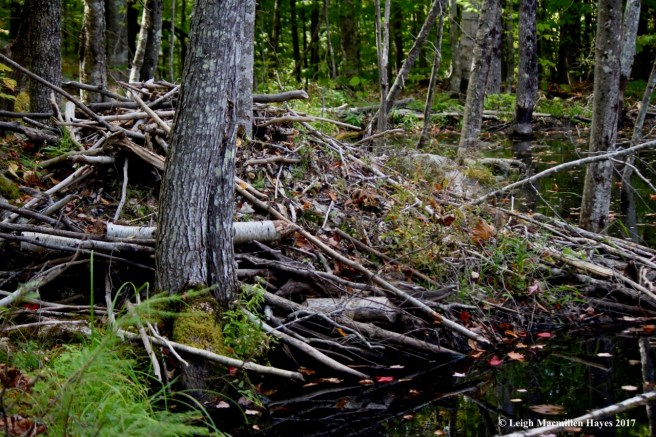
And then one friend and I returned to the beaver quest I’ve been pursuing for the past two weeks. It was another reconnaissance mission intended to find some new activity. Today, we traveled a different trail and visited an old lodge–again several years abandoned.

m3-anthill

Though no one was home at the stick lodge, we did find a few inhabitants of a nearby sand lodge, aka ant hill. And Forester Dave, with whom I was traveling, pointed out that the sweet and bracken ferns circled the spot, but didn’t grow within at least a foot of the hill. His theory is that the ants chemically affect the ferns. That was new to me and one to observe in other places.

m4-side lodge

We continued on our way and eventually came to another beaver pond that seemed equally abandoned. The lodge was built along a side bank, but no new construction had taken place recently. Nor was there a display of food gathering in preparation for winter.

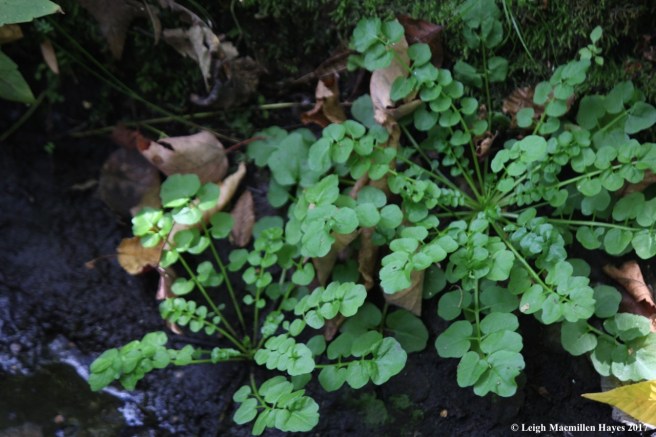
m5-watercress

But . . . we found a food source of a different kind in the form of watercress.

m8-green frog

We also watched a number of green frogs leap into the leaf-strewn water to hide–and yet slowly float to the surface in an ever curious way.

m9-hornbeam hop

And we saw numerous “hop” balloons, those little slightly inflated cases of hop hornbeam fruits that protect the seeds–many of which flowed in the water. So where was the source?

m10-hornbeam bark

We scanned the forest and finally found the shaggy barked tree beside the water.

m11-bobcat print

After that, some bushwhacking found us passing through a muddy zone–and prime tracking location. Deer, raccoons, coyotes and bobcats had previously walked where we stepped. Do you see the C for cat in this print?

m13-dam3

At last we reached our intended destination, only to realize that the beavers still eluded us. We were sure that since all other areas had been abandoned, this one would be active.

m14-beaver pond of yore

We were wrong. The only activity seemed to be leaves clustering on the water’s surface.

m16-raccoon prints

And so we backtracked and made our way down to another beaver pond, deciding  that we’d travel in the opposite direction of the raccoons and follow the stream downhill. From the top of the land to the lower portion, we encountered four or five well built dams, all still intact, yet the water levels were much lower than we would have noted if the ponds had active beavers. To say we were disappointed would be an understatement.

m17-bobcat scat?

We did, however, find a great scat specimen. We debated bobcat and coyote–sectioned as it was had us leaning toward bobcat, but there were some large bone pieces that suggested coyote. Either way–we knew both had passed through.

m18-spring peeper

And we found a spring peeper and chatted about their callings in autumn weather that reflects their mating season–the fall echo season.

m20-brook view

A little more bush and whack and at last we reached the brook below.

m21-single leaf

As we stood in companionable silence, a single leaf floated past.

m24-balsam seedling

When it was time to turn away, we continued on, reveling in sights missed on previous missions, including a balsam sapling growing on a fern-covered stump.

m25-fresh beaver works!

And then, and then, much to our surprise, we encountered fresh beaver works where only three days ago there had been none. In at least three locations, we discovered that tree roots had been gnawed upon. It was a subtle sign–but a positive sign.

m26-smaller lodge

The lodges, which number at least three in this particular beaver pond that keeps pulling me back, still don’t look like they’ve been attended to. And there are no winter food platforms yet, but apparently they have time and don’t need to button down the hatches yet.

m28-brook

Happy in the knowledge that we’d found the beavers, though we never saw them, we decided to continue to follow the stream to a trail that abuts the property boundary.

m27-black ash

And being a forester, Dave quizzed me on a tree or two. This one I got wrong by its bark because it doesn’t exactly look like its white and green siblings, but knew by its leaf–black ash with no petioles on the leaflets.

m29-foam reflecting bark

About three hours later, we left the beaver community behind–our circle completed, figuratively and literally. Even the brook appeared to know, its froth circled in reflection of the log above.


The Mighty Tracker

“Quick, look at the bird feeder,” my guy said this morning.

I expected some exotic bird and chuckled to myself, a memory of our youngest son telling me about the huge gray bird with a black head and long, long tail that it was in the driveway last week. I showed him a picture of a catbird. Bingo.

So when I did look out the kitchen window, I was taken aback–a large black bear stood at the feeder. I know I should have taken it in a month ago, but took my chances. And then I ran for my camera, not remembering that I’d left it on the counter right next to where I’d been standing. Finally, camera in hand, I dashed out the back door.  And . . .

b-bear !

he’d moved on. At the stonewall, he gave me one backward glance before climbing over it. Consequently, the bear is in this photo on the other side of the wall, but I was so excited I forgot to focus it and my guy and I will be the only ones that truly know it.

b-boots

But, I love to track mammals and so this afternoon I donned my tracking uniform and headed off on the trail to see what I might see.

b-bird feeder

I began at the spot of our first sighting–the bird feeder by the garden.

b-bear impression

All that my closer examination revealed was a few stomped leaves. No hair. Nothing else.

b-stonewall

From there, I kept examining the grass on my way to the stone wall. And then the wall itself and the trees around it. Nada.

b-tree stump

Stepping over the wall, I tried to determine the bear’s next direction. Still nothing to see. And so I started checking the numerous tree stumps, figuring it was hungry and might have looked for ants or other insects. All the disturbance I saw was made prior to this morning.

b-hemlock cones

My next decision was to follow the cowpath east and then west, but still nothing to report. I did notice the baby hemlock cones showing off their aquamarine color.

p-gray squirrel

As I walked, I heard some commotion. Did you know that gray squirrels can make more noise than a black bear?

b-deer prints

When I got to the the ruts in the snowmobile trail, I thought I might finally find what I was looking for. Instead, I spotted plenty of deer prints and  . . .

b-squirrel prints

even those made by the squirrels.

b-wood frogs 1

Since I was in the neighborhood, I decided to stop by the vernal pool, thinking perhaps the bear had done the same.

b-wood frog 2:gills

Nothing looked disturbed and the tadpoles showed off their latest growth. This might be the year wood frogs finally hop out of the pool.

b-blue-eyed grass

Not far from the pool, I discovered the first blue-eyed grass of the season.

b-turkey track

And as I returned, I went a bit beyond the cowpath and found turkey prints.

b-turkey and fox prints

There were some coyote prints as well, but one of my favorite print sightings was that of the turkey headed north and fox headed south. The fox print shows where the front foot came down and the hind foot fell almost directly into the same spot thus looking like two sets of front toes and nails pointed inward–direct registration.

Phew, I am the mighty tracker after all.

But that bear–it eluded me. It’s one for our mind’s eye as a memory shared and there it shall remain.


Morning Glory at Kezar River Reserve

Some mornings the hallelujahs spring forth from my being–and fortunately not from my vocal cords.

k-Kezar River sign

Today was one of those days as I ventured down the snowmobile trail, aka Parnes Landing Road, at the Greater Lovell Land Trust’s Kezar River Reserve. Just past the kiosk, I veered to the left to follow the GLLT’s trail into the woods.

k-jelly topside1

Within steps I was greeted by Auricularia auriula, a jelly ear fungus. The sun’s beams revealed veins reminiscent of stained glass windows and polished woodwork in an older church.

k-jelly under 2

Flipping the fallen oak branch to look at the underside revealed an equally, if not more beautiful design with its frosted outline.

k-wintergreen

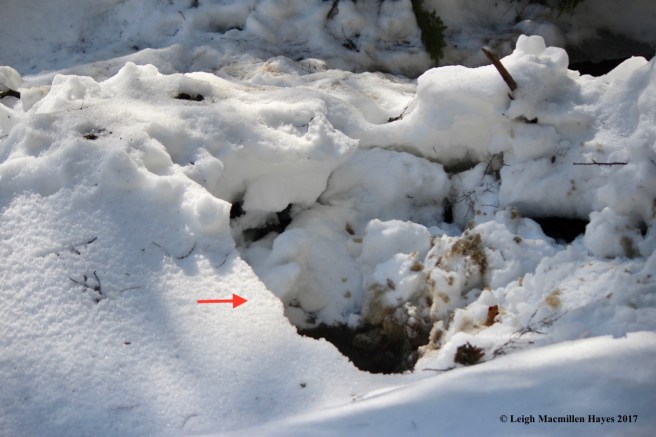
On a steep hill beside Kezar River, actually the sloped side of a ravine I’d never hiked upon before, a southerly orientation presented lives past and present.

k-bench

Below, at the point where the trail, road and river meet, few have paused recently, including no sign of otter.

k-river view

But many have zoomed by with a need to reach the next destination as fast as possible.

k-ravine 1

I followed their tracks a little way out and peeked into the second ravine from a vantage point seldom celebrated.

k-big tooth aspen leaf

And then I headed back up the road to the next trail intersection. At my feet, form bespoke name, such is the manner of the big tooth aspen.

k-ravine 2

Down into the second ravine I tromped as I made my way to view the outlet from the other side.

k-otter 1

Because of the snow’s depth, I traveled to places less frequented and beside the stream I noted previous action. Lots of it.

k-otter activity1

And I spied evidence of the creator–whose prints were hard to distinguish, but other signs easily discernible.

k-my otterness

In my attempt to take a closer look, I practiced my inner otter and managed to find the water and leave my own set of muddy, though not quite webbed, prints. I laughed aloud as I pulled myself up and gave thanks for remembering to bring my hiking pole. Fortunately, the breakthrough was the only sign I left behind.

k-nature's snowball

Heading up the ravine, I smiled at the sight of the universe having fun–nature rolled her own snowballs–perhaps in preparation to build a snow woman.

k-pine cathedral

Through the cathedral of pines I continued–always looking up . . .

k-ice art

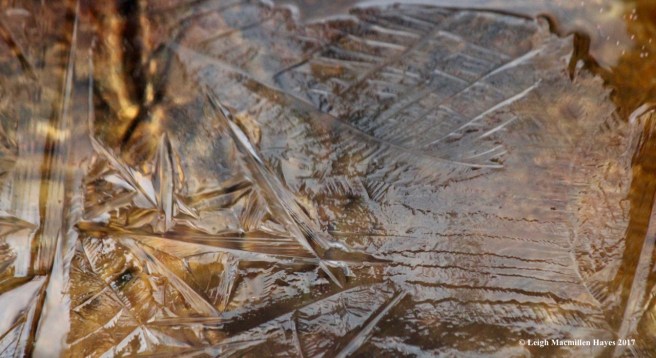
and down, where intricate patterns formed naturally in the ice offered a feathery look at the world below.

k-paper birch lateral bud

Sometimes, I stopped to spend a few moments with family members . . .

k-yellow birch

taking time to marvel in their similarities and differences as they stood side by side.

k-oak gall

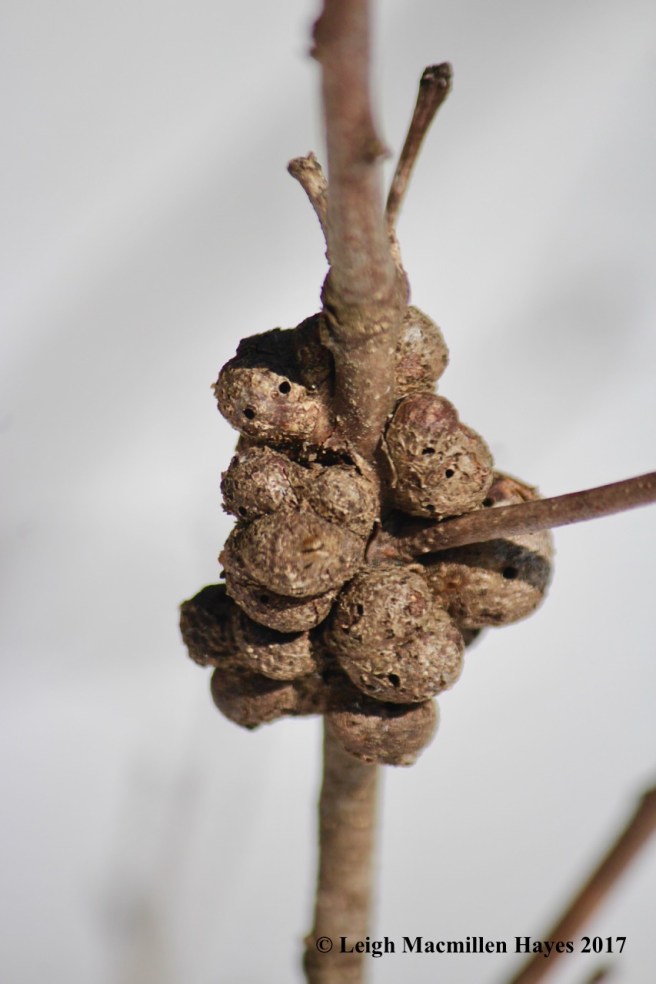
And it seems there are many hosts throughout our woodlands that offer a spot for others to evolve.

k-oak crown

Despite or perhaps because of that, knowing they’d offered a helping hand, the oaks sported their crowns proudly.

k-pussy willow

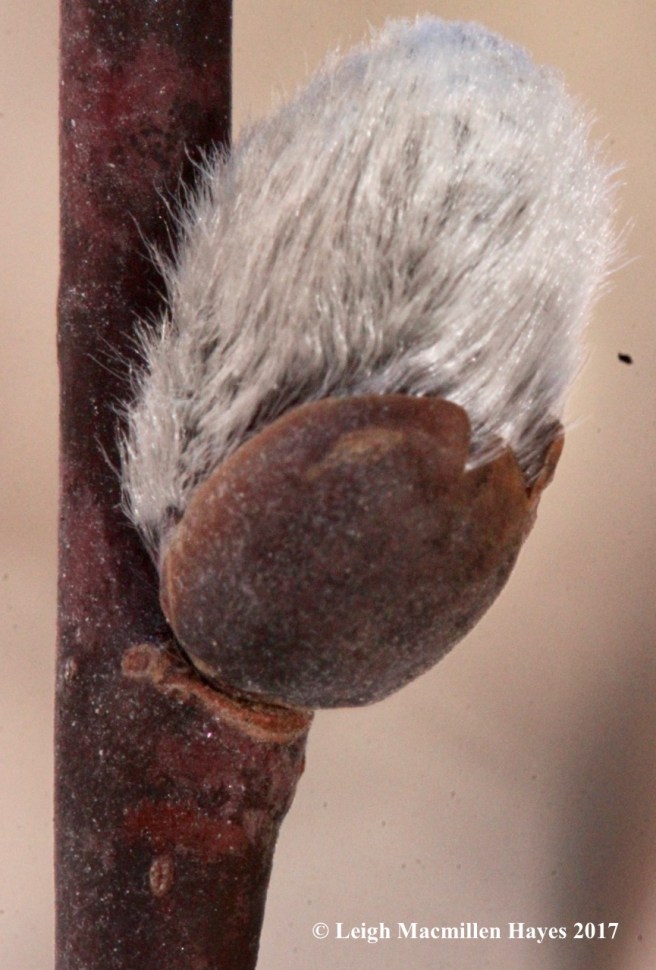
Quite unexpectedly, I stumbled upon a picture of youth that warms my heart endlessly.

k-flowers in bloom

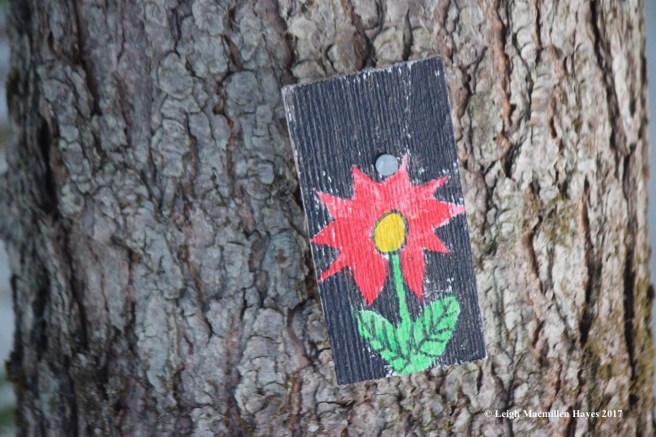
My journey wasn’t long, such is the trail. It’s decorated with small bright signs painted by local youngsters. Though I wouldn’t want to see these on every trail, they make me smile as I enjoy their colorful renditions of the natural world.

Not a picture of a morning glory, certainly, but a morning full of glory as I wandered and wondered and sang hallelujah along the trail at Kezar River Reserve.


The Sun Always Shines

In the grayness of the day sunlight lit my way.

o-skunk tracks

Oh, it wasn’t as bright as yesterday when I wandered in brilliant light under clear blue skies and saw hints of spring, including skunk prints in the snow,

o-algae

and some blue-green algae in a vernal pool that is slowly opening up.

o-ice goddess

But given the temperature and wind, the ice goddess reminded me that winter prevailed.

b-deer 2

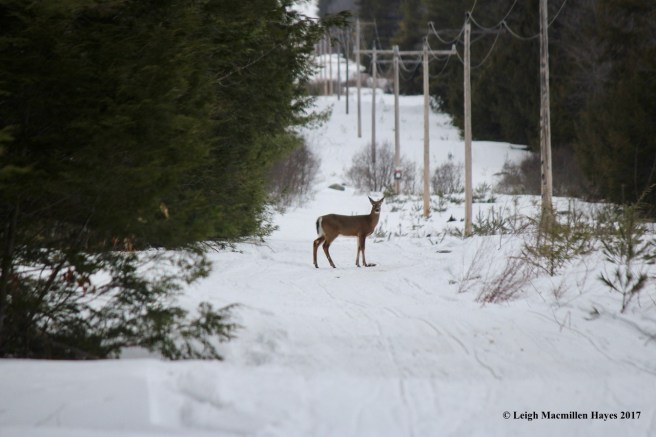
This morning presented a different picture that didn’t feature Mount Washington in the background because it was obscured by clouds. Rather than don my snowshoes, I decided to stick to the snowmobile trail for the most part. I wasn’t the only one who ventured that way. Because I wasn’t making as much noise as usual, the deer didn’t hear me approach. And so we stood for many minutes contemplating each other. I didn’t want to scare her for I knew she wouldn’t just stick to the trail and the snow depth continues to be such that she sinks with each step. It was in those shared moments that I began to think about energy and how much she put forth all winter and now continues to do the same as spring evolves. Every day I spy more and more young hemlocks trunks that have been scraped. She and her family are feeding on sunlight, which first feed the insects in the soil and then the trees. At each stage or tropic level of the food chain only ten percent of biomass from the previous level is retained. Thus, a thousand pounds of plant biomass is necessary to support a hundred pounds of an herbivore–that’s a lot of little buds for a deer.

b-bobcat prints

Eventually, she made her way across the powerline and joined her family. I decided to turn around so I wouldn’t disturb them further. And it’s then that I recognized some prints I’d missed previously. My micro-spike print is on the left, beside those of a carnivore–a bobcat, or rather, two. Usually bobcats travel in a solitary manner, but their breeding season is upon them. And those thousand pounds of plant biomass that supported  a hundred pounds of herbivore, in turn support ten pounds of carnivore. The hunt becomes important.

b-motherwort

I did find a few spots where the snow had melted and winter weeds, such as this motherwort, provided hints of future buffet items for the herbivores and omnivores to consume.

b-junco and hemlock needle

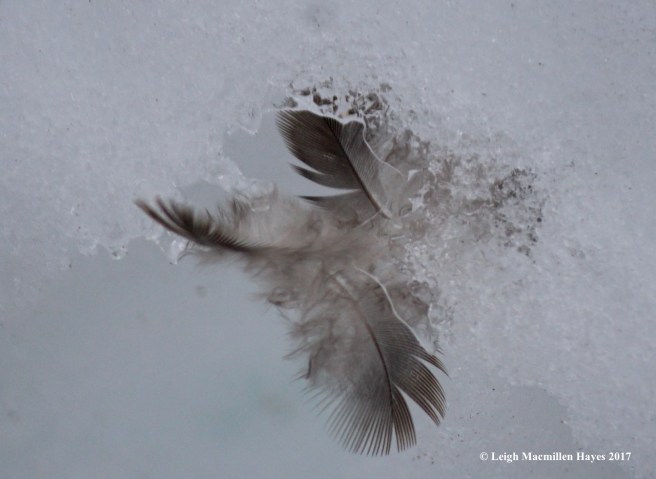
And then I came upon junco feathers and knew that a different consumer had benefited from the sunlight offered forth by this little bird. The hemlock needle provides a perspective of size.

b-junco feathers 2

Despite its demise, the feathers surrounded by melting snow created an artistic arrangement. That was my attempt at positive thinking, for like us, all things must eat to survive.

b-white ash opposite

And then a few producers caught my attention and I found myself focusing on young trees and shrubs. I’ve walked past this young tree numerous times and never saw it until today.

b-ash 2

White ash or green? They both look similar, but the leaf scar is the giveaway. It’s shaped like a C or misshapen horseshoe with a deep notch at the top.

b-ash bud

And its terminal bud is domed. In these woods, the ash trees aren’t a preferred food source of the deer–lucky for them.

b-silky 2

Nearby, another neighbor caught my attention and it, too, I hadn’t met before.

b-silky dogwood 1

My assumption was dogwood, given the bright red/purpishish color of its shrubby stems, long-gone fruits and opposite leaf buds. But–red osier or silky? I’ve leaned toward the latter but will have to pay attention as the season moves forward. These did seem to tickle the herbivores fancy from time to time, though not nearly as much as the maples that grow nearby.

b-peanut

As I headed toward home, I stumbled upon another site I’ve seen frequently all winter. Actually for the past few winters. There must be a peanut plantation somewhere in these woods. That, or the blue jays have discovered a good source at someone’s bird feeder.

b-ice goddess

Before heading indoors, I paused to acknowledge another ice goddess, one who also knows the sun’s power and found relief in today’s shadows . . .

b-snow

and flakes. It’s snowing again, this fourth day of spring. Liquid sunshine, for the snow also provides nourishment to all who live here.

You see, the sun always shines . . . even when you can’t feel the warmth of its rays.


Because I Wandered

It’s still cold and blustery. Oh, we had warm spells in January and February. But now it’s March. And it’s Maine. So wind chill in negative to single digits shouldn’t come as a surprise. Nor should the impending Nor’easter predicted for this week. Only more than a foot of snow possible.

Today’s cold wasn’t nearly as frigid as yesterday’s and when I stepped out the back door, I could feel the warmth of the sun penetrating my outer being. It worked wonders for my inner being as well.

o-quaking aspen

My first stop was beside the quaking aspen tree. Yesterday, some Maine Master Naturalist students and I examined tree buds and their characteristics. I love looking at these and do so every day since the tree is right off our back deck.

Varnished scales protect the  aspen’s leaf and flower buds as they lay dormant through the winter. Its flower is produced within a catkin and already the cottony part of the seeds is appearing, much like a pussy willow.

o-striped maple

As I moved into the woodlot, I stopped to re-admire the only striped maple that grows here. Last year a deer used the lower portion of the bark as an antler rub. Yesterday, as we stopped to look at the characteristics of its bark, we noticed it’s been used most recently as deer food. This tree is barely larger than the circle formed within my thumb and pointer finger–and I have small hands. How much more deer attention can it take?

o-gray fox tracks

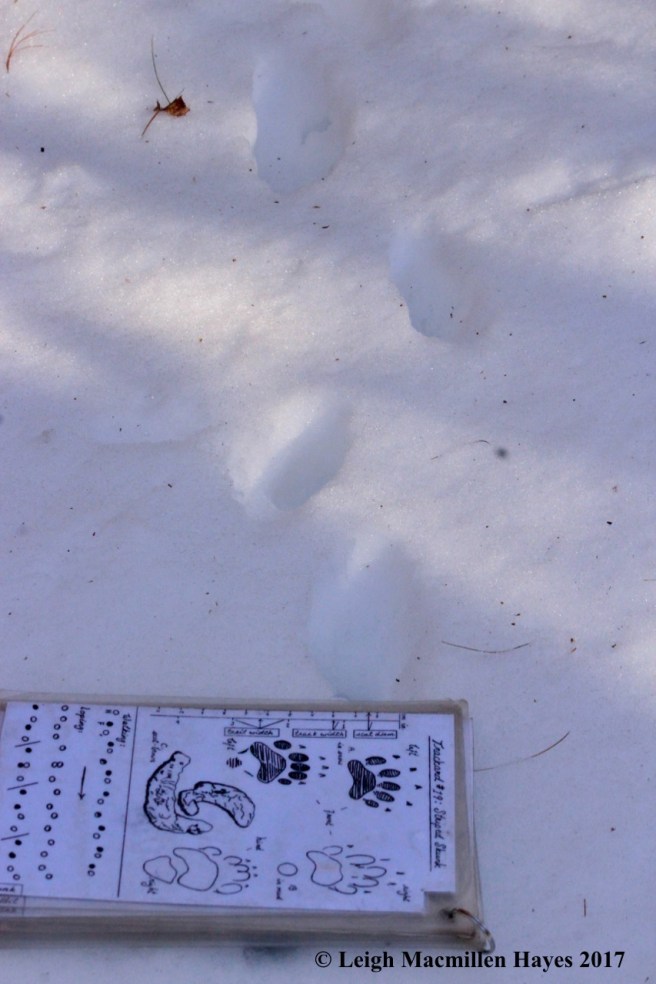
As I looked at the striped maple, my eyes were drawn to the activity of another mammal. Out came my Trackards and I took measurements. I knew by the walking pattern that it was a canine. And I knew by the size that it was a fox. But red or gray was the question. I suspected the latter because I could see details clearly in the soft snow atop the hardened crust.

o-gray fox prints

Measurements and a look at a bunch of prints confirmed my suspicion. Rather than stay on the path, I decided to backtrack the fox’s trail.

o-gray fox and coyote 1

Within minutes, I realized another mammal had traveled in the opposite direction. Also a canine.

o-gray fox and coyote intersect

And atop a double-wide stone wall, I found where the coyote (follow the red pencil) and gray fox (yellow) crossed paths. Not at the same time, I’m sure, but given the track conditions, I don’t think they were too far apart. We saw neither set of tracks as we examined trees and lichens in the same area yesterday.

o-gray fox sat and peed

I also found where the fox sat and then peed. Not much odor–in case you’re wondering.

o-turkey plus

My journey took me across a few more stone walls and through a hemlock grove. I lost the fox, but followed the coyote and then I found others including squirrels, deer and turkeys.

o-turkey wings

It looked like the turkeys had been dancing on an ice-covered puddle. And then perhaps they took off for the wing marks were well defined. Did they fly because the coyote approached? Or was there another reason? Time to head up into the trees for the night, maybe? It’s difficult work for these hefty birds to lift off.

o-many travelers

Everywhere I went, others had been before me. It seemed the prey followed the old logging routes and predators crossed.

o-bs lichen

My own wander became a bushwhack meander. And a few lichens called me in for a closer look. My inclination was to quickly brush off all the gray foliose (leaf like) lichens as weedy hammered shield, but I suspect there was some bottleshield lichen in the mix and realize I need to look again. I’m forever a student–thankfully.

o-crustose mosaic

While there were specks of shield lichens on a young maple tree, the variety of flattened crustose lichens covered so much of the trunk that it was almost difficult to distinguish the bark color.  The mosaic pattern suggested a painting–naturally.

o-beech 1

The buds and leaves of the beech trees also asked to be noticed. It’s been my experience that younger American beech keep their leaves throughout the winter–perhaps because their buds are lower to the ground and therefore easy targets for hungry herbivores. There are other theories as well, but I think it’s key to note that it’s the younger trees who keep their leaves, or in the case of this one, those that remain were on the lower branches.

o-beech leaves

They remain until the tree buds begin to break or leaf out. The word to describe this leaf retention is marcescent (mahr-ses-uh nt), which means withering but not falling off. Their rattling in the slightest breeze may be enough to keep those herbivores at bay.

o-beech 4

In the tree’s silhouette, the pointed buds stood out,

o-beech scales


each one a cylinder of overlapping scales in opposite orientation on a hairy stem.

o-witch hazel leaves

That, of course, led me to another marcescent tree that loves this wet woodland, the witch hazel. Its leaves have always intrigued me with their wavy margins and asymmetrical base. But it’s the winter color of the withered leaves that I also find attractive.

o-witch hazel scalpel

And its naked buds, which don’t have waxy scales like the aspen or beech. Somehow the fuzzy hairs must provide enough protection for the winter months.

o-witch hazel bracts

Everything is fuzzy on a witch hazel, including the bracts left from last fall’s ribbony flowers,

o-witch hazel pods

and the woody, two-seeded pods that ripen a year after the flowers have formed. These split open in the fall as the seeds were forcibly ejected.

o-moose scat

I wandered for hours and miles and never saw any prints from the moose that frequented these woods earlier in the season. But, where the snow had melted under a spruce, I found evidence that blended in with the leaf litter.

o-moose browse

And in an area I used to frequent prior to the logging operation of the last few years, I found more sign. The ruler is mine and this side shows centimeters.

o-coyote x2

When I reached the former log landing, my coyote friend made its presence known again. Actually, one became two as they had walked in single file and then split apart several times. They were on the hunt and a snowshoe hare was in the vicinity.

o-cherry

I followed the main logging trail for a while and then turned off to explore unknown territory. But . . . before turning, it was the maroonish color of the cherry bark that warranted attention. And the lenticels–raised, elongated and horizontal imprinted on my brain.

o-deciduous forest

My meanderings continued and again I saw lots of predator and prey activity. Even a porcupine, though that shouldn’t come as a surprise. Finally, I walked into an area of young red oak, red maple and gray birch and knew I was approaching familiar ground. And so I stepped onto the snowmobile trail.

o-deer 1

All along, I’d thought about the many tracks I’d seen, but no mammals . . . until I approached our cowpath. I wasn’t the only one headed that way.

o-deer browsing first

The deer herd seems to have survived this winter well. I’ve yet to find evidence that suggests otherwise.

o-deer browsing

And I felt blessed that I was able to move as close as possible despite the crunching of the snow beneath my feet. The wind was in my favor. And then, it heard me, flashed its white tail and ran down the cowpath. Perhaps we should rename it the deer path for a cow hasn’t walked on it in decades, but like me, the deer use it almost daily.

My day was made because I wandered.


Focusing Our Eyes at Wilson Wing

I almost canceled our Tuesday Tramp this morning. The weather seemed iffy and though that doesn’t often stop us, road conditions do. But Mary and I exchanged a few e-mails and decided that even though we were the only two available, we’d go for it.

w1--deer 1

As we made up our minds, I watched another who also experienced some indecision. Lately, eight deer have spent many moments in the field and our yard, nipping buds along the edge.

w2-deer 2

While the rest of its clan was further out, this one came over the stone wall.

w3a--deer 3a

For me, it was a matter of watching how its legs worked and where it placed its cloven toes.

w4-deer 5

About to visit some trees, it turned suddenly when it realized it was being stalked–not by me but rather a neighbor’s cat. Well, maybe I was as well, but I was indoors.

w6-deer 6

Gingerly, it moved in for a closer look.

w7-deer 7

Tail down, it seemed curious to make a new acquaintance. And the big, tough cat–it ran home.

w8--Sucker Brook 1

And so, I packed up and met Mary for our adventure at the Greater Lovell Land Trust’s  Wilson Wing Moose Pond Bog Preserve on Horseshoe Pond Road in Lovell. We’d had a dusting of snow overnight and weren’t sure what to expect. Always expect the unexpected.

From the start, we found older coyote tracks that we decided to follow. Those led us to mink tracks that began near Sucker Brook. For a while, we followed both as they ran parallel, the mink tracks being much fresher. And then we stood in one spot and realized we were encircled by coyote, mink, red squirrel and short or long-tailed weasel tracks. We could have gone home then, but of course we didn’t.

w9-ice skirt

We decided to follow the brook for a while, hoping to see otter tracks and a slide. Instead, we were treated to aprons of ice surrounding boulders and tree roots.

w10-hoar ice

Some hoar frost at a hole made us wonder who might be within.

w11-mink tracks with tail drag

And our eyes again recognized that we were still on the trail of the coyote and mink. All along, we were curious to see the drag marks left behind by the mink’s tail. Unless it was carrying something–another option.

w12-Sucker Brook 2

As we stood and looked about, movement caught our eyes and we realized we were looking at the mink. Unfortunately, neither of us thought to capture it in a photograph, but it will remain forever in our mind’s eye. While I did exactly what I tell others not to do–tried to follow it for a couple of minutes–Mary stood and listened. A sound above make her crick her neck.

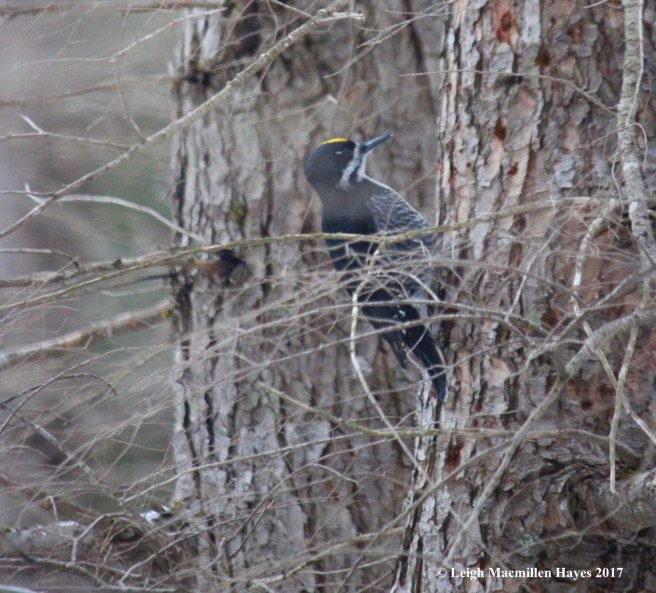
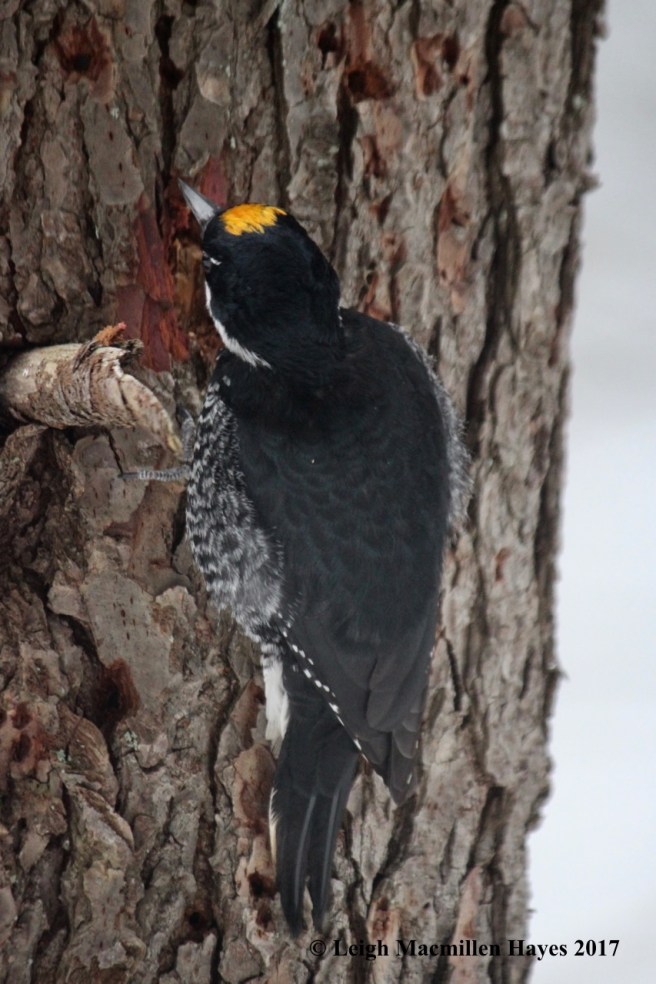
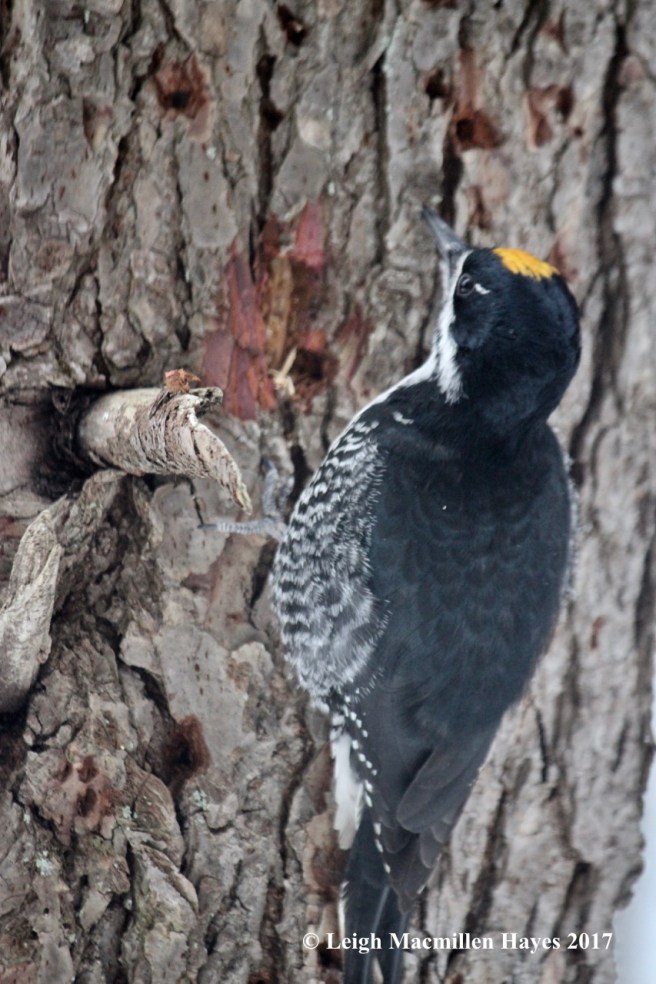
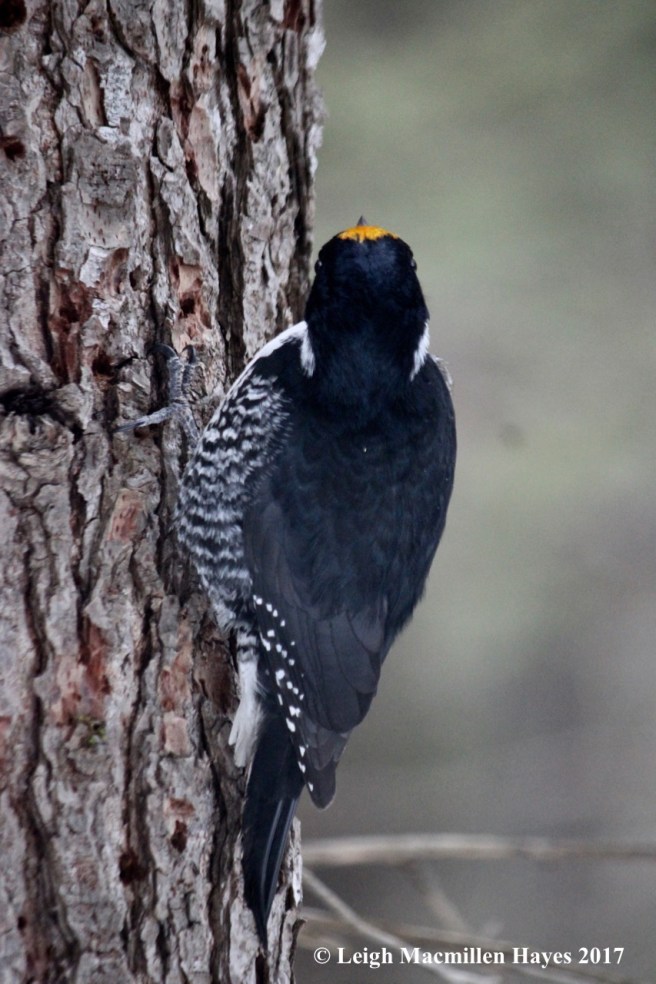
w13-black backed woodpecker

On a dead trunk, a woodpecker foraged among the bark scales. We watched it for a while, trying to note its features from below and we then moved on.

w14--hobblebush

My visits to Wilson Wing are never complete without a stop to worship the hobblebush. For those anticipating spring, it’s only a few weeks away. It won’t be long and these naked leaf and flower buds will unfurl and I’m sure I’ll share their blooming glory with you.

w15-Moose Pond Bog

Another stop that I can’t pass by is a climb up the stairs to the platform–the perfect viewing spot for the bog.

w16-car

Finally, we continued along the trail and I realized my focal points were redundant of all past visits, but it’s fun to view some of these in various seasons. For those who know, this is the old blue vehicle.

w17-lungwort

And right near it, my favorite of all foliose lichens–lungwort, indicative of unpolluted air. At Wilson Wing–indeed.

w18-hemlock catkins ;-)

We crossed the last little stream, found some deer tracks and a beaver chew, and then decided to follow the trail back rather than the road. One of our stops included admiring the hemlock catkins. (Smiley face)

w19-black backed 2

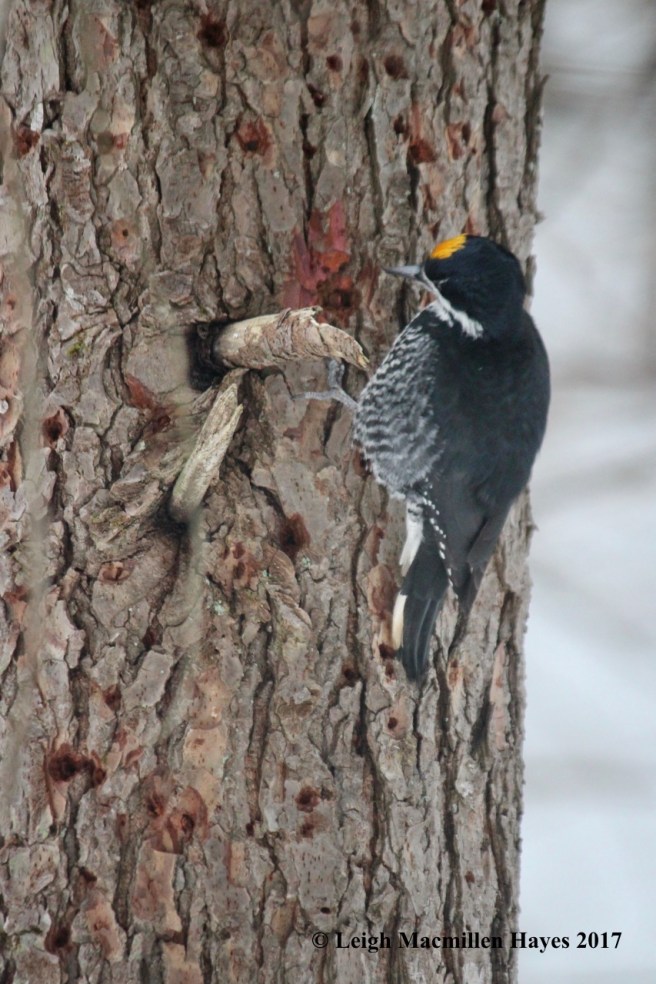
And then we returned to the woodpecker. By now he was our woodpecker, just as the mink that we saw and other critters we didn’t see were also “our mink” and “our coyote,” etc. It’s amazing how even when we don’t see the mammal, recognizing that it has passed through is enough to excite us. But this bird . . . oh my.

w20-black backed 3

We noted the orangey yellow crown as it cocked its head.

w26-black backed 8

Its face was black and white, including a black mustache and white eye line.

w22--black backed 5

We were surprised by its stocky build.

w24-black backed 6

And those black and white barred sides or flanks weren’t like the woodpeckers we normally see.

w25-black backed 7

It worked constantly, flaking the scales off the trunk as it searched for insect larvae.

w27-black backed 9

Cinnamon colored underbark revealed itself where the bird had recently excavated.

w28-black backed 10

As it contemplated its next move, it didn’t seem to mind our admiration.

w30-black backed 11

With its strong beak, it probed and probed.

w31-black backed 12

Then held its head back and . . .

w32-black backed 13

probed some more.

w33-black backed 14

First it cocked its head to the right.

w36-black backed 17

And then back to the left.

w38-blackbacked 18

Frequently, it paused for a brief break. Or perhaps it was dining and we didn’t know it.

w40-black backed 21

We were mesmerized.

w39-black backed 20

And delighted . . .  for we’d had the opportunity to focus our eyes on so many wonders, but especially the mink and this . . . a black-backed woodpecker. This was a rare opportunity for these birds seldom show themselves, especially this far south–all the more reason to be thankful that we decided to go for it and focus our eyes on the nature of Wilson Wing Moose Pond Bog Preserve.

Tickling the Feet

I don’t often write about indoor events, but while the rest of the world was out playing in the brisk wind of this late winter day, a few of us gathered inside the community center at Two Echo Cohousing to meet some feet.

f-dorcas-and-sally

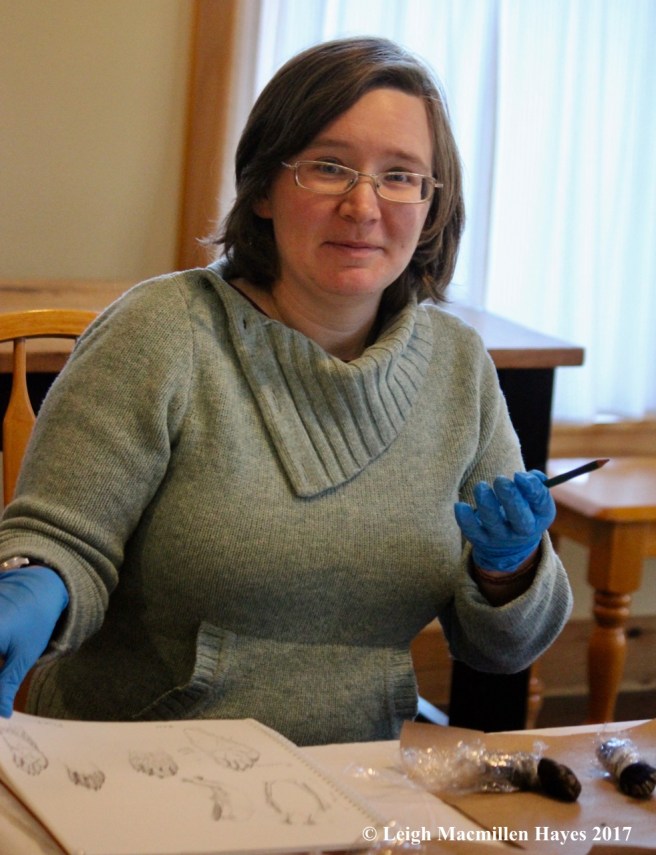
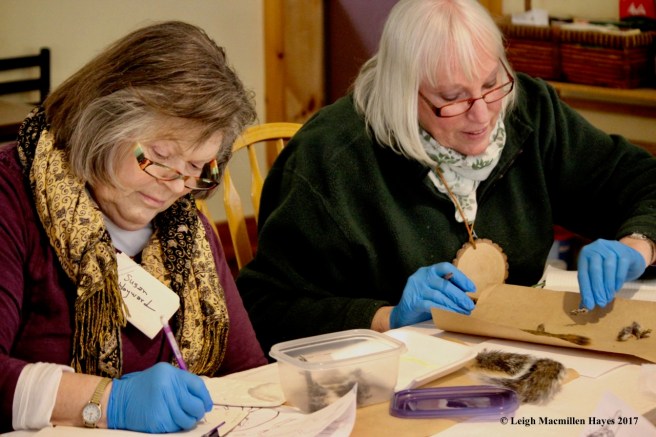
Meet the feet? Yes, mammal feet. It was an Advanced Seminar prepared for students and graduates of the Maine Master Naturalist Program by one of our founders and past president, Dorcas Miller.

f-gaby

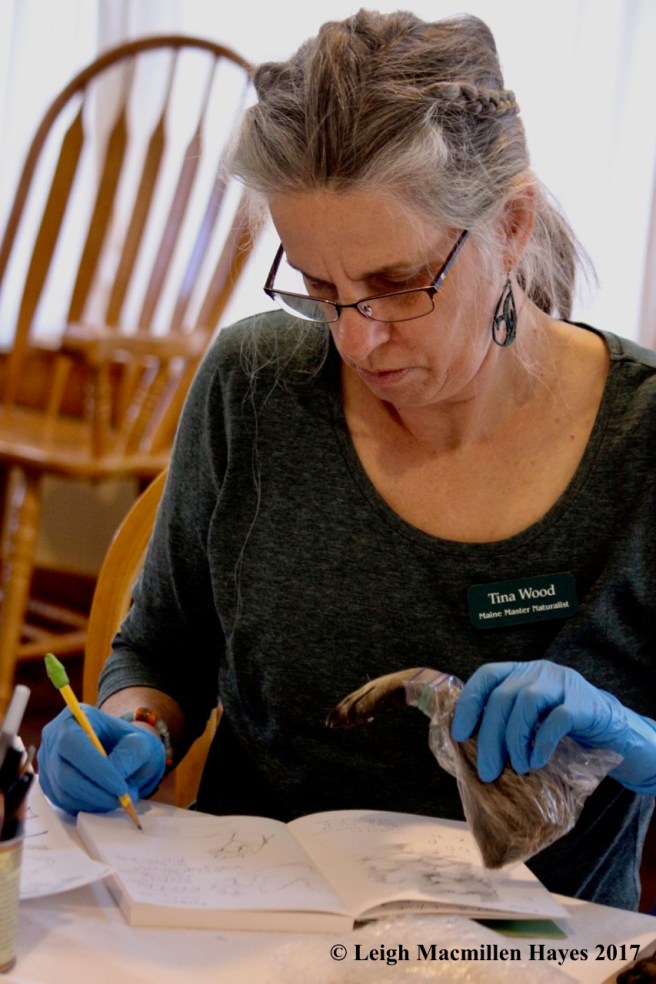
Dorcas has gathered mammal feet from road kill and gifts. And we gathered to take a closer look at them, determine if their stance was plantigrade (walking–entire foot on ground as we do), digitigrade (tip-toeing like a fox or coyote), or unguligrade (en pointe in ballet, like the ungulates–deer, moose, sheep), and sketch what we saw.

f-tina

Sketching is a fabulous way to take a closer look.

f-mary

And so we did,

f-fred

with intensity,

f-beth-b

curiosity,

f-christy

smiles,

f-cheryl

and giggles.

f-gordon

From tiny

f-beth

to big, we had them all to study.

f-sharon

We wondered what we’d find.

f-ruth

And survived some interesting scents (think skunk).

f-susan-penny

Probably the best part was that we renewed friendships formed through a combined interest in learning about the natural world.

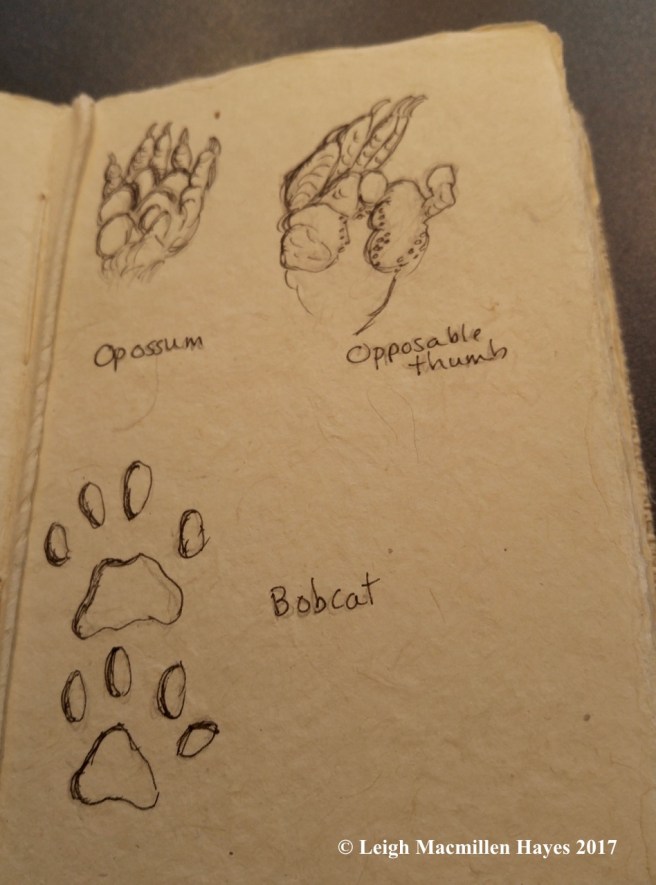
f-raccoon-1-1

My own sketches were rather primitive.

f-muskrat-1-1

But it was noticing the details that appealed to me most.

f-opossum-2-1

One of my favorite pairs–the opossum with its opposable thumb, puffy pads and grip bumps.

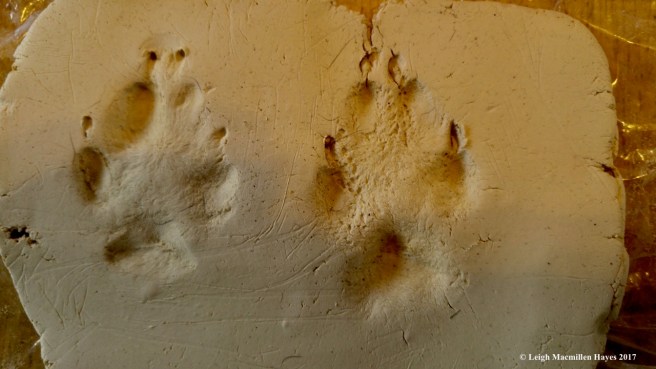
f-opossum-cast-1

When we finished sketching, we made some casts in clay. These illustrate the opossum better than I ever could.

f-red-fox-cast-1

My final cast was the red fox–I love that the chevron shows in the print on the left and the hairiness of its feet is evident.

f-cover-1-1

At the end of the seminar, we celebrated the release of the second edition of Track Finder, written by Dorcas.

f-dorcas-feet

And coveted her bear claw shawl–a gift from her guy.

f-attribution-1-1

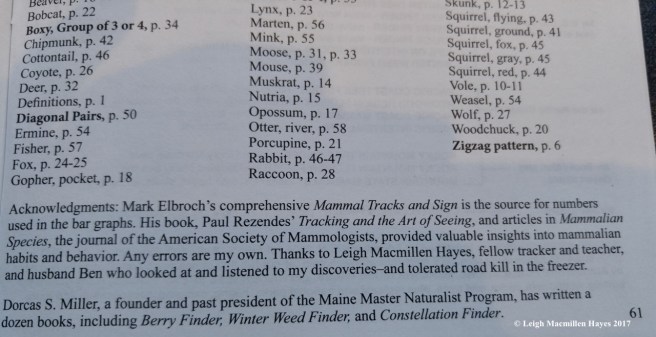
As she gave me my signed book, she told me to take a look at the Acknowledgements. She acknowledged me! I’m not sure why, but I’m certainly humbled and honored.

I also love her note to her guy–about the road kill in the freezer.

Yup, we stayed indoors today and tickled some feet. They tickled us back.


From Lion to Lioness

Given yesterday’s rain and fog, March forgot its lion-like nature and seemed rather tame. Or so we thought.

h-lion

This morning, however, dawn broke with sunshine and clouds, followed by raindrops the size of half dollars, followed by clouds and wind, followed by snow and wind, followed by clouds and sunshine, followed by hail, followed by sunshine and clouds. And all of that before noon.

h-clothes-line

The wind continued to blow, but was down a few knots when two friends and I noticed this bark hanging out to dry much the way laundry does.

h-beaver-bog

Our intention was to explore Lakes Environmental Association‘s newly acquired property in North Bridgton. The 325-acre property was the gift of the David and Carol Hancock Charitable Trust. And based on the wildlife signs we encountered today, it offers a valuable corridor. It’s all of that plus it’s part of the Highland Lake watershed and ultimately the Sebago Lake watershed. And it will provide a place for research, public education and recreation.

h-bog-1

And so today, I followed Marita Wiser, author of HIKES & Woodland Walks in and around Maine’s LAKES Region and JoAnne Diller, who has conquered all 100 4,000-foot peaks. Our intention was to skirt around the outside of the wetland, but curiosity got the better of us.

h-coyote-prints

For a bit, we followed the tracks of several coyotes who had traveled through rather recently given that we could clearly see the toes, nails and X between pads .

h-coyote-trot

And then we found a set of prints, also coyote, that appeared to be even fresher. What made us wonder were the drag marks we saw in various places associated with the tracks, which we don’t often see.  It was obvious that the mammal was trotting give the sets of four prints in a backward C fashion. But was it dragging its tail because it was sinking in a bit, much as we were? Or was it dragging some prey? We never did figure it out, but enjoyed the chance to wonder.

h-heron-nest-2

We do know that it led us to a heron nest high up in a tree. I’d only visited the property twice before, in the early summer and had seen another heron nest, but this one was new to me. Such big birds. Such little nests given that they raise three or four young who grow as big as their parents while waiting to fledge.

h-beaver-brook-meanders

Though we could feel the wind on our faces, we enjoyed the sunshine as we journeyed on through this special place. Soon this world will change and so we were rejoicing in the opportunity to view it from such an upclose perspective.

h-beaver-lodge-1

Our next stop was one of the beaver lodges. It appeared that no one was home, given the fact that there was no meltdown at the top and no mammal tracks leading to or from it.

h-beaver-lodge-2-opening

Instead, we followed faded weasel tracks presumably made by an otter, to another lodge, where the top was exposed.

h-beaver-damotter

As we circled around behind it, we noted that many visits had been made.

h-heron-nest-3

And then we turned again, to another heron nest that I recognized. During my June visit, an adult had flown in, indicating there may have been young in the nest.

h-lungwort-brown-1

From there, we paused briefly to admire some lungwort that was the brownest and driest I’ve ever seen, especially given yesterday’s rain and today’s mixed precipitation.

h-beaver-dam-approach

And then our eyes were suddenly drawn to a line of lumps in the snow and we realized we were standing on the infinity pool created by a beaver dam.

h-beaver-dam-3

Being mighty explorers, Marita led the way and we climbed up and over a hemlock hill to garner a closer look. And then JoAnne led us onto a little island where we stood and took in the views.

h-beaver-brook-below-dam

Tracks leading to the water indicated we weren’t the only ones who had ventured this way. But . . . no sign of beaver activity.

h-beaver-trees

Back up over the hill we tramped and suddenly our eyes began to focus . . .

h-beaver-teeth-marks

on beaver works.

h-beaver-goddess

With our imagination wheels turning, we saw a sculpture of a pregnant woman.

h-beaver-birch

And marveled at the amount of fresh works everywhere.

h-beaver-trail

Their path was well traveled and led us to more.

h-beaver-chew-stick

We even spied beaver chews, the snack of choice.

h-beaver-dam-small

And another smaller dam.

h-marita-and-joanne

Eventually, we left the beavers behind and continued across the hardwood/hemlock/pine forest, crossing a couple of skid roads before finally following one out, sharing stories and future plans as we hiked.

For this day that came in like a lion, we were thankful for the opportunity to enjoy its more lioness form and to roar with our own joy and laughter shared.

The Second Anniversary of Wondermyway

Milestones are always important as they mark significant events in our lives. And for me, such an event occurs today as I celebrate the second anniversary of the day wondermyway.com was born.

Since I was in elementary school and made few and far between entries into a chunky journal bound in a green cover (which I still own), to the first empty book journal my sister gave me when I graduated from high school, to a variety of travelogues and other journals I’ve filled from cover to cover,  I’ve recorded my life’s journey from time to time.

The most satisfying for me has been this very blog, to which I’ve added numerous events and discoveries, both natural and historical, over the last two years. As personal as it all is, I’ve taken a leap of faith by sharing it with you. And you have been gracious enough to read it, and comment on it, and “like” it, and sometimes “love” it, and offer me suggestions, corrections and gentle nudges.

Thank  you for following along on the journey. It’s been scary to put myself out there, but I have.

And now, I thought I’d review some favorite finds I noted in posts over the past year. My learnings have been many and it’s been fun to review all that I’ve seen and thought and admired and wondered about. I hope you’ll feel the same and will continue to follow along and comment and share those that you enjoy with your family and friends.

Here’s my countdown , or maybe I should say my count up of favorite moments in time over the past year:

Feb 21, 2016: Celebrating a Year of Wonder-filled Wanders
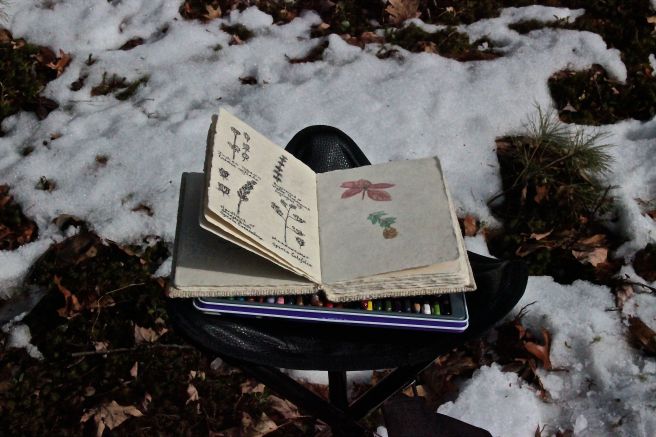
b-sit spot

b-sketch 1

I made time one year ago to sit and sketch–one of my favorite activities. To be still and embrace life around me. To notice. And commemorate.

February 28 2016: Gallivanting Around Great Brook

h-yellow and white partners

Usually, we drive the forest road in to the gate on Hut Road in Stoneham, but in winter it isn’t passable, and thus one must walk–which means paying attention to things you might not normally notice, such as this: a special relationship between a yellow birch and a white pine. Rooted in place, they embrace and share nutrients. Forever conjoined, they’ll dance through life together.

March 18, 2016: On the Verge of Change
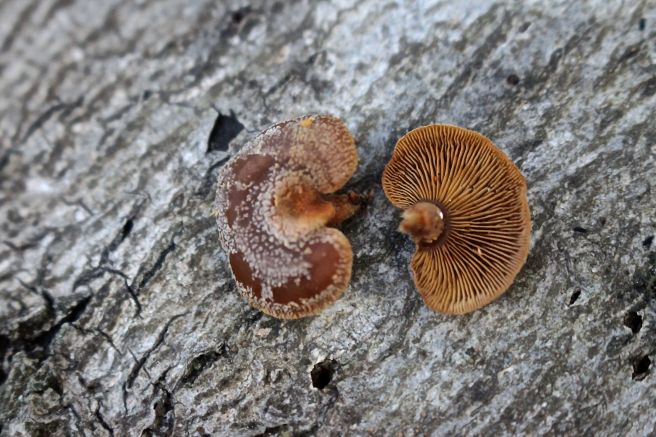
b-panellus stipticus?

While exploring the Greater Lovell Land Trust‘s  Back Pond Reserve in Stoneham with my friend, Parker,  who is a master mycologist, he found Panellus stipticus, a bioluminescent species. Check out those gills on the underside. According to Lawrence Millman in his book Fascinating Fungi of New England, ” . . . specimens in the Northeast glow more obviously than specimens in other parts of North America.” So if you are ever in these woods late at night, don’t be freaked out by a light greenish glow. It just might be nature’s night light.

March 22 2016: Wet Feet at Brownfield Bog

b-pellet

When I first spied this lump of gray I assumed it was a dead mouse. I know, I know–I should never assume because I risk “making an ass out of u and me.” And so I took a closer look. And noticed tons of bones and those orange teeth. An owl pellet filled with the remains of dinner. Owl pellets are extra cool and dissecting one is even cooler. I collected this one but haven’t dissected it because I think it makes for a great teaching tool as is. If you want to see it, just ask.

April 13, 2016: So Many Quacks

v-egg mass 1

At the vernal pool, or frog pond as we’ve always fondly referred to it, just steps from our property, I kept a keen eye on the situation last spring. In general, each mass laid by  female wood frogs was attached to a twig or branch. They tend to take advantage of the same site for attachment and usually in a warm, sunny spot.

A couple of masses were positioned independent of the rest, like this one–embraced in oak and maple leaves. Eventually, they’ll gain a greenish tinge from algae, which actually helps to camouflage them. One of the many wonders is that any given mass may contain up to 1,000 eggs–from a two-to-three-inch frog.

April 28, 2016: The Big, The Little and Everything in Between

b-bear2

The phone rang as I stepped out of the shower and a male voice yammered away about something in the snow and it had come last night and I had to get there quickly. My friend, Dick,  was standing in a friend’s yard about a half mile from here and looking at bear tracks in the snow.

As he knew he would, he had me on the word “bear.” His voice was urgent as he insisted I stop everything and get to his friend’s house. “I just need to dry my hair and then I’ll be right there,” I said. Deadlines loomed before me but bear tracks won my internal war. Dick suggested I just wrap a towel around my head. Really, that’s what I should have done because my hair has no sense of style whether wet or dry, so after a few minutes I said the heck with it and popped into my truck, camera and trackards in hand.

May 21, 2016: Wallowing in Wonder

p-ph dragon ending 4

Along Perky’s Path at the GLLT’s Heald and Bradley Ponds Preserve, a bunch of us had the honor to watch a dragonfly split open its exoskeleton and emerge from the nymph stage. Of course, we were standing by a beaver pond, and so it seemed only appropriate that it would use the top of a sapling cut by a beaver. As it inflated the wings with blood pressure, they began to extend.

May 31, 2016: Slippers Fit for a Princess–Including Cinderella

p-ph lady y 15

Members of the Orchid family, lady’s slippers feature the typical three petals in an atypical fashion. The pouch (or slipper or moccasin), called the labellum, is actually one petal–inflated and veined. With a purplish tint, the petals and sepals twist and turn offering their own take on a ballroom dance. From every angle, it’s simply elegant.

June 10, 2016: The Main(e) Exotics

snake2

At Lakes Environmental Association‘s Holt Pond Preserve, a friend and I had moved from the swamp to the first hemlock hummock and chatted about natural communities when suddenly we realize we were being hissed at. Its coloration threw us off and beautiful though it was, the hairs on the back of our necks stood on end. Apparently we made it feel likewise. And so we retreated. It was a common garter, but really, there didn’t seem anything common about it in the moment.

June 18, 2016: Paying Attention

partridge berry

j- trailing 2 (1)

j-  trailing 7 (1)

In May, trailing arbutus wowed us by its gentle white and pale pink flowers. In June,  they faded to a rusty tone. And some transformed into swollen round seed pods–a first for me to see.

The sepals curled away to reveal the white fleshy fruit speckled with tiny brown seeds. It was well worth getting down on knees to look through a hand lens–especially since ants, chipmunks and mice find these to be a delicacy so they wouldn’t last long.

July 9, 2016: Wondering About Nature’s Complexity
img_1364-1

I posed a question this day: So dear reader, I enjoy teaching you, but now need you to teach me. I found this under another leaf on a shrub. And I often see the same thing stuck to our house. It reminds me of a caddisfly case. What is it?

And fellow Master Naturalist Pam Davis responded: Check out bagworm moths to see if it might be an answer to the stick thing on the leaf and your house. Here’s a discussion: http://nature.gardenweb.com/discussions/2237505/not-a-bug-maybe-a-gall and a Wikipedia link: https://en.wikipedia.org/wiki/Bagworm_moth

Indeed.

July 27, 2016: Searching for the Source of Sweetness
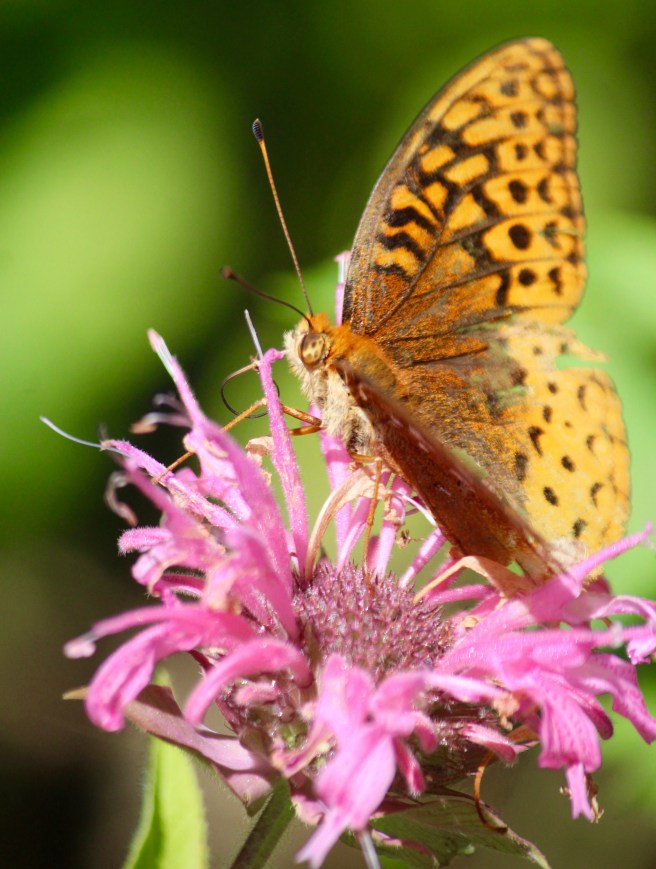
w-frit 2

It was no mistake the this fritillary butterfly chose the beebalm on which to land. Check out its mouth. A butterfly feeds through a coiled mouth part called a proboscis. When not in use, the proboscis recoils and is tucked into position against the butterfly’s head.

August 21, 2016: Sundae School

n-Indian pipe bee 1

My lessons began immediately. What to my wondering eye should appear, but a bee pollinating an Indian Pipe. And in the middle of the afternoon. Huh? I’ve always heard that they are pollinated by moths or flies at night. Of course, upon further research, I learned that bees and skipper butterflies have been known to pay a visit to the translucent flowers. Add that to the memory bank.

August 27, 2016: Halting Beside Holt Pond

h-pitcher  flower up close

Halting–prone to pauses or breaks. I didn’t break, but I certainly was prone to pauses as I moved along the trails and boardwalks at the Holt Pond Preserve in South Bridgton. One of my first stops–to admire the pitcher plant flowers in their August form. When I took a closer look, I realized that the seeds were developing–certainly a WOW moment in the world of wonder.

September 9, 2016: Golden Rulers

g-assassin-1

What first caught my eye was a bee that dangled upside down. And then I spied the green legs of an assassin bug. What? Yup, an assassin bug. I believe this one is a nymph. Regardless of age, here’s the scoop: Assassin bugs are proficient at capturing and feeding on a wide variety of prey. Though they are good for the garden, they also sometimes choose the wrong species like this bee. The unsuspecting prey is captured with a quick stab of the bug’s curved proboscis or straw-like mouthpart. Once I saw this, I continued to return for a couple of hours, so stay tuned.

September 15, 2016: The Wonders of Kezar River Reserve
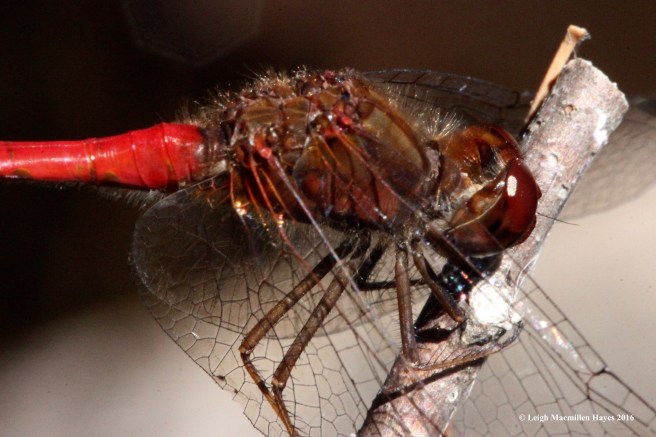
k-ruby-1

My favorite wonder of the day . . . moments spent up close with a meadowhawk.

October 17, 2016: Everybody Loves Raymond? Mondate

r-mushroom-growth

My guy and I discovered several of these examples of fungi on fungi at Loon Echo Land Trust‘s Raymond Community Forest and had no idea what they were–so I sent the photos to Parker and Jimmie Veitch, of White Mountain Mushrooms, and Jimmie responded with this explanation:

“That’s what mycologists call “rosecomb” mutation, where a mushroom’s gills start forming on the cap in a really mutated fashion. It’s been reported in many mushroom species but I haven’t seen it in this one (Armillaria AKA honey mushrooms). As far as I know, no secondary fungus is involved.

The suspected cause (not so nice) is ‘hydrocarbons, phenols and other compounds contaminating the casing or contacting the mushroom surface. Diesel oil, exhaust from engines, and petroleum-based pesticides are thought to be the principal source.'”

October 22, 2016: Cloaked By the Morning Mist
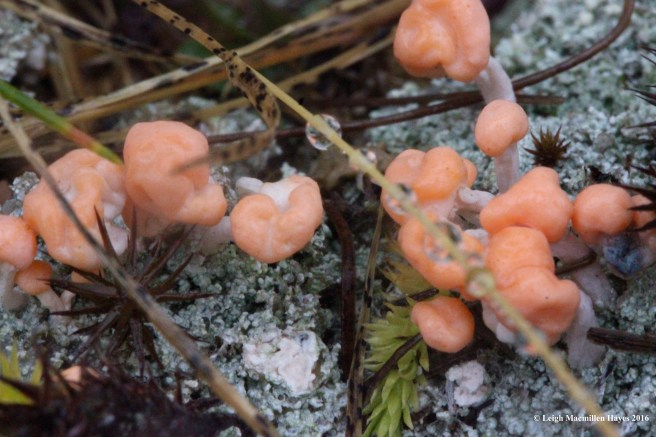
u-candy-2

On a rainy day adventure with the Upper Saco Valley Land Trust in nearby New Hampshire, we paused to admire candy lichen, a crustose (think–flattish or crust-like) lichen with green to bluish-green coloration. Its fruiting bodies, however, are candy-pinkish berets atop stalks, even reflected in the raindrops.

November 6, 2016: Focus on the Forest Foliage
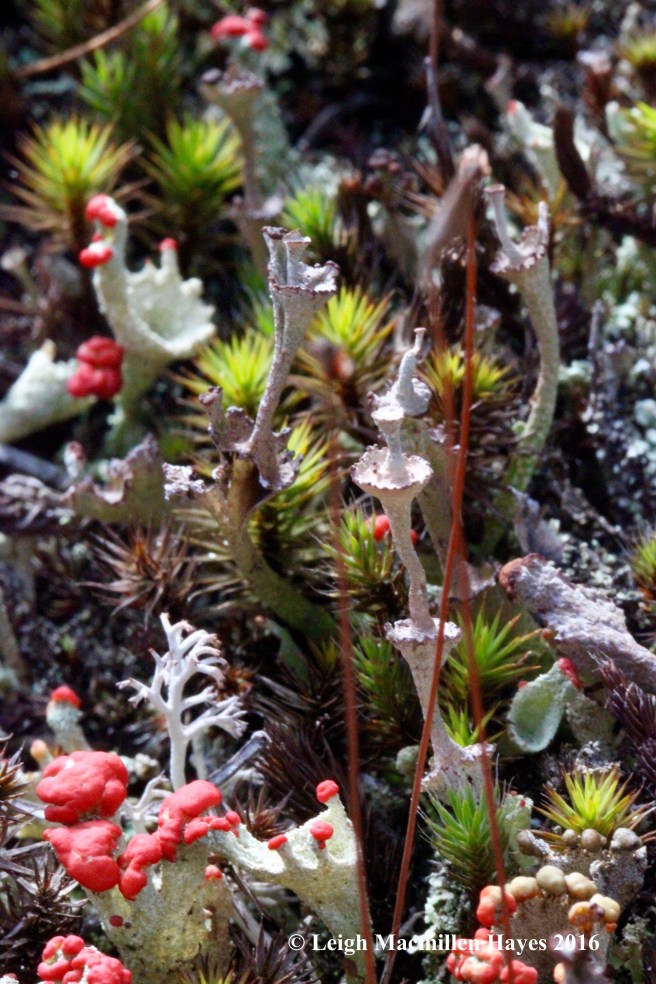
j-lichens-galore

And then . . . and then . . . and then just as our eyes trained on the red caps before us, something else made itself known. We spied another lichen that I’ve only seen once before: Cladonia cervicornis ssp. verticillate.

Its growth formation is rather unique. In one sense, it reminded me of a sombrero, but in another sense, I saw fountains stacked one atop another, each giving forth life in their own unique fashion. But rather than being called Fountain Lichen, its common name is Ladder Lichen–perhaps referring to the fact that the pixies can easily climb up and up and up again.

November 20, 2016: Forever a Student
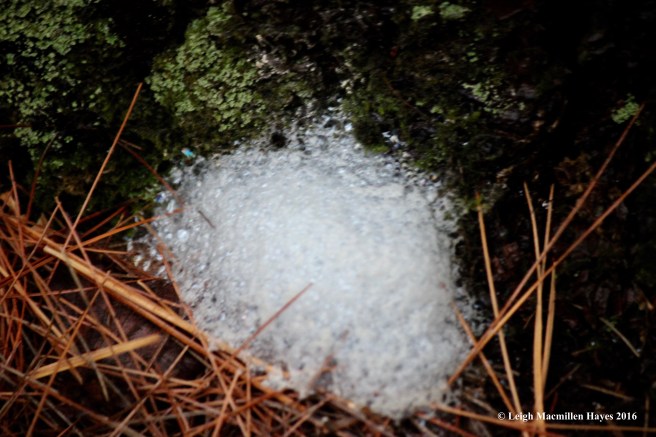
h-pine-suds

A sight I was hoping for presented itself when I returned to our woodlot–froth at the base of a pine tree. It’s not unusual and occurs following a rain event such as we’d had all night and morning. So what causes the tree to froth? Well, like all lessons, there are several possibilities. Maine Master Naturalist Science Advisor Fred Cichocki recently had this to say about it: “I’ve noticed this phenomenon often, and in every case I’ve seen it’s associated with white pine, and always after a dry spell followed by heavy rain. Now, conifers, especially, produce hydrocarbons called terpenes (it’s what gives them their lovely pine, balsam and fir scent). These hydrocarbons are hydrophobic by nature and form immiscible films on water. During a heavy rain, water running down the trunk of a white pine picks up terpenes on the way. Air (having accumulated in bark spaces, channels, etc. perhaps under slight pressure) then “bubbles” through terpene-water films producing a froth. Recall the cleaning products PineSol, and the like. They are made from terpenes, and produce copious bubbles when shaken. One could get the same result directly by shaking terpentine in water, or by bubbling air through a terpentine-water mixture with a straw . . . Of course, it may be that other substances (salts, etc.) enhance the frothing.”

No matter how much I have learned on this life-long course, there’s always more. I certainly don’t have all the answers and for that I am thankful. I’m forever a student.

December 4, 2016: The Art of Nature

s-tree-ring-labyrinth

Some cut stumps reminded me of the circular movement leading toward the center of a labyrinth–appearing quick and easy, and yet providing a time to slow down while following the path.

December 23, 2016: Won’t You Be My Neighbor

m-print

I followed the porcupine trail along his regular route and over the stonewall only to discover prints I’ve never met before. My first impression was raccoon, but the shape of the prints and the trail didn’t match up in my brain. More and more people have mentioned opossum sightings in the past few years, but I’ve only seen one or two–flattened on the road. Today, in our very woods, opossum prints.

January 19, 2017: Keep an Open Mind

o-deer

While I always head out with expectations of what my forest wanderings will offer, I’m happily surprised time and time again with the gifts received.

And so it was the other day when a friend and I happened upon this trophy in an area I’ve only visited a few times. We’d been noting the abundant amount of deer tracks and realized we were between their bedding and feeding areas and then voila–this sweet sight sitting atop the snow. It now adorns a bookcase in my office, a wonder-filled addition to my mini natural history museum. (I’m trying to give Henry, Jessie, Violet, and Benny of the Boxcar Children series a run for their money in creating such a museum.)

January 25, 2017: On the Prowl at Heald and Bradley Ponds Reserve

w-tube-moth-2

Notice how these pine needles are clumped together? What I learned from Mary Holland, author of Naturally Curious,  is that these are tubes or tunnels created by the Pine Tube Moth. Last summer, larvae hatched from eggs deposited on the needles. They used silk to bind the needles together, thus forming a hollow tube. Notice the browned tips–that’s due to the larvae feeding on them. Eventually the overwintering larvae will pupate within the tube and in April when I come back to check on the vernal pool, I need to remember to pay attention, for that’s when they’ll emerge. Two generations occur each year and those that overwinter are the second generation. The good news, says Holland, is that “Pine Tube Moths are not considered a significant pest.” I only found the tubes on two young trees, but suspect there are more to be seen.

February 8, 2017: Embracing the Calm
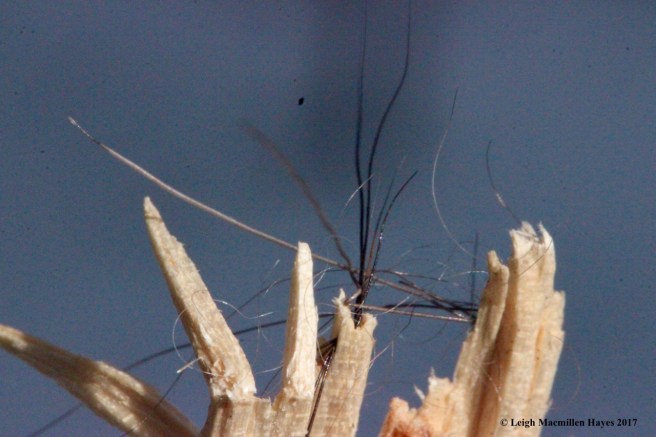
h-moose-hair-2

A bull moose, like a buck deer, thrashes bushes and small saplings when the velvet on its antlers dries. It could be that the velvet itches. But it could also be a response to increasing testosterone and the need to scent mark.

February 16, 2017: When Life Gives You Flakes
s-snow-angel-in-trail

When life gives you flakes . . . make a snow angel in the middle of the trail.

To all who have read this far, thanks again for taking a trip down memory lane today and sticking with me these past two years. I sincerely hope you’ll continue to share the trail as I wander and wonder–my way.

And to wondermyway.com–Happy Second Anniversary!
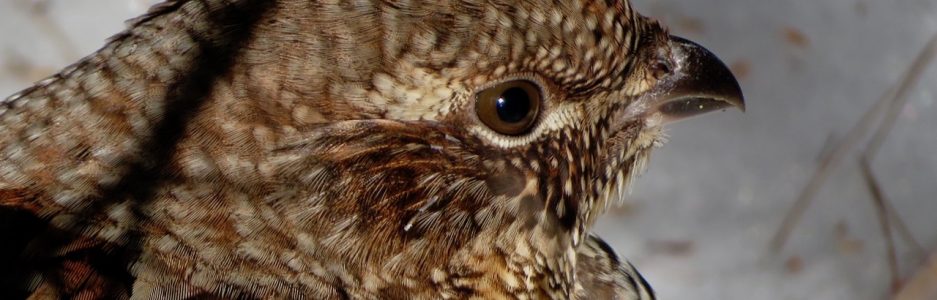


Mondate with Tom and Friends

My guy and I–we drove to Portland this morning for a two-hour meeting and then enjoyed lunch with one of his sisters at the Miss Portland Diner before moving on to South Portland to run an errand and finally returning home.

Too much food and sitting time. And so the woods beckoned.

v-turkeys-1

Right out the back door, male turkeys took advantage of our offerings. The snow is crusty and while acorns were plentiful, foraging for them has become a more difficult task. But birdseed is free feed and once discovered means often frequented.

v-turkey-1

That’s OK for now because it gives me a chance to get to know these guys. We live in an 1870s house on former farmland (I often refer to the cowpath), all of which played a part in the reduction of forest land, one of the factors that led to the extirpation of native wild turkeys in Maine. Slowly, the land has reverted to forest, which helped in reestablishing turkeys to their former range. At the same time, our neighbors, thankfully, continued to mow the adjacent field that we look upon, which provides for prime turkey nesting habitat.

v-turkey-2

Tom and his brother Tom and his other brother Tom are handsome devils in their own unique ways. Their featherless heads of blue and pink and red raised bumps called  caruncles change colors with their moods.

v-turkey-3

And on their chests, bristle-like feathers that don’t look at all like feathers are referred to as beards (by us humans–I’m not sure what turkeys call them). Though some hens sport beards, theirs are not as robust or long as those of the Toms.

v-turkey-4

“You looking at me?” asked Tom.

“Yes, I am. I’m admiring your iridescent feathers layered like slates on a roof and those spurs on your legs used for defense and dominance. Do you object?”

“Well, I guess I am rather handsome.”

“I didn’t say that.”

Yeah, the turkeys and I, we talk. We’ve long had a relationship and I truly don’t think you should eat them. Maybe next Thanksgiving I’ll tell you my turkey story.  I know they can leave a mess in the yard and become aggressive, but . . .

v-turkey-tracks-2

I encourage you to follow their tracks into the woods. You never know where they might lead.

v-turkey-tracks

Following them today led to the vernal pool. Note the pen, my form of perspective in relationship to size because it’s what I had in my pocket. The pen measures 5.5 inches. Turkey prints are large.

v-vernal-pool-adventures

The pool wasn’t teeming with amphibian life yet, but for the first time all winter, it was obvious that visitors had stopped by.

v-vernal-pool-action

Their timing wasn’t the same, but the turkeys strutted across, while deer slid and skidded on the ice. Life happened over and over again.

v-deer-prints-2

It appeared to be more than one deer–perhaps a mother and a skipper or two wanted to skate, much as our sons used to do at this very same spot.

v-coyote

And among the prints, those of a predator, though its journey appeared to be earlier than the deer. Gray squirrel tracks circled the perimeter and maybe that was the intended prey, though really, any of these critters would have made a desirable meal–the forest being what it is, groceries gleaned when needed.

v-deer-hemlock

Continuing the journey, plenty more turkey tracks and then the white tails of deer  flashing in the distance. Beside the trail another item on the grocery shelf–fresh hemlock bark scraped.

v-pileated-holes

One final item in a different aisle–fresh pileated woodpecker holes. They wake us each morning with their drumming and the sound continues throughout the day. Wrapped around the tree, a vine that added to this bird’s food.

v-pileated-scat

Its scat told of the source–not only a few carpenter ants, but also bittersweet fruits. Yes, this is how the seeds of this invasive species spread.

And so it was today that I traveled the woodland trail alone after a morning and afternoon spent with my guy. And . . . the Toms shared their story and those of others. It was indeed a Mondate–spent with others.

(Did you think I was going to mention Tom Brady? Congrats to the Pats on their Super Bowl victory.)


Misty Mountain Sundate

It was a dark and dreary day. The end. Or so it could have been. But we decided to hike anyway, our destination once again Jackson, New Hampshire.

b-trail-sign

We thought we’d explore Boggy Brook Trail, but after a half mile reconnaissance mission, we changed our minds and headed over to the Black Mountain hike/backcountry ski trailhead.

b-cabins-below

As we passed by the cabins at the base of the trail, our mountain view was obscured.  Despite the grayness of the day, the reds of tree buds and catkins brightened the view. And since the trail was well packed, I opted for spikes, while my guy wore only his hiking boots. That limited us, of course, since we’d have to stay on the trail, but it also brought our vision into focus.

b-stream-crossings

Hikers/skiers must cross about a half dozen streams, where cascading water splashed over rocks and presented the formation of frozen drips.

b-wood

We weren’t far along and near one of those stream crossings when an anomoly stood out on the trail. Because this trail leads to a rustic cabin built by the CCC in 1932, we surmised that the most recent renters found the bundle of wood too heavy to lug on sleds and so they left it behind.

b-paper-birch-colors

Further along, we realized it wasn’t just the tree buds that stood out on this colorless day. The pink and orange hues of paper birch were enhanced by the lack of sunshine.

b-paper-birch-old

And where the birches stood tall, long, black mustaches draped over fallen branches.

b-love-on-birch

We think of paper birch as white birch, but really, its colors are many. Wounded bark formed an intended heart, highlighted by pinkish reds. (I did wonder if this was a display of love for the National Hockey League.)

b-bear-tree

We found another curious sight on a tree as we climbed higher. It was the change in color and direction of the slash marks that caught our attention. We couldn’t say for sure and without snowshoes couldn’t check further (unless we wanted wet feet), but suspected a bear had stopped by and left its signature.

b-yellow-birch-old

Old yellow birches were also abundantly present, their bark turned silvery gray with age–rather like us.

b-old-yeller1

My favorite yellow birch had many stories written on its bark and within its limbs. I thought that it would take at least three of us to wrap our arms around its trunk. We were only two and I had a hunch that if I suggested we hug this one I’d get a funny look.

b-lungwort-1

The higher we hiked, the more lungwort, mosses and lichens we saw decorating the tree trunks.

b-lungwort-2

The forty shades of green that Ireland is known for seemed well represented–thanks to the mist.

b-hobblebush

And if you know me like my friend Jinny Mae does, you know I can’t resist admiring the tan hobblebush leaf and flower buds. This one was for you, Jinny Mae.

b-black-mtn-cabin

At long last, we spied the cabin up ahead and visions of lunch filled our minds.

b-lunch-plank

We couldn’t find a rock, but we did note that the wood shed was nearly empty and wondered if the renters had regretted their choice to leave the bundle of wood behind. Within the shed, we found a plank and borrowed it–lunch plank it would be. As we settled down, spitting rain coated us.

b-lunch-view

With the view of Wildcat Ridge and Mount Washington enveloped in fog, we enjoyed our lunch spot just the same.

b-mcvities

The PB&J sandwiches were quickly consumed. And then . . . one of our favorite colors, dark chocolate, served as dessert. I first discovered McVitie’s Digestives in 1979, when I studied in York, England, and my guy knows the way to my heart so this package appeared in my Christmas stocking.

b-hare-and-weasel

After lunch, he put the plank back in the wood shed and I checked out the tracks left behind by the local residents–snowshoe hare and weasels, based on the patterns of their trails.

b-hare-1

We weren’t going to climb the final .4 to the summit because we knew the views would be obscured, but at the last minute we decided it was a short stretch and so we did. The snowshoe hare activity increased significantly and snow conditions demonstrated splayed toes.

b-summit-sign

The higher we climbed, the eerier the woods seemed, with shades of gray being the most predominant. And the temperature dropped.

b-frosted-lichen

From lichens to  . . .

b-frosted-fir

firs, everything was frosted.

b-summit-view-1

And that summit view, which should have been of Carter Dome and Carter Notch, was equally glazed.

We followed the same trail down. It was still a dark and dreary day–despite that, we enjoyed our opportunity on this Sunday to fully embrace the misty mountain together.


The BOF of Ron’s Loop

Huh? The BOF of Ron’s Loop? What in the world is that all about. Read on, if you dare.

r-kiosk

This morning dawned bright and chilly, just perfect for a tracking expedition with my friend, Joan, along Ron’s Loop at Back Pond Reserve in North Waterford/Stoneham. It’s a Greater Lovell Land Trust property that we love to visit. Then again, is there a GLLT property we don’t like? Uhuh.

r-bobcat

The snow was crusty and we were able to snowshoe atop it for most of the way. The same was true for many of the mammals that traveled about–including the bobcat whose print was difficult to see, but that’s because of the conditions. We went off trail and followed it for quite a ways, hoping to find other signs it left behind, but no such luck today.

r-otter-1

It did lead us to the stream that flows toward Five Kezar Ponds and we recognized the filled-in evidence that an otter had been this way. Based on the bobcat conditions, we assumed it had moved through recently, quite possibly last night or this morning. But the otter had visited after the last snowstorm, but before Tuesday’s ice storm, such were its offerings.

r-woolly-first

Eventually, we returned to the trail and continued on our merry way. But then we came upon a beech tree that begged noticing. In the reserve are a number of bear paw trees, though I have yet to find one along Ron’s Loop. And we didn’t today.

It was the fuzziness of a large clump of small white specks that drew our attention. Beech scale insect or more technically, Cryptococcus fagisuga, is a tiny insect that sucks sugar and other nutrients from beech trees only. In the summer, wingless larvae hatch and crawl (the only mobile stage of this insect) during their first instar stage of development. They search for suitable feeding spots such as cracks or crevices in the bark. What struck us today was the size of the colony.

r-woolly-1

A waxy substance secreted from its glands allows the insect to survive the winter months under a protective woolly-like coat.

r-frullania-liverwort-and-scale-insects

Even the frullania liverwort showed a contrast with the white filaments. By spring, the beech scale insect will molt into its second, legless nymph stage and emerge. Immediately, it will start sucking the sap through its tubular mouthpart or stylet. That instar stage doesn’t last long, and quickly it will become a mature female. For the rest of its life it will remain sedentary, but repeatedly remove and reinsert its piercing stylet, wounding the tree and providing entry points for fungi to enter. An interesting fact about beech scale insects–its a world of females who reproduce by parthenogenesis; there are no known males.

r-beech-hell

At Ron’s Loop a sign refers to what happens to the beech trees once the scale insect has set up housekeeping.

r-beech-bark-4

They feed on trees that are at least thirty years old. Beech bark is typically smooth from a tender age to the end of its long life. But the scale insects puncture holes and . . . when two or more gather and withdraw fluids from the vascular tissues in close proximity with each other, those vascular cells collapse and cease to function.

r-beech-bark-3

Fissures form in the bark’s surface.

r-beech-bark-2

The stage is set for one or two Nectria fungal pathogens to take advantage of the wound sites. Their spores, transported by wind or insects, germinate, enter the wounds and their hyphae colonize the vascular tissues, eventually killing patches of inner bark.

r-beech-bark-5

The bark develops cankers that can expand and join together. Photosynthetic activity decreases and limbs die and break off.

r-beech-snap

r-beech-snap-2

Some trees survive for a while, but others, possibly due to environmental stresses, die within five to ten years, their crowns and upper trunks snapping off. We call that beech snap.

The scale insect is non-native to Maine, having arrived here via Nova Scotia and before that Europe. Consequently, except for a species of lady bugs, there is no known predator to reduce its number. Fortunately, some trees are resistant and the current thinking it is to leave those trees intact and hope that they disperse seeds that produce more resistant trees.

r-hoar-frost1

Another fortunate thing is that there is so much more to see at Ron’s Loop. We spied some hoar frost surrounding a small hole and imagined a vole or some other little brown thing snuggled below the snow’s surface.

r-hoar-frost-and-feeding-area

In fact, we found other examples of the same; this particular mound featured not only the frost, but also served as the site of dining table–for a red squirrel.

r-otter-slide

All in all, the tracking was good. We found plenty of otter slides and knew where it bounded. We also saw evidence of snowshoe hare, deer, mice and possibly fisher, though that too was diluted by the ice storm.

r-otter-x-2

Did I say plenty of otter sign? In fact, let’s make that otters with an s.

r-running-water

The mammal activity was prime because the property offers a mountain, ledges, streams and is located by five ponds.

r-ice-on-flow

Most often when we’ve traveled this way during the winter months, we cross the streams with little hesitation.

r-ice-flow-2

Today, we admired the ice formations and the flow, which we hope bodes well for all forms of life and puts an end to the drought.

r-stream-crossing-at-end

Our finally crossing was the most difficult due to lack of ice. But the water is shallow in this spot for the most part and it’s not far from the end of the trail.

Truth be known, we didn’t actually cross here. Instead, we found some rocks a wee bit upstream and made our precarious way across,  one of us almost falling in and the other climbing up the steep bank on hands and knees–not easy when donning snowshoes. BOF could have stood for big old fools. But we survived and highly recommend sticking with the trail crossing, even if your shoes get a wee bit wet.

r-snow-level

Back in the parking area where we could not park, the trail sign provided an indication of the current snow depth.

As for Joan and me, we spent three hours examining the beech trees, exclaiming over the tracks we found, especially those of the bobcat and otter (we’d like to be reincarnated as otters–if we have a choice), and rejoicing in the flow of the water. The BOF of Ron’s Loop.


Down the Rabbit Hole

Winter clothing? ✓

Hand warmers? ✓

Camera and extra lenses? ✓

Water? ✓

Trackards? ✓

Scat shovel? ✓

Snowshoes? Oh no. I didn’t realize until I met up with two fellow trackers for today’s Tuesday Tramp that I’d left my snowshoes home. “I’ll be fine,” I said. “Other’s have probably walked the trail before us.”

Indeed, they had. But I also knew that because we were tracking, we’d wander off trail. Indeed, we did.

It’s a good thing I had warm snow pants and tight boots on and brought along my sense of humor and adventure.

c-1

We began at the kiosk of the Greater Lovell Land Trust’s Chip Stockford property, where an Eastern Phoebe’s moss-lined nest awaits the return of its residents. Perhaps the funnel spider who took advantage of the nesting site is keeping the home fires lit amid the grasses and mud therein.

c-4

And then we reached the former log landing and the current site of Speckled Alders. We’d only seen squirrel evidence at that point, but knew to check on the fuzzy little woolly alder aphids who inhabit these shrubs.

c-5

We were surprised to see a black coating that seemed associated with the aphids and reminded us of black knot on fruit trees. Upon closer inspection, it appeared that the aphids were covered in black.

When I arrived home, I looked for more information and of course, Mary Holland, author of Naturally Curious, came to the rescue:

“Once leaves start to fall, one often observes white, fuzzy patches along the branches of Speckled Alder (Alnus incana). These fuzzy patches consist of colonies of aphids feeding on the sap of the shrub. In order to get enough nitrogen, they must drink volumes of sap, much of which is exuded from their abdomens as a sweet liquid called honeydew. The honeydew accumulates and hardens onto the branches as well as the ground beneath the shrub. Yesterday’s Mystery Photo was the honeydew of Woolly Alder Aphids (Paraprociphilus tessellates) which has been colonized by a fungus known as black sooty mold, a fairly common phenomenon.

Fairly common means we need to pay more attention. That’s how it is in the natural world–you see something for the first time and then realize it’s everywhere, you’ve just missed it all your life, or at least up until now. I love the noticing.

c-3

In places we predicted, we found snowshoe hare runways. Typically, I give thanks to them for the technology that holds us up closer to the surface of the white fluff that covers our winter world.

c-2

Where the trail splits, we were greeted by the keeper of these woods. It was here that we also found porcupine tracks, the prints a bit muted but the sashaying pattern easily decipherable. We followed its trail for a while, me making post holes, but moving with relative ease. Winter hiking is so much easier even when the snow is deep.

c-6

We’d come to track mammals despite the freezing rain, sleet and snow, but other things also drew our attention, like the lines that decorate a beech tree. Usually it seems obvious that they are made by either a formerly attached vine or branches from other trees that scratched in the breeze. We couldn’t say for sure with this one, despite taking a closer look.

c-9

At the scenic look out, other young beech trees provided a hint of light in the gray of the day as we took in the sight of Lower Bay below.

c-8

A turn to the right and we noted a number of artist conks decorating a tree.

c-7

And beside our feet, evidence that a Ruffed Grouse had passed under low limbs.

c-10

For a while, our tracking seemed limited to squirrels and then at the old foundation, we noticed a bounding pattern. Of course, we needed to follow it, up over what was probably a rock and then noted where it had passed under a branch close to the snow. It was under the tree that its prints gave us a few more clues and we determined it was a fisher. (Note: Fisher, not Fisher Cat. They are members of the weasel family, not feline.)

c-11

As we rounded the bend below the foundation, snow snaking across the limbs of a downed tree made us pause and admire.

c-12

And then we paused again–at The Rock. In the summer, it’s a great place to admire “Life on a Rock,” and in the winter we always expect some small mammal to take advantage of its protection. One of these days maybe we’ll be rewarded with evidence.

c-13

It was just beyond The Rock that we decided to go off trail again and further explore the porcupine’s trail. It led us to its home and then climbed upward. My two companions went first, making their way across what we soon realized was an old stump dump.

Seconds later, I disappeared . . . down a hole . . . well, at least up to my waist! Our first thought as I pulled my body out–would I discover quills on my boots? Thankfully no. I maneuvered  and my friend, Joan, who is half my size, pulled me up as we laughed about the possibilities.

We skedaddled across the rest of the dump and bushwhacked back to the alder trees.

So maybe I didn’t exactly disappear down a rabbit hole, but for a brief moment it felt like such. And will become part of our memory of a snowy, icy day spent on the prowl.


Won’t You Be My Neighbor?

I knew the minute I walked into the summer kitchen this morning and saw fresh tracks beside the barn that I’d head out the door as soon as possible. And then I realized that my snowshoes were in the back of my truck, which our youngest son had borrowed. Never fear. We have several more pairs.

m-cat-in-porky

The prints that drew me outside were those of our “friendly” neighborhood porcupine. And once again, he had much to share, the first being cat prints inside his–thanks to one of several that frequently pass under the barn.

m-porky-sashay

If you’ve never examined a porcupine trough before, I encourage you to do so. As it sashayed along, it left behind hair and quill impressions. Can you see them?

m-opossum-print-2

I followed Porky along his regular route and over the stonewall only to discover prints I’ve never met before. My first impression was raccoon, but the shape of the prints and the trail didn’t match up in my brain. More and more people have mentioned opossum sightings in the past few years, but I’ve only seen one or two–flattened on the road. Today, in our very woods, opossum prints.

m-opossum-walk

Our own marsupial. The front print obscured the hind, which features an opposable thumb. Their pattern, I learned from checking David Brown’s Companion Guide to the Trackards, is left hind-left front, right hind-right front, left hind-left front, etc.

m-opposom-trail

As it walked along, from tree to tree, past the studio and into the neighbor’s woodlot, I could practically see the animal moving, its long tail dragging in the snow. My heart sang with the journey. But how do they survive here, I wondered?

Eventually, I realized I was headed into a neighbor’s backyard several doors down and so I turned and continued in the other direction, but thankful that Porky had once again shared something new with me.

m-porky-trail

I traveled down the cowpath and into my smiling place, where what to my wondering eyes should appear, but a miniature sleigh and . . . oops, I mean another Porky trail. And so I followed it, back and forth over a stone wall and under fallen trees I needed to pass over.

m-porky-tree

It led me around an uprooted tree and there . . .

m-porky-in-den

the trail ended. You may notice ice crystals below the moss in the larger opening. And if you look closely below the moss, you might just see a few light colored streaks–those would be quills. I found Porky. He started to move and though I knew I could easily outrun him, unless I tripped and fell like I often do when snowshoeing, I decided to leave him be. But once again, my heart was singing.

m-moose-tracks

And then . . . some really large and deep prints crossed the trail I frequent.

m-moose1

They were almost the size of my mitt.

m-moose-slide

And every where I turned for the rest of the morning, it seemed moose had also turned. I soon realized there were at least three and they slipped in the snow much as I often do.

m-deer-and-moose-prints

In tracks I’d previously made, both a deer and moose had passed, providing a sense of size.

m-moose-mud

I followed one, who had paused to play–it’s hard to resist an inviting mud puddle. Had I not been wearing snowshoes . . .

m-moose-landing

I think we were both discouraged to realize a snowmobile had found its way to the log landing, though I for one, wasn’t surprised. The moose made a U-turn and headed back into the woods. A short time later, I followed suit.

m-deer-hair

It was there that I discovered hair stuck to a deer bed where its body had warmed the snow, which thus turned to ice.

m-spider-1

And another snow spider, this one not as green as the ones I’ve seen previously. I’m in awe that the tiny body, which appeared translucent, contains glycerol as an antifreeze compound. I did see numerous springtails bouncing about, so trust it had plenty of food upon which to prey. Again, my heart sang.

m-moose-bed

As I mentioned earlier, I continued to see moose tracks (not the ice cream, though it is one of my favorite Gifford flavors). And then a bed, about the size of three deer beds. And a lovely pile of scat right in it. Life is good.

m-snowshoe-lobsters

Closer to home, I realized I was in snowshoe hare territory when I recognized the lobster-like shape of their prints.

m-weasel-1

They’d better watch out, and all voles and other little brown things should also be on the alert, for weasel prints also decorated the snow.

m-print

At last I was back home, and had to take a peek at those opossum prints one more time. Thanks again to the porcupine(s) that wander these woods, I celebrated wonder as I moved about. Except for Porky, one gray squirrel and a sharp-shinned hawk, I saw no others with whom I share these woods, but I was grateful to be their neighbor. To know that they roam as I do. In the words of Mr. Rogers, “It’s a neighborly day in this beauty wood.” I’ll let him do the singing, from the song that rests within my heart today:

It’s a beautiful day in this neighborhood,
A beautiful day for a neighbor.
Would you be mine?
Could you be mine?…

It’s a neighborly day in this beauty wood,
A neighborly day for a beauty.
Would you be mine?
Could you be mine?…

I have always wanted to have a neighbor just like you.
I’ve always wanted to live in a neighborhood with you.

So, let’s make the most of this beautiful day.
Since we’re together we might as well say:
Would you be mine?
Could you be mine?
Won’t you be my neighbor?
Won’t you please,
Won’t you please?
Please won’t you be my neighbor?