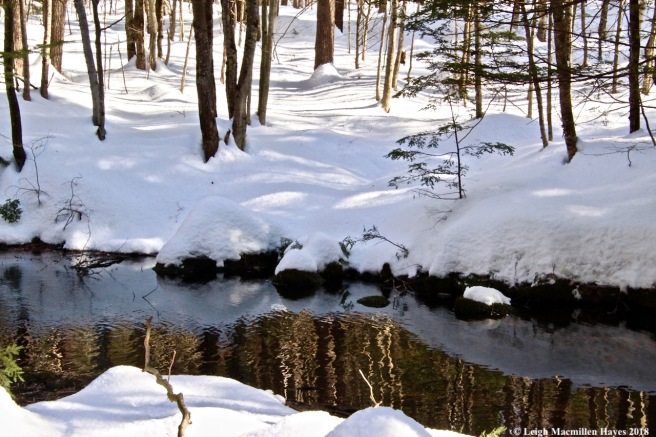
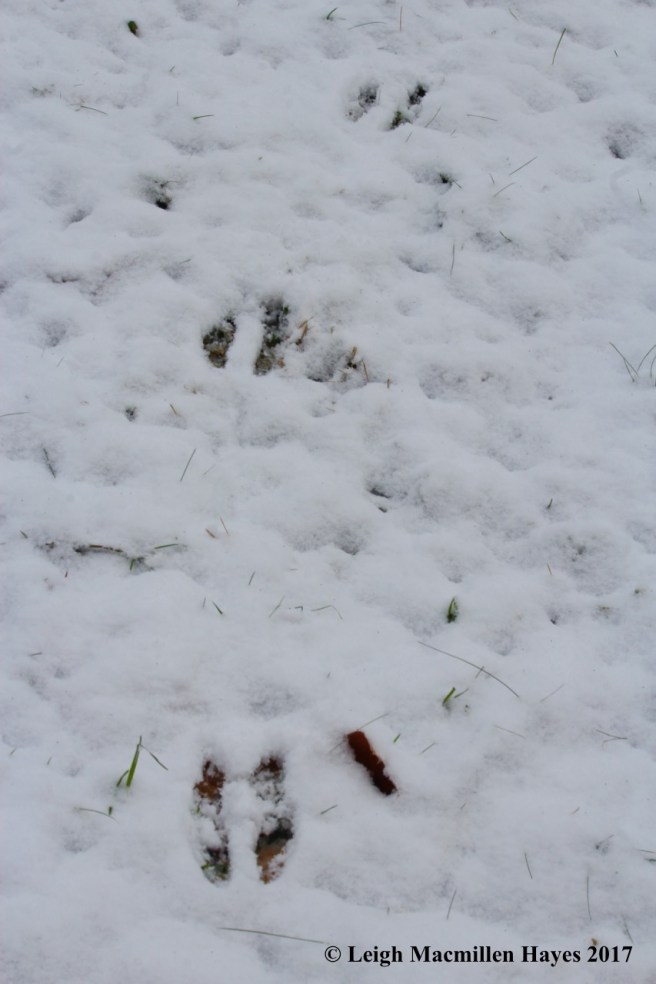
Books of the Month: Stone Walls–Stories Set in Stone

It’s March, that most indecisive of months. And so, I decided to follow in the same pattern by choosing not one,
s11

or two,

s9

or even three,

s10

but four–

s8

all books about stone walls which are once again revealing their idiosyncrasies. These are the Books of March.
p-on-the-cowpath

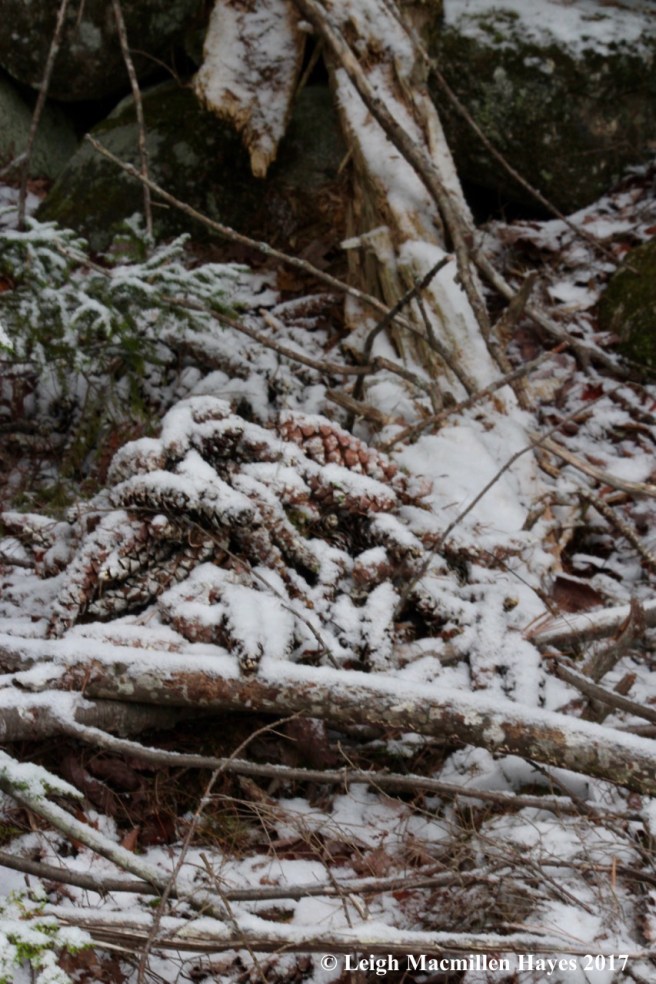
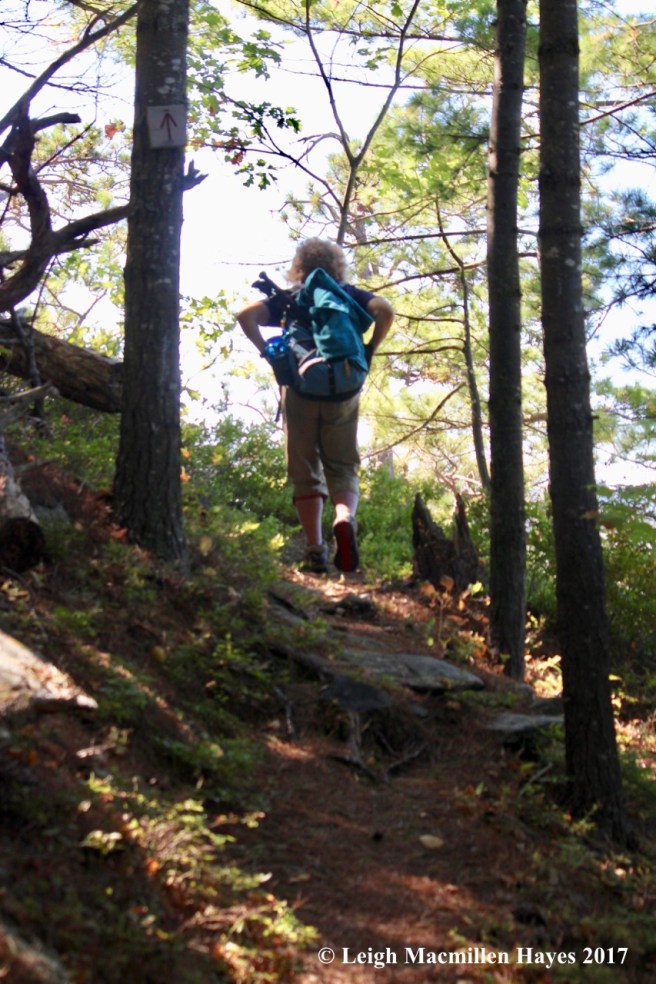
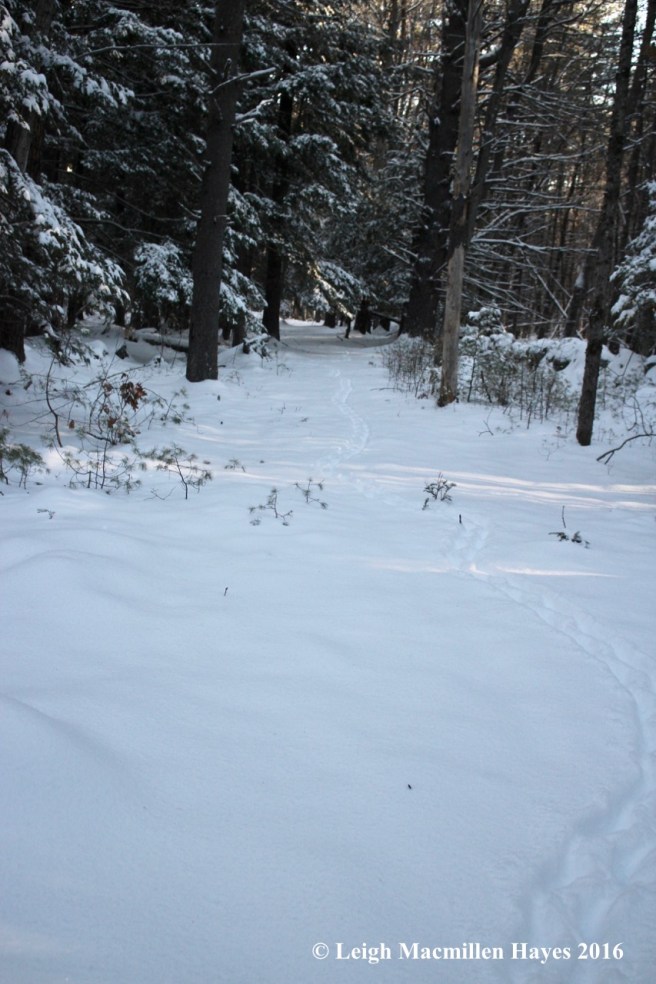
Walk along our woodland trail with me and you’ll know that something different happened there ages and ages ago. To reach the trail, we’ll need to pass through two stone walls. Continuing on, we’ll come to a cow path where several pasture pines, massive trees that once stood alone in the sun and spread out rather than growing straight up, must have provided shade for the animals.

e-pine whorls

They are the grandparents of all the pines that now fill this part of the forest.

Further out, one single wall widens into a double wall, indicating a different use of the land.

s4

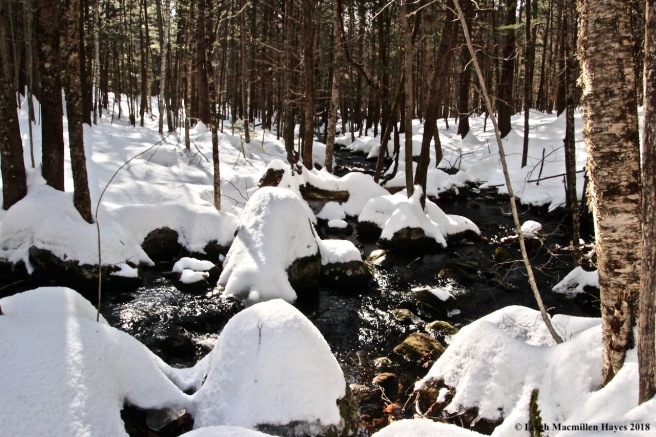
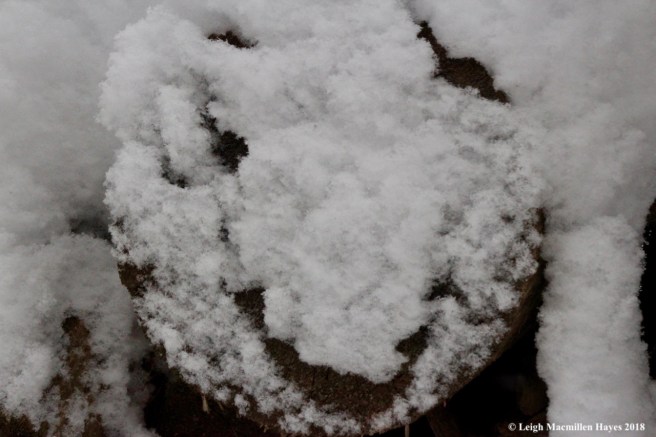
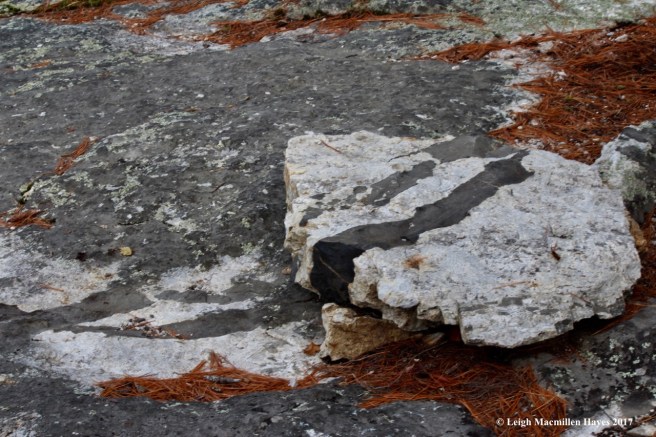
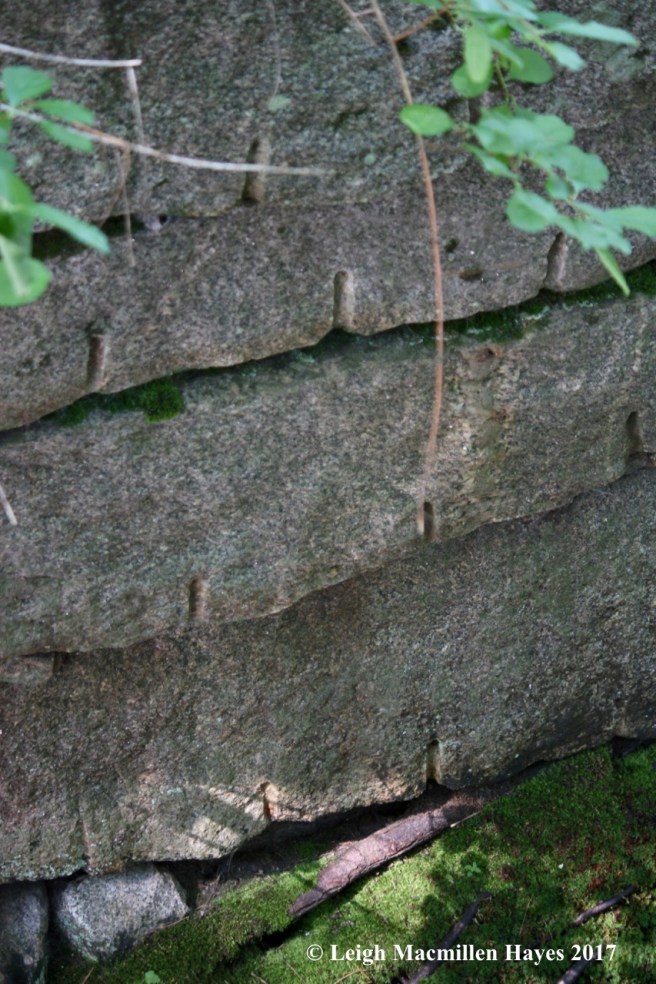
The walls stand stalwart, though some sections are more ragged than others. Fallen trees, roots, frost, weather, critters and probably humans have added to their demise, yet they are still beautiful, with mosses and lichens offering striking contrasts to the granite. Specks of shiny mica, feldspar and quartz add to the display. And in winter, snowy outlines soften their appearance.

The fact that they are still here is a sign of their endurance . . . and their perseverance. And the perseverance of those who built them. and yet . . . . the stone walls aren’t what they once were, but that doesn’t matter to those of us who admire them.

s2

For me, these icons of the past conjure up images of colonial settlers trying to carve out a slice of land, build a house and maybe a barn, clean an acre or two for the garden and livestock and build walls. The reality is that in the early 1700s, when western Maine was being settled, stones were not a major issue. The land was forested and they used the plentiful timber to build. It wasn’t until a generation or two later, when so much timber had been harvested to create fields for tillage and pasture, that the landscape changed drastically, exposing the ground to the freezing forces of nature. Plowing also helped bring stones to the surface. The later generation of farmers soon had their number one crop to deal with–stone potatoes as they called them. These needed to be removed or they’d bend and break the blade of the oxen-drawn plowing rake.

s1

Stone removal became a family affair for many. Like a spelling or quilting bee, sometimes stone bees were held to remove the stones from the ground. Working radially, piles were made as an area was cleared. Stone boats pulled by oxen transported the  piles of stones to their final resting place where they were woven into a wall.

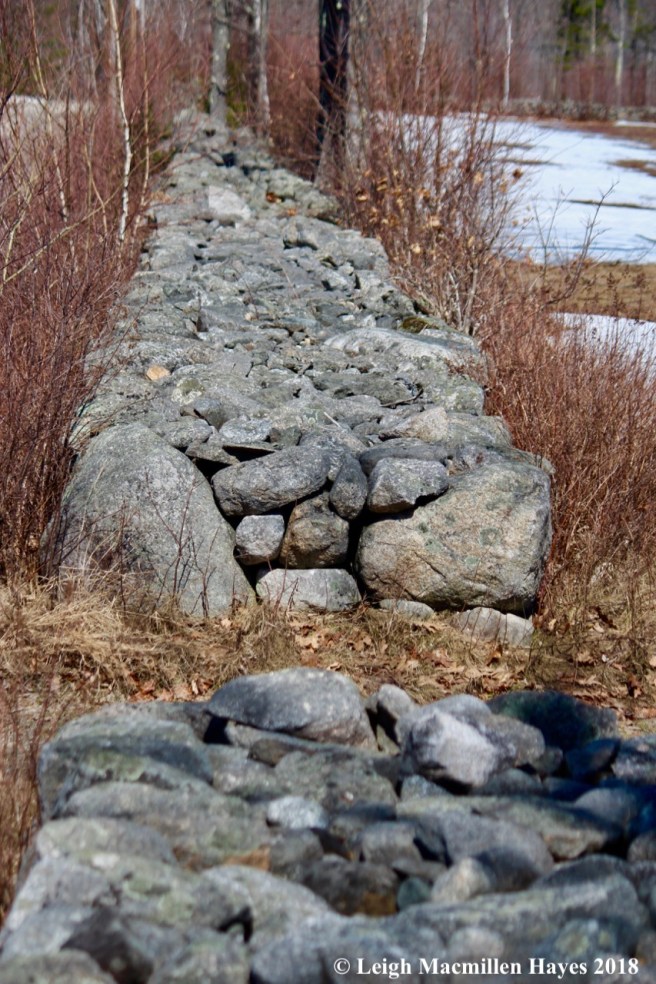
Eventually single walls, also called farmer or pasture walls, were built as boundaries, but mainly to keep animals from destroying crops. The advent of stone walls and fences occurred within a few years of homesteads being settled, but during the sheep frenzy of the early 1800s many more were built. Those walls were supposed to be 4.5 feet high and fence viewers were appointed by each town to make sure that farmers tended their walls.
s3

Double walls were lower and usually indicated an area that was to be tilled. A typical double wall was about 4-10 feet wide and consisted of at least two single walls with smaller rubble thrown between.

Drive our back roads and you’ll see many primitive walls created when stone was moved from the roadway and tossed into a pile, or wander through the woods and discover stone walls and fountains in unexpected places. The sheep craze ended about 1840 after the sheep had depleted the pastures and younger farmers heeded the call to “Go west young man, go west.” The Erie Canal, mill jobs, and better farming beyond New England all added to the abandonment of local farms.

s5

Today we’re left with these monuments of the past that represent years of hard labor. Building a wall was a chore. Those who rebuild walls now find it to be a craft.

Sam Black, who lives in Bridgton, Maine and spent twelve years rebuilding the walls on his property, once told me, “It was meditation time, like working in the garden. It’s one of those things you do philosophically and it lets you operate at a deeper level. You have time to think and contemplate as you work on the jigsaw puzzle.”

Frank Eastman of Chatham, New Hampshire, is the caretaker for the Stone House property in Evans Notch, and said when I asked if he’d ever worked on single walls, “No, I ain’t that good at balancing things. You got to have a pretty good ability to make things balance and a lot of the times your rock will titter until you put a small rock in just to hold it. No, I don’t want to monkey around with a single wall.”

Karl Gifford of Baldwin, Maine, told me, “I’m either looking for the perfect stone or trying to create the perfect space for the stone I’m working with. It takes a lot of practice, seeing what I need and being able to pick it out of the pile.” The entire time we chatted, his hands moved imaginary stones.

The more walls I encounter in the woods, the more respect I have for those who moved the stones and those who built the fences that became the foundation of life. Walk in the woods and you’ll inevitably find evidence that someone has been there before you–maybe not in a great many years, but certainly they’ve been there. Their story is set in stone.

If you care to learn more about stone walls, I highly encourage you to locate these books. I found all of them at my local independent book store: Bridgton Books.

Books of March:

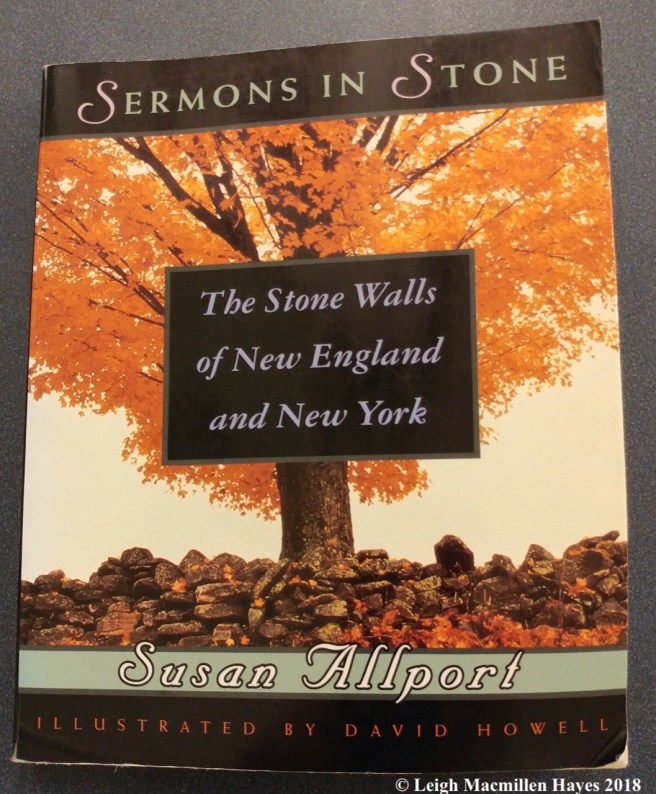
Sermons in Stone by Susan Alport, published 1990, W.W. Norton & Company, Inc.
A history of stone walls in New England.

Stone by Stone by Robert M. Thorson, 2002, Walker & Company.
A geological look at stone walls

Exploring Stone Walls by Robert M. Thorson, 2005, Walker & Company.
A field guide to determining a walls history, age, and purpose.

The Granite Kiss by Kevin Gardner, 2001, The Countryman Press.
A look at repairing walls of stone.

And now I leave you with this poem:

The Old Stone Fence of Maine

Shall I pay a tribute here at home,
To the Old Stone Fence of Maine?
It was here when you were born,
And here it will remain.
Stone monuments, to grand old sires,
Who, with a good right arm,
Solved problems little known to you,
E’re their “clearing,” was your farm.

When you see an Old Stone Fence,
Weed grown and black with age,
Let your mind’s eye travel backward
And read its written page.
And, as Moses left us words in stone,
That live with us today,
Almost, with reverence, let us read
What these Stone Fences say.

They tell of those who “blazed the trail,”
We are walking in today;
Those who truly “bore the burdens
In the heat of the day.”
For every stone was laid by hand,
First taken from the soil
Where giant trees were cut and felled,
Bare handed–honest toil.

The Stone Fence marked the boundary line
Whereby a home was known;
Gave them dignity, as masters
Of that spot they called their own.
The Stone Fence, guarded church and school
And the spots more sacred far,
The silent spots, in memory kept
For those who’ve “crossed the bar.”

Then, treasure this inheritance,
Handed down from sire to son,
Not for its worth, to you, today,
But for when, and why, begun.
For with it comes a heritage
Of manly brawn and brain,
That is yours today, from the builders
Of the Old Stone Fence of Maine.

~Isabel McArthur, 1920
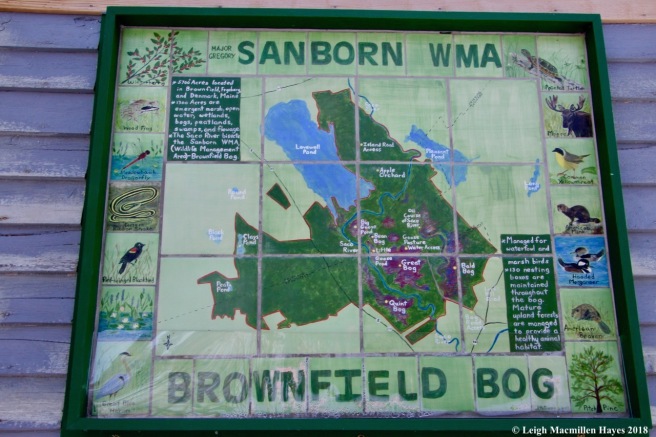
Bogging with Barb

Passing off a copy of the book, From Grassroots to Groundwater, about how two small Maine towns fought Nestlé and won, was the perfect excuse to head to Brownfield Bog. I told Barb I didn’t mind driving to her home or somewhere nearby to give her the book because I’d then go exploring and she welcomed the opportunity to do the same.

b2-Kathy's sign

As we began our journey, I asked if she knew Kathy McGreavy. Of course she did. I mentioned that Kathy walks in the bog daily and we might encounter her. Of course we did. Kathy and “her friend” were just coming out after walking their dogs and so we chatted for  bit. Our discussion included mention of the sign Kathy made last year as her capstone project for the Maine Master Naturalist Program. It’s an incredible piece of artwork and as she’s learned, I’m not the only one who thinks so. Recently, she discovered that a woodpecker had taken to pecking it and so the bottom is now protected with a piece of plexiglass. Crazy birds.

b1-Bog view from the road

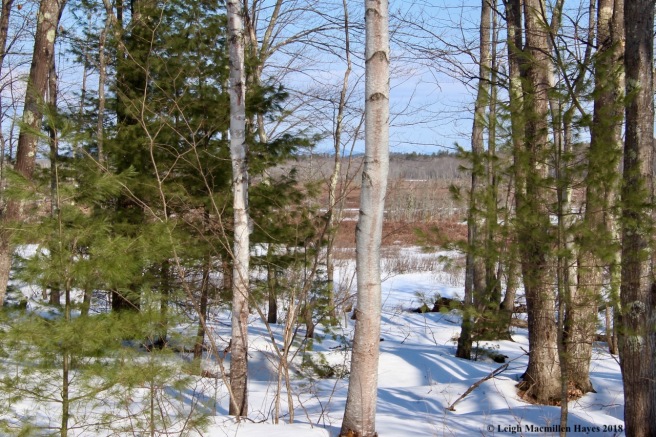
Eventually, Barb and I said our goodbyes to the McGreavys and walked down the unplowed road where I did warn her about my obsession for stopping frequently to take photos. It began from the start–when we spied the bog through the trees and noticed the contrast of colors and layers.

b3a-pussy willows

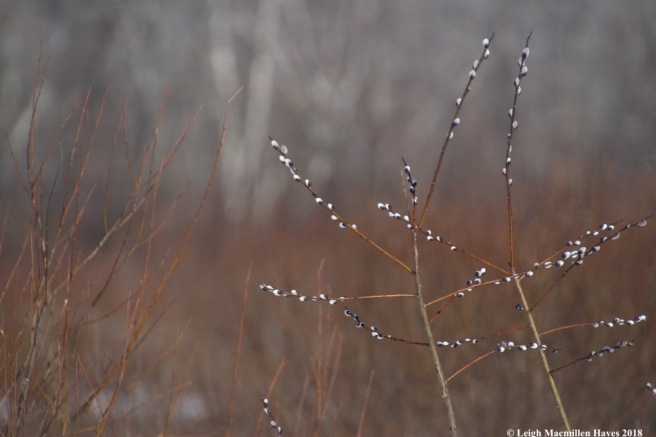
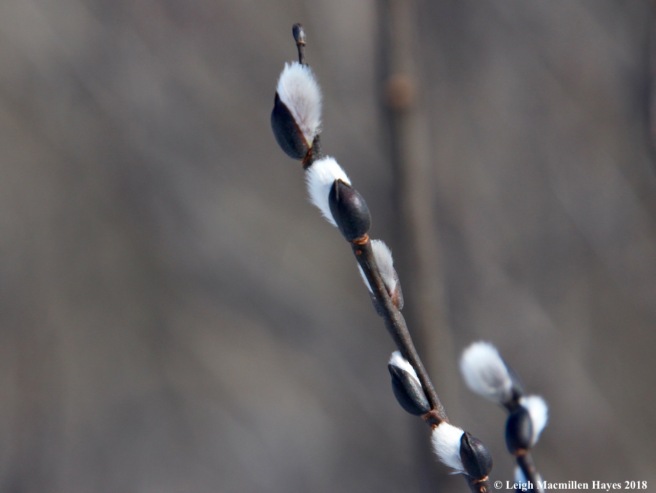
And then–specks of white were ours to behold.

b3-pussy willows

Pussy willows. Was it too early she wondered. No–in fact, I spotted some a year ago on February 23 at Lakes Environmental Association’s Holt Pond Preserve.

b4-red-winged blackbirds

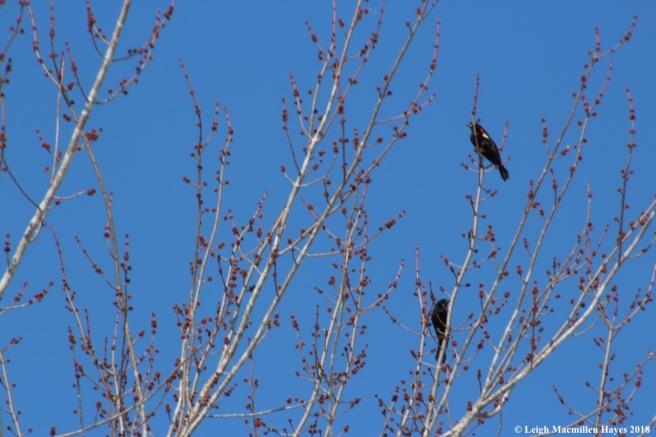
Our next reason to stop–the red and yellow shoulder patch or epaulet providing their name: Red-Winged Blackbirds. Again, Barb asked if it was too early. This time, I referenced Mary Holland for the February 27th entry in her book Naturally Curious Day by Day has this headline: Returning Red-Winged Blackbirds Survive Cold Temperatures and Few Insects. Bingo.

b5-water obstacles

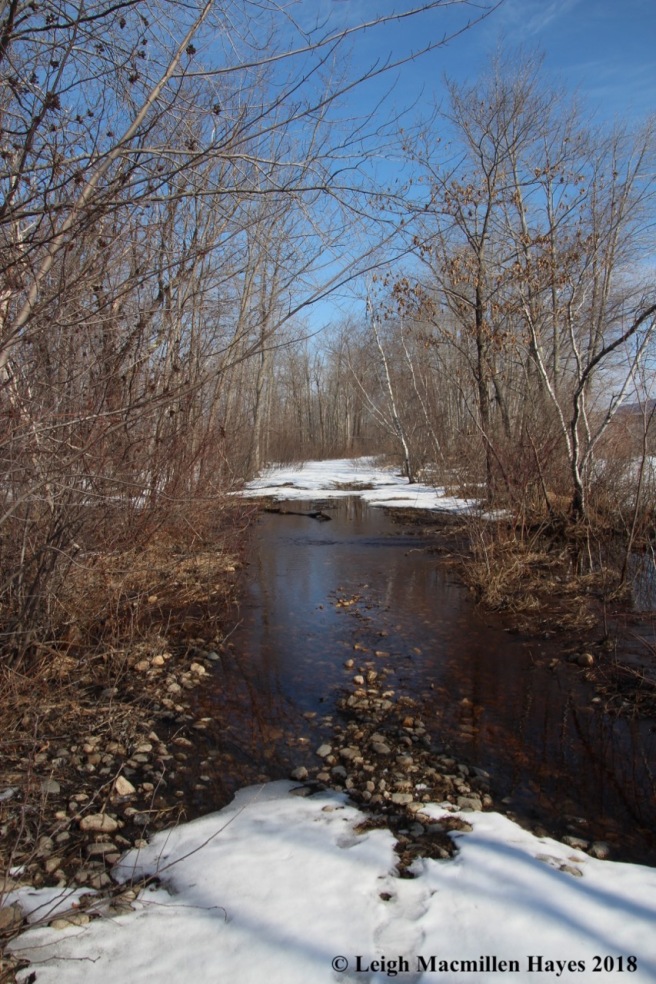
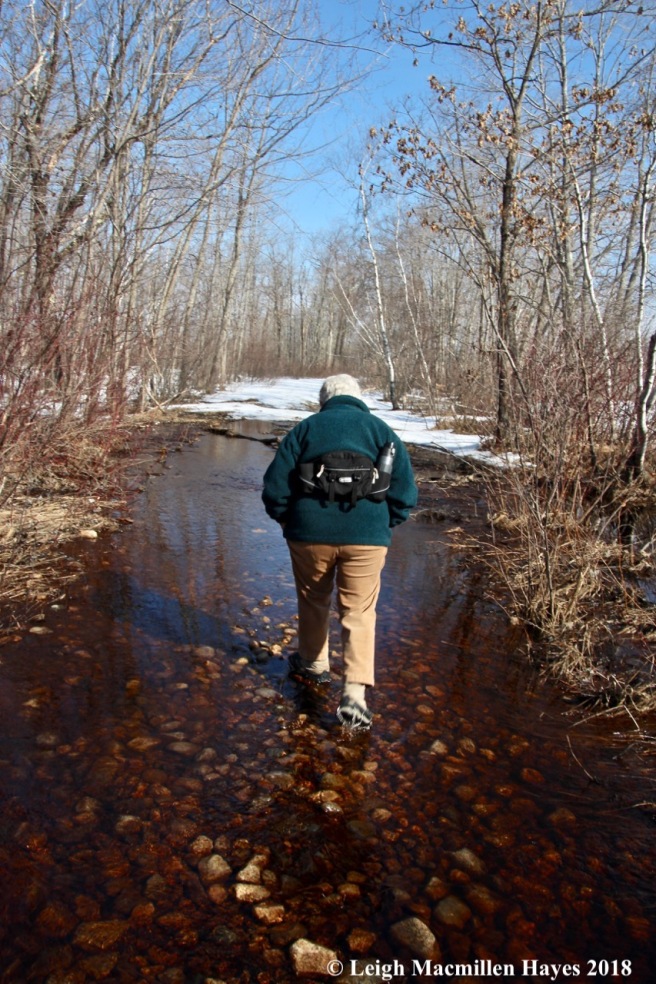
Sometimes our stops were to contemplate our next steps–especially when it came to the water that covered the cobble stones on the road.

b6-Barb charges through the water

But sometimes you just have to go for it. And we did. As the morning continued, we ventured through deeper water and plowed ahead knowing that we would need to dry our hiking boots out when we arrived home.

b7-bird's nest

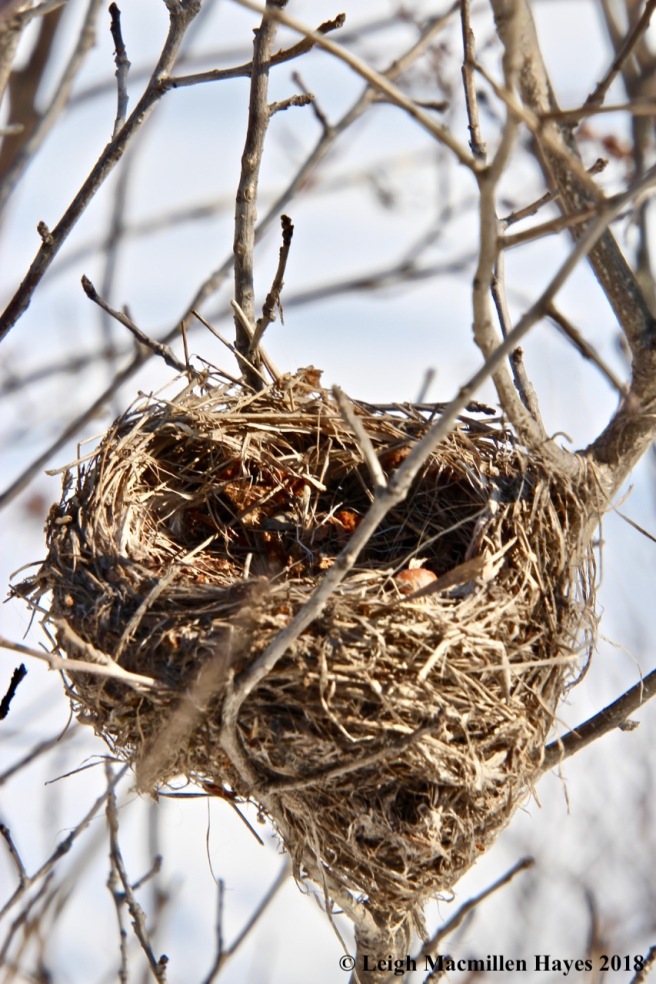
We found a bird nest and wondered about its creator. We did note some acorn pieces inside, so we think it had more than an avian inhabitant.

b8-beaver lodge

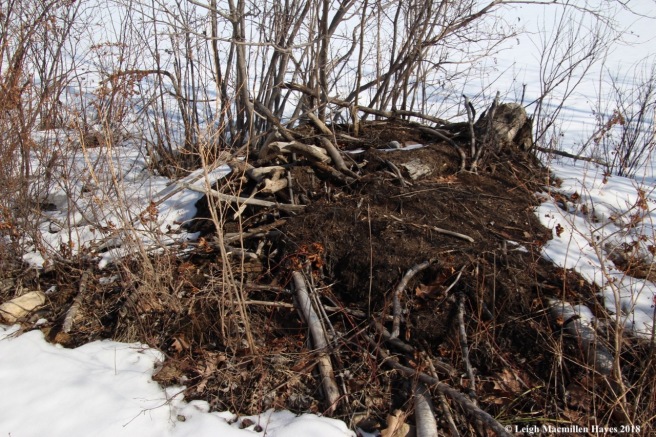
And we paused to look at an old beaver lodge. The mud looked recent but none of the sticks were this year’s additions so we didn’t know if anyone was home.

b9-map in the snow

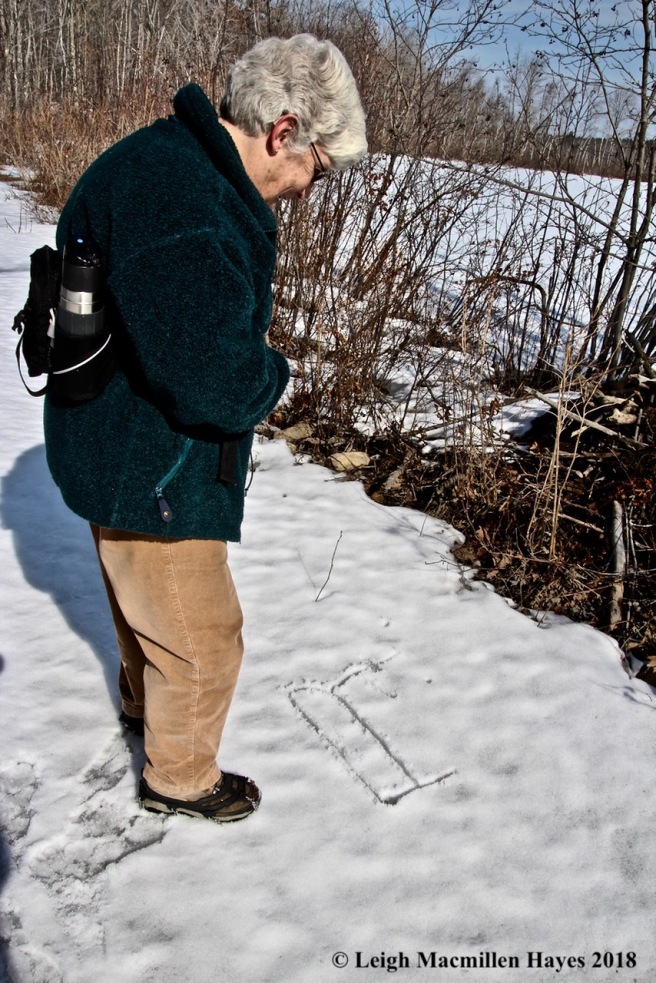
All along, we’d been talking about places we’ve hiked and other topics of interest to both of us. We even learned that we’d both worked in Franklin, New Hampshire, just not at the same time. But speaking of hikes, with her finger, Barb drew a map in the snow and now I have another trail to check out soon with my guy. Should I forget the way, I’ll just reference this map. ;-)

b10-raccoon prints

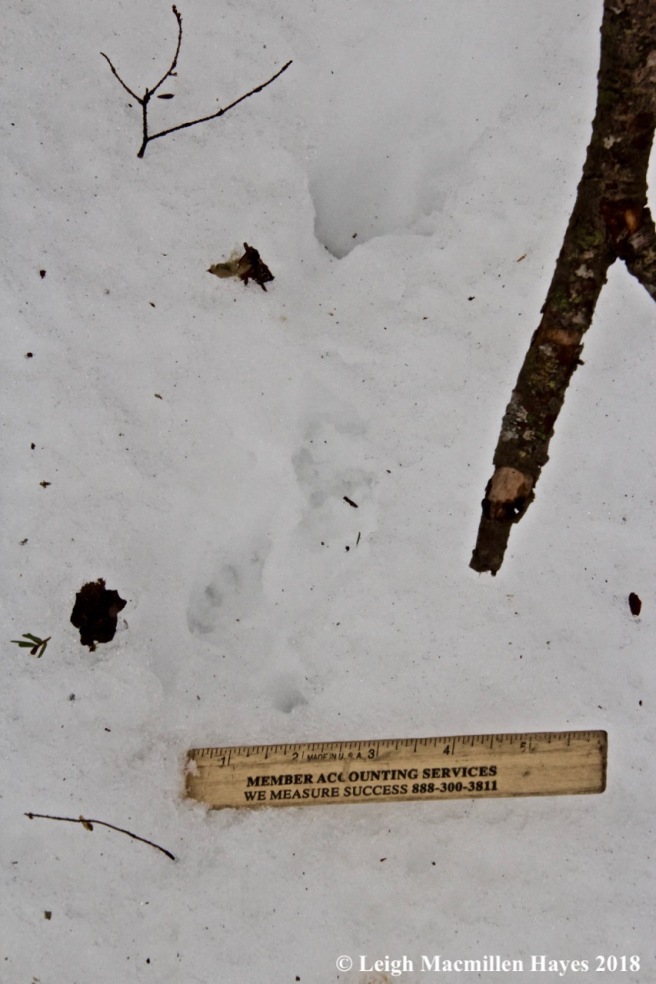
Because we were near water, though most of it still frozen, and the temp was high (actually, too high–in fact, it felt HOT as it soared into the upper 60˚s today), we weren’t surprised to find this set of prints created recently by a raccoon. I love the hand-like appearance and opposite diagonal of each two feet. Can’t you just see him waddling through–in your mind’s eye, that is?

b11-the bog

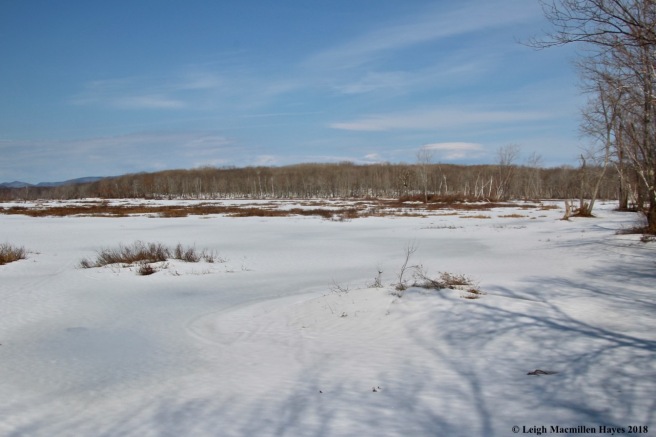
Our turn-around point offered an expansive view of the bog. As much as we may have wanted to head out onto it, we sided with caution and kept to the edge of the shore.

b12-winterberry

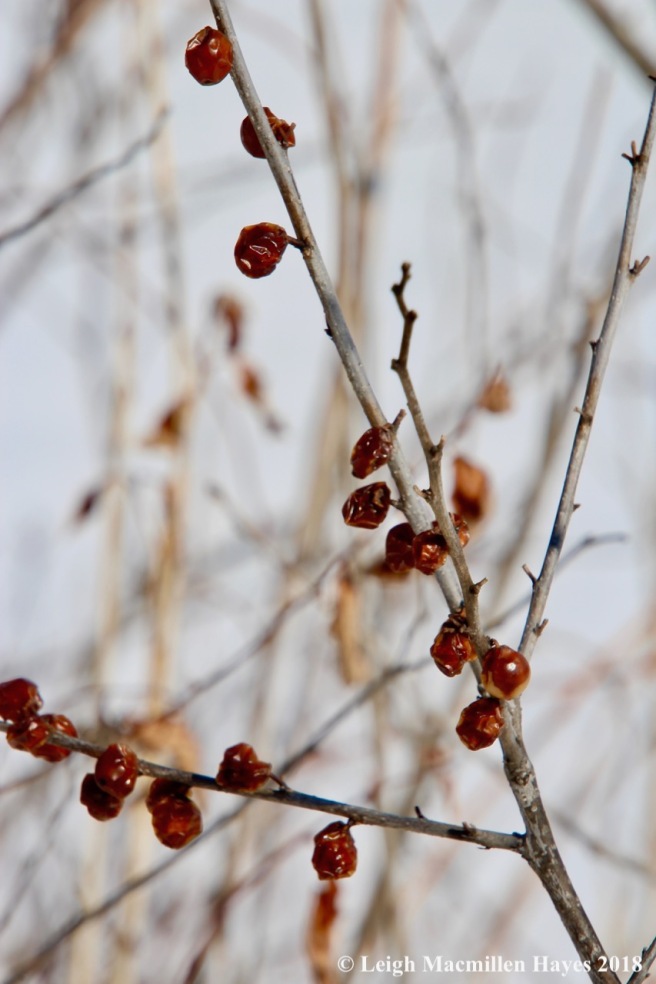
On the way back, there were other things to admire as there always is even when you follow the same route: winterberries drying up;

b13-rhodora

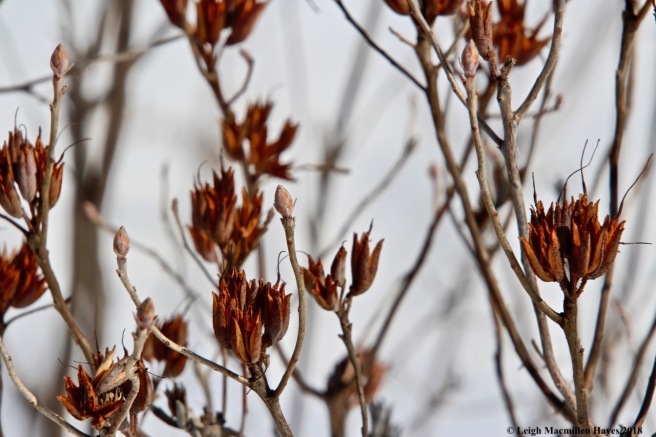
rhodora’s woody seed pods and flower buds swelling;

b14-willow gall

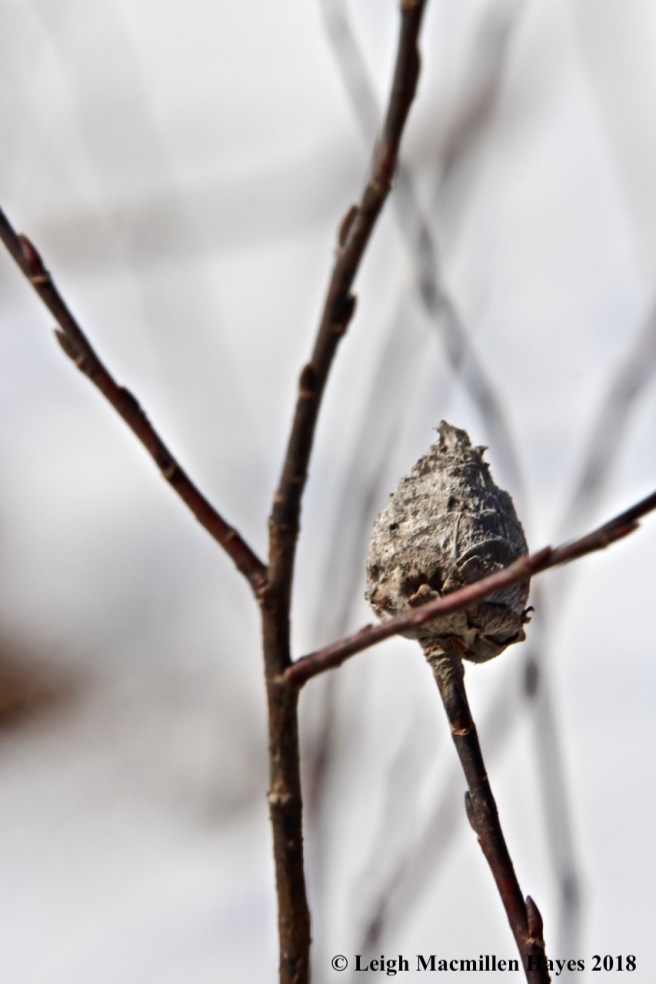
and the pinecone-like structure created with leaves by a reaction to a chemical released by the larva that allows a gall gnat midge to overwinter on the willows.

b16-carrion-flower tendrils

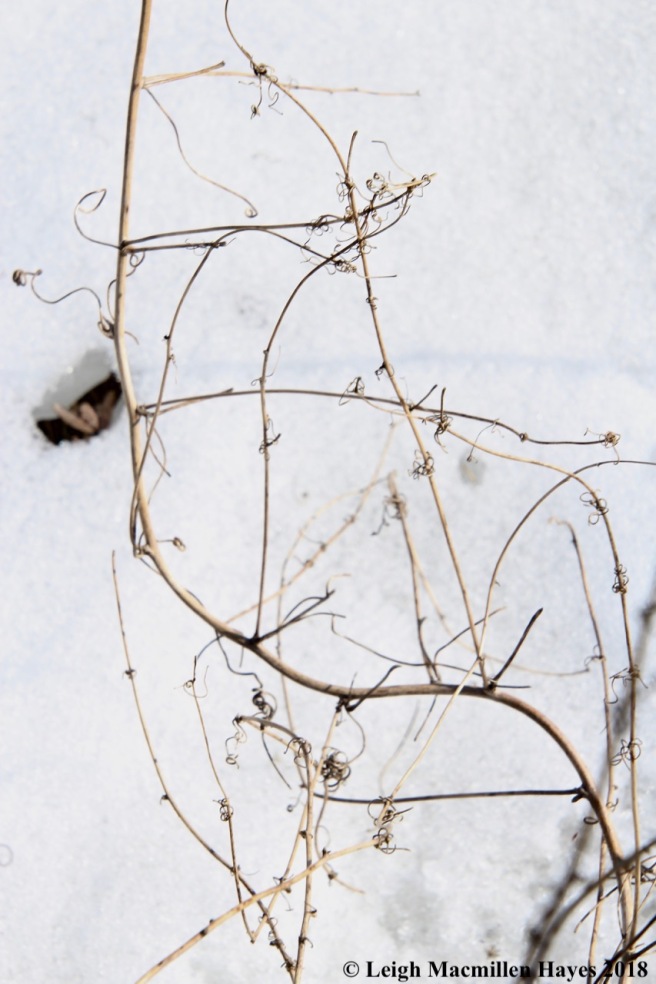
And then we stumbled upon a plant neither of us knew. With it’s long stem and curly tendrils, we were sure it was a vine.

b15-carrion-flower

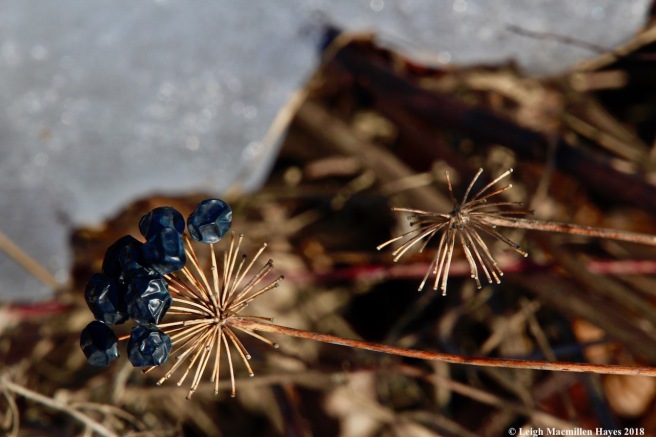
Upon arriving home, however, I wondered about the umbel structure that had been its flower and now still held some fruits. A little bit of research and I found it: Carrion Flower (Smilax herbacea), which apparently smells rather foul when it’s in bloom and thus attracts carrion flies as its pollinator. Now I can’t wait to return and check it out in the next two seasons. Any excuse to get back there.

b17-bog to Pleasant Mountain

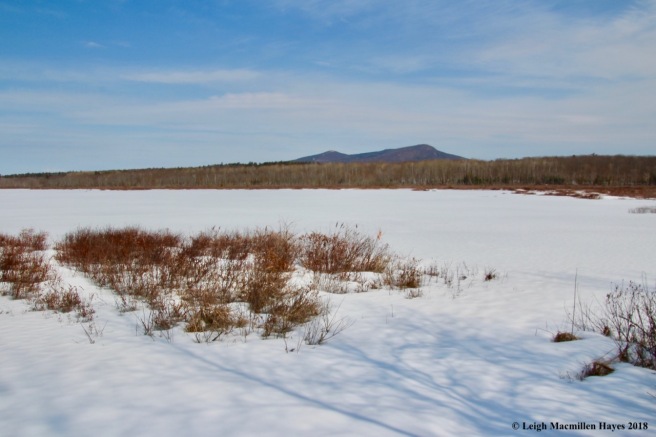
At last the time had come to say goodbye to the bog and then goodbye to each other. Thanks Barb, for giving me an excuse to go bogging with you. It was indeed a treat.

Wondermyway Celebrates Third Anniversary

Three years ago this journey began as a quiet entry into the world of blogging, of sharing my finds and questions found along the trail. And ever so slowly, you joined me to wander and wonder.

So really, today is a celebration of you, for I give thanks that you’ve continued to follow and comment and wander and wonder along, whether literally or virtually.

I absolutely love to travel the trail alone and do so often. But I also love hiking with my guy and others because my eyes are always opened to other things that I may have missed while hiking on my own.

I’m blessed with the community of naturalists with whom I’m surrounded–and this includes all of you for if you’re following along and taking the time to actually read my entries, then you share my interest and awe. And you may send me photos or I may send you photos and together we learn.

t6-cecropia cocoon

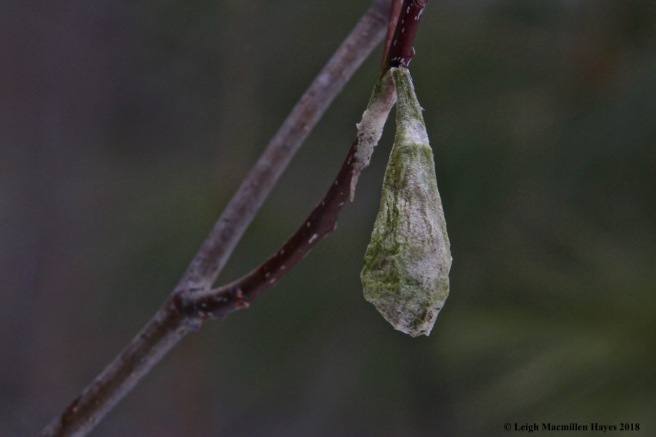
Just yesterday, while tramping in Lovell, Maine, with fellow trackers, I spotted a cocoon  dangling from a beech tree. My first thought–Cecropia moth, but I contacted Anthony Underwood, a Maine Master Naturalist who has great knowledge about insects, and learned that I was wrong. He said it looked more like the cocoon of a Promethea moth. “They hang down whereas Cecropia are usually attached longitudinally,” wrote Anthony. And there you have it.

Now I just have to remember it, which is part of the reason I value my post entries. The information has been recorded and I can always plug a key word, e.g. Promethea, into the search bar and today’s blog will come up–jogging my memory.

And so, without further ado, I present to you my favorites of the past year. It’s a baker’s dozen of choices. Some months, I had difficulty narrowing the choice to one and other months there was that one that absolutely stood out. I hope you’ll agree with my selection. I also hope that you’ll continue to follow me. And if you like what you read here, that you’ll share it with your families and friends and encourage others to follow along.

February 23, 2017:  Knowing Our Place

h-muddy-river-from-lodge

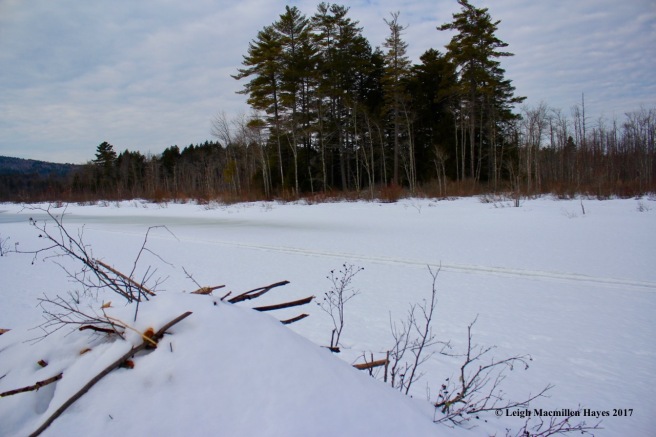
Holt Pond is one of my favorite hangouts in western Maine on any day, but on that particular day–it added some new notches to the layers of appreciation and understanding.

March 5, 2017: Tickling the Feet

CE 3

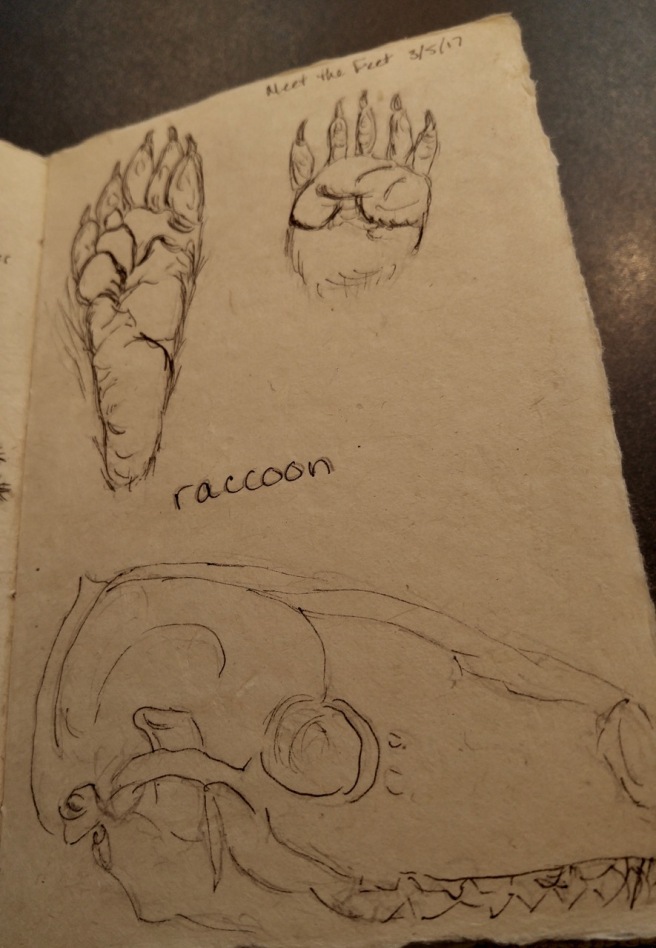
I don’t often write about indoor events, but while the rest of the world was out playing in the brisk wind of this late winter day, a few of us gathered inside to meet some feet.

April 22, 2017: Honoring the Earth

h-spotted sallie 2 (1)

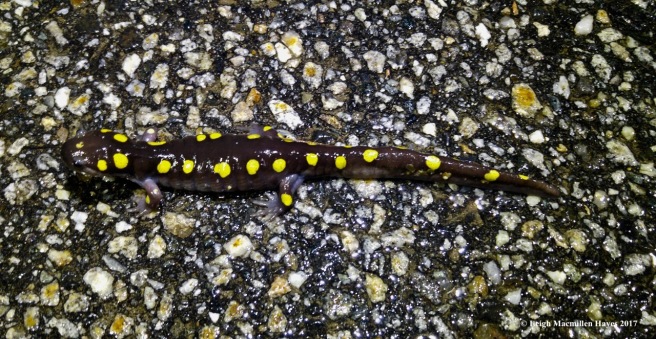
It would have been so easy to stay home that night, curled up on the couch beside my guy while watching the Bruins play hockey. After all, it was raining, 38˚, and downright raw. But . . . the email alert went out earlier in the day and the evening block party was scheduled to begin at 7:30.

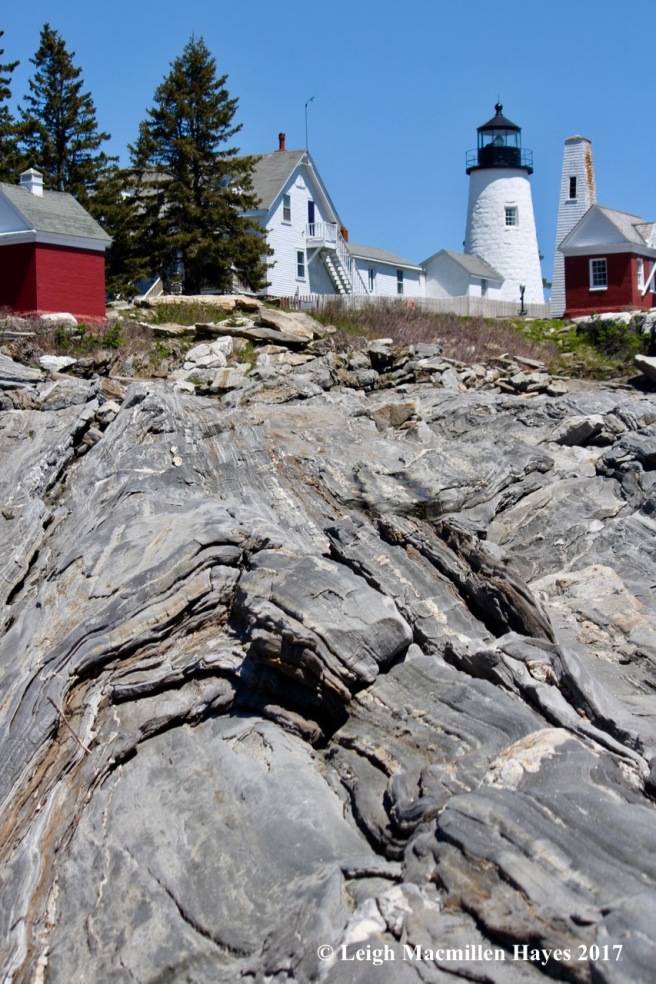
May 21, 2017: On the Rocks at Pemaquid Point

p16-fold looking toward lighthouse

Denise oriented us northeastward and helped us understand that we were standing on what is known as the Bucksport formation, a deposit of sandstone and mudstone metamorphosed into a flaky shist. And then she took us through geological history, providing a refresher on plate tectonics and the story of Maine’s creation–beginning 550 million years ago when our state was just a twinkle in the eyes of creation.
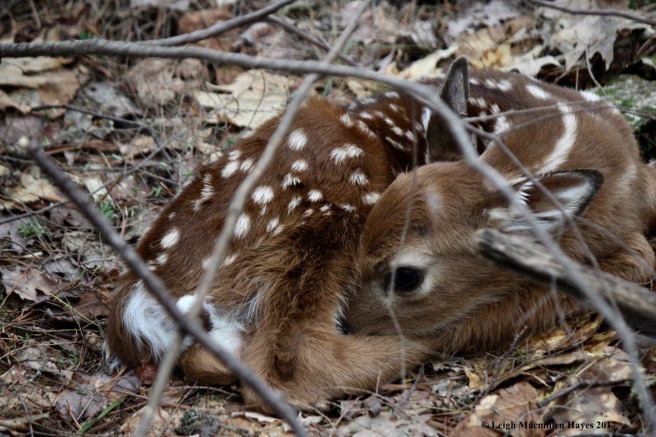
June 9, 2017: Fawning with Wonder

p-fawn 2

Though fawning is most oft used to describe someone who is over the top in the flattery department (think old school brown nose), the term is derived from the Old English fægnian, meaning “rejoice, exult, be glad.”

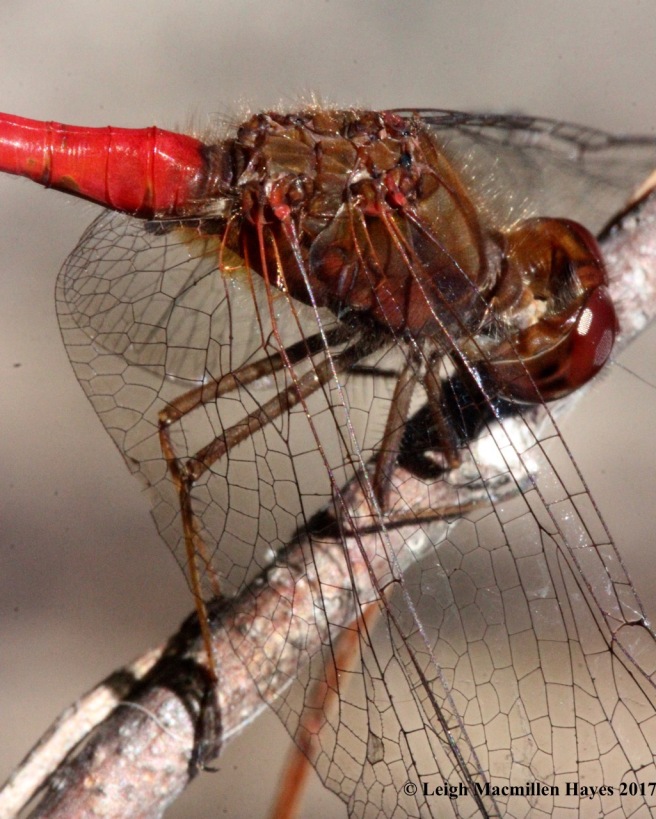
July 3, 2017: Book of July: Flying on the Wild Wind of Western Maine

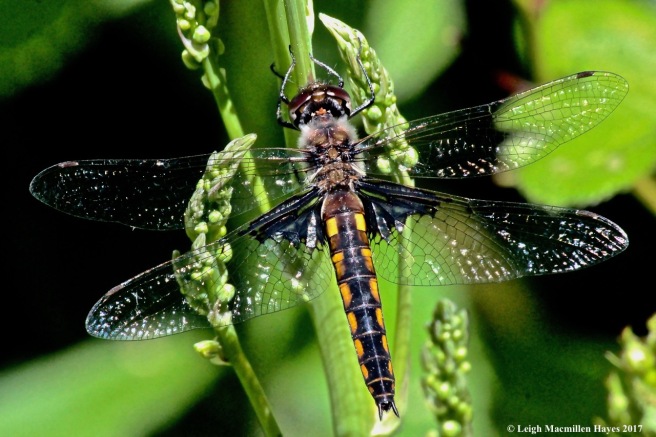
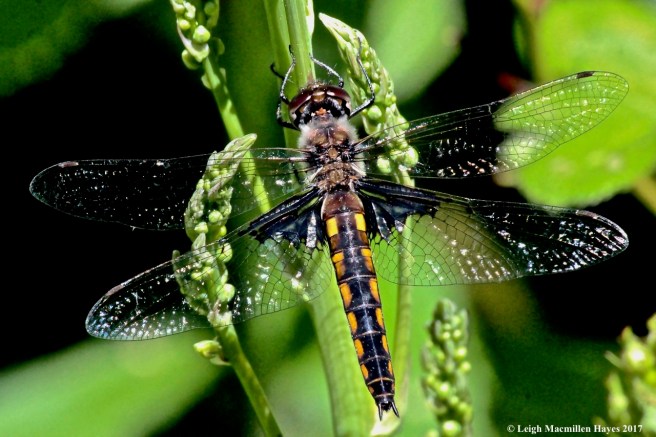
d-skimmer, yellow legged meadowhawk, wings

My intention was good. As I sat on the porch on July 1st, I began to download dragonfly and damselfly photographs. And then the sky darkened and I moved indoors. Suddenly, and I mean suddenly, the wind came up. Torrential rain followed. And thunder and lightening. Wind circled around and first I was making sure all screens and doors were closed on one side of the wee house and then it was coming from a different direction and I had to check the other side. Trees creaked and cracked. Limbs broke. And the lightening hit close by.

August 6, 2017: B is for . . .

b-bye

Our original plan was to hike to the summit of Blueberry Mountain in Evans Notch today,  following the White Cairn trail up and Stone House Trail down. But . . . so many were the cars on Stone House Road, that we decided to go with Plan B.

September 15, 2017: Poking Along Beside Stevens Brook

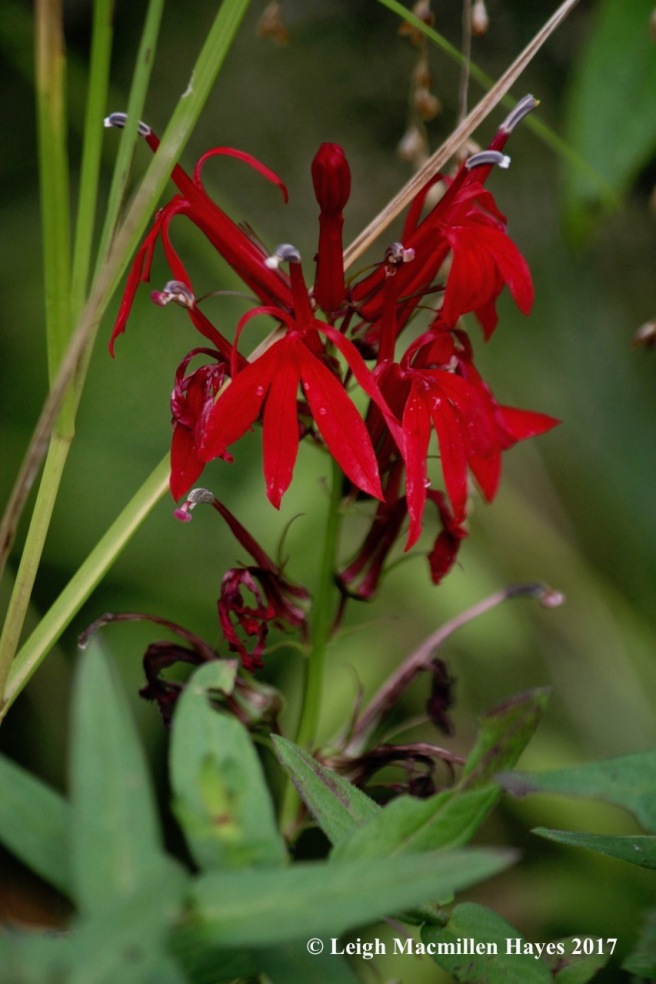
s22-cardinal flower

Raincoat? √

Notecards? √

Camera? √

Alanna Doughty? √

This morning I donned my raincoat, slipped my camera strap over my head, and met up with LEA’s Education Director Alanna Doughty for our reconnaissance mission along Stevens Brook in downtown Bridgton. Our plan was to refresh our memories about the mill sites long ago identified and used beside the brook.

October 5, 2017: Continued Wandering Into the World of Wonder

i-baskettail, common baskettail 1

May the answers slowly reveal themselves, while the questions never end.

November 24, 2017: Black Friday Shopping Extravaganza

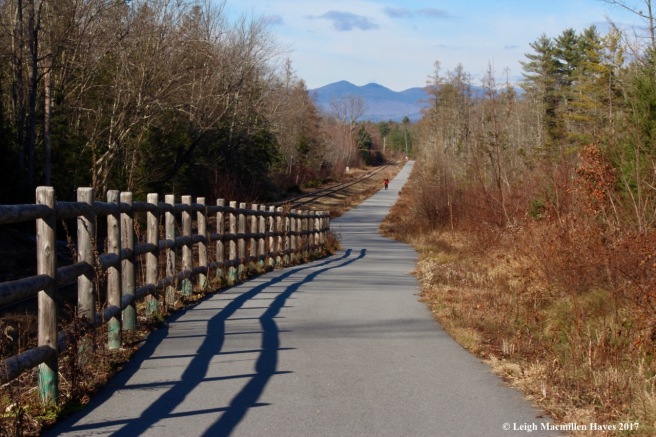
b8-the main aisle

At last, I’d raided enough aisles. My cart was full to the brim and my brain overwhelmed. I guess I’m not really a “shop-til-you drop” kind of gal. It was time to wind along the trail and end my Black Friday shopping extravaganza.

December 29, 2017: Oh Baby!

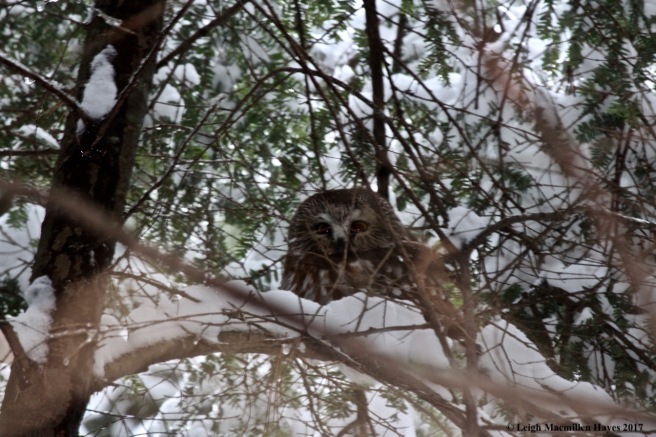
s-screech owl 2

We shared about ten minutes together and it was definitely an “Oh baby!” occasion. But there was more . . .

January 21, 2018: Sunday’s Point of View

p17-Needle's Eye

We arrived home with ten minutes to spare until kickoff.

February 8, 2018: Hardly Monochromatic

p18-Stevens Brook

My world always takes on a different look following a storm and today was no different.

To all who have read thus far, thanks again for taking a trip down memory lane today and sticking with me these past three years. I sincerely hope you’ll continue to share the trail as I wander and wonder–my way.

And to wondermyway.com–Happy Third Anniversary!


Distracted by Nature

A morning message from my dear friend Carissa set the tone for today. Her Lenten devotional is based on the poetry of Mary Oliver and she thought of me when she read “The Summer Day.”

The Summer Day
Who made the world?
Who made the swan, and the black bear?
Who made the grasshopper?
This grasshopper, I mean-
the one who has flung herself out of the grass,
the one who is eating sugar out of my hand,
who is moving her jaws back and forth instead of up and down-
who is gazing around with her enormous and complicated eyes.
Now she lifts her pale forearms and thoroughly washes her face.
Now she snaps her wings open, and floats away.
I don’t know exactly what a prayer is.
I do know how to pay attention, how to fall down
into the grass, how to kneel down in the grass,
how to be idle and blessed, how to stroll through the fields,
which is what I have been doing all day.
Tell me, what else should I have done?
Doesn’t everything die at last, and too soon?
Tell me, what is it you plan to do
with your one wild and precious life?
~Mary Oliver

A perfect beginning, indeed.

w-Horseshoe Pond

A short time later I joined a couple of other friends and we traveled together to the Greater Lovell Land Trust’s Wilson Wing Moose Pond Bog Preserve. Our snowshoe journey began beside Horseshoe Pond where we paused to enjoy its beauty and recall trips up Lord Hill, whose face was obscured to the left.

w-hemlock cones and seed below

Once we got onto the trail, it was the little things that we noticed, like the hemlock cones with partially opened scales, their seeds all released. One tiny seed sits atop my name in this photo, but we wondered together why we’ve always seen the cones only in their closed up formation, whether fresh or old. Had they always looked like this one in late winter and we just never realized it previously?

w-frullania liverwort with new growth

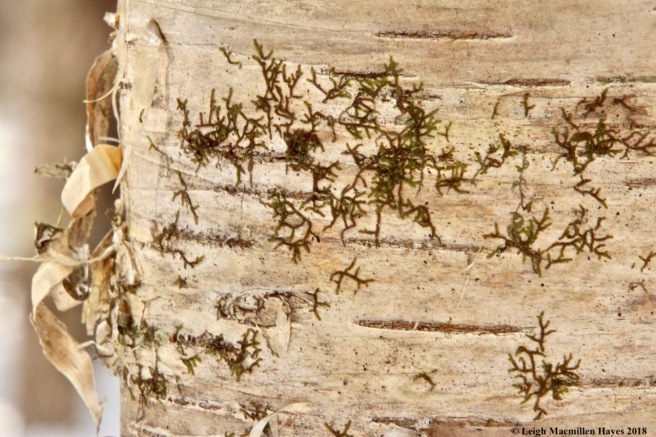
And then we paused beside yellow birches where the liverwort Frullania eboracensis grew in abundance. Again, a new realization for us. We knew it to have brown stems, but today spied the green. As it turns out, in his book, Mosses, Liverworts and Hornworts, author Ralph Pope begins his description with this: “Plant dark green to brown . . .” Our eyes were opened.

w-crowded parchment laterally fused

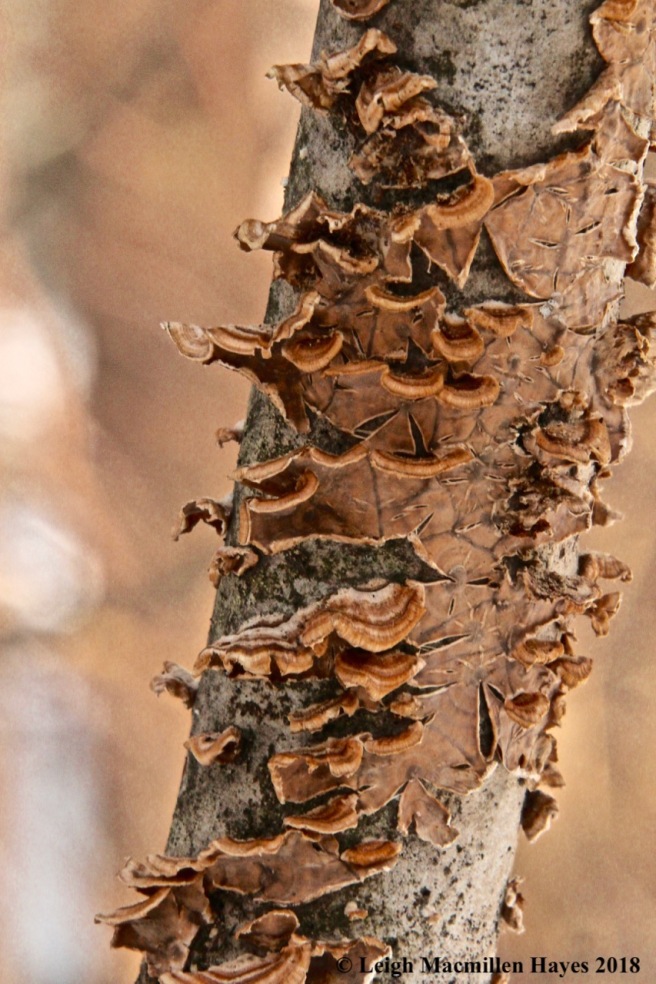
Next there was the Crowded Parchment fungus that threw us off momentarily. We recognized the cap, but were unsure about the part of the fungus that was spread out flat like a crust. It turns out, the flat parts or fertile surfaces of this mushroom laterally fuse or join together at the dark ridges. This behavior certainly spoke to its name of crowded. In Fascinating Fungi of New England, Lawrence Millman refers to it as “One of the most common fungi as well as one of the most crowded in New England . . . It’s not unusual to see several hundred gregarious fruiting bodies laterally fused or in dense clusters on a single branch.” Common or not, we were wowed.

w-script lichen

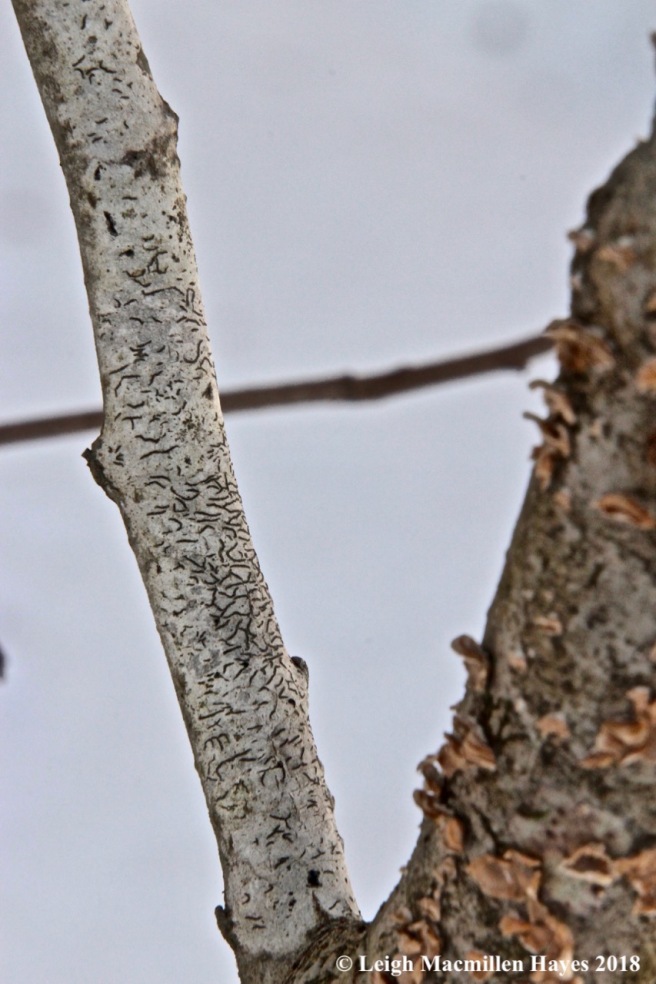
And because we stopped to gain a better understanding of the Crowded Parchment, another gift was offered in the form of script lichen writing its own story on an adjoining branch.

w-nectria fruiting bodies?

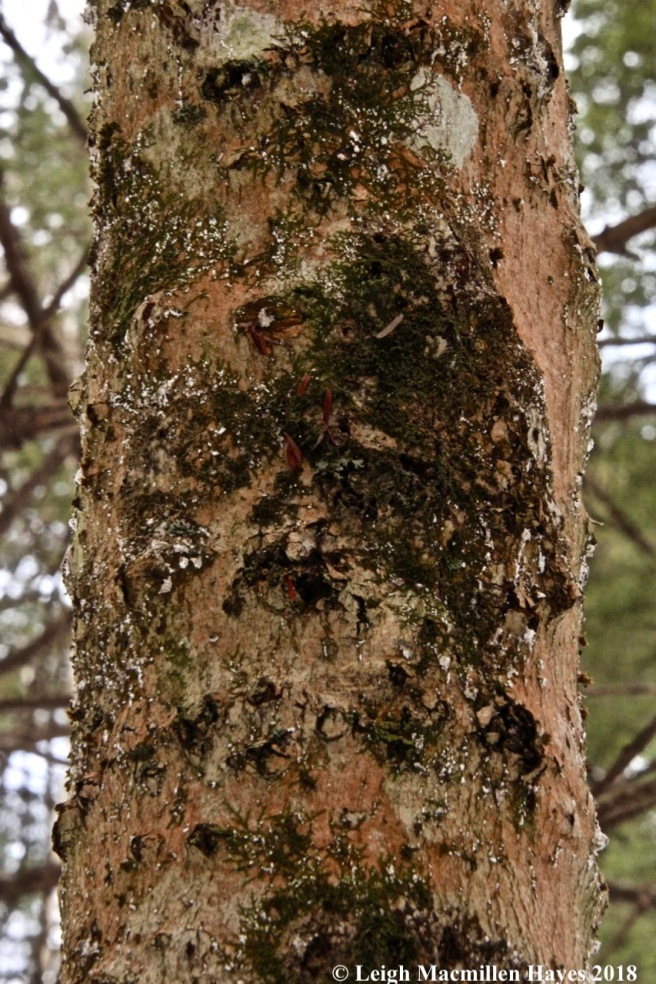
Nearby, there was a similar cinnamonish color on beech bark. This particular beech was dotted with the waxy exterior winter coating of the beech scale insect. As I’ve noted before, the scale insect or more technically, Cryptococcus fagisuga, is a tiny insect that sucks sugar and other nutrients from beech trees only.

Soon, the beech scale insect will molt into its second, legless nymph stage and emerge. Immediately, it will start sucking sap through its tubular mouthpart or stylet. That instar stage doesn’t last long, and quickly it will become a mature female. For the rest of its life it will remain sedentary, but repeatedly remove and reinsert its piercing stylet, wounding the tree and providing entry points for fungi to enter. An interesting fact about beech scale insects–its a world of females who reproduce by parthenogenesis; there are no known males.

w-closer look

But what about that cinnamon color? Was it a fungus? Or was it related to the insects? Yes and yes. As some further research revealed, two species of nectria fungi are associated with beech bark disease, Nectria coccinea var. faginata and Nectria gallengiaIt is now my understanding that what we examined was a large area of the former’s fruiting bodies. Oh my.

w-lichen garden1

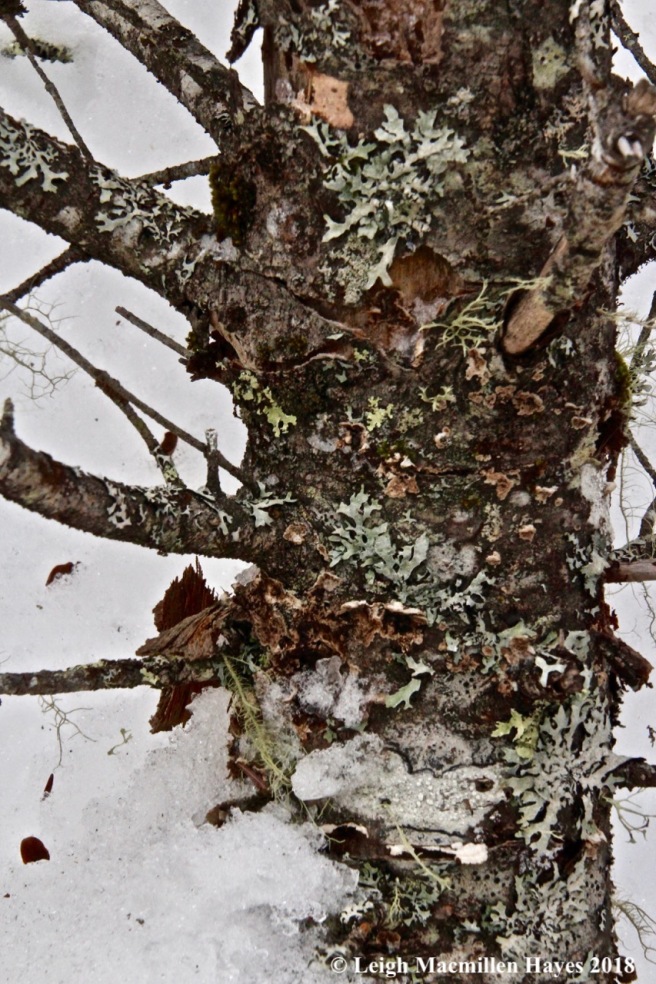
We also paused frequently beside gardens dominated by lichens. Crustose, foliose and fruticose varieties completely enveloped the bark of this toppled tree, their individual colors and textures adding to the visual display.

w-mink 1

And then . . . and then . .  . as we looked, a motion captured the attention of one in our group. I only wish my focus had been better, but still, it was enough.

w-mink 2

We were blessed with the opportunity to spend a few moments with a mink as it bounded down the hill before realizing it had an audience.

w-mink measurements

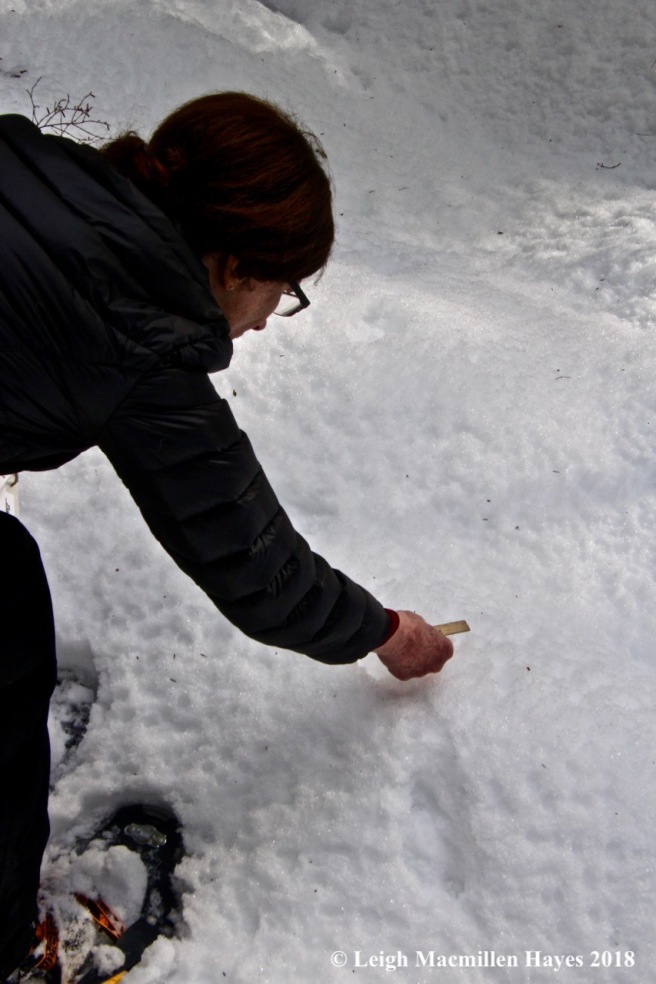
Of course, after it disappeared down a hole into a stream and we’d waited a bit, we checked out the tracks it left behind. The size of the prints and length of the straddle or measurement from the outside of one print to the outside of the other confirmed our ID.

w-mink prints

From that point on, we continued to find evidence that the mink had traveled to and fro over the course of several days. Our hearts were grateful to have shared such a moment.

w-hairy, bony find

And as we took measurements, we spotted something else on the snow. Something hairy and bony found about three or four inches from the fresh mink tracks.

w-hairy, bony--scapula

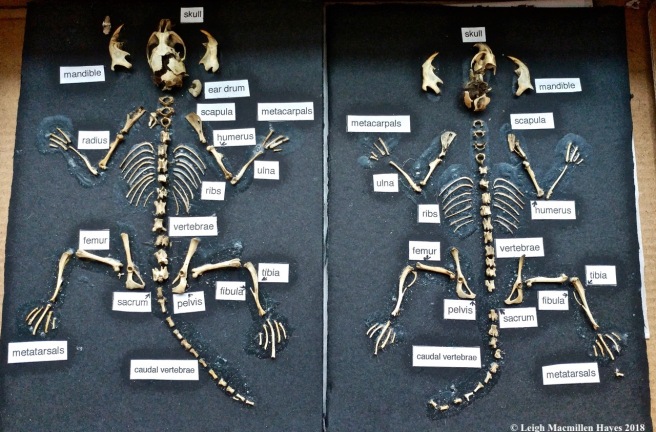
A scapula from a little brown thing, possibly a vole. Dropped from the mink or from above by a bird? We’ll never know. But we do know that someone consumed someone else–as it is in the natural world.

w-Sucker Brook

Seeing the mink made perfect sense because we traveled on and off trail beside Sucker Brook.

w-hobblebush flower and leaf buds

It was there that the naked but hairy hobblebush leaves and flower buds reminded us that spring isn’t far off. The three of us don’t necessarily want winter to end for we love how it forces us to notice other things such as the nectria’s fruiting bodies. And we love to track. But . . . we also love the other seasons, so we’re happy exploring at any time of the year.

w-suds

Beside the water, the icy formations kept calling my name and I honored many by snapping a photograph. But, then we met the suds. Water foam is caused by the decay of twigs and plants and occurs naturally in streams and brooks. As they release compounds, the interaction breaks the surface tension, allowing air to mix in and create bubbles. And just as we found the Crowded Parchment living in a large community, we also found this congregation of bubbles–creating a design all its own.

w-Wilson Wing Moose Pond Bog

Despite the short trail, it took us forever to reach the point where the brook becomes Moose Pond Bog, but we did.

w-stream with rattlesnake liverwort

And then we beelined (sort of, for still we kept stopping) to the final stream crossing on the trail for we wanted a glimpse of the rattlesnake liverwort we’d discovered growing there last year. Alas, it was buried under snow. And that means we’ll have to return again. Darn.

w-sucker brook reflections

In the end, it was a morning well spent as we dillied and dallied over the littlest of things. And watched a mink. We got to see a mink!

No, it wasn’t a summer day. But . . . we were distracted by nature. As Mary Oliver asked, “What else should we have done?”


The Books of February: The HIDDEN LIVES of OWLS & OWLS of the NORTH

“Who cooks for you?” was the question I heard being asked as I fell asleep last night. And “Who cooks for you all?” the response I awoke to this morning.

‘Tis the season for owl mating calls, in this case Barred Owls, and therefore the season to promote two books about some species that hoot in our neighborhoods.

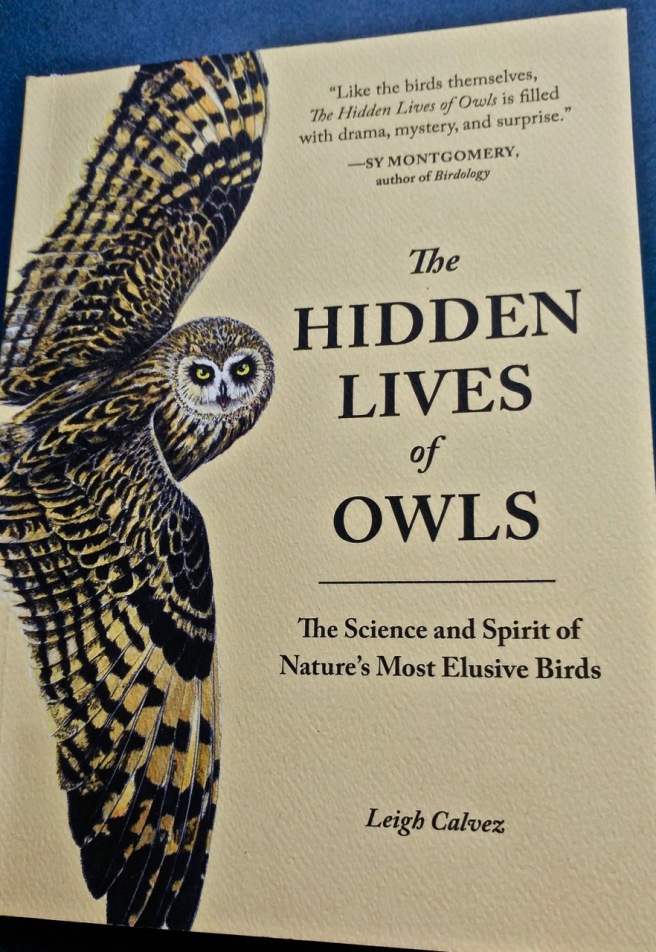
o-The Hidden Lives of Owls

The first, The HIDDEN LIVES of OWLS: The Science and Spirit of Nature’s Most Elusive Birds by Leigh Calvez, provides a fun and informative read. Perhaps I like it so much because we share a name and an interest in nature. But really, it’s the stories she tells about her experiences in the night world that make me feel as if I’m sitting on a tree stump or rock wall beside her–waiting and watching.  Listening and learning.

Calvez begins her book with silhouettes for eleven owls and a list that includes the scientific name of each, overall length, and wingspan.

s-screech owl 2

The first chapter is about Northern Saw-whet Owls, a new favorite for me since I was honored with the opportunity to meet one at the end of 2017 as I snapped my way through a thicket of hemlock trees, twigs breaking with each movement. Despite all the noise, this owl flew in and our eyes connected. Like Calvez, that sighting quivered in my mind and heart as I tried to remain calm and maintain my focus. I felt like a little kid wearing big girl boots, such was my excitement.

It’s through Calvez that I learned the origin of this bird’s name: the rasping call reminding those who named it of the sound made when “whetting” or sharpening a saw against a file.

And did you know that within mated pairs of these little birds, minute members of the owl family as they aren’t much bigger than a robin, the female sits on the nest for an almost one-month incubation period, while the male dutifully brings food? He actually continues this process even after the young’uns fledge, while momma goes off to the spa in order to regain her strength (or start another brood).

Since she first became fascinated by owls, Calvez had the good fortune to travel to a variety of locations and learn from others–as well as from the owls. She delved into the science of the species and the spirit of some individual birds; her stories are all tucked into this 205-page book. While some are species we may not see in the Northeast, for she writes about those she most familiar with in the Northwest, there’s still plenty to be gained from reading this book.

The book ends with the following: “Notes from the Field: Insights from an Owl.” I wish I could share it with you, but don’t have permission to do so. Let me just say–this list and the silhouettes and comparisons at the beginning make the book well worth the purchase. And the stories in between, filled with wit and wisdom, make it well worth the read.

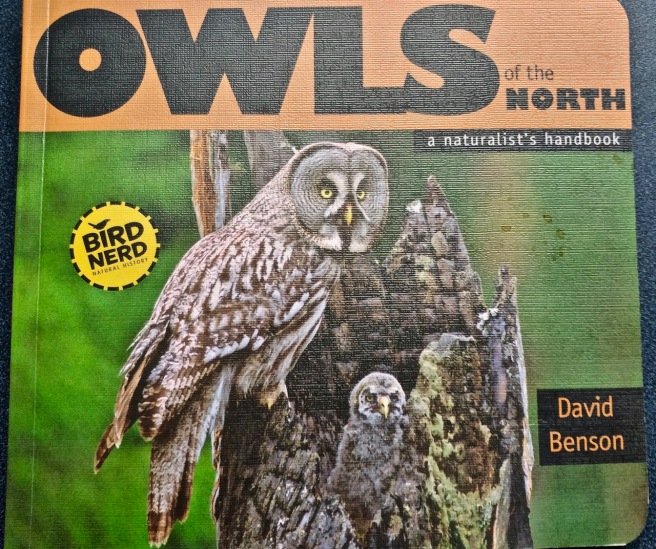
o-Owls of the North

The second book, which I purchased the same day, is OWLS of the NORTH: a naturalist’s handbook by David Benson.

This book is more of a guide, filled to the brink as it is with photographs and facts about ten owls. For each species, Benson includes a global map and quick list of the following: description, range, size, wingspan, other names, diet, a brief personal story about an experience with the particular owl, identification, sounds, habitat, food, hunting, courtship and nesting, juveniles, and behavior. Almost every page features one or two action shots.

And then there are the sidebars, highlighted within an orange box on each of the odd-numbered pages. One included information about pellets, whitewash and skulls.

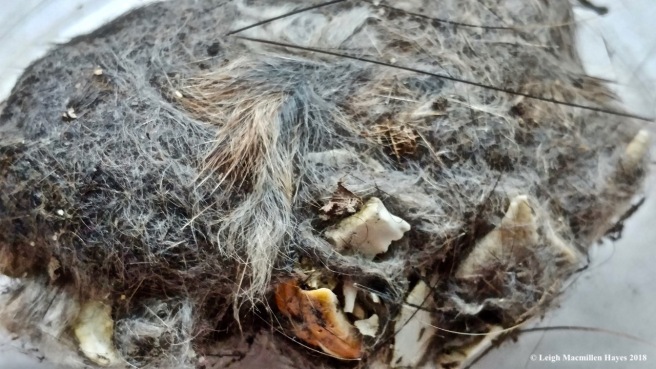
o-owl pellet

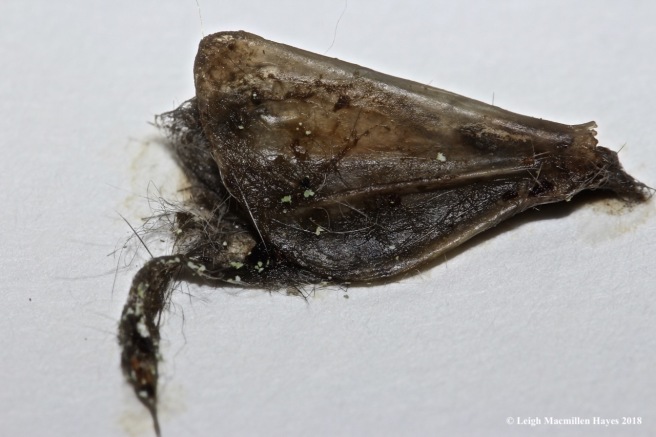
Of course, that reminded me that I have an owl pellet in my collection of all things natural. I found it in March 2016 at Brownfield Bog. According to Benson’s sidebar: “Owls usually swallow their prey whole. An owl catches a mouse, kills it with its talons or by biting its neck and then bolts the whole thing down. Much of the mouse is not very digestible though–the bones, fur and other tough parts don’t provide much nutrition. These are compacted together in the owl’s digestive tract. Then, about six hours after the meal, a pellet of these indigestible parts is coughed up and it drops to the ground beneath where the owl is roosting.”

o-pellet critters--voles

I’ll probably never dissect the pellet I found, but did dissect one for the Maine Master Naturalist Course–and determined that the owl had consumed two voles. (Don’t look too closely for I know that I put a couple of bones in the wrong place–nobody’s perfect.)

We have an Owl Prowl coming up at the Greater Lovell Land Trust and I’m trying to learn as much as I can. The two books, The HIDDEN LIVES of OWLS by Leigh Calvez and OWLS of the NORTH by David Benson, have proven to be valuable resources. I purchased both at Bridgton Books, an independent book store.

If you want to learn more, I encourage you to check out these books, join us for the Owl Prowl, or step outside–tis mating season and the calls can be heard. You might even think about responding. Go ahead–give a hoot.

The HIDDEN LIVES of OWLS: The Science and Spirit of Nature’s Most Elusive Birds by Leigh Calvez, published 2016, Sasquatch Books.

OWLS of the NORTH: a naturalist’s handbook by David Benson, published 2008, Stone Ridge Press.

Book of January: Winter World

It seemed only apropos as a blizzard intensifies that the January Book of the Month be Bernd Heinrich’s Winter World: the ingenuity of animal survival.

w-Winter World by Bernd Heinrich

In this very readable book, biologist and illustrator Heinrich takes us into the depths of animal adaptation that allows even the tiniest among us to deal with the elements in order to avoid freezing to death. Of course, some do. And others become food.

A main theme of the book is the yellow-crowned kinglet, a bird Heinrich describes as weighing as little as two pennies. I’ve only had the honor of observing these tiny birds a couple of times, but daily watch other birds puff out their feathers to insulate their bodies from the frigid temps we’ve experienced this winter.

w-snow on pines

The bird frenzy was crazy at the feeders all day today. And the blizzard conditions drew me outside for a while on a quest of my own to see what else I might observe. Other than lots of snow, I didn’t see much. A few chickadees flew in to check on me as they worked on hemlock cones–in their attempt to release seeds. And I startled a ruffed grouse, which in turn startled me.

w-no Mount Washington in sight

But really, the wind was strong and view at times quite limited.

w-gray birch

One of the curious things that Heinrich doesn’t address in this book is the affect of a changing habitat on survival. With all the snow and ice we’ve had, gray birches everywhere have bent with their burdens. I know this area to be frequented by snowshoe hares, but suspect that will change as the birches die and red maples take their  place.

w-deer tag

It’s also an area that the deer pass through, not stopping to rest for it’s a bit wet at times, but certainly pausing to browse.

w-deer rub

And leave behind their scent.

w-vernal pool

Nearby exists my favorite vernal pool. In chapter 13: Frozen Frogs on Ice, Heinrich addresses the chemistry that allows the wood frogs and peepers who will sing from this pool in the future to become frost-tolerant. “When the first ice crystals begin to form on or in the skin of a wood frog, it sets off an alarm reaction. Skin receptors relay the message of freezing to the central nervous system (CNS), and the CNS activates the adrenal medulla to release adrenaline into the bloodstream. When the adrenaline circulates to the liver, it there activates the enzymes that convert the liver’s stores of glycogen to glucose. In the wood frog, this response is massive and before the ice reaches the cells they become packed with glucose that acts as an antifreeze . . . in about fifteen hours, the frog is frozen solid except for the insides of its cells. Its heart stops. No more blood flows. It no longer breathes. By most definitions, it is dead. But it is prepared to again revive at a later date.” As he says, the wood frogs (and hibernating bears) are “biological marvels that challenge the limits of our believes of what seems possible.” 

w-goldenrod gall

There’s so much more in his book, including chapter 14: Insects: From the Diversity to the Limits, in which among other things he discusses the goldenrod gall fly larva that is “physiologically specialized to overwinter.” 

While I was out and about, I checked on the red squirrel cache I’ve been keeping an eye on. No action of any kind today. In fact, most critters seemed to have hunkered down to wait out the storm, huddled together in ground or tree holes and dens. Sometimes in the quiet of a snowstorm I meet deer, but not so today. With the wind whipping through the trees, large plops of snow whooshed off of hemlocks and pines, while shards of ice crackled and fell. A few times I felt like Chicken Little as a chunk hit my hat. All of that was reason enough to find a cozy spot.

w-blizzard of 2018

Finally, it was time for me to do the same. To return home, brew a cup of tea, and reread Bernd Heinrich’s book. It’s one of my favorites, although I also love The Geese of Beaver Bog, The Trees in My Forest, and A Year in the Maine Woods. (Note: my least favorite is Summer World. Not sure why, but try as I might, I can’t get through it.)

w-a smile and a wink

Winter World literally and figuratively makes me smile.

Winter World: The ingenuity of animal survival by Bernd Heinrich, published 2003, HarperCollins Publishers, Inc.

Whetting Our Apatite

Our hunger is never satisfied each time we gather. We always manage to see more, share more and learn more because of our combined knowledge. We also always come away with questions. And so it was this afternoon when about ten of my Maine Master Naturalist Lewiston classmates and I gathered with two of the programs founders, Dorcas Miller and Fred Cichocki, to explore a public park in Auburn, Maine.

a1a-looking at trees

From the get go, we bounced back and forth along the trail to look at the idiosyncrasies of trees and chat about the book, A Beginner’s Guide to RECOGNIZING Trees of the NORTHEAST.

a1-red maple target fungus

And as they should, teachable moments kept presenting themselves, including a prime example of the bull’s eye target fungus on red maple bark. Suddenly, those who hadn’t quite seen the target in an earlier specimen had the opportunity to meet it and I trust they will recognize it going forward.

a2-slime mold

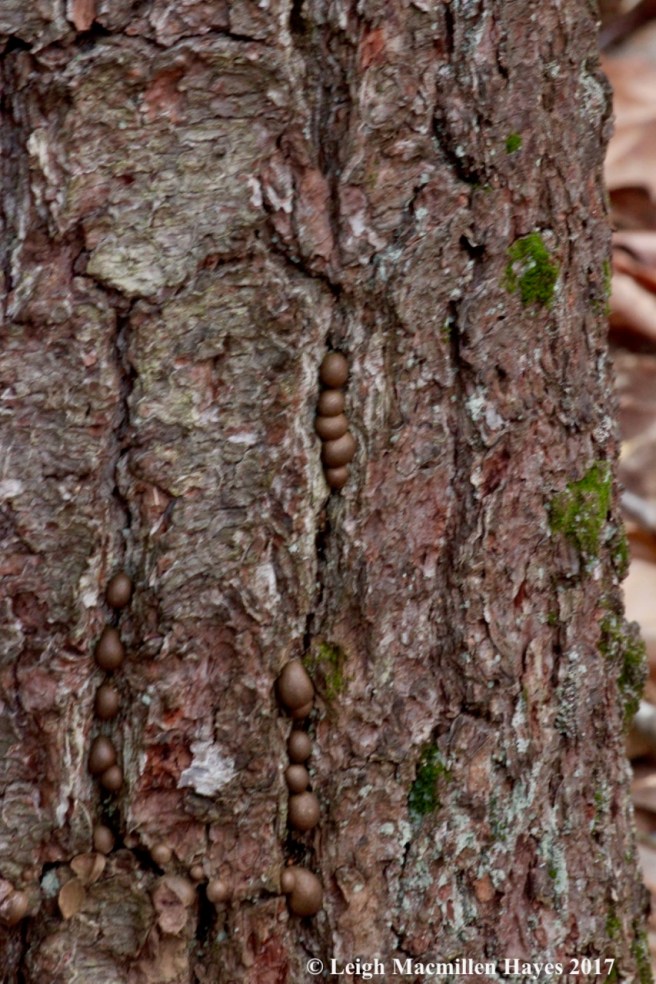
As much as we zigzagged down the trail, we also bounced off of each other as we shared our knowledge. Because we all suffer from Nature Distraction Disorder, and have the tendency to travel at a slower than slow pace, it was no surprise that a stop to look at a fungus closer to the ground meant that one of us noticed a slime mold in the crevasses of pine bark. A poke with a finger nail and the spores oozed out.

a2a-approaching the mines

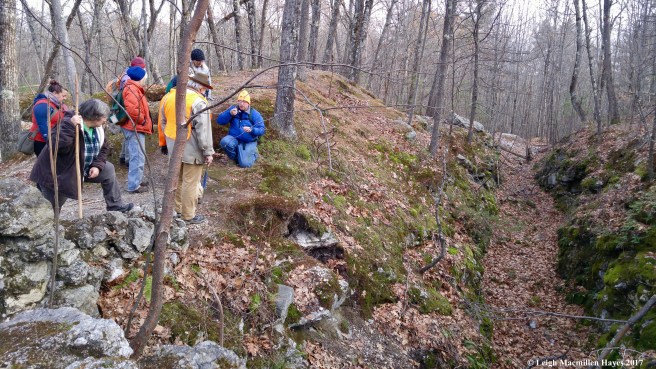
There were mosses to look at. Ferns to recognize. Lichens to question. And a trench that probably had been used to drain water back in the day.

a3-Dr Fred

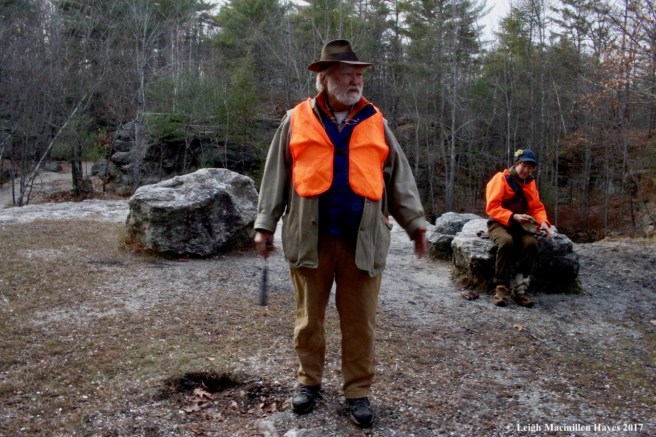
Just beyond the trench, the star of the show took over. Dr. Fred was in his element as he reviewed the geological history of this place.

a21

And when he talks, we listen.

a4- Greenlaw quarry 1

We had come upon the first of the quarries, where feldspar had been mined in the early 1900s for porcelain. But, as Fred explained, while mining the feldspar, rare and unusual minerals had been discovered including a phosphate mineral called apatite.

a6a-Maine Feldspar Quarry

From there, we circled down and around and looked across at the Maine Feldspar Quarry.

a6-Maine Feldspar quarry

We learned from Fred that the wall of the feldspar quarry was a demonstration of light-colored pegmatite just above the water, topped by gray metamorphic rock.

a8-basalt dyke

Next, we encountered a fractured wall of fine-grained basalt–an igneous vein that formed a dyke.

a9-basalt:iron

Basalt is fine-grained due to the molten rock cooling too quickly for large mineral crystals to grow. Typically, it’s gray to black in color with rust from iron oxidation.

a12-another quarry

From there we moved on to another quarry, where our attention was not so much focused on the rocks as on other things.

a13-squirrel cache

For deep within, we spied several red squirrel caches and dining tables. Later, we watched a chipmunk take advantage of the squirrel’s work. Minerals aren’t the only gems of choice at this place.

a14-labyrinth

As we made our way around to a quarry dump, we discovered a labyrinth that made its way around the pine trees. I followed it to the center–struck by the fact that we were examining rocks dating back to the Carboniferous period, and I was walking a path based on an ancient archetype dating back 4,000 years. Time. Worth a wonder.

a15-tourmaline 1

In the dump field, we scattered about looking for souvenirs and then paused at a boulder to examine its offerings.

a16-tourmaline crystal

On the back side, Fred pointed out several depressions where tourmaline crystals had been discovered and removed. We were awed.

a20-graphic granite

There was so much to see from milky and smoky quartz to feldspar, mica and garnet, but my favorite find was more graphic.

a17-graphic granite

Graphic granite–a pegmatite of igneous origin that splits in such a way to make it look as if stories have been expressed with a fountain pen. In this case, I was sure the story was about birds flying over mountains.

The quarries were our turn-around point. We had begun our adventure with plans to visit them quickly, then explore the outer trails of the park, but as we knew would happen, two and half hours later we’d only made our way to the quarries and it was time to head out because the sun was sinking.

That didn’t matter for happy were we to spend time exploring together and whetting our naturalist appetites at Mount Apatite.


Book of December: A Beginner’s Guide to RECOGNIZING TREES of the NORTHEAST

Fellow master naturalist Alan Seamans recently sent me an e-mail with this message: “I found a new book that might be of interest to you. It’s called A Beginner’s Guide to Recognizing Trees of the Northeast, by Mark Mikolas, published Oct. 3, 2017. Rather than leaves, buds or flowers, he focuses on bark, stature, habitat, and some other techniques to teach beginners how to recognize about 40 common tree species. It’s a compact softcover guide, very educational, lots of photos illustrating his points. Not text heavy. I like it, and learned many things.”

IMG_3897

Book of December

And so I did what I often do when I hear of a book that might interest me and marched into Bridgton Books in search of a copy. Alan was correct. It isn’t text heavy and indeed simplifies things in a way a dichotomous key cannot. Actually, this book includes so many of the nuances I like to share along the trail with folks who are looking at trees for the first or hundredth time and as I read it I felt like I was on a guided tour with a new friend.

Mikolas begins this tree identification book by restricting the focus area to the Northeast–in a zone those of us who live in New England may find amusing for it ranges from our grand states south to West Virginia and west to Indiana and Michigan. As he explains, though, that’s the Northeast as defined by the World Geographical Scheme of Recording Plant Distributions.

The book is divided into two sections–deciduous or broad-leaf trees and coniferous–or cone-bearing trees. And within each section, it’s broken down into individual trees with plenty of photographs to explain each characteristic.

Mikolas keeps it simple and I wish I’d had this book when I first began my journey into familiarizing myself with different tree species. Similar to the approach taken by Donald W. Stokes in A Guide to Nature in Winter, who suggested learning six deciduous trees and the evergreens, Mikolas also encourages the reader to start with the most common, though he prefers the number twelve.

I wondered what I might learn or relearn as I began reading. And found plenty of information, some of it already stored in my brain, and more to be tucked away.

s-target

The book begins with red maple, which always has something red to display, but Mikolas also mentions the target fungus that affects only this species, creating a round bull’s eye on the bark. I know from experience that once your eye focuses on the target, you’ll begin to see if on so many maple trees. And as he said, and a forester told me several years ago, here in western Maine, 90% of our maples are Acer rubrum. That’s one thing you don’t have to worry about, except for one instance that I could find, he doesn’t use the Latin names. For some folks, that may be a downfall, but this is a beginner’s guide.

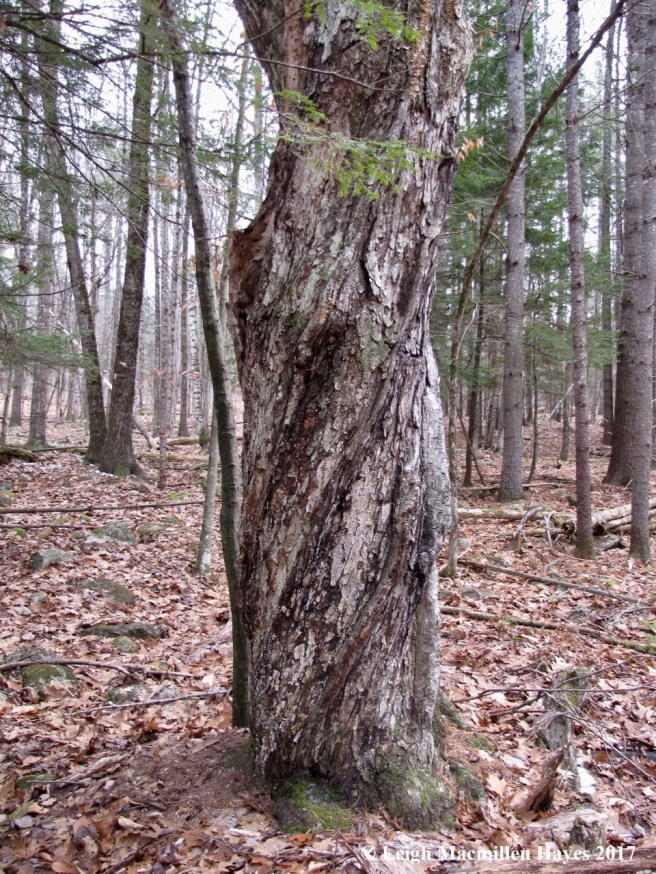
b-twisted maple

I was pleased that he included the twisting of a sugar maple. Other trees twist as well and I can remember first realizing this while tramping with a friend. We couldn’t understand what was going on. The reason for the spiral growth is on page 26–you’ll have to read it for yourself.

After describing these two trees, as he does periodically throughout the book, Mikolas gives clues on how to tell them apart. For these two, he describes their habitat, bark, twig and bud color.

m-beech sunshine

One of the clues he provides for beech trees is the fact that the leaves remain on the trees all winter. What I like about his comment is that he says this happens on young trees, for indeed, since I started paying attention, that’s what I’ve noted.

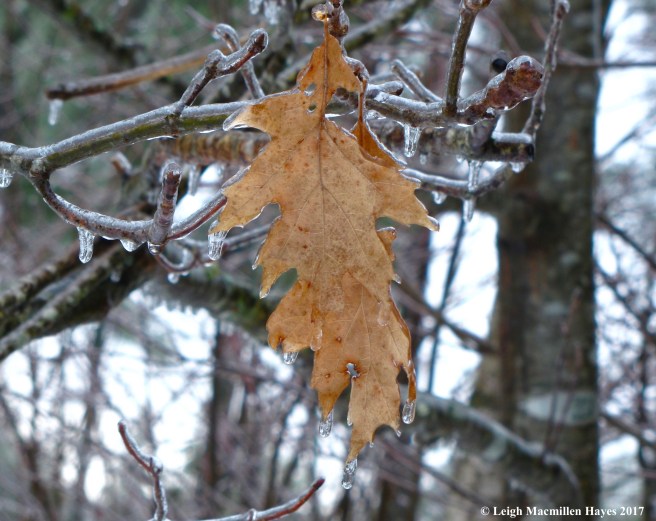
b-marcescent leaf

He also described the habit of oaks retaining their leaves, but what he didn’t mention was the term to describe this habit: marcescence or withering. Maybe I was disappointed because I just like to say marcescence.

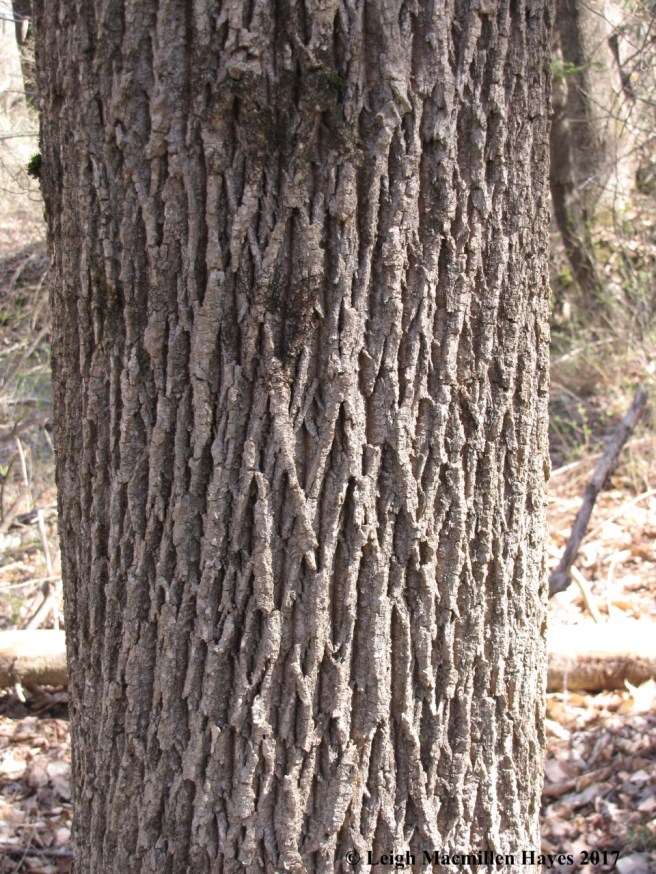
b-ash bark

When it came to ash trees, I was pleased that he described the bark as being diamond-shaped, but he added an X to the pattern and that may help when I next look at an ash tree with others. Some have a difficult time finding the diamonds. They don’t exactly glitter in the sunshine.

b-aspen bark

I was thankful that when it came to the quaking and big-toothed aspen trees, Mikolas acknowledged that they are difficult to identify by bark alone. A few years ago, I spent some time practicing my tree ID with two different foresters and when I asked about these trees, they too, had a difficult time pinpointing the differences. Both were sure we were looking at quaking, but a quick scan of the ground below showed us big-tooth leaves.

b-aspen 2

One thing I’d add to Mikolas’ description is that on the lower portion of older trees, the vertical lines are similar to that of a red oak. One of the really cool tricks I picked up from the book in reference to aspens is what he calls “birds on a wire.” Again, you’ll need to purchase a copy to find out what he means. Or join me for a tramp.

b-grandaddy birch

Another description that brought a smile to my face was how he casted a mature and shaggy yellow birch as “the granddads or old wise men of the forest.”

b-yellow birch

I had the good fortune to meet one such character just the other day.

b-basswood

In reference to basswood,  Alan Seamans wrote in his e-mail message: “I didn’t know you could confirm i.d. of basswoood by the sound it makes when you hit it with a stick!” I didn’t either, but you can bet that’s on my list of things to do–frequently.

b-paper-birch-old

Mikolas’ photo essay on the aging of paper birch bark from a teen to an old man is well worth a look. My only disagreement with him in this section is that what he sees as an inverted V over the branch, looks more like an inverted U to me, or as I’ve always described it–a fu manchu mustache of sorts.

b-gray birch

Likewise, Mikolas sees black triangles under the branches of gray birches. I could agree with him on that for when I say it’s a chevron, people don’t always get what I’m talking about. One friend, in keeping with the paper birch’s mustache, suggested the gray birch may have a beard–a gray beard. Mikolas also says that gray birches are chalkier than paper–experiment for yourself  by rubbing your fingers on the bark and come to your own conclusion on that one.

IMG_5301

Turning to striped maples, I was tickled to learn a new common name. He used goosefoot, which describes the leaf shape,  and moosewood because deer and moose like to leave their scent by rubbing their antlers on the bark, but a name I hadn’t heard before–whistle wood. Apparently, slip-bark whistles can be carved from striped maple or willow in the spring.

n-Central Park 1

I do wish I’d read this book before venturing to Central Park a few weeks ago. I was in awe of the American elms that grow there, and wondered about their health given that so many elms have succumbed to Dutch elm disease. What I didn’t realize is that what I saw before me was one of the largest and last stands of these majestic trees.

b-red pine plantation

Heading back into a woodland setting, and this one was actually in Vermont, occasionally we stumble upon red pine plantations. It was my understanding that these were planted by the CCC or Civilian Conservation Corps between 1938 and 1942 to provide farmers with a hill crop and others with employment. When walking in the woods and suddenly encountering a sterile environment where trees stand stalwart in lines and there is no undergrowth due to the thick needle cover below, and little diversity in wildlife, one may have entered such a plantation. At the time, it seemed like a good idea and provided work.

hemlock petioles (stems) and stomata lines

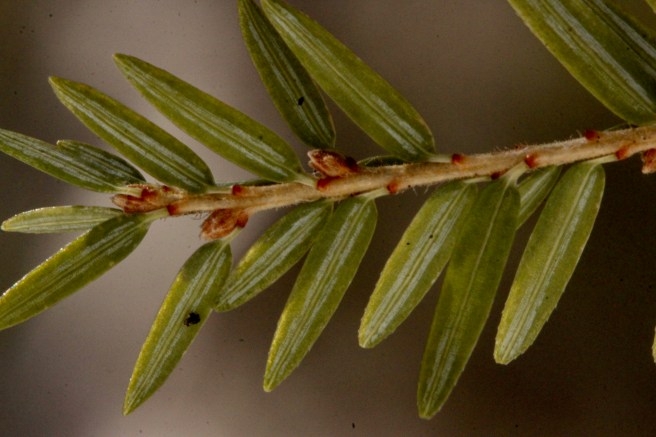
In the forest, I often discover hemlock and balsam fir saplings sharing a space. One word of caution when it comes to differentiating between the hemlock shown here and balsam fir needles that are shown on page 188–both have two white stripes of stomata on the underside. There are other clues to help tell them apart and I’ve actually written about such in the upcoming issue of Lake Living magazine so you’ll have to stay tuned.

spiky spruce

And then there are the spruces and I have to admit, I have a difficult time with red versus white, though forester friends have said they hybridize. I noticed that Mikolas mentions both, but doesn’t provide the fine details about scent and twig hair. Perhaps it’s enough to know it’s a spruce–especially if it’s spikey to the touch.

b9-tamarack gold

The tree descriptions conclude with the one and only deciduous conifer of our woods–the tamarack–the cone-bearing tree that loses its leaves (needles) each winter.

And with that, I will conclude this rather lengthy review. I’m so glad Alan recommended it to me, for it really is a gem. I hope you’ll purchase a copy and together we can head out on the tree trail and get to know our local species even better.

Put A BEGINNER’S GUIDE TO RECOGNIZING TREES OF THE NORTHEAST on your wish list and shop local.

A BEGINNER’S GUIDE TO RECOGNIZING TREES OF THE NORTHEAST, by Mark Mikolas, published 2017, The Countryman Press.

Post script, or maybe it should be post post. This comment appears on my About page, but I couldn’t resist including it here. I’m always tickled and honored when an author responds to one of my posts:

Thanks so much for the detailed and positive review of my book, A Beginner’s Guide to Recognizing Trees. It sounds like it would be great to take a hike with you. I really appreciate the good press. –mm

Liked by you

  1. Mark, Thank YOU so much for taking the time to read this and comment. I think A Beginner’s Guide to Recognizing Trees is a fabulous addition to my book shelf and back pack. In fact, I’m on the board of the Maine Master Naturalist Program and asked our curriculum coordinator to review it. If it doesn’t become one of our text books, it should at least be on our recommended reading list. Well done, indeed. Oh, and if you’re ever in western Maine–give a shout. LMH


Snow White Magic

Our first official snow storm of the season left us with about an inch of the white stuff that makes me rejoice. And upon waking this morning and peeking out the window, the sight of porcupine tracks looping around the yard brought a smile to my face.

m-porcupine trail 1

I love the first snow storm for even though I have seen signs of the critters that pass this way, their tracks confirm my convictions. Over the years, I’ve come to recognize the prints and trail patterns, but as the snow gets deeper the tracks sometimes become more difficult to decipher. This one was easy due to its pigeon-toed sashay.

m-porcupine prints

And then the individual prints, especially those that crossed the deck, showed the large foot pad and five toes with nails extended. A friend in Poland, Maine, sent me a couple of photos of the critter that crossed her deck this morning. She ID it herself, but wanted confirmation–for it was an opossum and a first for her.  I found my first opossum prints last December and wonder if I’ll have that opportunity again. Anything is possum-able.

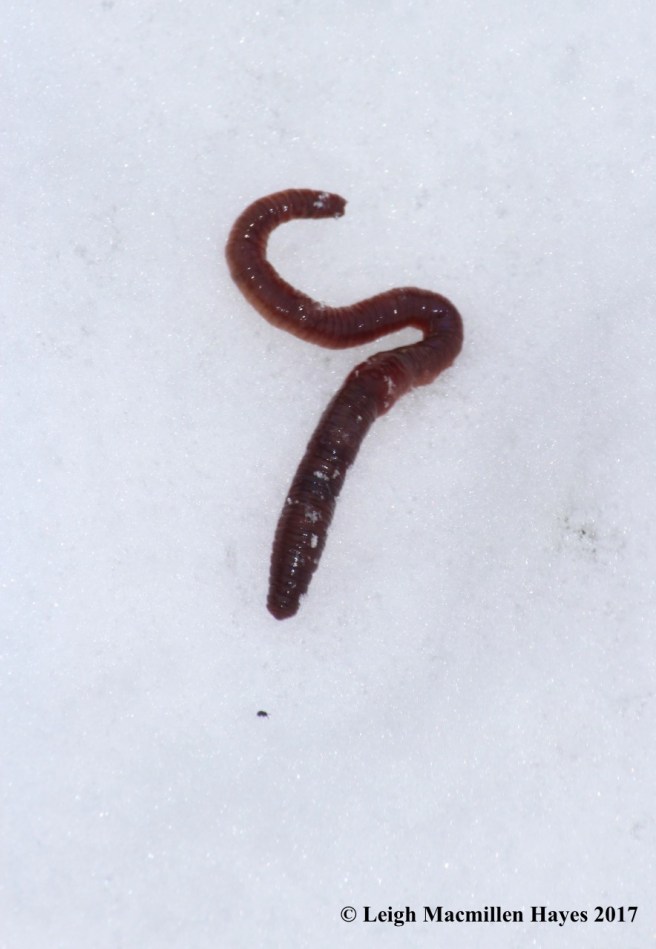
m-worm and junco prints

Since the porcupine had drawn me out (and I noted that it disappeared under the barn–of course), I decided to head off into the woods. But before I left the yard, I spotted junco tracks–and . . .

m-worm

a couple of worms–frozen upon the snow. Juncos don’t eat worms; they look for fallen seeds. And so it seemed that the bird flew off before quite reaching the C-shaped worm. And this other worm was about a foot away from the first worm. Robins were in the yard last week, and I can only hope that they returned today for a frozen dinner awaited.

m-snow art 2

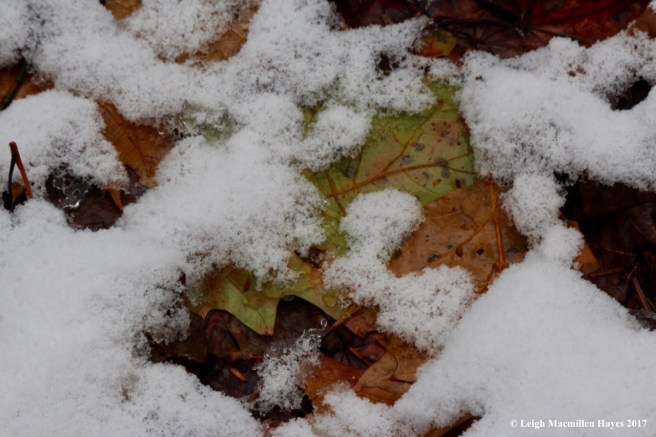
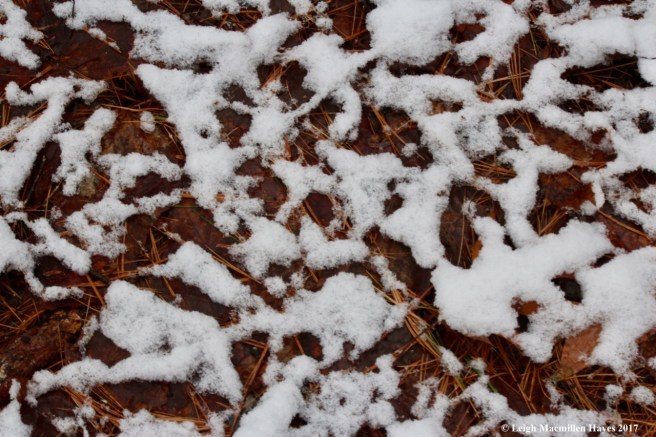
Into the woods I trudged, and the ever-changing colors and designs at my feet reminded me of works of art.

m-snow art 1

Some were palettes of mahoganies juxtaposed against white. A variety of textures gave the scene relief, much like an inlaid mosaic.

m-snow art intersections

Others embodied interconnections; a mingling of lines outlined for emphasis.

m-rock people

Along the cow path, I noticed the rock people for the first time, their mouths gaping open.

m-snow fleas

The minute snow fleas would hardly sustain them.

m-morning light

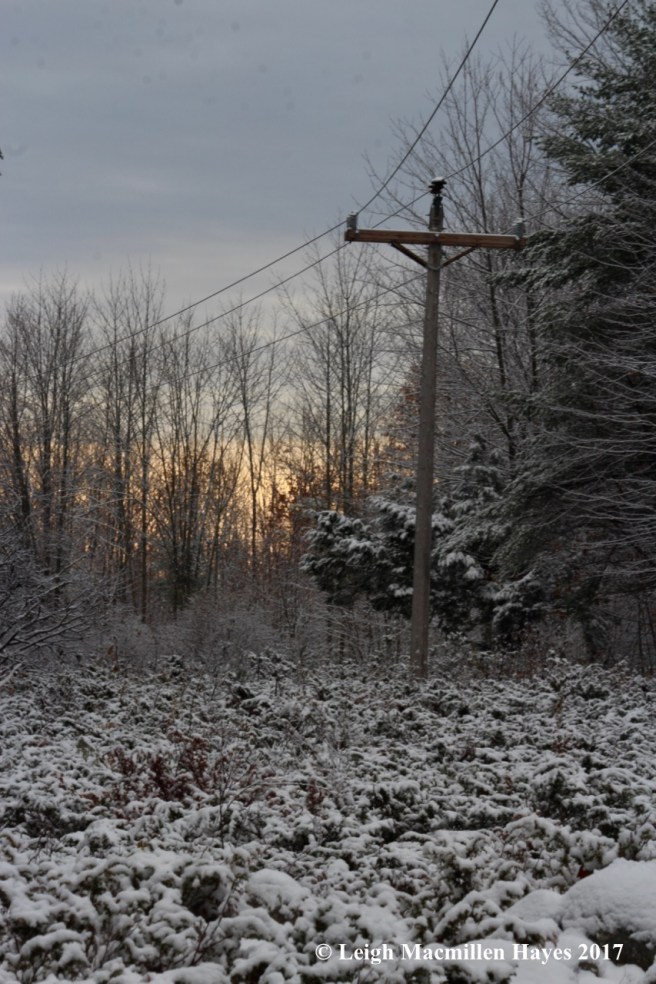
As it does, my trail crossed the line, where power seemed to originate with its source . . . the sun.

m-Mount Washington

And in the opposite direction, it flowed from pole to pole and onward . . . as if powering the mighty mountain.

m-pine sapling

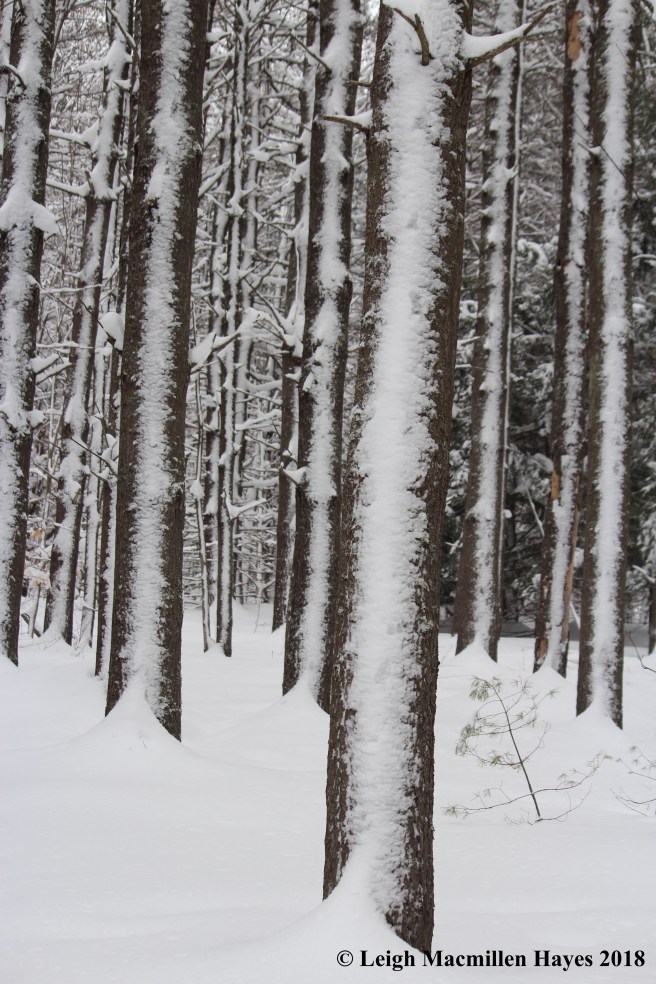
My journey continued into the land of the pines and their saplings, momentarily coated with decorative baubles.

m-mini oaks

And the red oak saplings I’ve been watching looked more festive than ever.

m-squirrel tracks

I was on a mission and soon found what I was looking for. Some tracks that looked like exclamation points led me to another source of sustenance that I wanted to check on.

m-squirrel cache growing

The red squirrel’s cache had grown taller in the past week, but . . .

m-squirrel dining room

many pine seeds had been consumed in the refectory. All that remained were scales and cobs to show a number of dinners consumed.

m-squirrel rocks

The dining hall extended beyond the reaches of the cache, for every table available was a table used.

m-squirrel dinner in the future

As I walked back toward home, I discovered another table awaiting a guest.

m-beech sunshine

I was almost home when I stood under a beech tree. As winter embraces me, I find that their marcescent leaves create their own golden glow and warm my soul.

m-British soldier

One more sweet peek offered a tiny touch of red to today’s fading winterscape–for the British soldier lichens’ red caps announced their minute presence.

m-snow drops

And then this afternoon, I joined a few friends for a gallivant across the Wild Willy Wilderness Trail beside Province Brook in South Chatham, New Hampshire. And the snowdrops created their own works of art announcing that the meltdown was on.

m-pinwheel 1

As we walked, we noticed delicate parasol-shaped fungi fruiting.

m-pinwheel gills

Their common name is Pinwheel Marasius, but in my mind the shape of the umbrella-like top above the wiry stem looked like a parasol and so I called it such. But to add to the confusion, I first called it carousel. Word association might get me there eventually, but it wasn’t until I looked it up in Lawrence Millman’s Fascinating Fungi of New England, that I realized my confusion. One of the fun facts from Millman is worth quoting: “Resurrection! Shriveled and inconspicuous, Marasmius species are rarely noticed during dry weather, but after rainy periods the tiny fungi revive–hence the nickname ‘resurrection fungi.'” And if not rain, then snow will make them rise again!

m-liverwort magic 1

The water from the melting snow highlighted other lifeforms along the Wild Willy Wilderness Trail. Bazzania liverwort grew abundantly, but one in particular gave us pause . . .  for it glowed. And no matter what position we stood in to look at this worm-like beauty, it continued to glow as if it had a golden halo surrounding it. We had no answers–only questions and wonder.

m-glue fungi

Another find that had been marked with tape, for it too was special–a broken branch attached to a young tree. I’m stepping out on a limb here–pun intended, but I believe this was an example of a glue crust fungus that glues twigs together. Seriously? Yes.

m-Bob, Janet and Pam

It was getting dark when we finally found our way to Province Brook and marveled at the water and ice forms. It was also getting close to the moment when we’d need to say, “See you later,” to Bob and Pam, for they’ll be heading to warmer climes soon. But we know they’ll be back for a winter adventure and then before we know it, spring will be here. And then, we hope the brook will be full with spring run-off from all the snow that is in our future. Until then, see you later we also said to much of the snow for it had almost disappeared.

m-ice works 1

But the ice art will continue to grow.

m-Province Brook 1

And the snow white magic will capture our minds again . . . one flake at a time. And with it, the wonders of the world will continue to be revealed.


Through Younger Eyes

Zigzagging through the woods, my young friends find wonder in every moment. They embrace their discoveries–often with exclamations and excitement. Following the blazed trail is not in their blood, for they know that some of the coolest finds are off trail, where the fungi aren’t trampled and mammal signs not obliterated.

w-striped ledge

And so it was that this past week, I had the honor of spending lots of time exploring with them. First, on Tuesday, our Greater Lovell Land Trust docent tramp found us atop the “striped ledge” beside Keewaydin Lake in Stoneham, Maine. One of our docents, Mary, had obtained landowner permission for this grand adventure. From the Maine Geological Survey: “The dikes cutting the granite trend generally from southwest to northeast. They most likely intruded the host rock during the Jurassic period, when continental rifting caused extensive fracturing of New England’s bedrock (McHone 1992). Basaltic magma intruded these cracks, and cooled and solidified to form dikes such as those seen in Striped Ledge. Close examination of the ledge shows a complex intrusion history at this locality Some of the dikes have layering parallel to their walls, which may have resulted from several pulses of magma into the fractures and/or chilling of the dike margins in contact with cooler host rock . . . the dikes locally cross one another, with the older dikes being offset where they are torn apart by the younger ones.” How cool is that?

w-smiling for rosy quartz

Darn cool, especially when rose quartz was among the great finds.

w-rock hounds

And in that instant, a few rock hounds were initiated.

w-turning two twigs into a fish

When not looking at rocks, a couple of broken twigs on the ledge became a fish in one moment, and hotdog tongs in another–ever versatile were they.

w-eyeing a flower in rock tripe

But it wasn’t the ledge alone that drew their attention. When we stopped to admire rock tripe growing atop a boulder, it was the eye of the youth that discovered the green “flower” at the center.

w-Sucker Brook 2

And then the next morning, which dawned even colder than the previous, I joined the same family for a pre-hike at the GLLT’s Wilson Wing Moose Pond Bog Preserve as we prepared for a public hike. The trail meanders beside Sucker Brook, and we, too, meandered.

w-dipping into the cold for a Pooh stick

Pooh sticks were launched periodically and sometimes had to be dislodged.

w-wondering about foam

There were bubbles to watch in the brook and the foam formed to hypothesize about.

w-stump art

Nature’s artistic designs were viewed with awe.

w-pointing to hobblebush

The intention was to find a few of their favorite things. They found a few hundred and  . . .

w-seesaw

had lots of fun along the way.

w-exploring the stream

All the way along, the water, moss-covered rocks and sticks became part of their playground. But really, they also noted a variety of fungi, including their favorite green stain, which was in fruit,  a tree that had brought distress this summer for it housed honeybees and they learned that the hard way, great sliding spots from which to practice being river otters, the sunlight glittering on Moose Pond Bog and Indian pipes in their capsule form. There were sapsucker holes, pileated woodpecker activity, birch polypores, and even a surprise. They couldn’t wait for the public hike to show off their discoveries.

l-measuring diameter 4

That same afternoon, District Forester Shane Duigan, joined our GLLT after-school program at New Suncook School in Lovell. The Trailblazers, as the group is known, first introduced Shane to their trees. And then he showed us some of the tools stored in his vest, such as the tape measure used to determine diameter.

w-learning how to age a tree

As the kids made guesses about a tree’s age, Shane demonstrated how foresters use an increment borer to extract a small core from a tree.

l-counting rings on tree core

They crowded in to watch him count its rings. The predicted age: 100. The actual age: 50. The fun: 100%.

w-Horseshoe Pond

And then this morning dawned, colder than our previous outings and the wind created white caps on Horseshoe Pond below the kiosk for the Wilson Wing Moose Pond Bog Preserve. It was time for our public walk to enjoy the wonders of Wilson Wing.

w-ice 1

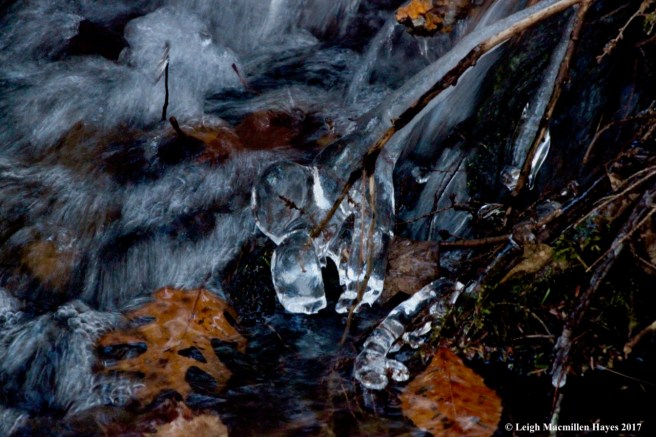
One of the biggest surprises were the icicles that had formed on Sucker Brook since our last visit on Wednesday morning.

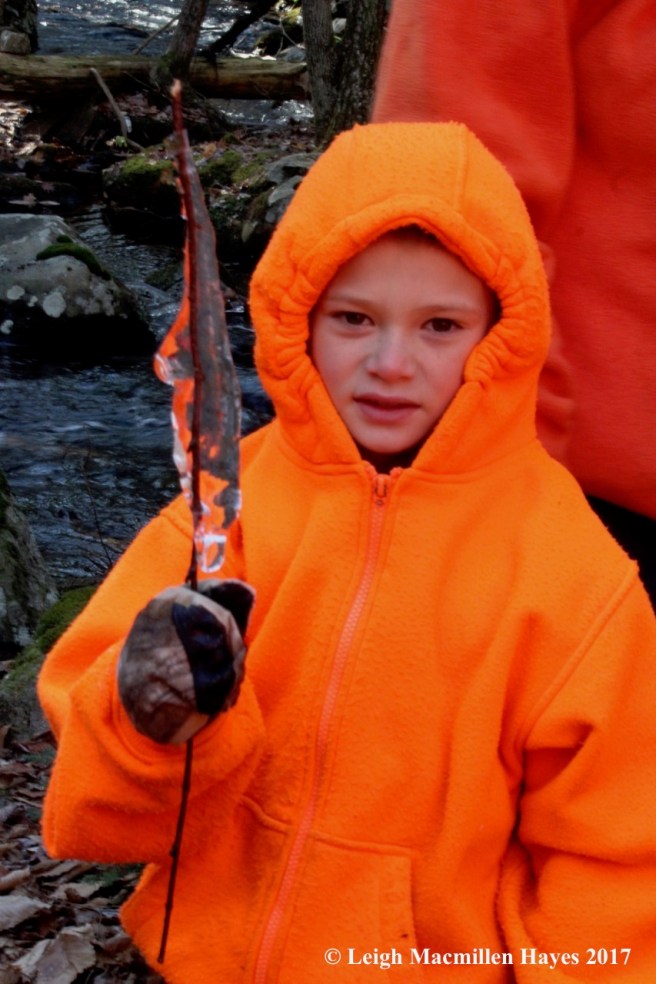
w-carrot-shaped icycle

And because they are kids, they couldn’t resist gathering such to admire up close. This one looked like a carrot, and actually appeared so as it reflected the blaze orange–our color of the season.

w-ice 2

The kids realized that the icicles formed upon all types of vegetation and created their own interesting shapes worth celebrating.

w-ice 3

One even looked like a flag blowing in the breeze when turned upright, and this guy showed it to his mom in honor of her service in the Army and the fact that today is Veterans Day. Turned on its side, it became a maze game and he really wanted to place a small ball in it and watch the ball move through. And as much as he wanted to take it home, it has to live on in his mind’s eye and this photograph.

w-wondering about the car

They showed us so many things of nature, and even the unnatural, though they imagined all the critters for which the old blue car might create a fine home–squirrels, weasels, porucpines, foxes, and coyotes were on their list. And then they turned into otters themselves and slide back down the hill over and over again.

w-polypody 1

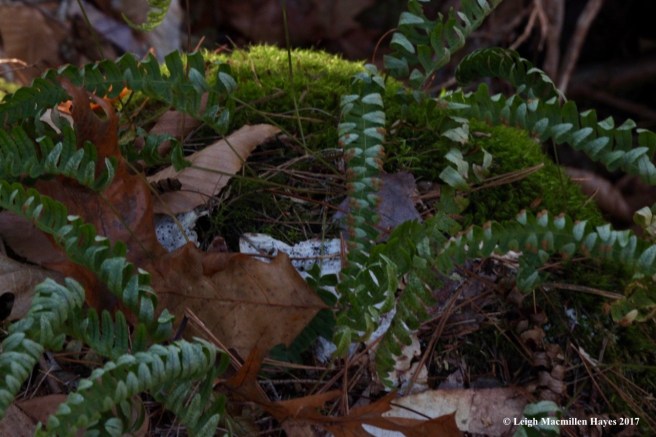
They wanted to share some other great finds, including a few squirrel dining tables and a rock with bad hair day, but the crowd had gotten ahead of them. Despite that, they looked at the “bad hair day” fern, aka polypody, and realized that it had curled in since Wednesday’s visit. And then they figured out that the fern curls when it gets cold. Who knew you could use a fern to determine the temperature?

w1-artist conks

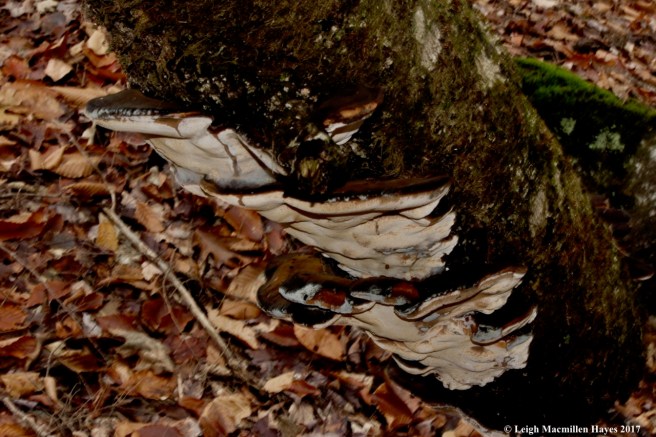
Though they didn’t get to share all of their finds this morning, they did make some new discoveries as they wandered off trail, like the artists conks that grew in abundance.

w1-dead man's fingers

And deadman fingers fungi that reminded one of them of scat standing upright. I’ve a feeling that description will stay with me each time I look at it going forward.

w-bear hair 1

In what seemed like no time, for we traveled the trail much faster than intended, we were back on Horseshoe Pond Road and one among us was particularly excited about a certain display upon pole 13. She ran ahead to be able to show all the participants as they passed by.

w-bear hair on pole 13

It was bear hair and scratch marks that she shared with enthusiasm. And the knowledge that we are not alone in these woods.

And just after that one of her brothers realized our walk was almost over and he was disappointed for so much fun had he had being a junior docent.

w-Sarah signing my book

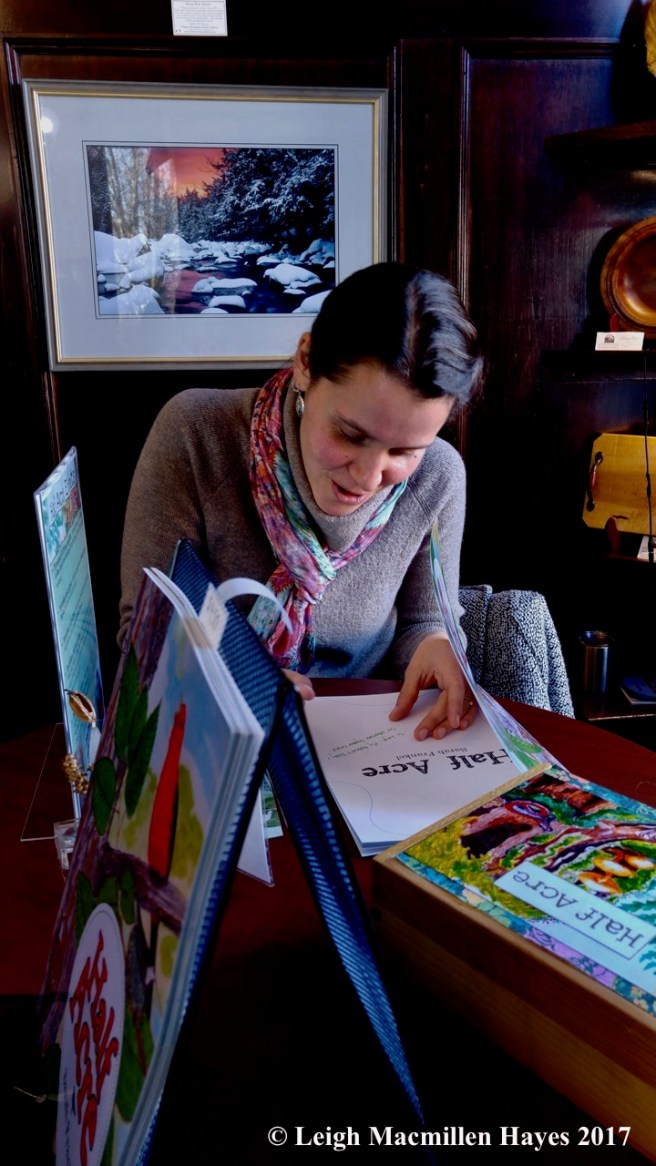
A few hours later, my guy and I ventured to The Met Coffee House and Gallery in North Conway to meet up with another who encourages children and their adults to explore the outdoors. It was our great joy to join my dear friend, Sarah Frankel, for the first book signing event as she celebrated the publishing of Half Acre.

w-posing by an uprooted tree

And now it’s the end of the day and the end of the week, and I’m a better person because of the time I’ve spent with young friends as they’ve moved quickly at times and then stopped to wonder. They taught me the joy of looking with open minds.

If you don’t have kids to learn with and from, may you find time to channel your inner child and look at the world through younger eyes.


Book of November: Half Acre

I am so tickled for my friend and fellow naturalist, Sarah Frankel, who recently published her first book.

IMG_1906

Half Acre is a children’s book both written and illustrated by this talented young lady.

In rhyming fashion, she takes the younger set outdoors to explore her yard, which is a half acre in size. The size, however, is not important because Sarah knows how to look and to wonder. Or maybe in this case, it is important, because she wants others to realize that there are great things to find on their own small plot of land.

And now she and her husband are teaching their young daughter to do the same. Her hope is that the book will encourage others to step outside and notice as well.

In thirty-four pages, Half Acre explores the yard in all seasons and at different times of day. As much as I enjoyed the rhymes, I especially loved the paintings–of birds and leaves, flowers and bees, butterflies and trees, moss and ferns, night sky and nocturnal visitors, and so much more. Can you find the frozen tree frog? You’ll have to buy the book and look for it.

My favorite painting is the last one–with her house in middle, surrounded by snippets from each of the other paintings, like a sugar maple leaf floating in midair. There’s more to this painting though, for Sarah takes the reader through the four seasons at the house–in 8 x 6-inches, she begins with winter on the left and every two inches the season changes,  ending with autumn on the right. I wish I could share that with you, but you’ll just have to trust me and purchase the book. Of course, she used the same scene to introduce her half acre of land, but it really stands out in the final mural framed by small portions of all the other paintings.

IMG_1904

Since I’m on the topic of Sarah, though this isn’t a book, I was the recipient of one of her paintings. For the past four years, it has leaned against the wall on a counter in the butler’s pantry and makes me think of both Sarah and Mom.

Of Sarah because she knows winter is my favorite time of year and she included tracks in the snow, a starry night, full moon and a shooting star. When I was a Maine Master  Naturalist student, Sarah was a mentor. At that time, though she lived in Conway, NH, she worked at Lakes Environmental Association as the Education Director. And so, we’d drive to and from class at Bates College in Lewiston together. On our way home one night, we saw a shooting star. And many times we tramped together on snowshoes, following mammal tracks. I have to share one more fond memory–the spring night that it rained and we tried to dodge the frogs and salamanders as we drove home. Finally, we got out a few times and helped the sallies cross the road. We were tired from class, and it was a long drive home that night, but by helping a few, we forgave ourselves for the ones we’d smooshed.

Of Mom, because Sarah gave me the painting after my mother died at the end of January during the year I was taking the course–I’m forever honored by Sarah’s thoughtfulness.

Interested in purchasing the book and meeting Sarah? She’s got some book events coming up in the North Conway, New Hampshire area:

November 11th from 11am-3pm – A book signing at The Met Coffee House and Gallery during the Bring A Friend Shopping weekend.

December 2nd at 3pm – A book signing event at White Birch Books, the best book store around!

December 7th from 6-8pm – A book signing at the Adults Only Shopping Night at The Toy Chest. Shop for the holidays, get a copy of Half Acre signed for your little ones and pick your own discount on the way out.

December 9th at 10am – Read aloud, book signing and outdoor exploration at the Conway Public Library. What creatures can we find in the gardens and lawn of the Conway Public Library? Come and see for yourself!

I can’t wait to attend one of these, give her a hug, and ask her to sign my copy. And I may have to steal a kid to attend the outdoor exploration at the Conway Public Library.

Is there a young’un in your life? Then I think Half Acre should finds its way onto their book shelf.

Half Acre, written and illustrated by Sarah Frankel, LifeRich Publishing, 2017. And available at www.liferichpublishing.com, or a local independent bookstore.

Power-filled Mondate

It may not have been a hurricane, but the storm that began as Philippe, left its mark as it whooshed through New England. Along its path, the world darkened. We lost power about 1am, but it was restored by the time we awoke this morning. And yet, many may be without electricity for days.

Our tentative plan had been to hike, but we realized last night that we’d need to consider Plan B. And when the sun shone this morning, we were rather oblivious to the havoc caused by downed trees and flooding. We did check the weather report, however, and saw that there would be a few showers and the wind would continue to blow. So, Plan B it was–yard work between rain drops.

For my guy, that began with work on the back screen door for a bang we’d heard in the night turned out not to be the grill or furniture sliding off the deck, but rather the door banging against a bench. And after that, it wouldn’t shut properly.

o2-bee on lavendar

While he worked on the door, I headed into the kitchen/cottage garden, which had become quite overgrown due to my lack of a green thumb. While my intention was to put the garden to bed, some flowers like the lavender needed to remain for they still invited visitors.

o3-spring tails

As I poked about, cutting some plants back, I made a few discoveries, including the sight of snow fleas or spring tails climbing a stalk.

o1-bird nest fungi 1

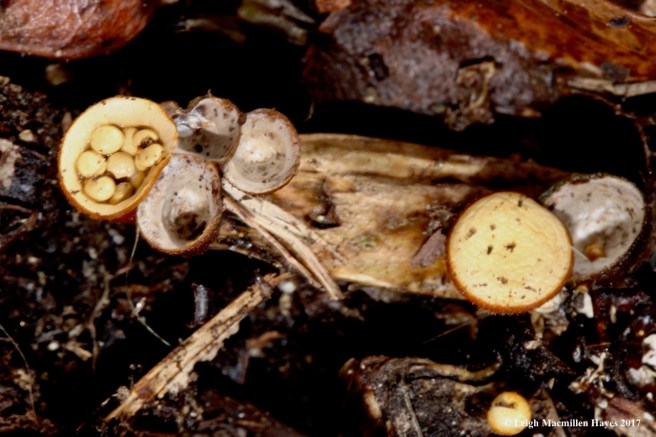
And buried beneath, I unearthed bird’s nest fungus, which look like such for which they were named, only in miniature form for they are no more than a quarter inch in height or diameter. Nestled inside the nests, like a bunch of eggs in a basket, are the fruiting bodies that await drops of water in order for their spores to spring out and find their own substrate on which to grow.

o5-beebalms last bloom

And then I approached the beebalm, where a few blossoms still bloomed on this late date.

o4-meadowhawk 1 on bee balm

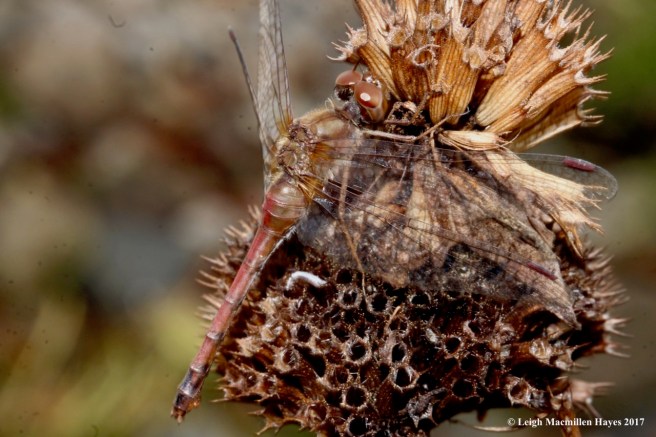
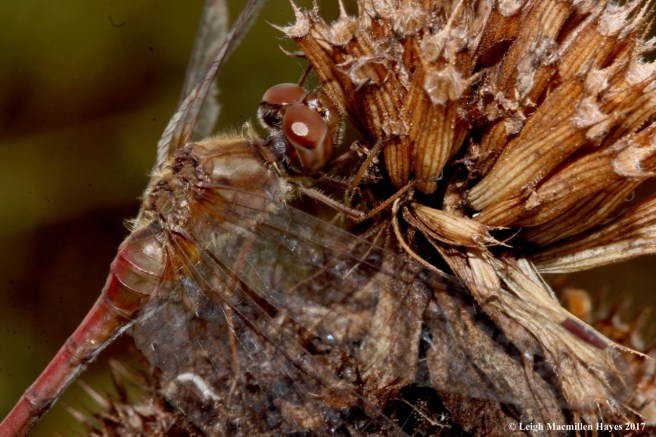
Most of the beebalm had long since gone to seed, and today one structure became a resting spot as the wind blew. A male autumn meadowhawk seemed to hold on for dear life.

o6-meadowhawk 2

Of course, I took advantage of his moments of rest to take a closer look at the divine body structure . . .

o7-meadowhawk 3

from a variety of viewpoints.

o8-meadowhawk 4

Gender determination is based on the terminal appendages. Male dragonflies have three, known as claspers, which they use to grasp and hold a female during mating. The upper or from this view, outer appendages, are called cerci, while the lower, or middle appendage, is the epiproct–meaning its the appendage situated above the anus. Females have only a pair of cerci, and I’m not sure of their purpose. That beebalm still stands–in hopes he’ll return again.

o9-quaking aspen buds and leaf scars

As I continued to work and observe the world around me, my guy found one project after another to complete–each of which required a trip to the hardware store. Hmmmm. And so, I too, decided to go for a trip–into the woods. Donning my blaze orange vest and hat, and knowing that I wasn’t going far, I took off. My first stop was at a branch below the quaking aspen that had fallen in the night. Though it had reached its end of life, the waxy bud scales and leaf scars were a sight to behold. The smiley-face leaf scar showed where the stem or petiole of this past year’s leaf broke from the branch. As the leaf pulled away, it severed the vessels through which water and food moved. The dots within the scar indicate where those vessels had been connected and are known as bundle scars.
o10-pathway in woodlot

In our woodlot, my trail was littered with pine cones and branches, but that was the extent of tree damage.

o13-selfie

I found puddles that invited me in.

o11-jelly ears

Some branches, decorated with a variety of lichens and jelly ear fungi also found their way to the puddles.

o12a-vernal pool

At last, I reached the vernal pool and was surprised to find it only partially filled.

o12-vernal pool leaves

Atop and within it, the mosaic of broad leaves and needles formed a tapestry of shape and color–in the moment.

014-goldenrod bunch gall 1

Nearby, I paused by a goldenrod that sported a bunch, rosette, or flower gall, for really, it resembles all three.

o15-goldenrod bunch gall 2

The Goldenrod Gall Midge, which is a tiny fly, laid an egg in a leaf bud, hatched into grub form, and prevented the stem from growing, though the plant continued to produce leaves that formed a tight cluster.

o16-maple samara between milkweed pods

I finally made my way home, and turned to other gardens on the eastern side of the house, where milkweed pods also needed to remain standing. I even left the sugar maple samara because I thought it was a fun place to land.

o-17-aphids on milkweed

Also at home on the milkweed were a hundred aphids all clustered together.

020-monarch chrisalys

But the best find of all–the delicate remains of a monarch butterfly chrysalis. I had no idea it was there, but presume it housed one of the monarchs that consumed my attention a few weeks ago.

Just after we headed in, my sister-in-law called to say her sump pump had conked out. Off my guy went again.

It wasn’t the hike date we’d hoped for, but our day was filled with power tools and powerful insects and power-filled love.


Book of October: The Secrets of Wildflowers

It hardly seems right to be choosing a book about wildflowers as the book of the month for October, but . . . I have. And for so many reasons. Therefore, the book of October is The Secrets of Wildflowers: A Delightful Feast of Little-Known Facts, Folklore, and History  by Jack Sanders.

1019171344a (1)

First and foremost, there’s the cover! I know . . . I shouldn’t judge a book by its cover. But . . . I do. And this one appeals to my sense of color. My eyes are soothed by it, and therefore, so is my brain, and I find it a lovely addition to my summer kitchen office or the upstairs library (aka bathroom).

Then there’s the subtitle: “A Delightful Feast of Little-Known Facts, Folklore, and History.” And it is . . . a delightful feast, for its varied in format, offering prose and poetry, stories, descriptions, comparisons, suggestions, and a vast variety of tidbits during this time of harvest.

On the introductory page, Sanders writes, “The Secrets of Wildflowers covers natives and immigrants, friends and foes, because both kinds are here and both are interesting.” Oh my . . . isn’t that enough to make if perfect for right here and now. And I don’t mean just flowers.

The book is divided into three sections, based on approximate blooming seasons, (bringing me to another reason to choose such a book for October–it seems our growing season has extended and my day lilies have new leaves. That’s scary.), beginning with a section on spring, then summer, followed by late summer & fall. Within each section, several pages are devoted to a particular flower, including photographs and sketches–and oh, so much information. The only drawback that I can see, is the fact that I can’t see–the type is a wee bit small, perhaps because Sanders had so much to share and the book is already quite lengthy at 304 pages.

The book concludes with a two-page list of websites, a brief glossary and an extensive bibliography.

And so, as the October breezes send leaves dancing off the trees and the color begins to wane from the landscape, despite the small type, I find myself drawn to this treasure trove of information. I can pick it up and read a short section, while in the “library,” or spend an hour focusing on one plant while drinking a cup of tea in my office. I can skip around from season to season and not feel out of place. In the midst of it all, my hope it that I’ll retain some of what Sanders shares and I, too, can share when I lead future walks–adding to the story and helping others make connections.

With all of that in mind, I think The Secrets of Wildflowers is the perfect October book, for now that I own a copy, I have the rest of fall, on into winter, and next spring to devour this delightful feast. You might think the same and add it to your Christmas list. (Along with a magnifying glass–just in case).

Oh, and it was published in Guilford, Connecticut, next to my hometown–so that, of course, makes it special.

I found my copy on the shelves at Bridgton Books.

Book of October: The Secrets of Wildflowers: A Delightful Feast of Little-Known Facts, Folklore, and History by Jack Sanders. Lyons Press, Guilford, CT, 2014.


Belated Book of September: Butterflies and Moths

All month long books have been staring at me from their shelves, piles or baskets, a few begging for the honors. But each time I thought I knew which book I’d feature for September, a different month made a claim on it.

b-monarch 1

And then, mid-morning, I looked out the kitchen window and saw a certain visitor nectaring at the flowering mint and instantly knew what book it would be.

b-cover

Bufferflies and Moths by Dr. Walter Robert Corti is an oldie but goodie that has graced my personal library since 1964. I don’t remember its origin, but think it may have been a birthday or Christmas present when I was in second grade–such was my wonder even then.

On the back, The Odyssey Library is described as “a new and exciting concept in book publishing, combining in convenient, compact format, texts by leading authorities and full-color illustrations by outstanding artists and photographers. Designed for the reader who wants to add a new dimension to his [or her] understanding of the world, these are books to enjoy, to study, to treasure.” Indeed, I’ve treasured it for over fifty years and referred to it often.

b-monarchs and others

Today found me examining the differences between “look-alikes” because I wanted to make sure that what was fluttering about the garden wasn’t a Viceroy.  They do look similar, but the Viceroy is smaller than a Monarch and its hind wings have a line that runs parallel to the outer margin. There are other differences, but that was enough for me to note. Another thing to note: the illustrations in this book were by Swiss artist Walter Linsenmaier.

b-monarch 2

No such line existed on this morning’s beauty.

b-monarch map

Though the author states that in September, “large flocks” of Monarchs gather to fly south, and that was once the case, at least in my backyard it’s no longer true. This is only the second one I’ve seen this year, the first being in a field yesterday and it didn’t light long enough for me to snap a photo. In the past few years, I don’t recall seeing any. But . . . when our twenty-something sons were the age I was when I received this book, we did have large flocks that completely covered some flowering plants and shrubs.

b-monarch probiscus 2

Outdated though the book may be, some things haven’t changed. The order is still Lepidoptera, so named for the scales on their wings; lepis being Greek for “scale,” and pteron for “wing.”

b-monarch probiscus 1

Some cool features include the tongue or proboscis–can you see the coiled dark tube below the antennae? Once you find it, return in your brain to your sixth birthday party (if you had one–my next-door-neighbors, Pat and Kate always came for my birthday dinners, but we never had parties) and the blowouts that were curled until you blew into them and made noise.

b-monarch 6

The same thing happens with the proboscis (though it lacks a sound effect), which is actually two half tubes joined to form one, and includes muscles, nerves and the trachea, as it straightens out and penetrates the far reaches of flowers in search of nectar to suck.

b-monarch eyes

The book also mentions the faceted eyes–each compound and consisting of up to 17,000 “ommatidia,” or  individual light receptors with their own microscopic lenses. Think about what the world around them looks like. How in the world do they hone in on their targeted plants? They have their ways. Read on.

b-painted lady 2a

Prior to seeing today’s Monarch, I’d been blessed with many opportunities to observe Painted Ladies, which share similar colorings to a Monarch, though the pattern differs.

b-painted lady map

Dr. Corti describes their migration pattern, but mentions with all that migrate, it could be that it’s a second or third generation that actually completes a given journey.

b-painted lady 3

The outer wing coloration is what always reminds me that I’m looking at a Painted Lady and not a Monarch.

b-painted lady 1

One thing I’ve observed about the butterflies that I watch–nectaring can happen whether one is right-side up or upside-down. The straw works from any approach.

b-painted lady 2

The club-shaped antenna, common features of butterflies, are angled and work like radar to detect scents. And I mentioned the palpi, which are quite visible here as they are the small projections that protrude from the front of the head. These are covered with scent-detecting sensors as well. And actually, more sensors are located on the thorax, abdomen and legs. That’s how the butterflies find their sources of nourishment.

b-painted lady 5

One of the things I noted about the Painted Ladies that have graced my path lately is that they flit from flower to flower in constant motion . . .

b-painted lady 9

and seek goodness . . .

b-painted lady 10

from a variety of benefactors. I know Monarchs do the same, but today the one I watched much preferred the mint.

b-fritillary 1

An early season butterfly that some may confuse with the Monarch is the Fritillary.

b-fritillary 2

While its coloration is similar,

b-fritillary probiscus

its much smaller in size.

b-clouded sulphur 1

Most butterflies feed with their wings pulled together, such as this clouded sulphur portrayed. I love the subtle blend of pink, yellow and green in this beauty, and especially the yellow-green eyes.

b-white admiral 1

Early on in the summer, white admirals flew about.

b-white admiral 2

Occasionally one posed. Noticed its tattered hind wings. Such is the life of a butterfly.

b-Canada tiger swallowtail 1

We admire them for their beauty and they suffer for it–becoming easy prey. But until they succumb, they spend their days seeking sustenance. And bringing us joy.

As Dr Corti states, “The enchanting colors of their wings, their intimate commerce with quiet flowers, their modest food needs, the innocence of their courtships make them seem like fairy creatures from some unspoiled paradise. They are a delight to curious children, harmless idlers, contented topers, and strolling lovers wherever they appear. It is as if they were created solely to make the world more beautiful.”

Weren’t they?

I know there are updated butterfly guides, but I still love my first.

Butterflies and Moths, by Dr. Walter Robert Corti, The Odyessey Press, New York, 1964.


Falling Toward Autumn

It’s another nine days until the autumnal equinox, that time of year when the shift from sultry summer weather gives way to the crispness we all love about fall. But . . .  over the past few weeks we’ve been on the cusp. Warm days, some a little less warm than others, and cool nights, some a wee bit cooler. And with the change in temp comes a change in coloration of the world around us.

o-morning view 4

And so this morning as Marita and I approached Overset Mountain in Greenwood, our fancy was tickled by the tapestry reflected on Hicks Pond.

o-boulder in river

At last we reached the trailhead we were seeking, and first hiked beside Sanborn River, where the flow of the water added a voice to the display.

o-jack in pulpit fruit

On one small rocky outgrowth I spied something red and we quickly realized it was a lonely jack-in-the-pulpit in fruit form.

o-following marita

After a little more than a mile, the trail we chose to climb Overset Mountain turned right, away from the river and soon we passed under a power line, where energy hummed in a manner we couldn’t hear above. From our waists to our feet, however, the pollinators buzzed.

o-aster gone to seed

While many flowers were still in full bloom, a few, like this aster, were ready to send their young forth on individual parachutes.

o-Indian cucumber 2

Others also shared their colorful youth-filled fruits, including Indian cucumber root,

o-hobblebush

hobblebush,

o-bluebead lily

blue bead lily,

o-witherod berries

witherod,

o-maple-leaf viburnum

and maple-leaf viburnum.

o-overset pond and mountain

At last we reached Overset Pond, its water as calm as could be while it clearly reflected the sky and mountain we were soon to climb. Here and there, touches of color peeked out among so much green.

o-overset cliff

As we circled the pond, our voices echoed off the cliff above–our destination. We were going to climb up the rock face . . .

o-marita just before summit

but decided we’d take our time and hike up the trail instead. (And if you believe we would have attempted that cliff, think again.) We’d describe the hike as a moderate climb to the summit. The terrain changed with the natural communities, so while we’d been on soft duff beside the river, we encountered some granite, including steps, on our skyward leg of the journey.

o-approaching the summit

About an hour and a half after starting, we reached the view point, where lunch was served–BYOB style, of course.

o-Noyes Mountain

To our left, we recalled a recent climb up Noyes Mountain.

o-tapestry begins

To the right, a colorful tapestry that changes daily.

o-heart-shaped overset pond1

And below us, Overset Pond, which appeared heart-shaped from this vantage point.

After lunch, we continued on the loop trail, paying attention for a ground nest we’d been forewarned about. Thankfully, we spied it before the bees spied us and were able to bushwhack around to avoid being stung. We continued on and finished up the mountain hike, then decided to also follow the Sanborn River Loop, thus covering about seven miles by the time we were done.

o-blood milkwort

And near where we’d parked I spotted some flowers I met for the first time the other day–purple milkwort. It’s always that way–meet something for the first time and then realize it’s everywhere. In this setting the milkwort added its own variation to the start of the fall tapestry.

I love all seasons and the in-betweens as well. That being said, it’s always hard to give one up for the next. But I guess that’s the job of the in-betweens–to help us transition. Right now, I’m falling toward autumn.


Artful Eclipse Mondate

Because they are so gracious, when I recently begged Faith and Ben Hall for an opportunity to follow them on a trail through the Perley Mills Community Forest, they not only invited us to walk, but planned out an intinerary, pre-hiked the trail, made chicken noodle soup for lunch and took us for a boat ride. All of this before the great solar eclipse of 2017.

h-perley pond beaver dam?

After taking a tour of their neighborhood, Faith dropped Ben, my guy, and me off to begin our first bushwhack beside Perley Pond. In a few minutes, we came upon an earthen structure and I couldn’t help but wonder if it was an old beaver dam.

h-perley pond

We were at the base of the pond and perhaps just as those who dammed it up for their mill sites, the beavers had their own intentions. Of course, I could be totally off and it could have been manmade, but such was the formation and growth above, that I’m sticking with my original thought.

h-sawdust pile

Moments later, we emerged into a clearing and grabbed handfuls of fine saw dust, letting it sift through our fingers as it slowly drifted back to the ground. Occasionally, on our tramps through the woods, we’ve encountered such mounds and have been amazed that they still exist with little vegetation.

h-mill site approach

The mound bespoke the reason for the mill up ahead. (Notice the stream beside–we crossed over it, two of us more successfully than the third, but fortunately for him, I didn’t take a photo. He preserved the rest of the hike with soaking wet pants, socks and boots, but never complained, such is my guy. Oops–don’t tell him I told.)

h1-mill site, looking down

Climbing up, we looked down. According to the “History of Perley Mills” by Arthur Rankin on the Denmark Historical Society’s website, the part of town known as Perley Mills was “1st settled by a family named Cliffords in the early 1800s. They built a road by Little Pond to connect with the stage road from Denmark to Ingalls Road and Cole Road in South Bridgton and to Biddeford. The Cole Family had apple trees. Mr. Cole was a fiddler and he used to play for the dances in Denmark and Sebago. Mr. Wallis Berry purchased the Cole farm. About 1807, Mr. Berry and Mr. Perley built a dam at the outlet of Pickerel Pond. They built a saw mill to saw staves and shingles. They made barrels. They employed many men.”

We weren’t sure exactly what we were looking at below, but pieces of the former structure remained intact in what looked like a sluiceway.

h-mill drill holes

The stone had been split using the feather and wedge technique.

h1-mill site looking back

As we looked back, I was once again reminded of the work that went in to creating the foundations of yore.

h-cranberries 2

Our bushwhack included a few other fun finds, such as a small patch growing in an unexpected place.

h-cranberries

The little green balls actually threw me off when we first looked at them.

h-cranberrries 3

But it was my guy and his well-trained naturalist eye that knew they were cranberries.

h-virginia meadow beauty 1

We also spied a clump of Virginia meadow-beauty with its delicate petals and prominent stamen. It’s also known as Handsome Harry, but I think Harriet would be more fitting.

h-survey mark

When we reached the Narrow Gauge Trail, Ben showed us the elevation maker that neither of us recalled seeing previously.

h-pickerel pond

We stood beside the pond for a few minutes, looking for frogs.

h-sharp-shined back

h-sharp-shined front

And realized we weren’t the only ones on the hunt.

h-gall of the earth

As our journey continued down the old rail bed, we all wondered about the work that went into building it. Years ago, we used to find railroad spikes, but the trail has been improved recently and that seems hardly possible any more. Instead, we found gall of the earth in flower,

h-raccoon prints

raccoon prints showing their opposite diagonal manner,

h-Faith's arrow

and either one large turkey print or a message in the sand. We knew it was the latter for Faith had preceded us and as we passed her she mentioned she’d left a note.

h-off the Narrow Gauge

It wasn’t long after Faith’s message, that Ben veered off the rail trail and took us up an old logging road.

h-following Ben

We followed him through thick and thin, the thickest being where the goldenrods bloomed and bees buzzed in former log landings.

h-approaching the stone cemetery

Along the way, he spoke of a stone cemetery. We both conjured up images of an old cemetery reflecting an earlier time. But . . . he meant a large pile of rocks that had been dumped by a previous owner who had logged the area.

h-walking the Narrow Gauge

Eventually, we met up with Faith again, then she drove to our next meeting point, while the three of us walked the Narrow Gauge in a direction my guy and I had never traveled.

h-beaver dam:infinity pool

It was there that we saw beaver works we were certain of, including a dam that created an infinity pool above.

h-swamp beside Narrow Gauge

Beside a swamp, we kept searching for moose, but never spied one.

h-thistles, Faith

At last our journey by foot came to an end . . . almost. Faith had a surprise waiting for us. And so she drove us back up their road and just past their house pulled off to the side on land owned by their oldest son. We’ve explored that property with them previously, but today she wanted to show me one of my favorite plants, which also happens to be hers.

h-thistles in all forms

Thistle . . . in all of its forms, it deserves reverence.

h-thistle 2

And so we revered.

h-Hayes True Value bucket

Back at their camp, our time together wasn’t over for we broke bread. And then they offered a quick boat ride. On the way to the dock, we knew we were in the right place, such did the signage on one bucket indicate.

h-Faith and Ben

Out onto the pond we went, thankful for a few more minutes with Ben and Faith. We cherish any time spent in their company before they head south again. And today, we were also excited to explore our local area and visit places we’ve never been to before. Thank you both for everything, from the hike to thistles to lunch and the boat ride and all the conversation in between.

h-squirrel and eclipse

Before we departed, we had one more stop to make–at Ben’s sand table, where he recreates the natural world with found rocks.

Today’s creation–a red squirrel devouring the seeds of a white pine cone as the moon covered the sun–an artful eclipse on this Mondate.


Book of August: Mosses, Liverworts and Hornworts

Last winter when I scheduled a talk/walk on lichens and another on mosses for this summer, I wasn’t sure what the public response would be, and so it was a pleasant surprise that both were well received. While Maine Master Naturalist Jeff Pengel spoke to us and then led us down the trail taking a close-up look at lichens in July, Ralph Pope introduced many to mosses for the first time on August 1. And then he took us only part way down a trail on August 2, for there were samples everywhere–both at our feet and sometimes even eye level.

m-mosses book

Ralph is the author of Mosses, Liverworts and Hornworts: A Field Guide to Common Bryophytes of the Northeast. He began thinking about writing such a guide while teaching a course on bryophyte identification at Antioch University New England. “I realized that the available resources were not inviting for a beginning student,” says Ralph.

His book begins with a description of bryophyte biology, taxonomy and ecology for those who are interested. As he states on page 11, “Mosses, hornworts, and liverworts, the three groups making up the bryophytes, evolved from the aquatic ancestors of modern green algae and represent the beginnings of terrestrial plant life, eventually giving rise to our amazingly diverse array of vascular plants.” Beyond words. Beyond our world.

I’ve used another guide, but this one seems so much easier to follow for Pope has formatted it into divisions that make sense to my brain–Spagnaceae: peat mosses; Acrocarpous: (acro-high; carpous-fruit) upright-growing mosses with fruits on the top; Pleurocarpous: (pleuro-side; carpous-fruit) mat-forming mosses with fruits extended on side branches; Liverworts (body of plant flat-thalloid; leaves in two rows-leafy) and Hornworts (uncommon–in fact, I’ve yet to meet one). These are in color-coded sections, making the process even easier.

And while each section begins with a key, for those who don’t like such things, there is a description of preferred habitat, family characteristics and then the species presented in alphabetical order (think Latin, for as Ralph pointed out, we’ve been spoiled by common names for birds and think that everything should have such, but for some species there are several common names, thus making it difficult to know for sure across the globe that we are talking about the same species.–Guess I need to get my Latin on) and illustrated with fabulous photographs.

m-looking at samples

With a few slides, Ralph introduced the audience to bryophytes, which are the most primitive of plants having no roots, no flowers, and no woody structure. They are usually green (as opposed to the gray-green hues of lichens), translucent as they are only one cell thick, and often have spore capsules that last a long time.

m-studying examples

After the talk, he encouraged the audience to take a closer look at species gathered that day along the Westways Trail at the Greater Lovell Land Trust’s Heald and Bradley Ponds Reserve.

lm-checking out the field guide

Behind each species an enlarged poster of the related page from his book included a description, similar species, range and habitat, and meaning of names or tips for identification.

lm-large group

A crowd of 25 spanning ages 5 to 25 a few times over, stepped onto the Westways Trail with Ralph the next morning.

lm-listening to Ralph

His combined knowledge and humor kept us all enraptured with the world below our feet. To get a sense of Ralph’s voice is this sample from page 7, “Remember the old adage that if you happen to lose your compass, your iPhone, your GPS, your ability to see the sun, and your sense of direction, moss growth will show you the north side of a tree? Well, keep the compass handy, but the north side of a tree trunk does indeed get less desiccating sunlight than the rest of the tree trunk, so it just might have more moss growth. Score one for the Boy Scouts.”

m-big red stem 1

On moss-topped rocks, Ralph and his wife, Jean, had marked species to be sure to stop at for our edification. The number referred to the page in the book and for those who didn’t have their own copy, he had loaners. In this case, 255 is Pleurozium schreberi or Big Red Stem.

m-big red 2

He picked samples so we could each take a closer look and see the reason for the name–notice that red stem? Because most bryophytes cells are totipotent–thus they have the ability to grow into a new plant, trampling them or even breaking some off can lead to new growth, so he was happy to pass small samples around.

m-close up

We looked . . .

m1-Aidan

and looked . . .

m-another close up

and looked . . .

m-Caleb

some more.

m-Wes

Of course, sometimes we just had to take a break. Oh to be five again!

m-sphagnum

Our samples included Sphagnum pylaesii, with its pompom head,

m-cushion

an acrocarp–Leucobryum glaucum, or pincushion moss,

m-calliergon 221

the pleurocarp, Calliergon cordifloium, 

m-porella 343

and the liverwort, Porella platyphylloidea. 

m-do you see what I see?

For a couple of hours, we were all thoroughly enchanted . . .

m-Ralph

as we focused our intention on these miniature plants and this man–who opened our eyes.

m-weasel scat

Only once did our attention get diverted–for some weasel scat. Thanks to intern Kelley’s keen eyes, a few of us saw the weasel scampering about thirty feet ahead. Still . . . notice where the weasel chose to make its contribution–on a rock covered in moss in the middle of the trail.

This book was a Christmas present from my guy and I look forward to many more days spent sitting on a rock getting to know my surroundings better.

Mosses, Liverworts and Hornworts: A Field Guide to Common Bryophytes of the Northeast, Ralph Pope, Cornell University Press, 2016.


Flying on the Wild Wind of Western Maine

My intention was good. As I sat on the porch on July 1st, I began to download dragonfly and damselfly photographs. And then the sky darkened and I moved indoors. Suddenly, and I mean suddenly, the wind came up. Torrential rain followed. And thunder and lightening. Wind circled around and first I was making sure all screens and doors were closed on one side of the wee house and then it was coming from a different direction and I had to check the other side. Trees creaked and cracked. Limbs broke. And the lightening hit close by. That’s when I quickly shut down my computer and checked my phone to see how much battery life it had. And saw two messages. One was an emergency weather alert. Tornado Watch. And the other was from my friend Marita, warning me that there was a tornado watch for our area. I stood between the kitchen door and the downstairs water closet, where a hatchway leads to the basement. But, there was stuff in the way and I really wanted to watch the storm. At the same time, I was frightened. Of course, in the midst of it all, the power went off.

ph 3 (1)

It didn’t last all that long, as storms go, but the damage was incredible, including telephone poles left standing at 45-degree angles. Soon, the neighbors and I assessed our properties. We somehow lucked out and only two branches plus a bunch of twigs fell. Others were not so fortunate. Trees uprooted along the shoreline or crashed onto houses, sheds, vehicles and boats. Our neighbors float shifted about thirty feet north from its usual anchored spot. And the National Weather service did indeed determine it was an EF-1 Tornado with winds of 90-100 miles per hour.

d-firetruck on causeway

At first traffic along the causeway moved extremely slowly because fallen trees had closed the south-side lane, but eventually the police shut the road down and the fire crew arrived to begin the clearing process. After the first storm, it rained on and off, but once my guy got back to camp (he dodged a detour–don’t tell), we still managed to grill a steak and sat on the porch in the dark, which is our evening habit anyway. Central Maine Power worked most of the night and they’ve been at it all day–resetting poles and lines while neighbors’ generators and the buzz of chainsaws filled the air.

And my focus returned to others who also fill the air–though in a much more welcome manner, to we humans that is. Damselflies and dragonflies. Other insects don’t necessarily agree with us–as they become quick food.

Therefore, it seems apropos that the Book of July is the Stokes Beginner’s Guide to Dragonflies and Damselflies by Blair Nikula, Jackie Sones, with Donald & Lillian Stokes.

d-book

It’s not a big book by any means, and doesn’t include all species of the insect order Odonata, but for me right now, it’s enough. And it fits easily into my pack. I can not only try to give a name to what I see, but more importantly to recognize the subtle differences in these favorite of insects.

d-book key

One of the features I really like is that it has a key on the inside cover, first divided between damselflies and dragonflies, and then further divided by families based on size, percher or flier, flight height, wings, body colors, eye position and other clues. As you can see, there are color tabs and I can quickly move to that section and search for the species before me. I’ve discovered that I’m now looking at eye position and colors as a quick key, with other features falling into place.

The book also discusses the life cycle and behavior of damselflies and dragonflies.

d-pond damsels mating, Marsh bluets 1

Of course, it all begins when he grabs her–for damselflies such as these marsh bluets, he clasps her by the neck. Dragonflies do the same, only he clasps his female of choice behind the eyes.

d-damsel love, variable dancers

Eventually damsel love occurs as the mating couple forms a “copulation” wheel, thus allowing him to remove any sperm she may have already received from another, and replacing it with his own. Sneaky dudes. Soon after, hundreds to thousands of eggs are deposited, either in the water or on vegetation, depending on the species.

d-damselfly nymph1

Emerging from an egg, the larvae develop underwater. Damselflies such as this one, obtain oxygen through the three tail-like projections at the end of their abdomens. From 8-17 times, they molt, shedding their outer shells, or exoskeletons.

d-exoskeleton shrubs

In the spring, the big event happens. We all celebrate the emergence of the last stage in the larval skeleton, when the insects climb up vegetation or onto rocks, or even the ground, and make that final metamorphosis into the damsel or dragonfly form we are so familiar with, thus leaving their shed outer shell (exuviae) behind.

d-emerging dragonfly

On a warm, sunny spring day toward the end of May, there’s no better place to be than sitting in the presence of an emerging adult.

d-emerging 2

I encourage you to look around any wetland, even as the summer goes on, for you never know when those moments of wonder might occur.

d-Broad-winged damsel, River Jewelwing 1

In the guide, the authors include all kinds of observation tips. And then, the real nitty gritty. The first thirty-six pages of the Identification section are devoted to damselflies. And those are divided into Broad-winged damsels, Spreading, and Pond damsels. This is a river jewelwing, and for me it was a first a few weeks ago. I spotted this beauty beside the Saco River in Brownfield Bog–its iridescent green body showing through the dark-tipped wings.

d-pond damsel, ebony jewelwing, male

In the same category, the ebony jewelwing is equally stunning with brilliant green highlighted by black accents. This was a male; the female has a white dot or stigma toward the tip of her wings.

d-spreadwing, common spreadwing

Spreadwings are next and so named for their spread wings. This one happened to be a common spreadwing, though really, I don’t find them to be all that common.

d-pond damsel, variable dancer

The pond damsels are the ones I do see often, including the female variable dancers. Check out her spotted eyes.

d-pond damsel, sedge sprite 1

And one of my favorites for its colors and name–the sedge sprite. If you noted the dancer’s eyes, do you see how the sprite’s differ?

From page 79-155, dragonflies are identified. I don’t have one from every type, but I’m working on it.

d-clubtail, lancet clubtail, male

Clubtails have clear wings, and their coloration is often green, yellow or brown. Check out those eyes–and how widely separated they are. Meet a lancet club tail, so named for the yellow “dagger” markings on its back.

d-Emeralds, Ameican Emerald 2

The emeralds are known by their eyes, which are often green. This American emerald has a black abdomen with a narrow yellow ring at the base near the wings.

d-baskettail, common baskettail 1

Also included with the emeralds is the common baskettail. Notice how stout this handsome guy is.

d-skimmer, chalk-fronted corporal male

Among the easiest dragonflies to actually get a good look at are the skimmers. And it seems that on many paths I follow, the chalk-fronted corporals are there before me. His thorax has two bluish-gray stripes with brown on the sides. And his wings–a small brownish-black patch.

d-skimmer, slaty blue 2

Then there’s the slaty skimmer, in a shade of blue I adore. His wings are clear, except for the black stigmas toward the tips.

d-skimmer, common whitetail

The common whitetail is also a skimmer. Not only is his abdomen different–with white markings on the side, but he has wings with black and chalky white bases and broad black bands in the middle.

d-skimmer, calico pennant, male

They’re all pretty, but I think that so far, my all time favorites are the calico pennants; the male with red highlights including stigmas on his wings and hearts on his back, plus a hint of red everywhere else.

d-skimmer, calico pennant female

For once the male isn’t to be outdone in the color department, and the female looks similar except that she’s yellow.

d-skimmer, yellow legged meadowhawk, wings

There’s so much to admire about damselflies and dragonflies. I mean, first there are those compound eyes. But look at the thorax–where both the three pairs of legs and two pairs of wings attach. I find that attachment to be an incredible work of nature. It’s awe inspiring at least.

d-ending, female calico pennant on screen

Then again, nature is awe-inspiring. When I awoke as the sun rose yesterday morning, I wondered about the damsels and dragons. Did they survive the storm? I stepped outside to once again check for damage and look who I spotted on the porch screen. Mrs. Calico stayed for about an hour or two, letting her wings dry off before heading out to perform today’s duties–flying on the wild wind of western Maine.

Damselflies and dragonflies are one more point of distraction for me these days. I won’t always get their ID correct, but I’m thankful for the Book of July, Stokes Beginner’s Guide to Dragonflies and Damselflies, that I found at Bridgton Books.

Stokes Beginner’s Guide to Dragonflies and Damselflies by Blair Nikula, Jackie Sones, with Donald & Lillian Stokes. Little, Brown and Company, 2002.

Book of June: Bogs and Fens

My wish was granted when I asked for a copy of Bogs and Fens: A Guide to the Peatland Plants of the Northeastern United States and Adjacent Canada by Ronald B. Davis for Christmas.

b-bogs and fens cover

The idea for this book came from many years spent by Davis as a biology and Quaternary studies professor at the University of Maine and Colby College, plus his services as a docent at the Orono Bog Boardwalk in Orono, Maine.

Since I spend a lot of time tramping through a few favorite bogs and fens as well as visiting others, this seemed like the perfect guide to help me better understand the world of these special communities. And then I realized that on our own property grows some of the vegetation associated with these wetlands. With them right under my nose, what better way to learn?

Davis begins by describing the occurrence and indicator species of peatlands and then he goes on to give a lesson on the ecology of wetlands, including a description of peat, fens and bogs. A bibliography is provided for further reading and terms are defined.

What really works for me though, is the species descriptions, which he’s taken the time to divide into their various layers–trees, tall shrubs, short and dwarf shrubs, prostrate shrubs, herbaceous plants and ferns. Within each section, a specific plant is described, including its Latin name, common names, family, characteristics such as how tall it grows, number of petals, fruit, if any, etc., and its occurrence–whether in a fen, bog, dry hummock or other. All in all, he features 98 species, but also mentions 34 comparative species and includes an annotated list of 23 additional trees, shrubs, herbs and ferns that may grow in one or more community. And finally, the book ends with a description of pathways and boardwalks worth visiting.

b-sphagnum moss

And so this morning, I walked out back to look at our wetland, where the sphagnum moss’s pompom heads were crisscrossed by spider webs donned with beads of water.

b-sundew 2

It’s there that the round-leaved sundews grow, which I only discovered last year. Notice those bad-hair day “tentacles” or mucilaginous glands and the black spots upon the leaves. Dinner was served–in the form of Springtails or Collembola–their nutrients being absorbed by the plant to supplement the meager mineral supply of the sphagnum community.

b-sundew flower forming

And in the plant’s center, the flower stem begins to take shape. This summer, it will support tiny white flowers that will turn to light brown capsules by fall.

b-sheep laurel

Sheep laurel also grows in this place, its new buds forming in the axils below the newly emerged leaves. I can’t wait for its crimson flowers to blossom. Its flowers provide an explosion of beauty, and yet, danger lingers. This small shrub contains a chemical that is poisonous to wild animals, thus one of its common names is lambkill.

b-steeplebush leaves

Another short shrub is the rosy meadowsweet or steeplebush with its deeply toothed leaves.

b-steeplebush

Being only June 1st, it’s too early to flower, but last year’s steeple-like structure still stands tall in the landscape.

b-lowbush blueberries

Low-bush blueberries grow here as well and it’s only now that I realize I need to return and study these some more for Davis differentiates between velvet-leaved blueberries and common low-bush. I assumed these were the latter, but according to his description, the leaves will tell the difference. Apparently velvet-leaved, which I’ve never heard of before, feature “smooth-edged, alternate leaves, and bear fine, short hairs on the underside, edges and along veins of the upper side,” while low-bush leaves “have a finely serrate edge and a lack of pubescence, except rarely a sparse pubescence along the veins.” The next time I step out there, I will need to check the leaves to determine whether we have one or both species.

b-black chokeberry1

Of course, my favorite at the moment is the black chokeberry because the flowers provide a wow factor.

b-black chokeberry and ant

I’m not alone in my fascination.

b-water scavenger beetle larvae

Because I was nearby, I walked to the vernal pool, where a wee bit of sunlight highlighted another fascination of mine–my most recent discovery of water scavenger beetle larvae. Check out those heads and eyes.

b-tadpoles 1

Today, the tadpoles weren’t as shy as the other day and so they let me get up close and personal.

b-tadpoles 2

I’m holding out hope that the pool doesn’t dry up before they are able to hop away. Already, I can see their frog form beginning to take shape. This is a shout out to one of the Books of May: Vernal Pools–A Field Guide to Animals of Vernal Pools.

But back to the Book of June, and really the book of all summer months–Bogs and Fens by Ronald B. Davis. It’s heavy as field guides go and so I don’t always carry it with me, but it’s a great reference when I return to my truck or home. I appreciate its structure and information presented in a format even I get.

Bogs and Fens: A Guide to the Peatland Plants of the Northeastern United States and Adjacent Canada, by Ronald B. Davis. University Press of New England, 2016.

My copy came from Bridgton Books, my local independent book store.

At a Snail’s Pace

The mosquitoes were thick. The ground damp. But the rain held off and so four docents and I met at the Greater Lovell Land Trust‘s Flat Hill parking lot at the end of Heald Pond Road.

p-beaked hazelnuts forming

From the getgo, our fun began as we spotted numerous beaked hazelnuts forming–the trick is to pay attention to them and watch their continued growth, for in a flash, or so it seems, they’ll mature and . . . disappear. The nuts those hairy beaks cover are favorites for wildlife and we human folk also like them.

p-red trillium

Our mission was to get reacquainted with the spring flowers–some being obvious to us like the red trillium, though the fact that it was still in bloom offered a delightful surprise. We chatted about the fact that its also known as Stinking Benjamin for its undelightful odor, but try as we might and we did again today, none of us have ever been offended by it. Apparently, they smell like rotting meat, but you can’t prove it by us.

p-fringed polygala

Here and there we were awed by the delicate fringed polygala, aka gaywings. They did remind us of birds with crazy head dresses taking off in flight.

p-false solomon seal

As we shared brains and practiced relearning species before the next season gives us even more, we felt proud to quickly ID a false solomon seal, aka wild spikenard, before it had fully flowered. It’s the cluster of flowers on the end branch, the arching, zigzag stem and long oblong leaves that stand out in our minds.

p-Rose Twisted Stalk or Rosybells

A seal of another sort, the rose twisted stalk, aka rosybells, also adorned the trail. Pam held the stalk up so we could look at the bell-shaped flowers that dangled below.  Notice how the leaves are green below and stalkless but don’t necessarily clasp the stem–as opposed to twisted stalk (white mandarin), which features greenish flowers dangling below and stalkless leaves that do clasp the stem. Plus the latter’s leaves have a white bloom on the underside. We didn’t see any twisted stalk, but were tickled with our rosybell finds.

p-raindrops all in a row

Periodically, we stopped to examine ferns, or quiz each other on the ID. But sometimes, it was just fun to notice presentations, including raindrops all in a row.

p-beech fern

And though a couple of our fern experts couldn’t be with us, Joan was and she loves nothing more than squatting beside them with the Fern Finder to determine a species, including the long beech fern.

p-clitonia 2

It was while looking at bracken ferns that Mary and Nancy spotted the greenish yellow flowers of clintonia. We were excited because we’d seen plenty of plants, but these were the first in flower, and they were well hidden.

p-clintonia flowers

Yellow clintonia is also called bluebead for the fruit that develops is a porcelain blue bead-like berry. Check out those pistils (she’s a pistil) dangling below the stamen, their anthers coated in pollen. Bring on the bees and the beads.

p-baby toad

Suddenly, we discovered movement at our feet and saw our first baby toad of the season. It’s diminutive size and obvious camouflage made it difficult to see, but unlike the adult members of its family who will freeze in position, thus allowing us to study them further, this little one wanted to escape as quickly as possible. Smart move on its part.

p-bench view

Only about two hours later we’d covered maybe a half mile and found our way to the bench that overlooks the swampy area surrounding the brook between the beaver pond and Bradley Pond.

p-red maple leaves

We sat below a red maple and listened to a chorus of birds–and gave thanks for the food supply. Let them eat bugs. We offered up a few mosquitoes.

p-red-winged blackbird

A red-winged blackbird flirted with us, showing off its bright red shoulder and yellow wing bar as it flew from shrub to shrub. The five of us swooned.

p-Indian Cucumber pre-flower

All along the path, we’d spotted Indian Cucumber Roots with their buds formed atop the second layer of their double-decker formation. When we finally stepped from the bench back to the trail, we noted a couple of the buds were beginning to dangle below the second story, meaning the blossoming season would soon be upon us.

p-Indian Cucumber flower 2

And just like that . . .

p-Indian Cucumber flowering

Voilà. I’m of the belief that if this flower doesn’t make you wonder, nothing will.

p-beaver pond view

Our next stop was at the bridges that cross below the beaver pond. We’d been looking for fresh beaver works all the while, but only discovered the work that had been completed over a year ago.

p-royal fern crown

There was still plenty to see, including the fertile crowns atop royal ferns,

p-jack-in-the-pulpit 2

a small jack-in-the-pulpit,

p-mayfly hitchhiker

and a mayfly that chose Pam’s jacket to rest upon.

p-foamflower 1

One of our many finds included foam-flower, with its cluster of star-shaped white flowers and conspicuous stamens. According to Mary Holland in her book, Naturally Curious Day by Day, “Its genus name, Tiarella, is the Greek word “tiara,” a word for a turban worn by ancient Persians which bears some resemblance to the shape of this flower’s pistil.”

p-foamflower carpet

Tiara or not, we were quite taken with a carpet of it.

p-snail

Those were only a few of the findings we saw as we moved at a snail’s pace during our three hour tour along Perky’s Path. Each time we visit, we say, “This is my favorite property.” That is . . . until we visit another one of the GLLT properties.